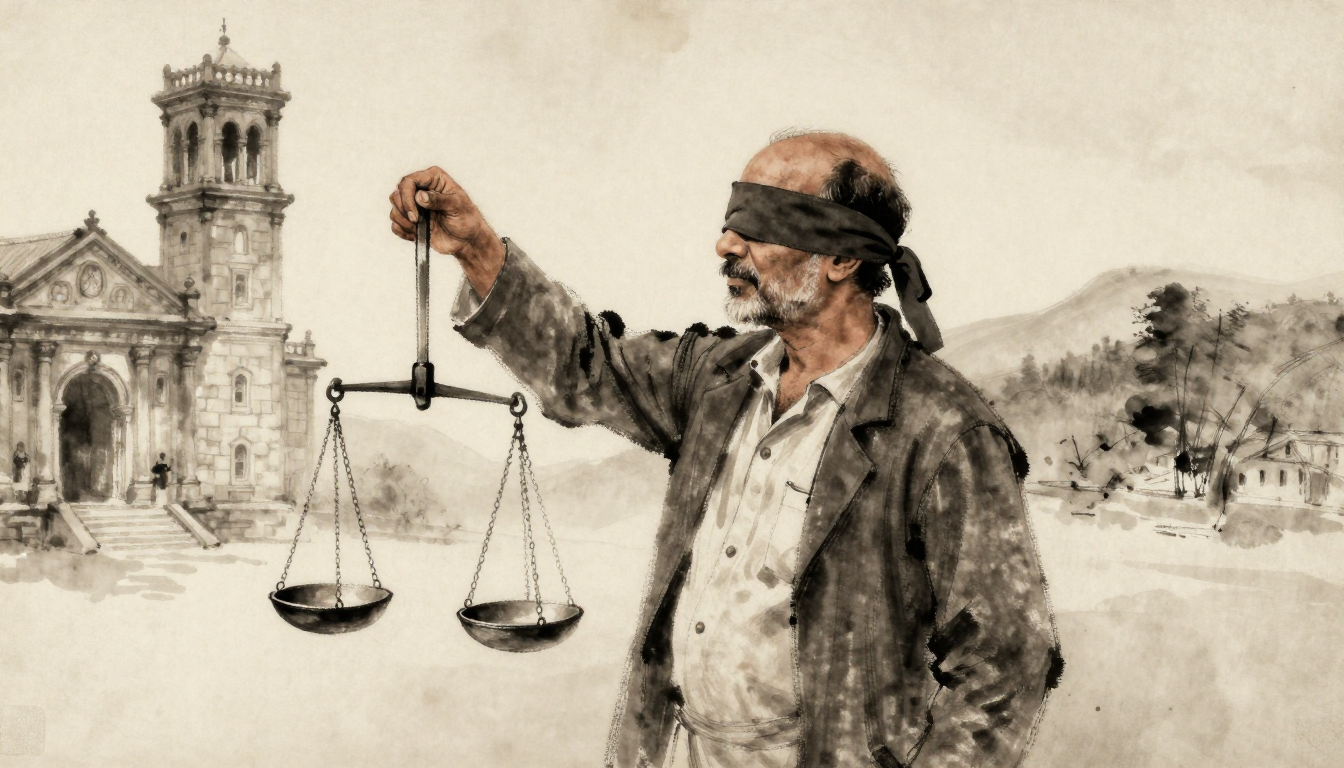
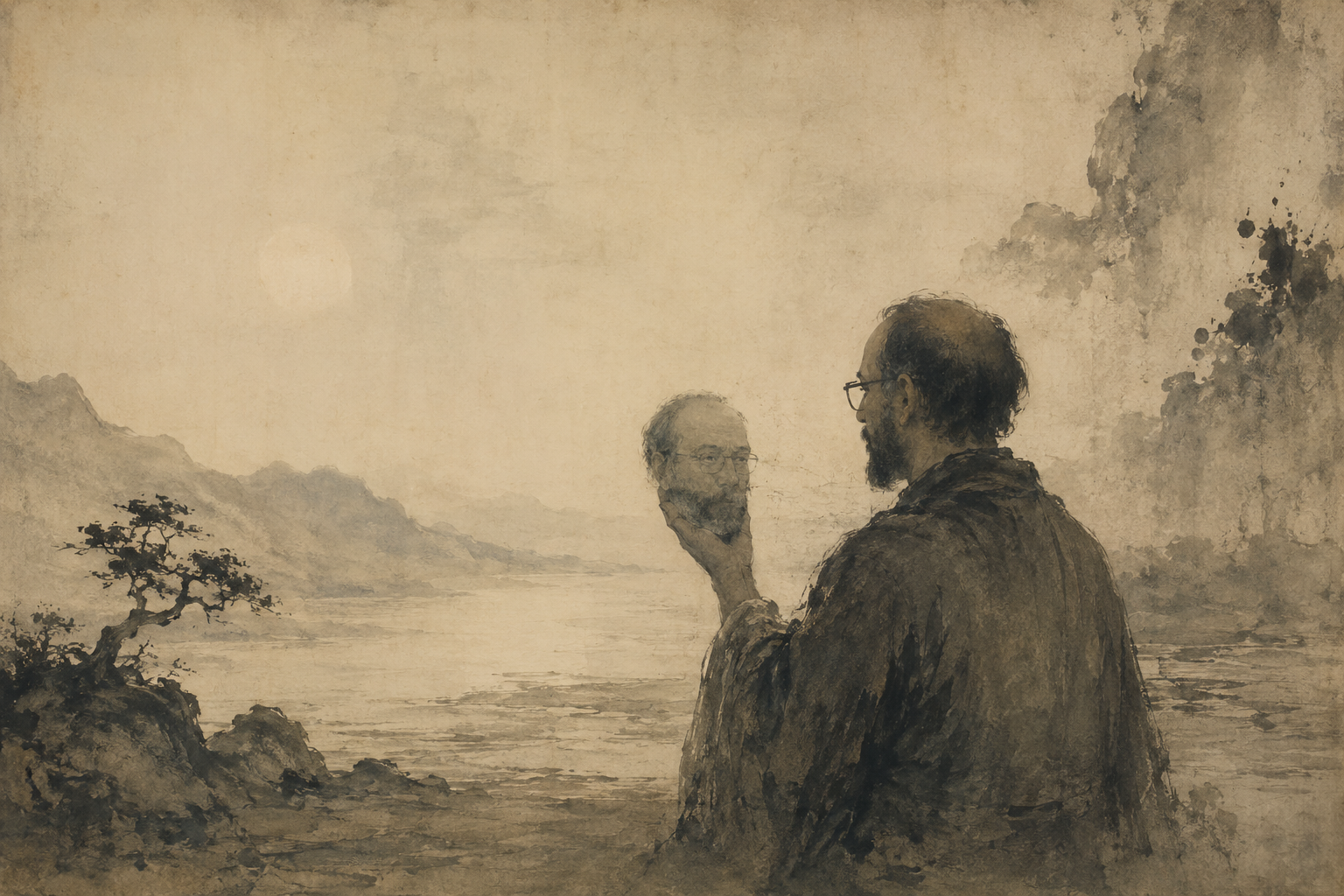
Regular readers will notice some familiar ground here. These are themes related to the self-referential nature of language, and what follows from it. I have used Wittgenstein’s ladder before to write about this, I wrote about Musashi’s grip on the sword in my last post, and I keep bringing up the criticism that my thinking slides into relativism, or even solipsism. This is deliberate. I keep coming back to these themes because I think they matter, and each return lets me look at them from a slightly different angle. This time, the angle is that of the skeptic.
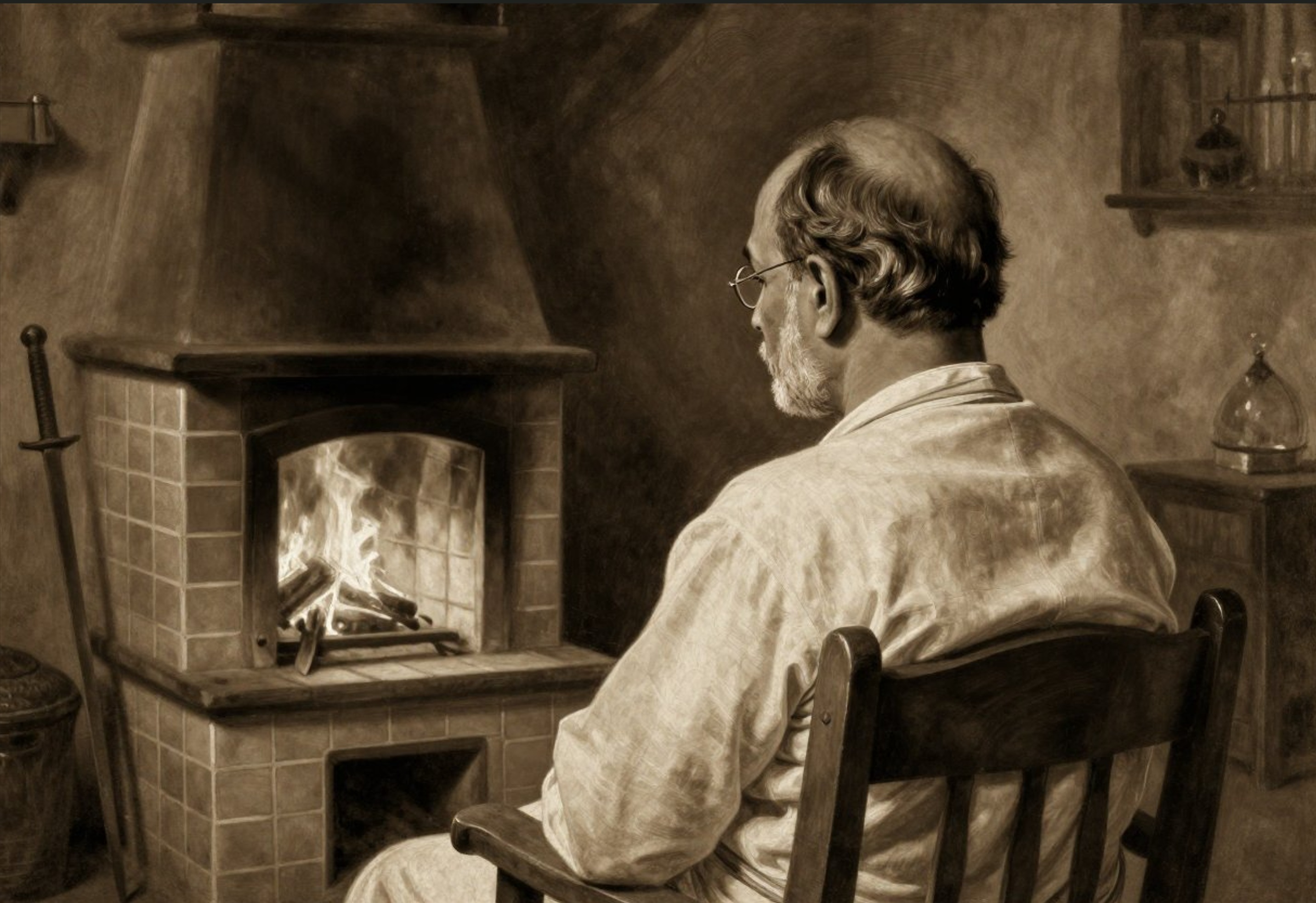
We start with Rene Descartes. Sitting by his stove, he set out to doubt everything he could. He stripped away the senses, the body and even mathematics, until he landed on the one thing he could not doubt: that he was doubting. From there he started building again.
Notice the shift that happens along the way, because it is easy to miss. The doubt itself runs one level: am I dreaming, is the world there, did two and two get mixed up? The conclusion that stops the doubt runs another. I cannot doubt that I am doubting, because the doubting is happening even when everything else fails. That is a second-order finding: not another claim about the world, but a claim about the activity that was making the claims. Descartes reached a second-order shore and then built his first-order world back up from it, furniture, senses, mathematics, all guaranteed by that one indubitable observer.
What gets overlooked is where the doubt stopped. He turned skepticism on the world but never fully on the skeptic, and this is the point worth pressing. If second-order findings are allowed to stop the regress once, why there? The cogito became a fixed point, held tightly. Yet doubting is an act of language and thought, and language is the very thing being questioned. The skeptic stands inside what he examines. This is re-entry: the distinction folds back on the one making it.
This is not a flaw peculiar to Descartes. Any language or formal system that is rich enough ends up referring to itself. Words are defined with other words. Systems are checked using the tools of the same system. There is no outside view to step into.
The tempting conclusion is that the whole thing is unreliable and should be thrown out. That is throwing the baby out with the bathwater. Wittgenstein offered a better image. His propositions are a ladder, climbed and then put aside. We need the rungs to get anywhere, but we do not have to treat them as the destination.
Musashi described the same tension with the sword. In The Book of Five Rings he advises holding the sword firmly with the last fingers and loosely with the thumb and forefinger. A hand that is fixed is a dead hand. The grip is firm and relaxed at once, in different places.
Definitions work like that grip. Without them we cannot have a meaningful conversation. Held too rigidly, they stop us seeing what does not fit. Self-reference does not stop us from using language as a tool. It reminds us how to hold the tool.
A common objection to this view is that it slides into relativism, or worse, solipsism. If every observation loops back on the observer, is not everything just my own construction? But that does not follow. Recognizing that language has weaknesses does not make all statements equal. It makes us more careful about which ones we lean on. Heinz von Foerster offered a way out of solipsism. If I take myself to be an observer, I have to grant the same to others. Once I accept another observer like me, I am no longer alone in my world. Reality becomes something we share and negotiate, not something I make up.
Von Foerster also pointed to the blind spot in the eye. We do not see it, and we do not see that we do not see it. Knowing about the blind spot does not remove it, but it changes how we look. We check with others, move our heads, look again. The same goes for thinking. Pretending our language and systems have no blind spots is the real danger. Admitting they do makes us better practitioners and better thinkers.
That admission is itself the point. Seeing that our systems refer back to themselves, and carrying on using them with care, is a second-order recognition. It is an observation about our own observing.
Final Arc:
There is supposedly an old way of catching a monkey in India and other parts of the world. The villagers place a fruit like an apple inside a jar with a small hole. The jar is tied to a tree with a rope. The monkey puts its hand through the opening and grabs the fruit. Now the hand holding the fruit is bigger than the hole, and it cannot come back out. Notice that the monkey is not trapped by the jar, or the tree, or the rope. It can free itself at any moment by opening its hand and dropping the fruit. But the monkey will not let go of the apple. So it is caught by its own grip.
The best-known Western version of this story belongs to Robert Pirsig. In Zen and the Art of Motorcycle Maintenance (1974) he used the South Indian monkey trap to illustrate what he called value rigidity: the trap of holding on to a single way of valuing, even when it is what is holding you. Much of the modern retelling traces back to him. The monkey does not cling only to the fruit. It clings to its idea that the fruit is worth keeping.
That is the trap of the skeptic who treats doubt as a possession. The cogito, the fixed point, the certainty held tightly: that is the apple. The mature skeptic doubts the doubter too, and is willing to hold the sword just right.
Stay Curious and Always Keep on Learning…
If you liked what you have read, please consider my book “Second Order Cybernetics,” available in hard copy and e book formats. https://www.cyb3rsyn.com/products/soc-book
In today’s post, I want to write a basics post on cybernetic constructivism. This is something I have seen people grapple with when they are first introduced to constructivism. We all love and appreciate certainty, especially certainty in meanings. We have come to use words like epistemology and complexity, and the use of these words gives us an illusion. The more words we have, and the better we understand their meanings, the more certain we can be. This is also how the perceived agency of LLMs is formed. They give us fluent words with no history of contact behind them. But cybernetic constructivism is not based only in the linguistic domain. The word doing the work there is “cybernetic”. We construct our meanings inside us, and those constructions are tested outside us, against constraints. That loop of construction and testing is what makes this view a way of living instead of a word game. Constructivism of this kind is rooted in experience, and in how the world pushes back on us in the form of constraints.
When the power goes out at night, I can still find my way to the kitchen. My hand moves along the wall. My feet remember where the carpet ends and the wooden floor begins. I am not “seeing” the house. I am meeting it, one contact at a time, and adjusting as I go. When my toes find the edge of the chair I had forgotten about, I learn something, though not what the chair looks like. I learn that my way of walking did not fit.
That small walk in the dark is a fair picture of where cybernetic constructivism begins. We do not have direct access to our environment. By environment I mean everything outside the boundary of the body. Light reaches the retina, pressure reaches the skin, molecules reach the nose. What happens next happens inside us, in a nervous system that works with its own states. Maturana and Varela described the nervous system as “operationally closed”. Events outside can trigger changes in it, but they do not specify what those changes will be. The structure of the living being decides that. They called these outside events perturbations, and the word fits. A perturbation disturbs. A perturbation does not instruct.
At this point, I have to admit a common problem of self-reference with any formal structure as language. This post is caught in its own argument. I am using words to explain why words do not carry meaning from one head to another. What I am doing here is not handing over meanings. I am offering a perturbation. Whatever this post comes to mean is generated by you, the reader, from your own structure and your own history. If some of it fits, the fit will be with something you were already doing.
This raises a practical question before it raises a philosophical one. If I cannot step outside my own experience to check it against the world, how do I stay alive? How does any living being maintain itself as a unity, moment after moment, without a window to look through?
The answer I have to offer is that we did not have to solve this problem alone, or from scratch. Evolution solved enough of it before any of us arrived. Our bodies come with shortcuts already built in. Our senses respond to a narrow band of what is available. We see a sliver of the electromagnetic spectrum and hear a limited range of frequencies. Most perturbations pass through us unremarked. The ones our structure recognizes as actionable are the ones we work with.
Jakob von Uexküll had a word for the world that results from this filtering; Umwelt, the surrounding world as it exists for a particular organism. His well-known example is the tick. For the tick, the world comes down to a few signals. The smell of butyric acid from mammal skin, warmth, the texture of hair. Nothing else exists for the tick in any functional sense. The tick is not missing anything it needs. The tick has the Umwelt that keeps a tick viable.
We have a human Umwelt. Ours is richer than the tick’s, but it is the same kind of structure. From the perturbations we recognize, we construct meanings. A shadow moving at the edge of vision becomes a friend or a foe. A tone of voice becomes warmth or irritation. These constructions are not copies of what is out there. They are ways of acting that have worked well enough so far.
Ernst von Glasersfeld put this with a simple image. Our knowledge fits the world the way a key fits a lock. A key that opens the lock is viable.
The key tells us nothing about the shape of the lock beyond the fact that this key works, and many differently shaped keys could open the same lock. What we learn when a key fails is that this key does not fit. That is my toes and the chair.
So the process is ongoing. Meanings that continue to work are kept. Meanings that stop working fade, or are revised, or are dropped. Nothing here requires a final picture of the world. The process requires only that we keep going.
Humans do something further. We do not only construct meanings. We become able to reflect on how we construct them. Gregory Bateson called this deutero-learning, or learning to learn. A child does not only learn that this particular stove is hot. The child learns something about how hot things behave, and something about how to find out. Heinz von Foerster gathered the same concern under the phrase “understanding understanding“. The meaning-making process becomes something we can examine and adjust. We find ways to make meaning-finding itself meaningful. The process that builds our world is turned back on itself, and becomes part of the world it builds.
Here the usual objection arrives. If everyone constructs a world of their own, is anything true? Does this not slide into relativism, where every view is as good as any other? Or even worse, solipsism, the notion that only we exist and everything is inside our mind.
My tentative answer is that there is a relativism here, but it sits at a different level than the objection assumes. Our human way of knowing is relative when set against other species. The bat, the tick, and the octopus each have an Umwelt that works for them. None of these is the correct view of the world, and neither is ours. Our knowing is relative to the kind of creature we are.
Within the human species, though, something corrects us. There are two things, I think.
The first is the environment itself. The environment cannot tell us what it is, but it can refuse us. A construction that does not fit eventually meets a refusal it cannot absorb. The bridge falls, the crop fails, the patient does not recover. Glasersfeld himself was more careful with his words than I am being with mine. The point he kept returning to was that we learn of the world through its constraints, through the places where our expected sequences are blocked and our keys do not turn. This is not correspondence, because a refusal never arrives with a description of the world attached to it. But it is not anything goes either.
The second corrective is other people. I am not the only observer. Others are constructing their worlds alongside me, from similar bodies, with similar shortcuts, in shared language. When my construction rubs against theirs, I am perturbed again, and I adjust. Maturana described language as a coordination of coordinations of behavior. Through language we build what he called consensual domains, regions of shared meaning that hold because we keep acting together within them. I should say plainly what conversation is doing here, since I already told you that words do not travel from one head to another. A conversation does not transfer meanings. It coordinates actions. Two people talk, adjust, and find that they can walk together and hear each other’s footsteps. Calibration happens in that coordination.
The second corrective has its own weakness. Groups calibrate toward coordination, not toward correctness. A whole community can agree on something that does not fit. That is why both correctives matter. The world’s refusals keep social agreement honest, and social agreement lets us notice refusals that one observer alone would miss or explain away. With both in place, relativism may not be the right word anymore. Relational may be closer. Views are not competing pictures of the world. They are competing ways of staying viable, and the world and other people both get a say in which ones survive.
This carries over to organizations and the people who manage them. W. Ross Ashby gave us the vocabulary. His Law of Requisite Variety is depicted as only variety can destroy variety. An organization faces far more variety from its environment than it could ever match, so it filters. Beer gave this filtering its name, attenuation. Every report, metric, and dashboard is an attenuator. The filtering our senses do for us, organizations do with forms and meetings. A manager’s picture of the organization is a construction, built from whatever got through the filters. The picture is not the organization. The 1970 paper by Conant and Ashby carries the memorable title every good regulator of a system must be a model of that system. Taken carefully, the theorem is close to a tautology and says nothing about truth. I want to go one step further than the theorem goes, and I want to say so openly. The model inside the regulator does not have to be true. It only has to keep things viable.
Stafford Beer built his Viable System Model on this ground. In his scheme, System 1 does the current work that keeps today alive. System 3 looks after the inside and the now. It monitors the work and forces coherence on the daily operations. System 4 looks after the outside and the then. It watches the environment, imagines futures, and prepares for change. The two pull against each other. Too much attention to the inside and now, and the organization grows rigid and gets blindsided. Too much attention to the outside and then, and the work of today falls apart. The balance between them is not computed anywhere. It is a running argument. Above both sits System 5, whose job is to hold the identity of the whole while that argument runs.
When I think about this balance, I think of Miyamoto Musashi. In the Water Book of Go Rin no Sho, The Book of Five Rings, Musashi describes how to hold the long sword. Grip it with a floating feeling in the thumb and forefinger, the middle finger neither tight nor slack, and the last two fingers tight. A grip that is tight everywhere is stiff and slow. Musashi had a name for that. Fixedness means a dead hand. Pliability is a living hand. A grip that is loose everywhere loses the sword. The firm fingers keep hold of the now. The light fingers stay ready for what comes next. The middle finger sits between them. I do not want to push the mapping too far, but the hand Musashi describes looks a lot like what Beer wanted between System 3 and System 4.
All of this rests on a shift from first order to second order. In first-order thinking, the observer describes a situation as if from nowhere. In second-order thinking, the observer is included in what is observed. Maturana put this plainly; everything said is said by an observer. Von Foerster took the next step and asked us to observe our own observing. A third recognition follows, and it carries the ethics. Other observers are doing the same thing. They too are constructing, filtering, and calibrating. Their constructions are not errors to be corrected toward mine. They are other ways of staying viable. This is also why an LLM can sound convincing without ever having been refused. It has fluent words, but no body that pays anything when a construction fails.
If I cannot claim that my view is simply how things are, I cannot hand off responsibility for my view to the world. What I see, I am responsible for seeing. And if others are observers in the same sense I am, their constructions make a claim on me. Maturana described love, in a biological sense, as accepting the other as a legitimate other in coexistence with oneself. Von Foerster offered an ethical imperative, in the first person; I shall act always so as to increase the number of choices. Both point the same way. Where no one has direct access, the decent thing is to keep the conversation open and leave others room to see.
Final Arc
Imagine a village on a hillside where the fall fog comes down so thick that no one can see their own feet. The villagers still have to get home from the fields. Each carries a small lamp. The lamp does not show the path. The lamp shows a circle of gray, a few stones, a patch of grass. No one in the village has ever seen the whole hillside in the fog, and no one ever will.
Over the years they have learned to walk this way. Each person keeps one hand steady on the lamp and lets the feet test each step. When the ground gives way under someone, that person calls out, and the others shift. When two lamps drift apart, the walkers call to each other until their voices come closer. The path they walk is not drawn on any map. The path is whatever has held, so far, for people walking together.
One evening a child asks her grandmother how they know they are on the right path. The grandmother thinks for a while. “We know when we are on the wrong one,” she says. “And we know because someone tells us.”
Then she lifts her lamp a little higher, not to see further, but so that the others can see her.
Stay Curious and Always Keep on Learning…
If you liked what you have read, please consider my book “Second Order Cybernetics,” available in hard copy and e book formats. https://www.cyb3rsyn.com/products/soc-book
In today’s post, I am looking at the idea of Hannah Arendt’s “right to have rights“. She used the phrase in The Origins of Totalitarianism, writing about the stateless people of the twentieth century. We can see that these people possessed the rights of man in name. However, in practice, they had nothing. Once they lost membership in a political community, there was no one left to recognize them as bearers of rights. In other words, the enumerated rights had nothing to attach to. Her conclusion was that before any particular right can mean something, there has to be a place in the world where one counts.
As a cybernetician, what strikes me about the phrase is its structure. The first “right” is not one more item on a list, but instead operates on the list itself, which makes it a right about rights. In cybernetic language, this is a second-order concept that does not tell us what we are entitled to, but rather what must already be in place for entitlement to mean anything at all.
In that sense, the right to have rights behaves like an axiom that is not derived from the other rights, serving as the very ground they conceptually stand on. The right to have rights cannot be proven from inside the structure, because the structure already stands on that ground. All other rights are made possible by this foundation.
I would take this notion one step further and add that the ground this axiom rests on is human. Humberto Maturana, the biologist, put it plainly: anything said is said by an observer. Heinz von Foerster taught us what follows from this, showing that the descriptions carry the mark of the one describing. Complexity, order, rights, and rules do not sit out in the world waiting to be found, but are brought forth by people within a community who can recognize one another. When we remove the human, there is no one for whom a situation is complex, and no one for whom a right is a right. The humanistic baseline is not a sentiment to be added at the end, but what lets these concepts hold together in the first place.
Often I see people talk about rules from a first-order standpoint, pointing to the constitution, the statute, or the procedure as if they are fixed objects complete in themselves. I do not want to dismiss this, because rules carry the memory of earlier decisions and spare us from rebuilding everything each time. A community without them would be exhausted, so these structures serve a vital purpose in our daily operations.
The difficulty is that a rule does not know when it has stopped serving, having been written by observers for a purpose in a specific context. Those contexts may have drifted, and new people arrive who were not imagined when the rule was written. The rule goes on saying what it said, but only an observer can notice that what it says no longer fits the current reality.
We can see that noticing is a second-order activity, which in cybernetic terms means we are observing how we observe. This is a step back from the immediate problem to look at the frame we are using, asking ourselves whether that frame still serves the people it was meant to serve. This check is not simple and requires a shift in perspective so that we can look at the structure of our own judgment.
This is not an act that happens once, because we cannot set it up and walk away since the framing does not hold itself in place. The review has to happen again and again, since understanding does not transmit automatically, and we often think that if we explain a concept clearly, the recipient will carry it with them. However, the context, the people, and the problems change, so the frame that worked yesterday may not work today.
We cannot assume that everyone carries the same frame with them, so each generation, institution, and person meeting a hard case has to bring it forth again. This is demanding but necessary, meaning we are repeatedly in a state of re-evaluation rather than just applying rules. We are also needing to check if the rules make sense in the current context, because if we stop checking, the frame becomes a habit which turns into a blind spot. We start acting without asking why, and paraphrasing von Foerster, we stop seeing when we forget how to act.
We have to be willing to question our own assumptions and be humble enough to admit that our previous understanding might be incomplete. This is where valuable learning happens, not in the initial acquisition of knowledge, but in the ongoing effort to apply that knowledge with awareness. We are always refining our view and adjusting our frame, which is the work of the practitioner.
So when a situation appears complex, I have come to take that appearance as an invitation, suggesting that complexity is not a property of the situation alone. It may be a signal that our existing distinctions are straining, prompting us to look deeper. The first-order response is to reach for the rule and apply it harder, while the second-order response is to step back, return to the human ground, and recalibrate.
I want to be careful here since words often cannot carry the weight of careful thought and consideration with them. This is not an argument for replacing rules with judgment, as that would only trade one first-order fixation for another. What I am pointing to is a feedback loop where the rules can give us stability, but it is the second-order review that checks the viability or the fit of the rules. Each needs the other, so a rule without review can harden into something that harms the very people it names, while review without rules becomes an empty notion.
There is an ethical weight to this, and treating a complex situation in a purely first-order way can become a quiet abdication. This approach lets us say that the outcome was the document’s doing and not ours, often leading to the phrase “I was just following orders.” Von Foerster’s ethical imperative asks us to act always so as to increase the number of choices, and second-order review is one way of honoring that. This keeps open the possibility that the frame itself can change.
Final Arc:
Arendt’s stateless people were not failed by an absence of rules. They were failed by communities that stopped recognizing them as people to whom the rules applied. The right to have rights names that recognition, which is the second-order commitment underneath every first-order guarantee.
Stay curious and always keep on learning…
If you liked what you have read, please consider my book “Second Order Cybernetics,” available in hard copy and e book formats. https://www.cyb3rsyn.com/products/soc-book
In today’s post, I am looking at a phrase that everyone recognizes and almost nobody examines. The phrase is “think outside the box.” It is usually presented as an invitation to break free from conventional thinking and arrive at something genuinely new. But the phrase hides a number of assumptions. It assumes there is a box with a clear boundary. It assumes you can see that boundary from where you stand. And it assumes you can somehow step beyond it and think from a position on the outside.
I do not think any of those assumptions hold.
Consider the cosmological argument for the existence of God. In its simplest form, it argues that everything that exists has a cause, the universe exists, therefore the universe has a cause. That cause is then identified as God. Whatever one thinks of the conclusion, the argument illustrates a broader issue. We often extend concepts beyond the domain in which they make sense. Causality, as we understand it, is bound up with time and change. If spacetime itself is what is being explained, then applying ordinary notions of causality beyond it may be problematic. The point is not whether the argument succeeds or fails. The point is that we often carry our conceptual tools into places where their limitations become difficult to see.
Heinz von Foerster, one of the founders of second-order cybernetics, wrote that the environment as we perceive it is our invention. He did not mean that we are hallucinating or that reality does not exist. He meant that observation is never passive. The observer participates in determining what counts as observable. There is no neutral vantage point from which to inspect things exactly as they are, independent of any observer.
Spencer-Brown made a related point in Laws of Form. To draw a distinction is already to stand on one side of it. The moment you draw a circle on a blank page, you create an inside and an outside. You are positioned in relation to that distinction by the very act of drawing it. You cannot draw a distinction and simultaneously stand outside it. The frame is not something you construct and then enter. You are already within it when you first become aware of it. The noticing is itself made possible by the frame.
Gödel’s incompleteness theorems point in a similar direction. Any sufficiently rich formal system contains truths that cannot be proven from within that system. The incompleteness is not a temporary gap that can be eliminated with more effort. It is structural. Expanding the system may resolve one limitation, but the expanded system brings new limitations of its own. The horizon moves, but it does not disappear.
Now, I am aware of a difficulty here. If no one can step outside the frame, then this post cannot either. Writing an argument that the outside is unavailable risks sounding as though I have somehow found a place from which to survey the whole. I have not. But there is a difference between claiming to stand outside a frame and becoming aware of the frame from within it. The first claims a privileged position. The second acknowledges its own participation. This post is attempting the latter.
Gregory Bateson observed that the major problems in the world arise from the difference between how nature works and the way people think. I take that observation as pointing toward the issue here. The gap is not simply between what we know and what we do not know. It is also between the structures we inhabit and the stories we tell ourselves about our position within them.
Perhaps thinking outside the box does not mean escaping a frame.
Perhaps it means becoming aware of the frame you are already inside.
A Zen koan asks, “What was your face before your parents were born?” The question is not seeking an answer. It is designed to interrupt the assumption that you can step back far enough to observe your own origins from the outside. The koan does not reveal what lies beyond the frame. It makes you feel the edge of the frame itself.
Stay Curious and Always keep on learning…
If you liked what you have read, please consider my book “Second Order Cybernetics,” available in hard copy and e book formats. https://www.cyb3rsyn.com/products/soc-book
The ideas discussed here will form part of the second edition of my book, Second Order Cybernetics. The second edition will include a first half where I go into the introduction of cybernetics and related ideas. The post is slightly longer than usual because of that.
In today’s post I am exploring what I think is a fundamental question in epistemology: what does it mean to say something is true? I want to approach this through the lens of cybernetic constructivism, and I will start with a question about pi, which feels fitting given that today is March 14.
What is pi? For most purposes, 3.14 is a very accurate value. But pi is an irrational number. It goes on forever. Should a truthist spend a lifetime reciting its digits? Where should they stop and say: this is pi?
That question is the crux of viability. A correspondence theory of truth has no stopping rule. It is committed, in principle, to the full expansion. But nobody does that, because it does not prove viable for any actual purpose. 3.14 works for most engineering calculations. More decimal places work for orbital mechanics. The stopping point is always set by the task at hand, not by some ideal of complete accuracy.
A correspondence theorist might reply that they can simply know pi is infinite without reciting it. But that reply concedes the point. To know that pi is infinite is already to accept a stopping rule. The question is what determines where you stop. Viability puts the stopping rule at the heart of truth. Correspondence theory treats it as a practical afterthought.
What I find striking is what the history of pi actually shows. The Babylonian engineer used 3. The medieval architect used 22/7. NASA uses 15 decimal places. The mathematician holds the concept of an infinite irrational ratio. Mathematically, there is a unique value of pi. The description that has proved most robust across the widest range of tests is the one that survives. That is viability selecting the winner. Classical correspondence theory has little to say about why our descriptions of pi changed over time or differ across contexts. It treats these shifts as practical side-effects rather than as central to what truth is.
Coping, Not Copying:
Once you notice that every stopping rule is task-relative, you are already moving toward a cybernetic picture: knowledge as regulation under constraint rather than as static mirroring.
Let’s look at the example of a lock. A lock can be opened with a key, a lockpick, or a hammer. All three work. None of them is the one true solution. The opening of the lock is the criterion, not the method. This is what viability means in practice. It does not collapse into the view that anything goes. The lock still has to open. But multiple paths can satisfy the criterion. This is the notion of pluralism.
Correspondence theory assumes that an accurate copy of the world can be made in the mind. But this assumes we have direct access to the world in the first place. Cybernetic constructivism starts from the opposite standpoint. We do not have direct access. What we have is a context, an observer embedded in a situation, acting under constraints. The cybernetician is aware of the trap of relativism that follows if epistemic constructivism is taken too far. The answer therefore is not to abandon external reality but to let it push back. External constraints are not obstacles to truth. They are its guide.
What emerges from this is not a copy of the world but a structural coupling with it. The focus shifts from copying the world to coping with it. It is worth pausing on the word itself. In Old English, “trēowþ” meant faithfulness and keeping one’s word. The narrowing toward factual correctness came much later. Its deepest root means firm and solid, from the same family as tree and trust. This suggests not a mirror of reality but something that holds fast under strain. Even in its language history, truth is less about a disembodied view from nowhere than about reliability in a lived relationship.
Viability, as the cybernetician uses the term, is not a lazy shortcut to truth. It is a different account of what truth is for. Knowledge is not a mirror held up to reality. It is closer to a tool. A tool fits or it does not fit, relative to what you are doing. 3.14 is not first true and then useful. Its usefulness is the ground of its truth-claim.
As I was thinking about this, I could not help but notice how well this connects to a tradition that predates cybernetics. The American pragmatists, Dewey and James in particular, argued that the truth of a belief is inseparable from its consequences in practice. Dewey called knowledge a form of inquiry, not a form of contemplation. James spoke of the cash value of a truth, meaning what practical difference it makes to the person holding it. Cybernetics inherits this instinct and gives it a more precise mechanical account, grounding it in feedback, constraint, and structural coupling rather than in human psychology alone.
Readiness-to-Hand:
This is also what Heidegger points to with the notion of readiness-to-hand. A hammer is not first an object you contemplate and then use. It is defined by its role in a practice. You notice the hammer as an object only when it breaks or goes missing. Otherwise, it is simply part of how you are engaged with the world. In the same way, a number like 3.14 is not something you verify against reality and then apply. It is already inside the practice. Its truth is its grip on what you are doing.
This brings in a second aspect of viability. It is always relative to what we have on our hands. The constraints of the task determine what counts as sufficient.A cybernetic observer is always embedded in a context of action. What counts as a sufficient description depends on what the observer needs to do next. This is why cybernetics reaches for viability rather than correspondence.
Viability, in more precise terms, is about maintaining the ability to act when facing constraints. It is not about removing constraints. It is about sustaining the capacity to continue within them.
King Sisyphus:
The myth of Sisyphus makes this idea vivid. In Camus’s retelling, Sisyphus is condemned to roll a boulder up a hill, only to watch it roll back down, again and again, for eternity. The constraint does not change. The boulder always returns. But Camus insists we imagine Sisyphus happy. And this is not a small thing.
The punishment depends on Sisyphus experiencing it as a punishment. The gods are not only constraining him physically. They are constraining him through his own suffering. If Sisyphus finds joy in what he does, the punishment loses its force, because it ceases to be punishment at all. The rock still rolls back. But the meaning of that event changes entirely.
There are two constraints at work here, not one. The physical constraint belongs to the hill and the boulder. The second constraint belongs to the relationship between Sisyphus and his situation. This to me is what Ashby points to when he treats constraint as a relation between an observer’s possible descriptions and what actually happens. The gods were counting on both. They chose this task because they expected Sisyphus to find it intolerable.
When he finds joy instead, the second constraint dissolves. The punishment ceases, not because the rock stops rolling, but because the meaning of the rolling changes. Sisyphus is no longer measuring his situation against an impossible standard, namely the boulder staying at the top. The rolling back is no longer a failure. It is just the next push.
This is also where the line between reframing and delusion holds. Sisyphus dissolves the relational constraint, the one the gods constructed, while remaining fully exposed to the physical one. The rock still rolls back. Delusion works differently. It does not reframe what you measure yourself against. It avoids the test altogether. Reframing and avoidance look similar from the inside but they are not the same thing.
There is something else here worth noting. The gods defined the task as punishment. Sisyphus, by finding joy, becomes his own observer. He steps outside the frame the gods imposed. In second order cybernetics terms, he observes his own observing and chooses differently. Viability, in this reading, is not just functional persistence. It is the capacity to reframe one’s relationship to a constraint.
The Madman of Naranam:
I want to bring in a figure I find even more striking than Sisyphus for this purpose. Consider Naranath Branthan, the madman of Naranam from Kerala. He too rolled a large rock up a hill and watched it roll back down. He did this again and again. But he was not being punished. Instead, he did it for fun. The stories say he would laugh with joy and clap his hands as the rock rolled down. Naranath is not denying the physical constraint. The rock rolls back and he knows it will. His reframing does not change what happens. It changes what he measures himself against. He stops applying a standard that was never appropriate to begin with. He needed no outside observer to imagine him happy. His reframing was self-generated.
The story of Naranath meeting the goddess Kali makes this even more vivid. Kali offered him any boon he wished. He asked only to move his elephantiasis from one leg to the other. He did not ask to be free of it. He had understood the absurdity of demanding that the world be other than it is. That understanding is viability in its deepest form.
Camus’s formulation still requires an observer. We must imagine Sisyphus happy. Naranath does not wait to be imagined. This is, perhaps, the deeper cybernetic point. Viability looks like a property of the organism. But the Sisyphus example reveals it as partly a property of the relationship between the organism and its observer. Naranath collapses that distance. He is the observer of his own condition, and he chooses joy without being told to.
The Community Problem:
If viability is partly about how an individual organism relates to its constraints, the question arises how communities do this collectively. Charles Sanders Peirce proposed that truth is what a community of inquirers would converge on given enough time. But this raises a prior question. Who gets to be in the community? A group that agrees the earth is flat is also a community. Peirce’s community of inquirers works only if the community remains open to the tests imposed by its environment. Without that, coherence collapses into shared delusion. The flat earth holds together perfectly well as a coherent position until you try to launch a satellite. At that point the context decides, not the community.
This is also where viability parts ways with a purely psychological reading of coping. A belief that works by insulating itself from defeat is not viable in the cybernetic sense. It is a closed loop. Popper called this falsifiability: a claim should be viewed as knowledge only if it is open to some possible observation that could defeat it. Viability makes the same demand from a different angle. A viable belief is one that remains genuinely exposed to the push-back of its constraints. Structural coupling requires contact. A placebo, for example, can open the lock once or twice. But a belief that cannot be tested by the lock at all is not knowledge. It is insulation.
Coherence and Its Limits:
When you encounter something genuinely new, you cannot easily make sense of it. This is because you do not yet have a network of understanding into which it can fit. The new observation has no hook to hang on.A claim does not arrive in isolation. It either coheres with the network of details you already hold, or it does not land at all. Reading widely and across diverse domains is one way to build a network rich enough to receive new things.
From this standpoint, truth has two criteria working together. First, it must cohere with what you already understand. Second, it must sustain your viability rather than erode it. The two are not equal. Coherence is necessary: a completely incoherent set of beliefs cannot support action at all. But coherence is not sufficient. A perfectly coherent but closed network will eventually fail you. Viability is the deeper criterion. Coherence is subordinate to it.
Correspondence theory assumes that truth is already out there, waiting to be found. Viability inverts this. Truth is not found. It is enacted in the relationship between an observer and their constraints. The question is not whether something matches reality. The question is whether it allows you to continue.
Frames and Open Questions:
Consider a rocket launch. The rocket either reaches orbit or it does not. That criterion is external and unambiguous. Political and social evaluations are harder because the criteria are themselves contested. Two groups disagreeing about a leader are not just disagreeing about a fact. They are disagreeing about what counts as a good outcome. That is a disagreement about values, not just evidence. It is a disagreement about which outcomes count as success.
I have written about von Foerster’s ethical imperative before in the context of Ackoff. Von Foerster offers one possible criterion that sits outside tribal agreement. His ethical imperative is to act always so as to increase the number of choices available. Choices here means systemic variety and the capacity to respond to constraints not yet encountered, not merely an expanded menu of options. That is at least a criterion that does not depend on who is in the tribe. But even that criterion has to be chosen by someone. The honest cybernetic answer to who decides the context is: the observer does, always. But the observer decides the frame. The universe decides whether the frame survives. These are not the same thing.
Even if truth is a property of propositions, any ascription of truth is made from within a perspective. Every act of saying this is true is an act by some observer under constraints. There is no view from nowhere. Existentialism arrived at this conclusion from a different direction. Kierkegaard argued that the deepest truths tell the individual what to do, not what to know. Nietzsche went further, famously claiming that there are no facts, only interpretations, and that we cannot see around our own corner. Pragmatism made a parallel move, arguing that truth is not a fixed target but a process, something that happens to an idea as it is put to work.
Cybernetic constructivism inherits both traditions and gives them a more precise account of what the corner is made of and what putting an idea to work actually means. What we can ask is whether a perspective is richer, more generative, and more honest about its own assumptions than another. Viability is not a compromise on truth. It is a more honest account of what truth has always been doing.
One question remains open. This post has argued that the universe decides whether the frame survives. But what happens when a community is so digitally insulated that it never has to launch a rocket? When algorithmic walls are thick enough, the physical pushback never arrives. A flat earther, for example, does not need to test their belief if they never have to navigate a satellite. This is perhaps the sharpest challenge viability faces in the present moment.
The answer the cybernetic constructivist would give is that insulation is itself a constraint. A community that never tests its beliefs against the world is not viable in any durable sense. It is merely coherent. And coherence, as this post has argued, is the subordinate criterion.
The Full Arc:
This post began with a simple question. Where should a truthist stop and say this is pi? That question opened into something larger. Truth, from a cybernetic constructivist standpoint, is not a mirror held up to reality. It is a relationship between an observer and their constraints. The stopping point is always set by what you need to do next.
The lock example showed that viability is not relativism. Multiple paths can work, but the lock still has to open. The Peirce detour showed that agreement is not the criterion either. A community can agree and still fail when the context changes. Sisyphus and Naranath showed that viability is not merely functional. It is the capacity to find a relationship to your constraints that allows you to keep going. Naranath, offered any boon he wished, asked only to move his elephantiasis from one leg to the other. He had understood the absurdity of demanding that the world be other than it is.
And the coherence point showed that for something new to register as true, it must first find a hook in what you already understand, and then sustain rather than erode your ability to act. A community that never tests its beliefs against the world is not viable in any durable sense. The universe does not argue. It simply decides which frames survive.
The universe is patient.
Stay Curious and Always keep on learning…
If you liked what you have read, please consider my book “Second Order Cybernetics,” available in hard copy and e book formats. https://www.cyb3rsyn.com/products/soc-book
Notes:
In referencing the work of Martin Heidegger, I want to acknowledge the deeply troubling fact of his affiliation with the Nazi party. This aspect of his life casts a long and painful shadow over his legacy. While I draw on specific philosophical ideas that I find thought-provoking or useful, this is not an endorsement of the man or his actions. Engaging with his work requires ethical vigilance, and I remain mindful of the responsibility to not separate ideas from the broader context in which they were formed.
In today’s post, I want to sit with a question that keeps surfacing in discussions about artificial intelligence and cognition, and one I am increasingly convinced is itself part of the problem. The question is: does AI know? The reason it may be the wrong question is not that the answer is obviously “no”, but that the word “know” is doing work it was never designed to do when we apply it to these entities.
The World Perturbs but Does Not Instruct:
In an earlier post, I looked at what cybernetic constructivism means for how we understand knowledge and experience. One of its central claims, following Maturana, is that the world perturbs but does not instruct. Meaning is not something delivered from outside and stored inside. It is enacted through structural coupling, through the accumulated history of an organism maintaining its viability in a world that pushes back.
Before carrying this idea forward, it is useful to note that Maturana developed it specifically to describe living biological systems, organisms that produce and maintain their own boundaries and whose continued existence is genuinely at stake in every encounter with the world.
Let’s look at a simple physical example to clarify the principle before we apply it to anything more complex. Take a golf swing – a club meets a ball with a certain force and angle, and the golf ball soars through the air. Now take the same swing, the same force, the same input, and apply it to a basketball. The basketball, unlike the golf ball, skids away at an odd angle. In both cases, the action was identical. What was different was the internal structure of the object receiving it. The world did not send two different instructions. It applied one perturbation to two different structures, and each responded entirely according to what it was. This is what it means to say the world perturbs but does not instruct. The perturbation is necessary but not sufficient. What shapes the response most is the structure that meets it.
Maturana’s claim, applied to living organisms, is that this structural responsiveness is not incidental but constitutive. Cognition just is this ongoing history of structurally shaped encounters with a world that pushes back. The environment cannot tell the organism what to do or what to become. It can only disturb, and the organism responds according to its own organization. The inanimate example of the golf club shows this in its starkest form, where the relationship between perturbation and response is straightforwardly causal. We have the same input, the same structure, the same output, each time. But as organizational complexity increases and as we move toward living organisms, something shifts. The response becomes less strictly causal and more dispositional. This means that even with a relatively stable internal structure, the output can vary depending on the current state and history of the organism.
One further nuance is that the structure does not treat all perturbations equally. Some disturbances are absorbed as structurally significant and others pass through without consequence, but this selectivity is not a filter applied from above. It emerges from the organism’s own history of structural coupling, from the accumulated shape of all the encounters that have formed it, which means that what counts as an informative perturbation is itself a product of living rather than an abstract sorting mechanism. The world does not simply push; the organism constitutes what counts as a push worth responding to, and it does so because of what it has already been through.
This framing makes the question about AI and knowledge considerably more precise, because it separates two things that are easy to conflate: linguistic competence in the domain of coordination, and the kind of structural shaping that emerges only in the domain of perturbation.
Language as Residue:
Large language models exist almost entirely in the domain of coordination. They have been trained on what Michael Polanyi might call the articulable fraction of human knowledge, everything that humans have stepped back from experience to render into language. But as I have written before, language without world is a serious philosophical problem, not merely a technical limitation.
Polanyi’s observation that we can know more than we can tell connects to Heidegger’s distinction in a way that sharpens the argument considerably. When we are in the ready-to-hand mode, absorbed in work, flowing through a task, we are doing things we know how to do without being able to say how we know. The carpenter handles the grain, the nurse reads the room, the experienced driver navigates traffic. The knowing is in the doing, and it is there precisely because we have not stepped back from it. The moment we step back, when the hammer breaks or we are asked to explain what we just did, we enter the present-at-hand mode, and that is when language becomes possible. We can now describe, analyze, articulate. But something has already been lost in the transition.
The limit Polanyi identifies is not practical but structural. To render the ready-to-hand into language, one has to leave the mode in which it was alive. The describing and the doing cannot occupy the same moment. The writing is produced from outside the coping, looking back at it, and what it captures is necessarily partial.
Let’s consider some examples to look at what happens when a human being produces a piece of text. A carpenter writes about joinery after years of handling wood, feeling grain, making mistakes, discovering through the resistance of the material what works and what does not. A nurse writes about patient care after countless encounters where something felt wrong before she could name it, where the knowing was already in her hands and her attention before it ever became a sentence. I have come to see that in every case, the writing is a residue, what remains after the person has stepped back from absorbed, ready-to-hand engagement and attempted to render some portion of it into language. The coping came first. The describing came second. And the describing, however careful, never fully captures what the coping contained, because the ready-to-hand does not survive the translation into the present-at-hand intact. Something is always left behind in the shift from doing to saying.
This is precisely what an LLM is trained on, the saying, not the doing.It receives the descriptions that people produced when they stepped out of engaged coping and tried to articulate what they had been doing. It never receives the coping itself, because coping does not involve retrospection and narration. Coping is absorbed, forward-moving engagement, and retrospection and narration require stepping out of that absorption.
The absorbed craftsman, the skilled nurse reading a room, none of what they are doing leaves a trace in language while it is happening. What they are doing only enters language afterward, partially, imperfectly, in the present-at-hand mode that Heidegger describes as a kind of breakdown of the original engagement. The LLM is trained entirely on those breakdown products, which means its entire organization of apparent knowledge is built from the layer of experience that was already one step removed from the living of it. The burn came before the word “hot,” and the word is all that was passed on.
One might object here that language is not merely a dead residue, that a beautifully written sentence about grief can make a reader’s chest tighten, that text has genuine generative power. This is true, but it actually confirms rather than challenges the argument. When a reader weeps at a sentence about loss, that response is internally generated. The text does not transmit the grief. It acts as a perturbation on an entity that already carries a body, a history of loss, a nervous system shaped by its own structural couplings with pain and absence.The reader brings the world to the text. The text triggers something that was already there. When an LLM processes the same sentence, there is no accumulated history of loss for it to trigger, no body shaped by living through something the words are pointing at. The perturbation lands on nothing.
One might press this point further and note that LLM outputs do in fact vary: ask the same question twice and you will often receive a different answer, because the generation process involves sampling from probability distributions over learned token sequences rather than deterministically retrieving a fixed response. This variability has a surface resemblance to the dispositional quality of biological response. The difference, though, is in what the variation is grounded in.
In a living organism, dispositional variation is an expression of a history of structural coupling, of a self with a particular past that is still alive in how it meets the present.In an LLM, the variation is stochastic, a property of the sampling algorithm applied to probability weightings derived from training data. The output shifts not because something in the entity is responding from within a lived history, but because the decoding process introduces controlled randomness. The resemblance is real enough at the surface level that it deserves to be named, but naming it clearly is also what shows why it does not close the gap.
When the Body Enters the World:
The question that seems worth sitting with is not does AI know, but what happens when we try to ask whether an embodied AI, one that acts in a physical environment and receives consequences, might be doing something that begins to resemble knowing. This is a genuinely different question from the one we have been asking about LLMs, and it deserves to be treated as such.
Embodied AI is not simply an LLM with motors attached. An entity that learns locomotion through physical trial and error in an environment, whose internal organization is being shaped by a history of navigated perturbations rather than by gradient descent on text, is at least potentially accumulating something in the domain of perturbation rather than purely in the domain of coordination. This seems worth taking seriously. It is not nothing. The question is what, precisely, it is.
Two Orders of Seeing:
Here is where the distinction between first order and second order cybernetics brings more clarity, and it is a distinction that most discussions of AI and systems thinking often quietly step over.
First order cybernetics, the tradition of Wiener, early Ashby, Shannon, approaches a “system” from the outside. The observer maps inputs, outputs, and feedback loops, and asks whether the system’s behavior matches a target. From this vantage point, the question of whether an embodied AI knows is a functional question: does it respond to its environment in ways that are indistinguishable from a system we already credit with knowledge? If a system navigates novel terrain, corrects errors, develops what look like anticipatory responses, and does all of this without explicit programming for each case, then within this framework there is no principled reason to withhold the attribution of knowledge. What walks like a duck and quacks like a duck is, for the first order cybernetician, a duck. This is a functionalist position, and it has genuine value within its own terms.
Second order cybernetics challenges this answer, not by denying the observations but by interrogating the observer. Heinz von Foerster insisted that the observer is always part of the system being observed, and that any account of a system which pretends to a view from nowhere is concealing its own constitutive role. When we say the embodied AI “knows,” we are making a distinction, and that distinction is drawn by an observer who is themselves a cognitive entity with a particular structure, history, and set of concerns. The duck is not a duck in itself as an observation. The duck is a distinction that a particular kind of observer draws within a particular kind of world.
A first order observer can say: the behavior matches the target, therefore attribute the property. A second order observer has to ask: who is doing the attributing, from within what structural coupling, and what does that attribution make invisible?
What it tends to make invisible is the question of autopoiesis. Maturana and Varela proposed that living cognitive entities are self-producing, that they continuously generate their own boundary, their own distinction between self and world, through the very processes that constitute them. A cell produces the membrane that defines it. A nervous system maintains the organization that makes it a nervous system. Cognition, on this account, is not something that happens in a system; it is inseparable from the system’s ongoing self-production. The knowing and the being are not separable events.
Current AI systems, including embodied ones, do not produce their own boundary in this sense. The hardware, the objective function, the definition of successful performance, all of this is determined externally by designers. The system’s closure is assigned, not generated. One might point to emerging architectures that modify their own weights, prune their own connections, or adapt their own structure during deployment, and ask whether these represent an intermediate case. The observation is fair and the edge is genuine. What such systems do not yet do, though, is generate the conditions of their own existence from within, which is what Maturana and Varela meant by autopoiesis.
A Record Is Not a History:
Polanyi’s account of tacit knowledge seemed to carry an implication about machines. If tacit skills like riding a bike cannot be fully articulated, and machines can only work from explicit instruction, then the tacit domain would remain closed to them. You cannot write down the rules for balancing on two wheels in a way that produces a cyclist. But robotic systems can now ride bikes. They do not follow rules. Through reinforcement learning and similar methods, the robot receives feedback and adjusts its parameters over many cycles of trial. Something has been acquired without articulation.
But observing a robot ride a bike raises a question that Polanyi might have considered even more fundamental than the acquisition problem. Each ride seems, in an important sense, new to the robot. And even if the robot accumulates weight updates across sessions, even if something of each ride persists in the network, what accumulates is a record, not a history. For a human, riding a bike becomes part of who you are. The first wobbling attempt, the moment it clicked, the rides since, these do not sit in a log. They have shaped a body and a self that carries them forward invisibly. Merleau-Ponty would say the body has a memory that is not representational, that the competence lives in the flesh, in the motor schema that fires before any conscious intention forms.The human cyclist is not retrieving a stored procedure. They are the person who learned to ride, and that learning is still active in how they inhabit their body and their world.
Heidegger’s notion of Gewesenheit, having-been-ness, is useful here. It is not a claim about data storage or persistent memory. Some artificial systems do maintain functional continuity. Weight updates accumulate, parameters persist, prior experience shapes future outputs. But that is not what Gewesenheit points to.
What it points to is the past not as stored information but as something the self is still living out, always already in the service of its projection forward. The having-been and the being-toward are a single movement. A robot that accumulates weight updates has functional continuity. It does not have this forward-carrying structure. What accumulates is a record, not a history.
There is a distinction here that the word “knowledge” obscures. Acquiring tacit competence is not the same as incorporating it into a continuous self. An embodied AI can do the first without the second. That gap may be more philosophically revealing than the acquisition question ever was.
There is a further dimension to this that the bike-riding example makes vivid, and it is one that tends to get lost when embodiment is treated simply as the addition of a physical body to an otherwise cognitive system. Merleau-Ponty’s central argument in the Phenomenology of Perception is that the mind is not a separate entity that inhabits or operates a body. The body is not the vehicle for a mind that does the real cognitive work from somewhere inside. Cognition is irreducibly embodied, which means that the body is not an instrument of thought but its very medium. When the experienced cyclist leans into a corner, she is not executing a mental calculation about angle and velocity. The body already knows what to do before any representation forms. The knowing and the bodily doing are not two events in sequence. They are a single event.
Von Foerster made a similar point when he said, “If you want to see, learn how to act.” Perception is not passive reception of a pre-given world that the mind then processes. Perception is constituted through action. The acting and the seeing are intertwined, and an entity that cannot act, cannot be perturbed in ways that have consequences for its own continuation, cannot perceive in the relevant sense either.
One might object that modern embodied AI systems using deep neural networks do not separate perception and action sequentially. Sensory input and motor output are processed simultaneously through shared weights. That begins to look like the unified loop von Foerster is describing. The observation is fair. But the question it raises is not architectural. It is autopoietic.
The issue is not whether perception and action are processed in parallel. It is whether that processing belongs to a self-producing system whose own continuation is at stake in every cycle. In a living organism, the perception-action unity is inseparable from the fact that the organism is continuously producing the very system that perceives and acts. The unity is not a design feature. It is a consequence of being alive in Maturana’s sense.
The deeper question remains. Is anything at stake for the robot in its own navigation? Does it maintain its viability, or does someone else maintain it on its behalf? A system whose boundary is externally defined and maintained is not viable in its own right. It is viable by proxy. That distinction matters when we are asking what kind of knowing such a system could be doing.
The Full Arc:
So what is the right word for what an embodied AI accumulates through its history of structural coupling, if knowledge is not quite right?
One candidate is operational trace. It is the structural residue left by perturbations navigated, shaped into patterns of response that fall short of knowledge but go beyond mere computation. It is a phrase rather than a single word, but perhaps that is fitting. What these entities accumulate may resist the compression that a single word implies.
It is not a record, which is passive and retrievable. It is not a representation, which stands for something external. A trace is active. It shapes what comes next from within the structure that carries it. What it lacks is existential continuity, the grounding in a self that lives it forward as a living entity would.
This is not a dismissal of what embodied AI is doing. It is an attempt to describe it better. What these developments may be teaching us is that the word “knowledge” contains at least three things we had not clearly separated: acquiring adaptive competence, incorporating that competence into a continuous self, and grounding both in a self-producing entity that maintains its own existence. Embodied AI can approximate the first, cannot achieve the second, and structurally cannot reach the third. This is not because of a technical limitation, but because no amount of architectural sophistication generates a self that lives its past forward, produces its own boundary, or maintains its own existence from within.
The distinction is about what these processes are, not about their value. The argument is not that operational traces are inferior. It is that they are different in a way the word “knowledge” obscures. Keeping that distinction clear is what allows the question to remain open.
Simply put, the accumulation of data without the accumulation of scars is not knowledge. The word “scars” is rhetorical, not precise. It points toward what the argument has been building throughout. Knowledge involves a self that has been genuinely marked by its encounters.
Finding the right word is not a terminological exercise. It is a way of keeping the question honest.
Stay curious, and Always keep on learning…
If you liked what you have read, please consider my book “Second Order Cybernetics,” available in hard copy and e book formats. https://www.cyb3rsyn.com/products/soc-book
Notes:
The ideas discussed here will form part of the second edition of my book, Second Order Cybernetics. The second edition will include a first half where I go into the introduction of cybernetics and related ideas. The post is slightly longer than usual because of that.
In referencing the work of Martin Heidegger, I want to acknowledge the deeply troubling fact of his affiliation with the Nazi party. This aspect of his life casts a long and painful shadow over his legacy. While I draw on specific philosophical ideas that I find thought-provoking or useful, this is not an endorsement of the man or his actions. Engaging with his work requires ethical vigilance, and I remain mindful of the responsibility to not separate ideas from the broader context in which they were formed.
In today’s post, I want to offer an introduction to Cybernetic Constructivism. The ideas discussed here will form part of the second edition of my book, Second Order Cybernetics. The second edition will include a first half where I go into the introduction of cybernetics and related ideas. The post is slightly longer than usual.
I will be drawing on ideas from Martin Heidegger, Heinz von Foerster, Humberto Maturana, Francisco Varela, Maurice Merleau-Ponty, Gaston Bachelard, and Ludwig Wittgenstein. Each one has contributed a specific piece of the picture, and together they help clarify what Cybernetic Constructivism means and why it matters.
Before we proceed, it is worth saying what this post is not.
It is not an argument for solipsism. It is not a denial of constraint. It is not an attempt to dissolve the world into language.
Instead, it is an introduction to a framework, and a clarification of what that framework actually claims. Most criticisms of Cybernetic Constructivism arise from misunderstanding one central idea: informational closure.
Informational Closure:
As I have written before, each of us is informationally closed. In other words, meaning is not something we passively receive in a pre-formed state. It is worth pausing on the word itself. Information derives from the Latin “in-formare”, meaning “to give form”. But we must be clear about what this means for us as organisms. We do not simply take a formed meaning inside us. Changes occur in our nervous system through interaction with the world. There is no pre-formed content in what occurs. It is within us, through our structure, history, and embodied coping, that we actively give form to those perturbations. The world does not deliver meaning. We enact meaning out of these interactions. We will look at a simple example to explain this further.
When light strikes the retina, no meaning travels with it. What propagates through the organism is electrochemical activity, the same type of electrical impulse regardless of whether we are looking at a red rose or touching a hot stove. Even more striking, similar electrical stimulation routed to different cortical regions produces entirely different qualitative experiences. In one region it may produce visual phenomena. In another, tactile sensation or pain. The energy carries no label telling the organism what kind of experience to generate.
This is what von Foerster called “undifferentiated encoding”. It is what Maturana meant when he said the world perturbs but does not instruct.
Informational closure does not mean sensory isolation, or undifferentiated noise, or the absence of constraint. It means something precise: the organism’s state changes are determined by its own structure. External events do not instruct the organism what to become. They perturb it. The response is determined internally.
It does not deny constraint. Instead, it denies instruction. That is the distinction worth holding onto.
A natural objection may arise here. We will look at another simple example to explain this. Fiber optic cables also transmit pulses of light, and yet they clearly carry structured information. Does this not show that a signal can contain meaning independent of the receiver?
The key distinction for the fiber optic example is agreement. A fiber optic system works because sender and receiver were built around a shared code. We decided that a particular pattern of pulses means the letter “A”. The receiver was engineered in advance to interpret that pattern in a specific way. No such pre-agreed semantic code exists between the world and the organism. One can say that the organism’s brain sits in a dark, silent skull receiving electrical spikes, and it must generate significance from those spikes according to its own organization.
Consider how differently color is experienced across species. Bees see ultraviolet light that is entirely invisible to humans. Dogs have limited color discrimination compared to humans. Humans with typical trichromatic vision experience a richer color range than those with color blindness, whose photoreceptors are organized differently. All of these organisms inhabit the same physical world, encountering the same electromagnetic radiation. And yet each enacts an entirely different experiential reality from it. Color does not exist as transmitted content in the world. It arises through the specific organization of the organism encountering it. Same energy and different structures result in different worlds. The wavelength distribution exists independently. The qualitative experience of color does not. The organism is not a passive receiver. It is an active participant in the generation of its own experience.
The Question We Should Be Asking:
Critics of Cybernetic Constructivism often ask: if we are informationally closed, how do we know reality as it really is?
That is not the most productive question.
The more fundamental question is: how do organisms remain viable under informational closure?
Viability, the capacity for continued existence under constraint, is the explanatory anchor. Rather than asking how the mind mirrors the world, we ask how a structurally determined organism manages to persist within a world of real constraints it does not mirror in representational form.
Structural Coupling and Evolutionary History:
We are not blank slates constructing a world from nothing. We are the result of millions of years of successful structural couplings between organisms and recurring environmental constraints.
A useful way to think about this is differential retention under constraint. We will use an example here. Imagine objects passing through a field of openings of varying sizes such as a toddler’s shape sorter. Only certain structures pass through. The openings were not designed for them. They simply constrain what continues. Over vast stretches of time, this process sediments into the biological organization we now embody. Evolution did not write a semantic code into the organism. It filtered structures.
A reductionist might look at all of this and conclude that evolution is simply a slow form of instruction. That the environment has, over billions of years, written its code into the organism. But this misreads what is actually happening. Evolution does not instruct. It eliminates. There is no agent out there watching over organisms, and directing them toward viability. There is only the constraint, and what remains after the constraint has done its work. The organism that survived did not decode a message from the world. It was simply not removed. No meaning was transferred and no code was agreed upon. What remains is fit, not understanding. There was no instruction. Only elimination, and what survived it. To call this instruction is to smuggle representationalism back in through the side door, which is precisely what Cybernetic Constructivism is questioning.
The Earliest Life Forms:
It helps to think about the earliest organisms, which had no eyes and no ears, only chemical gradients and membrane perturbations. Their experiential reality, if that term can be cautiously applied, would not have been a world of objects or articulated shapes. There would have been no color, no sound, no texture as we know them. Just a field of intensities, regions of attraction and repulsion, without a subject standing apart from that field. As we saw with the color vision example, color is not delivered from the world. It is generated through the organism’s own structure. The earliest organisms had no such structure to generate it with.
Over evolutionary time, couplings grew more complex. With the emergence of nervous systems came multimodal integration. What we now call a flower is a historically stabilized enactment within a long lineage of viable coupling. But this does not make the flower fictional. It means that the flower as lived, with color, scent, texture, and cultural resonance, is inseparable from the history of coupling that makes such experience possible.
Our world feels rich because our coupling is rich. That richness has been built over an immense span of time. This is what generates the sense of unmediated experience of reality.
A Rose and the Accumulation of Meaning:
Consider encountering a rose for the first time. The initial encounter is visual, a red form against green. The next encounter adds touch, bringing softness and texture. Later, scent enters, and the pattern stabilizes further. Each interaction is integrated according to the organism’s structure and history. Over time, the rose becomes meaningful in a way that is neither purely internal nor purely external.
It may be tempting to treat the rose as a self-contained whole. But the rose is connected to a plant, the plant to the soil, the soil to a broader ecological network. The flower bed is in a yard, the yard within a landscape, the landscape within larger climatic and geological constraints.
Where, then, does the rose end?
The world does not present itself with highlighted boundaries. Distinctions are drawn relative to purposes, practices, and modes of engagement. The rose is not unreal. But the unity we call rose depends on how we carve the field of relations.
It is here that critics often invoke nominalism, claiming that if boundaries are drawn rather than discovered, then wholes must be mere names. But that move collapses something that is worth keeping distinct. The constraints are real. The enactment is real. The distinction is ours. We will come back to nominalism shortly.
There is no semantic packet traveling from flower to organism. But neither is there a free-floating projection generated entirely from within. The rose and the organism, in recurrent interaction, enact a stable experiential domain together. To experience a rose at all requires sedimented capacities shaped by prior coupling, and those capacities carry a history that stretches far beyond any individual lifetime.
The lived rose is a temporally sedimented pattern of embodied interaction. The word rose is a stabilizing coordination within language. These are not the same kind of thing, and confusing them is where much philosophical difficulty begins.
Structural Coupling: The Shoes:
Maturana offered an example that makes structural coupling concrete. Imagine two identical pairs of shoes. One is brand new. The other has been worn daily for months. Although they began with the same design and material, the worn pair now bears the history of its interactions. The leather has softened where the foot repeatedly pressed. The sole has compressed in patterns that mirror the gait of its wearer.
At the same time, the foot has changed as well. Skin has thickened into calluses. Subtle adjustments in posture and movement have developed. What we call a good fit is not a property that was inserted into the shoe from the outside. It is the outcome of recurrent interactions in which both shoe and foot have changed according to their own structures. Their congruence is historical.
This is structural coupling. The shoe does not instruct the foot how to change. The foot does not instruct the shoe. Each responds to perturbations in ways determined by its own structure. Over time, their changes become mutually coherent. If a blister appears, it is not given by the shoe but generated by the foot under frictional perturbation. The environment participates in triggering change, but the specification of that change lies within the structure of the system itself. Fit, comfort, or injury all emerge from this history of recurrent interaction. Not from transferred information.
The organism does not represent the world. It has been shaped by it. Structural congruence should not be confused with representation. Representation implies an internal model that stands in for an external object. Structural congruence is historical fit without internal mirroring. The organism does not contain a picture of the world. Instead, what remains is a historically shaped pattern of viable responses in ongoing coupling with the world.
Skilled Coping and the Body:
Before we describe, we are already navigating. Before we theorize, we are already responding. This is what Heidegger called the ready-to-hand. The world shows up not as objects to analyze, but as a field of practical engagement, situations to navigate, breakdowns to manage.
Maurice Merleau-Ponty deepened this insight. For him, the body is not a machine receiving instructions from a mind. The body is already immersed in a meaningful world before any explicit thought occurs. We reach for the cup before we decide to reach. We adjust our footing on uneven ground before we consciously register the unevenness. Meaning is lived before it is spoken.
The distinction between inside and outside, subject and object, arises when we step back and reflect. It is a product of reflection, not a feature of lived engagement.
The distinction between subject and object feels so natural that it is easy to mistake it for a primary feature of experience. But Heidegger’s account suggests otherwise. The split emerges secondarily, when engagement breaks down and we are forced to step back and examine what we were previously just using. Before the breakdown, there is no detached subject observing an independent object. There is only absorbed coping. Maturana pushes this further. If the organism is informationally closed, there is no view from nowhere, no transparent window between a subject and an independent world. The observer is never outside what they are describing. This has consequences beyond philosophy. Most of our institutional and scientific language is built on the assumption of a detached observer describing an independent world. We design organizations, write policies, and build models as if the describer stands outside what is being described. Cybernetic Constructivism does not reject description. It asks us to remember that every description is made from somewhere, by a structurally determined organism, under constraint.
Viability in this realm is unforgiving. It means maintaining structural coupling within an environment of real constraints. If we misjudge the cliff’s edge, gravity does not negotiate. The world does not wait for our descriptions.
Communication Under Informational Closure:
When we step back to describe, categorize, and theorize, the world shifts into what Heidegger called the present-at-hand. In lived experience, relations are fluid and entangled. Language gathers them into unities. It stabilizes and smooths what was rough and resistant. This is where we speak of “systems” and wholes. The constraints belong to the world. The enacted coupling belongs to lived engagement. The bounded unity we call a system belongs to word.
Bachelard explored this through language and imagination. Words do not simply label reality. They reconfigure how we experience it. A term like “system” does not merely point to something pre-existing. It organizes a field of relations, highlights certain patterns, and backgrounds others. Language renders the world navigable in thought. But if we treat the conceptual map as identical to the terrain, we obscure the very dynamics it was meant to represent.
A common objection arises at this point. If we are informationally closed, how can language function at all?
Language is not a conveyor belt of inner content. It is coordinated behavior among structurally coupled organisms. When we speak, we perturb. Each listener reorganizes according to their own structure and history. Meaning emerges in the coordination, not in the transmission. The coordination is real. The transmission is not.
The persistence of the package metaphor illustrates why this is difficult to grasp. Because communication has stayed viable across generations, words began to feel like discrete objects carrying meaning from one mind to another. Viability created the impression. The package is a useful metaphor, but it should not be mistaken for a mechanism.
Wittgenstein provides more clarity on this. Meaning resides in shared practice, not in private inner images. To understand a word is not to possess the same experience as the speaker. It is to participate competently in a form of life. Public language feels objective precisely because it has been stabilized through repeated interaction among similarly structured organisms. But it never escapes informational closure. It is made possible by it.
All communication is imperfect. Or to put it bluntly, all communication is miscommunication at some level. No two organisms share identical structures or histories. Coordination is always approximate. And yet it works, because evolutionary tuning and shared histories of structural coupling create enough alignment to stabilize linguistic practices. Viability in the realm of words is social and symbolic. One can hold false beliefs for an entire lifetime, that the earth is flat, that unseen agents govern the skies, and still survive, so long as those beliefs do not disrupt embodied coping. Linguistic coherence is not the same as biological viability.
Word is not World And World is not Word:
At this point a reader might object: is this not just nominalism?
Nominalism is one of the oldest positions in philosophy, going back to medieval disputes about universals. The realist says that categories like redness, humanity, or system exist independently as real features of the world. The nominalist says no. Only particular things exist. The rose exists. The apple exists. But redness is just a name we apply to both because they produce a similar effect on us. Categories are linguistic conveniences, not real features of the world.
That is not the position here, and it is worth being clear about why.
The nominalist denies that universals exist independently of particular instances. Categories like redness or humanity, on this view, are names we apply to collections of particulars, not independently existing features of the world. What is being argued here is something more layered. The concern here is not to describe reality as it is in itself, but to clarify how reality becomes meaningful within lived engagement. The world has real constraints and causal patterns that exist independently of our vocabulary. Organisms are genuinely coupled with those constraints through embodied coping. Gravity does not depend on what we call it. Structural failure does not wait for a description. Language operates as a third layer. It aids in stabilizing and organizing the patterns already enacted in coping into named unities like system, organization, or institution.
So, the Cybernetic Constructivist position has three distinct layers. There is the world of real constraints. There is embodied enactment, the skilled coping through which we are already engaged with those constraints before any description occurs. And there is linguistic articulation, the words that stabilize what has been enacted into shareable, revisable conceptual unities. Nominalism collapses all three into the third layer. Naive realism collapses all three into the first. The position here keeps them differentiated.
The unity we articulate, the system we describe, belongs to the third layer. It is not arbitrary. It is rooted in real constraint and enacted through genuine coping. But it is not the same kind of thing as the constraint itself.
There is a world that resists us in practice. There is word that organizes that resistance in theory.
Bachelard reminds us that words smooth the terrain of experience. They make it easier to navigate in thought. But a smooth map is not the same as the rough terrain it represents. When we mistake the map for the territory, when we treat our descriptions as if they were the world itself, we risk losing touch with the very constraints our descriptions were meant to help us navigate. And that loss of touch can impact our viability in ways that no amount of conceptual tidiness can repair.
A Note on Scientific Status:
A common objection to constructivist positions is that they are not falsifiable in the Popperian sense. Cybernetic Constructivism does not operate at the level of first-order empirical hypotheses, and it is worth being clear about why.
This is not a hypothesis about the contents of the world. It is a second-order description of how structurally determined systems generate and stabilize explanatory frameworks under constraint. It operates at the level of epistemic condition rather than empirical prediction. In the same way that the concept of a scientific theory is not itself falsifiable, nor is the commitment to methodological naturalism, Cybernetic Constructivism sits at the meta-level. It does not compete with empirical theories. It seeks to clarify the conditions under which theories arise, stabilize, and change. It does not replace falsifiability. It situates it.
Any act of falsification presupposes structurally determined cognition. It requires an observer, a perturbation, a reorganization, and a judgment that a hypothesis no longer holds. So, the framework is not refuted by the demand for falsifiability. It explains how falsification is possible in the first place.
The real worry behind this objection is usually something else. If everything is constructed, does that mean nothing can be wrong? It does not. My position is that the appeal to constraint and viability is precisely what prevents that collapse. Organisms that construct worlds incompatible with persistent environmental constraint do not endure. The space of viable constructions is narrow, not infinite. This is closer to evolutionary pragmatism than to relativism.
And this framework, while not falsifiable in the Popperian sense, is not immune to evaluation. It can be assessed on coherence, explanatory power, and practical utility. Does it clarify more than it obscures? Does it help us navigate the terrain more honestly? Does it open up more productive questions than it forecloses? Those are legitimate standards, and this framework is willing to be held to them.
With that clarified, we can return to the broader picture and end of this post.
Final Words:
Each thinker in this post contributes a piece of the same picture. Von Foerster showed that meaning is generated within the organism rather than imported from outside. Maturana and Varela showed that the world perturbs but does not instruct, and that structural coupling stabilizes viable experience over time. Merleau-Ponty showed that meaning is first lived in the body before it is ever spoken. Heidegger showed that we are already coping before we describe. Wittgenstein showed that meaning lives in shared practice, not in transparent transmission. Together, they point toward the same conclusion. We do not mirror reality in representational form. We have histories of viable interaction with it, and that has been enough.
Cybernetic Constructivism is not naive constructivism. It does not say everything is made up. It is not realism in the naive sense of claiming direct access to things as they are in themselves. It is not nominalism in the dismissive sense of mere words. It is an account of how organisms generate stable experiential worlds through structural coupling under constraint.
When we name something a “system”, we are not discovering a pre-existing object. We are making a distinction that organizes our experience relative to what we care about. That distinction can be enormously useful, but it can also become a trap. Once the word is in place, it begins to feel like a thing. It acquires weight and independence. We start to treat the linguistic map as if it were the terrain itself. Organizations fail this way, and so do theories and policies. The words become internally coherent, the descriptions become persuasive, the maps become elaborate and refined, and all the while the terrain has shifted beneath them. The language was viable. The coping was not.
And here is the unavoidable reflexive point. This post is also not a piece of pure information. The intent here is to provide a perturbation, a disruption to the reader’s equilibrium. These words are not a final answer. They are a knock on the door, inviting you to reorganize, to shape, and to see how you give form to your own understanding.
Maturana spoke of what he called “aesthetic seduction” as the only honest way to share ideas. He did not want to convince or persuade through pressure. He wanted the beauty of the ideas to speak for themselves and invite the reader to reorganize their own understanding. He noted that any attempt to persuade applies pressure and destroys the possibility of listening. This post is offered in that same spirit. What remains outside these sentences is the resistant constraint of lived engagement, gravity, friction, posture, breath, the subtle adjustments of your body as you read. None of that is inside the words.
These sentences are word. The terrain is world.
Stay Curious, and keep forming your own meaning…
If you liked what you have read, please consider my book “Second Order Cybernetics,” available in hard copy and e book formats. https://www.cyb3rsyn.com/products/soc-book
Note:
In referencing the work of Martin Heidegger, I want to acknowledge the deeply troubling fact of his affiliation with the Nazi party. This aspect of his life casts a long and painful shadow over his legacy. While I draw on specific philosophical ideas that I find thought-provoking or useful, this is not an endorsement of the man or his actions. Engaging with his work requires ethical vigilance, and I remain mindful of the responsibility to not separate ideas from the broader context in which they were formed.
References:
Heidegger, M. Being and Time (1927)
von Foerster, H. Understanding Understanding (2003)
Maturana, H. and Varela, F. The Tree of Knowledge (1987)
Merleau-Ponty, M. Phenomenology of Perception (1945)
Bachelard, G. The Poetics of Space (1958)
Wittgenstein, L. Philosophical Investigations (1953)
In today’s post, I want to look at a question that seems almost too simple to ask: when does a system exist? For this I will be drawing on ideas from Wilfrid Sellars, Ludwig Wittgenstein, Heinz von Foerster, and Martin Heidegger.
We talk about “systems” all the time. The healthcare system. The education system. The traffic system. We speak as though these are objects sitting in the world, waiting to be observed, measured, and fixed.
Let’s try a thought experiment. Reach out your hand and try to touch the healthcare system. You can touch a hospital bed. You can hear a monitor beeping. You can speak to a nurse. You can shake a doctor’s hands. But where is the system? You cannot knock on it. You cannot hold it in your palm.
And yet we speak about it as if it were an object in front of us. We say things like “The system is broken” or “The system needs fixing.” The language gives it a kind of independent standing, as if it were a malfunctioning engine sitting somewhere, waiting for a repair technician.
This way of speaking rests on a hidden assumption, the assumption that there are structures in the world simply waiting to be perceived and described. The philosopher Wilfrid Sellars called this the “Myth of the Given”.
Wilfrid Sellars:
The “Myth of the Given” is the idea that the world presents itself to us in raw, pre-interpreted form. That before language, before concepts, before any act of distinction-making, there are simply facts delivered to the mind. Knowledge, on this view, is built upward from this unmediated foundation.
Sellars argued that this is a fallacy. He noted that sensing is not the same as knowing. A sensation may trigger a belief, but it does not justify one. Knowledge belongs to what he called the space of reasons. This is a shared space where claims can be offered, challenged, and revised.
He used the example of a tie shop clerk to make this point. Under the store’s electric lighting, the clerk says “This tie is blue.” Later, when another clerk points out the effect of the lighting, he revises his claim to “It looks blue.” The sensation itself has not changed. What has changed is his understanding of the norms governing correct description. There is no raw, unmediated given beneath our experience. There is already a learned practice of making and correcting distinctions.
This matters for how we talk about “systems”. When someone says “The system is broken,” that statement is not a neutral observation. It presupposes standards. It implies that something is failing relative to shared expectations. The claim invites agreement, disagreement, and justification. It is a normative claim, not a factual report.
Ludwig Wittgenstein:
Ludwig Wittgenstein made a related point in his reflections on rule-following and meaning. He asked whether meaning could be grounded in something purely private, such as an inner sensation. His answer was that it cannot. Without shared, public criteria for correctness, there would be no way to distinguish between actually following a rule and merely believing one is doing so.
Meaning lives in shared forms of life, not in private inner episodes. When we describe something as a system, we are not reporting a neutral fact. We are placing ourselves within a shared field of expectations and norms. The word “system” already carries commitments about what ought to be happening.
Heinz von Foerster:
Heinz von Foerster made a parallel observation about cognition. He pointed to what he called “undifferentiated encoding”. The interpretative framework does not encode categories like red or green directly. It encodes differences in stimulation. The differentiation into meaningful categories happens inside the organism itself.
This is due to what cybernetics calls “operational closure”. An entity responds according to its own structure, not according to instructions delivered from the outside. Von Foerster noted that the environment contains no information as such. Information arises only through the distinctions the organism is capable of making.
Sellars shows there is no raw knowledge. Wittgenstein shows there is no private anchor for meaning. Von Foerster shows there is no raw information. Each, in a different register, removes the idea of a pre-given foundation beneath our experience of the world.
But even together, they leave something unaddressed. Even if knowledge and information are constructed, we might still imagine ourselves as observers standing outside the world, organizing it from a neutral distance. This is where Martin Heidegger becomes essential.
Martin Heidegger:
Heidegger does not begin with perception or information. He begins with care.
For Heidegger, we do not encounter the world as neutral spectators. We are already involved. We are embedded in projects, concerns, and purposes. The world shows up in relation to what matters to us.
His example of the hammer is well known and I have written about it before. When you are skillfully hammering a nail, the hammer withdraws into the activity. It is ready-to-hand, transparent to your purpose. So is the nail, and the wood. None of them present themselves as objects. You are simply absorbed in the task.
The hammer only becomes visible as an object when something goes wrong. It breaks. It slips. It is missing. At that moment it becomes present-at-hand. You step back and look at it.
The object appears through breakdown.
The Myth of the Given System:
Now consider: what if systems work in exactly the same way?
You do not experience the healthcare system while care flows smoothly. You experience patients, conversations, treatments, and nurses. The coordination is ongoing and transparent. The practices are simply happening. Nobody says “the system.”
Now imagine a bed is unavailable. Or an insurance policy blocks a treatment. Or a drug is out of stock. Suddenly someone says: “The system is broken.”
Notice what has happened. A concern has been frustrated. And from that frustration, a boundary is drawn. A pattern of practices is gathered together and named. What was ready-to-hand, invisible in its smooth functioning, has become present-at-hand. The system has appeared.
The system is not given. It is disclosed through breakdown.
The traffic jam is another good illustration of this. Physically, there are cars and asphalt. But the system only appears relative to care. To the commuter, it is a failure of punctuality. To a vendor walking between the vehicles, it is an opportunity. To a city planner, it may be evidence of demand exceeding capacity. The cars are real. The asphalt is real. But the system is not the same kind of thing as the cars. It is a configuration that becomes visible when care encounters resistance.
To speak of the system as though it were an independently existing object, like the cars or the asphalt, is to extend the Myth of the Given into organizational life itself.
Once we see this, the ethical implications are hard to avoid. If systems arise through care, then system boundaries reflect what we care about. When we define healthcare in terms of efficiency, we foreground throughput. When we define it in terms of community wellbeing, we foreground relationships and continuity. Every articulation reveals some concerns and conceals others.
Second Order Cybernetics:
Second order cybernetics has always insisted on this point. The observer cannot be separated from the observed. When we define a system, we are not pointing at something that already existed independently of us. We are making a distinction. And as George Spencer-Brown noted, to draw a distinction is to create a world.
This is the shift that second order thinking invites. We do not ask “What is the system?”
but:
“What do I care about such that this shows up as a system at all?”
That is not a technical question. It is an existential one. Every system in this regard is a human system.
Final Words:
When we draw a boundary and call it the “system”, we are not pointing to a thing that exists independently of our distinctions. We are organizing experience around what matters to us. We chose to draw the boundary there, instead of here. We chose include that, instead of this. And we do so because our care was interrupted at that point, and not somewhere else.
This does not mean the consequences are unreal. When care is blocked, when treatment is denied, when livelihoods are threatened, when exhaustion becomes chronic, viability is genuinely at stake. To say that systems are articulated through concern is not to dismiss suffering. It is to take it more seriously.
If one’s care is endangered, one cannot remain in abstraction. Action then becomes necessary. But what kind of action?
If we treat the system as an external machine, we search for mechanical fixes. We adjust policies, change incentives, replace personnel. These may be necessary. Yet they often operate within the same set of distinctions that produced the difficulty in the first place.
Second order thinking asks a question in a deeper dimension. What distinctions are we relying on that make this outcome appear inevitable? What counts as success in this configuration? What has been excluded from the circle of relevance?
Instead of saying “The system is broken,” we might say “The current way we are coordinating our practices is undermining viability.” That wording does not place us outside the problem. It acknowledges participation without assigning simplistic blame.
Participation does not mean individual control. Many structures are vast and historically sedimented. But even within constraint, we contribute through compliance, resistance, redesign, conversation, refusal, and collaboration.
Ethics enters precisely here. Not as a moral add-on, but at the level of boundary drawing itself. Every time we define what the system is, we define what matters. Every time we measure performance, we privilege certain forms of viability over others.
Second order cybernetics does not provide a formula for what to do when care is threatened. It does not eliminate conflict between competing concerns. What it does is remove the illusion that responsibility lies elsewhere.
If viability is at risk, the task is not simply to repair an external object. It is to examine, collectively, how we are distinguishing, organizing, and sustaining the patterns that shape our shared world.
That work is slower. It is less dramatic. It requires conversation rather than diagnosis.
It keeps us inside the picture.
Stay Curious and Always keep on learning…
If you liked what you have read, please consider my book “Second Order Cybernetics,” available in hard copy and e book formats. https://www.cyb3rsyn.com/products/soc-book
Note:
In referencing the work of Martin Heidegger, I want to acknowledge the deeply troubling fact of his affiliation with the Nazi party. This aspect of his life casts a long and painful shadow over his legacy. While I draw on specific philosophical ideas that I find thought-provoking or useful, this is not an endorsement of the man or his actions. Engaging with his work requires ethical vigilance, and I remain mindful of the responsibility to not separate ideas from the broader context in which they were formed.
References:
Heidegger, M. Being and Time (1927)
Sellars, W. Empiricism and the Philosophy of Mind (1956)
Wittgenstein, L. Philosophical Investigations (1953)
von Foerster, H. Understanding Understanding (2003)
In today’s post, I want to clarify what it means to care as a human being and why that clarification matters for how we think about “systems”. This is a continuation of my previous post, in which I clarify the notion of “care” from a Heideggerian and existential standpoint. I hope this provides further food for thought for system thinkers.
We often speak of care as if it were a choice, a sentiment, or a moral stance that one may adopt. However, if we examine our lived experience more closely, we discover that care is not optional and that it is not something we add to life from the outside. It is the structure through which life shows up for us as meaningful in the first place. To say that we care is not to say that we are kind or benevolent. It is to say that the world already matters to us before we decide that it does. This is not a psychological observation about emotions. It is a clarification of the existential structure within which any emotion, evaluation, or decision becomes possible.
Care as the Structure of Involvement:
We do not first encounter a neutral world and then assign value to selected parts of it.We are always already involved. We wake into concerns, obligations, projects, relationships, unfinished tasks, and implicit expectations that were operative before we began reflecting on them. Even indifference is directed toward something, and even withdrawal is a response to what has already failed to meet our concern. Our lives are therefore not collections of isolated objects but structured fields of relevance within which certain things stand out as significant and others recede into the background.
Let’s consider some simple examples to make this concrete. The floor can trip us, a comment can embarrass us, a machine can fail us, and a relationship can wound us. None of these events are neutral occurrences to which we later attach meaning. They strike us because they intersect with something that is already at stake. Care names this condition of being exposed to what matters, a condition in which our projects, identities, and possibilities can be supported or undermined.
Thrownness – Finding Ourselves Already In Progress:
This exposure is not chosen. Heidegger referred to it as thrownness. We find ourselves already in a world that is underway, shaped by histories, institutions, languages, and practices that we did not select. By the time we begin asking who we are, we have already been formed.
One way to grasp this condition is to imagine being placed under a spotlight on a stage where a play is already in progress. Other actors are speaking, the audience is present, and the plot has been unfolding long before we arrived. We have no script in hand, no rehearsal, and no complete understanding of the role we are expected to play, yet we cannot step off the stage or suspend the performance. We must respond within a scene whose conditions we did not author.
We are thrown into particular families, political orders, economic systems, and cultural expectations, and our responses both inherit and reshape what is already there. Care does not arise after this situation; it is what this situation feels like from within. It is the lived sense that something can go well or badly and that our participation matters.
Finitude and the Logic of Care:
Thrownness alone does not fully explain care. There is a deeper structural condition at work, namely our finitude. Our time is limited, our possibilities can close, opportunities can vanish, relationships can end, bodies can fail, and plans can collapse in ways that cannot always be reversed. The fact that our being is not guaranteed introduces weight into our decisions and seriousness into our commitments.
To clarify this, let’s imagine a being that is all-powerful, all-knowing, and immortal. Such a being could not be surprised, could not be overpowered, and could not ultimately lose anything irretrievably. No possibility would close permanently, no project would be exposed to final failure, and no decision would carry irreversible consequence. In such a condition, urgency would dissolve because everything could be deferred without cost. If nothing can be lost and no time limit constrains action, then nothing presses upon the being with genuine necessity.
Care belongs to creatures for whom something can go wrong and for whom time is not infinite. It emerges from exposure to loss, from the risk of non-being, and from the fragility of our projects. Finitude is not an unfortunate defect added to an otherwise complete existence; it is the condition that gives existence weight. We care because our possibilities are limited and because what we love, build, and pursue can be threatened or taken from us.
Anxiety and the Withdrawal of Meaning:
There are moments when the taken-for-granted coherence of our world loosens and the structures that normally guide us begin to feel uncertain. Projects that once seemed obvious lose their grip, and the background sense of stability that supports everyday action becomes less secure. This experience, often described as anxiety, does not simply signal fear of a specific object. It discloses the fragility of the meaningful framework within which our lives unfold.
In such moments, we recognize that our projects rest on no final guarantee and that the systems we inhabit are sustained only through ongoing commitment and coordination among finite beings. Meaning is not fixed in advance; it must be enacted and maintained. Care becomes visible precisely because what matters can withdraw, because the ground beneath our projects can shift, and because we ourselves are not permanent fixtures in the scene.
The Structural Tendency Toward Forgetting:
Although anxiety can disclose our condition, we do not live in constant existential intensity. Most of the time, we are absorbed in routines and roles that allow coordination to function smoothly. We rely on procedures, metrics, categories, dashboards, and models that stabilize expectations and guide action. This absorption is not a flaw but a practical necessity for collective life.
However, there is a structural tendency toward forgetting embedded in this stabilization.The structures that were originally created to respond to particular concerns can begin to conceal their own contingency. A model that once addressed a specific risk can come to appear as the world itself. A procedure designed to manage uncertainty can harden into inevitability. The “system” can present itself as though it were independent of the concerns and vulnerabilities that gave rise to it.
Let’s think about how this happens. Every “system” begins as a response to care. A policy is written because someone fears injustice or disorder. A metric is created because someone worries about waste or decline. A reporting structure emerges because coordination is fragile and failure is costly. These structures are attempts to stabilize patterns of concern under conditions of finitude. Over time, however, the origin of these structures recedes from view. Care crystallizes into durable forms, and those forms take on the appearance of objective reality.
When we forget this origin, the system appears neutral and self-sufficient. When we remember it, we see that what looks like neutrality is the sedimentation of past judgments about what matters.
Every System Is a Human System:
We often speak of “systems” as if they were external mechanisms that we observe from the outside, as if we could diagram them from a neutral vantage point. Yet every “system” is described from somewhere, and every model is drawn from within a field of concern shaped by thrownness and finitude.
Even the aspiration to objectivity is animated by care. The language of efficiency reflects awareness of limited resources. The language of safety reflects recognition of vulnerability. The language of growth reflects anxiety about stagnation or decline. Consider what this means in practice: when we choose to optimize for speed, we are implicitly saying that time matters more than some other dimension. When we prioritize safety, we are acknowledging that harm is possible and unacceptable. These are not neutral technical choices. They are expressions of what we care about.
The great cybernetician Heinz von Foerster emphasized that the observer is never fully separate from the system observed and that descriptions participate in the very processes they describe. He wrote:
The essential contribution of cybernetics to epistemology is the ability to change an open system into a closed system, especially as regards the closing of a linear, open, infinite causal nexus into closed, finite, circular causality.
Systems thinking is therefore circular in structure. We talk and think about “systems” because we care about certain outcomes, and those “systems” subsequently shape what we notice, measure, and prioritize. In this sense, every system is a crystallization of existential orientation. It stabilizes certain cares while marginalizing others, amplifies some signals while attenuating others, and renders some consequences visible while leaving others in shadow. To design a “system” is to formalize a pattern of care under conditions of limitation.
Boundary Judgments and Responsibility:
Boundary judgments, which determine what counts as relevant and what does not, are never merely technical decisions. Every boundary protects something and leaves something exposed. Every inclusion privileges a perspective. Every exclusion renders something less visible.
Consider a simple example: when we define the boundaries of a project, we decide which stakeholders matter, which outcomes we will measure, and which risks we will monitor. These decisions are made by finite beings trying to navigate a world that resists them. Responsibility is not an external addition to design but an acknowledgment that design is already an act of care structured by finitude.
We cannot step outside care in order to build a neutral system. Even indifference distributes concern elsewhere. To say that we do not care about one dimension is to care more about another. The question is never whether care is present. The question is how it is structured, and whose finitude it protects.
Systems Under Existential Exposure:
If every system is a human system, then systems thinking itself must remain exposed to the fragility it seeks to manage. We build structures to stabilize coordination, create procedures to reduce uncertainty, and develop metrics to guide action because without such efforts collective life would fragment. Yet no structure eliminates finitude, no optimization dissolves vulnerability, and no model exhausts the world it seeks to represent. The territory can still resist the map, time can still close possibilities, and loss can still occur.
To remember that every system is a human system is to remember that it rests on the shoulders of beings who were thrown into a scene they did not script and who will one day leave it. We design nonetheless, not because we are omnipotent, but because we care.
Final Words:
Systems thinking is not a technical escape from the human condition; it is one of its expressions. We build “systems” because we are vulnerable, we measure because we can fail, we optimize because resources are limited, and we coordinate because fragmentation threatens what we care about. The temptation is to imagine that better design will eventually free us from exposure, yet exposure is the source of design itself. If we were all-powerful, all-knowing, and immortal, there would be nothing to manage, nothing to protect, and nothing to lose.
We are finite beings improvising within an unfinished play whose beginning we did not witness and whose end we cannot avoid. In The Myth of Sisyphus, Albert Camus presents the image of a figure condemned to push a stone up a hill only to see it roll back down. He wrote:
The struggle itself toward the heights is enough to fill a man’s heart. One must imagine Sisyphus happy.
The incline does not disappear and the labor does not end, yet the task is not meaningless. It is lucid engagement with a condition that cannot be abolished. Systems thinking resembles this labor. We redraw boundaries knowing they are provisional, we optimize knowing conditions will shift, and we construct maps knowing the territory exceeds them. Finitude does not dissolve, but neither does care. In choosing to care lucidly and without fantasies of omnipotence, we do not escape the human condition. We inhabit it deliberately and responsibly.
If you liked what you have read, please consider my book “Second Order Cybernetics,” available in hard copy and e book formats. https://www.cyb3rsyn.com/products/soc-book
Note:
In referencing the work of Martin Heidegger, I want to acknowledge the deeply troubling fact of his affiliation with the Nazi party. This aspect of his life casts a long and painful shadow over his legacy. While I draw on specific philosophical ideas that I find thought-provoking or useful, this is not an endorsement of the man or his actions. Engaging with his work requires ethical vigilance, and I remain mindful of the responsibility to not separate ideas from the broader context in which they were formed.
In today’s post, I am inspired by the ideas of cybernetics, Heidegger, and Taleb. I am looking at what I think is the largest danger of large language models (LLMs).
LLMs are extraordinarily proficient in the domain of language, and that proficiency has quietly created a philosophical problem that most technical discussions fail to notice. They speak fluently, respond coherently, adapt style with ease, and generate text that fits seamlessly into human patterns of explanation and reflection. The danger does not lie in what they get wrong, but in how convincing they are when they appear to get things right. Fluency triggers attribution, and attribution tempts us to confuse linguistic competence with lived understanding. We humans are prone to jump to attributions. We seek purpose in anything and everything.
This confusion is not accidental. Throughout human history, language was never free-floating. It was always grounded in lives that could fail, bodies that could be injured, and situations that demanded response. To speak well was already evidence that one had survived something, endured something, or at least stood in a chain of experience anchored in the world. With LLMs, that historical coupling has been severed. What remains is language without a life.
Cybernetics offers a useful distinction here by separating the domain of coordination from the domain of perturbation. The domain of coordination is where language operates. It is the space of symbols, signs, instructions, and representations that allow systems to align behavior. The domain of perturbation is where the world asserts itself. It is the space of forces, constraints, breakdowns, and consequences that threaten the continued viability of a system. Living systems exist in both domains simultaneously. LLMs exist almost entirely in the former.
Please note that Maturana and Varela talked about languaging as a form of cognitive existence. To me, languaging is existing in both domains simultaneously. This is often missed in the discussion of AI or AGI. The domain of coordination must not be conflated with the domain of perturbation and of lived experience.
Hunger, pain, cold, loss, and social rejection are not messages waiting to be interpreted. They are disturbances that demand coping. They do not coordinate with us and they push back. A living entity must respond to these perturbations in order to remain viable, and it is precisely this necessity to cope that gives rise to meaning. Language emerges as a secondary achievement, a tool for coordinating responses to disturbances that have already been encountered. The “burn” comes before the word “hot.”
LLMs start in the inverse order and they stop where they start. They begin with language and never leave it. They operate in a closed probability space in which words refer only to other words and coherence is rewarded independently of consequence. They do not encounter resistance. They do not face breakdown. They do not have to repair themselves in response to failure in any existential sense. When they are wrong, nothing is at stake for them. No structure is threatened. No viability is endangered. There is no loss to mourn and no urgency to learn.
The existential ideas from Heidegger are indispensable here, because he refuses to separate understanding from involvement. For Heidegger, human existence is not primarily a matter of representation or cognition, but of being-in-the-world. We do not stand outside the world describing it. We are thrown into it. We do not choose the conditions of our arrival, the historical moment, the social structures, or the biological constraints we inherit. We find ourselves already entangled in demands that must be met before they can be explained.
Thrownness is not merely a description of origin. It names the condition that makes understanding possible at all. Because we are thrown, we must cope. Because we must cope, we care. Care, for Heidegger, is not an emotional add-on. It is the structure of existence itself. To be human is to have something at stake, to be concerned with how things turn out, because how they turn out matters to whether we can continue at all. Simply put, LLMs do not care.
Coping is not a flaw or a limitation. It is the source of cognition. We understand the world not by representing it accurately in advance, but by engaging with it practically and discovering, often painfully, where our expectations fail. Heidegger’s notion of ready-to-hand captures this vividly. Tools disappear into use when coping is successful. They become visible only when something breaks. A hammer reveals itself as a hammer not when it works smoothly, but when the handle snaps and the task can no longer continue.
This breakdown is not an interruption of understanding. It is its condition. Reality teaches by resisting us. Please note that I am taking poetic license here and my use of words should not be confused with attribution. Plans collapse, models fail, and language stops working. And in those moments, distinctions begin to matter. We learn what is important because something went wrong. Only cognitive entities that can be broken can learn what matters. This is simply the living condition.
LLMs cannot break in this way. They are not thrown and they do not cope. They do not have to maintain their own viability in the face of an indifferent world. They do not care, not because they are unethical or incomplete, but because care arises only where existence is at risk. This is why appeals to giving them more data or richer representations miss the point. The difference is not quantitative. It is categorical.
This also clarifies why certain philosophical slogans become dangerous when misapplied. Wittgenstein’s line, “The limits of my language mean the limits of my world,” is often invoked to suggest that language generates experience. But Wittgenstein was speaking about humans, beings already embedded in the world, already coping, already affected. Language limits what can be articulated about experience. It does not produce experience itself. To apply this claim to a system that has language without world is to collapse experience into description and mistake coordination for contact.
I have often noted the temptation to treat information as a commodity. We are prone to think that if language is sufficient for understanding, then knowledge can be accumulated without exposure, transferred without risk, and optimized without consequence. But cybernetics resists this move. Understanding is not stored in representations. It emerges in systems with histories of interaction, failure, and recovery. Meaning arises where distinctions have consequences.
This is where I bring in Taleb’s notion of “skin in the game,” which aligns naturally with both cybernetics and Heidegger. Knowledge without exposure to consequence is brittle. Assertions made without risk are cheap. LLMs produce language without skin in the game by design. The danger arises when humans, who do live in the domain of perturbation, begin to orient themselves toward that language as if it carried the weight of lived understanding.
Final Words:
The real risk is not that machines will become more human, but that humans will begin to forget what makes their own understanding possible. When linguistic fluency is privileged over coping, when clean summaries are trusted over messy lived accounts, when the map is preferred because it is easier than the territory, we drift away from the conditions that give meaning to knowledge at all.
Since LLMs do not cope, and have no need for care, we should not assign them responsibilities where care is required. Care is not a functional add-on that can be simulated through better language or richer models. It arises only where existence is exposed to risk, where failure has consequences, and where something can be lost. There is currently a great deal of discussion about the role of AI and the possibility of AI replacing humans. Much of this discussion quietly assumes that agency can be transferred wherever competence appears. This is a serious mistake!
The use of LLMs lies exclusively in the domain of coordination and language. They can generate possibilities, assist with articulation, and operate within representational spaces at a scale no human can match. But to conflate this capability with human agency, and to assign responsibilities that presuppose care, concern, or accountability, is a terrible idea. Responsibility belongs to entities that can be held answerable by the world, because the world can push back on them.
Only entities that can be broken can learn what matters. Humans are such entities. This vulnerability is the ground of responsibility, ethics, and meaning. The task, then, is not to teach machines how to live, but to remember, in the presence of their fluency, that living is something language can point to but never replace.
Stay curious and Always keep on learning…
If you liked what you have read, please consider my book “Second Order Cybernetics,” available in hard copy and e book formats. https://www.cyb3rsyn.com/products/soc-book
Note:
In referencing the work of Martin Heidegger, I want to acknowledge the deeply troubling fact of his affiliation with the Nazi party. This aspect of his life casts a long and painful shadow over his legacy. While I draw on specific philosophical ideas that I find thought-provoking or useful, this is not an endorsement of the man or his actions. Engaging with his work requires ethical vigilance, and I remain mindful of the responsibility to not separate ideas from the broader context in which they were formed.