
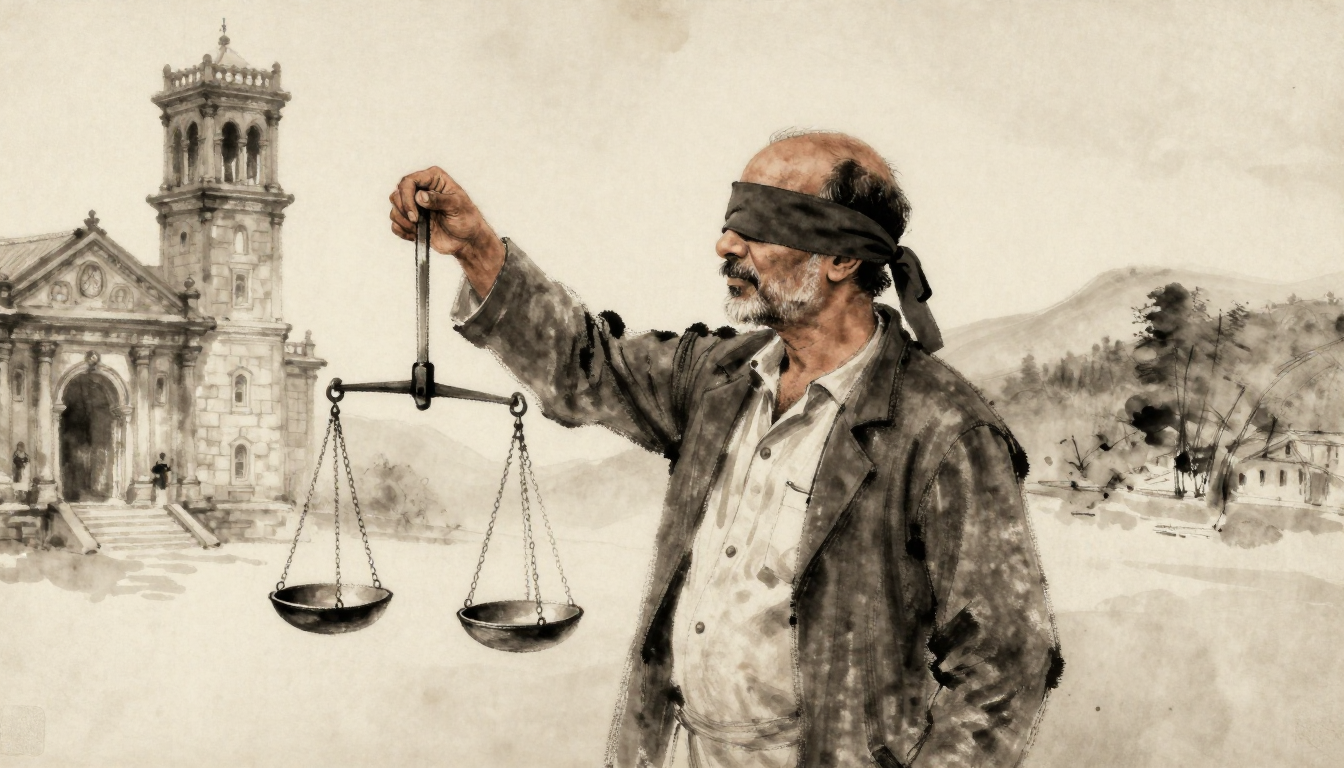
In today’s post, I am looking at the idea of Hannah Arendt’s “right to have rights“. She used the phrase in The Origins of Totalitarianism, writing about the stateless people of the twentieth century. We can see that these people possessed the rights of man in name. However, in practice, they had nothing. Once they lost membership in a political community, there was no one left to recognize them as bearers of rights. In other words, the enumerated rights had nothing to attach to. Her conclusion was that before any particular right can mean something, there has to be a place in the world where one counts.
As a cybernetician, what strikes me about the phrase is its structure. The first “right” is not one more item on a list, but instead operates on the list itself, which makes it a right about rights. In cybernetic language, this is a second-order concept that does not tell us what we are entitled to, but rather what must already be in place for entitlement to mean anything at all.
In that sense, the right to have rights behaves like an axiom that is not derived from the other rights, serving as the very ground they conceptually stand on. The right to have rights cannot be proven from inside the structure, because the structure already stands on that ground. All other rights are made possible by this foundation.
I would take this notion one step further and add that the ground this axiom rests on is human. Humberto Maturana, the biologist, put it plainly: anything said is said by an observer. Heinz von Foerster taught us what follows from this, showing that the descriptions carry the mark of the one describing. Complexity, order, rights, and rules do not sit out in the world waiting to be found, but are brought forth by people within a community who can recognize one another. When we remove the human, there is no one for whom a situation is complex, and no one for whom a right is a right. The humanistic baseline is not a sentiment to be added at the end, but what lets these concepts hold together in the first place.
Often I see people talk about rules from a first-order standpoint, pointing to the constitution, the statute, or the procedure as if they are fixed objects complete in themselves. I do not want to dismiss this, because rules carry the memory of earlier decisions and spare us from rebuilding everything each time. A community without them would be exhausted, so these structures serve a vital purpose in our daily operations.
The difficulty is that a rule does not know when it has stopped serving, having been written by observers for a purpose in a specific context. Those contexts may have drifted, and new people arrive who were not imagined when the rule was written. The rule goes on saying what it said, but only an observer can notice that what it says no longer fits the current reality.
We can see that noticing is a second-order activity, which in cybernetic terms means we are observing how we observe. This is a step back from the immediate problem to look at the frame we are using, asking ourselves whether that frame still serves the people it was meant to serve. This check is not simple and requires a shift in perspective so that we can look at the structure of our own judgment.
This is not an act that happens once, because we cannot set it up and walk away since the framing does not hold itself in place. The review has to happen again and again, since understanding does not transmit automatically, and we often think that if we explain a concept clearly, the recipient will carry it with them. However, the context, the people, and the problems change, so the frame that worked yesterday may not work today.
We cannot assume that everyone carries the same frame with them, so each generation, institution, and person meeting a hard case has to bring it forth again. This is demanding but necessary, meaning we are repeatedly in a state of re-evaluation rather than just applying rules. We are also needing to check if the rules make sense in the current context, because if we stop checking, the frame becomes a habit which turns into a blind spot. We start acting without asking why, and paraphrasing von Foerster, we stop seeing when we forget how to act.
We have to be willing to question our own assumptions and be humble enough to admit that our previous understanding might be incomplete. This is where valuable learning happens, not in the initial acquisition of knowledge, but in the ongoing effort to apply that knowledge with awareness. We are always refining our view and adjusting our frame, which is the work of the practitioner.
So when a situation appears complex, I have come to take that appearance as an invitation, suggesting that complexity is not a property of the situation alone. It may be a signal that our existing distinctions are straining, prompting us to look deeper. The first-order response is to reach for the rule and apply it harder, while the second-order response is to step back, return to the human ground, and recalibrate.
I want to be careful here since words often cannot carry the weight of careful thought and consideration with them. This is not an argument for replacing rules with judgment, as that would only trade one first-order fixation for another. What I am pointing to is a feedback loop where the rules can give us stability, but it is the second-order review that checks the viability or the fit of the rules. Each needs the other, so a rule without review can harden into something that harms the very people it names, while review without rules becomes an empty notion.
There is an ethical weight to this, and treating a complex situation in a purely first-order way can become a quiet abdication. This approach lets us say that the outcome was the document’s doing and not ours, often leading to the phrase “I was just following orders.” Von Foerster’s ethical imperative asks us to act always so as to increase the number of choices, and second-order review is one way of honoring that. This keeps open the possibility that the frame itself can change.
Final Arc:
Arendt’s stateless people were not failed by an absence of rules. They were failed by communities that stopped recognizing them as people to whom the rules applied. The right to have rights names that recognition, which is the second-order commitment underneath every first-order guarantee.
Stay curious and always keep on learning…
If you liked what you have read, please consider my book “Second Order Cybernetics,” available in hard copy and e book formats. https://www.cyb3rsyn.com/products/soc-book

