The Firm Grip and the Light Hand

In today’s post, I want to write a basics post on cybernetic constructivism. This is something I have seen people grapple with when they are first introduced to constructivism. We all love and appreciate certainty, especially certainty in meanings. We have come to use words like epistemology and complexity, and the use of these words gives us an illusion. The more words we have, and the better we understand their meanings, the more certain we can be. This is also how the perceived agency of LLMs is formed. They give us fluent words with no history of contact behind them. But cybernetic constructivism is not based only in the linguistic domain. The word doing the work there is “cybernetic”. We construct our meanings inside us, and those constructions are tested outside us, against constraints. That loop of construction and testing is what makes this view a way of living instead of a word game. Constructivism of this kind is rooted in experience, and in how the world pushes back on us in the form of constraints.

When the power goes out at night, I can still find my way to the kitchen. My hand moves along the wall. My feet remember where the carpet ends and the wooden floor begins. I am not “seeing” the house. I am meeting it, one contact at a time, and adjusting as I go. When my toes find the edge of the chair I had forgotten about, I learn something, though not what the chair looks like. I learn that my way of walking did not fit.

That small walk in the dark is a fair picture of where cybernetic constructivism begins. We do not have direct access to our environment. By environment I mean everything outside the boundary of the body. Light reaches the retina, pressure reaches the skin, molecules reach the nose. What happens next happens inside us, in a nervous system that works with its own states. Maturana and Varela described the nervous system as “operationally closed”. Events outside can trigger changes in it, but they do not specify what those changes will be. The structure of the living being decides that. They called these outside events perturbations, and the word fits. A perturbation disturbs. A perturbation does not instruct.

At this point, I have to admit a common problem of self-reference with any formal structure as language. This post is caught in its own argument. I am using words to explain why words do not carry meaning from one head to another. What I am doing here is not handing over meanings. I am offering a perturbation. Whatever this post comes to mean is generated by you, the reader, from your own structure and your own history. If some of it fits, the fit will be with something you were already doing.

This raises a practical question before it raises a philosophical one. If I cannot step outside my own experience to check it against the world, how do I stay alive? How does any living being maintain itself as a unity, moment after moment, without a window to look through?

The answer I have to offer is that we did not have to solve this problem alone, or from scratch. Evolution solved enough of it before any of us arrived. Our bodies come with shortcuts already built in. Our senses respond to a narrow band of what is available. We see a sliver of the electromagnetic spectrum and hear a limited range of frequencies. Most perturbations pass through us unremarked. The ones our structure recognizes as actionable are the ones we work with.

Jakob von Uexküll had a word for the world that results from this filtering; Umwelt, the surrounding world as it exists for a particular organism. His well-known example is the tick. For the tick, the world comes down to a few signals. The smell of butyric acid from mammal skin, warmth, the texture of hair. Nothing else exists for the tick in any functional sense. The tick is not missing anything it needs. The tick has the Umwelt that keeps a tick viable.

We have a human Umwelt. Ours is richer than the tick’s, but it is the same kind of structure. From the perturbations we recognize, we construct meanings. A shadow moving at the edge of vision becomes a friend or a foe. A tone of voice becomes warmth or irritation. These constructions are not copies of what is out there. They are ways of acting that have worked well enough so far.

Ernst von Glasersfeld put this with a simple image. Our knowledge fits the world the way a key fits a lock. A key that opens the lock is viable.

The key tells us nothing about the shape of the lock beyond the fact that this key works, and many differently shaped keys could open the same lock. What we learn when a key fails is that this key does not fit. That is my toes and the chair.

So the process is ongoing. Meanings that continue to work are kept. Meanings that stop working fade, or are revised, or are dropped. Nothing here requires a final picture of the world. The process requires only that we keep going.

Humans do something further. We do not only construct meanings. We become able to reflect on how we construct them. Gregory Bateson called this deutero-learning, or learning to learn. A child does not only learn that this particular stove is hot. The child learns something about how hot things behave, and something about how to find out. Heinz von Foerster gathered the same concern under the phrase “understanding understanding“. The meaning-making process becomes something we can examine and adjust. We find ways to make meaning-finding itself meaningful. The process that builds our world is turned back on itself, and becomes part of the world it builds.

Here the usual objection arrives. If everyone constructs a world of their own, is anything true? Does this not slide into relativism, where every view is as good as any other? Or even worse, solipsism, the notion that only we exist and everything is inside our mind.

My tentative answer is that there is a relativism here, but it sits at a different level than the objection assumes. Our human way of knowing is relative when set against other species. The bat, the tick, and the octopus each have an Umwelt that works for them. None of these is the correct view of the world, and neither is ours. Our knowing is relative to the kind of creature we are.

Within the human species, though, something corrects us. There are two things, I think.

The first is the environment itself. The environment cannot tell us what it is, but it can refuse us. A construction that does not fit eventually meets a refusal it cannot absorb. The bridge falls, the crop fails, the patient does not recover. Glasersfeld himself was more careful with his words than I am being with mine. The point he kept returning to was that we learn of the world through its constraints, through the places where our expected sequences are blocked and our keys do not turn. This is not correspondence, because a refusal never arrives with a description of the world attached to it. But it is not anything goes either.

The second corrective is other people. I am not the only observer. Others are constructing their worlds alongside me, from similar bodies, with similar shortcuts, in shared language. When my construction rubs against theirs, I am perturbed again, and I adjust. Maturana described language as a coordination of coordinations of behavior. Through language we build what he called consensual domains, regions of shared meaning that hold because we keep acting together within them. I should say plainly what conversation is doing here, since I already told you that words do not travel from one head to another. A conversation does not transfer meanings. It coordinates actions. Two people talk, adjust, and find that they can walk together and hear each other’s footsteps. Calibration happens in that coordination.

The second corrective has its own weakness. Groups calibrate toward coordination, not toward correctness. A whole community can agree on something that does not fit. That is why both correctives matter. The world’s refusals keep social agreement honest, and social agreement lets us notice refusals that one observer alone would miss or explain away. With both in place, relativism may not be the right word anymore. Relational may be closer. Views are not competing pictures of the world. They are competing ways of staying viable, and the world and other people both get a say in which ones survive.

This carries over to organizations and the people who manage them. W. Ross Ashby gave us the vocabulary. His Law of Requisite Variety is depicted as only variety can destroy variety. An organization faces far more variety from its environment than it could ever match, so it filters. Beer gave this filtering its name, attenuation. Every report, metric, and dashboard is an attenuator. The filtering our senses do for us, organizations do with forms and meetings. A manager’s picture of the organization is a construction, built from whatever got through the filters. The picture is not the organization. The 1970 paper by Conant and Ashby carries the memorable title every good regulator of a system must be a model of that system. Taken carefully, the theorem is close to a tautology and says nothing about truth. I want to go one step further than the theorem goes, and I want to say so openly. The model inside the regulator does not have to be true. It only has to keep things viable.

Stafford Beer built his Viable System Model on this ground. In his scheme, System 1 does the current work that keeps today alive. System 3 looks after the inside and the now. It monitors the work and forces coherence on the daily operations. System 4 looks after the outside and the then. It watches the environment, imagines futures, and prepares for change. The two pull against each other. Too much attention to the inside and now, and the organization grows rigid and gets blindsided. Too much attention to the outside and then, and the work of today falls apart. The balance between them is not computed anywhere. It is a running argument. Above both sits System 5, whose job is to hold the identity of the whole while that argument runs.

When I think about this balance, I think of Miyamoto Musashi. In the Water Book of Go Rin no Sho, The Book of Five Rings, Musashi describes how to hold the long sword. Grip it with a floating feeling in the thumb and forefinger, the middle finger neither tight nor slack, and the last two fingers tight. A grip that is tight everywhere is stiff and slow. Musashi had a name for that. Fixedness means a dead hand. Pliability is a living hand. A grip that is loose everywhere loses the sword. The firm fingers keep hold of the now. The light fingers stay ready for what comes next. The middle finger sits between them. I do not want to push the mapping too far, but the hand Musashi describes looks a lot like what Beer wanted between System 3 and System 4.

All of this rests on a shift from first order to second order. In first-order thinking, the observer describes a situation as if from nowhere. In second-order thinking, the observer is included in what is observed. Maturana put this plainly; everything said is said by an observer. Von Foerster took the next step and asked us to observe our own observing. A third recognition follows, and it carries the ethics. Other observers are doing the same thing. They too are constructing, filtering, and calibrating. Their constructions are not errors to be corrected toward mine. They are other ways of staying viable. This is also why an LLM can sound convincing without ever having been refused. It has fluent words, but no body that pays anything when a construction fails.

If I cannot claim that my view is simply how things are, I cannot hand off responsibility for my view to the world. What I see, I am responsible for seeing. And if others are observers in the same sense I am, their constructions make a claim on me. Maturana described love, in a biological sense, as accepting the other as a legitimate other in coexistence with oneself. Von Foerster offered an ethical imperative, in the first person; I shall act always so as to increase the number of choices. Both point the same way. Where no one has direct access, the decent thing is to keep the conversation open and leave others room to see.

Final Arc

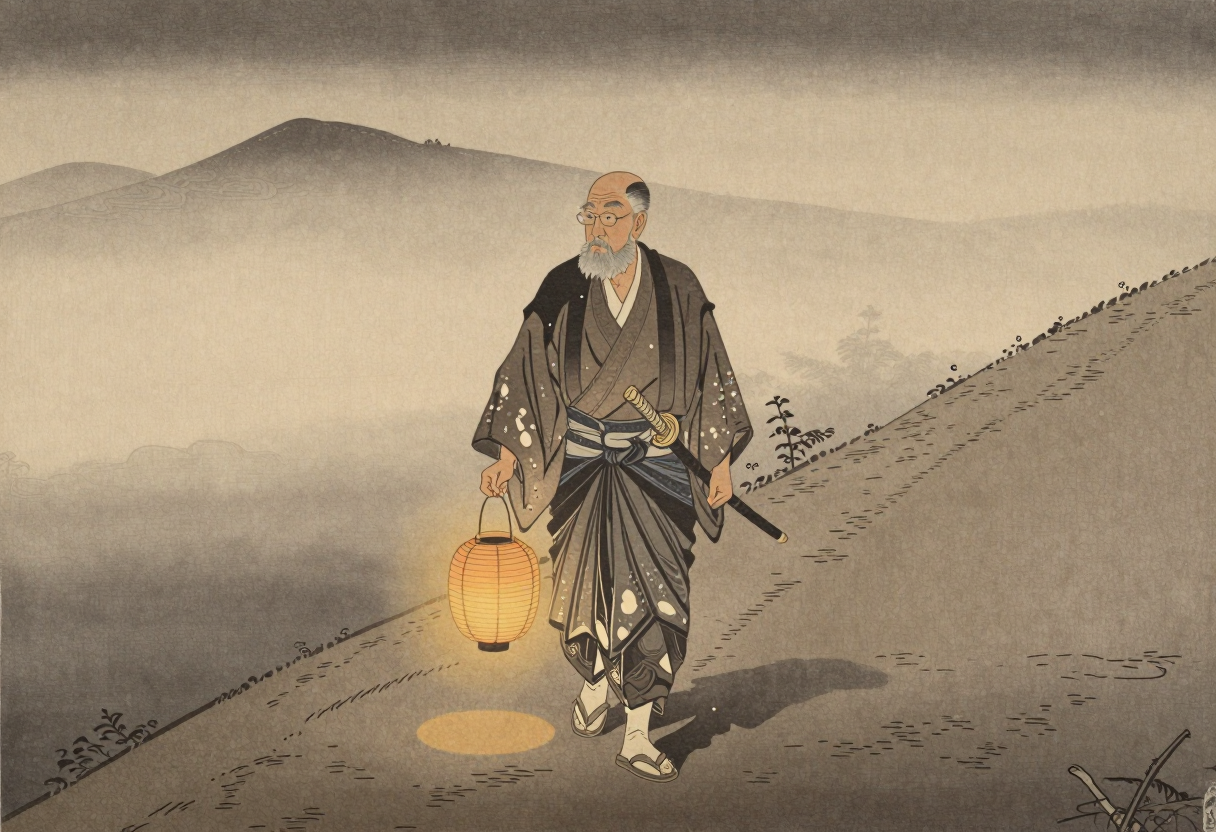
Imagine a village on a hillside where the fall fog comes down so thick that no one can see their own feet. The villagers still have to get home from the fields. Each carries a small lamp. The lamp does not show the path. The lamp shows a circle of gray, a few stones, a patch of grass. No one in the village has ever seen the whole hillside in the fog, and no one ever will.

Over the years they have learned to walk this way. Each person keeps one hand steady on the lamp and lets the feet test each step. When the ground gives way under someone, that person calls out, and the others shift. When two lamps drift apart, the walkers call to each other until their voices come closer. The path they walk is not drawn on any map. The path is whatever has held, so far, for people walking together.

One evening a child asks her grandmother how they know they are on the right path. The grandmother thinks for a while. “We know when we are on the wrong one,” she says. “And we know because someone tells us.”

Then she lifts her lamp a little higher, not to see further, but so that the others can see her.

Stay Curious and Always Keep on Learning…

If you liked what you have read, please consider my book “Second Order Cybernetics,” available in hard copy and e book formats. https://www.cyb3rsyn.com/products/soc-book
Karakuri Kaizen:

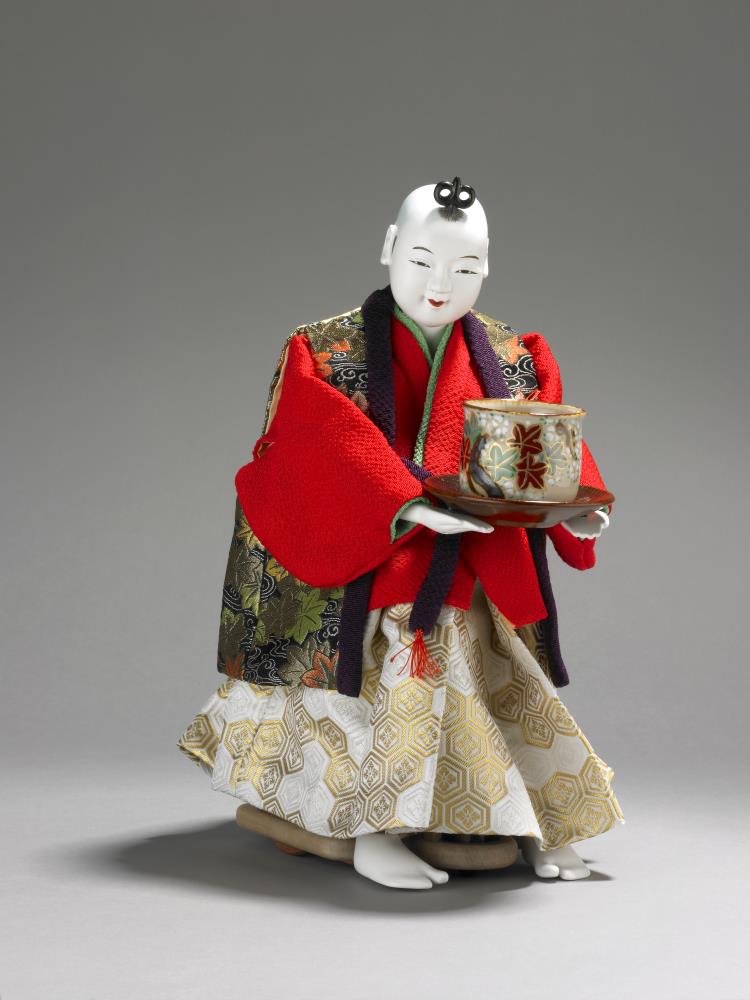
karakuri doll tea

As the readers of my blog know, I am an ardent student of Toyota Production System (TPS). One of the core philosophies of TPS is kaizen, often translated from Japanese as continuous improvement. It is the idea that one should continuously find ways to eliminate non-value adding activities, and in the process develop oneself and others to get better at kaizen. The idea of kaizen begetting more kaizen. Kaizen is a human capital enrichment philosophy. As Eiji Toyoda, Toyota Motor Corporation President from 1967 to 1982, said – “It is people that make things, and so people must be developed before work can start.”

One of the ways Toyota inspire their employees to nurture their creativity is Karakuri Kaizen. It is said that in the early seventeenth century, during the Edo period, European clocks were introduced in Japan. This sparked a wide curiosity amongst the Japanese craftsmen. The idea of developing motion mechanisms with elaborate sets of springs and gears was new to them. This led to the development of karakuri ningyō, or mechanized dolls. These were dolls that moved around and did several tasks such as bring tea to a guest and then bring it back to the owner, or climb a set of stairs. There was even a magician doll that performed a cups and balls routine.

What set the karakuri dolls of Japan separate from the European clockwork mechanism was the humanization of the dolls. The dolls were created with high importance to its physical features such as face, movement of head and limbs; in an effort to the make the doll life-like. Aesthetics was of utmost importance. All the mechanisms were cleverly hidden beneath clothing such that no mechanism was visible from outside. The doll moved around as if it is alive. The karakuri dolls brought fascinated delight to its spectators.

All the motion was achieved using simple springs, gravity and gears. No external power source was used. How does this all relate to the manufacturing floor? One of the challenges that is often posed to an organization is to increase its production. This is often tackled by either hiring more employees or by using automation. Automation is highly attractive even though it is sometimes cost prohibitive. It might make sense that the nonvalue added activities such as transportation and repeated motions could be replaced with a robot. Most modern manufacturing operations are riddled with automation. However, this comes with its own problems. The main one is that the automation becomes the focus of manufacturing rather than the employees. The high cost, large equipment becomes a monument that everything has to work around the monument. It is an expensive way to ensure that the status quo is maintained. To get the most out of the high expense, the new machine is run around the clock increasing the unwanted inventory and it raises the cost of the operation.

This is where karakuri kaizen comes in. Karakuri, as explained before, is a low-cost automation that does not utilize external power resources. It is comparatively small and works solely based on gravity, counterweights, springs, gears etc. The key point of karakuri kaizen is that it should inspire more kaizen. Generally, a challenge is posed to the operators to come up with a means to remove unwanted strain and motion, and to eliminate waste. Normally, this would be task where a heavy part(s) is lifted and moved to another location or where a part is turned around and operated on. The first impulse is to automate the process. This would require an expensive piece of equipment. Karakuri kaizen focuses on solving the problem on hand with what is readily available and using minimal resources. This might be construed as pushing to minimize capital expenditure. However, the most important part is that the operators are being challenge to use their wit and brains. As Fujio Cho, Toyota Motor Corporation President from 1999 to 2005, said – “Human ingenuity has no bounds.” The karakuri mechanism does not become the center of focus. Instead, the operator does. The mechanism generally is such that it can easily be modified if needed, and even replaced with another karakuri. Unlike, a heavy piece of machinery, a karakuri does not become a monument. It is built specifically to achieve a purpose, and thus it is highly customized. It is also designed in-house. The “challenge” portion is a core ingredient for kaizen.

When Toyota started car manufacturing, it did not have a lot of capital or resources. They modified existing machinery to achieve its needs. They first used what they had in-house before going outside for solutions. They relied on their employees to come up with ingenious solutions to their problems. This meant that the solutions were made specifically for their problems. Generally, when an equipment or a software is purchased, it is not always made specific to the need of the customer. The customer often has to work with what was offered. Toyota had to come up with ingenious solutions to solve their problems without spending much capital. The only capital they would come up with was human capital. Even after Toyota became successful, this mindset was maintained.

As Toyota veteran Kazuhiko Furui explained:

Toyota has tried to use as little external power as possible in its car manufacturing since its foundation. Karakuri kaizen is one of the Toyota Way values. Karakuri is a mechanism that uses gravity, springs and gears instead of external power sources to manipulate objects. A karakuri does not always work well on the first try. If something breaks, we rebuild it, trying continuously to make it better, always reforming the mechanism. For us, when we succeed, there is a great sense of achievement: “we did it!” And that brings a drive to try making yet another mechanism. Developing karakuri is also about developing people. 

Final Words:

What is the point of kaizen? The simple answer is often to make things better. If kaizen does not beget more kaizen and if it does not improve the thinking of the persons involved, then it is missing the meaning of kaizen. Kaizen should lead the employees to develop their abilities to see and identify waste, and come up with ways to eliminate waste. It should lead them to second order thinking where they don’t just what is my goal, but also ask what is the purpose of my goal. This means that the employee becomes part of the meta-system rather than just doing what they are told.

I will finish with some fine words from the great philosopher, Immanuel Kant:

The human being can either be merely trained, broken in, mechanically instructed, or really enlightened. One trains dogs and horses, and one can also train human beings. Training, however, does little; what matters above all is that they learn to think. The aim should be the principles from which all actions spring.

In case you missed it, my last post was Weber’s Law at the Gemba:


A “Complex” View of Quality:

Q

I am a Quality Manager by profession. Thus, I think about Quality a lot. How would one define “Quality”? A simple view of quality is – “conformance to requirements.” This simplistic view of quality lacks the complexity that it should have. This assumes that everything is static, the customer will always have the same requirements and will be happy if the specifications/requirements are met. Customer satisfaction is a complex thing. Customers are external to the plant manufacturing the widget. Thus, the plant will always lack the variety that the external world will impose on it. For example, lets look at a simple thing like a cellphone. Theoretically, the purpose of a cellphone used to be to allow the end user to make a phone call. Think of all the variety of requirements that the end user has for a cellphone these days – internet, camera, ability to play games, ability to use productivity apps, stopwatch, alarms, affordability etc. Additionally, the competition is always coming out with a newer, faster, and maybe cheaper cellphone. To paraphrase the red queen from Alice in Wonderland – the manufacturer has to do a lot of running to stay in the same place – to maintain the share of market.

320px-Alice_queen2

In this line of thinking, quality can be viewed as matching the complexity imposed by the consumer. There are two approaches in Quality that differs from the concept of just meeting the requirements.

1) Taguchi’s idea of quality:

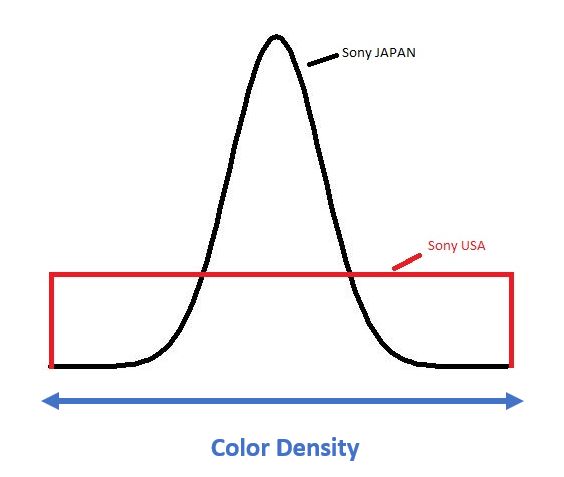
Genichi Taguchi, a Japanese engineer and statistician, came up with the idea of a “loss function”. The main idea behind this is that anytime a product deviates from the target specification, the customer experiences a loss function. Every product dimensional specification has a tolerance for manufacturability. When all of the dimensions are near the target specification, the loss function is minimal resulting in a better customer experience. One of the best examples to explain this is from Sony. The story goes that Sony had two television manufacturing facilities, one in Japan and one in the USA. Both facilities used the same design specifications for television. Interestingly, the televisions manufactured in the USA facility had a lower satisfaction rating than the televisions manufactured in Japan. It was later found that the difference was in how the two facilities approached quality for the color density. The paradigm that the USA facility had was that as long as the color density was within the range, the product was acceptable, whereas, the Japanese facility made a point to meet the nominal value for the color density. Thus, the Japanese Sony televisions were deemed superior to the American Sony televisions.

TV

2) Kano’s idea of quality:

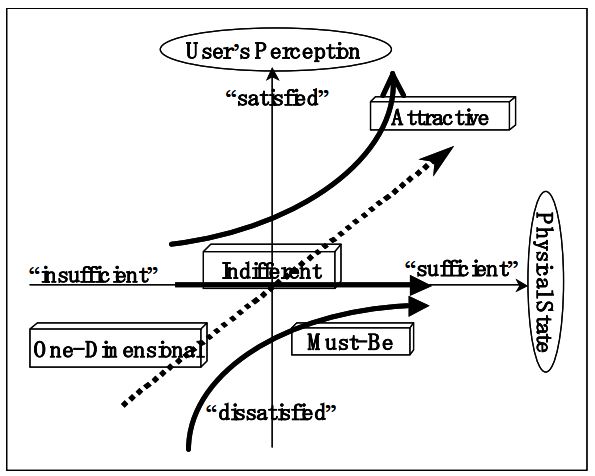
Noriaki Kano is another Japanese Quality Management pioneer who came up with the idea of the Kano model. The Kano model is a great way of looking at a characteristic from the point of the customer. The Kano model has two axes – customer satisfaction and feature implementation. The customer satisfaction goes from satisfied to dissatisfied, and the feature implementation goes from insufficient to sufficient. This two-dimensional arrangement leads to various categories of “quality” such as Attractive quality, One-dimensional quality, Must-be quality and Indifferent quality. Although there are more categories identified by Kano, I am looking at only the four categories identified above.

  • Attractive quality – this is something the customer would find attractive if it is present, and indifferent if it is absent. For example, let’s say that you went to get a car wash, and the store gave you free beverage and snack. You were not expecting this, and getting the free beverage and snack made the experience pleasant. If you were not aware of the free beverage and snack, you would not be dissatisfied because you were not expecting to get the free beverage and snack.
  • One-dimensional quality – this is something that customer would view on a one-dimension. If there is more of it, the customer is more happy, and if there is less of it, the customer is less happy. For example, let’s look at the speed of your internet connection at home. The faster the internet, the happier you are, and the slower the internet, the sadder you are.
  • Must-be quality – this is something that the customer views as an absolute must-have. If you go into a store to buy eggs, you expect the carton to have eggs in it. If the eggs are not there, you are not happy.
  • Indifferent – this is something that a particular customer truly does not care about. The example that Kano gives to explain this in his 2001 paper was the “I-mode” feature on some Japanese cellphones. This feature allowed the user to connect to the internet. When a survey was conducted, most of the middle-aged people viewed this feature indifferently. They could care less that the cellphone could be used to connect to the internet.

Kano

The brilliant insight from the Kano model is that the perception of quality is not linear or static. The perception of quality is non-linear and it evolves with time. Kano hypothesizes that a successful quality element goes through a lifecycle detailed below:

Indifferent => Attractive => One-Dimensional => Must-Be.

A feature that began as indifferent could become an attractive feature, which would then evolve into a one-dimensional feature and finally it becomes a must-be feature. Take for example, the ability to take pictures on your cellphone. This was treated indifferently at the beginning, and then it became an attractive feature. The better the resolution of the pictures taken, the happier you became. Finally, the ability to take sharp pictures became a must-have on your cellphone.

The customer is not always aware of what the attractive feature could be on a product. This is akin to what Ford said – “If I had asked people what they wanted, they would have said faster horses.” Steve Jobs added on to this and said – “People don’t know what they want until you show it to them. That’s why I never rely on market research. Our task is to read things that are not yet on the page.”

Kano had a brilliant insight regarding this as well. In the 2001 paper, “Life Cycle and Creation of Attractive Quality”, he gave the Konica model. Kano talked about the camera that Konica came out with in the 1970s that had built-in flash and the capability to auto focus. At that time, the camera was treated as a mature product and to survive the competition Konica decided to come up with a new camera. Konica engaged in a large survey with the customers with the expectation of coming out with a completely new camera. The R&D team was disappointed with the survey results which only suggested minor changes to the existing designs. The team decided to visit a photo processing lab to examine the prints and negative films taken by consumers and to evaluate the quality of prints and developed films. This is the spirit of genchi genbutsu in lean (go and see to grasp the situation). The team learned that the two main issues the users had were to do with underexposures due to lack of flash and out-of-focus.

Kano notes that:

To solve these problems, Konica developed and released cameras with auto focus and a built-in flash as well as auto film loading and winding functions from the middle to the end of 1970s. This prompted consumers to buy a second and even a third camera. Thereafter, Konica’s business considerably grew and completely changed the history of camera development in the world.

As long as customers are around, quality should be viewed as non-linear, complex and evolving.

Always keep on learning…

In case you missed it, my last post was Lessons from Genkan:

Lessons from Genkan:

Bodhidharma.and.Huike-Sesshu.Toyo

Readers of my blog know by now that I am a “Japanophile”. Keeping up with that theme, I will be talking about “genkan” today. Genkan is a small sunken area behind the front door of a Japanese house. This vestibule has a great significance in the Japanese culture. A guest coming to a Japanese house should open the front door to enter genkan, and calls out “Gomen kudasai” (“Anybody home?”) The house owner can then come out and carry a conversation while the guest stays in the genkan. The genkan allows the opportunity to conduct any informal business like paying bills or having a short conversation. The genkan allows the opportunity to not engage in any formal etiquette that will be required if the guest enters the house. If the guest is welcomed inside the house, the guest is expected to remove his shoes while inside the genkan and have the shoes facing towards the door.

The word genkan means is made up of two characters “gen” and “kan”; “gen” stands for mysterious or profound, while “kan” stands for barrier or connection point, Genkan stands for dark and mysterious entrance. The concept of genkan comes from the Zen temples. The term genkan was used metaphorically to remind everyone entering a Zen temple that it is the path to the realm of enlightenment. When a student wishes to join a Zen temple/monastery, he is supposed to stand in the genkan in a bowing posture sometimes for days. During this period, his desire to join the monastery will be tested in many different ways. This ritual is called as “niwazume”. The concept of genkan was adopted by the samurai and included in the houses.

As Michael Lazarin explains in his paper, “A Phenomenology of Japanese Architecture: Heidegger and Derrida”:

We can see that the genkan is not simply a way of getting into or out of the house, a place for changing and storing shoes. lt serves an important social function; it provides a way of getting around the excessive formalities of Japanese social life. lt provides a way of being familiar with someone who, as visitor, is also estranged. lt de-ranges the formalities in order to arrange social communication. Without such a space, people raised according to traditional standards of politeness would be at a loss.

I was very enthralled when I learned about genkan. I loved the idea of a place where the formalities can be ignored. This idea can be of great use at a workplace. In many workplaces, innovation and creativity are stymied due to the rigid policies and procedures in place. The thinking behind the  rigid rules and procedures is that they promote standardization and structure. Unfortunately, if they cannot match the local variety needed, they will break or worse create a stymied workplace that people want to leave. The inflexibility of the procedures causes stagnation. In such a situation, we can learn from genkan. We can create an “informal” area or space where rules are not applicable, and where we can experiment safely and fail as many times as needed. The failures will be in a controlled environment and this leads to innovation, creativity and learning. This brings to my mind, the ideas of the Soviet engineer, Peter Palchinsky. Palchinsky was killed in 1929 due to his political standings. He was the focus point of the book, “The Ghost of the Executed Engineer” by Loren Graham. Tim Harford also wrote about Palchinsky in the book “Adapt”.

Peter Palchinsky’s ideas can be summarized as follows (from Tim Harford’s Adapt):

  • Seek out new ideas and try new things.
  • When trying something new, do it on a scale where failure is survivable.
  • Seek feedback and learn from your mistakes as you go along.

In “The Ghost of the Executed Engineer”, Loren Graham wrote:

Although Palchinsky praised the idea of central planning, he thought that the central plan should be very general, allowing many local variations. It should allow room for individual initiative.

Another example of having an “informal” program outside of the norm is now defunct (?) Google’s 20 percent initiative. Google’s founders Larry Page and Sergey noted in 2004: “We encourage our employees, in addition to their regular projects, to spend 20% of their time working on what they think will most benefit Google,” the pair wrote. “This empowers them to be more creative and innovative. Many of our significant advances have happened in this manner.” Several successful initiatives like Gmail and Adsense came out of this initiative.

Does your workplace have a genkan?

I will finish with the story of Dazu Huike. The custom of niwazume perhaps goes all the way back to Dazu Huike. Dazu Huike was the student of Bodhidharma. Bodhidharma, a south Indian prince, was the first Chinese patriarch for Chan Buddhism, and considered by many to be the creator of Shaolin Kungfu.

Legend has it that Bodhidharma initially refused to teach Huike. Huike stood in the snow outside Bodhidharma’s cave all night, until the snow reached his waist. In the morning Bodhidharma asked him why he was there. Huike replied that he wanted a teacher to “open the gate of the elixir of universal compassion to liberate all beings”.

Bodhidharma refused, saying, “how can you hope for true religion with little virtue, little wisdom, a shallow heart, and an arrogant mind? It would just be a waste of effort.”

Finally, to prove his resolve, Huike cut off his left arm and presented it to the First Patriarch as a token of his sincerity. Bodhidharma then accepted him as a student, and changed his name from Shenguang to Huike, which means “Wisdom and Capacity”.

Always keep on learning…

In case you missed it, my last post was Tesler’s Law of Conservation of Complexity:

Kufu Eyes:

Huike_thinking-big-569924185f9b58eba49ede26

I came across an interesting phrase recently. I was reading Kozo Saito’s paper, “Hitozukuri and Monozukuri”, and I saw the phrase “kufu eyes”. Kufu is a Japanese word that means “to seek a way out of a dilemma.” This is very well explained in K. T. Suzuki’s wonderful book, “Zen and Japaense Culture.” Suzuki talks about kufu in three sections of the book, and each time he adds a little more detail.

“Kufu is not just thinking with the head, but the state when the whole body is involved and applied to the solving of a problem.”

 “Kufu means ‘employing oneself assiduously to discover the way to the objective.’ One may say that this is literally groping in the dark, there is nothing definite indicated… I am afraid this is as far as any master of Zen or swordsmanship can go with his disciples. He leads them until no more leading is possible, and the rest is left to their own devices. If it is a matter of intellection, the way to the goal may be ‘definitely’ prescribed… The students must resort to something very much deeper than mere intellection – something which they cannot obtain from another.”

‘‘The term kufu is the most significant word used in connection with Zen and also in the fields of mental and spiritual discipline. Generally, it means ‘to seek the way out of a dilemma’ or ‘to struggle to pass through a blind alley.’ A dilemma or a blind alley may sound somewhat intellectual, but the fact is that this is where the intellect can go no further, having come to its limit, but an inner urge still pushes one somehow to go beyond. As the intellect is powerless, we may enlist the aid of the will; but mere will, however pressing, is unable to break through the impasse. The will is closer to fundamentals than the intellect, but it is still on the surface of consciousness. One must go deeper yet, but how? This how is kufu. No teaching, no help from the outside is of any use. The solution must come from the most inner part of oneself. One must keep knocking at the door until all that makes one feel an individual being crumbles away. That is, when the ego finally surrenders itself, it finds itself. Here is a newborn baby. Kufu is a sort of spiritual birth pang. The whole being is involved. There are physicians and psychologists who offer a synthetic medicinal substance to relieve one of this pang. But we must remember that, while man is partially mechanistic or biochemical, this does not by any means exhaust his being; he still retains something that can never be reached by medicine. This is where his spirituality lies, and it is kufu that finally wakes us to our spirituality.’’

In his paper, Saito talked about kufu eyes to explain the process of having a curious scientific mind. Kufu eyes looks at the whole and uses personal intuition than just the analytical thinking process. Kufu eyes pushes you to think further perhaps through thought experiments, and to experiment to truly understand the whole picture. One interesting note I would like to make here is of the great American philosopher Dan Dennett’s “intuition pumps.” An intuition pump is a thought experiment structured to allow the thinker to use their intuition to develop an answer to a problem. Just like a mechanical device, if you can model your thought in a thought experiment, you can push on different buttons and pull on different levers and see what happens.

With kufu eyes, you can observe to gain insight. Siato talked about Taiichi Ohno, the father of Toyota Production System, to explain the concept of kufu eyes further:

… learning engineering and science is not enough. There is a third element: professional intuition, probably the most important, yet most difficult to master, but required for the engineering problem solving process. Taichi Ohno, one of the pioneers who developed Toyota Production System, once declared that the essence of TPS is to develop the well trained ‘‘eyes’’ that can see waste which is invisible to the untrained.

Taiichi Ohno took the task of catching up to the American market when the Japanese worker was assumed to be only 1/8th productive as his American counterpart. The most recent development in manufacturing at that time was the idea of mass manufacturing, which is essentially a push system that led to lots of inventory. Toyota could not afford to carry a lot of inventory. The thinking in those days was to combine similar equipment together and perform operations in isolation. Ohno rearranged the entire layout of the plant he was in charge of, so that the equipment was set to follow the process. The practice at that time was to have one operator manning one piece of equipment. Ohno had one operator man multiple equipment at a time. This led to autonomation or Jidoka. To control the amount of parts produced, Ohno came up with the idea of Kanban. Looking back, Ohno definitely had to employ himself assiduously to discover the way to his objective. He could not just rely on his analytical mind, it was more complex than that. His thinking is clearly stated when he said that efficiency must be improved at every step and at the same time, for the plant as a whole. This is the big picture view that is needed in kufu.

Saito combines the different ideas of total-unit, dedication to the team, holistic view, dialectic approach, and nonlinear thinking to explain kufu. Logic and words have limits. I am inspired by the phrase “kufu eyes”. To me, it means looking outward and inward, looking at the big picture, thinking inside and outside of the “box”, and always pushing to go to the edge of a problem. It means to look with the determination to gain insight. It also means to not fall for status-quo, and to always improve. It also means to go slow but deliberately. It means to not stop until you have solved the problem. And at the same not stop there but keep on improving. This is further explained by Suzuki.

This may be difficult , but when you go on exercising kufu toward the subject, you will after some time come to find this state of mind exercising kufu toward the subject, you will after some time come to find this state of mind actualized without noticing each step of progress. Nothing, however, can be accomplished hurriedly.

I will stop with a wonderful lesson from Suzuki’s book:

When we tie a cat, being afraid of its catching a bird, it keeps on struggling for freedom. But train the cat so that it would not mind the presence of a bird. The animal is now free and can go anywhere it likes. In a similar way, when the mind is tied up, it feels inhibited in every move it makes, and nothing will be accomplished with any sense of spontaneity.  Not only that, the work itself will be of a poor quality, or it may not be finished at all.

Always keep on learning…

In case you missed it, my last post was Hitozukuri:

Hitozukuri:

Zenmind

In today’s post, I am looking at “hitozukuri” from the famous Toyota saying, “monozukuri wa hitozukuri.” This can be translated as “making things is about making (developing) people”. To me, this encapsulates the idea of a sociotechnical system. When organizations attempt to business process reengineer, there is a tendency to focus on improving processes only from the technical standpoint. Their focus is on – How to make the process flow better or how to make the operation faster by removing waste? Toyota does focus on this, but at the same time, they also focus on developing their people. Unfortunately, as the lessons from Toyota got copied, the emphasis became more on the tools and not on the people development.

While we can translate monozukuri as craftsmanship, it also represents the spirit of creativity, doing more with less and not wasting valuable resources. Japanese culture has a strong emphasis on harmony, and this can also be seen with monozukuri. Monozukuri is the art of making things in the most harmonious way possible, with minimal waste, and maximum aesthetics. At the same time, we can also look at hitozukuri as lifelong development. Kozo Saito, Director of the Institute of Research for Technology Development at the University of Kentucky, describes hitozukuri as:

Hitozukuri … stresses a life-long process of learning. Hitozukuri emphasizes several different steps of human development, whose original form was emphasized by Confucius in his famous six different human development stages. It goes: ‘‘when I (Confucius) was fifteen years old, I decided to study; at thirty I became independent; at forty I focused; at fifty I realized my mission in my life; at sixty I became able to listen to people without bias and prejudice; finally at seventy I attained the stage that my thinking and action are harmonized with nature. Hitozukuri is a continuous life-long process of human development.

Hitozukuri aligns with the second pillar of the Toyota Way – respect for people. As part of developing people, Toyota focuses on teaching them to see waste and come up with ways to fix the problems. They are challenged with improving their processes, and in the process improve and develop themselves. This is all done in an environment of mutual respect, again based on the concept of harmony.

The technical aspects of monozukuri resides in the simple and complicated domains of order. It is like saying, follow this recipe exactly, and you will make a delicious food item. The social aspects of hitozukuri resides in the complex domain. There is no one best way of “developing” a person. As the famous saying goes, humans do not come with manuals. One heuristic that Toyota uses is – do not tell exactly how to solve a problem. As part of their development, the trainee identifies a problem. The trainer challenges the trainee to start experimenting, identifying patterns and to come up with countermeasures. The trainer provides the various concepts to help the trainee understand the problem, and works with him to find the root cause(s) and thus potential solutions.

In the delightful book, “Not Always So”, about the great Zen Teacher Shunryu Suzuki, Jusan Kanei tells a beautiful anecdote. Kanei was struggling with sitting still for meditation. Suzuki Roshi sat next to him and without saying a word rested his hands on Kanei’s shoulder. Soon, Kanei’s breath softened and lengthened, and he was able to stay with his breath. Kanei later asked Suzuki Roshi what he was doing when he had his hands on Kanei’s shoulders, and Suzuki Roshi responded, “I’m meditating with you.” Suzuki Roshi did not say to do this or do that. His touch did not say “Go over there” or “Get over here”, “Straighten Up” or “Calm down.” Kanei stated that the touch said, “I’ll be here with you wherever you are.”

This is a beautiful story that encapsulates the idea of not telling people what to do, and instead reflects on developing the person. When you have to tell someone what to do, the responsibility of their actions becomes yours. You are also stealing their opportunity to learn from the experience. We learn more from failures than from successes.

Always keep on learning…

In case you missed it, my last post was Distrust Simplicity:

Looking at Kaizen and Kaikaku:

trotoise-hare

In today’s post, I will be looking at the “Kaizen” and “Kaikaku” in light of the Explore/Exploit model. Kaizen is often translated from Japanese as “continuous improvement” or “change for better”. “Kaikaku”, another Japanese term, is translated as “radical change/improvement”. “Kakushin” is another Japanese word that is used synonymously with “Kaikaku”. “Kakushin” means “innovation” in Japanese. Kaikaku got more attention from Lean practitioners when the previous Toyota President and CEO, Katsuaki Watnabe said  in 2007- “Toyota could achieve its goals through Kaizen. In today’s world, however, when the rate of change is too slow, we have no choice but to resort to drastic changes or reform: Kaikaku”

The explore/exploit model is based on a famous mathematical problem. I will use the example from Brian Christian and Tom Griffith’s wonderful 2016 book “Algorithms to Live By: The Computer Science of Human Decisions”. Let’s say that you are very hungry and do not feel like cooking. Which restaurant should you go to? Your favorite Italian restaurant or the new Thai place that just opened up? Would your decision capabilities be impacted if you are traveling? Sticking with what you know and being safe is the “exploit” model. Trying out new things and taking risks is the “explore” model. The dilemma comes because you have to choose between the two. The optimal solution depends on how much time you have on your hands. If you are traveling and you are at a new place for two weeks, you should try out different things at the beginning (explore). As days go by and you only have a few more days left, you should definitely stick with what you know to be the best choice so far (exploit). Christian and Griffith stated in the book – Simply put, exploration is gathering information, and exploitation is using the information you have to get a known good result.

From an organization’s standpoint, the explore/exploit dilemma is very important. The exploit model is where the organization continues to focus on efficiency and discipline in what they already manufacture. The explore model on the other hand, is focusing on innovation and new grounds. The exploit model does not like risk and uncertainty. The exploit model does not necessarily mean maintaining status-quo or not rocking the boat. The exploit model is getting better at what you already do. One way that I have heard the differentiation between the two explained is like this – exploitation is like playing in the same sandbox and getting better at the games you play inside the sandbox. Exploration is like venturing outside of your sandbox and finding new sandboxes to play with and creating new games.

Some strategies used for the exploit model are:

  • Optimize the organization for current organizational rules and structure
  • Make sure standards are in place and the established rules are followed in order to achieve efficiency
  • Make incremental improvements for existing processes better and still stay within the current organizational structures
  • Keep making more of the current product portfolio

The explore model is about breaking new grounds. Some strategies used for the explore model are:

  • Break away from the current organizational rules and structure
  • Develop new structures to allow for diversity and discovery
  • Make radical improvements to overhaul current processes, rules and structures
  • Add new product portfolios altogether

The exploit model relies on current constraints, rules and structures. The exploration model relies on the willingness to break away from the current constraints, rules and structures. A perfect balance between the two models and oscillating between both models or engaging in both models simultaneously is very important for an organization to thrive. The organizations that can do both are called “ambidextrous”.

The explore/exploit model has some similarities to Kaizen and Kaikaku. Kaizen is about getting better at what we do incrementally. It is a personal development model. Kaikaku, on the other hand, is about breaking the mold and overhauling the organization in some cases. Launching a Lean initiative can be viewed as Kaikaku. Kaizen could be an ideal strategy for exploitation and Kaikaku for exploration. I came across a paper from Yuji Yamamoto called “Kaikaku in Production in Japan: An Analysis of Kaikaku in Terms of Ambidexterity” that further shed light on this. The paper is part of the collection called “Innovative Quality Improvements in Operations”. Yamamoto points out that while Kaizen is incremental; Kaikaku entails large-scale changes to both the social and technical systems of an organization. Kaizen is often viewed as an opportunity and Kaikaku may sometimes be viewed as a necessity. Kaizen is also viewed as a bottom-up activity with autonomy, and Kaikaku on the other hand can be viewed as top-down activity with direction from the top management. Kaikaku may be continual (with definite timelines and stops) and Kaizen is continuous. Kaizen is described as engaging everybody in improvement every day, everywhere in the organization.

Yamamoto discussed data from 65 case studies where Kaikaku activities were implemented at Japanese manufacturing companies. Yamamoto noted that the defining characteristic for Kaikaku based on the studies was that Kaikaku requires everybody’s exploration effort. In the 65 reports, the importance of everyone in the organization having a specific mental mode related to exploration, for instance, a challenging spirit, give-it-a-try mentality, and unlearning, is frequently mentioned. In the Kaikaku activities, managers often encouraged everyone in the organizations to think and act in a more explorative way than they were used to. Apparently, companies used the word Kaikaku as a way to make managers and employees be aware of this mental stance toward exploration.

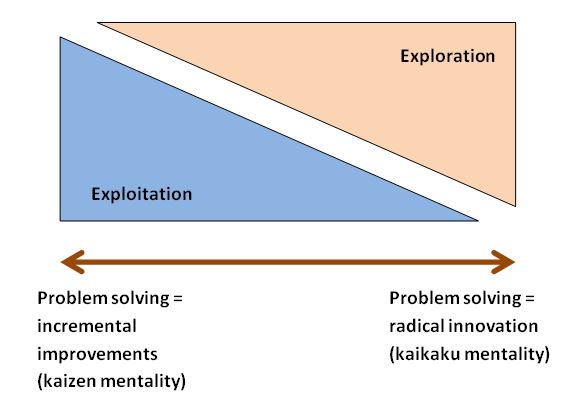
Yamamoto used the exploit/explore model to further differentiate Kaizen and Kaikaku. The figure below is adapted from Yamamoto. The figure shows different degrees of exploitation and exploration activities. Problem solving with a high degree of innovativeness tends to involve more exploration than exploitation.

K and K

Some key takeaways from Yamamoto’s paper are:

  • Kaikaku and Kaizen are complementary and reinforce each other. Effective Kaizen often has a positive influence on Kaikaku, and Kaikaku can stimulate Kaizen.
  • Employees engaged in iterative problem solving activities in Kaizen and Kaikaku develop exploitation and exploration abilities as part of a learning cycle. The beginning of this learning cycle is about making problems and challenges visible to increase the sense of urgency. Once they are resolved, the results are made visible throughout the organization. The organizations in the case studies created an environment for keeping the learning cycle going with opportunities to engage in improvement and innovation.
  • The participants of Kaikaku activities reflect on and learn from their successes and failures. They achieve a sense of achievement and are motivated to tackle challenges that are even more difficult.
  • Problem solving activities often lead to identifying further improvement opportunities.
  • Some companies in the report used Kaikaku to enhance Kaizen because Kaizen had been slow and reactive. While some other companies initiated Kaikaku to make employees more competent in innovation.

I will end with a Zen quote with focus on when we should be doing more:

You should sit in meditation for 20 minutes a day, unless you are too busy. In that case, you should meditate for an hour a day.

Always keep on learning…

In case you missed it, my last post was Hammurabi, Hawaii and Icarus:

Shisa Kanko, a Different Kind of Checklist:

Shisa Kanko

Regular readers of my blog know that I am a keen Japanophile. I love learning new things about the cultural nuances of Japan. In today’s post I will be looking at “Shisa Kanko” translated as “point with finger and call”.

Perhaps, like many others, when I was the last one to leave my house, I always questioned myself whether I closed the garage door. A mental trick I came up with was to talk to myself aloud as I pressed on the Garage Remote, “I am pressing on the remote”, and as the door closed I would remark again to myself, “look, the garage door is closing”. This action of talking it aloud created a physical and memory record that I could refer to later and recall that I did close the garage door.

Shisa Kanko is a similar process of “checking off” that an action was completed. Shisa Kanko is the process of pointing to something and calling out what happened. This could be a visual indicator for the status of an operation and calling out the status. This idea is said to have originated by a steam-train engineer of the name Yasoichi Hori. Hori started to lose his eye sight and thus began to call out the status signal to the fireman riding with hm. This was an attempt by Hori to not go through a wrong signal by mistake. The fireman would then repeat the status signal back to him and confirm it. This practice was deemed important and was implemented as a practice for railway staff. The practice of Shisa Kanko was published in the Japanese railway manual in 1913.  You can read about the proper way to point and call at the old website of JICOSH (Japanese International Center for Occupational Safety and Health) [1].

02

This activity involves pointing at target objects by stretching your arm and stating out loud, “Such and such is OK” at important points in the work in order to proceed with work safely and correctly.

Pointing and calling are methods for raising the consciousness level of workers and confirming that conditions are regular and clear, increasing the accuracy and safety of work. This method for ensuring safety is based on the philosophy of respecting human life and can be achieved only with the full participation of the workforce in practice activities across the whole of the workplace.

It is said that implementing the practice of Shisa Kanko can reduce mistakes by about 85% percent [2]. Shisa Kanko is a form of a checklist in some regards. By pointing and calling out, it is similar to the action of checking off on a checklist – “yup, this is done.” The physical and audible actions ensure that an important signal or action is not omitted. This is also an indicator to those around and provides an indication that an action was completed or the status of an operation. An example is the railway staff scanning to ensure that the tracks are free of debris before the train takes off. Instead of just scanning the tracks, the operator will point towards the track, making a sweeping action with the eyes following the hand. Once confirmed, the operator will announce that the track is clear.

Just like a checklist, the absence of Shisa Kanko will not always result in mistakes. However, the presence of Shisa Kanko will always aid in preventing mistakes. Thus it is a positive enabling constraint.

I will finish this post with a lesson from Buddha on learning to meditate;

Meditation can be a really hard skill to master and requires a lot of practice. Buddha’s advice is to make note of what is going on with your breath, similar to Shisa Kanko. Buddha’s lesson for mediation is “Anapanasati”. In Pali language “Ana” means “inhalation”, “pana” means “exhalation” and “sati” means “mindfulness”. Buddha is teaching us to be mindful of our breath going in (saying internally “in”), and going out (saying internally “out”). This practice of mindfulness, acknowledging the status of our breath, will allow us to be in control and in focus.

Buddha teaches about Anapanasati in the Anapanasati Sutta:

Breathing in long, he discerns, ‘I am breathing in long’; or breathing out long, he discerns, ‘I am breathing out long.’ Or breathing in short, he discerns, ‘I am breathing in short’; or breathing out short, he discerns, ‘I am breathing out short.’ He trains himself, ‘I will breathe in sensitive to the entire body.’ He trains himself, ‘I will breathe out sensitive to the entire body.’ He trains himself, ‘I will breathe in calming bodily fabrication.’ He trains himself, ‘I will breathe out calming bodily fabrication.‘

Always keep on learning…

In case you missed it, my last post was Concept of Constraints in Facing Problems:

[1] http://www.jniosh.go.jp/icpro/jicosh-old/english/zero-sai/eng/

[2] http://www.japantimes.co.jp/news/2008/10/21/reference/jr-gestures/#.WVujaemQzIU

Respect and Yokai:

Tsukumogami

In today’s post I am looking at Respect and Yokai. “Yokai” is a catch-all word in Japanese which refers to supernatural beings. I have written several posts regarding respect for people [1]. Respect for people is an important concept in the Toyota Production System, and it goes beyond the superficial “let’s be nice to people”. As a Japanophile, I was very enthralled by the “Yokai” culture. One of the things I learned about yokai was the connection between respect and yokai. Yokai originated from Japanese folklore. Later on, yokai was used to represent creatures that originated from material things like an umbrella or a lantern. Yokai are generally mischievous and can be good or bad. Yokai filled the gap to explain the unexplainable or mysterious events. For example, “Tenjoname”, a yokai who likes to lick the ceilings can be used to explain the stains on the ceilings. The word “tenjoname” literally means “to lick the ceiling”. Tenjoname has a long tongue that can reach all the way up to the ceiling, and he comes out when there is nobody around and licks ceilings in buildings and this leaves stains on them.

tenjoname

The respect part in this post comes from the belief in the Japanese culture to use everything to its fullest value. If you have a lantern, and you throw it away to buy a new lantern, the discarded lantern can turn into a yokai, generally called as tsukumogami, and come back for “revenge” or “payback”. I found this to be a fascinating thought. One needs to respect one’s belongings. I can relate to this concept – as a kid, I was scolded by my parents if I left books on the floor. Leaving books on the floor can lead to one inadvertently stepping on them. Books represented wisdom and learning, and a lack of respect for books meant that I will not be able to learn from them.

Japan has limited natural resources and thus the concept of using things to its full value is a very important concept in Japanese culture. In this regard, one can see how being wasteful can extend to the idea of yokai. Being wasteful is bad, and disrespectful to the environment and your neighbors. In my eyes, this also extends to respect for people. In Japanese culture, it is said that at the end of life an item is “discarded” with respect. One may even go to a shrine to pay respect to the item before discarding it. The respect is not only for the item, but also for the numerous people who had a hand in creating that item. In today’s world of use-and-discard and buying the latest tech gadget, yokai reminds us to respect the planet and others.

I will finish by discussing my favorite yokai – kappa. “Kappa” is a yokai that is associated with water bodies like ponds or rivers. Kappa is depicted as a humanoid form generally the size of a child, with webbed feet and hands. Sometimes they are depicted as monkey-like or like frog-like. They have a saucer-like indentation on the head that has water in it. This is the source of their power and losing the water from its head can make them powerless. Even though they are small, they are very strong. Kappa was often used by elders to warn children to stay away from the river or pond.

kappa

The most interesting characteristic of kappa is that they are very polite. Thus, the way to capture or defeat a kappa is to bow your head down as a show of respect. The kappa will have to then bow their head back, and this will empty the water in their head thus making them powerless. Thus kappa is most likely the only evil being in any culture that can be defeated with respect and politeness.

Always keep on learning…

If you enjoyed this post, you can read more here.

In case you missed it, my last post was Kant and Respect for Humanity:

[1] https://harishsnotebook.wordpress.com/?s=respect+for+people