
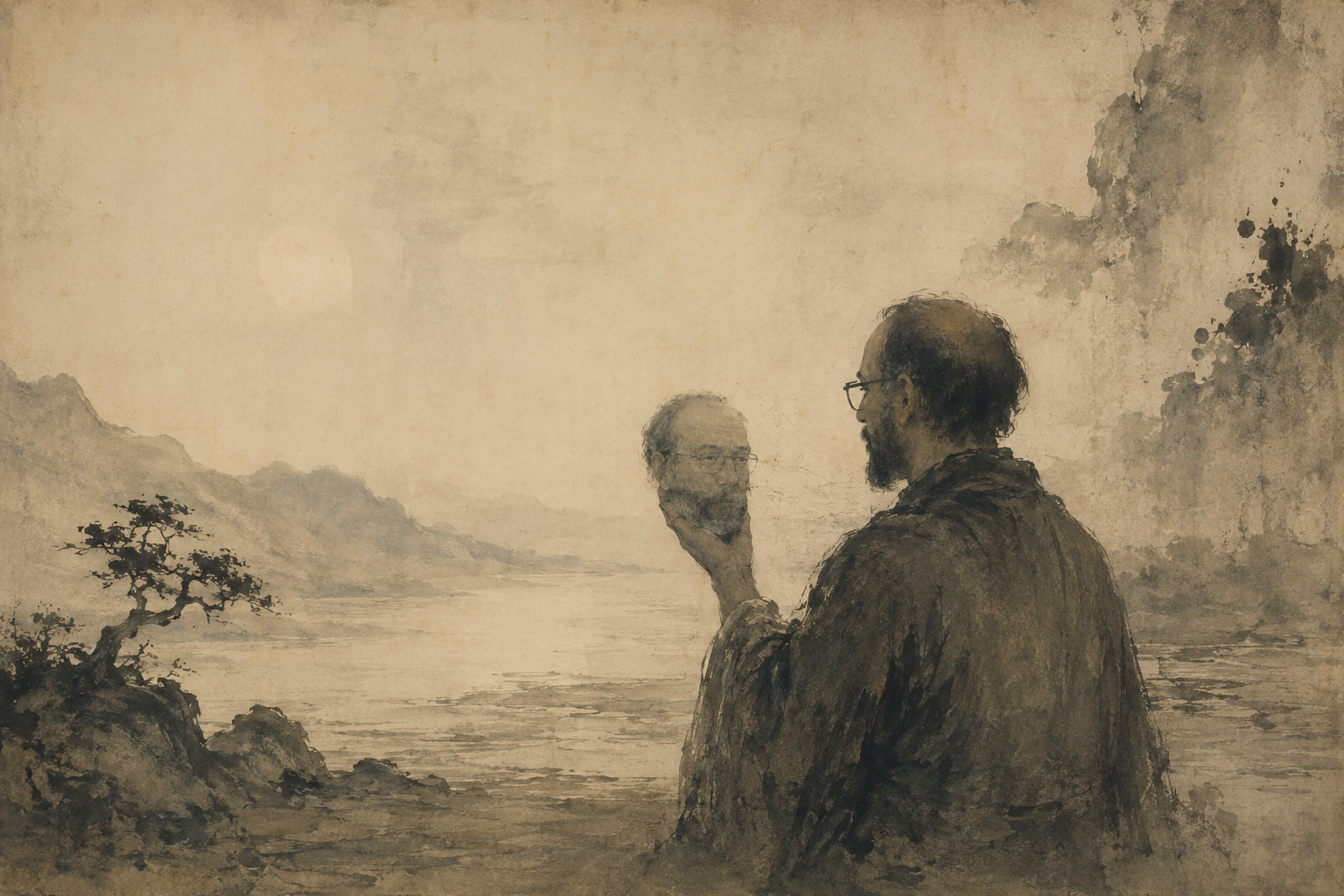
In today’s post, I am looking at a phrase that everyone recognizes and almost nobody examines. The phrase is “think outside the box.” It is usually presented as an invitation to break free from conventional thinking and arrive at something genuinely new. But the phrase hides a number of assumptions. It assumes there is a box with a clear boundary. It assumes you can see that boundary from where you stand. And it assumes you can somehow step beyond it and think from a position on the outside.
I do not think any of those assumptions hold.
Consider the cosmological argument for the existence of God. In its simplest form, it argues that everything that exists has a cause, the universe exists, therefore the universe has a cause. That cause is then identified as God. Whatever one thinks of the conclusion, the argument illustrates a broader issue. We often extend concepts beyond the domain in which they make sense. Causality, as we understand it, is bound up with time and change. If spacetime itself is what is being explained, then applying ordinary notions of causality beyond it may be problematic. The point is not whether the argument succeeds or fails. The point is that we often carry our conceptual tools into places where their limitations become difficult to see.
Heinz von Foerster, one of the founders of second-order cybernetics, wrote that the environment as we perceive it is our invention. He did not mean that we are hallucinating or that reality does not exist. He meant that observation is never passive. The observer participates in determining what counts as observable. There is no neutral vantage point from which to inspect things exactly as they are, independent of any observer.
Spencer-Brown made a related point in Laws of Form. To draw a distinction is already to stand on one side of it. The moment you draw a circle on a blank page, you create an inside and an outside. You are positioned in relation to that distinction by the very act of drawing it. You cannot draw a distinction and simultaneously stand outside it. The frame is not something you construct and then enter. You are already within it when you first become aware of it. The noticing is itself made possible by the frame.
Gödel’s incompleteness theorems point in a similar direction. Any sufficiently rich formal system contains truths that cannot be proven from within that system. The incompleteness is not a temporary gap that can be eliminated with more effort. It is structural. Expanding the system may resolve one limitation, but the expanded system brings new limitations of its own. The horizon moves, but it does not disappear.
Now, I am aware of a difficulty here. If no one can step outside the frame, then this post cannot either. Writing an argument that the outside is unavailable risks sounding as though I have somehow found a place from which to survey the whole. I have not. But there is a difference between claiming to stand outside a frame and becoming aware of the frame from within it. The first claims a privileged position. The second acknowledges its own participation. This post is attempting the latter.
Gregory Bateson observed that the major problems in the world arise from the difference between how nature works and the way people think. I take that observation as pointing toward the issue here. The gap is not simply between what we know and what we do not know. It is also between the structures we inhabit and the stories we tell ourselves about our position within them.
Perhaps thinking outside the box does not mean escaping a frame.
Perhaps it means becoming aware of the frame you are already inside.
A Zen koan asks, “What was your face before your parents were born?” The question is not seeking an answer. It is designed to interrupt the assumption that you can step back far enough to observe your own origins from the outside. The koan does not reveal what lies beyond the frame. It makes you feel the edge of the frame itself.
Stay Curious and Always keep on learning…
If you liked what you have read, please consider my book “Second Order Cybernetics,” available in hard copy and e book formats. https://www.cyb3rsyn.com/products/soc-book
Discover more from Harish's Notebook - My notes... Lean, Cybernetics, Quality & Data Science.
Subscribe to get the latest posts sent to your email.
 Harish's Notebook - My notes... Lean, Cybernetics, Quality & Data Science.
“Think outside the box” is a metaphor and – as I wrote in a chapter of a book on Narrative Leadership – a metaphor is both true and false, and neither true nor false. The structure of a metaphor accounts for its usefulness, like the structure of a map.
The fact that a metaphorical concept – the Thinking Box – is both true and false (and neither) invokes a paradox (the endless regression is a sign of paradoxes at work). Vaihinger – The Philosophy As-If – has shown that all our usefull concepts are paradoxical in nature (or should I say “in culture”, as nature is beyond paradox).
Because human being use language pragmatical. Like tools. You can use a screw driver in many practical ways, not only to drive screws. So a metaphor has pragmatical value.
In dealing with metaphor, one can use “Clean Language” and start asking questions without adding “MAPS”: Metaphor, Association, Process, Senses. I would ask: “… and this box is like…?” And repeat the question on the answers, until the other one starts to stop and … think. Then, depending on the answers, I could ask, “… and what was before that…?” or “…. and what happens when you think this…?” or… (You see the principle of Von Foerster at work).
—
An other thing I noticed: you use the phrase of an observer … observable, a renentry. Not coincendentally, there’s an other use of the word “to observe“, which is to follow (“observe”) the rules as imposed by some authority or group. This “observation” invokes a “box” from which one (has to) think. We sometimes do this by starting out with definitions.
A manager of mine once said to me: “You shouldn’t think like that, Lelie”. Of course, I did my own thinking and ignored his indication.
LikeLiked by 1 person
I asked Chat-GPT “Can AI think outside the box?” and I got the answer “Yes — but with limits“. Very funny.
Asked a second time, I got the answer “Short answer: Yes — but only partially.“.
Of course the answer should have been: “define thinking?”, “define the box?”
When I asked: “define thinking“, I got the answer: “Thinking: the mental process of forming, manipulating, and evaluating representations (ideas, images, concepts, symbols) to make sense of information, solve problems, plan, reason, imagine, or decide.” Which omits the most important aspect of thinking: facts!
“Define the box” only got, “do you meand a physical box, a rulebook, a frame, a cage, or something else?” Which is the – in my opinion – the correct answer.
—
LikeLiked by 2 people
That is very nice. I can imagine ChatGPT as a smart alec.
LikeLike