Wittgenstein’s Ladder in Complexity: Why We Need Tools We Must Abandon

My propositions serve as elucidations in the following way: anyone who understands me eventually recognizes them as nonsensical, when he has used them as steps to climb beyond them. (He must, so to speak, throw away the ladder after he has climbed up it.) – Ludwig Wittgenstein, Tractus Logico-Philosophicus

In my recent post on the two dogmas of complexity science, I talked about ontological complexity realism and epistemological representationalism. These are the beliefs that complexity exists ‘out there’ to be measured and that our task is to create neutral representations of it. Today, I want to explore why these dogmas persist and why overcoming them requires something that seems paradoxical. We need conceptual tools that we must eventually abandon.

This is where Wittgenstein’s ladder becomes particularly relevant for complexity work. When reentry per Spencer-Brown’s Laws of Form is needed to achieve second-order understanding, the ladder offers a path through what might otherwise be an intractable problem.

The Reentry Problem in Complexity:
When talking about complexity, we often overlook the point that the observer cannot be separated from what they observe. Every attempt to map or measure complexity changes the observer-system relationship, which changes the ‘complexity’ itself. This creates what George Spencer-Brown called reentry: when a distinction folds back on itself.

Consider the Ashby Space framework I critiqued earlier. The moment we try to plot an organization on its coordinates, we encounter reentry. Who determines where the organization sits on the ‘variety of stimuli’ axis? The organization itself, through its own distinction-making processes. What counts as ‘variety of responses’? Again, this depends entirely on the distinctions the observer can make about meaningful action.

The framework cannot escape this recursion. It treats as measurable quantities what are actually dynamic processes of distinction-making between observer and observed. This recursion is not a bug to be fixed but a feature of complexity itself.

As I explored in my post on the form of decency, reentry reveals contradictions in systems that try to maintain rigid boundaries. When xenophobic ideologies apply their own criteria to themselves, when the form folds back, they collapse under their internal logic. The same dynamic occurs when complexity frameworks attempt to map the very processes of distinction-making that generate complexity.

Why Reentry Creates a Need for Ladders:
If our tools for understanding complexity are themselves subject to reentry effects, how do we develop more sophisticated ways of thinking about complex systems? We cannot simply abandon all conceptual tools, yet we cannot treat them as neutral representations either.

This is where we need to recognize a crucial distinction about when ladder consciousness becomes necessary. When we engage with situations in ways that generate significant recursive coupling between observer and observed (when our distinction-making substantially shapes what we are trying to understand, when our interventions change the system which changes us which changes our interventions), then treating our models as stable representations becomes counterproductive.

Consider the difference between using a roadmap to navigate familiar streets versus using a systems model to understand organizational dynamics. The roadmap engages with relatively stable relationships such as the streets that rarely change position because we are looking at the map. But organizational systems modeling involves high degrees of recursive coupling. The very process of creating models changes how participants see their organization, which changes how they behave, which changes the organizational dynamics, which requires updating the models.

When we are complexifying our relationship with a situation through high degrees of recursive engagement, our models must become ladders. They cannot remain permanent reference tools because both we and the situation are co-evolving through the modeling process itself.

This is where Wittgenstein’s ladder becomes relevant. The ladder offers a way to use conceptual tools while remaining aware of their provisional nature. We need frameworks to help us think about complexity, but we also need mechanisms for transcending the limitations of those same frameworks.

The ladder works through what might seem like a contradiction: we use conceptual distinctions to develop awareness of the limitations of conceptual distinctions. We employ frameworks like Ashby Space not because they represent reality accurately, but because they can help us recognize how our own distinction-making processes shape what appears as ‘complex’.

This creates what Heinz von Foerster called second-order cybernetics, observing observation. First-order thinking assumes we can step outside the system and create objective maps. Second-order thinking recognizes that we are always already participants in the systems we are trying to understand.

The Ladder in Practice: From Tools to Meta-Awareness:
Consider how this works in organizational consulting. When we facilitate a systems mapping exercise, we might begin by treating the resulting diagram as if it represents the ‘real’ organizational structure. This first-order approach focuses on improving the accuracy of the map.

But when we are engaged in recursive coupling with the organization (when the mapping process itself changes how participants understand and enact their organizational reality), ladder consciousness suggests a different approach. The map becomes valuable not when it accurately represents the organization, but when the mapping process helps participants recognize how their own distinction-making participates in creating organizational dynamics. We use the tool to develop meta-awareness of how we collectively complexify organizational life.

This shift points to the very needed meta-awareness. Instead of asking ‘Is our systems map accurate?’ we ask ‘How does the process of creating this map reveal and reshape our current ways of making distinctions about organizational life?’ The tool serves its purpose when it points beyond itself toward the processes that we participate in creating organizational reality, then becomes disposable once we have developed more direct awareness of our participation.

This principle applies across complexity frameworks. When we use any analytical tool, ladder consciousness means recognizing that we are not discovering objective properties but enacting particular ways of making sense that bring certain possibilities into view while obscuring others. The framework becomes useful when we can use it to examine our own sense-making, then let it go.

Beyond Tools: What Emerges After the Ladder:
This raises an important question. What happens after we kick away the ladder? What replaces our conceptual tools once we have transcended their limitations?

The answer is not the absence of structure but a different relationship to structure. After using and abandoning frameworks, what can emerge is what John Dewey called ‘inquiry’, a more fluid, responsive way of engaging with situations that draws on conceptual resources without being constrained by them.

Dewey’s conception of inquiry is particularly relevant here because it transcends the subject-object dualism that creates many of our analytical problems. Instead of treating thinking as something that happens inside our heads while we observe an external world, Dewey understood inquiry as a transactional process between organism and environment. The inquirer and the situation inquired into are parts of a single unfolding transaction.

This means inquiry is not about representing a pre-existing reality but about transforming problematic situations into more settled ones. When we encounter what we call a ‘complex situation’, inquiry suggests we are not discovering complexity ‘out there’ but participating in an ongoing transaction that we might call ‘complexifying’. The situation becomes complex through our engagement with it, just as we become complex through our engagement with the situation.

For Dewey, genuine inquiry involves what he called ‘learning by doing’ coupled with reflection on that doing. We act, observe the consequences, and adjust our future actions based on what we learn. This creates a recursive cycle where our understanding evolves through engagement rather than through detached observation. The goal is not to achieve final truth but to develop more intelligent ways of acting within ongoing situations.

This approach naturally incorporates ladder consciousness. We use conceptual tools as hypotheses for action rather than as final descriptions of reality. We test these tools against their consequences in lived experience, keeping those that prove helpful and abandoning those that constrain effective action. The tools serve inquiry rather than replacing it.

This post-ladder engagement is characterized by several qualities. This is not meant to be an exhaustive list by any means. Just like the ladder, this should serve as an intuition pump.

Responsiveness over methodology: Instead of applying predetermined frameworks, we develop sensitivity to what each situation calls for. We maintain access to various conceptual tools while remaining free to abandon them when they no longer serve.
Process awareness: We become more conscious of how our own sense-making participates in creating the realities we encounter. This is not relativism but what Donna Haraway called ‘situated knowledge’: knowledge that acknowledges its own positioning.
Provisional commitment: We can act decisively based on our current understanding while remaining open to revision. This allows for second order approach to wisdom, intuitive knowledge of the limits of knowledge.

The Ethics of Temporary Tools:
There is an ethical dimension to ladder consciousness that connects to my earlier post on reentry and xenophobia. When we hold our conceptual tools too tightly, we risk treating our provisional distinctions as absolute truths, our temporary boundaries as permanent walls. This is one of the main reasons why we must discard the ladder rather than hold onto it.

The ladder teaches a different relationship to our beliefs and frameworks, firm enough to guide action, light enough to avoid becoming weapons. This balance is crucial and deserves deeper exploration.

What does it mean to hold beliefs firmly enough to guide action? It means we must be able to act decisively based on our current understanding, even while acknowledging that understanding is provisional. Without some degree of commitment to our frameworks, we become paralyzed by infinite doubt. We need enough conviction to move forward, to make choices, to take responsibility for our actions.

But what does it mean to hold these same beliefs lightly enough to avoid weaponizing them? It means maintaining what Keats called ‘negative capability’. This is the ability to remain in uncertainty and doubt without irritably reaching after fact and reason. It means recognizing that our strongest convictions might be wrong, our clearest insights might be partial, our most cherished frameworks might be limiting us in ways we cannot yet see.

This creates a paradoxical situation that the ladder helps us navigate. We must act as if our current understanding is enough to work with, while remaining open to its revision. We must commit without clinging. We must form strong opinions, but hold them lightly.

This becomes particularly crucial when working with others who hold different frameworks. Instead of engaging in battles over whose map is more accurate, ladder consciousness invites us to explore how different ways of making sense might serve different purposes. It asks us to treat our frameworks as offerings to collective inquiry rather than as territories to defend.

The ethical imperative here connects to von Foerster’s principle: ‘Act always so as to increase the number of choices’. When we hold our tools lightly, we create space for others to contribute their own sense-making resources. When we avoid weaponizing our frameworks, we keep possibilities open rather than shutting them down.

Our role becomes less about providing definitive maps and more about helping develop capacities for making better distinctions in the face of uncertainty. This suggests designing interventions that increase what von Foerster called ‘the number of choices’ rather than narrowing them down to predetermined solutions.

Climbing Toward Participatory Knowing:
This brings us back to my critique of complexity science’s foundational dogmas, but with an additional insight that shifts how we use language itself. We typically use complexity as a noun (‘this system has complexity’) or an adjective (‘this is a complex situation’). But it may be time to recognize complexity as a verb, something we do rather than something we encounter.

When we complexify a situation, we are not discovering pre-existing complexity but participating in an ongoing process of distinction-making and sense-making that brings complexity into being. The situation becomes complex through our engagement with it, just as we become complex through our engagement with the situation. Complexity emerges from what I have called epistemic coupling: the recursive interaction between knowing systems and their environments.

This verb-oriented understanding aligns with Dewey’s transactional thinking and Spencer-Brown’s emphasis on the observer’s role in creating distinctions. It suggests that when we say a situation is ‘complex’, we might more accurately say we are ‘complexifying’ our relationship with that situation through the particular ways we choose to engage with it.

This reframing has practical implications. Instead of asking ‘How can we manage this complex system?’ we might ask ‘How are we complexifying this situation, and how might we complexify it differently?’ Instead of treating complexity as a problem to be solved, we recognize complexifying as an ongoing process we participate in creating.

This perspective naturally leads to ladder consciousness. If complexity emerges from observer-system interactions, then studying complexity must include studying how we study. We cannot step outside the epistemic coupling that generates complexity in the first place.

The ladder provides a way to work with this recursion constructively. It allows us to use conceptual tools to bootstrap ourselves into meta-cognitive awareness, then abandon those tools once they have served their purpose of revealing our own participation in constructing what we take to be reality.

Final Words:
Wittgenstein’s ladder offers more than a philosophical metaphor for complexity work. It suggests a practical approach to navigating situations where traditional analytical tools reach their limits. In a world facing unprecedented challenges that resist conventional problem-solving approaches, we may need frameworks that can help us think more clearly while remaining open to possibilities we cannot yet imagine.

The ladder teaches us that sometimes the most sophisticated response to complexity is paradoxical, using our best analytical tools while remaining prepared to abandon them in favor of more direct engagement with emerging situations. Sometimes deeper understanding comes not from having better maps, but from developing better capacities for navigation in unmapped territory.

This suggests a form of wisdom that seems well-suited to our current historical moment: recursive and reflective, provisional and purposeful. Each of these qualities that represent a cybernetic Constructivist approach deserves elaboration.

Recursive wisdom acknowledges that we are always inside the systems we are trying to understand. It recognizes that our attempts to make sense of complexity are themselves part of the complexity we are trying to navigate. This leads to what we might call ‘meta-learning’: learning about how we learn, thinking about how we think. Recursive wisdom asks us to include ourselves in our analyses, to observe our own observing.

Reflective wisdom suggests that effective action in complex situations requires ongoing consideration of our own assumptions, biases, and blind spots. But this is not the paralysis of infinite self-doubt. Rather, it is the cultivation of the ability to think about what we are doing while we are doing it, to adjust our approach based on emerging feedback from the situation itself.

Provisional wisdom means holding our current understanding as our best guess given available information, while remaining genuinely open to revision. It means acting with conviction while maintaining epistemic humility. This is what we can call as ‘fallibilism’, the recognition that any particular perspective, no matter how well-supported, might be incomplete or mistaken.

Purposeful wisdom suggests that this openness to revision is not aimless but directed toward some vision of beneficial outcomes. It means using our provisional understanding to work toward flourishing, justice, and expanded possibilities for all participants in the situation. Purposeful wisdom asks us to take responsibility for the worlds our actions help create.

Together, these aspects suggest an approach to complexity that is both humble and decisive, both open and committed. It invites us to use our best tools while holding them lightly, to think systematically while remaining open to surprise, to act decisively while staying curious about the consequences of our actions.

Perhaps most importantly, it reminds us that we are not outside observers of complex systems but participants within them. The ladder helps us climb to a perspective from which we can see this participation more clearly. And then, if we choose wisely, we can kick it away and engage more consciously with the complexity we help create.

Stay curious and Always keep on learning…
The Arbitrariness of Objectivism:

The readers of my blog might be aware that I appreciate the nuances of cybernetic constructivism. Cybernetic constructivism rejects the idea that we have access to an objective reality. It does not deny that there is an external reality independent of an observer. However, we do not have direct access to it. Additionally, the external world is more complex than us. As part of staying viable, we construct a version of reality that is unique to our interpretative framework. This takes place in a social realm, and error corrections happen because the construction occurs in the social realm.

Heinz von Foerster, the Socrates of Cybernetics, formulated two imperatives that provide insight into this framework. The first is the ethical imperative that states “act so as to increase the number of choices.” The second is the aesthetical imperative that states “if you desire to see, learn how to act.” I welcome the reader to check out previous posts on these concepts. This worldview supports pluralism, the idea that there can be multiple valid versions of reality. This emerges primarily because the external world being more complex than our cognitive apparatus, we maintain viability by constructing particular versions of reality rather than accessing reality directly.

Common Mischaracterizations:

A primary criticism I encounter involves misrepresenting this worldview as relativism or solipsism. Critics suggest that acknowledging multiple perspectives means that anything goes, or that nothing is shared between observers. This represents a caricature rather than a substantive critique.

Precision is necessary here. Some forms of relativism claim that all views are equally valid, including contradictory ones. In that model, if claim A asserts “only A is valid,” then relativism must also treat that assertion as valid. It has no mechanism for comparison or critique. The result is a flattening of all claims into mere equivalence, where strength, coherence, or context carry no weight.

Solipsism advances an even more extreme position. It claims that only one’s own mind is knowable, denying shared reality altogether. It discards the very possibility of meaningful intersubjectivity. No systems thinker, and certainly no pluralist, takes this position seriously.

Pluralism as a Distinct Position:

Pluralism is neither relativism nor solipsism. It does not claim all views are valid. Rather, it asserts that no view is valid by default. Pluralism insists that perspectives must be made visible, situated in context, and evaluated through dialogue. It resists automatic authority, including authority derived from its own assertions.

Consider what objectivism accomplishes by contrast. It selects a single claim and declares that only this claim is valid while all others are not. But on what basis does it make this selection? Often, no external justification is offered. The grounding remains internal, context-bound, or inherited, yet it is presented as if it were neutral, universal, and self-evident.

This selection process reveals a potential arbitrariness of objectivist claims. The view appears arbitrary because its assumptions may remain hidden from examination. Without transparent justification for why one view should be privileged, objectivism risks the appearance of arbitrariness. What presents itself as necessity may simply be preference in disguise. From a pluralist standpoint, this represents concealment rather than clarity.

The Paradox of Objectivist Authority:

Paradoxically, this form of objectivism begins to mirror the very relativism it claims to oppose. Relativism declares that all claims are valid, including any particular claim A. Objectivism declares that only claim A is valid while offering no method to interrogate why this should be so. Each approach shuts down evaluation through different mechanisms. Relativism dissolves differences into sameness. Objectivism excludes all but one view from consideration at the outset.

This dynamic reveal what objectivism risks becoming, not solipsism in the strict philosophical sense, but functional solipsism. When a worldview refuses to acknowledge its own perspective and denies legitimacy to all others, it ceases to see the world. It sees only itself, reflected and reinforced. This represents the erasure of other ways of seeing under the illusion that one’s own interpretative lens is the world itself.

The Hidden Nature of Objectivist Claims:

The danger of objectivism lies in its method: selecting a single view, designating it as truth, and treating alternatives as error, noise, or confusion. It dresses up a personal, historical, and situated position as universal and eternal. This approach is not more objective than pluralism. It is simply better concealed.

Frameworks that prioritize ontology over epistemology tend to overlook the epistemic humility that characterizes pluralism. When we claim to know what reality is before examining how we come to know it, we bypass the very process of inquiry that might reveal the limitations and situatedness of our perspective. This ontological presumption becomes particularly problematic when it denies its own epistemological foundations.

Pluralism does not collapse into solipsism. Objectivism risks this collapse precisely when it denies that it operates from a particular perspective. The refusal to acknowledge one’s interpretative framework does not eliminate that framework. It merely renders it invisible to examination.

Pluralism is not weakness, indecision, or relativistic drift. It represents a disciplined humility and a refusal to collapse complexity into certainty prematurely. It does not reject standards but demands that they be made visible, questioned, and held accountable to the context in which they arise.

Pluralism increases the space for dialogue, choice, and possibility. It reminds us that what we do not question becomes invisible, not because it is true, but because it hides within the taken-for-granted assumptions of our frameworks.

In a world increasingly polarized between loud certainties and quiet disillusionment, pluralism offers something increasingly rare: the courage to remain open, to ask how we know what we claim to know, and to stay in conversation with perspectives we might otherwise reject.

Final Words:

Not everything is permissible under pluralism. But no single view should escape questioning. The cybernetic constructivist position maintains that our constructions of reality emerge from our particular biological, cognitive, and social constraints. These constructions prove viable not because they correspond to an objective reality we cannot access, but because they enable us to navigate the complexity we encounter.

I will finish with a quote from Heinz von Foerster:

Objectivity is the delusion that observations could be made without an observer.

The task before us is not to eliminate the observer but to acknowledge the observer’s role in every observation. This acknowledgment does not lead to relativism or solipsism. It leads to a more rigorous understanding of how knowledge emerges from the interaction between observer and observed within particular contexts and constraints.

Always keep learning.

When Cybernetics Replaced Philosophy – Heideggerian Insights into Systems Thinking – Part 3:

SPIEGEL: And what now takes the place of philosophy?

Heidegger: Cybernetics. [1]

In today’s post, I am wrapping up the series of posts on the Heideggerian insights by tying his later ideas with Cybernetics. You can view my earlier posts here and here.

Heidegger realized that the reliance of modern times on technology is leading humanity away from thinking itself. He went on to say that cybernetics has replaced philosophy. Cybernetics, particularly in its early days (first-order cybernetics), proposed the idea that the world could be understood and controlled through feedback loops, systems, and control mechanisms. This approach brought about the view that systems could be analyzed and optimized by focusing on information flow, communication, and control.

For Heidegger, this shift was significant because it represented a transformation from philosophical reflection on being to technological thinking that prioritizes efficiency, control, and calculation. The concern was that cybernetics, as a science and as a philosophy of systems, would replace the deeper, reflective inquiry into human existence, nature, and being. Instead of focusing on the questions of meaning, existence, and our relationship to the world, cybernetics focuses on problem-solving, control, and optimization.

Cybernetics and the “Standing-Reserve”

Heidegger’s main critique of technology is that it reduces everything (nature, people, even time itself) to a “standing-reserve” (Bestand), something to be used, optimized, and controlled. Cybernetics (especially first order cybernetics), as a way of organizing systems (whether biological, mechanical, or social), fits perfectly into this framing.

In this context, cybernetics offers a model of system control, where everything is measured, processed, and optimized. Heidegger feared that this would become the dominant worldview, replacing the deeper ontological reflections of philosophy with purely functional, instrumental thinking. The philosophical inquiry into what it means ‘to-be’ would be overshadowed by the technological mindset, where the world is treated not as a place for human reflection but as a set of interlocking systems to be controlled. It has become quite normal to consider humans as resources. It would be abnormal to not have a human resources department in any organization.

Heidegger believed that the core of philosophy, especially in the existential tradition, was to ask questions about being, meaning, and human existence. It was about understanding the world in a way that was not reducible to mere calculations or control. Cybernetics, in his view, represents a shift towards quantitative, calculative thinking that bypasses deeper reflections on human existence. When Heidegger says that cybernetics could replace philosophy, he warns that the dominant mode of thought in the future might be one that prioritizes instrumental control over reflection. By doing this, we are reducing human life to a set of inputs and outputs rather than exploring the more profound questions of existence and meaning.

Philosophy’s traditional role, the search for wisdom, would be replaced by functional, managerial thinking: “How do we optimize? How do we stabilize systems? How do we predict outcomes?” In that world, humans themselves risk becoming just another kind of standing-reserve, resources to be managed, data points in systems, not beings questioning their existence. This brings in questions about ethical thinking that is rarely considered in terms of managerial thinking. Here is where second order cybernetics comes into play. Second order cybernetics aligns very well with the later ideas of Heidegger.

The World as a Picture

Heidegger argues that modernity transforms the world into a representable object: a picture that stands before a human subject.

The fundamental event of the modern age is the conquest of the world as picture.[2]

This transformation does not just add new tools; it redefines what the world is. Everything becomes a resource, available for control and calculation. Cybernetics, particularly in its first order form, mirrors this tendency. It maps systems, constructs models, and aims for control. But second order cybernetics, which emerged in the 1970s, turns inward, asking: “Who is doing the observing? What does it mean to know?”

Second order cybernetics, shaped by thinkers like Heinz von Foerster and Humberto Maturana, breaks from the God’s-eye view. The observer is no longer external to the system. They are part of it. Observation itself becomes an action, a construction, an intervention. We are not out there looking into a pre-given world; rather, we are disclosing the world through care, through being-in-the-world. Knowledge, then, is not correspondence but involvement. It is not about having a picture in the head, but about being attuned to a situation, about knowing how to go on in the world.

We do not navigate life by carrying internal maps. We act skillfully because we are already attuned to the world, through our bodily presence and history of engagement. We are always already involved in what we observe. There is no “view from nowhere”.

Von Foerster – The Map Is All We Have

Von Foerster sharpened this critique of representation when he said, “The map is all we have”. This was a nod to Alfred Korzybski’s famous dictum – “the map is not the territory”. von Foerster goes further with this and says that there is no access to the territory outside of our mappings. However, this does not imply that we carry mental blueprints.

Instead, cognition is about structural coupling. When a system is perturbed by its environment and it responds according to its structure and its history of past interactions. This knowledge did not arise from accurate representation, but from historically tuned participation. We are bringing forth a world through interaction, not mirroring it.

This is also why von Foerster said: “If you want to see, learn how to act”. Understanding emerges from doing. Seeing is not prior to action. It is shaped by how we move, respond, and care. Like Heidegger’s hammer that is ready-to-hand, our understanding is practical, not theoretical. The “map” then is a trace of engagement, not a neutral diagram or mental map. This brings up the keen ethical insight of constructivism – we are responsible for the worlds we bring forth. There is no neutral observation, only involvement. We do not just see; we enact distinctions, and those choices matter.

How to Proceed?

Heidegger’s answer to technological enframing is releasement (Gelassenheit). This is not withdrawal but a posture of openness—a “letting-be” of beings. It is both a refusal to dominate and a readiness to engage differently.

Releasement echoes the ethic of second order cybernetics – a recognition that control is never total, that knowing is always situated, and that ‘systems’ are too rich to be fully grasped. It is a call to humility, responsibility, and care. We do not stand apart from the world, looking at it as if it is just “out there” and complete, just waiting to be ‘represented’ in our minds. Instead, we bring forth the world through our involvement, through practical activity, care, concerns and relationships.

When we place Heidegger and second order cybernetics side by side, a powerful ethical sensibility emerges that is often missing from modern managerial thinking. We should act as an observer who matters. Our observations shape what becomes real. We must opt for situations where future possibilities are protected. Freedom is about future possibilities. We must resist the reduction of everything to resources. We must balance calculative and meditative thinking. Cybernetics may offer powerful tools, but it must be nested within deeper questions of meaning. We should learn to dwell and not to dominate. Our task is not to master the world but to participate wisely in it.

Final Words:

In his 1966 Der Spiegel interview [1] (published posthumously), Heidegger made his famous statement:

Only a god can save us.

He was not advocating that we should pray for divine intervention. He was imploring us to realize that we need a fundamental shift in how we think, see, and act. And perhaps second order cybernetics, rightly understood, can help us return to that question. Treating the world as picture blinds us to other modes of revealing—poetic, responsive, ethical. Second order cybernetics, in turn, reminds us that every act of observation is also an act of construction. This reframes truth, not as correspondence, but as coherence within a relational, historical process. Meaning arises from engagement, not representation. We ultimately bear responsibility for how the world comes into view. Both Heidegger and cybernetics are inviting us to move beyond prediction and control—toward participation, humility, and care.

Always keep learning…

[1] “Only a God Can Save Us”: The Spiegel Interview (1966)

[2] The Question Concerning Technology and Other Essays, M. Heidegger, translated by William Lovitt, 1977.

Note:

In referencing the work of Martin Heidegger, I want to acknowledge the deeply troubling fact of his affiliation with the Nazi party. This aspect of his life casts a long and painful shadow over his legacy. While I draw on specific philosophical ideas that I find thought-provoking or useful, this is not an endorsement of the man or his actions. Engaging with his work requires ethical vigilance, and I remain mindful of the responsibility to not separate ideas from the broader context in which they were formed.

An Existentialist’s View of Complexity:

Art by NightCafe

In my post today, I am looking at the idea of complexity from an existentialist’s viewpoint. An existentialist believes that we, humans, create meanings for ourselves. There is no meaning out there that we do not create. An existentialist would say, from this viewpoint, that complexity is entirely dependent upon an observer, a meaning maker.

We are meaning makers, and we assign meanings to things or situations in terms of possibilities. In other words, the what-is is defined by an observer in terms of what-it-can-be. For example, a door is described by an observer in terms of what it can be used for, in relation to other things in its environment. The door’s meaning is generated in terms of its possibilities. For example, it is something for me to enter or exit a building. The door makes sense to me when it has possibilities in terms of action or relation to other things. This is very similar to the ideas of Gibson, in terms of “affordances”.

In existentialism, there are two concepts that go hand in hand that are relevant here. These are “facticity” and “transcendence”. Facticity refers to the constraints a subject is subjected to. For example, I am a middle-aged male living in the 21st century. I could very well blame my facticity for pretty much any situation in life. Transcendence is realizing that I have freedom to make choices to stand up for myself to transcend my facticity and make meaning of my own existence. We exist in terms of facticity and transcendence. We are thrown into this world and we find ourselves situated amidst the temporal, physical, cultural and social constraints. We could very well say that we have a purpose in this world, one that is prescribed to us as part of facticity or we can refer to ourselves to enable us to transcend our facticity and create our own purposes in the world.

In the context of the post, I am using “facticity” to refer to the constraints and “transcendence” to refer to the possibilities. Going back to complexity and an observer, managing complexity is making sense of “what-is” as the constraints, in terms of “what-it-can-be” as the possibilities. We describe a situation in terms of complexity, when we have to make meaning out of it. We do so to manage the situation – to get something out of it. This is a subject-object relationship in many regards. What the object is, is entirely dependent on what the subject can afford. When one person calls something as complex, they are indicating that the variety of the situation is manifold than what they can absorb. Another subject (observer) can describe the same object as something simple. That subject may choose to focus on only certain attributes of the situation, the attributes that the subject is familiar with. Anything can be called as complex or simple from this regard. As I have noted before, a box of air can be as complex as it can get when one considers the motion of an air particle inside, or as simple as it can get when one considers it as a box of “nothing”. In other words, complexity has no meaning without an observer because the meaning of the situation is introduced by the observer.

A social realm obviously adds more nuance to this simply because there are other meaning-makers involved. Going back to existentialism, we are the subject and at the same time objects for the others in the social realm. Something that has a specific meaning to us can have an entirely different meaning to another person. When we draw a box and call that as a “system”, another person can draw a different box that includes only a portion of my box, and call that as the same “system”. In the social realm, meaning-making should be a social activity as well. It will be a wrong approach to use a prescribed framework to make sense because each of us have different facticities and what possibilities lie within a situation are influenced by these facticities. The essence of these situations cannot be prescribed simply because the essence is brought forth in the social realm by different social beings. A situation is as-is with no complexity inherent to it. It is us who interact with it, and utilize our freedom to assign meaning to it. I will finish off with a great quote from Sartre:

Human reality everywhere encounters resistance and obstacles which it has not created, but these resistances and obstacles have meaning only in and through the free choice which human reality is.

Stay safe and always keep on learning…

In case you missed it, my last post was Plurality of Variety:

How Blank is Your Paper?

Art by NightCafe

This is available as part of a book offering that is free for community members of Cyb3rSynLabs. Please check here (https://www.cyb3rsynlabs.com/c/books/) for Second Order Cybernetics Essays for Silicon Valley. The ebook version is available here (https://www.cyb3rsyn.com/products/soc-book)

Stay safe and always keep on learning… In case you missed it, my last post was OC Curve and Reliability/Confidence Sample Sizes:

Cybernetics and the Stoics:

In today’s post, I am continuing on my thoughts on stoicism through the lens of cybernetics. In Cybernetics, we call regulation the act (art) of responding to external disturbances in order to maintain selected internal variables in a range. For example, our body maintains the internal temperature in a specific range. We have internal regulations built in through evolution to ensure that this is done. In the language of cybernetics, regulation refers to the act of countering the external variety. In order to counter the external variety, we must have requisite variety. As noted in the last post, only variety can absorb variety. If the external temperature goes up or goes down, our body should have a mechanism to react so that the internal temperature is maintained in a specific range. If it is not able to do this, we will not stay viable. The goal of requisite variety in this instance is about maintaining the status quo.

There are mainly two types of regulations in cybernetics as Ross Ashby noted – direct and indirect regulation. Direct regulation is the type of regulation where there is an established framework of counteractions that the agent can use. In the case of body temperature, heat loss can be promoted in a hot environment by many different mechanisms such as sweating or by reduction of muscular activities. Similarly, heat loss can be minimized in a cold environment using several mechanisms such as shivering or other activities to improve body insulation (reducing blood flow to the skin). There are several other mechanisms used by our bodies that are not listed here. These activities come under direct regulation because these happen without any oversight from us. Our bodies have evolved to do these things. Direct regulation is obviously limited in what it can do. For a low complex organism such as a wasp, direct regulation is adequate for survival. When the environmental conditions change or become extreme, direct regulation will no longer be able to provide requisite variety. In this case, we need indirect regulation. Indirect regulation refers to our ability to achieve requisite variety through second order activities. This involves learning mechanisms. For example, when it gets cold, we learn to move to a warmer location or to put on more clothes or to start a fire. We learned to create warm clothes or generate fire at will. This type of regulation did not come through evolution. What did come through evolution is our ability to learn to adapt. The second order refers to the ability to learn. Direct regulation is first order in nature. Second order is where you realize that the current specification is not working and that we need to change what we are doing or change the specification altogether. First order is simply realizing that there is a gap between the current state and where we want to be, and upon this realization continue on an already prescribed path.

We can see that indirect regulation has much more impact for our continued survival than direct regulation. Both types of regulation involve attenuation and amplification of variety in order to achieve requisite variety. As noted before, external variety is always higher than internal variety. Variety is directly correlated to complexity. The impact that the complexity in the world can have on us is ever increasing mainly because we are getting connected to the world in unprecedented ways. What I am typing here at my home can reach someone else in the farthest corners of the world in a matter of seconds. Something that happens locally in one location can have a direct impact on the entire world, as evidenced by the Covid 19 pandemic. How can we ensure our viability in these conditions?

Stoicism provides a lot of guidance for us in this regard. Stoicism provides us guidelines for us to improve our indirect regulatory activities. I am not discussing the dichotomy of control here since I discussed it last time. Instead, I will look at what Stoicism says about adversities in life. Most of our trouble comes from the fact that we do not orient ourselves properly. We give into direct regulation such as freeze, flight or fight. This worked for our ancestors, but this will not work, say for example, in a workplace environment. It is not easy for us to orient because we are not expecting the variety of the adversity that was thrown at us. It could be that we were put in a challenging situation where we have put ourselves or our company at a huge risk condition. Or something drastic happened that requires immediate action or our lives are in danger. How does one improve our internal variety in these conditions? How does one learn to attenuate the external variety so that we don’t focus on the noise? How do we amplify our variety so that we concentrate only on what is needed?

Stoics talk of a great tool that will help us here. It is called “premeditatio malorum”. This stands for “negative visualization”. When we start our day, think of the many ways, the day could go wrong. Think of driving in the traffic and someone cutting us off or getting into an accident. What can we do in this situation? Think of going into the important meeting and you saying something that would be perceived as silly. What would you do in this situation? Meditating on this is in many regards a way to prepare ourselves to better prepare in case such things do happen. It is obviously easy to go wild with this exercise, so we should keep it as practical as possible.

Another key insight from the stoics is the idea of seeing every experience as an opportunity. Every adversity or challenge that we face is an opportunity to learn. The big project that we are embarking upon work is an opportunity to improve ourselves. The challenges that are thrown at us actually make us better when we welcome them as challenges to finetune our skills. Many a time, stoicism is badly represented as being detached from reality. When something bad happens, the stoics are expected to be emotionless. On the contrary, stoicism is about being able to ground ourselves to reality and reorient ourselves so that we can use every experience as a learning opportunity. As with the premeditation malorum, we must exercise caution and not go out of our way looking for challenges. Instead we must take on the challenges that come our way and not run away from them. We must learn to be practical with the theory.

Seneca presents us with a paradox of fortune and laments those who were not fortunate enough to have gone through any misfortunes:

I judge you unfortunate because you have never lived through misfortune. You have passed through life without an opponent—no one can ever know what you are capable of, not even you.

Epictetus asks us who Hercules might have been without any of his adversities:

“What would have become of Hercules do you think if there had been no lion, hydra, stag or boar – and no savage criminals to rid the world of? What would he have done in the absence of such challenges?

Obviously he would have just rolled over in bed and gone back to sleep. So, by snoring his life away in luxury and comfort he never would have developed into the mighty Hercules.

And even if he had, what good would it have done him? What would have been the use of those arms, that physique, and that noble soul, without crises or conditions to stir into him action?”

Perhaps, at this juncture the reader is reminded of resilience and maybe of antifragility. From a cybernetics standpoint, resilience is a matter of maintaining status quo after a setback. This can be done mainly through first order activities and through second order activities as needed. Antifragility, on the other hand requires second order activities which leads to post traumatic growth (PTG).

I will finish with some wise words from the philosopher king, Marcus Aurelius:

Our actions may be impeded . . . but there can be no impeding our intentions or dispositions. Because we can accommodate and adapt. The mind adapts and converts to its own purposes the obstacle to our acting. The impediment to action advances action. What stands in the way becomes the way.

If you are interested in Stoicism, you might like:

Stay safe and always keep on learning…

In case you missed it, my last post was Cybernetics and the Dichotomy of Control:

Cybernetics and the Dichotomy of Control:

This is available as part of a book offering that is free for community members of Cyb3rSynLabs. Please check here (https://www.cyb3rsynlabs.com/c/books/) for Second Order Cybernetics Essays for Silicon Valley. The ebook version is available here (https://www.cyb3rsyn.com/products/soc-book)

If you are interested in Stoicism, you might like:

Stay safe and always keep on learning…

In case you missed it, my last post was The Phenomenology of Informationally Closed Beings:

The Authentic Cybernetician:

In today’s post, I am looking at the idea of “authenticity” in relation to existentialism. I am inspired by the ideas of Kierkegaard, Heidegger, Sartre and De Beauvoir. The title of this post may be misleading. From an existentialist standpoint, to talk about an authentic person is contradicting the very ideas it stands for. An existentialist believes that existence precedes essence. This means that our essence is not pregiven. Our meaning is something that we create. It is an ongoing construction. I do admit that I find the idea of an authentic cybernetician quite fascinating. I am exploring the idea of “authenticity” in existentialism with relation to cybernetics. As Varga and Guignon note:

The most familiar conception of “authenticity” comes to us mainly from Heidegger’s Being and Time of 1927. The word we translate as ‘authenticity’ is actually a neologism invented by Heidegger, the word Eigentlichkeit, which comes from an ordinary term, eigentlich, meaning ‘really’ or ‘truly’, but is built on the stem eigen, meaning ‘own’ or ‘proper’. So the word might be more literally translated as ‘ownedness’, or ‘being owned’, or even ‘being one’s own’, implying the idea of owning up to and owning what one is and does. Nevertheless, the word ‘authenticity’ has become closely associated with Heidegger as a result of early translations of Being and Time into English, and was adopted by Sartre and Beauvoir as well as by existentialist therapists and cultural theorists who followed them.

From an existentialist standpoint, authenticity has come to be associated with freedom and responsibility. Authenticity is about freedom – of self and others. We are responsible for our actions. Our existence is contingent on many things such as the time and place where we live, the society we live in etc. This is referred to as “facticity” in existentialism. We are not limited by this and we cannot live a life as defined by others. We are autonomous beings and we are able to unfold our lives based on our choices. Having said that we are always existing in relation to others. The “I” is in relation to others. I am a husband and a father; I am also an employee; I am also a friend and so on. The “I” is a stable construction that is continuously unfolded. I am continuously constructing a stable presentation of who I am to other people and to myself. Authenticity comes in when we become aware of all this, and when we strive for the freedom of others.

The idea of unfolding is an interesting idea. It has an undertone of potentiality. The term ‘potentiality’ refers to possibilities. At any given point in time, there are a large number of possibilities, some that we are aware of and many that we are not aware of. We have the freedom to choose the specific possibility and we have to be responsible for that choice. The notion of possibilities aligns with the notion of variety in cybernetics. Variety is the number of possible states of a ‘system’. When a ‘system’ has requisite variety, it is able to stay viable. As Ross Ashby, one of the key pioneers of cybernetics, put it – only variety can absorb variety. When the ‘system’ is able to use one of the many possible states it has, to tackle a specific demand imposed on it by the external world, it is able to stay viable. This is what is referred to as the “absorption” of variety. The ‘system’ should be able to identify the available possible states it has at its disposal. This requires the ‘system’ to have some knowledge of what each possible state can do or not do. This knowledge comes from previous experiences or past interactions. The states that worked will be retained by the ‘system’, and in some cases the ‘system’ will modify certain states while interacting with the external world through a learning situation. All these notions are part of first order cybernetics. I believe that the ‘authentic cybernetician’ should be more interested in second order cybernetics. As Heinz von Foerster put it, first order cybernetics is the cybernetics of observed systems, and second order cybernetics as the cybernetics of observing systems.

From the second order cybernetics standpoint, we are aware of the observing process itself. This means that we are aware of the observation of our act of observing – being aware that we have blind spots and that our observation is a construction based on our biases, experiential reality etc. This would also mean that we realize that there are others also involved in similar observations and constructions. Authenticity in existentialism is being aware of our facticity and the freedom that we have to make choices, and being responsible for our actions. The idea that we are constructing a version of reality, and that we are responsible for that construction is a key point in second order cybernetics. When I talk about ‘authentic cybernetician’, there might be an expectation that I should put forth a prescribed step-by-step formula for being an authentic cybernetician. This would be a first order viewpoint. Being authentic however, requires a second order approach. There is no prescribed methodology here. We are invited to be aware of how we are thrown into this world, and how we are situated here; how we are somewhat defined by our past actions and yet somehow, we are not necessarily bound by those actions. It is about improving our interpretative framework so that we can afford requisite variety.

I will finish with some wise words we should heed from Simone de Beauvoir:

We have to respect freedom only when it is intended for freedom, not when it strays, flees itself, and resigns itself. A freedom which is interested only in denying freedom must be denied. And it is not true that the recognition of the freedom of others limits my own freedom: to be free is not to have the power to do anything you like; it is to be able to surpass the given toward an open future; the existence of others as a freedom defines my situation and is even the condition of my own freedom.

Stay safe and always keep on learning…

In case you missed it, my last post was Affording What’s In Your Head:

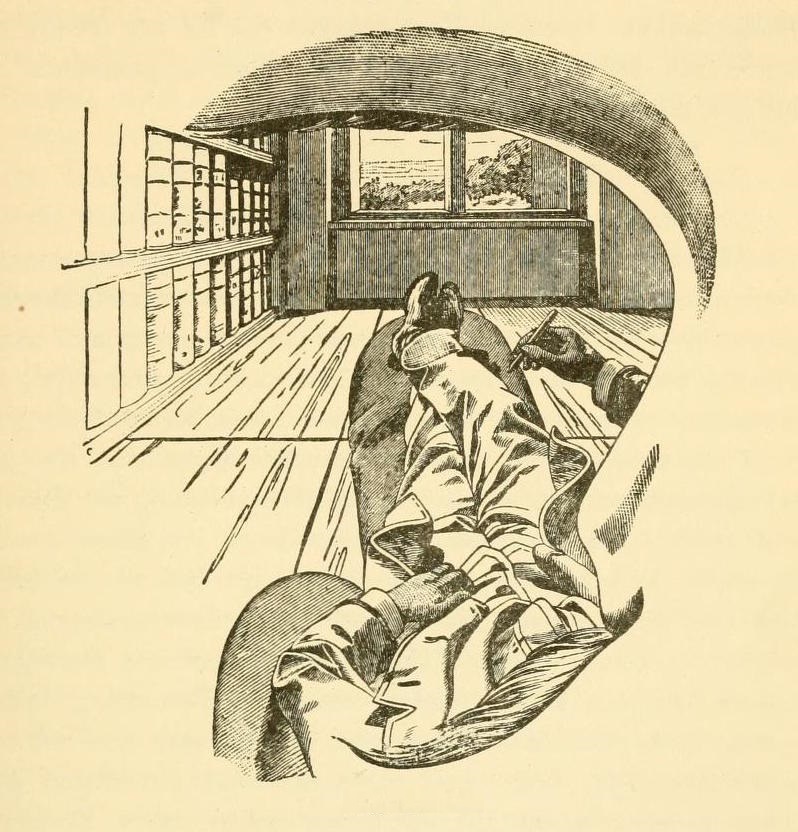
View from the Left Eye – Modes of Observing:

I was introduced to the drawing above through Douglas Harding who wrote the Zen book, “The Headless Way.” The drawing was drawn by Ernst Mach, the 19th Century Austrian physicist. He called the drawing, “the view from the left eye.” What is beautiful about the drawing is that it is sort of a self-portrait. This is the view we all see when we look around (without using a mirror or other reflective surfaces). If we could draw what we see of ourselves, this would be the most accurate picture. This brings me to the point about the different modes of observing.

Right now, you are most likely reading this on a screen of some sort or perhaps you are listening to this as a podcast. You were not paying attention to the phone or computer screen – until I pointed it out to you. You were not paying attention to how your shoes or socks or clothes feel on your body – until I pointed them out to you. This is mostly how we are in the world. We are just being in the world most of the time. Everything that we interact with is invisible to us. They just flow along the affordances we can afford. The keyboard clacks away when we hit on the keys, the door knobs turn when we turn them, etc. We do not see them until we have to see them. The 20th century German philosopher, Martin Heidegger called this ready-to-handedness. Everything is connected to everything else. We interact with the objects in order to achieve something. We open the door to go inside a building to do something else. We get in the car to get to a place. We use a hammer to hammer a nail in order to build something. Heidegger called these things equipment, and he called the interconnectedness, the totality of the equipment. The items are in the background to us. We do not pay attention to them. This is how we generally see the world by simply being in the world.

Now let’s say that the general flow of things breaks down for some reason. We picked up the hammer, and it is heavier than we thought and we pay attention to the hammer. We look at the hammer as a subject looking at an object. We start seeing that it has a red handle and a steel head. The hammer is not ready-to-hand anymore. The hammer has become an object and in the foreground. Heidegger called this as present-at-hand. When we really look at something, we realize that we, the subjects, are looking at something, the object. We no longer have the affordances to interact with it in a nonchalant manner. We have to pay attention in order to engage with the object, if needed.

With this background, I turn to observing again. In my view(no pun intended), there are three modes of observing:

  1. No self – similar to ready-to-hand, you just “are” in the world, enacting in the world. You just see things without any thought to self. There is no distinction of self in what you observe. Perhaps, we can refer to this as the zero person or zero order view.
  2. Seeing self – you make a distinction with this. You draw a line between you the subject, and the world out there. The world is out there and you are separate from the world. This is similar to present-at-hand. The world is out there. This is also the first order in First Order Cybernetics.
  3. Seeing self through self/others – Here you are able to see yourself through self or others. You are able to observe yourself observing. This is the second order in Second Order Cybernetics. In this case, the world is in here, within you, as a constructed stable reality.

In the first mode, you are being in the world. Heidegger would call this as “dasein.” In the second mode, you see the world as being outside. And in the third mode, you see the world as being inside. There are no hierarchies here. Each mode is simply just a mode of observing. In the second and third modes, you become aware of others who are like you in the world. In the third mode, you will also start to see how the others view the world since you are looking through others’ eyes. You realize that just as you construct a world, they too construct a world. Just like you have a perspective, they too have a perspective. The different modes of observing lead to a stable reality for us based on our interpretative framework. We cognize a reality by constructing it based on the stable correlations we infer from our being in the world. Sharing this with others lead to a stable societal realm through our communication with others. A community is formed when we share and something common emerges. It is no accident that the word “community” stems from the root word “common.”

When we observe a system, we also automatically stipulate a purpose for it. Systems are not real-world entities, but a means for the observer to make sense of something. We may call a collection of automobiles on the road as the transportation system just so that we can explain the congestion in the traffic. The same transportation system might be entirely different for the construction worker working on the pavement.

We have to go through the different modes of observation to help further our understanding. Seeing through the eyes of others is a practice for empathy. And this is something that we have to continuously practice to get better at. Empathy requires continuous practice.

I will finish with Ernst Mach’s explanation for his drawing:

Thus, I lie upon my sofa. If I close my right eye, the picture represented in the accompanying cut is presented to my left eye. In a frame formed by the ridge of my eyebrow, by my nose, and by my moustache, appears a part of my body, so far as visible, with its environment. My body differs from other human bodies beyond the fact that every intense motor idea is immediately expressed by a movement of it, and that, if it is touched, more striking changes are determined than if other bodies are touched by the circumstance, that it is only seen piecemeal, and, especially, is seen without a head

It was about 1870 that the idea of this drawing was suggested to me by an amusing chance. A certain Mr L., now long dead, whose many eccentricities were redeemed by his truly amiable character, compelled me to read one of C. F. Krause’s writings, in which the following occurs:

“Problem : To carry out the self-inspection of the Ego.

Solution : It is carried out immediately.”

In order to illustrate in a humorous manner this philosophical “much ado about nothing,” and at the same time to shew how the self-inspection of the Ego could be really “carried out,” I embarked on the above drawing. Mr L.’s society was most instructive and stimulating to me, owing to the naivety with which he gave utterance to philosophical notions that are apt to be carefully passed over in silence or involved in obscurity.

This post is also available as a podcast episode – https://anchor.fm/harish-jose/episodes/View-from-the-Left-Eye–Modes-of-Observing-e1297um

Please maintain social distance and wear masks. Please take vaccination, if able. Stay safe and Always keep on learning…

In case you missed it, my last post was The Stories We Live By: