
Regular readers will notice some familiar ground here. These are themes related to the self-referential nature of language, and what follows from it. I have used Wittgenstein’s ladder before to write about this, I wrote about Musashi’s grip on the sword in my last post, and I keep bringing up the criticism that my thinking slides into relativism, or even solipsism. This is deliberate. I keep coming back to these themes because I think they matter, and each return lets me look at them from a slightly different angle. This time, the angle is that of the skeptic.
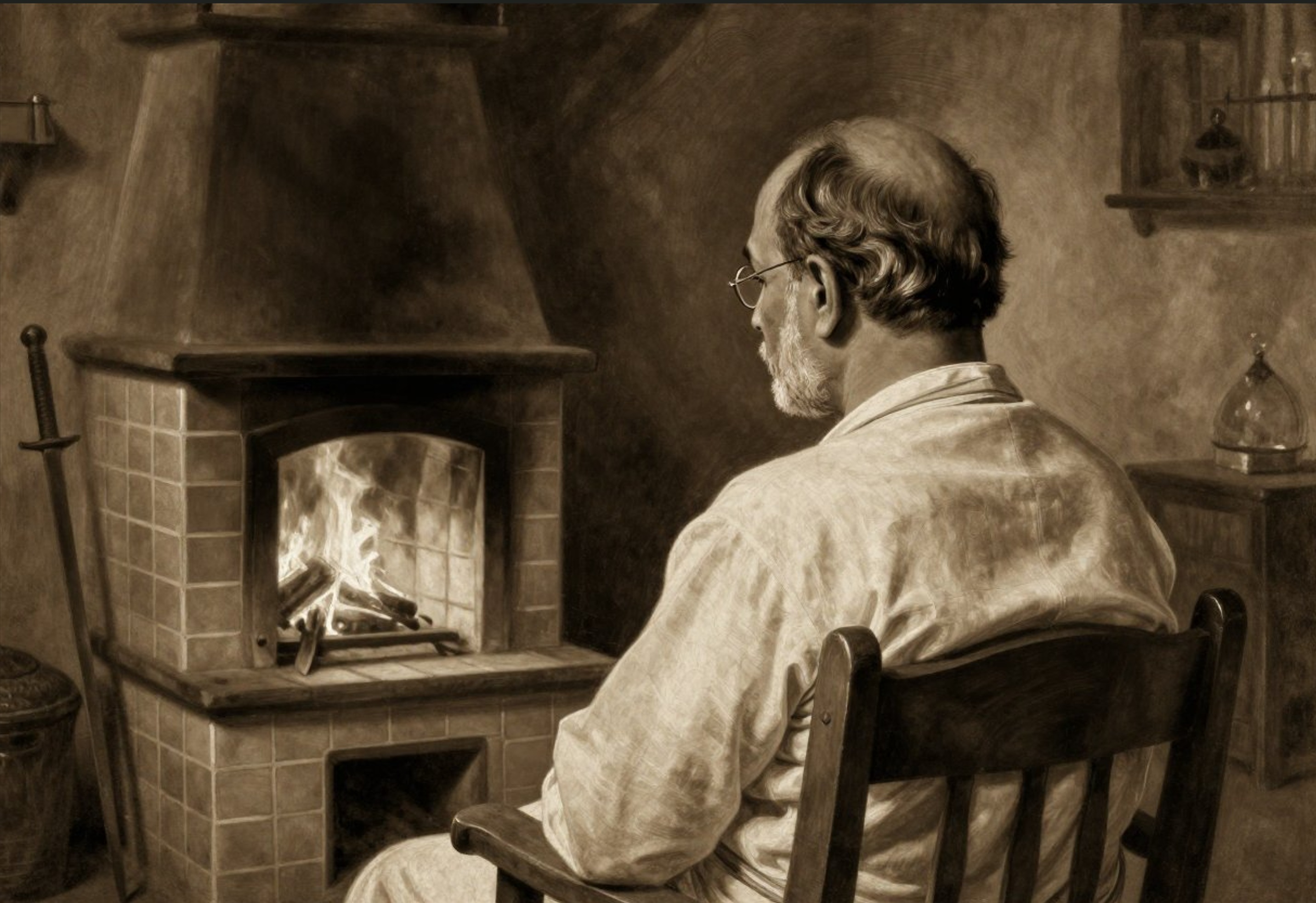
We start with Rene Descartes. Sitting by his stove, he set out to doubt everything he could. He stripped away the senses, the body and even mathematics, until he landed on the one thing he could not doubt: that he was doubting. From there he started building again.
Notice the shift that happens along the way, because it is easy to miss. The doubt itself runs one level: am I dreaming, is the world there, did two and two get mixed up? The conclusion that stops the doubt runs another. I cannot doubt that I am doubting, because the doubting is happening even when everything else fails. That is a second-order finding: not another claim about the world, but a claim about the activity that was making the claims. Descartes reached a second-order shore and then built his first-order world back up from it, furniture, senses, mathematics, all guaranteed by that one indubitable observer.
What gets overlooked is where the doubt stopped. He turned skepticism on the world but never fully on the skeptic, and this is the point worth pressing. If second-order findings are allowed to stop the regress once, why there? The cogito became a fixed point, held tightly. Yet doubting is an act of language and thought, and language is the very thing being questioned. The skeptic stands inside what he examines. This is re-entry: the distinction folds back on the one making it.
This is not a flaw peculiar to Descartes. Any language or formal system that is rich enough ends up referring to itself. Words are defined with other words. Systems are checked using the tools of the same system. There is no outside view to step into.
The tempting conclusion is that the whole thing is unreliable and should be thrown out. That is throwing the baby out with the bathwater. Wittgenstein offered a better image. His propositions are a ladder, climbed and then put aside. We need the rungs to get anywhere, but we do not have to treat them as the destination.
Musashi described the same tension with the sword. In The Book of Five Rings he advises holding the sword firmly with the last fingers and loosely with the thumb and forefinger. A hand that is fixed is a dead hand. The grip is firm and relaxed at once, in different places.
Definitions work like that grip. Without them we cannot have a meaningful conversation. Held too rigidly, they stop us seeing what does not fit. Self-reference does not stop us from using language as a tool. It reminds us how to hold the tool.
A common objection to this view is that it slides into relativism, or worse, solipsism. If every observation loops back on the observer, is not everything just my own construction? But that does not follow. Recognizing that language has weaknesses does not make all statements equal. It makes us more careful about which ones we lean on. Heinz von Foerster offered a way out of solipsism. If I take myself to be an observer, I have to grant the same to others. Once I accept another observer like me, I am no longer alone in my world. Reality becomes something we share and negotiate, not something I make up.
Von Foerster also pointed to the blind spot in the eye. We do not see it, and we do not see that we do not see it. Knowing about the blind spot does not remove it, but it changes how we look. We check with others, move our heads, look again. The same goes for thinking. Pretending our language and systems have no blind spots is the real danger. Admitting they do makes us better practitioners and better thinkers.
That admission is itself the point. Seeing that our systems refer back to themselves, and carrying on using them with care, is a second-order recognition. It is an observation about our own observing.
Final Arc:
There is supposedly an old way of catching a monkey in India and other parts of the world. The villagers place a fruit like an apple inside a jar with a small hole. The jar is tied to a tree with a rope. The monkey puts its hand through the opening and grabs the fruit. Now the hand holding the fruit is bigger than the hole, and it cannot come back out. Notice that the monkey is not trapped by the jar, or the tree, or the rope. It can free itself at any moment by opening its hand and dropping the fruit. But the monkey will not let go of the apple. So it is caught by its own grip.
The best-known Western version of this story belongs to Robert Pirsig. In Zen and the Art of Motorcycle Maintenance (1974) he used the South Indian monkey trap to illustrate what he called value rigidity: the trap of holding on to a single way of valuing, even when it is what is holding you. Much of the modern retelling traces back to him. The monkey does not cling only to the fruit. It clings to its idea that the fruit is worth keeping.
That is the trap of the skeptic who treats doubt as a possession. The cogito, the fixed point, the certainty held tightly: that is the apple. The mature skeptic doubts the doubter too, and is willing to hold the sword just right.
Stay Curious and Always Keep on Learning…
If you liked what you have read, please consider my book “Second Order Cybernetics,” available in hard copy and e book formats. https://www.cyb3rsyn.com/products/soc-book
Discover more from Harish's Notebook - My notes... Lean, Cybernetics, Quality & Data Science.
Subscribe to get the latest posts sent to your email.


Language isn’t self-referential, every speaker is. And in two ways: (s)he always talks to her/himself and their body makes her/himself (I won’t name it “it”). When one describes re-entry as a verb, re-entering, one could name it is like self-referring. Following Spencer-Brown, re-entering “makes time” for self-referring, while self-referring “makes space” for re-entering. We hides these processes by using the metaphor “system”.
Constructing actuality (what we call “werkelijkheid” in Dutch, what works, works), always fits actuals, fitting actualizes, as constructing involves re(con)structing. What works fits and what fits works, what we call in English, real. We cannot construct actuality at will.
I use the concept of actuality – acting is like making – to distinguish between the concept of reality and actuality. We have it Dutch to as “realiteit”, the way things (res) relate. As our body is also a “thing”, the re-entry is always present and “hidden”, like you can see your eye only in the reflection of another. (Von Foerster used you cannot see, but I prefer not to use not. I found this through Claude, who refers to Socrates by Plato).
So the paradox of self-reference (self-refering) – knowing thy self – can only be done through the others. Trying to understand others through “grasping” – holding on – becomes self-defeating, when one doesn’t allow others to understand.
LikeLike