
The Core Maxim for Systems Thinking:

In today’s post, I will explore Systems Thinking from a pragmatist viewpoint. I will draw on the ideas of the great American pioneer pragmatist philosopher, C. S. Peirce and the pragmatist systems thinker, Charles West Churchman.

Pragmatism can be viewed as a push against the idea that there are fundamental, unchanging “Truths”. Pragmatism emphasizes experience and observable consequences rather than abstract notions of certainty. There is a hint of utilitarianism in pragmatism in that both philosophies prioritize practical outcomes and the consequences of actions as measures of value. Perhaps, one of the attractive notions in pragmatism is the idea of fallibilism, the view that any claim to knowledge could be mistaken and therefore, we need a means for error correction. This is mostly achieved in the form of social consensus. In this regard, pragmatism also supports the idea of pluralism, the recognition that there may be multiple valid ways of seeing a phenomenon or approaching a phenomenon.

As Philip Campbell noted [1]:

Pragmatism is the proposal that the value and meaning of any concept is the set of its possible effects… If a concept has no possible effects, then it has no value and no meaning. If two concepts have the same set of possible effects, then the two concepts are the same… Pragmatism is utilitarianism with long-range goals.

This idea brings up a core maxim in pragmatism that is attributed to Peirce. This is called the “pragmatic maxim”. The maxim basically states that to further our understanding of a concept or a thing, we need to also understand the practical consequences to us of that concept or thing. Peirce noted in 1878 essay, “How to Make Our Ideas Clear? [2]:

If one can define accurately all the conceivable experimental phenomena which the affirmation or denial of a concept could imply, one will have therein a complete definition of the concept, and there is absolutely nothing more in it.

In that essay, Peirce presented three grades of clarity for a concept. Loosely put, they are in the increasing order:

  • The user has a general familiarity with the concept.
  • The user can provide a working definition for the concept.
  • The user knows the conceivable practical effects of the concept.

The last step focuses on the pragmatic maxim. Peirce argued that to fully understand an idea, we must examine what experiences or actions it would lead to if it were true. Peirce gave the example of the concept of hardness to explain this. We have a general understanding that a rock is hard, while a pillow is not hard (soft). This allows us to define hardness as the ability to withstand deformation. Therefore, we realize that a hard object resists deformation and can be used to deform relatively softer objects.


Peirce’s maxim teaches us that understanding a concept is not fully developed until we grasp its practical consequences and how it influences our interactions and expectations in the world. In other words, the meaning of an idea is linked to its practical effects. In social contexts, this introduces the notion of pluralism. Different individuals can interpret a concept based on their unique perspectives and worldviews, all of which can be valid. In this sense, knowledge becomes provisional and always evolving. Pragmatism encourages epistemic humility, as well as continuous inquiry and revision of beliefs. Truth is multifaceted and shaped by multiple contexts and practical consequences. This represents a soft view on the complexities of truth rather than a dogmatic hard view.

With this background, let us look at the idea of a system. A “system” is generally construed as a collection of interconnected parts working together to represent a whole. This leads to the common notion that systems are real and present everywhere and can be fixed or changed to achieve a desired outcome. This type of thinking is based on faulty pretense that whole system can be modeled accurately to represent the complex situation. They might argue that the outcomes of the systems can be designed, and their view is the accurate representation. As David Matthews wrote [3]:

Undoubtedly, the early systems theorists were uncritically committed to both foundationalism and representationalism. They aimed to produce models that corresponded with reality (representationalism) and, moreover, assumed that it was feasible to justify the outcomes of their studies by claiming to always model the ‘whole system’ (foundationalism).

It is here that we can introduce Charles West Churchman. At heart, Churchman was a pragmatist who challenged the notion of the hard systems approach. He did not see that the boundaries of a system are given by the structure of reality in favor of a pragmatic understanding that what is ‘given’ and what is ‘constructed’ are irreducibly intertwined. The system became a constructed notion to represent a phenomenon based on multiple perspectives and value systems. Matthews continued:

Accordingly, traditional distinctions between subject and object (and for that matter ontology and epistemology) are undone and boundary definition becomes an issue not of systems modelling but of practical philosophy. That is, it becomes an ethical issue. Something that appears to be an improvement from a narrow point of view may not be seen as such if the boundaries are extended or arranged in a different way. According to Churchman, systems approaches too often have us analyze ‘the problem’ as if it represented the total system.

Multiple perspectives stem from the pluralistic approach in pragmatism. This means there is not one representation of what a system means; the meaning can change depending on who the participant is. This highlights the importance of ethics in systems thinking. My narrow view of what a system should do and what the outcomes should be may not align with another participant’s perspective. For example, what a transportation system means to a train driver can differ significantly from what it means to a passenger. Each participant has their own perspectives and cultural nuances that can drastically affect practical consequences. To understand what the system is, we must consider these different perspectives. Churchman’s famous maxim states that a systems approach begins when first you see the world through the eyes of another.

Churchman also teaches us that if we come to view our own version of system as the correct one, we are deceiving ourselves. We may not be aware of our cognitive biases and other blind spots. He wrote, the ultimate meaning of the systems approach, therefore, lies in the creation of a theory of deception and in a fuller understanding of the ways in which the human being can be deceived about his world.

His systems approach was rooted in pragmatism. He advocated listening to our ‘enemies’ so that we can challenge our own assumptions. Matthews noted that he suggested pitting alternative options (based on alternative a priori metaphysical assumptions) against each other. By listening to the arguments of our ‘enemies’ we become aware of the assumptions in our own thinking and both are better for it.

Churchman’s Social System Design aimed at ‘surfacing’ the implicit worldviews (a priori assumptions) of the systems designer and/or decision maker. Once these assumptions are brought to the surface an alternative set of assumptions are developed. From this alternative set, different proposals (courses of action, decisions, systems designs etc.) are derived that, because of their different foundational assumptions, challenged the former ones. The aim is to develop a more critical understanding of the complex problem (or system) by seeing aspects of the problem that would have remained hidden by the uncritical implementation of policy founded on a single worldview.

In my view, the core maxim of systems thinking is same as the pragmatic maxim. To understand the system, we should grasp its practical consequences. In social contexts, there are multiple participants and, therefore, multiple perspectives on what the system is and what they desire from it. What a system does is emergent and contextually dependent. We should not seek to optimize without first understanding the pluralistic nature of the system and its practical consequences.

I will end with a quote from one of Churchman’s students, Werner Ulrich:

It is not the reality ‘out there’ that determines the boundary between the system and the environment, but rather the inquirers standpoint, the purpose of his mapping effort, his personal preconceptions of the reality to be mapped and the values he associates with it.

Always keep on learning…

[1] Peirce, Pragmatism, and The Right Way of Thinking, Philip L. Campbell, Sandia Report

[2] How to Make Our Ideas Clear?, Charles Sanders Peirce

[3] Pragmatism Meets Systems Thinking: The Legacy of C. West Churchman, David Matthews

Of Mental Models and Internal Representations:

In today’s follow-up to last week’s post, I am exploring the concept of mental models and internal representations in the context of sensemaking. The term “mental model” is frequently used in business literature. I am utilizing the ideas of Martin Heidegger and Humberto Maturana to look at this deeper.

The traditional view in cognitive science has been that we construct internal representations or mental models that map external reality, and that this allows us to deal with the complexity thrown at us. Both Heidegger’s and Maturana’s ideas challenge this notion. In their view, rather than us having an internal representation, a copy of the world outside, we interact directly with the world in an embodied and experiential manner.

Heidegger’s view suggests that we are situated in this world within a specific time, space, and culture. We are beings in the world, not detached observers who construct representations to navigate it. Our primary mode of engaging with the world is practical and direct—what Heidegger terms “ready-to-hand.” For instance, consider a carpenter using a hammer. The carpenter does not mentally map the hammer’s properties while working; rather, they engage with it intuitively and fluidly for the task at hand. Representations of the hammer only arise when the hammer fails or is no longer functioning smoothly. At that point, the carpenter steps back and adopts a more reflective stance. Meaning emerges from the carpenter’s direct engagement with the hammer, which is influenced by the context of the task.

Heidegger wrote:

“The less we just stare at the hammer-thing, and the more we seize hold of it and use it, the more primordial does our relationship to it become.”

He elaborated:

“In our dealings, we experience the world not as a collection of objects and properties, but as a network of relations tied to our activity.”

This perspective emphasizes an embodied, experiential approach. Even if we detach ourselves to observe an object, our interaction with it remains experiential. In Heideggerian terms, we skillfully cope with our environment without relying on internal models or representations. The world itself becomes our model through direct engagement. Meaning is not internally calculated and then applied to the world; it emerges from our interaction with it. Our interaction is immediate and practical, not mediated by abstract mental models.

Similarly, Maturana along with Francisco Varela argue that we engage with the world based on our dynamic biological and experiential structures. Our understanding of an object like a hammer arises from past interactions. This experiential knowledge is embodied and emerges through action and interaction. Maturana and Varela reject the idea that our brains passively receive information and build representations of reality. Instead, organisms respond to environmental changes based on their internal structure, which evolves through ongoing interactions with their surroundings. This process does not rely on explicit rules or static patterns, such as in the case of mental models.

Our interpretative framework does not represent the world but operates as a closed system that continuously interacts with and updates based on the world. We respond dynamically to environmental changes, modifying our internal structure as necessary to ensure survival. Like Heidegger, Maturana and Varela emphasize that we bring forth the world through our activity rather than by constructing mental representations. Our experience of the world emerges from our embodied interactions with it.

Heidegger, Maturana and Varela reject the idea of internal representation primarily because they believe it contradicts the concept of an embodied mind. The mind is not independent of the body. They emphasize direct, embodied interaction with the world through the process of living. In fact, living itself is an act of cognition. There is no need for internal representations because meaning arises from our direct involvement in the world.

Perhaps this is one of the main reasons artificial intelligence will fall short of achieving sentience. AI relies on static internal representations and lacks the embodied, experiential living necessary for achieving sentience.

I will conclude with a quote from Maturana and Varela from their wonderful book, Tree of Knowledge:

 “We do not see what is ‘out there,’ but rather we bring forth a world through the process of living.”

Always keep on learning…

Note: Thank you Ivo Velitchkov for the corrections.

Ontology and Epistemology Walk into a Bar:

In today’s brief post, I’ll explore Ontology and Epistemology. Simply put, Ontology is the study of what exists, while Epistemology explores how we come to know what exists. I view this distinction similarly to Cartesian duality, which separates mind and body. Just as the embodied mind concept unites mind and body into a single, complex entity, I believe Ontology and Epistemology should also be seen as interconnected.

To explore this connection, I’ll draw on the ideas of the controversial German philosopher Martin Heidegger. Heidegger challenged traditional views on ontology by suggesting that before we understand “what” something is, we should first consider “being” itself. His concept of “Dasein” emphasizes that understanding starts with our experience of being and who is doing the experiencing. This inquiry reflects our human existence, shaped by our specific time, place, and culture.

Heidegger introduced several key ideas, including the modes of interaction with our world: ready-to-hand and present-at-hand. In the ready-to-hand mode, we engage with the world as a seamless part of our existence, using it naturally. In contrast, the present-at-hand mode involves studying the world as if it is separate from us, aligning more with the subject-object dichotomy.

In his seminal work Being and Time, Heidegger wrote:

“…‘Nature’ is not to be understood as that which is just present-at-hand, nor as the power of Nature. The wood is a forest of timber, the mountain a quarry of rock; the river is water-power, the wind is wind ‘in the sails’. As the ‘environment’ is discovered, the ‘Nature’ thus discovered is encountered too. If its kind of Being as ready-to-hand is disregarded, this ‘Nature’ itself can be discovered and defined simply in its pure presence-at-hand. But when this happens, the Nature which ‘stirs and strives’, which assails us and enthralls us as landscape, remains hidden. The botanist’s plants are not the flowers of the hedgerow; the ‘source’ which the geographer establishes for a river is not the ‘springhead in the dale’.”

“The senses do not enable us to cognize any entity in its Being; they merely serve to announce the ways in which ‘external’ Things within-the-world are useful or harmful for human creatures encumbered with bodies….they tell us nothing about entities in their Being.”

Heidegger suggests that our default mode is to be immersed in and interact with our environment. While we may try to objectify and categorize the world, this approach often leads to confusion. Heinz von Foerster captures this idea well: we are not apart from the world; we are a part of it. Our experience of the world is inherently social, and its meanings are co-created with others.

Dasein implies that our understanding is not about abstract, systematic explanations but about practical, lived experiences. Attempting to fit our understanding into rigid categories misses the point that our primary way of making sense of reality is through direct, immersive interaction. The second-order nature of sensemaking involves reflecting on our understanding itself. This highlights why understanding the second-order nature of sensemaking is crucial—our initial engagement with the world is practical and lived, and only later do we reflect on it abstractly.

I encourage readers to explore this further here.

I will finish with a philosophical joke:

Ontology and Epistemology walk into a bar.

Ontology asks Epistemology, “What are you having?”

The bartender replies, “Still talking to yourself, huh?”

Always keep on learning…

Relationship Between Process Capability Index and Sigma:

Recently, I wrote about the process capability index and tolerance interval. In today’s post, I am writing about the relationship between process capability index and sigma. The sigma number here relates to how many standard deviations the process window can hold.

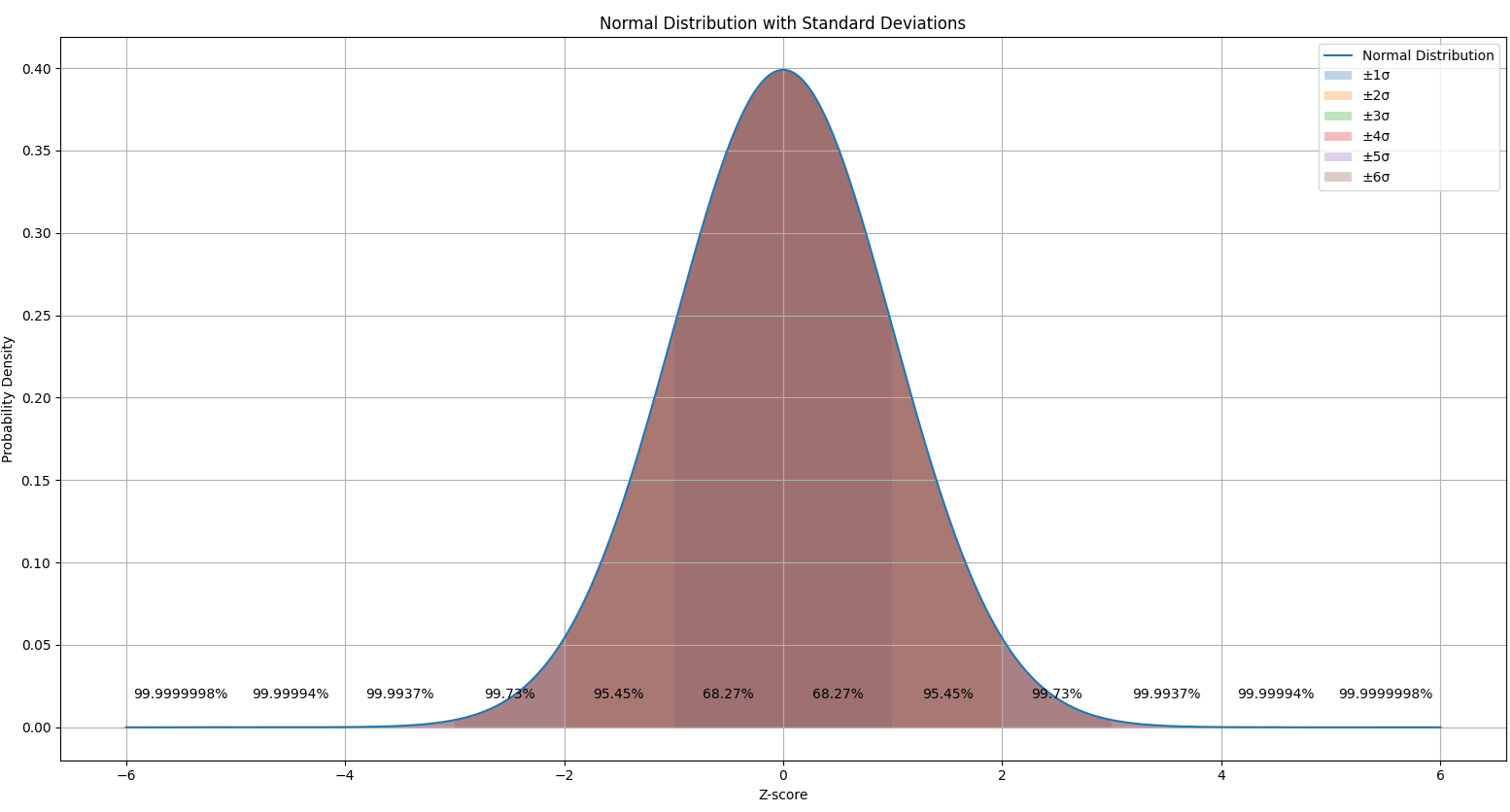
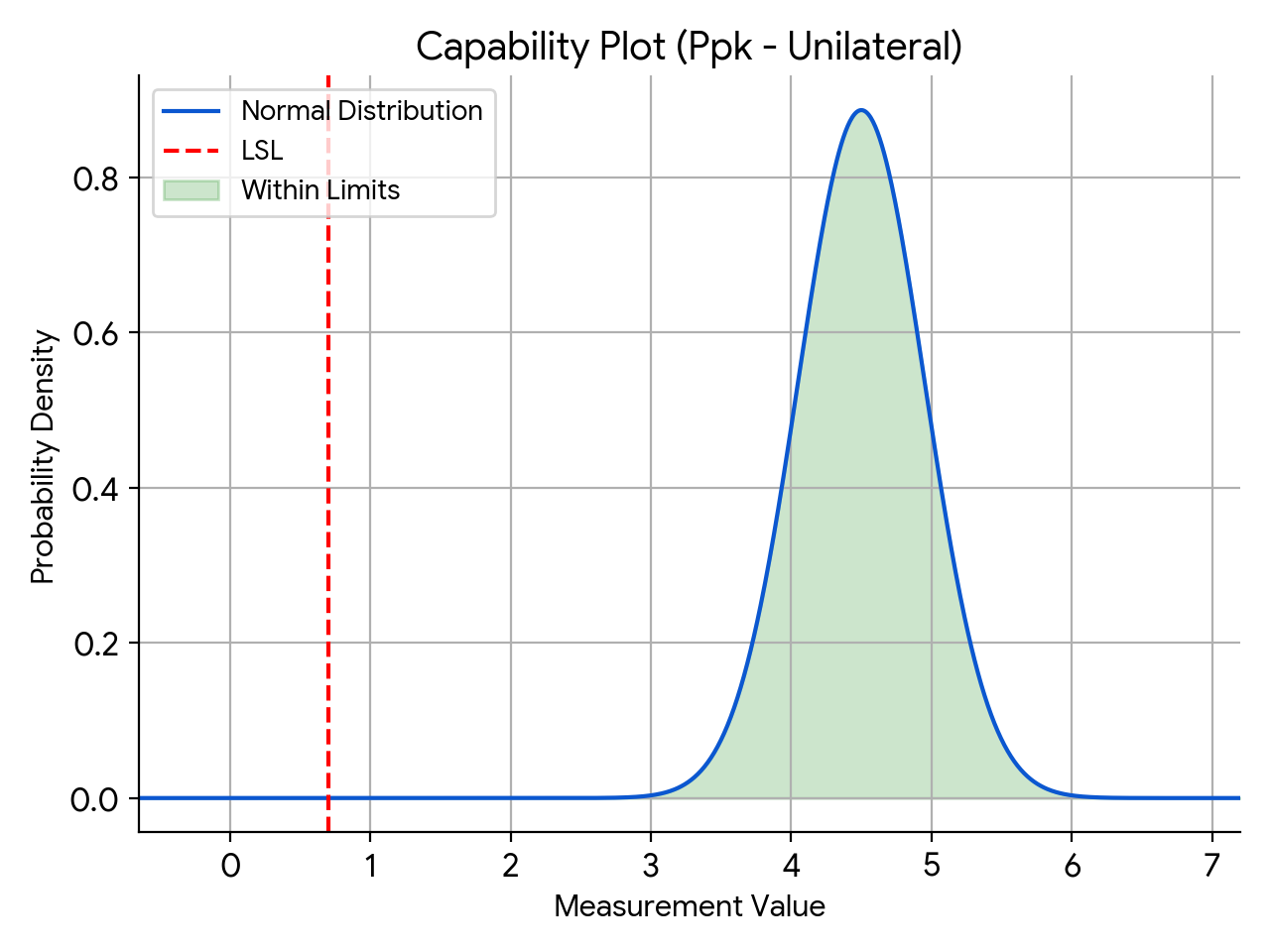
A +/- 3 sigma contains 99.73% of the normal probability density curve. This is also traditionally notated as the “process window”. The number of sigma’s is also the z-score. When the process window is compared against the specification window, we can assess the process capability. When the process window is much narrower than the specification window and is fully contained within the specification window, we say that the process is highly capable. When the process window is larger than the specification window, we say that the process is not capable. How much the process window is enclosed within the process specification window is explained by the process capability index. The most common process capability index is Cpk or Ppk. Here, we will consider Ppk.

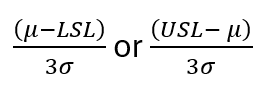
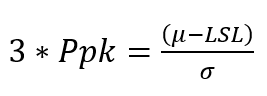
Ppk is the minimum of two values:

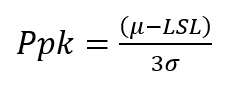
Here µ is the mean, σ is the standard deviation, LSL is the Lower Specification Limit, and USL is the Upper Specification Limit. We are splitting the process window into two here, and accounting for how centered the process is. If the process window is not centered compared to the process specification window, we penalize it by choosing the minimum of the two.

For convenience, let’s assume the equation below:

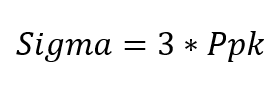
If we multiply both sides by 3, the equation becomes:

The value on the right side can be expressed as – how many standard deviations are contained in the split process window? This is also the Sigma value or the z-score.

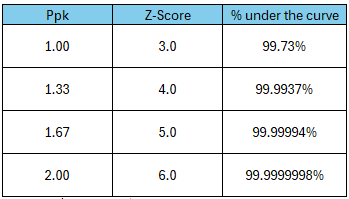
For example, if the Ppk is 1.00, then the z-score is 3.00. This means that the process window and the specification window overlap exactly. This corresponds to 99.73% of the curve. Please note that, I am assuming that the process is perfectly centered here. Refer to this post for additional details on calculations for unilateral and bilateral capabilities.

In other words,

This relationship allows us to estimate the %-conforming (% under the curve) by just knowing the process capability index value. A keen reader may also notice the similarity to tolerance interval calculations. If we go back to the idea that sigma is the number of standard deviations that the split process window can accommodate, then we can replace Sigma with k1 and k2 factors used for the tolerance interval calculations for unilateral and bilateral interval calculations.

A word of caution here is about the switcheroo that happened. The calculations we are doing are based on the normal probability distribution curve, and not the actual process probability distribution curve. The accuracy of our inferences will depend on how close the actual process probability distribution curve matches the beautiful symmetric normal curve.

Always keep on learning…

Ppk, Capability Index and Tolerance Interval Relation:

In today’s post, I am looking at the relationship between capability index (Cpk or Ppk) and Tolerance Intervals. The capability index is tied to the specification limits, and tying this to the tolerance interval allows us to utilize the confidence/reliability statement allowed by the tolerance interval calculation.

Consider the scenario below:

A quality engineer is tasked with assessing the capability of a sealing process. The requirement the engineer is used to is that the process capability index, Ppk, must be greater than or equal to 1.33. The engineer is used to using 30 as the sample size.

But what does this really tell us about the process? Is 1.33 expected to be the population parameter? If so, does testing 30 samples provide us with this information? The capability index calculated from 30 samples is only the statistic and not the parameter.

We can utilize the tolerance interval calculation approach here and calculate the one-sided k-factor for a sample size of 30. Let us assume that we want to find the tolerance interval that will cover 99.9% of the population with 95% confidence. NIST provides us a handy reference to calculate this and we can utilize an Excel spreadsheet to do this for us. We see that the one-sided k-factor calculated is 4.006.

The relationship between the required Ppk and the one-sided k-factor is as follows:

Ppkrequired = k1/3

Similarly for a bilateral specification, the relationship between the required Ppk and the two-sided k-factor is:

Ppkrequired = k2/3

In our example, the required Ppk is 1.34. In other words, if we utilize a sample size of 30 and show that the calculated Ppk is 1.34 or above, we can make the following statement:

With 95% confidence, at least 99.9% of the population is conforming to the specifications. In other words, with 95% confidence, we can claim at least 99.9% reliability.

This approach is also utilized for variable sampling plans. However, please do note that the bilateral specification also requires an additional condition to be met for variable sample plans.

I have attached a spreadsheet that allows the reader to perform these calculations easily. I welcome your thoughts. Please note that the spreadsheet is provided as-is with no guarantees.

Final words:

I will finish with the history of the process capability indices from a great article by Roope M. Turunen and Gregory H. Watson. [1]

The concept of process capability originated in the same Bell Labs group where Walter A. Shewhart developed SPC. Bonnie B. Small led the editing team for the Western Electric Statistical Quality Control Handbook, but the contributor of the process capability concept is not identified. The handbook proposes two methods by which to calculate process capability: first, “as a distribution having a certain center, shape and spread,” and second, “as a percentage outside some specified limit.” These methods were combined to create a ratio of observed variation relative to standard deviation, which is expressed as a percentage. The handbook does not call the ratio an index; this terminology was introduced by two Japanese quality specialists in their 1956 conference paper delivered to the Japanese Society for Quality Control (JSQC). M. Kato and T. Otsu modified Bell Labs’ use of percentage and converted it to an index, and proposed using that as a Cp index to measure machine process capability. Subsequently, in a 1967 JSQC conference paper, T. Ishiyama proposed Cpb as a measurement index of bias in nonsymmetric distributions. This later was changed to Cpk, where “k” refers to the Japanese term katayori, which means “offset” or “bias.”

Always keep on learning…

My last post was All Communication is Miscommunication:

[1] Analyzing the capability of lean processes by Roope M. Turunen and Gregory H. Watson (Quality Progress Feb 2021)

All Communication is Miscommunication:

The title of this post is a nod to the French psychoanalyst, Jacques Lacan[1]. In today’s post, I am looking at the idea of communication. The etymology of “communication” goes back to the Latin words, com and munus. The basic meaning of communication is to make something common. “Com” means “together” while “munus” means “service”, “gift” etc. A closely related word to “communication” is “information”. Similar to “communication”, the etymology of “information” also goes back to its Latin roots. The two Latin words are “in” and “formare”. Taken together, the meaning of “information” is something like – to give shape or form to something. In the context of “information”, this would be – to give shape or form to knowledge or a set of ideas.

In Cybernetics, a core concept is the idea of informational closure. This means that a system such as each one of us is informally closed. Information does not enter into the system. Instead, the system is perturbed by the external world, and based on its interpretative framework, the system finds the perturbation informative.

Informationally closed means that all we have access to is our internal states. For example, when we see a flower, the light hitting the retina of our eyes does not bring in the information that what we are seeing is a flower. Instead, our retinal cells undergo a change of state from the light hitting them. There is nothing qualitative about this interaction. Based on our past interactions and the stability of our experiential knowledge we see the perturbation as informative, and we represent that as “flower”.  The word is used to describe a sliver of our experiential reality.

Now this presents a fascinating idea – if we are informationally closed how does communication take place? There can be no direct transfer of information happening between two interacting agents. All that is happening is a relay of perturbations mainly.  In order to posit the possibility of communication, the interacting agents should have access to a common set of meanings. When a message is transmitted, both the transmitter and the receiver should be working with a set of possible messages that are contextual. This allows the receiver to choose the most meaningful messages from the set of possible messages. For example, if my friend says that he has a chocolate lab, and I take it to mean that he has a lab where he crafts delectable chocolate creations, then from my friend’s standpoint a miscommunication has occurred. A person more familiar with dogs would have immediately started talking about dogs.

Communication takes place in the form of verbal and nonverbal communication. This adds to the complexity of communication. All communication takes place in a social realm in the background of history of past interactions, cultural norms, language norms, inside jokes etc. Language, as Wittgenstein would say, lies in the public realm. In other words, our private experiences can only be described in terms of public language. Being informationally closed means that we have to indeed work hard at getting good at this communication business. Language is dynamic and ever evolving, and this makes communication even more challenging. Our communication will always be lacking.

I will finish with the wise words of William H. Whyte:

The great enemy of communication, we find, is the illusion of it… we have failed to concede the immense complexity of our society–and thus the great gaps between ourselves and those with whom we seek understanding.

Always keep on learning…

My last post was Absurdity in Systems Thinking

[1] The Democracy of the Objects, Levy Bryant

Absurdity in Systems Thinking

In today’s post, I am looking at absurdity in Systems Thinking. Absurdity is an official term used in the school of philosophy called existentialism. An existentialist believes that existence precedes essence. This means that our essence is not pregiven. Our meaning and purpose are that which we create. In existentialism, the notion of absurdity comes from the predicament that we are by nature meaning makers, and we are thrown into a world devoid of meaning. We do not have direct access to the external world; therefore, our cognitive framework has been tweaked by evolution to seek meaning in all perturbations we encounter. We are forever trying to make sense of a world devoid of any sense or meaning.

We like to imagine that there is greater meaning to this all and that there is a “system” of objective truths in this world. In this framework, we all have access to an objective reality where we can use 2 x 2 matrices to solve complex problems. In the existentialist framework, we see that instead of a “system” of objective truths, we have multiplicity of subjective truths. Soren Kierkegaard, one of the pioneers of existentialism, viewed subjective truth as the highest truth attainable.

When we talk about a “system” we are generally talking about a collection of interrelated phenomena that serves a purpose. From the existentialism standpoint, every “system” is a construction by someone to make sense of something. For example, when I talk about the healthcare system, I have a specific purpose in mind – one that I constructed. The parts of this system serve the purpose of working together for a goal. However, this is my version and my construction. I cannot act as if everyone has the same perspective as me. I could be viewing this as a patient, while someone else, say a doctor, could see an entirely different “system” from their viewpoint. Systems have meaning only from the perspective of a participant or an observer. We are talking about systems as if they have an inherent meaning that is grasped by all. When we talk about fixing “systems”, we again treat a conceptual framework as if they are real things in the world like a machine.  The notion of absurdity makes sense here. The first framework is like what Maurice Merleau-Ponty, another existential philosopher, called “high-altitude thinking”.  Existentialism rejects this framework. In existentialism, we see that all “systems” are human systems – conceptual frameworks unique to everyone who constructed them based on their worldviews and living experiences. Each “system” is thus highly rich from all aspects of the human condition.

Kevin Aho wrote about this beautifully in the essay, “Existentialism”:

By practicing what Merleau-Ponty disparagingly calls, “high-altitude thinking”, the philosopher adopts a perspective that is detached and impersonal, a “God’s eye view” or “view from nowhere” uncorrupted by the contingencies of our emotions, our embodiment, or the prejudices of our time and place. In this way the philosopher can grasp the “reality” behind the flux of “appearances,” the essential and timeless nature of things “under the perspective of eternity” (sub specie aeternitatis). Existentialism offers a thoroughgoing rejection of this view, arguing that we cannot look down on the human condition from a detached, third-person perspective because we are already thrown into the self-interpreting event or activity of existing, an activity that is always embodied, felt, and historically situated. 

We are each thrown here into the world devoid of any meaning, and we try to make meaning. In the act of making sense and meaning, we tend to believe that our version of world and systems are real. We often forget to see the world from others’ viewpoints.

Every post about Systems Thinking must contain the wonderful quote from West Churchman – the systems approach begins when first you see the world through the eyes of another. This beautifully captures the essence of Systems Thinking. Existentialism teaches us to realize the absurdity of seeking meaning in a world devoid of any meaning, while at the same time realizing that the act of seeking meaning itself is meaningful for us.

Always keep on learning!

References:

[1] Aho, Kevin, “Existentialism”, The Stanford Encyclopedia of Philosophy (Summer 2023 Edition), Edward N. Zalta & Uri Nodelman (eds.), URL = <https://plato.stanford.edu/archives/sum2023/entries/existentialism/&gt;.

Utilizing Stress/Strength Analysis to Reduce Sample Size:

Art by NightCafe

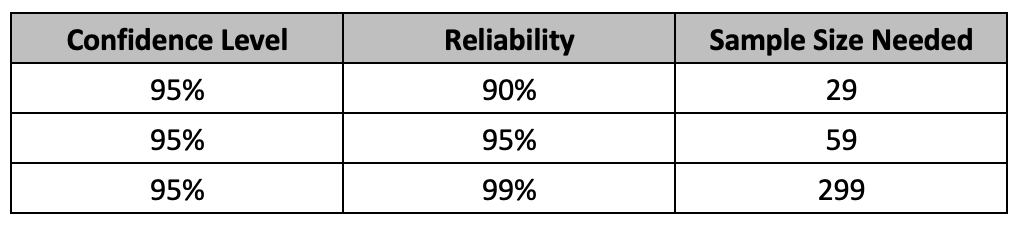
In today’s post, I am looking at some practical suggestions for reducing sample sizes for attribute testing. A sample is chosen to represent a population. The sample size should be sufficient enough to represent the population parameters such as mean, standard deviation etc. Here, we are looking at attribute testing, where a test results in either a pass or a fail. The common way to select an appropriate sample size using reliability and confidence level is based on success run theorem. The often-used sample sizes are shown below. The assumptions for using binomial distribution holds true here.

The formula for the Success Run Theorem is given as:

n = ln(1 – C)/ ln(R), where n is the sample size, ln is the natural logarithm, C is the confidence level and R is reliability.

Selecting a sample size must be based on risk involved. The specific combinations of reliability and confidence level should be tied to the risk involved. Testing for higher risk profile attributes require higher sample sizes. For example, for a high-risk attribute, one can test 299 samples and if there were no rejects found, then claim that at 95% confidence, the product lot is at least 99% conforming or that the process that produced the product is at least 99% reliable.

Often time, due to several constraints such as material availability, resource constraints, unforeseen circumstances etc., one may not be able to utilize required sample sizes needed. I am proposing here that we can utilize the stress/strength relationship to appropriately justify the use of a smaller sample size while at the same time not compromise on the desired reliability/confidence level combination.

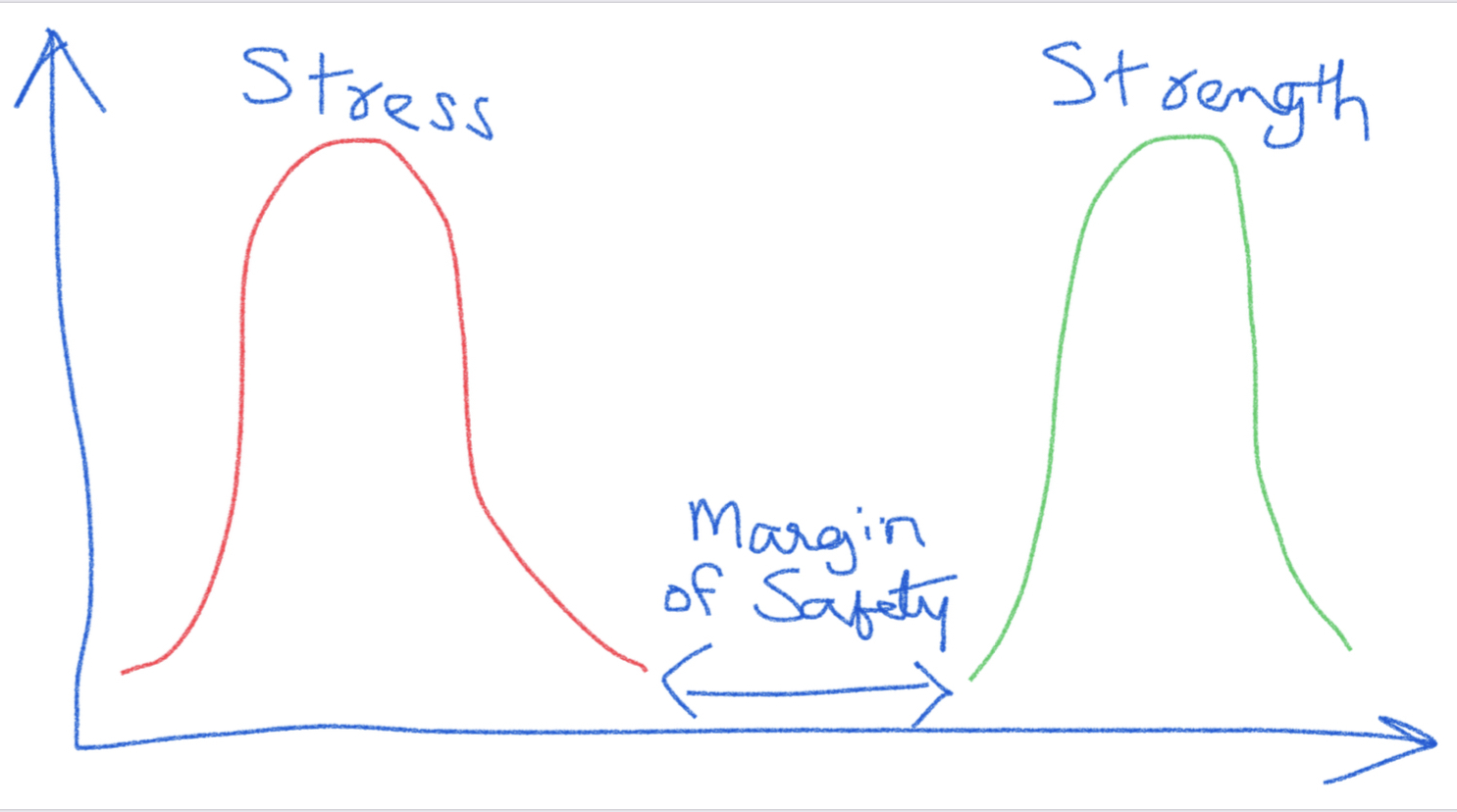
A common depiction of a stress/strength relationship is shown below for a product. We can see that as long as the stress distribution does not overlap with the strength distribution, the product should function with no issues. The space between the two distributions is referred to as the margin of safety. Often, the product manufacturer defines the normal operating parameters based on this. The specifications for the product are also based on this and some value of margin of safety is incorporated in the specifications.

For example, let’s say that the maximum force that the glue joint of a medical device would see during normal use is 0.50 pound-force, and the specification is set as 1.5 pound-force to account for a margin of safety. It is estimated that a maximum of 1% can likely fail at 1.5 pound-force. This refers to 99% reliability. As part of design verification, we could test 299 samples at 1.5 pound-force and if we do not have any failures, claim that the process is at least 99% reliable at 95% confidence level. If the glue joint is tested at 0.50 pound-force, we should be expecting no product to fail. This is after all, the reason to include the margin of safety.

Following this logic, if we increase the testing stress, we will also increase the likelihood for failures. For example, by increasing the stress five-fold (7.5 pound-force), we are also increasing the likelihood of failure by five-fold (5%) or more. Therefore, if we test 60 parts (one-fifth of 299 from the original study) at 7.5 pound-force and see no failures, this would equate to 99% reliability at 95% confidence at 1.5 pound-force. We can claim at least 99% reliability of performance at 95% confidence level during normal use of product. We were able to reduce the sample size needed to demonstrate the required 99% reliability at 95% confidence level by increasing the stress test condition.

Similarly, if we are to test the glue joint at 3 pound-force (two-fold), we will need 150 samples (half of 299 from the original study) with no failures to claim the same 99% reliability at 95% confidence level during the normal use of product. The rule of thumb is that when aiming for a testing margin of safety of ‘x,’ we can reduce the sample size by a factor of ‘1/x’ while maintaining the same level of reliability and confidence. The exact number can be found by using the success run theorem. In our example, we estimate at least 95% reliability based on the 5% failures while using 5X stress test conditions, when compared to the original 1% failures. Using the equation ln(1-C)/ln(R), where C = 0.95 and R = 0.95, this equates to 59 samples. Similarly for 2X stress conditions, we estimate 2% failures, and here R = 0.98. Using C = 0.95 in the equation, we get the sample size required as 149.

If we had started with a 95% reliability (5% failures utmost) and 95% confidence at the 1X stress conditions, and we go to 2X stress conditions, then we need to calculate the reduced sample size based on 10% failures (2 x 5%). This means that the reliability is estimated to be 90% at 2X stress conditions. Using 0.95 for confidence and 0.90 reliability, this equates to a reduced sample size of 29.

A good resource to follow up on this is Dr. Wayne Taylor’s book, “Statistical Procedures for the Medical Device Industry”. Dr. Taylor notes that:

An attribute stress test results in a pass/fail result. However, the unit is exposed to higher stresses than are typical under normal conditions. As a result, the stress test is expected to produce more failures than will occur under normal conditions. This allows the number of units tested to be reduced. Stress testing requires identifying the appropriate stressor, including time, temperature, force, humidity and voltage. Examples of stress tests include dropping a product from a higher height, exposing a product to more cycles and exposing a product to a wider range of operating conditions.

Many test methods contained in standards are in fact stress tests designed to provide a safety margin. For example, the ASTM packaging standards provide for conditioning units by repeated temperature/humidity cycles and dropping of units from heights that are more extreme and at intervals that are more frequent than most products would typically see during shipping. As a result, it is common practice to test smaller sample sizes. The ASTM packaging conditioning tests are shown… to be five-times stress tests.

It should be apparent that if the product is failing at the elevated stress level, we cannot claim the margin of safety, we were going for. We need to clearly understand how the product will be used in the field and what the normal performance conditions are. We need a good understanding of the safety margins involved. With this approach, if we are able to improve the product design to maximize the safety margins for the specific attributes, we can then utilize a smaller sample size than what is noted in the table above.

Always keep on learning. In case you are interested, my last post was Deriving the Success Run Theorem:

Note:

1) It’s commonly used to depict a distribution using +/-3 standard deviations (σ). This is a practical way to visualize a distribution.

2) The most prevalent representation of a distribution often resembles a symmetrical bell curve. However, this is a simplified sketch and not intended to accurately represent the true data distribution, which may exhibit various distribution shapes with varying degrees of fit.

Deriving the Success Run Theorem:

Art by NightCafe

In today’s post, I am explaining how to derive the Success Run Theorem using some basic assumptions. Success Run theorem is one of the most common statistical rational for sample sizes used for attribute data. It goes in the form of:

Having zero failures out of 22 samples, we can be 90% confident that the process is at least 90% reliable (or at least 90% of the population is conforming).

Or

Having zero failures out of 59 samples, we can be 95% confident that the process is at least 95% reliable (or at least of 95% of the population is conforming).

The formula for the Success Run Theorem is given as:

n = ln(1 – C)/ ln(R), where n is the sample size, nl is the natural logarithm, C is the confidence level and R is reliability.

The derivation is fairly straightforward and we can use the multiplication rule of probability to do so. Let’s assume that we have a lot of infinite size and we are testing random samples out of the lot. The infinite size of the lot ensures independence of the samples. If the lot was finite and small then the probability of finding good (conforming) or bad (nonconforming) parts will change from sample to sample, if we are not replacing the tested sample back into the lot.

Let’s assume that q is the conforming rate (probability of finding a good part).

Let us calculate the probability of finding 22 conforming products in a row. In other words, we are testing 22 random samples and we want to find out the probability of finding 22 good parts. This is also the probability of NOT finding any bad product in the 22 random samples. For ease of explanation, let us assume that q = 0.9 or 90%. This rate of conforming product can also be notated as the reliability, R.

Using the multiplication rule of probability:

p(22 conforming products in a row) = 0.9 x 0.9 x 0.9 …… x 0.9 = 0.9 ^22

            = 0.10

            = 10%

If we find zero rejects in the 22 samples, we are also going to accept the lot. Therefore, this is also the probability of accepting the lot.

The complement of this is the probability of NOT finding 22 conforming products in a row, or the probability of finding at least one nonconforming product in the 22 samples. This is also the probability of rejecting the lot.

p(rejecting the lot) = 1 – p(22 conforming products in a row)

            = 1 – 0.10 = 0.90

            = 90%

This can be also stated as the CONFIDENCE that if the lot is passing our inspection (if we found zero rejects), then the lot is at least 90% conforming.

In other words, C = 1 – R^n

Or R^n = 1 – C

Taking logarithms of both sides,

n * ln(R) = ln(1 – C)

Or n = ln(1 – C)/ln(R)

Using the example, if we tested 22 samples from a lot, and there were zero rejects then we can with 90% confidence say that the lot is at least 90% conforming. This is also a form of LTPD sampling in Acceptance Sampling. We can get the same results using an OC Curve.

Using a similar approach, we can derive a one-sided nonparametric tolerance interval. If we test 22 samples, then we can say with 90% confidence level that at least 90% of the population is above the smallest value of the samples tested.

Any statistic we calculate should reflect our lack of knowledge of the parameter of the population. The use of confidence/reliability statement is one such way of doing it. I am calling this the epistemic humility dictum:

Any statistical statement we make should reflect our lack of knowledge of the “true” value/nature of the parameter we are interested in.

Always keep on learning. In case you missed it, my last post was An Existentialist’s View of Complexity: