
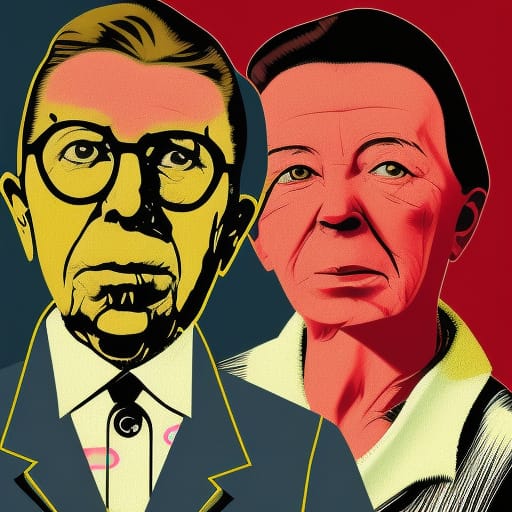
In my post today, I am looking at the idea of complexity from an existentialist’s viewpoint. An existentialist believes that we, humans, create meanings for ourselves. There is no meaning out there that we do not create. An existentialist would say, from this viewpoint, that complexity is entirely dependent upon an observer, a meaning maker.
We are meaning makers, and we assign meanings to things or situations in terms of possibilities. In other words, the what-is is defined by an observer in terms of what-it-can-be. For example, a door is described by an observer in terms of what it can be used for, in relation to other things in its environment. The door’s meaning is generated in terms of its possibilities. For example, it is something for me to enter or exit a building. The door makes sense to me when it has possibilities in terms of action or relation to other things. This is very similar to the ideas of Gibson, in terms of “affordances”.
In existentialism, there are two concepts that go hand in hand that are relevant here. These are “facticity” and “transcendence”. Facticity refers to the constraints a subject is subjected to. For example, I am a middle-aged male living in the 21st century. I could very well blame my facticity for pretty much any situation in life. Transcendence is realizing that I have freedom to make choices to stand up for myself to transcend my facticity and make meaning of my own existence. We exist in terms of facticity and transcendence. We are thrown into this world and we find ourselves situated amidst the temporal, physical, cultural and social constraints. We could very well say that we have a purpose in this world, one that is prescribed to us as part of facticity or we can refer to ourselves to enable us to transcend our facticity and create our own purposes in the world.
In the context of the post, I am using “facticity” to refer to the constraints and “transcendence” to refer to the possibilities. Going back to complexity and an observer, managing complexity is making sense of “what-is” as the constraints, in terms of “what-it-can-be” as the possibilities. We describe a situation in terms of complexity, when we have to make meaning out of it. We do so to manage the situation – to get something out of it. This is a subject-object relationship in many regards. What the object is, is entirely dependent on what the subject can afford. When one person calls something as complex, they are indicating that the variety of the situation is manifold than what they can absorb. Another subject (observer) can describe the same object as something simple. That subject may choose to focus on only certain attributes of the situation, the attributes that the subject is familiar with. Anything can be called as complex or simple from this regard. As I have noted before, a box of air can be as complex as it can get when one considers the motion of an air particle inside, or as simple as it can get when one considers it as a box of “nothing”. In other words, complexity has no meaning without an observer because the meaning of the situation is introduced by the observer.
A social realm obviously adds more nuance to this simply because there are other meaning-makers involved. Going back to existentialism, we are the subject and at the same time objects for the others in the social realm. Something that has a specific meaning to us can have an entirely different meaning to another person. When we draw a box and call that as a “system”, another person can draw a different box that includes only a portion of my box, and call that as the same “system”. In the social realm, meaning-making should be a social activity as well. It will be a wrong approach to use a prescribed framework to make sense because each of us have different facticities and what possibilities lie within a situation are influenced by these facticities. The essence of these situations cannot be prescribed simply because the essence is brought forth in the social realm by different social beings. A situation is as-is with no complexity inherent to it. It is us who interact with it, and utilize our freedom to assign meaning to it. I will finish off with a great quote from Sartre:
Human reality everywhere encounters resistance and obstacles which it has not created, but these resistances and obstacles have meaning only in and through the free choice which human reality is.
Stay safe and always keep on learning…
In case you missed it, my last post was Plurality of Variety:



 Harish's Notebook - My notes... Lean, Cybernetics, Quality & Data Science.