
In today’s post, I am looking at the self-referential nature of language and learning. I am also looking at how we might escape the infinite regress that seems to follow from it.
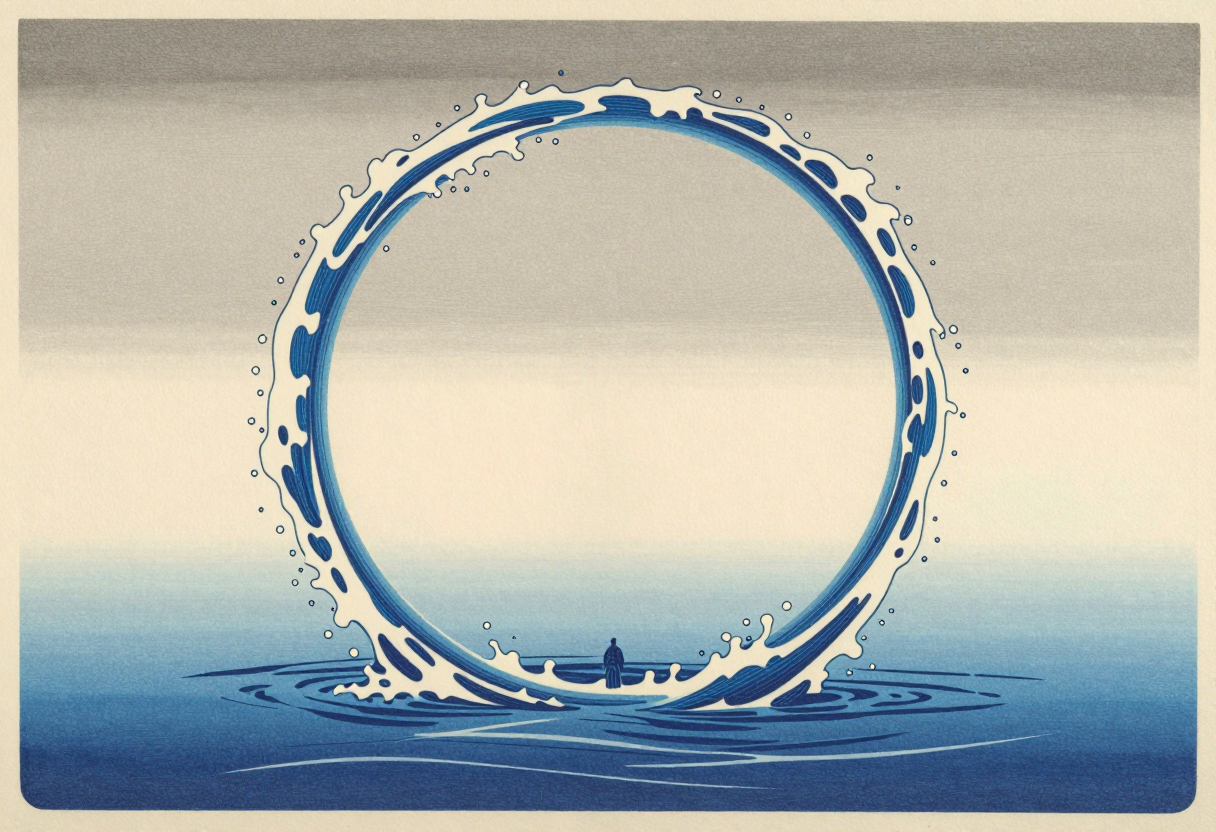
Open a dictionary and look up any word. The definition is made of other words. Look those up and you get more words. If you keep going, you will likely come back to where you started. Language, seen this way, is a closed loop. Every word points to other words, and none of them stand on their own.
That raises a simple question. If every word is defined by other words, how does anyone ever get in? A child does not start with a dictionary, yet the child comes to understand. Cognitive scientists call this the symbol grounding problem, a name that comes from Stevan Harnad’s 1990 paper. Symbols defined only by other symbols seem to float without an anchor. The puzzle in plain terms: a loop of words alone cannot give meaning.
The way out, in my view, is to stop looking for meaning inside language. Meaning is possibly not something words carry, but something we bring forth. Humberto Maturana described language as a coordination of coordinations of behavior. A child does not learn “ball” from other words. The child learns it by grabbing, throwing, chasing and pointing, alongside someone doing the same. The word becomes a marker inside a shared activity that is already going on. The words come later.
Heinz von Foerster had a striking way of putting it: the hearer, not the speaker, determines the meaning of an utterance. Language may well be self-referential as a system, yet it is not sealed off. Each of us closes the loop through our own doing and experiencing. The regress stops not at a first word, but at the observer.
That answer does not fully settle the matter, because we can push the question one level down. If we learn meaning by doing, where did we learn to do? And where did we learn to learn? It seems the regress has simply moved from language to learning.
Gregory Bateson offers a helpful ladder here. He described levels of learning. Learning Zero is a fixed response, something that does not change with experience. Learning One is changing a response based on experience. Learning Two is learning to learn: getting better at learning itself and picking up the context in which learning happens. The ladder points to something beneath it. Before any learning, there has to be a body that can respond and be changed by responding. A newborn does not learn that capacity. It arrives with it, as the result of a very long history. So the capacity to learn was likely never learned at all.
Maturana takes this further. Living systems are structure-determined: what happens to them is determined by their own structure, not by what comes from outside. The environment can only trigger changes, never instruct them. From this view, learning is not taking in information from outside but the ongoing change of our structure as we interact with the world. Maturana and Varela called this structural coupling. There is no first lesson. There is only a continuous drift that started when life started, and it has carried on ever since. This replaces the question of where it began with another one: how does it keep going?
Animals learn to learn too. Harry Harlow, working at the University of Wisconsin, gave rhesus monkeys hundreds of simple object-choice problems, one after another. Each new problem got solved faster, and after a while the monkey chose right on the first try. Harlow called this learning to learn, in a 1949 paper titled The Formation of Learning Sets. What sets us apart is likely learning to learn carried through language: not just learning within a context, but reflecting on the context itself.
This is where second-order learning becomes interesting. No one taught us this capacity. It came about through evolutionary history, as a structure able to change how it changes, even though what we learn with it comes from our living. The cybernetic view helps here: second-order learning is learning turned back on itself, a loop that includes itself. In second-order cybernetics, self-reference is not a problem to be avoided but the very thing that makes an observer possible. We do not need a foundation outside the loop. The loop is what we stand on.
An infinite regress looks for a starting point that keeps slipping away. A recursion does something different: it needs no starting point outside itself, only what is already there, applying an operation to its own results, again and again, until a stable pattern appears.
Von Foerster showed that recursive processes can settle into stable patterns, and he called them eigenbehaviors. These stable patterns are what we experience as objects, meanings and words. A word’s meaning, from this view, is an eigenbehavior, stable not because it is anchored to something outside, but because our ongoing interactions keep producing it.
Von Foerster made the same point about objects in a paper titled “Objects: Tokens for (Eigen-)Behaviors.” An object, on this reading, is not something sitting out there, waiting to be discovered. The object is a token for a stable pattern in how we keep interacting with the world. When I pick up a cup, the “cup” is the name for what stays stable across my seeing, holding and drinking.
Words and objects end up in the same position. Neither is the outside anchor the regress was hunting for. Both are tokens that recursive living keeps producing. The ground we were looking for was likely never outside the loop. And this is why the self-referentiality of language is not a flaw. Self-reference may be the very reason language works. Meaning arises from the loop, through our living, rather than from a first word.
Final Arc:
We began with a worry that self-reference leads to an endless regress. The way out, as I see it, has three parts. Meaning is not inside language but brought forth by observers in their doing. Learning does not begin with a first lesson, but with a structure that was never learned. And learning to learn is an evolved capacity that lets the loop include itself. The regress dissolves when we stop asking for a beginning and start looking at the circle.
Stay Curious and Always Keep on Learning…
If you liked what you have read, please consider my book “Second Order Cybernetics,” available in hard copy and e book formats. https://www.cyb3rsyn.com/products/soc-book
Discover more from Harish's Notebook - My notes... Lean, Cybernetics, Quality & Data Science.
Subscribe to get the latest posts sent to your email.

