In today’s post, I am looking at the Socrates of Cybernetics, Heinz von Foerster’s ethical imperative:
“Always act so as to increase the number of choices.”
I see this as the recursive humanist commandment. This is very much applicable to ethics, and how we should treat each other. Von forester said the following about ethics:
Whenever we speak about something that has to do with ethics, the other is involved. If I live alone in the jungle or in the desert, the problem of ethics does not exist. It only comes to exist through our being together. Only our togetherness, our being together, gives rise to the question, How do I behave toward the other so that we can really always be one?
Von Foerster’s views align with that of constructivism, the idea that we construct our knowledge about our reality. We construct our knowledge to “re-cognize” a reality through the intercorrelation of the activities of the various sense organs. It is through these computed correlations that we recognize a reality. No findings exist independently of observers. Observing systems can only correlate their sense experiences with themselves and each other.
Paul Pangaro reminded me that von Foerster did not mean “options” or “possibilities”. Von Foerster specifically chose the word “choices”. By choices, he meant those selections among options that you might “actually take” depending on who “you are” right now. Here choices narrow down to the few that apply most to what you are now in this moment and in this context, down to a decision that makes you who you are. As von Foerster said, “Don’t make the decision, let the decision make you.” You and your choice you take are indistinguishable.
Since we are the ones doing the construction, we are also ultimately responsible for what we construct. No one should take this away from us. Ernst von Glasersfeld, father of radical constructivism explained this well:
The moment you begin to think that you are the author of your knowledge, you have to consider that you are responsible for it. You are responsible for what you are thinking, because it’s you who’s doing the thinking and you are responsible for what you have put together because it’s you who’s putting it all together. It’s a disagreeable idea and it has serious consequences, because it makes you truly responsible for everything you do. You can no longer say “well, that’s how the world is”, or “sono così”; you know, that’s not good enough.
Cybernetics is about communication and control in the animal and machine, as Norbert Wiener viewed it. When we view control in terms of von Foerster’s ethical imperative, interesting thoughts come about. Control is about reducing the number of choices so that only certain pre-selected activities are available for the one being controlled. For example, a steersman has to control their ship such that it maintains a specific course, and here the ship’s “available options” to move are drastically reduced. When we use this view of control and apply it to human beings, we should do so in light of von Foerster’s ethical imperative.
Von Foerster also said – A is better off when B is better off. This also provides further clarity on the recursiveness. If I am to make sure that I act so as to increase the number of choices for B, then B also in turn does the same. How I act impacts how others (re)act, which in turn impacts how I act back… on and on. This might remind the reader of the golden rule – Treat others as you would like others to treat you. However, this is missing the point about constructivism and the ongoing interaction that leads to the construction of a social reality. I see this as part of a social contract. As Jean-Jacques Rousseau noted, Man is born free, but everywhere he is in chains. The social contract comes about from the ongoing interactions and the contexts we are in with our fellow human beings as part of being in a society or social groups. This also means that this is dynamic and contingent in nature. What was “good” before may not be “good” today. This requires an ongoing framing and reframing though interactions.
John Boyd, father of OODA loop, shed more light on this:
Studies of human behavior reveal that the actions we undertake as individuals are closely related to survival, more importantly, survival on our own terms. Naturally, such a notion implies that we should be able to act relatively free or independent of any debilitating external influences — otherwise that very survival might be in jeopardy. In viewing the instinct for survival in this manner we imply that a basic aim or goal, as individuals, is to improve our capacity for independent action. The degree to which we cooperate, or compete, with others is driven by the need to satisfy this basic goal. If we believe that it is not possible to satisfy it alone, without help from others, history shows us that we will agree to constraints upon our independent action — in order to collectively pool skills and talents in the form of nations, corporations, labor unions, mafias, etc — so that obstacles standing in the way of the basic goal can either be removed or overcome. On the other hand, if the group cannot or does not attempt to overcome obstacles deemed important to many (or possibly any) of its individual members, the group must risk losing these alienated members. Under these circumstances, the alienated members may dissolve their relationship and remain independent, form a group of their own, or join another collective body in order to improve their capacity for independent action.
In a similar fashion, Dirk Baecker also noted the following:
Control means to establish causality ensured by communication. Control consists in reducing degrees of freedom in the self-selection of events. This is why the notion of “conditionality” is certainly one of the most important notions in the field of systems theory. Conditionality exists as soon as we introduce a distinction which separates subsets of possibilities and an observer who is forced to choose, yet who can only choose depending on the “product space” he is able to see. If we assume observers on both sides of the control relationship, we end up with subsets of possibilities selecting each other and thereby experiencing, and solving, the problem of “double contingency” so much cherished by sociologists. In other words, communication is needed to entice observers into a self-selection and into the reduction of degrees of freedom that goes with it. This means there must be a certain gain in the reduction of degrees of freedom, which for instance may be a greater certainty in the expectation of specific things happening or not happening.
Ultimately, this is all about what we value for ourselves and for the society we are part of. Our personal freedom makes sense only in light of other’s personal freedoms. That is the context – in relation to another human being, one who may be less fortunate than us. Making the world easier for those less fortunate than us makes the world better for everyone of us. I will finish with a great quote from one of my favorite science fiction character, Doctor Who:
“Human progress isn’t measured by industry. It’s measured by the value you place on a life. An unimportant life. A life without privilege. The boy who died on the river, that boy’s value is your value. That’s what defines an age. That’s what defines a species.”
Please maintain social distance, wear masks and take vaccination, if able. Stay safe and always keep on learning…
Please maintain social distance, wear masks and take vaccination, if able. Stay safe and always keep on learning… In case you missed it, my last post was The Open Concept of Systems:
In today’s post, I am looking at observation. This will be a general overview and I will follow up with more posts in the future. I am inspired by the ideas of George Spencer-Brown (GSB), Niklas Luhman, Dirk Baecker and Heinz von Foerster. In Cybernetics, observation does not mean just to utilize your eyes and look at something. It has a deeper “sensemaking” type meaning. Observation in Cybernetics does not follow the rigid subject-object relationship. Toth Benedek explains this:
Heinz von Foerster tried to develop a point of view that replaces the linear and rigid structure of the object-subject (observer-observed) distinction. According to von Foerster, the observer is really constructed by the observed and vice versa: ‘observation’ is nothing else but the circular relation between them. Observation as a relation defines the observer and the observed, so the observer refers not only to the observed, but also to himself by the act of observation.
Observation is an operation of distinction. The role of an observer is to generate information. If no information is being generated, then no observation has been made. An observation is an act of cognition. GSB in his seminal work, Laws of Form noted:
A universe comes into being when a space is severed or taken apart. The skin of a living organism cuts off an outside from an inside. So does the circumference of a circle in the plane. By tracing the way we represent such a severance, we can begin to reconstruct, with an accuracy and coverage that appear almost uncanny, the basic forms underlying linguistic, mathematical, physical, and biological science, and can begin to see how the familiar laws of our own experience follow inexorably from the original act of severance.
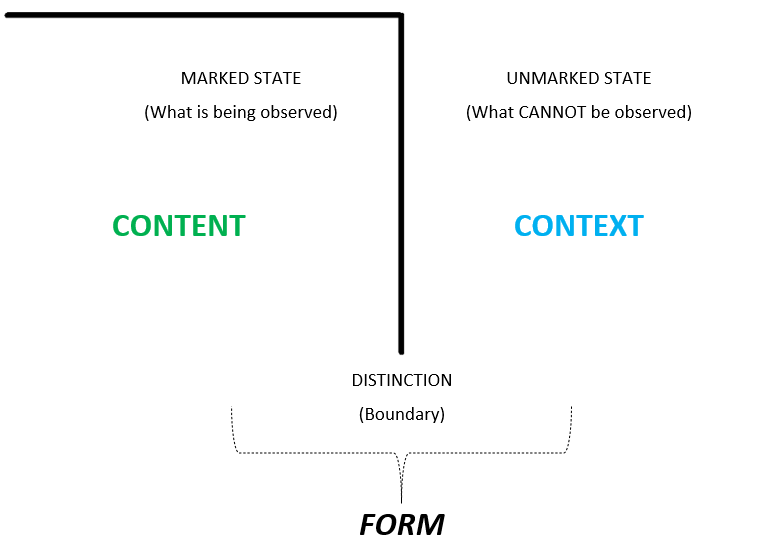
GSB advises us to draw a distinction. He proposed a notation called as “mark” to do this. A basic explanation of a mark is shown below. It separates a space into two sections; one part that is observed and the other that is not observed. We can look at a space, and identify a difference, a distinction that allows us to identify a part of the space as something and the remaining of that space as NOT that something. For example, we can distinguish a part of a house as kitchen and everything else is “not kitchen”. At that point in time, we are looking only at the kitchen, and ignoring or not paying attention to anything else. What is being observed is in relation to what is not being observed. A kitchen is identified as “kitchen” only in the context of the remaining of the house.
Dirk Baecker explains this:
Spencer-Brown’s first propositions about his calculus is the distinction being drawn itself, considered to be “perfect continence”, that is to contain everything. A distinction can only contain everything when one assumes that it indeed contains (a) its two sides, that is the marked state and the unmarked state, (b) the operation of the distinction, that is the separation of the two sides by marking one of them, and (c) the space in which all this occurs and which is brought forth by this occurrence.
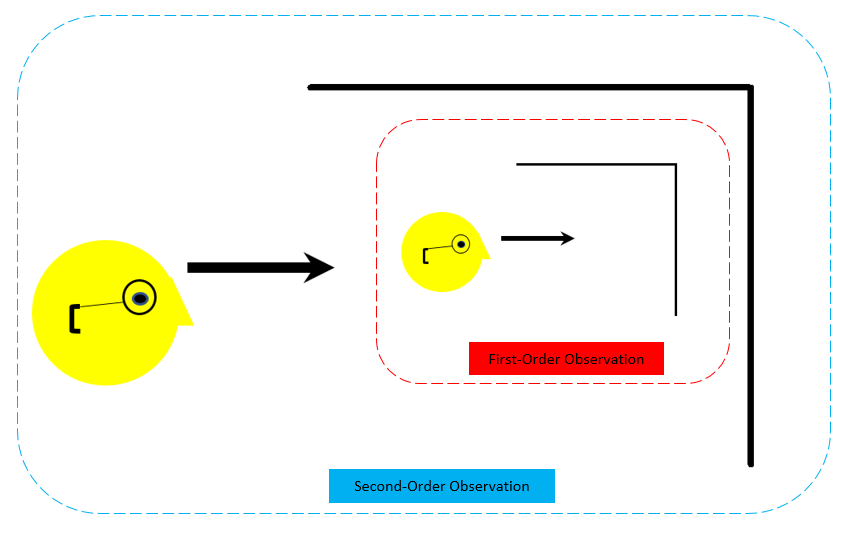
From the context of GSB, we can view a distinction as a first order observation. We can only see what is inside the box, and not what is outside the box. What is outside the box is our “blind spot.”
Hans-Georg Moeller explains this very well:
A first-order observation can simply observe something and, on the basis of this, establish that thing’s factuality: I see that this book is black—thus the book is black. Second-order observation observes how the eye of an observer constructs the color of this book as black. Thus, the simple “is” of the expression “the book is black” becomes more complex—it is not black in itself but as seen by the eyes of its observer. The ontological simplicity is lost and the notion of “being” becomes more complex. What is lost is the certainty about the “essential” color of this book.
The first order observer is confident about the observation he makes. He may view his observation as necessary and not contingent. However, a second order observer is able to also see what the first order observer is not. The second order observer is able to understand to an extent how the first order observer is making his distinctions. The second order observer thus comes to the conclusion that the distinction made by the first order observer is in fact contingent and somewhat arbitrary.
The most important point about the first order observation is that the first order observer cannot see that he does not see what he does not see. In other words, the first order observer is unaware that he has a blind spot. A second order observer observing a first order observer is able to see what the first order observer is not able to see, and he is also able to see that the first order observer has a blind spot. This is depicted in the schematic below:
As the schematic depicts, the second order observer is also making a distinction. In other words, what he is doing is also a first order observation! This means that the second order observer also has a blind spot, and he not aware that he has a blind spot! As Benedek further notes:
the first order of observation (our eye’s direct observation) is unable to get a coherent and complete image about the world out there. What we can see is something we learnt to see: the image we “see” is a result of computing processes.
The second order observation can also be carried out as a self-observation, where the observer doing the first order observation is also the observer doing the second order observation. This may appear paradoxical. GSB talked about an idea called “reentry” in Laws of Form. Reentry is the idea of reentering the form again. In other words, we are re-introducing the distinction we used onto the form again. The reentry is depicted in the schematic below:
Dirk Baecker explains:
Spencer-Brown’s calculus of form consists in developing arithmetic with distinctions from a first instruction—”draw a distinction”—to the re-introduction (“re-entry”) of the distinction into the form of distinction, in order to be able to show in this way that the apparently simple, but actually already complex beginning involved in making a distinction can only take place in a space in which the distinction is for its part introduced again. The observer who makes this distinction through it becomes aware of the distinction, to which he is himself indebted.
Self-observation requires a reentry. In order to become aware that we have cognitive blind spots, we have to perform reentry. The re-entry includes what was not part of the original distinction. This allows us to understand (to a point) how we make and utilize distinctions. To paraphrase Heinz von Foerster, we come to see when we realize that we cannot see.
The reentry is a continuous operation that is self-correcting in nature. There is no end point to this per-se and it oscillates between the inside and the outside. This leads to an emergent stability as an eigenform. As noted before, the second order observation is still a form of first order observation even with reentry. There are still cognitive blind spots and we are still subject our biases and limitations of our interpretative framework. We are affected by what we observe and we can only observe what our interpretative framework can afford. As noted at the start of the post, the role of the observer is to generate information. If the observer is not able to make a distinction, then no information can be generated. This has the same effect as us being in a closed system where the entropy keeps on increasing. Borrowing a phrase from Stafford Beer, this means that observers are negentropic pumps. We engage in making dynamic distinctions which allows us to gather the requisite information/knowledge to remain viable in an everchanging environment.
The discussion about first order and second order observations may bring up the question – is it possible to have a third order observation? Heinz von Foerster pointed out that there is no need for a third order observation. He noted that a reflection of a reflection is still a reflection. Hans-Georg Moeller explains this further:
While second-order observation arrives at more complex notions of reality or being, it still only observes—it is a second-order observation, because it observes as a first-order observation another first-order observation. It is, so to speak, the result of two simultaneous first-order observations. A third-order observation cannot transcend this pattern—for it is still the first-order observation of a first-order observation of a first-order observation… No higher-order observation—not even a third-order observation—can observe more “essentially” than a lower-order observation. A third-order observation is still an observation of an observation and thus nothing more than a second-order observation. There is no Platonic climb towards higher and higher realities—no observation brings us closer to the single light of truth.
I will finish with some wise words from Dirk Baecker:
In today’s post, I am looking at magic and cybernetics. From a young age, I have been a fan of magic. I have talked about magic here before. I see magic as the art of paradoxes. The word paradox stems from the Greek words – “para” and “dokein”, and taken together it means contrary to expectation.
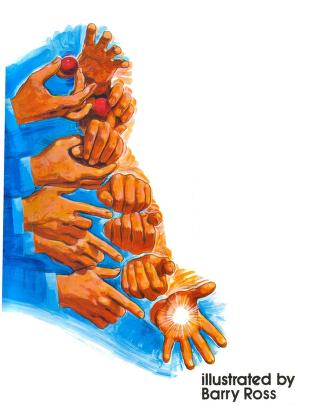
Take for example a simple magic trick where the magician shows you an open empty hand. The magician closes the hand, and does a gentle wiggle and then opens his hand to reveal a coin. He again closes his hands, and does another gentle wiggle and then opens the hand to show that his hand is empty. The magic happens from a self-referential operation. The spectator (or the observer) sees an empty hand and describes it to themselves as an empty hand. Later, when the magician shows their hand again, the hand now contains a coin. The spectator has to reference back to the previous state of empty hand, and face the moment of paradox. The hand that was empty now has a coin. The moment of magic comes only when the spectator can reference back to the empty hand. If we denote the empty hand as A, the value of the hand now is !A or in other words, not an empty hand. If the spectator cannot reference back to their original observation, they will not see the magic. From the magician’s standpoint, he should take care to make sure that this experience is as strong as possible. For example, he should take care to maintain the image of the hand with and without the coin, the same. This means that the position of the fingers, the gap between them, the gesture etc. are all maintained the same for the two states – one where the hand has no coin, and the second where the hand has a coin. This reinforces the “magic” for the spectator.
The idea of self-reference is of great importance in cybernetics. In logic, the idea of self-reference is shunned because it normally leads to paradoxes. A great example for a paradox is the liar paradox. One of the oldest forms of liar paradox is the statement that Epimenides, the Cretan made. He said that, “all Cretans are liars.” Since he himself was a Cretan, that would mean that he is also a liar, but that would mean that what he is saying is true, which means that he must be a liar… and so on. This goes into a paradox from the self-reference. There have been many solutions suggested for this conundrum. One of the ways to resolve any apparent paradox is to introduce temporality into this sentence. We can do this by making the statement slightly ambiguous and add the word “sometimes”. So, the sentence becomes, “all Cretans are liars sometimes.” The temporality suggests that the value for the statement and the person uttering the statement changes with time and this dissolves the paradox.
Paradoxes don’t exist in the “real world.” The reasonable conclusion is that they have something to do with our stubborn and rigid thinking. When we are unwilling to add temporality or ambiguity, we get stuck with our thinking. Another way to look at this is from a programmer’s standpoint. The statement a = a + 1, is valid from a computer program standpoint. Here the variable, “a” does not stand for a constant value. It is a placeholder for a value at a given point in time. Thus, although the equation a = a +1 is self-referential, it does not crash the computer because we introduce temporality to it, and we do not see “a” having one unique value at all times.
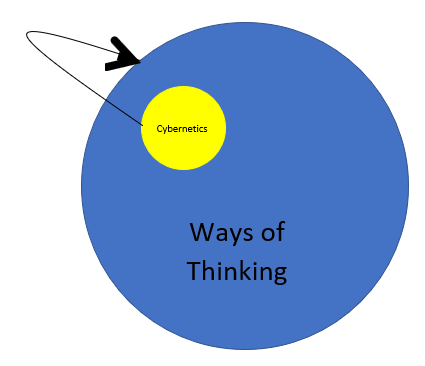
In Cybernetics, self-reference is accepted as a normal operation. Cyberneticians talk about second order concepts such as “understanding understanding” and “observing observing”. One of my favorite description of Cybernetics comes from Larry Richards. He describes cybernetics as a way of thinking about ways of thinking (of which it – cybernetics – is one). This is form of self-reference.
In Cybernetics, self-reference does not lead to paradox. Instead, it leads to a stable outcome. As cognizing agents, we build a stable reality based on self-reference. We can do activities such as thinking about thinking or learning about learning from this approach. Louis Kauffman talks about this:
Heinz von Foerster in his essays has suggested the enticing notion that “objects are tokens for eigen behaviors.” … The short form of this meaning is that there is a behavior between the perceiver and the object perceived and a stability or repetition that “arises between them.” It is this stability that constitutes the object (and the perceiver). In this view, one does not really have any separate objects, objects are always “objects perceived,” and the perceiver and the perceived arise together in the condition of observation.
We identify the world in terms of how we shape it. We shape the world in response to how it changes us. We change the world and the world changes us. Objects arise as tokens of behavior that leads to seemingly unchanging forms. Forms are seen to be unchanging through their invariance under our attempts to change, to shape them.
My post was inspired by the ideas of Spencer-Brown, Francisco Varela and Heinz von Foerster. I will finish with another gem from Heinz von Foerster:
I am the observed relation between myself and observing myself.
Please maintain social distance and wear masks. Please take vaccination, if able. Stay safe and Always keep on learning… In case you missed it, my last post wasTPS’s Operation Paradox:
Note: The point of a = a+ 1, was made also by Elena Esposito (Kalkul der Form).
In today’s post, I am looking at a simple idea – Loops, and will follow it up with Heinz von Foerster’s ideas on second order Cybernetics. A famous example of a loop is “PDCA”. The PDCA loop is generally represented as a loop – Plan-Do-Check-Act-Plan-Do…, and the loop is represented as an iterative process where it goes on and on. To me, this is a misnomer and misrepresentation. These should be viewed as recursions. First, I will briefly explain the difference between iteration and recursion. I am using the definitions of Klaus Krippendorff:
Iteration – A process for computing something by repeating a cycle of operations.
Recursion – The attribute of a program or rule which can be applied on its results indefinitely often.
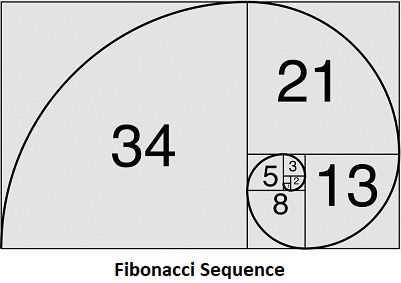
In other words, iteration is simply repetition. In a program, I can say to print the word “Iteration” 5 times. There is no feedback here, other than to keep count of the times the word was printed on screen. On the other hand, in recursion, the value of the first cycle is fed back into the second cycle, the output of which is fed into the third cycle and so on. Here circular feedback is going on. A great example of a recursive function is the Fibonnaci sequence. The Fibonacci sequence is expressed as follows:
Fn = Fn-1 + Fn-2, for n > 1
Fn = 1, for n = 0 or 1
Here, we can see that the previous value is fed into the equation to create a new value, and this is an example of recursion.
From the complexity science standpoint, recursions lead to interesting phenomenon. This is not an iterative non-feedback loop any longer, where you come back to the same point again and again. With recursion, you get to circular causality with each loop, and you enter a new state altogether. Each loop is directly impacted by the previous loop. Anything that leads back to its original starting point doesn’t lead to emergence and can actually lead to a paradox. A great example is the liar paradox. In a version of this, a card has a statement written on both sides of a card. They are as follows:
The statement on the other side of this card is FALSE.
The statement on the other side of this card is TRUE.
This obviously leads to a paradox when you follow it along a loop. You do not get to a new state with each iteration. Douglas Hofstadter wonderfully explained this as a mirror mirroring itself. However, with recursion, a wonderful emergence can happen, as we see in complexity science. Circular causality and recursion are ideas that have strong footing in Second Order Cybernetics. A great example of this is to look at the question – how do we make sense of the world around us? Heinz von Foerster, the Socrates of Cybernetics, has a lot to say about this. As Bernard Scott notes:
For Heinz von Foerster, the goal of second-order cybernetics is to explain the observer to himself, that is, it is the cybernetics of the cybernetician. The Greek root of cybernetics, kubernetes, means governor or steersman. The questions asked are; who or what steers the steersman, how is the steersman steered and, ethically, how does it behoove the steersman to steer himself? Von Foerster begins his epistemology, in traditional manner, by asking, “How do we know?” The answers he provides-and the further questions he raises-have consequences for the other great question of epistemology, “What may be known?” He reveals the creative, open-ended nature of the observer’s knowledge of himself and his world.
Scott uses von Foerster’s idea of undifferentiated coding to explore this further. I have written about this before here.
Undifferentiated coding is explained as below:
The response of a nerve cell encodes only the magnitude of its perturbation and not the physical nature of the perturbing agent.
Scott continues:
Put more specifically, there is no difference between the type of signal transmitted from eye to brain or from ear to brain. This raises the question of how it is we come to experience a world that is differentiated, that has “qualia”, sights, sounds, smells. The answer is that our experience is the product of a process of computation: encodings or “representations” are interpreted as being meaningful or conveying information in the context of the actions that give rise to them. What differentiates sight from hearing is the proprioceptive information that locates the source of the signal and places it in a particular action context.
Von Foerster explained the circular relationship between sense data and experiences as below:
The motorium (M) provides the interpretation for the sensorium (S) and the sensorium provides the interpretation for the motorium.
How we make sense depends on how we experience, and how we experience depends upon how we make sense. As Scott notes, we can explain the above relationship as follows:
S = F(M). Sensorium, S, is a function of motorium, M.
M = G(S). Motorium, M, is a function of sensorium, S.
Von Foerster pointed out that this is an open recursive loop, since we can replace M with G(S).
S=F(G(S))
With more replacements for the “S”, this equation becomes an open recursive loop as follows:
S=F(G(F(G(F(G(…………G(S)))))……
Scott continues:
Fortunately, the circularity is not vicious, as in the statement “I am a liar”. Rather, it is virtuous or, as von Foerster calls it, it is a creative circle, which allows us to “transcend into another domain”. The indefinite series is a description of processes taking place in sequence, in “time”, with steps t, t+1, t+2 and so on. (I put “time” in quotes as a forward marker for discussion to come). In such indefinite recursive expressions, solutions are those values of the expression which, when entered into the expression as a base, produce themselves. These are known as Eigen values (self-values). Here we have the emergence of stabilities, invariances. The “objects” that we experience are “tokens” for the behaviors that give rise to those experiences. There is an “ultimate” base to these recursions: once upon a “time”, the observer came into being. As von Foerster neatly puts it, “an observer is his own ultimate object”.
The computations that give rise to the experience of a stable world of “objects” are adaptations to constraints on possible behaviors. Whatever else, the organism, qua system, must continue to compute itself, as a product. “Objects” are anything else it may compute (and recompute) as a unitary aspect of experience: things, events, all kinds of abstraction. The possible set of “objects” it may come to know are limited only by the organism’s current anatomy and the culture into which she is born.
Heinz von Foerster said – The environment contains no information; it is as it is. We are informationally closed entities, which means that information cannot come from outside to inside. We make meanings out of the perturbations and we construct a reality that our interpretative framework can afford.
I will finish with a great observation from the Cybernetist philosopher Yuk Hui:
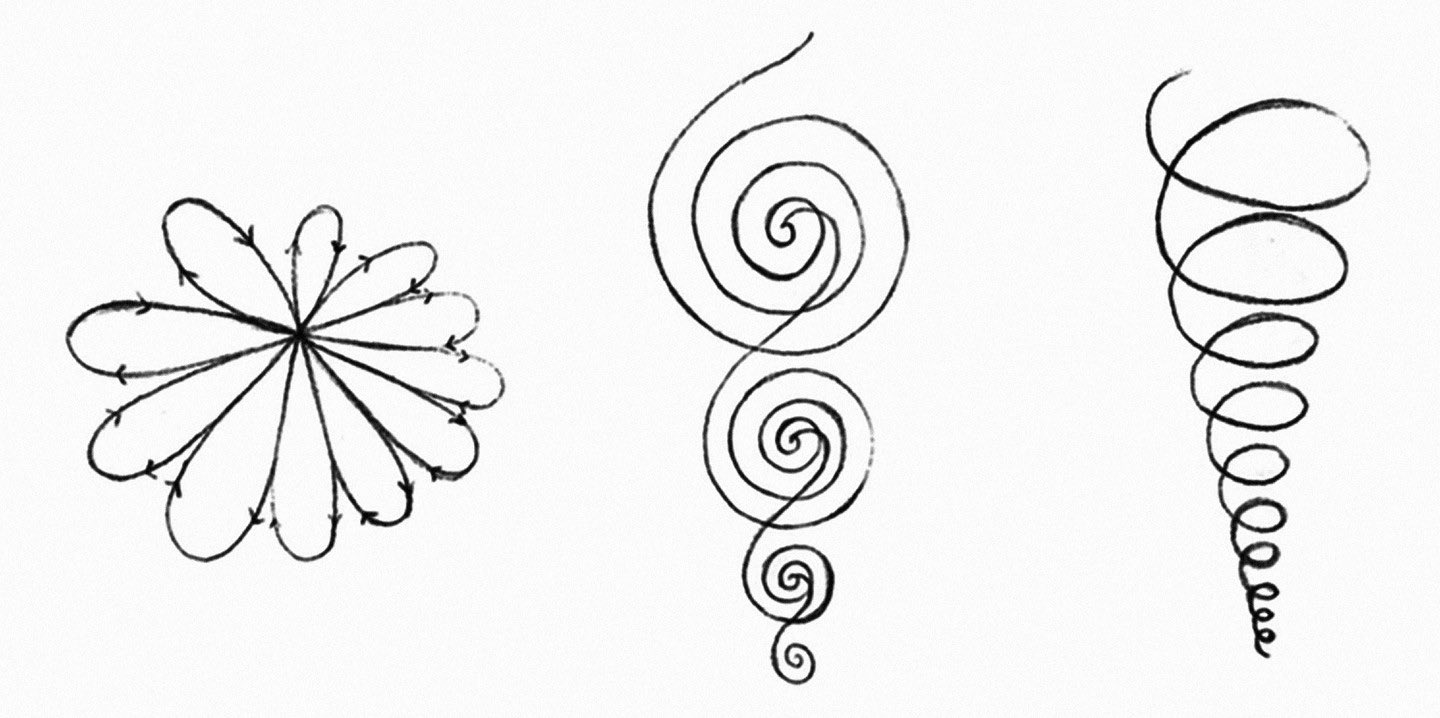
Recursivity is a general term for looping. This is not mere repetition, but rather more like a spiral, where every loop is different as the process moves generally towards an end, whether a closed one or an open one.
Please maintain social distance and wear masks. Stay safe and Always keep on learning…
In today’s post, I am looking at the ideas inspired by mirror neurons. Mirror neurons are a class of neurons that activate when someone engages in an activity or when they observe the same activity being performed by someone else. It was first identified by a group of Italian neurophysiologists led by Giacomo Rizzolatti in the 1980s. They were studying macaque monkeys. As part of their research, they placed electrodes in the monkeys’ brains to study hand and mouth motions. The story goes that the electrodes sent signals when the monkeys observed the scientists eating peanuts. The same neurons that fired when the monkeys were eating peanuts fired when they merely observed the same action. Several additional studies indicate that the mirror neurons are activated to respond to goal-oriented actions. For example, when the scientist covered the peanut bowl, and performed the action of picking a peanut and eating, the mirror neurons still fired even though the monkeys could not see the peanut bowl. However, when the scientist simply mimicked the action of taking a peanut without a peanut bowl, the neurons did not fire. There have been several hypotheses regarding the mirror neurons such as they facilitate learning by copying, and that they are the source for empathy.
The most profound idea about mirror neurons is that action execution and action observation are tightly coupled. Our ability to interpret or comprehend other’s actions involve our own motor system. For example, when we observe someone doing an action, depending upon whether we have performed the action adds depth to how we can observe the action being performed. If I am watching a ballet and the ballerina performs a difficult move, I may not fully grasp what I have seen since I do not know ballet and because I have never performed it. However, if I watch a spin bowler in Cricket throwing an off-spin, I will be able to grasp it better and possibly tell how the ball is going to spin. This is because I have played a lot of Cricket as a youth. The same with a magician performing a sleight of hand.
The idea of mirror neurons brings an extra depth to the meaning of going to the gemba. Going to gemba is a key tenet of Toyota Production System. We go to the gemba, where the action is, to grasp the current situation. We go there to observe. Gemba, it is said, is our best teacher. When we go there to observe the work being performed, we may get a different experience depending upon whether we ourselves have performed the work or not. Heinz von Foerster, the Socrates of Cybernetics, said – if you want to see, learn how to act. He was talking about the circular loop of sensorium and motorium. In order to see, there has to be interaction between the sensorium and motorium.
In a similar way, Kiichiro Toyoda, the founder of Toyota Motor Corporation is said to have remarked that engineers would never amount to anything unless they had to wash their hands at least three times a day; the evidence they were getting their hands dirty from real work.
I will finish with a great advice from Taiichi Ohno:
Don’t look with your eyes, look with your feet. Don’t think with your head, think with your hands.
Please maintain social distance and wear masks. Stay safe and Always keep on learning…
In today’s post, I will be following the thoughts from my previous post, Consistency over Completeness. We were looking at each one of us being informationally closed, and computing a stable reality. The stability comes from the recursive computations of what is being observed. I hope to expand the idea of stability from an individual to a society in today’s post.
Humberto Maturana, the cybernetician biologist (or biologist cybernetician) said – anything said is said by an observer. Heinz von Foerster, one of my heroes in cybernetics, expanded this and said – everything said is said to an observer. Von Foerster’s thinking was that language is not monologic but always dialogic. He noted:
The observer as a strange singularity in the universe does not attract me… I am fascinated by images of duality, by binary metaphors like dance and dialogue where only a duality creates a unity. Therefore, the statement.. – “Anything said is said by an observer” – is floating freely, in a sense. It exists in a vacuum as long as it Is not embedded in a social structure because speaking is meaningless, and dialogue is impossible, if no one is listening. So, I have added a corollary to that theorem, which I named with all due modesty Heinz von Foerster’s Corollary Nr. 1: “Everything said is said to an observer.” Language is not monologic but always dialogic. Whenever I say or describe something, I am after all not doing it for myself but to make someone else know and understand what I am thinking of intending to do.
Heinz von Foerster’s great insight was perhaps inspired by the works of his distant relative and the brilliant philosopher, Ludwig Wittgenstein. Wittgenstein proposed that language is a very public matter, and that a private language is not possible. The meaning of a word, such as “apple” does not inherently come from the word “apple”. The meaning of the word comes from how it is used. The meaning comes from repeat usage of the word in a public setting. Thus, even though the experience of an apple may be private to the individual, how we can describe it is by using a public language. Von Foerster continues:
When other observers are involved… we get a triad consisting of the observers, the languages, and the relations constituting a social unit. The addition produces the nucleus and the core structure of society, which consists of two people using language. Due to the recursive nature of their interactions, stabilities arise, they generate observers and their worlds, who recursively create other stable worlds through interacting in language. Therefore, we can call a funny experience apple because other people also call it apple. Nobody knows, however, whether the green color of the apple you perceive, is the same experience as the one I am referring to with the word green. In other words, observers, languages, and societies are constituted through recursive linguistic interaction, although it is impossible to say which of these components came first and which were last – remember the comparable case of hen, egg and cock – we need all three in order to have all three.
Klaus Krippendorff defined closure as follows – A system is closed if it provides its own explanation and no references to an input are required. With closures, recursions are a good and perhaps the only way to interact. As organizationally closed entities, we are able to stay viable only as part of a social realm. When we are part of a social realm, we have to construct reality with reference to an external reference. Understanding is still generated internally, but with an external point of reference. This adds to the reality of the social realm as a collective. If the society has to have an identity that is sustained over time, its viability must come from its members. Like a set of nested dolls, society’s structure comes from participating individuals who themselves are embedded recursively in the societal realm. The structure of the societal or social realm is not designed, but emergent from the interactions, desires, goals etc. of the individuals. The society is able to live on while the individuals come and go.
I am part of someone else’s environment, and I add to the variety of their environment with my decisions and actions (sometimes inactions). This is an important reminder for us to hold onto in light of recent world events including a devastating pandemic. I will finish with some wise words from Heinz von Foerster:
A human being is a human being together with another human being; this is what a human being is. I exist through another “I”, I see myself through the eyes of the Other, and I shall not tolerate that this relationship is destroyed by the idea of the objective knowledge of an independent reality, which tears us apart and makes the Other as object which is distinct from me. This world of ideas has nothing to do with proof, it is a world one must experience, see, or simply be. When one suddenly experiences this sort of communality, one begins to dance together, one senses the next common step and one’s movements fuse with those of the other into one and the same person, into a being that can see with four eyes. Reality becomes communality and community. When the partners are in harmony, twoness flows like oneness, and the distinction between leading and being led has become meaningless.
Please maintain social distance and wear masks. Stay safe and Always keep on learning…


 Harish's Notebook - My notes... Lean, Cybernetics, Quality & Data Science.