In today’s post, I will be following the thoughts from my previous post, Consistency over Completeness. We were looking at each one of us being informationally closed, and computing a stable reality. The stability comes from the recursive computations of what is being observed. I hope to expand the idea of stability from an individual to a society in today’s post.
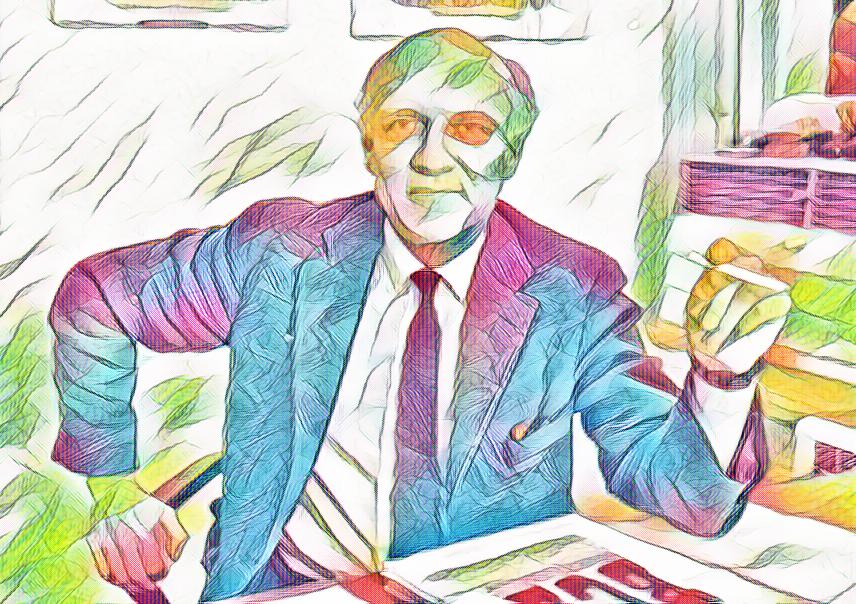
Humberto Maturana, the cybernetician biologist (or biologist cybernetician) said – anything said is said by an observer. Heinz von Foerster, one of my heroes in cybernetics, expanded this and said – everything said is said to an observer. Von Foerster’s thinking was that language is not monologic but always dialogic. He noted:
The observer as a strange singularity in the universe does not attract me… I am fascinated by images of duality, by binary metaphors like dance and dialogue where only a duality creates a unity. Therefore, the statement.. – “Anything said is said by an observer” – is floating freely, in a sense. It exists in a vacuum as long as it Is not embedded in a social structure because speaking is meaningless, and dialogue is impossible, if no one is listening. So, I have added a corollary to that theorem, which I named with all due modesty Heinz von Foerster’s Corollary Nr. 1: “Everything said is said to an observer.” Language is not monologic but always dialogic. Whenever I say or describe something, I am after all not doing it for myself but to make someone else know and understand what I am thinking of intending to do.
Heinz von Foerster’s great insight was perhaps inspired by the works of his distant relative and the brilliant philosopher, Ludwig Wittgenstein. Wittgenstein proposed that language is a very public matter, and that a private language is not possible. The meaning of a word, such as “apple” does not inherently come from the word “apple”. The meaning of the word comes from how it is used. The meaning comes from repeat usage of the word in a public setting. Thus, even though the experience of an apple may be private to the individual, how we can describe it is by using a public language. Von Foerster continues:
When other observers are involved… we get a triad consisting of the observers, the languages, and the relations constituting a social unit. The addition produces the nucleus and the core structure of society, which consists of two people using language. Due to the recursive nature of their interactions, stabilities arise, they generate observers and their worlds, who recursively create other stable worlds through interacting in language. Therefore, we can call a funny experience apple because other people also call it apple. Nobody knows, however, whether the green color of the apple you perceive, is the same experience as the one I am referring to with the word green. In other words, observers, languages, and societies are constituted through recursive linguistic interaction, although it is impossible to say which of these components came first and which were last – remember the comparable case of hen, egg and cock – we need all three in order to have all three.
Klaus Krippendorff defined closure as follows – A system is closed if it provides its own explanation and no references to an input are required. With closures, recursions are a good and perhaps the only way to interact. As organizationally closed entities, we are able to stay viable only as part of a social realm. When we are part of a social realm, we have to construct reality with reference to an external reference. Understanding is still generated internally, but with an external point of reference. This adds to the reality of the social realm as a collective. If the society has to have an identity that is sustained over time, its viability must come from its members. Like a set of nested dolls, society’s structure comes from participating individuals who themselves are embedded recursively in the societal realm. The structure of the societal or social realm is not designed, but emergent from the interactions, desires, goals etc. of the individuals. The society is able to live on while the individuals come and go.
I am part of someone else’s environment, and I add to the variety of their environment with my decisions and actions (sometimes inactions). This is an important reminder for us to hold onto in light of recent world events including a devastating pandemic. I will finish with some wise words from Heinz von Foerster:
A human being is a human being together with another human being; this is what a human being is. I exist through another “I”, I see myself through the eyes of the Other, and I shall not tolerate that this relationship is destroyed by the idea of the objective knowledge of an independent reality, which tears us apart and makes the Other as object which is distinct from me. This world of ideas has nothing to do with proof, it is a world one must experience, see, or simply be. When one suddenly experiences this sort of communality, one begins to dance together, one senses the next common step and one’s movements fuse with those of the other into one and the same person, into a being that can see with four eyes. Reality becomes communality and community. When the partners are in harmony, twoness flows like oneness, and the distinction between leading and being led has become meaningless.
Please maintain social distance and wear masks. Stay safe and Always keep on learning…
In case you missed it, my last post was Consistency over Completeness:
Source – The Certainty of Uncertainty: Dialogues Introducing Constructivism By Bernhard Poerksen