Kintsukuroi and Kaizen:

kintsukuroi_tunasima

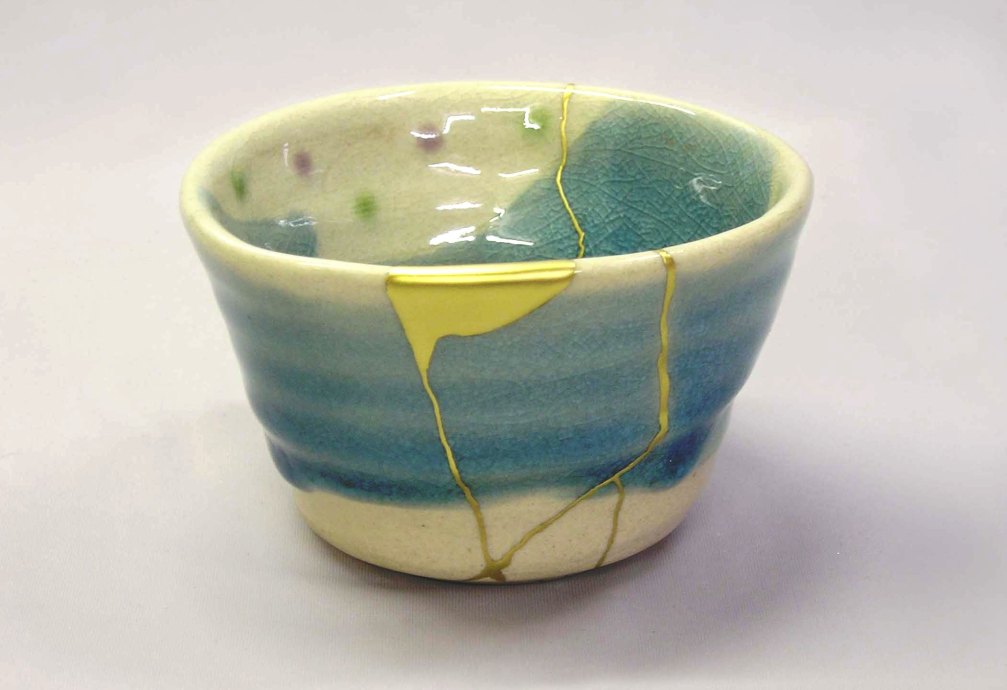
In today’s post, I will look at kintsukuroi and how it applies to lean. Kintsukuroi can be translated from Japanese as “to repair with gold”. This process converts broken ceramic pieces to beautiful art forms. The damaged piece is not thrown away, but is embellished by filling the cracks with a lacquer mixed with gold dust. The final product becomes more valuable than the original.

The Origin Story of Kintsukuroi:

There are several versions of the origin story.

Toyotomi Hideyoshi was a ferocious military ruler in Japan during the 1500’s. He was well known for his quick temper.

He hosted tea ceremonies which were well attended. He was particularly fond of a Korean Ido-style tea bowl. One day, a page handling the bowl accidentally dropped it and it broke into several pieces. Hideyoshi was furious at the page, and everybody feared for the poor page’s life.

One of the guests calmed the military ruler, and went away with the broken pieces of the bowl. He returned after a few days with a fully restored bowl that was “repaired with gold”. Hideyoshi was blown away by the beauty of the restored bowl, and he loved the repaired bowl even more. The repaired bowl was more valuable, more beautiful and became more cherished.

What can we learn from this?

I have been learning about Japanese culture for some time now and the concept of kintsukuroi fascinates me. The readers of my blog know that I enjoy connecting things together. I believe that the concept of kintsukuroi creates a new perspective on Kaizen.

As a lean leader, we should look at breaking the current process, and restoring it through process improvements (Kaizen). We are sometimes too close to the action that we fail to see the wastes in the process. We believe that the current process is adequate as is. We may not see opportunities to improve.

However, we should break apart the bowl, and restore it with gold. We should evaluate the process through the steps of ECRS:

  • Are there any steps we can Eliminate?
  • Are there any steps that we can Combine?
  • Are there any steps that we can Rearrange?
  • Are there any steps we can Simplify?

This is the basic idea of Kaizen. The new process should be more valuable than the old process, in that it has fewer wastes and it utilizes the available resources efficiently and effectively.

Each kintsukuroi process is unique. Similarly each process improvement activity is unique. One should understand the problem first and apply solutions. To understand the problem, one must break apart the process (bowl). Once the process is broken apart, one should utilize Kaizen thinking (gold lacquer mix) and put the process back together.

Always keep on learning…

If you enjoyed this post, you can read more here.

In case you missed it, my last post was What is my purpose?

What is my purpose?

purpose

Peter Drucker declared in his 1954 book “The Practice of Management” that the purpose of a business is to create a customer. In today’s post I will talk about purpose, specifically what do I think my purpose is at work? There is of course the utilitarian answer about my purpose at work – to fulfill my job duties/responsibilities. However, fulfilling the job duties/responsibilities does not always complete my purpose.

The purpose is to create/increase value in anything I do:

Peter Drucker in the book “The Practice of Management” talks about understanding customers. He notes that the manufacturer of gas kitchen stoves should not consider himself to be in competition with only other gas kitchen stove manufacturers. The customer is not just buying a stove. The customer is looking for the easiest way to cook food. There are many forms of stoves/utensils available to the customer that are in direct competition. There are several different ways to cook food including microwave ovens, cooking ranges, grills, etc. Ignoring them will result in loss of business. This example may be outdated. However, the core idea is applicable here. If you are simply fulfilling just your basic job duties/responsibilities, you are like the gas stove manufacturer. You will not grow and develop yourself if you just stick to your defined duties/responsibilities and you will eventually get passed by.

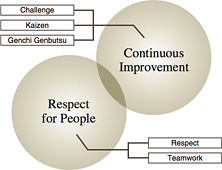
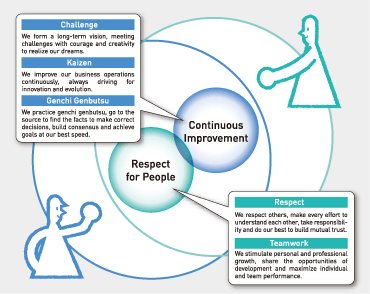
Your purpose is to create/increase value in anything you do. From a Toyotayesque philosophy, this is similar to the Continuous Improvement attitude. You are always trying to improve what you are doing. You are expanding your boundaries and you have a responsibility to develop yourself. One of the two pillars for the Toyota Philosophy identified in the Toyota Way 2001 is “Continuous Improvement”. The first key concept for “Continuous Improvement” is the “Spirit of Challenge”. In Jeffrey Liker’s “The Toyota Way to Lean Leadership”, Liker talks about the Spirit of Challenge as follows;

“Like the two founding Toyoda family members, every Toyota leader is expected not just to excel in his current role but to take on the challenges to achieve a bold vision with energy and enthusiasm.”

toyotaway_img01

The two Toyoda family members are Sakichi Toyoda and Kiichiro Toyoda. I have referenced them in my last two posts. It is likely that Liker meant every Toyota employee when he said Toyota leader. This type of thinking is instilled from an organization standpoint. To quote Peter Drucker again;

“Most people need to feel that they are here for a purpose, and unless an organization can connect to this need to leave something behind that makes this a better world, or at least a different one, it won’t be successful over time.”

Toyota has a core concept of True North. True North is your ideal state. You can never truly achieve this. However, it is your responsibility to strive moving towards your True North.

Final Words and a story on purpose:

I am a firm believer of taking responsibility and authority to do the right thing, and to develop yourself. One must always try to increase/add value in what they do. Increasing value in what you do ultimately increases your value. This is the Spirit of Challenge. This is your inner purpose.

I will finish off with an anecdote, I heard from the Indian author Shiv Khera (in his words).

16 years ago in Singapore I gave a taxi driver a business card to take me to a particular address. At the last point he circled round the building. His meter read 11$ but he took only 10.

I said Henry, your meter reads 11$ how come you are taking only 10.

He said Sir, I am a taxi driver, I am supposed to be bringing you straight to the destination. Since I did not know the last spot, I had to circle around the building. Had I brought you straight here, the meter would have read 10$. Why should you be paying for my ignorance?

He said Sir, legally, I can claim 11$ but ethically I am entitled to only 10. He further added that Singapore is a tourist destination and many people come here for three or four days. After clearing the immigrations and customs, the first experience is always with the taxi driver and if that is not good, the balance three to four days are not pleasant either. He said Sir I am not a taxi driver, I am the Ambassador of Singapore without a diplomatic passport.

In my opinion he probably did not go to school beyond the 8th grade, but to me he was a professional. To me his behavior reflected pride in performance and character. That day I learnt that one needs more than professional qualification to be a professional.

Always keep on learning…

In case you missed it, my last post was Toyota Production System House – Just-in-Time (JIT) and Jidoka (Part 2).

Toyota Production System House – Just-in-Time (JIT) and Jidoka (Part 2):

jidoka

I talked about the two conceptual houses of Toyota last week. In today’s post we will look JIT and Jidoka, the two pillars of the Toyota Production System house. The two pillars of the TPS house are actually based on the ideas of Sakichi Toyoda (Jidoka) and Kiichiro Toyoda (JIT). Ohno built his production system on the shoulders of these two giants.

Sakichi Toyoda, father of Kiichiro Toyoda, founded Toyoda Automatic Loom Works in 1926. Sakichi was an inventor and considered to be an eccentric (Source: Fifty Years in Motion, Eiji Toyoda 1985). His greatest invention was perhaps the Type G Automatic Loom, a non-stop shuttle change automatic loom. Sakichi sold the license to the Platt Brothers and Co. in England.

There is a great story about Sakichi Toyoda in Eiji Toyoda’s book, regarding the automatic loom invention. The looms used to be manually operated and were made of wood. Sakichi wanted to create a loom that ran on power. The best power source in his days was steam. He purchased a used steam engine to understand how it worked and to use that to power his looms. The looms however did not move because the steam kept leaking. Sakichi took the engine apart and found that the problem was worn down piston rods that caused the steam to leak. This would be an easy fix to have new rods turned down on a lathe. Sakichi, however, did not have access to a lathe. So Sakichi and his team spent a whole night manually filing the rods down! When they put the rods in the engine, it worked.

Kiichiro Toyoda, Sakichi’s son, formed an automotive division under Toyoda Automatic Loom Works. He later spun this off, and created Toyota Motor Company in 1937. He calculated that with a population of one hundred million people in Japan, a car-to-people ratio of 1:10 would equate to ten million cars. If there was a 10 percent replacement per year, this would equate to one million cars. He thought that this was a good reason to start a car company.

Just-in-Time:

Kiichiro Toyoda, who founded the Toyota Motor Corporation, had come up with the idea of making the right parts at the right time, and in the right amount. In those days, the norm was to use a lot production system. This is based on producing parts according to what the operation can produce. Thus, there was a disjoint between what is actually needed, and what the operation produced. The operation tended to produce as much as it could to be efficient. This led to high inventories, which led to large stock rooms to store these inventories. Kiichiro understood that this automatically increased the cost to run the business, something that Toyota struggled with tremendously in the beginning. He decided to switch over entirely to a flow-type production system. He called this the “just-in-time” concept:

“I believe that the most important thing is to ensure that there is neither shortage nor excess, that is, to ensure that there is no excess labor and time for the designated production. There is no waste and there is no excess. It means not having to wait for parts to be circulated around. For Just-in-Time, it is important that each part be ready ‘just in time’. This is the first principle of increasing efficiency.” (Source: July 1938 issue of Motor, Toyota-Global website)

Just make what is needed in time, but don’t make too much.” (Source: Fifty Years in Motion, Eiji Toyoda 1985)

Kiichiro wrote a four inch binder manual detailing his ideas for JIT. His ideas were used at Toyoda Automatic Loom Works, which is where Taiichi Ohno first joined Toyota at. Kiichiro tried to implement this at the Koroma plant, Toyota’s second automotive manufacturing facility. It did not take hold at the Koromo plant due to part shortages when the war with China (2nd Sino-Japanese War and World War II) expanded into the Pacific. It is said that Eiji Toyoda, Kiichiro Toyoda’s cousin, requested Ohno’s help to implement Just-in-Time at the Koroma plant.

Mr. Ohno”, Eiji said, “this plant looks like a storeroom. Can you do something to take care of this?” Eiji wanted to pleasantly surprise the big man (Kiichiro Toyoda) and show that Just-in-Time was already in operation at the Koroma plant. (Source: The Toyota Leaders, Massaki Sato.)

It should be noted that Eiji Toyoda was a strong supporter of Taiichi Ohno, and stood behind him when he was developing the system. In Taiichi Ohno’s words – “Our approach has been to investigate one by one the causes of various unnecessaries in manufacturing operations and to devise methods for their solution, often by trial and error.”

Ohno would later on create the Kanban system to incorporate the Just-in-Time philosophy.

Jidoka:

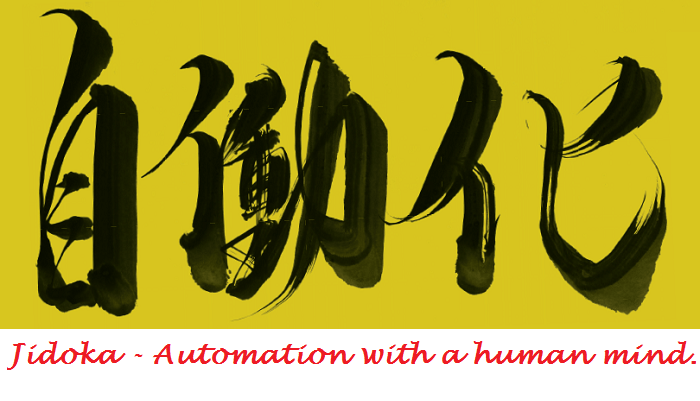
Jidoka in Japanese stands for “automation”. Toyota added an extra character representing “human” in Japanese to mean “autonomation” or “automation with a human mind”. In Japanese, both words can be expressed as “Jidoka”. The word autonomation comes from joining “autonomous” and “automation”.

There are two approaches to autonomation at Toyota. The first approach is to separate the operator’s work from the machine’s work. This means to treat the operator as being independent of the machine, or in other words the operator can operate multiple machines simultaneously. The norm had been to have one operator dedicated to one machine only. The operator had to watch the machine work, while not creating value at the same time. In his mind, he was creating value by simply watching the machine operate. The second approach is to have the machine detect an anomaly and stop by itself. This would prevent the machine from producing more defects. Additionally this will also force the operator to fix the problem immediately to maintain the flow of the process. Both of these ideas belonged to Sakichi Toyoda, father of Kiichiro Toyoda. His Type G loom was an automatic loom that stopped on its own when any of the threads broke. Thus, the loom did not continue producing defectively. Sakichi had successfully implemented the two approaches at the Toyoda Automatic Loom Works. At the Toyoda Automatic Loom Works, one operator could operate 25 automatic looms at the same time.

Soon after World War II, Kiichiro declared the company goal of catching up with America’s productivity within 3 years. In order to do this, Taiichi Ohno used the idea of having an operator in charge of multiple machines at a time. This increased the productivity by many fold. However, this came with its own problems. The machines were not aligned properly so that when the machine was done with its operation, instead of stopping it kept on making parts. Additionally, if the machine malfunctioned, it continued making defective parts. Thus, even though the productivity increased, it put a strain on process flow and quality.

In order to counter the flow problems, Ohno utilized machine layout and limit switches so that the machine stopped producing when the required amount of parts were produced. For the quality problems, Taiichi Ohno utilized the second approach of Jidoka, to have the machine stop production on its own when there is a problem or when the required quantity is made. This idea of Jidoka is to build in quality, ensuring that defective parts are not passed to the next station. This theme evolved into empowering the operator and giving him the authority and responsibility to stop the line if they identified a problem on the line. The operator would pull on the andon cord which would trigger an audio and visual signal for the lead or supervisor to come and help in fixing the problem. If the problem is not fixed in the allotted time, the entire line will stop until it is fixed.  Jidoka develops the operators to look for problems and then solve it. Jidoka thus evolved into a strong training tool and an employee empowerment tool for Toyota. Jidoka placed a spotlight on problems.

Final Words:

Ohno created the Toyota Production System based on the ideas from Kiichiro Toyoda (Just-in-Time) and Sakichi Toyoda (Stop on Defect).  It should be noted that all of the “tools” in TPS were created for the two pillars to work effectively. At first, the goal of TPS was to increase productivity to catch up with Detroit. However, as the productivity increased, it became necessary to maintain quality, and to ensure that the employees are challenged to continuously improve their processes.

I will finish off with an Ohno story. This was told by Michikazu Tanaka in the 2009 book “The Birth of Lean.”

Ohno was very interested in the Supermarket system that was in America. Ohno explained with passion to Tanaka how Toyota can utilize the concept of a Supermarket. Tanaka could not quite grasp the concept since supermarkets were still a foreign concept in Japan, where the shopkeepers fetched the items for the customers. Tanaka was amazed that the shopkeepers would let the customers freely pick what they want from the display, and pay as you go out.

“What would happen,” he asked Ohno, “if someone went in and ate a bunch of food without paying?”

Ohno was stumped and he did not have a good answer for Tanaka. He thought for a while, and said “I suppose that Americans are a people of integrity and they would know not to do that!”

Later on when Ohno implemented kanbans, he told the people on the floor Kanban is like money; if you take out parts without kanban, you are stealing the parts”. (Source: The Evolution of a Manufacturing System at Toyota, Fujimoto)

Always keep on learning…

In case you missed it, my last post was The Two Houses of Toyota.

The Two Houses of Toyota (part 1):

2

Toyota is famous for manufacturing automobiles. You may not know that Toyota also builds residential houses. You can learn more about it here. I will not be talking about the real livable Toyota houses today. I will be talking about the “conceptual” Toyota houses.

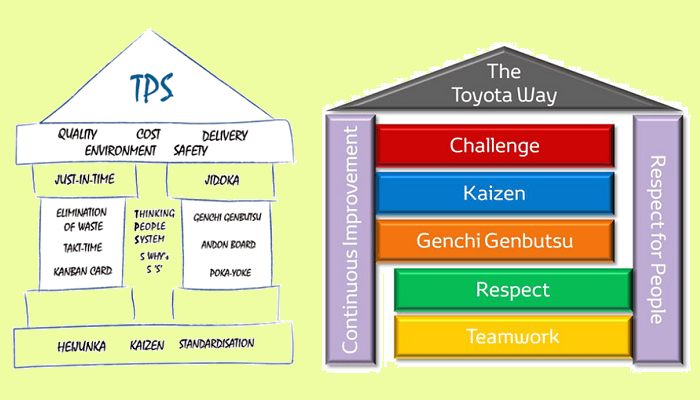
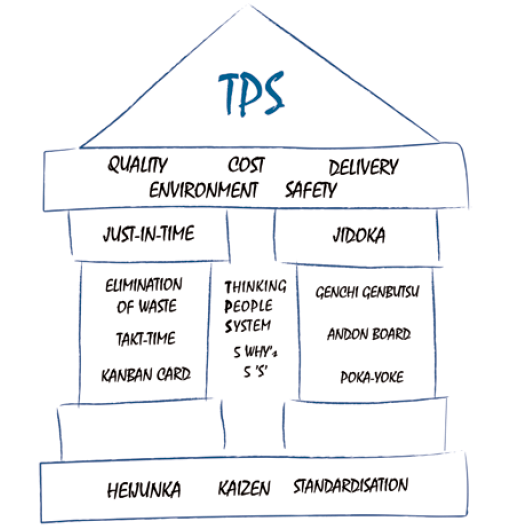
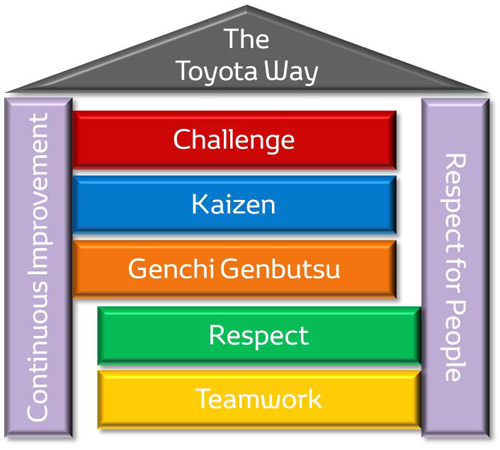
A lean enthusiast is familiar with the Toyota Production House. The house has two pillars – Jidoka and Just-in-Time. In 2001, Toyota revealed their organization’s guiding principles known as the Toyota Way. The Toyota Way also has two pillars – Continuous Improvement and Respect for People. There are literally thousands of depictions of the Toyota houses available online. The majority of these were created by non-Toyota people. I wanted to use only the depictions from a Toyota website.

The first house is the “Toyota Production House”. The picture below is taken from a Toyota Europe Forklift brochure. The reader can click on the picture to open the link to the brochure.

TPS

The second house is the “Toyota Way” house. The house below is taken from the Toyota Italy website. The reader can click on the picture to open the link.

way

First Descriptions of the Pillars:

From what I could find, the two pillars of TPS were first described officially in the “The first book of Toyota Production System”, an internal document released in 1973. The two pillars were later described in Taiichi Ohno’s 1978 book – “Toyota Production System”. Detailed descriptions of Respect for People and Continuous Improvement can also be found in the “The first book of Toyota Production System.” However, the Toyota Way house was not described in these earlier documents as it is currently.

It is interesting to note that starting in 1945, Taiichi Ohno began developing the Toyota Production System, but did not have the system documented until later. Norman Bodek, in his Foreword to Taiichi Ohno’s book “Toyota Production System” speculated that Ohno had feared Americans would discover his ideas and use them against the Japanese.

Fujio Cho, who was one of the people behind “The first book of Toyota Production System”, co-authored the 1977 paper “Toyota production system and Kanban system, Materialization of just-in-time and respect-for-human system”. This paper is available here. The roots of Toyota Way can be found in the paper. The section below is taken from the paper, and it is evident that Fujio Cho, the main architect of the Toyota Way 2001, had been thinking about the strategy for Toyota Production System:

Toyota is planning and running its production system on the following two basic concepts. First of all, the thing that corresponds to the first recognition of putting forth all efforts to attain low cost production is “reduction of cost through elimination of waste”. This involves making up a system that will thoroughly eliminate waste by assuming that anything other than the minimum amount of equipment, materials, parts, and workers (working time) which are absolutely essential to production are merely surplus that only raises the cost. The thing that corresponds to the second recognition of Japanese diligence, high degree of ability, and favoured labour environment is ” to make full use of the workers’ capabilities”. In short, treat the workers as human beings and with consideration. Build up a system that will allow the workers to display their full capabilities by themselves.

The Relationship Between the Two Houses:

Simon Dorrat, Manager of Toyota’s Business Intelligence function (2008 – 2013), has succinctly summed up the relationship between the two houses:

“The Toyota Production System is a practical expression of The Toyota Way – principles that guide everything we do in Toyota, based on Continuous Improvement and Respect for People.”

The Toyota Way 2001 represents the “What” and the “Why”, while the TPS House represents the “How”. In some ways this is akin to strategy and tactics.

Final Words – Even Ohno is fallible:

I will be exploring the pillars of the two Toyota houses in the future. I will finish this post with an Ohno story about Jidoka, one of the two pillars of the TPS house.

Even though Taiichi Ohno was a proponent of Genchi Genbutsu (Going to Gemba to learn actual facts), he was not infallible at this. Taiichi Ohno opened up in an interview with Michael Cusumano, author of the 1985 book – “The Japanese Automobile Industry – Technology and Management at Nissan and Toyota”. Ohno revealed that he had never tried to operate more than one machine at a time to see if it is easy or hard.

As part of implementing Jidoka at the Toyota automobile facility (Koroma plant), Ohno separated the operator’s work from the machine’s work. He treated the operator as being independent of the machine, and he had the operator work multiple machines simultaneously. The norm had been to have one operator dedicated to one machine only. The operator felt that he was creating value by simply watching the machine operate. Ohno understood that the operator is not adding value by watching over the machine. However, the operators hated operating several machines at once. Ohno admitted to Michael that he never felt the need to try operating several machines simultaneously to see how easy or hard it was. (Source: The Japanese Automobile Industry – Technology and Management at Nissan and Toyota, Michael Cusumano). Perhaps, it was because Ohno knew that the technique of one operator managing multiple machines was already successfully implemented at Toyoda Automatic Loom Works by Sakichi Toyoda, father of the founder of Toyota Motor Corporation. Ohno started at Toyota by working for the Loom Plant.

Ohno would later add in the interview that “Had I faced the Japan National Railways union or an American Union, I might have been murdered.” Ohno did have the support of the employee union at Toyota, as well as the upper management. Thus there was no immediate danger to Ohno’s life.

Always keep on learning…

In case you missed it, my last post was Wizard of Oz, Camel’s Nose and Being a Change Agent.

Wizard of Oz, Camel’s Nose and Being a Change Agent:

oz

In my last post, I talked about learning from Dr. Seuss’ quotes. In his “Greens Eggs and Ham” book, one of the characters(Sam) tries to persuade the other character to eat green eggs and ham. “Try it, try it, you may like it”, Sam says.

Aldean Jakeman commented on this post and stated that the “Green Eggs and Ham” book was her first change management book. This got me thinking about the “Wizard of Oz” story, and the story of the camel’s nose.

Learning from the Wizard of Oz:

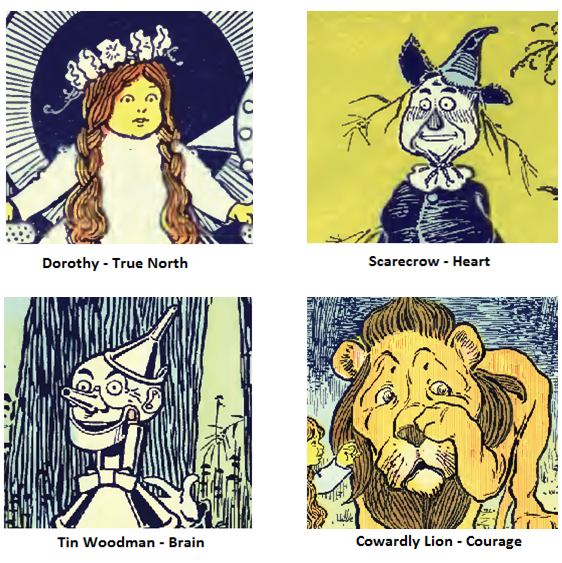
There are four main characters in “Wizard of Oz”, written by Frank Baum. These four characters represent a quality characteristic that every change agent needs:

  • Dorothy – the main protagonist of the story. She was swept into the wonderful fantasy land of Oz by a cyclone. All she wants is to go back home to Kansas.
  • Scarecrow – the first friend Dorothy makes on her journey home.
  • Tin Woodman – a character who originally was a real human, but now is completely made of tin. Tin Woodman is the second friend that Dorothy makes.
  • Cowardly Lion – the third and final member of Dorothy’s team.

True North (Home):

“True North” is a strong concept in Toyota Production System (TPS). True North depicts our ideal state. True North is what we are striving towards. We are trying to reach True North. In a TPS/Lean way, Dorothy represents the characteristic of True North, our ideal state. All she wants is to go home (True North). A change agent should form his/her team, like Dorothy did, to reach their goal (true north).

Heart:

The scarecrow represents the quality of “the heart”. A change agent should have his/her heart in the game. This allows you to think from the other person’s viewpoint. Having the heart characteristic makes you realize that this is a win-win, non-zero sum game. The heart represents empathy and compassion, without which you cannot gain the buy-in from your team. You should be open for suggestions and ideas for improvements. Toyota has identified “Respect for Humanity” as one of the two pillars of Toyota Way.

Brain:

Tin Woodman represents “the brain” characteristic. A change agent should never stop learning. You should be smart enough to try things out and learn from your mistakes. You should also be smart enough to realize that you need to train and develop more change agents. A change agent should know how to approach when he/she is trying to implement a change. Here, Brain represents both knowledge and wisdom. A wise change agent will request his/her team to try things out at first. The “for trial only” approach eases them into the actual implementation.

Courage:

Cowardly Lion represents “courage”. A change agent should be brave enough to look back at himself/herself with a critical eye and challenge assumptions. A change agent should be open about the problems, and transparent in communication. At Toyota, they talk about the importance of “Hansei”. “Hansei”, a Japanese term, loosely translated means “self reflection”. This can act as a strong and effective feedback loop that will steer you back on course towards True North. Having courage also means that you are capable of saying “No”. Ultimately, a change agent should be brave enough to stand up for what he/she thinks is right. Winston Churchill, the former UK prime minister, said the following about courage:

“Courage is what it takes to stand up and speak; courage is also what it takes to sit down and listen.”

Final Words:

I will finish off with an Arabian story that goes by the name “The Camel’s Nose”. The story has created the phrase “camel’s nose” in English language that is a metaphor for allowing a larger change in the pretense of small incremental changes. This phrase has a negative connotation since the change represents something that is not desirable. Here, I will be presenting it as a tactic for a change agent to encourage their team to implement the change. This story is about a wise camel, and the importance of implementing a change little by little at a time.

It was an unusually cold night in the desert. The camel was outside, tied to the tent. The master was inside the tent, comfortable and getting ready to sleep.

“Master,” the camel said putting his nose under the flap, “it is so cold outside. Can I at least put my nose inside the tent?”

“Sure,” the kind master replied, and rolled over.

A little later, the master rolled over and found that the camel had his whole head inside the tent.

“Master, it feels so nice here. Can I please put my front legs inside the tent too?”, the camel asked.

“Okay, you may”, the master said moving a little toward the edge since the tent was small.

The master again rolled over trying to sleep. A little while later, the camel again said “Master, Master, can I come inside the tent all the way? I will stand inside. It is very cold outside.”

“Yes,” the master said unwittingly. The master went back to sleep.

The next time the master woke up, he found himself outside the tent and cold.

I am not suggesting here that the change agents should be the camel kicking out the master. I am presenting the story to show the importance of taking things a small step at a time.

Always keep on learning…

In case you missed it, my last post was Learning from Dr. Seuss.

Learning From Dr. Seuss:

drseuss

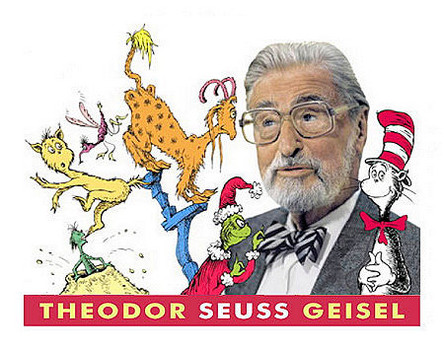
Dr. Seuss (Theodor Seuss Geisel), the renowned children’s book author, was born on this date (March 2nd) in 1904. Interestingly, he used “Dr.” in his pen name since his parents really wanted him to be a doctor. In today’s post, I will look at eight great quotes from him to learn from.

I immigrated to America from India. I did not know Dr. Seuss until I met my wife here in America. I grew up with Enid Blyton, the English author. I very much enjoyed reading the Dr. Seuss books with my kids because of his unique writing style. As I was introducing my three children to his books, I was also learning from Dr. Seuss at the same time.

Here are eight lessons from Dr. Seuss:

  • From there to here, and here to there, funny things are everywhere.(Source – One Fish, Two Fish, Red Fish, Blue Fish)

As Lean practitioners, we can translate this as “from there to here, and here to there, wastes are everywhere”! The funny things are the different wastes! Everything we do has waste in it. Taiichi Ohno is a big proponent of eliminating waste. He made managers stand inside a circle and look for wastes. Wastes forces us to be non-value adding, and increases overall cost.

  • Why fit in when you were born to stand out? (Source – Unknown)

If you try to copy the best, you will only come in second. Trying to copy Toyota does not make sense unless you have the same problems as Toyota. You should try to create your own system – Company XYZ Production System rather than a frail copy of Toyota Production System. Understand your problems and then address them, creating your own production system.

  • Sometimes the questions are complicated and the answers are simple. (Source – Looking Tall by Standing Next to Short People)

This is a true gem. The insurmountable problems become ant hills once they are solved. This is akin to Occam’s razor in some sense. Occam’s razor can be loosely stated as “the simplest answers provide the best explanations”. We have a tendency to complicate things. As an Engineer, I can vouch for this. At Toyota, they talk about using automation as the last resort to improve a process. They push for simple solutions.

  • You have brains in your head. You have feet in your shoes. You can steer yourself in any direction you choose. You’re on your own, and you know what you know. And you are the guy who’ll decide where to go.” (Source – “Oh, the Places You’ll Go!)

You have brains in your head – you need to use them. You have feet in your shoes – you need to go to the Gemba. This is a perfect summation of Genchi Genbutsu – going to the Gemba to learn the actual facts. You have to go to the source, where the action takes place and see for yourself.

  • You’ll miss the best things if you keep your eyes shut.(Source – I Can Read With My Eyes Shut!)

You have to keep your eyes open but you have to observe. Seeing and observing are two different things. When you keep your eyes open, you start to see things. When you see more things, you start to observe things. When you observe things more, you start to understand things more.

  • “It is better to know how to learn than to know. (Source – Unknown)

It’s not the tools system, it is the thinking system. To know and to understand are two different things. To know something makes you rigid in your thinking. To understand something makes you flexible in your thinking.

  • How did it get so late so soon?(Source – Poem by Dr. Seuss)

There is no better time than now to start improving and to start learning. Do not wait for the best idea to happen. Do not wait for the new and improved machine. Do not wait for next month. Now is indeed the right time. As Hillel the Elder said, “If not now, when?”

  • Try them, try them, and you may! Try them and you may, I say.(Source – Green Eggs and Ham)

This is the best way to implement process improvement activities. You can say “try them, try them, you may like them”. All you need them to do is to try the idea out. Once tried, they will provide ideas to improve and make them better. The lesson here is that you should not try to force your ideas, rather ask them to try it out. After all, what is the harm in trying it out? Brian Fitzpatrick, and Ben Collins-Sussman recommends saying “let’s try this for 30 days. If this does not work, we will go back to the way it was.” This approach helps in getting buy-in. Almost always, they will start using the new method. If they do not, at least you will get feedback as to why the new method does not work.

Thank you Dr. Seuss for everything you have done.

Happy Birthday!

Always keep on learning…

In case you missed it, my last post was Be an Amateur at the Gemba.

Be an Amateur at the Gemba:

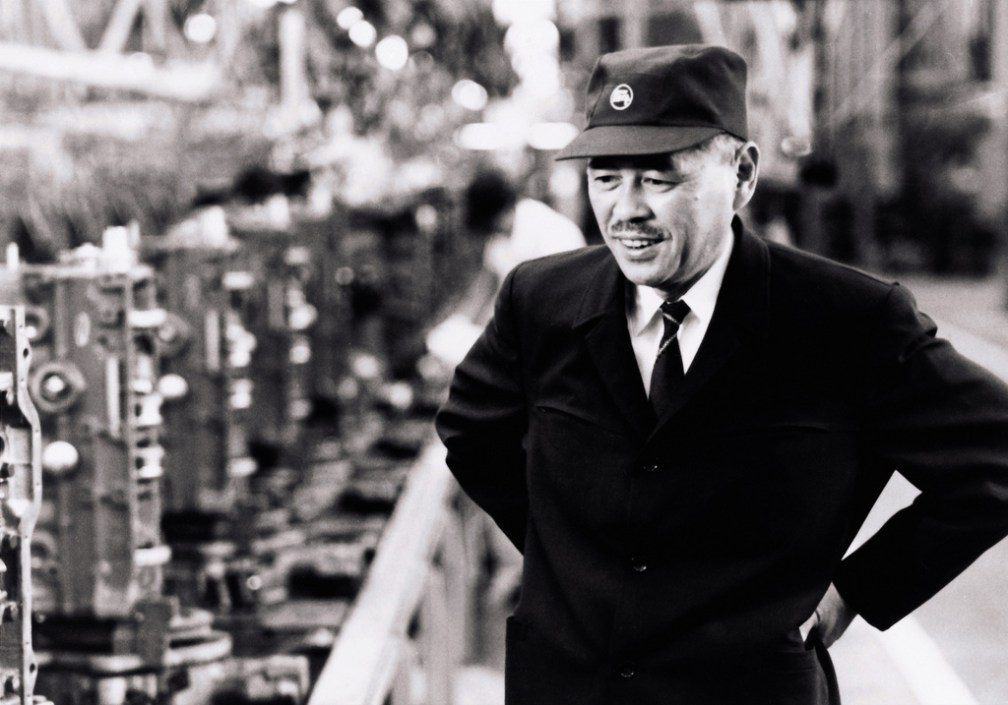
ohno

In my last post, I talked about being like a Samurai warrior at the gemba. Today, I am posting about being an amateur at the gemba.

The word “amateur” has roots in the Latin word “amare” which means to love. “Amateur” used to mean someone who is pursuing something out of pure love or passion. Once the word “amateur” entered the English language, it got associated with a negative connotation. Today being an amateur means that one is a mere hobbyist, and may lack experience and knowledge. Today, its meaning does not encompass the meaning of passion that it once used to have.

Taiichi Ohno was a man of passion and was new to the automobile world when he heard Kiichiro Toyoda, the then leader of Toyota, talking about the need for Toyota to catch up with American car manufacturing in three years to survive. Ohno was not an expert in auto manufacturing, and the Toyota Production System did not exist at that time. Ohno called himself a “layman” when it came to the auto industry. However, he did have a tremendous amount of love and passion for the manufacturing world. He was an amateur in the classic and modern sense.

Taiichi Ohno- What would Ohno Do?

Taiichi Ohno graduated from the Department of Mechanical Technology of Nagoya Technical High School in the spring of 1932. He then got a job at Toyota Textiles through his father, who was an acquaintance of Kiichiro Toyoda. He later got transferred to Toyota Motor Company in 1943, when Toyota Textiles was dissolved. At this time, it was declared that the Japanese worker’s efficiency was only 1/9th of that of an American worker. Kichiiro Toyoda gave Toyota the clear vision of catching up to America in three years.

Ohno correctly concluded that the high efficiency of the American operator was not due to him exerting ten times more physically than the Japanese operator. His only logical explanation was that there was a lot of waste in what the Japanese operator was doing. Ohno started experimenting and began planting the seeds of Toyota Production System (TPS). This was where the passion or love of the “amateur” came in. The amateur was not afraid to fail. Each step was a learning step for him. In my eyes, the turning point of TPS came when Ohno realized that he can have one operator take care of more than one machine at a time. The norm in those days was that one operator managed only one machine. The operator was not doing anything while the machine was operating. Ohno put the operator in charge of more than one machine. He had to ensure that the labor content remained the same. The operator was not being required to work harder! Ohno instead focused on the flow of operations. The machines were operated in the order as dictated by the flow of operations. In Ohno’s words;

The first step was to establish a flow system in the machine stop.

Ohno proposed to implement work improvement first, and then to do facility improvement. Ohno experimented with different layouts to improve the flow. Some of them are shown below (U-shape/Bracket, Triangle, Square and Diamond).

huki03

Ohno also introduced the idea that to manufacture beyond what is needed is to create waste (waste of over-production). He also introduced the idea of using kanban as a way to ensure a pull system and continuous flow.

One would imagine that Ohno’s ideas would be welcomed with open arms. Instead, he faced a lot of resistance. In fact, his ideas were first called “Ohno’s System” instead of “Toyota Production System”. Gandhi famously stated the following;

“First they ignore you. Then they laugh at you. Then they fight you. Then you win.”

This was true in Ohno’s case. Ohno was called “Mr. Mustache”. The operators thought of Ohno as an eccentric. They used to joke that military men used to wear mustaches during World War II, and that it was rare to see a Japanese man with facial hair afterward. “What’s Mustache up to now?” became a common refrain at the plant as Ohno carried out his studies. (Source: Against All Odds, Togo and Wartman)

His ideas were not easily understood by others. He had to tell others that he will take responsibility for the outcomes, in order to convince them to follow his ideas. To his credit, he taught his ideas at the top and bottom simultaneously.

Ohno could not completely make others understand his vision since his ideas were novel and not always the norm. His style of production was not being practiced anywhere. Ohno was persistent, and he made improvements slowly and steadily. He would later talk about the idea of Toyota being slow and steady like the tortoise. Many of his ideas were based on trial and error, and were thus perceived as counter-intuitive by others. Ohno loved what he did, and he had tremendous passion pushing him forward with his vision. For this reason, Ohno was truly an “amateur”.

Final Words:

I have cited the example of Ohno, the father of Toyota Production System, to propose that one should try to be like him, an amateur – one who has tremendous passion and love for what he does and one who does not mind trying out his ideas even if they might fail. I will finish off with a story I read about Ohno,

As I mentioned above, Ohno’s methods were counter-intuitive in nature. Ohno wanted to increase productivity, and yet not over produce! Ohno in fact called Over-production as the biggest waste of all.

Ohno had started implementing Just-in-Time in the plant. The operators became insecure with this. They felt secure having extra in-process inventory so that they can keep working if there were line stoppages.

Ohno understood this, and became angry about this. He decided to combat this by making the operators take the unneeded material home with them.

“Since the company does not need these things”, he would tell the men as he filled their arms with parts at the end of the day, “you must take them home.”

(Source: Against All Odds, Togo and Wartman)

Always keep on learning…

In case you missed it, my last post was Be a Samurai Warrior at the Gemba.

Be a Samurai Warrior at the Gemba:

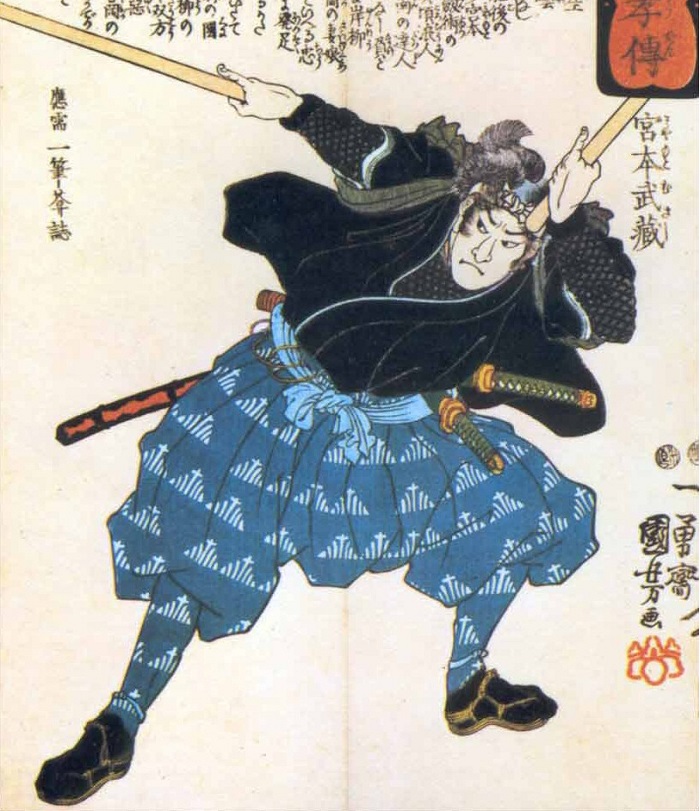
MM

There is a great Japanese notion about the Samurai Warrior. I first came across this in Norman Bodek’s preface to “Kanban and Just-in-Time at Toyota”. The main idea is that a Samurai warrior never stops perfecting his style. This is akin to a manager who should never stop improving his managerial ability. The Samurai warrior also never stops polishing his sword. This is akin to the manager constantly trying to improve the process and the product.

This got me thinking about Miyamoto Musashi. Miyamoto Musashi (1564 – 1645) was a great swordsman and a great artist from Japan. He is most commonly known as the author of the great book – “The Book of Five Rings. He was said to be undefeated in duels. His book is still considered to be a great book on strategy similar to the Art of War. His book consists of five different themes (earth, water, fire, wind and void). In this post, I will talk about five of his sayings from the Book of Five Rings that resonated the most with me.

  • If you practice diligently day and night in the strategy, your spirit will naturally broaden. Thus you will come to comprehend large scale strategy and the strategy of one on one combat. (Book of Earth)

Musashi is talking about the small picture and the big picture view here. In the book, the strategy refers to the use of the long sword. He advises the student to practice every day and to be fluent in both large scale strategy and small scale strategy.

In a similar vein, Musashi states the following in the Book of Water:

In strategy it is important to see distant things as if they were close and to take a distanced view of close things. It is important in strategy to know the enemy’s sword and not to be distracted by insignificant movements of his sword. (Book of Water)

The key points I am taking away to use are diligent practice in order to broaden your spirit. This allows you to see the big picture vs. the small picture, and strengthens your ability to look at the small details and not lose sight of the forest for the trees.

Musashi also said, “Know the smallest things and the biggest things, the shallowest things and the deepest things.”

  • The teacher is as a needle, the disciple is as thread. You must practice constantly.(Book of Earth)

In Lean we say that the Teacher has not taught, if the student has not learned. Musashi requires the student to follow the teacher as a thread follows the needle. This is such a powerful analogy.

  • Really skilful people never get out of time, and are always deliberate, and never appear busy.(Book of Wind)

When you look at successful people, they make you go, “How does he/she do it?” Continuous learning and practice makes you better at what you do and allows you to become so skilful that you are able to flow gracefully. Business does not equate to busyness. Being busy and getting things done are two different things.

  • You should not have any special fondness for a particular weapon, or anything else, for that matter. Too much is the same as not enough. (Book of Earth)

Musashi cautions us against having a favorite tool. This is akin to the saying; if you have a hammer everything you see is a nail. One should use the right tool for the right problem. To use the right tool, one should understand what the problem is. Do not become over-reliant on a favored approach or process.

  • There is rhythm in everything; however, the rhythm in strategy, in particular, cannot be mastered without a great deal of hard practice. (Book of Earth)

There is a constant theme in the book about being fluid. Musashi talks about having a rhythm in what you do. This is a toyotayesque approach of production leveling and takt time. Musashi also rightfully points out that the rhythm cannot be achieved without a great deal of practice.

Final Words:

Musashi’s book succinctly sums up the idea of constant practice and constant learning. I encourage the reader to read the Book of Five Rings. It is full of great nuggets that are applicable at the Gemba. I also encourage the reader to be a Samurai warrior at the Gemba – never stop practicing your style (always keep on improving) and never stop polishing your sword (always keep on learning).

I will finish off with a Zen Story that talks about working smarter and not harder:

A young man went to a famous teacher and asked, “I am devoted to your way of thinking. I am willing to work hard under you. How long will it take me to reach enlightenment?”

“Ten years”, the teacher replied.

“Ten years!”, the young man remarked. “But I want to reach enlightenment faster. I will work harder and devote ten or more hours a day. How long will it take me then?”

The teacher sipped his tea, thought for a bit and said. “Twenty years.”

Always keep on learning…

In case you missed it, my last post was Cpk/Ppk and Percent Conforming.

Cpk/Ppk and Percent Conforming:

cap

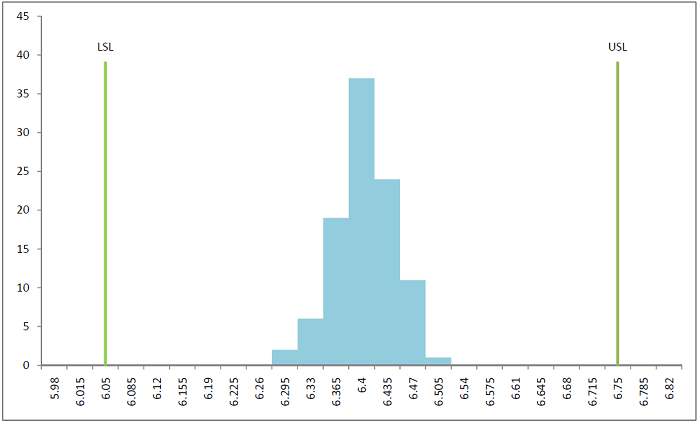
It has been a while since I have posted about Quality Statistics. In today’s post, I will talk about how process capability is connected to percent conforming.

In this post, I will be using Cpk and assuming normality for the sake of simplicity. Please bear in mind that there are multiple ways to calculate process capability, and that not all distributions are normal in nature. The two assumptions help me in explaining this better.

What is Cpk?

The process capability index Cpk is a one shot number that gives you an idea of the capability of the process to center around the nominal specification. It also tells you how much percent conforming product is the process producing. Please note that I am not discussing Cp index in this post.

Cpk is determined as the lower of two values. To simplify, let’s call them Cpklower and Cpkupper.

Cpklower = (Process Mean – LSL)/3* s

Cpkupper = (USL – Process Mean)/ 3* s

Where USL is the Upper Specification Limit,

LSL is the Lower Specification Limit, and

s is an estimate of the Population Standard Deviation.

Cpk = minimum (Cpklower, Cpkupper)

The “k” in Cpk stands for “Process Location Ratio” and is dimensionless. It is defined as;

k = abs(Specification Mean – Process Mean)/((USL-LSL)/2)

Where Specification Mean is the nominal specification.

Interestingly when k = 0, Cpk = Cp. This happens when the process is perfectly centered. An additional thing to note is also that Cpk ≈ Ppk when the process is perfectly centered.

You can easily use Ppk in place of Cpk for the above equations. The only difference between Ppk and Cpk is the way we calculate the estimate for the standard deviation.

But What Does Cpk Tell Us?

If we can assume normality, we can easily convert the Cpk value to a Z value. This allows one to calculate the percentage falling inside the specification limits using normal distribution tables. We can easily do this in Excel.

Cpk can be converted to the Z value by simply multiplying it by 3.

Z = 3 * Cpk

In Excel, the Estimated % Non-conforming can be calculated as =NORMSDIST(-Z)

It does get a little tricky, if the process is not centered or if you are looking at a one-sided specification. The table below should come in handy.
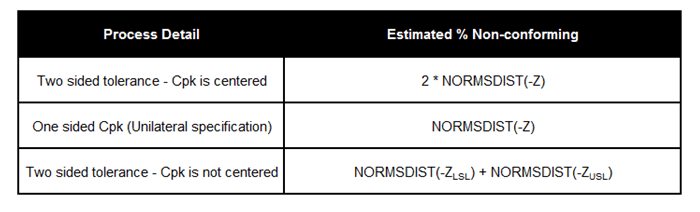
z table

The Estimated % Conforming can be easily calculated as 1 – Estimated % Non-conforming.

The % Conforming is very similar to a tolerance interval calculation. The tolerance interval calculation allows us to make a statement like “we can expect x% of the population to be between two tolerance values at y% confidence level.” However, we cannot make such a statement with just a Cpk calculation. To make such a statement, we will need to calculate the RQL (Rejectable Quality Level) by creating an OC curve. Unfortunately, this is not straightforward, and requires methods like non-central t-distribution. I highly recommend Dr. Taylor’s Distribution Analyzer for this.

What about Confidence Interval?

I am proposing that we can calculate the confidence interval for the Cpk value and thus, for the Estimated % Non-conforming. It is recommended that we use the lower bound confidence interval for this. Before I proceed, I should explain what confidence interval means. It is not technically correct that the population parameter value (e.g. height of kids between ages 10 and 15) is between the two confidence interval bounds. We cannot technically say that at 95% confidence level, the mean height of the population is between X and Y for kids between ages 10 and 15.

Using the mean height as an example, the confidence interval just means that if we keep taking samples from the population, and keep calculating the estimate for mean height, the calculated confidence interval for each of those sample would contain the true mean height, 95% of the time (if we used a 95% confidence level).

We can calculate the lower bound for Cpk at a preferred confidence level, say 95%. We can then convert this to the Z-value and find the estimated % conforming at 95% confidence level. We can then make a statement similar to the tolerance interval.

A Cpk value of 2.00 with a sample size of 12 may not mean much. The calculated Cpk is only an estimate of the true Cpk of the population. Thus like any other parameter (mean, variance etc.), you need a larger sample size to make a better estimate. The use of confidence interval helps us in this regard since it penalizes for lack of sample size.

An Example:

The Quality Engineer at a Medical Device company is performing a capability study on seal strength on pouches. The LSL is 1.1 lbf/in. He used 30 as the sample size, and found that the sample mean was 1.87 lbf/in, and the sample standard deviation was 0.24.

Let’s apply what we have discussed here so far.

LSL = 1.1

Process Mean = 1.87

Process sigma = 0.24

From this we can calculate the Ppk as 1.07. The Quality Engineer calculated Ppk since this was a new process.

Ppk = (Process Mean – LSL) /3 * Process Sigma

Z = Ppk * 3 = 3.21

Estimated % Non-conforming = NORMSDIST(-Z) = 0.000663675 = 0.07%

Note: Since we are using a unilateral specification, we do not need to double the % non-conforming to capture both sides of the bell curve.

Estimated % Conforming = 1 – Estimated % Non-conforming = 99.93363251%

We can calculate the Ppk lower bound at a 95% confidence level for a sample size = 30. You can use the spreadsheet at the end of this post to do this calculation.

Ppk Lower bound at 95% confidence level = 0.817

Lower bound Z = Ppk_lower_bound x 3 = 2.451

Lower bound (95%) % Non-conforming = NORMSDIST(-Lower_bound_Z) = 0.007122998 = 0.71%

Lower bound (95%) % Conforming = 99.28770023% =99.29%

In effect (all things considered), we can state that with 95% confidence at least 99.29% of the values are in spec. Or we can correctly state that the 95% confidence lower bound for % in spec is 99.29%.

You can download the spreadsheet here. Please note that this post is based on my personal view on the matter. Please use it with caution. I have used normal distribution to calculate the Ppk and the lower bound for Ppk. I welcome your thoughts and comments.

Always keep on learning…

In case you missed it, my last post was Want to Increase Productivity at Your Plant? Read This.

Want to Increase Productivity at Your Plant? Read This

bio

In my last post on Respect for People, I talked about the myth of Sisyphus and respect for people. In today’s post I will talk about Dan Ariely’s study and what he says about ways to increase productivity.

What makes you tick? What would cause you to give your best? Dan Ariely, a professor of Psychology and Behavioral Economics at Duke University, conducted a study in which he set out to understand how perceived meaning of a job impacted productivity. There were two study groups used for this study. Both groups consisted of 20 students from Harvard. The two groups were asked to build Bionicle Lego models and were offered pay for their work. The only condition was that the payment was made on a declining scale. The first model got $2.00. From then on each subsequent model was paid 11 cents less. This is a linear scale, and thus at the 19th model, the student would get paid 2 cents. From that point onwards, each model was paid 2 cents each. The intent of the study was to identify at what point is the student going to decline the payment and stop building.

The payment scale was the same for both groups. Group 1 was called “Meaningful”, and group 2 was called “Sisyphus”, after the myth of Sisyphus. The difference between the two groups was that for the second group, they were given only two Lego models. As they were working on one model, the other model that was already built was torn down in front of them by the experimenter. Thus, the study replicated the idea of the futile effort similar to Sisyphus. Sisyphus, a Greek mythological character was made to roll a rock up a hill. The rock would then roll down, and Sisyphus would have to then roll it up again. He was punished by having to repeat this for eternity. His story is the epitome of non-value added work. The students in Group 2 were made to feel like Sisyphus because the model they just built was being torn down in front of their eyes, and they had to build it up again.

Both groups had the same labor content, and the goal of the study was to find who was more productive. The productivity was measured by the amount of Lego Bionicle models they built. The results of the study showed that Group 1 (Meaningful) made 10.6 models on average, netting an average $14.40 earnings. Group 2 (Sisyphus) made only 7.2 models on average, netting an average $11.52 earnings. The experimenters argue that the subjects in the Sisyphus condition became disenchanted with their work and this impacted their productivity. In their words;

The background question, “Why am I doing this?”, is difficult to evade if an individual is in a situation where one’s work is repeatedly undone.

Respect for people & Continuous Improvement:

You feel good if you know what you are doing at work is meaningful. If the work is not meaningful, then you would soon feel burned out. Do you come later than usual to work? Do you leave earlier and earlier from work? Dan Ariely says that this could be an indication of you feeling that what you do at work is not adding any value. This is the spirit of Respect for People. Respect for People is creating an environment where your work is fully value added. Removing the elements of non-value added work is the spirit of Continuous Improvement. Thus, in my eyes, Continuous Improvement and Respect for People go hand in hand. This is the Toyota Way. I view Toyota Way as a synergy of Respect for People – creating an environment of value added work and Continuous Improvement – ensuring non-value added elements are eliminated.

employees_value

Final words:

Dan Ariely’s study can be summarized in one sentence:

Create/increase the value of the job to increase productivity.

Aside from eliminating non-value added steps, train your employees on how the product is actually used in the field. I have seen organizations bring in end users to talk to the employees on the floor. Having a sense of purpose increases the value of the day to day monotonous work.

I will finish off with a story I read about perceived value.

His Holiness, the Pope is making a tour of the United States and of course has a very busy schedule that he’s trying his best to stick to. Unfortunately, things run a bit long at one stop and he has to make up time any way he can if he’s to be on time for the next gathering. So he dismisses the rest of the entourage and takes off in his Pope-mobile with just his driver.

They’re making good time on the back roads, but His Holiness is still worried they’re going to be late. He tells his driver to floor it, but the fella refuses to push it any further. After all, he had heard the police in those parts were tough on speeders and didn’t want to find out first-hand.

This angers His Holiness and he orders the driver to pull over. The Pope insists on doing the driving himself for he says no one will toss the Pope in jail. They take off in a cloud of dust, His Holiness at the wheel, his driver cowering in the back seat.

Not too much later, a State Trooper pulls them over. The young man strides up to the car all businesslike and mean. This lasts right up until he sees who’s driving. His face pasty-white, he heads back to his car to radio in for some advice.

“Uh, let me talk to the Chief … Hello, sir. Sorry to trouble you, but I have a bit of a problem. Just pulled over a speeder and it turns out he’s someone quite important. How should I handle this?”

“Depends on who you got, son. Let me guess, it’s the Mayor, right?”

“Uh, no sir, not the Mayor.”

“Bigger than that, eh? Not the Senator again!”

“Uh, no sir, wasn’t the Senator. Someone a lot more important.”

“Well, who you got, son? The President?”

“I don’t rightly know, sir. But whoever he is, he must be damned important because the Pope is his driver.”

Always keep on learning…

In case you missed it, my last post was Ten Things I Learned from The Walking Dead.