The Pursuit of Quality – A Lesser Known Lesson from Ohno:

Ohno

In today’s post, I will be looking at a lesser known lesson from Taiichi Ohno regarding the pursuit of Quality.

“The pursuit of quantity cultivates waste while the pursuit of quality yields value.”

Ohno was talking about using andons and the importance of resisting mass production thinking. Andon means “lantern” in Japanese, and is a form of visual control on the floor. Toyota requires and requests the operators to pull the andon cord to stop the line if a defect is found and to alert the lead about the issue. Ohno said the following about andons;

“Correcting defects is necessary to reach our goal of totally eliminating waste.”

Prior to the oil crisis, in the early 1970’s in Japan, all the other companies were buying high-volume machines to increase output. They reasoned that they could store the surplus in the warehouse and sell them when the time was right. Toyota, on the other hand, resisted this and built only what was needed. According to Ohno, the companies following mass-production thinking got a rude awakening in the wake of the oil crisis since they could not dispose off their high inventory. Meanwhile Toyota thrived and their profits increased. The other companies started taking notice of the Toyota Production System.

Ohno’s lesson of the pursuit of quality to yield value struck a chord with me. This concept is similar to Dr. Deming’s chain reaction model. Dr. Deming taught us that improvement of quality begets the natural and inevitable improvement of productivity. His entire model is shown below (from his book “Out of the Crisis”).
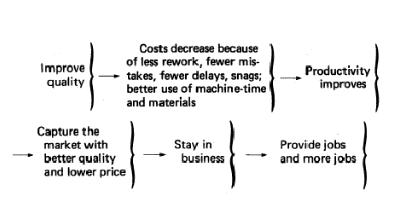
Deming Chain reaction

Dr. Deming taught the Japanese workers that the defects and faults that get into the hands of the customer lose the market and cost him his job. Dr. Deming taught the Japanese management that everyone should work towards a common aim – quality.

Steve Jobs Story:

I will finish with a story I heard from Tony Fadell who worked as a consultant for Apple and helped with the creation of the IPod. Tony said that Steve Jobs did not like the “Charge Before Use” sticker on all of the electronic gadgets that were available at that time. Jobs argued that the customer had paid money anticipating using the gadget immediately, and that the delay from charging takes away from the customer satisfaction. The normal burn-in period used to be 30 minutes for the IPod. The burn-in is part of the Quality/Reliability inspection where the electronic equipment runs certain cycles for a period of time with the intent of stressing the components to weed out any defective or “weak” parts. Jobs changed the burn-in time to two hours so that when the customer got the IPod, it was fully charged for him to use right away. This was a 300% increase in the inspection time and would have impacted the lead time. Traditional thinking would argue that this was not a good decision. However, this counterintuitive approach was welcomed by the customers and nowadays it is the norm that electronic devices come charged so that the end user can start using it immediately.

Always keep on learning…

In case you missed it, my last post was Challenge and Kaizen.
Challenge and Kaizen:

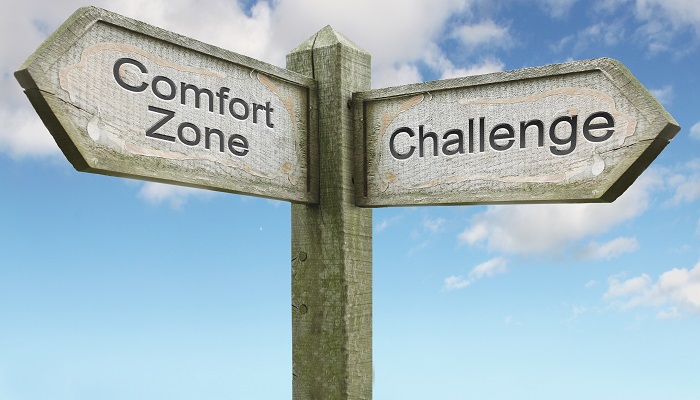
Comfort Zone/ Challenge Sign Concept

Toyota describes the two pillars of the Toyota Way as “Continuous Improvement” and “Respect for People”. Of this, the continuous improvement pillar is comprised of;

  1. Challenge
  2. Kaizen (change for the better), and
  3. Genchi Genbutsu (Go to the source and grasp the actual facts)

In this post, I will be looking at the “Challenge” aspect of the Continuous Improvement pillar.

Challenge – Why?

The secret to Toyota’s success is its ability to maintain itself as a learning organization. In 1967 P. M. Fitts and I. M. Posner identified three progressive phases of learning a new skill;

  • The cognitive stage – we understand the skill, but we make plenty of mistakes in the process. We are identifying strategies to do better.
  • The associative stage – we are getting better and making less mistakes.
  • The autonomous stage – we are pretty good at this point and can do the task on autopilot

The danger of the autonomous stage is that one starts to create a comfort zone for himself and stops “learning”. Thus, he reaches a plateau and his performance begins to degrade. He begins becoming complacent and accepting his performance saying that “this is good enough”. Unfortunately he is in a blind spot at this point and does not realize what is going on. This atmosphere is detrimental to kaizen.

“Challenge” thus becomes an important factor to sustain kaizen. The “challenge” is not necessarily personal as in challenging the employee to work harder. The “challenge” is in asking the employee to do his best and change the status quo – to be outside his comfort zone. The employee is allowed to make mistakes and in turn is expected to learn from mistakes. The employee continues improving through continuous learning.

Final Words:

Yoshio Ishizaka, a Toyota veteran explained challenge as follows;

Challenge guides us to setting higher objectives for achieving an ideal condition and continuously realizing such goals with courage and creativity.

I will finish off with a funny Zen story about learning;

The son of a master thief asked his father to teach him the secrets of the trade. The old thief agreed and that night took his son to burglarize a large house. While the family was asleep, he silently led his young apprentice into a room that contained a clothes closet. The father told his son to go into the closet to pick out some clothes. When he did, his father quickly shut the door and locked him in. Then he went back outside, knocked loudly on the front door, thereby waking the family, and quickly slipped away before anyone saw him. Hours later, his son returned home, bedraggled and exhausted. “Father,” he cried angrily, “Why did you lock me in that closet? If I hadn’t been made desperate by my fear of getting caught, I never would have escaped. It took all my ingenuity to get out!” The old thief smiled. “Son, you have had your first lesson in the art of burglary.”

Always keep on learning…

In case you missed it, my last post was Monument, Dynamo and Suitcase.

Monument, Dynamo and Suitcase:

trunk_2

There is a concept in Lean called a “Monument”. This refers to a large machine, equipment or something similar that cannot be changed right away and so you have to plan your processes around it. This generally impedes the flow and frequently becomes a hindrance to your lean initiatives. A monument is the opposite of the “flow” and “no waste” concepts of lean. Monuments do not always refer to an equipment or similar hardware. The worst kind of monument can sometimes be the culture or the mental models prevalent in the company. This results in the following excuses;

  • It might work in Japan but not here.
  • But we have to do it this way.
  • This is how we have always done it, and this is how I was taught.
  • How does cutting down inventory help with my production?

The Story of the Productivity Paradox – Computer and Dynamo:

Paul David, an economic historian wrote a wonderful paper in 1989 called “Computer And Dynamo: The Modern Productivity Paradox In A Not-Too Distant Mirror”. In the paper, he talked about the first productivity paradox involving steam engines and electrical engines. The steam engine was an outcome of the Industrial Revolution in England. All of the factories were using steam engines as a source of energy. The steam engine required all of the equipment to be clustered around it. This was the most efficient way of running equipment since there was only one major steam engine and all of the equipment ran from the steam power. The electric motor was an outcome of the technological innovations in America.  Electricity was introduced to the factories as early as 1890. Everybody understood that electrical power is far more efficient than steam power. However, this did not result in an increase in productivity. The productivity remained fairly level even with the introduction of electrical power in to the factories. This was later termed as the “productivity paradox”.

The reason for the lack of increase in productivity was due to the factory layouts that were implemented for the steam engines. The Industrial Engineers replaced the steam engines with electrical engines. They did not rearrange the equipment to utilize the flexibility that was offered by the electric motor. They were constrained by their mental models. Even when new factories were built, they followed the layout that was being used with the steam engines. All of the equipment was clustered into one place hindering the flow. It is said that the factory layouts did not change for about 30 years when the old management was replaced with new management personnel. At this point, the layout was rearranged to follow the flow of materials, and this caused a spike in productivity. All of the engines had its own motor and this allowed the equipment to be spread apart from one another. Each operator was now in full control of his equipment. The monument was broken down since the management was not tied down to the old ways of thinking.

Final Words:

Everybody works from their own mental models. A company’s culture is a collection of these mental models at an equilibrium state. The Dynamo story teaches us the importance of learning from experiments and self-reflection. This is part of the “Check” face of the PDCA cycle. The feedback loop is the only way that one learns the best. I have heard that “we are going 70 miles per hour to get this done, and we do not have time to stop and change the tires.” We need to find time to step back and reflect. The system is trying to talk to you and we should heed its words. Sometimes we get caught up in the firefighting and we stay in that mode for a long time even though we keep fighting the same fires on a daily basis. The feeling of déjà-vu is an indication that we need to stop, step back and try to see the big picture. It is time to reflect.

I will finish off with a similar story about suitcases. I heard this first from my brother:

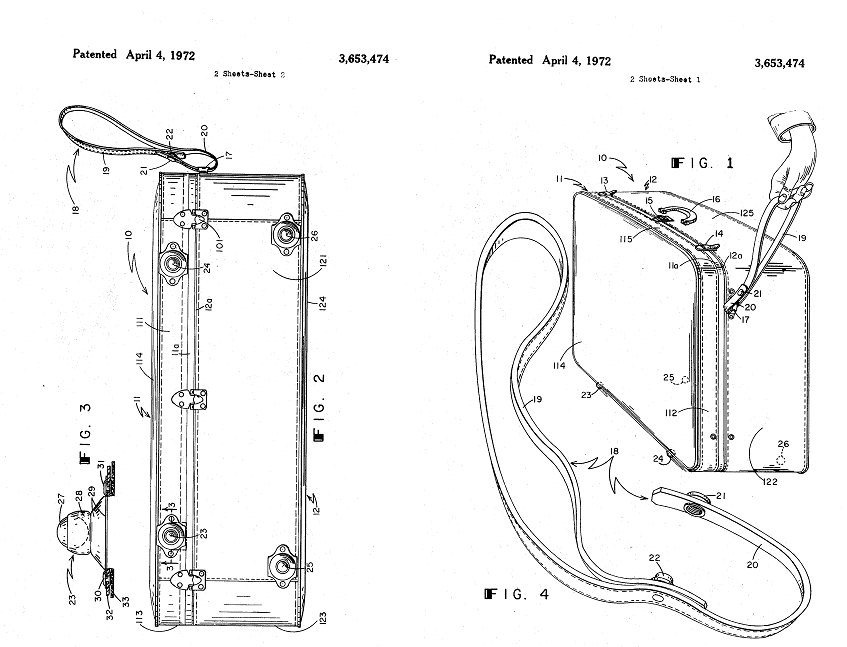
The “trunk” style of suitcases was the prominent form of luggage in the late 1800’s. People started traveling for leisure during the early 1900s which caused manufacturers to come up with new designs. These trunks were heavily built and weighed quite a lot. The term suitcase was introduced since these cases were used for holding suits. The suitcases became prominent in 1930s with the advent of commercial flights. Even at this time, they were not the light weight type that we have today. The addition of a wheel to the suitcase did not come till 1972. Up to that point, the suitcases were carried around by hand. The use of trolleys to transport luggage were seen as a sign of weakness. Even after the wheels were attached to the suitcases, it did not take off immediately. They were seen as mainly for stewardesses or women. Men were seen as wimpy if they used the wheel on the suitcase (talk about men-tal models!).

patent

In about 1989 (after more than ten years of having wheels), a Northwest Airlines pilot named Bob Plath came up with a vertical case with extendable handles and two large wheels on the side.  It took another 15 years to have a 360 degrees spinning wheel to be on the suitcase. Samsonite introduced this model in 2004.

The suitcase is a fairly straightforward design, and it took us about 70 years to achieve our present state.

Always keep on learning…

In case you missed it, my last post was Dr. Deming and Value Stream Mapping.

Dr. Deming and Value Stream Mapping:

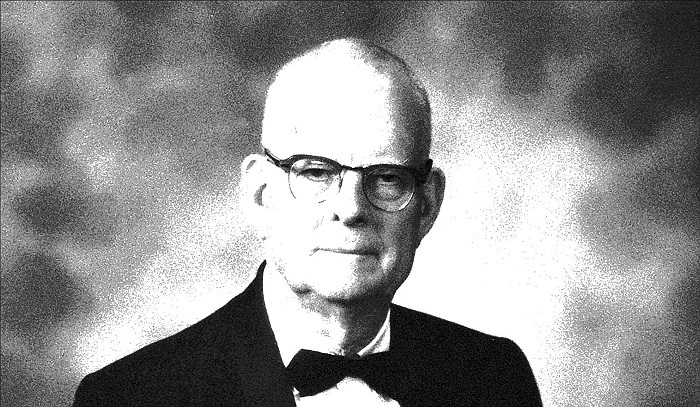
deming_2

Value Stream Mapping (VSM) has become an essential part of Lean. There have been several books written specifically on this topic. VSMs are not widely spread at Toyota. VSM is a creation of Mike Rothers and John Shook. This was based on the “Material and Information Flow Maps” at Toyota. The VSM was created as a means to systematically roll out lean implementation, and looked at current and ideal states from a system standpoint. The intent was to give the “big picture view” that was missing from lean implementations. The Material and Information Flow maps were used by a few specialists at Toyota as part of line conversions, and these later were used to help suppliers view the production system as an end to end pull system ultimately ending with material delivery to Toyota.

Dr. Deming’s Flow Diagram:

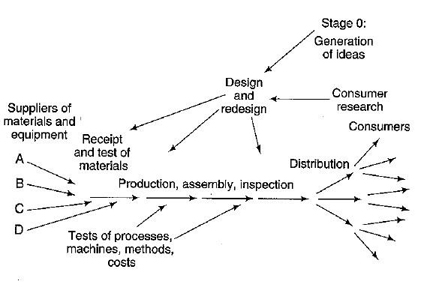
Dr. Deming was invited to Japan by the Union of Japanese Scientists and Engineers (JUSE) on July 15, 1950 to teach them about Quality Control. His teachings paved the way for a great change in regards to Quality in Japan. Dr. Deming taught the Japanese that production should be viewed as a system. The diagram below was taught first in August 1950 at a conference with top management at the Hotel de Yama on Mount Hakone in Japan.

deming_flow

Dr. Deming felt that his flow diagram was the spark in 1950 and onward that turned Japan around. It displayed production as a system to top management and engineers. He also viewed this as a type of diagram that showed the flow of materials and information. In his words;

To the make the flow diagram work, the flow of material and information from any part of the system must match the input requirements of the next stages. Thus, the aim in the flow diagram is for the material to come in at the front, and to emerge at the end as usable product or service. The flow diagram describes not only the flow of material, but also the flow of information needed to manage the system.

Source – “The New Economics For Industry, Government, Education” by Dr. Deming.

Dr. Deming described the diagram as a map for viewing the production system. He identified a feedback loop for continual improvement of products, services and continual learning, by keeping the consumer a part of the system.

Final Words:

It may be argued that Dr. Deming’s flow diagram is not similar to a Value Stream Map. However, I am positing that his lesson of seeing the system as a whole (end to end) laid the framework for the Material and Information Flow Maps. The first step of any implementation activity is to have a model of the system so that the cause and effect links in the system can be understood, first by theory and then by experiments. I will finish off with a funny Dr. Deming story;

One of Dr. Deming’s clients called him and said that he was having too many fires at his plant. Dr. Deming plotted the occurrences of fires on a control chart and determined that it was indeed a stable process.

“No, you are having just the right amount of fires,” he said, and then proceeded to explain the control chart to the client.

Source: Deming’s Profound Knowledge and Leadership, Carder and Monda.

Always keep on learning…

In case you missed it, my last post was Eight Lessons from Programming – At the Gemba.

Eight Lessons from Programming – At the Gemba:

At the gemba - coding

In today’s post, I will be writing about the eight lessons I learned from Programming. I enjoy programming, and developing customer centric programs. I have not pursued a formal education in programming, although I did learn FORTRAN and BASIC as part of my Engineering curriculum. Whatever I have learned, I learned with an attitude of “let’s wing it and see”.

  • Be Very Dissatisfied with Repetitive Activities:

Our everyday life is riddled with repetition. This is the operative model of a business. Design a product, and then make them again and again. This repetitive way of doing things can be sometimes very inefficient. The programmer should have a keen eye to recognize the repetitive non-value adding activities that can be easily automated. If you have to generate a report every week, let’s automate it so that it is generated every week with minimal effort from you.

  • There is Always a Better Way of Doing Things:

Along the same lines as the first lesson, you must realize that there is always a better way of doing things. The best is not here yet, nor will it ever be. This is the spirit of kaizen. Even when a process has been automated, there is still big room left for improvement. The biggest room certainly is the room for improvement.

  • Never Forget Making Models:

When a Lean Practitioner is looking at a system, creating a model is the first step. This model could be a mental model, a mathematical model or even a small scale physical model. This model can even be a basic flowchart. This is part of the Plan phase of PDCA. How do the components work with each other? How does the system interact with the environment? What happens when step A is followed by Step B? A good programmer should understand the system first before proceeding with creating programs. A good programmer is also a good Systems Thinker.

  • Keep Memory in Mind:

A good programmer knows that using up a lot of memory and not freeing up memory can cause the program to hang and sometimes crash. Memory Management is an important lesson. This is very much akin to the concept of Muri in Lean. Overburdening the resources has an adverse impact on productivity and quality, and it is not a sustainable model in the long run.

  • Walk in Their Shoes:

A good programmer should look at the program from the end user’s viewpoint. Put yourself in their shoes, and see if your program is easy to use or not. Programmers are sometimes very focused on adding as many features as possible, when the end user is requiring only a few features. There is some similarity with the use of lean or six sigma tools at the Gemba. If it is not easy to use, the end users will try to find a way around it. This brings us to the next lesson.

  • Listen to the Gemba:

One of the lessons I learned early in my career is that I am not the owner of the program I write. The person using the program is the owner. If I do not listen to the end user then my program is not going to be used. I do not make the program for me; I make it for the end user. Less can be more and more can be less. The probability of a program being successful is inversely proportional to the distance of gemba from the source of program creation.

  • Documentation:

I wrote at the beginning that I learned programming from a “winging it” attitude. However, I soon learned the importance of documentation. A good programmer relies on good documentation. The documentation should explain the logic of the program, the flow of the program, how it will be tested and qualified, how the program changes will be documented and how the bugs will be tracked. The simplest tool for documentation can be a checklist. My favorite view on using checklists is – not using a checklist for a project is like shopping without a shopping list. You buy several things that are not needed, and do not buy the things that you actually need.

  • Keep a Bugs List – Learn from Mistakes:

Bugs to a programmer are like problems on a factory floor to a lean practitioner- it depends on how you view them. For a lean practitioner, problems are like gold mine. They are all opportunities to improve. In this same line of thinking, bugs are also a programmer’s friends. You learn the most from making mistakes. No program is 100% bug free. Each bug is unique and provides a great lesson. The goal is to learn from them so that you do not repeat them.

Another important lesson is – ensure that fixing a problem does not cause new problems. A programmer is prone to the law of unintended consequences. Any change to a program should be tested from a system standpoint.

Final Words:

I will finish off with my favorite anecdote about programming:

When Apple introduced the IPod, they were very proud of its “shuffle” feature. There is no accurate way of truly randomizing songs. However, there are several algorithms that can generate a pretty good random order. Apple utilized such an algorithm. It was so good that the users started complaining because sometimes the same song was repeated, or the same artist was played repeatedly. That is not how random should be – the end users argued. Steve Jobs then asked his programmers to change the algorithm so that it is less random.

The Digital Music Service company, Spotify faced the same problem. As they explained on their blog;

“If you just heard a song from a particular artist, that doesn’t mean that the next song will be more likely from a different artist in a perfectly random order. However, the old saying says that the user is always right, so we decided to look into ways of changing our shuffling algorithm so that the users are happier. We learned that they don’t like perfect randomness.”

The perception of random for the end user meant that the songs are equally spaced from one another based on how similar they are. The end user did not want randomness in a theoretical sense. They wanted random from a human practical sense.

Spotify changed their algorithm in 2014. “Last year, we updated it with a new algorithm that is intended to feel more random to a human.”

Always keep on learning…

In case you missed it, my last post was Be Like Coal At the Gemba.

Be Like Coal at the Gemba:

Piece of coal isolated on white

One of the lessons I learned as a child from my mother was about being like coal and not like paper. Her point was that coal may not be fast to catch fire, but once lit the coal will retain heat for a long time. Paper on the other hand, catches fire quickly and burns out. The lesson was about persistence and not jumping on the band wagon only to lose interest quickly – about making decisions with level headed thinking for the long term.

Coal is also good at filtering water (information). When you are asking or looking for information, you get information along with opinions. You should be able to filter out the opinions and be able to find the information to make good decisions.

Observe, Gather Data, Gain Consensus and Then Act for the Long Term:

Toyota is famous for observing, gathering data from the gemba, and getting consensus before acting. This is the type of thinking that Toyota enriches in its culture. All decisions are based on long term thinking, and this goal does not lend itself to quick decisions or acting on fads. This is the essence of being like coal – slow to get hot but stays hot for a long time.

Filter Information – Don’t Jump to Conclusions:

Any information that is out there is information coated with opinions. Coal (activated charcoal) is used for purifying water. Using this analogy, you should train yourself to discern fact from opinions. Lean Thinking encourages coming up with hypotheses and running experiments to validate your thinking. The act of filtering data to “purify” or distill information is akin to the ability of coal to purify data. This requires constant reminding and practice from your part.

Final Words:

I will finish this post with the three filter story about Socrates. Source – Unknown

In ancient Greece, Socrates was reputed to hold knowledge in high esteem. One day an acquaintance met the great philosopher and said, “Do you know what I just heard about your friend?”

“Hold on a minute,” Socrates replied. “Before you talk to me about my friend, it might be a good idea to take a moment and filter what you’re going to say. That’s why I call it the triple filter test. The first filter is Truth. Have you made absolutely sure that what you are about to tell me is true?”

“Well, no,” the man said, “actually I just heard about it and…”

“All right,” said Socrates. “So you don’t really know if it’s true or not. Now, let’s try the second filter, the filter of Goodness. Is what you are about to tell me about my friend something good?”

“Umm, no, on the contrary…”

“So,” Socrates continued, “you want to tell me something bad about my friend, but you’re not certain it’s true. You may still pass the test though, because there’s one filter left—the filter of Usefulness. Is what you want to tell me about my friend going to be useful to me?”

“No, not really.”

“Well,” concluded Socrates, “if what you want to tell me is neither true, nor good, nor even useful, why tell it to me at all?”

Always keep on learning…

In case you missed it, my last post was Dharma, Karma and Quality.

Dharma, Karma and Quality:

Dharma

In today’s post I will be looking at the statement – quality is everyone’s responsibility. This is an interesting preachy statement. There are two questions that can be answered by this statement;

  1. Who is responsible for quality?
  2. What is everyone responsible for?

The first question (who is) is a wrong question to ask because it leads to blaming and never results in an improvement of current state. The second question is just too broad to answer. Everyone is surely responsible for more than just quality.

Dharma and Karma:

The best way to explain responsibility is by looking at “dharma”. “Dharma” is an ancient Sanskrit term, and goes back to about 1500 BC. The word was first explained in the ancient Indian script Rig Veda. This was explained as a means to achieve a sense of order in the world. The term loosely can be translated as “responsibility”, or “something that needs to be done from a sense of duty”. The main purpose of dharma is to preserve or uphold the order in a system. For example, the dharma of a plant is to bloom.

This brings me to the next word – “karma”. “Karma” is more commonly used in the English language, and everybody has some understanding of this word. The term actually means “action” in Sanskrit. The action can be in the past, present or in the future. However, every one of your actions has a consequence. This attaches the “cause and effect” meaning to the word “karma”.  There are three types of karma identified in the Sanskrit texts;

  1. Karma = action
  2. Vikarma = wrong action
  3. Akarma = no action (doing nothing is a form of action, and sometimes this is the right thing to do)

If everybody performs karma according to their dharma, then the system is sustained successfully.

Top Management – 85% or 100% Responsible?

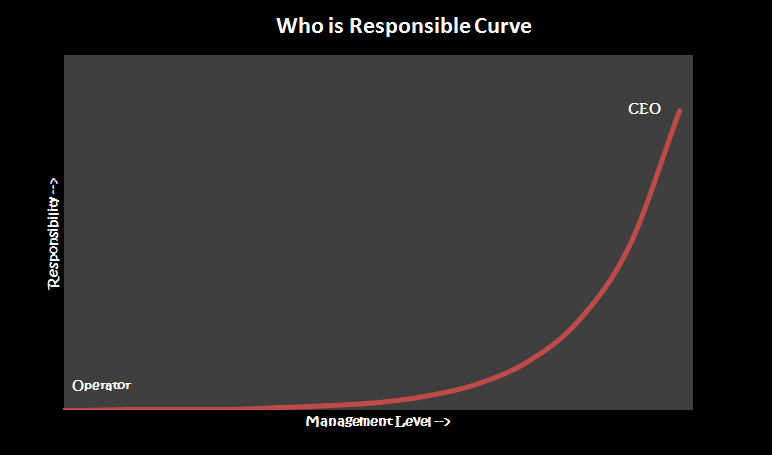
The answer to the question, “who is responsible for quality” is sometimes answered as “Top Management”. Dr. Deming taught that “85% of all quality problems are management problems”. He is also supposed to have stated “85% of TQC’s (Total Quality Control program) success depends on the president.” This can be depicted as the chart below.

Responsibility

I have viewed this as – patient zero is in the board room.

Taiichi Ohno’s, the father of Toyota Production System, view on this was as follows;

“In reality, TQC’s success depends on the president’s resolution to assume 100% responsibility. The president should imagine him or herself taken hostage by TQC and become devoted to human quality control.”

Dr. Deming has also said that – Quality is made in the board room. However, he goes on to clarify this. Quality is everyone’s responsibility, but top management has the most leverage of all to make a meaningful impact with their decisions.

In this light, the answer to the question – “what is your responsibility?” is “You are responsible for what you can control.”

Top management’s dharma is to lay down the framework for the entire organization to grow. This involves strong vision, big and drastic improvements (innovation) and growth. Middle Management’s dharma is to enforce and reinforce the framework through maintaining the status quo while encouraging small improvements (kaizen) and developing people. The operator’s dharma is to aid middle management to maintain status quo while looking for opportunities for improvements. The push for maintaining status quo is to provide a temporary structure for the process so that it can be studied for improvements. The main goal is destruction of the status quo so that a new standard can be achieved. If the karma aligns with the dharma, then the organization will sustain itself, grow and be successful.

Final Words:

I have recently rediscovered Dr. Deming’s definition of quality – Quality is the pride of workmanship. I will use Dr. Deming to succinctly summarize this post.

“In a well organized system all the components work together to support each other. In a system that is well led and managed, everybody wins. This is what I taught Japanese top management and engineers beginning in 1950.”

I will finish off with a Zen monk story;

A monk was driving his car when a dog from nowhere crossed the road. Although the monk tried stopping his car, he ran over the dog, killing it. The monk stopped his car and parked it. He looked around and saw a temple across from the road. He went to the temple and knocked at the door. Another monk opened the door.

The first monk bowed his head and said “I am so sorry.”

He pointed to where the accident happened and continued; “My karma ran over your dogma over dharma”. (My car ran over your dog over there.)

Always keep on learning…

In case you missed it, my last post was To Be or Not To Be.

To Be or Not To Be:

decide

In today’s post, I will be looking at the process of decision making and the use of a modified Pugh Chart to quantitatively conduct decision making.

The general process for decision making looks like something below;

  1. What do I have to decide? What is it about?
  2. What are my choices?
  3. What are the pros and cons for each?
  4. Act upon the decision and see if any further action is needed.

Decision Making is an Emotional Process:

As you go deeper into the decision making process, you can see that it gets more and more interesting. The neuroscientist, Antonio Damasio made the striking discovery that decision making is emotional in nature, and is rarely logical. He studied several patients who suffered injuries to their brains which impaired their emotions. Their reasoning capabilities were not impacted. They all had difficulty making decisions. The patients were all cognitively normal except that they had lost their ability to experience emotions, and this significantly impacted their ability to make decisions.

So at the point of decision, emotions are very important for choosing. In fact even with what we believe are logical decisions, the very point of choice is arguably always based on emotion.   

Complexity in Decision Making:

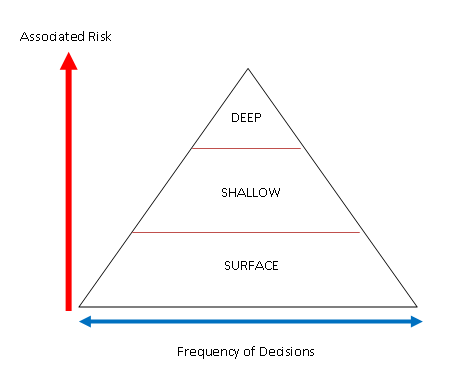
As a leader in your organization, you are required to make decisions on a daily basis. The types of decisions can be broken down into three classes;

  1. Surface – Simple situations requiring routine decisions
  2. Shallow – Complicated situations requiring supervisorial or managerial level decisions
  3. Deep – Complex situations requiring Upper management level decision making

This approach is adopted from Bennet and Bennet. The surface decisions are made on a daily basis, and do not have a high risk associated with them. The shallow decisions are more infrequent and have a medium level of risk associated with them. Finally, deep decisions are rare and have high risk associated with them.

bennet

Jeff Bezos, founder of Amazon.com, talks about a similar approach. He argues that there is no one-size-fits-all approach for decision making. In his opinion, there are two levels of decisions to be made. “Type 1 decisions” are those decisions that have critical consequences and are irreversible or nearly irreversible. He calls them “one-way doors”. He advises making Type 1 decisions carefully, slowly and with great thought and deliberation. The other kind is the “Type 2 decisions”. These are simple and easily reversible decisions. These decisions should be made much faster and frequently. A wise man knows the difference between the two.

To Include or to Exclude:

When you think about it, decision making is a process of deciding whether to include or exclude something. I came across a great article on this involving the custom of arranged marriages in India. The decision making process in an arranged marriage uses the approach of inclusion or exclusion. The two types of thinking are;

  • Inclusion – After careful thought, out of the 100 applicants choose the few that you think are most suitable for your child.
  • Exclusion – After careful thought, out of the 100 applicants eliminate the applicants that you think are not suitable for your child.

The counterintuitive outcome is that if you utilize the inclusion approach, you will select much fewer candidates. If you use the exclusion approach, you will retain a higher number of candidates, even though you are using eliminating criteria. Additionally, when the exclusion approach is used, you are highly likely to choose an “average” candidate. On the other hand, when the inclusion approach is used, you are highly likely to choose a candidate who is very strong in certain categories.

Quantitative Pugh Matrix Method:

My favorite tool for decision making is a version of the Pugh Matrix method. The steps for the Pugh Matrix are as follows;

  1. Decide upon the categories that are most important for making the decision
  2. Assign a weighted scale for each category
  3. Choose a scale for each category. This can be 1 – 5, where 1 = worst and 5 = best
  4. Score each category for the different options
  5. Find the final weighted score for each option. The option with the highest weighted score wins.

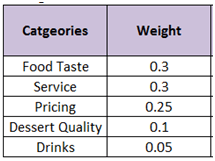
As an example, let’s look at the highly complicated decision of where to go for dinner. The following categories maybe suitable for this example – food taste, service, pricing, dessert quality and drinks. The next step is to assign the weighted scale. The sum of all the weighted scales should add up to 1 (100%). I have shown this below.

categories

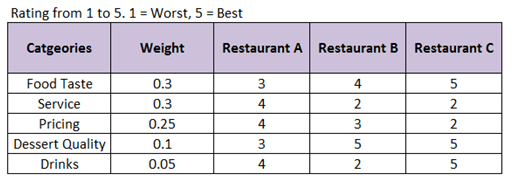
The next step is to assign the scores (1 to 5) for each category for the different options (Restaurant A, Restaurant B, and Restaurant C). This is shown below.

scores

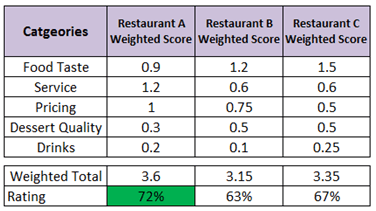
The final step is to multiply each score with its associated weighted scale, and sum it all up. This is shown below.

Pugh

This shows that Restaurant A is the best choice for me based on the initial categories I chose. This tool is applicable for all kinds of scenarios. I have attached the excel spreadsheet I used for the example here. Even in the Pugh matrix, some values carry an emotional component.

I will part with a teaching from the great Zen master Shunryu Suzuki.

In the beginner’s mind there are many possibilities, but in the expert’s there are few.”

Always keep on learning…

In case you missed it, my last post was Talking Trash.

Talking Trash:

ごみ

In today’s post, I will be looking at how trash and waste are handled in Japan, and lessons in lean from this. There are not many public trash cans available in Japan. Yet, the cities in Japan are mostly clean. This is an interesting contrast when compared to America, where public trash cans are readily available in order to keep the streets clean.

The Lack of Trash Cans:

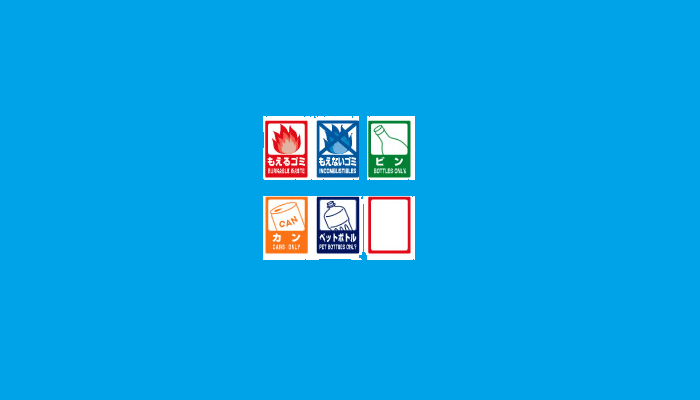
Japan has very limited space or land available for landfills. The main method of dealing with trash is incineration. It is estimated that about 80% of the garbage collected ends up in incinerators. In order to reduce garbage, Japanese officials in various towns and cities started implementing programs to increase recycling. This led to an interesting development. To aid recycling, the officials pushed the sorting to the source – the people. They introduced categories for sorting. Slowly the number of categories increased to double digit numbers. For example, the town of Kakimatsu in Shikoku has 44 different garbage categories. The sorting policies were strictly implemented, and those who did not comply were looked down upon. This led to public trash cans and garbage cans getting filled as part of people not wanting to sort. This may have led to the removal of several trash and garbage cans from the Japanese streets. The following is taken from the 2005 NYTimes article;

In Yokohama, after a few neighborhoods started sorting last year, some residents stopped throwing away their trash at home. Garbage bins at parks and convenience stores began filling up mysteriously with unsorted trash.

“So we stopped putting garbage bins in the parks,” said Masaki Fujihira, who oversees the promotion of trash sorting at Yokohama City’s family garbage division.

The garbage program is dealt with strictly. The peer pressure and the culture to fit in ensure that the program runs effectively. Additionally, there are “volunteers” who act as “leaders” and nudge the offenders to follow the program. It is encouraged that the trash bags are clear so that the trash is made visible. There is a cultural push to clean up after yourself and to be responsible.

Final Words:

Waste is a central theme in Lean. We are advised to eliminate waste in lean. There are many lessons that we can learn from the garbage program in Japan.

  • Everything should be based on a need- The program was put in place due to a lack of landfill space.
  • Tackle the problem at the source- The program put the responsibility at the source (the person throwing away the trash).
  • Auditing is an important aspect of any system (by your next customer or from an outside person)- For a system to sustain the auditing function is an important step.
  • Anticipate how the program can fail- the removal of public trash cans was done in response to people bringing trash from home and putting them in the public bins.
  • Any program requires people to participate in order to succeed.

As a side note, Toyota has been pursuing a zero landfill goal. As part of this, Toyota Engineering and Manufacturing of North America took away trash cans from its 1400 employees. This was described as a learning curve for the employees. The outcome of this move was that it created awareness about waste and a change in attitude.

The purging of the waste cans was a small but significant step toward Toyota’s zero-landfill goal. And Toyota has indeed achieved the goal (zero landfill is defined as diverting at least 95 percent of all waste away from landfills and into recycling or reuse).  It was one thing to reach the goal at the TEMA offices in Erlanger, where most people work at desk jobs.  Quite another to go zero landfill at its 12 manufacturing plants in North America, where they make cars, engines, auto parts and other things traditionally thought of as dirty manufacturing. Toyota has achieved that at all but two of its plants, and those  two are 97 percent of the way there. (From the article)

The other side of this is the point-of-use approach used widely elsewhere in the USA. Philadelphia is introducing a bill to require trash cans within 10 feet from the entrance of any business that sells prepared food for consumption off-premises. This is being done as a means to tackle the waste problem in the city. These seemingly two different approaches to tackle trash are interesting to say the least. The point-of-use is also an important tool used in lean to ensure that the operator has everything he needs in his reach.

I will finish off with an anecdote about Walt Disney. It is said that the average distance between two trash cans in any parks operated by Disney is 30 feet. This is based on the “study” performed by Walt Disney himself. As part of the planning he did for his parks, he ate a hot dog and he found that he took 30 steps before he was all done. He came to the conclusion that to meet the customers’ needs, he needed a trash can every 30 steps. This way the customer did not have to hold onto the trash.

Always keep on learning…

If you enjoyed this post, you can read more here.

In case you missed it, my last post was Take Pride in Your Work – Ji Kotei Kanketsu.

Take Pride in Your Work – Ji Kotei Kanketsu:

Customer

As a Quality professional, I am always interested in how “Quality” is handled in the Toyota Production System. A “Quality model” that Toyota uses is “Ji Kotei Kanketsu” or JKK. “Ji” in Japanese means “self”, “kotei” means “process” and “kanketsu” means “completion”. Putting all the words together, JKK means “Completion of your own work”. JKK has also been translated as “taking pride in what you are doing”, “not passing defects along to the next process”, or “next process is your customer”. The idea that the next process is your customer was something that Kaoru Ishikawa, the Japanese Quality Master, talked about a lot as part of the Total Quality Control movement.

Customer First:

JKK was initiated by Toyota as a means to increase employee awareness about quality. Every process after your process depends on your level of quality. They are all your customers. The concept of JKK is present in all facets of Toyota. JKK starts with the Engineering group through the product design and specifications – the best possible design. This is followed by Purchasing – ensuring quality components from suppliers. This is then followed by Production – maintaining and controlling the standardized work. Finally, Sales and Marketing – early detection and resolution of any potential problems. The model below is taken from the Toyota website.

Toyota

Toyota describes the EDER (Early Detection, Early Resolution) program as follows;

EDER is a communication system for quickly detecting quality issues, immediately resolving issues, and swiftly providing results of rectification and kaizen feedback to customers.

Toyota teaches JKK as part of kaizen, continuous improvement. By focusing on your process and looking at the weak points in the process, you are identifying areas for improvement. JKK is practiced by the following four steps;

  1. First, clarify target and objective of task
  2. Clarify detailed procedure of task
  3. Clarify Ryohin jyoken (quality points)
  4. Immediately contact your supervisor, if a problem and/or delay may occur (pull Andon) and repeat Kaizen.

The Big Picture:

There is a counterintuitive aspect to JKK. By focusing on your own operation, you are required to focus on the next process – to ensure that the next process is successful. Thus, JKK is instilling a big picture mindset – a system approach in the employees.

Final Words:

The concept of Jidoka, is embedded in JKK. The ability to stop the line to fix the problem is the basis of building in quality. JKK is ensuring Quality Assurance in everybody’s work. Quality is defined as meeting customer’s requirements. Thus, customer satisfaction is the outcome of quality. In this regard, every Quality professional can be viewed as a customer service personnel.

I will finish off with an anecdote from the late founder of Matsushita Electric Industries, Konosuke Matsushita.

Matsushita was having a conversation with a western executive, and the discussion led to customers and treating customers like kings.

“No, that is wrong”, Matsushita said. “The customer is a god. Because, a king is a human, and thus capable of making mistakes. But a god does not make mistakes!”

Source: The Shift to JIT, Ichiro Majima.

Always keep on learning…

In case you missed it, my last post was Giving Time for Kaizen to Work.