
The Colors of Waste:

dr who

Doctor Who, a British TV show started in 1963, is the longest running Science Fiction show today and I am a big fan. There is a cool gadget in the Whovian Universe called the “Perception Filter”. This is a gadget that renders something unnoticeable. It does not make it invisible like the “Invisible Cloak” in Harry Potter’s world. It just alters your perception so that you do not pay attention to it. As one of the characters said in the show;

“I know it is there but I do not want to know it is there.”

This is a brilliant concept and I love how it applies to Lean as well. You can eliminate waste only when you start to see waste. Ohno categorized waste in to seven buckets and this makes it easier for us to “see” waste. When mass production was the norm and inventory was considered to be an ideal thing to have, Ohno was able to “see” it for what it truly was – a waste. It was almost as if there was a perception filter around the waste that nobody wanted to truly see it for what it really was.

The first step of people development in TPS is to train them to see waste. Ohno famously did this through his “Ohno Circle” – a hand drawn chalk circle on the factory floor in which the supervisor or manager was made to stay in until he started to see the waste that Ohno was seeing. This act of observation was breaking down the “perception filters” so that the waste was made visible. Once the waste is seen, the second step of people development is to put countermeasures in place while completely eliminating the waste by fixing the root cause.

Homer’s Wine Dark Sea:

There is a great Radiolab podcast called “Colors”. This podcast asked the question – To what extent is color a physical thing in the physical world, and to what extent is it created in our minds? The podcast talked about William Gladstone, a famous British politician (1809-1898) who later became Prime Minister. Gladstone was the first to notice that in the famous Greek author Homer’s works, there were many discrepancies regarding colors. Homer described the color of sea as “wine-dark”, honey as “green”, and sheep as “violet”. Gladstone came to the conclusion that the Greeks were color blind! Perhaps a better explanation would be that there was only a limited vocabulary when it came to colors in the ancient world. They had to explain multiple colors using the same words. The interesting question is whether or not having a specific word for a color acts as a “perception filter” – you know it is there but you do not want to see it.

Jules Davidoff, a researcher, went to Namibia to study the Himba tribe on their abilities to perceive different colors. A similar study was part of the 2011 BBC documentary called “Do you see what I see?” Himba tribe does not have a separate word for “blue”. Their “blue” is part of the word for the color “green”. The Himba tribe took a long time to distinguish between a quite striking blue square from other green squares. This is because they did not have a word for that specific color of blue. They could not perceive it immediately as being different from the other green squares.

vlcsnap-2016-08-20-10h23m52s177

In another experiment, the Himba people were asked to distinguish between very similar shades of green, and they were able to quickly point out the odd color square because they had a separate word to distinguish that characteristic of shade. This task would be very difficult for others because all of the squares were “light green”. Thus our brains would not be able to immediately perceive the different square. Try this test for yourself. Can you pick the odd color out?

2

The right answer is below.

3

Final Words:

It may not be necessary that we have a word for each waste. We should also make effort to understand it. This can only be done by going to the Gemba, and observing. We become more perceptive to the different wastes only through the regular practice of observation at the Gemba.

I will finish off with a Zen story attributed to David Foster Wallace.

“..There are these two young fish swimming along and they happen to meet an older fish swimming the other way, who nods at them and says “Morning, boys. How’s the water?” And the two young fish swim on for a bit, and then eventually one of them looks over at the other and goes “What in the world is water?”

Always keep on learning…

In case you missed it, my last post was Naikan and Respect for People.

Naikan and Respect for People:

Naikan

One of the important themes in Lean or Toyota Production System is “Hansei”. “Hansei” is translated as self-reflection and is a form of acknowledging that there is room for improvement. I have written about it here. Another term for self-reflection in Japanese is “Naikan”, which means “inside looking” or “introspection”. Naikan is also a form of meditation that was popularized by Ishin Yoshimoto, a Japanese businessman and a devout Buddhist of the Jodo Shinshu sect in Japan. He developed Naikan based on Mishirabe, an intense form of meditation. His goal was to make the practice suitable for the general populace.

Naikan is based on three questions;

  1. What have I received from others/a specific person?
  2. What have I given to others/a specific person?
  3. What troubles have I caused others/a specific person?

Yoshimoto purposefully eliminated the question – What troubles have others/a specific person caused me? The first question forces us to acknowledge that we have benefitted from others. The second question makes us aware of how we have responded. The third question makes us accountable for our actions.

Respect for Others:

Naikan increases our awareness of interconnectedness with others in this world. The theme of harmony and interconnectedness is very strong in Japanese culture. The heart of Naikan is to nurture gratitude and compassion – which aligns really well with the concept of Respect for People in lean. The biggest offense in lean is to waste others time through non-value adding activities. Our mindset puts us in the center of the world and creates stories where we are always right or why others cause problems. Naikan challenges this and gives us a chance to put on a “corrective lens”.

An Example:

At the end of each day, I can focus on a specific coworker X and ask the following questions;

  1. What have I received from X today? I can think about the interactions I had with X and the “things” either material or nonmaterial I received. There is no focus on judging the person. This is an opportunity to feel grateful.
  2. What have I given to X today? Again, the things can be either material or nonmaterial. I am not judging whether the things are good or bad. I am just creating an inventory of my contributions.
  3. What troubles have I caused X today? This is an opportunity for me to put myself in X’s shoes and examine my actions today.

With all three questions, I can now reflect on how I feel, and what I need to change or improve. This helps me to get out of the view of myself as a helpless victim, and appreciate others around me.

I will finish off with a Zen story about respect;

 Wealthy patrons invited Ikkyu to a banquet. Ikkyu arrived dressed in his beggar’s robe. The host, not recognizing him, chased him away. Ikkyu went home, changed into his ceremonial robe of purple brocade, and returned.

With great respect, he was received into the banquet room.

There, he put his robe on the cushion, saying, “Evidently you invited the robe since you showed me away a little while ago,” and left.

You can learn more about Naikan here.

Always keep on learning…

In case you missed it, my last post was Changing the Game – An Olympic Story.

Changing the Game – An Olympic Story:

rings

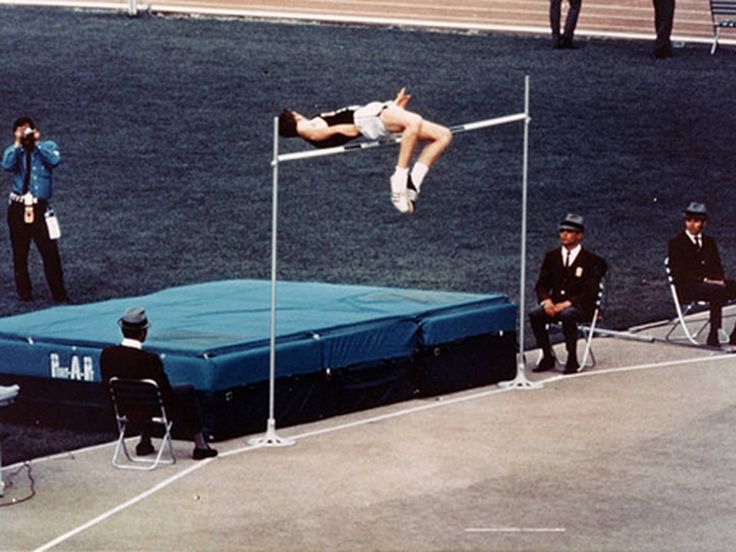
It is the Olympics season right now. One of my favorite stories about the Olympics is about an underdog from Oregon, USA named Dick Fosbury. Fosbury won the gold medal for the High Jump in the 1968 Mexico City Olympics. In those days, there were only a few different styles used for jumping. The main one was called the “Western Roll” where the athlete jumps forward with his face downward. Another style was called the “Scissors”, the oldest style of High Jump. This is where the athlete ran toward the bar and moved the legs in a “scissor” fashion to clear the bar. Fosbury chose the Scissors to be his style. His High School coach asked him to stop using the Scissors and to use the “Western Roll”. The Western Roll was the norm in those days and was used by the star athletes. Fosbury found no success with this. He was called the worst High Jumper in his school. He was getting frustrated, and intuitively he came up with a style that was not seen before. Rather than running straight and rolling “forward”, he ran in at an angle and jumped “backwards” which allowed him to move the bottom part of his body away from the bar. In his words;

“I take off on my right, or outside, foot rather than my left foot. Then I turn my back to the bar, arch my back over the bar and then kick my legs out to clear the bar.”

Fosbury

He was able to jump higher and higher with his method. The coach was not sure about the method, and even questioned whether the method was legal. He cautioned Fosbury that he was going to hurt his back. In those days, the athletes jumped into a big pile of saw dust. As luck would have it, Fosbury’s school installed a soft spongy landing pad at that time enabling him to perfect his style.

Fosbury went on to compete in the 1968 Olympics. As 80,000 spectators watched closely, Fosbury rocked back and forth, talking to himself and gaining confidence. It was also interesting to note that Fosbury wore different colored shoes. Fosbury slowly started running toward the bar and did what became to be known as the “Fosbury Flop”. He cleared 7 feet 4 1/4 inches to win the gold medal. His method was counterintuitive at that time. U.S. Olympic Coach Pat Jordan considered the Fosbury Flop to be dangerous and warned that it would “wipe out an entire generation of high jumpers because they will all have broken necks”. But the method was proven to be quite effective and the world of High Jump changed after that. Everybody started imitating him and improving their performance. Today the Fosbury Flop is considered to be the norm. All world record holders since 1980 used the Fosbury Flop to achieve their best performances.

Looking back, the scientists are able to explain that the Fosbury Flop is the ideal method for the high jump. The athlete is able to manipulate his center of gravity through this method to perform much higher (no pun intended) than any other method. Although Fosbury had an Engineering background, he came upon the method by accident. He was making the method work with his tall stature. His frustration with the standard methods of the day led him to find a new method.

Corollary in the Lean World:

The best form of kaizen happens when you are extremely dissatisfied with the current set of standards or if you are extremely lazy and want to find a better way of doing things. The spirit of kaizen is simply the thinking that there is always a better way of doing things. Fosbury was extremely dissatisfied with the methods in his days. In his words;

My assignment was to get over that damn bar. I was bound and determined not to quit. But I had to do something different.”

He knew that there was a better way and he found it. He explained that it was an iterative process. Once the method was proven, everybody wanted to copy it. Fosbury continued;

That day I was not trying to change the world. I was just trying to get over the bar.”

This is an important lesson for the Lean Leaders.

In a similar vein, Toyota started the Toyota Production System as a means to catch up with Germany and America. After the Second World War, Toyota realized that the productivity of the Japanese workforce was much less than their German and American counterparts. They tried to learn the norms of the day by visiting foreign manufacturing plants. But they came up with counterintuitive ways to achieve their goal slowly and steadily. They rearranged their factories to achieve better flow. They limited their work-in-process. They reduced the lot sizes and found ways to perform quick changeovers. For the painting operation, Toyota started using a paint cartridge system so that they can maintain small lot sizes. Toyota’s methods gained the attention of the world through the oil crisis in the 1970’s. Their process, Toyota Production System, became their Fosbury Flop which everybody wanted to emulate.

You can watch the Fosbury Flop performed by Dick Fosbury below.

Always keep on learning…

In case you missed it, my last post was Buy the Mountain Side.

Buy the Mountain Side:

horyuji

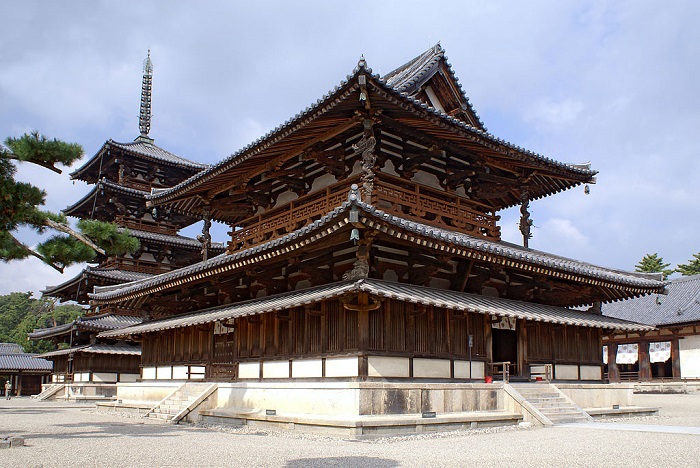
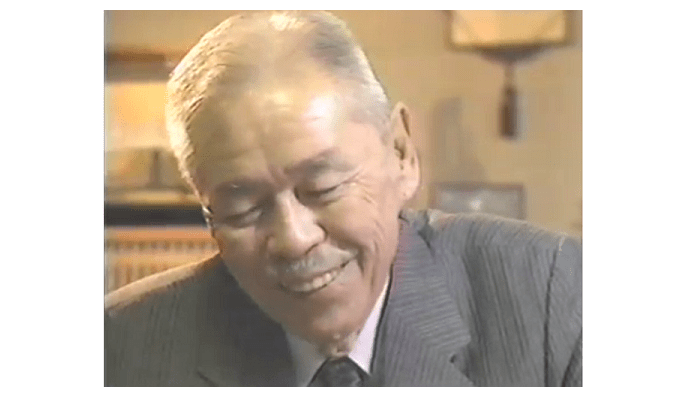
I enjoy learning about Japanese culture. I recently learned about the Horyuji Temple in Japan. The temple was founded in AD 607. This is said to be the oldest standing wooden structure in the world. This temple was completely restored over a span of 51 years by the Nishioka family and was completed by Tsunekazu Nishioka in 1985. In an interview given in 1985, the master carpenter Nishioka shared a great lesson.

When building a temple, don’t buy trees, buy a mountain side. He explained this as an unwritten principle given to him by his ancestors. He explained that a temple’s wood should come from a single location such that the wood can be positioned in the same orientation as the original trees – beams from the trees from north side of the mountain should go on the north side of the temple, and so on.

Each tree, shaped by its soil and decades of wind and rain, has a unique personality, artisans say. The builder, then, must understand and exploit these traits. Trees twisting slightly to the right should be used in conjunction with those twisting left, so that in the end the sum of the forces is zero.

This is a profound thought, and this applies to Teamwork. Everybody in a team works together and brings out the best in themselves and the team. Teamwork is a section of the “Respect for People” pillar of the Toyota Way 2001. In the Japanese culture, the sense of harmony is an important aspect. There is a strong effort to work together. Toyota was able to bring this regional attribute across the globe through Toyota Way 2001. Toyota strengthens their employee base through continuous mentoring and involvement. A team succeeds only when everyone understands the common goal and works collectively towards it. Toyota is able to achieve this and the end result is minimal resistance in their pursuit towards True North.

In an interview in 2007 with Yuki Funo, the chairman and CEO of Toyota Motor Sales USA, Funo also discussed the importance of teamwork with the supplier base. Toyota was entering into a new relationship with an axle supplier. The supplier was flabbergasted when Toyota awarded the contract to the supplier without any discussion about prices. The contract was awarded strictly based on the supplier’s processes and quality review. The supplier was not used to that.

“Toyota’s thinking based on the Toyota Way is teamwork with suppliers. This teamwork is going to be a long-lasting relationship. Price is only one element. Trust is a more important element. The relationship is a sharing concept, and should always be win-win. Price is important, too. But trust is perhaps more so.”

“In the church when you get married, the priest or minister doesn’t ask each partner how much each will get from the other in terms of money. You’re asked about how well you get along. What is your commitment to one another? Now, in real-life situations, some companies practice this, and some don’t.”

Final Words:

Tsunekazu Nishioka’s advice is perhaps the best advice I have heard about Teamwork – Everybody aligned in the right direction resulting in optimum results. There is a strong undercurrent of systems thinking in this. I will finish with a story I heard about 3 electricians who were working on the Apollo spacecraft:

A reporter was watching the three electricians work. He watched them intently for some time and asked each person what they were doing.

“I am inserting transistors in to circuits”, said the first person.

“I am soldering this wire”, said the second person.

“I am helping to put a man on the moon”, said the third person.

Always keep on learning…

In case you missed it, my last post was Hot Dog!

Hot Dog!

hot dog

One of my favorite quotes from Eiji Toyoda, former President of Toyota, is;

“Don’t think mechanically. Even a dry towel can produce water when ideas are conceived.”

Eiji was talking about Kaizen. Toyota talks about “There is always a better way”. This is the spirit of kaizen…reaching higher and challenging ourselves to find a better way in everything we do… every single day.

I recently relistened to a Freaknomics podcast called “A Better Way to Eat”. In the podcast, the host Stephen Dubner talked with Takeru Kobeyashi, a Japanese competitive eater now living in America. When Kobi, as he is called by his fans, came into the field, the world record was 25 and 1/8th hot dogs in 12 minutes. Kobi blew the record out of water with his first appearance in the Nathan’s Hot Dog Eating Contest, held every July Fourth on Coney Island in New York. Kobi ate 50 hot dogs in the same amount of time, almost doubling the record. The contest has been going on for over 40 years and Kobi completely broke the paradigm. Many people were in denial and some even accused Kobi of doping.

In Dubner’s opinion, Kobi looked at the problem differently thus changing the field of competitive eating forever. The question that others were tackling was – how can I maximize the number of hot dogs I eat? The question that Kobi looked at was – how can I make one hot dog easier to eat?

Putting my Lean glasses on, this made me think about the mass production versus one-piece flow production paradigm. The thinking at that time was to simply eat more hot dogs without analyzing the process. Kobi, however focused on eating one hot dog and making that process easier. Kobi researched the sport and came up with several strategies that gave him a superior edge over the competition. Some of his strategies were to split the hot dog into two and eat with both hands; and the other was to dunk the bun into water, squeeze it into a ball and gulp it down. The splitting of the hot dog came to be known as the “Solomon Method” after the story of King Solomon who settled a maternity dispute by saying that he would cut a baby in half. Several competitors started copying Kobi’s strategies and were able to double their eating intake resulting in improved performances.

In the podcast, Kobi gave the following advice about breaking the more than 40 year old artificial barrier;

I think the thing about human beings is that they make a limit in their mind of what their potential is. They decide I’ve been told this, or this is what society tells me, or they’ve been made to believe something. If every human being actually threw away those thoughts and they actually did use that method of thinking to everything the potential of human beings is great, it’s huge, compared to what they actually think of themselves. That is a factor that…If everyone could use it for everything, everything could be much better.

Final Words:

There is a similar lesson from Jesse Itzler, author of Living with a SEAL: 31 Days Training with the Toughest Man on the Planet. The lesson is as follows;

When your mind is telling you you’re done, you’re really only 40 percent done.

Always keep on learning…

In case you missed it, my last post was Toyota, The Green Tomato.

Toyota, the Green Tomato:

greenTomato

Toyota is referred to as the #1 car manufacturer in the world today. Toyota sold 10.15 million vehicles worldwide in 2015 and remained the world’s top selling carmaker for the fourth straight year. I recently came across an interesting metaphor depicting Toyota that I have not heard used before. The book “Extreme Toyota” documented an interview with Jim Press, former President of Toyota Motor North America, in which he said that Toyota wants to be a green tomato. His point was as follows;

“Green tomatoes know their futures are still ahead of them, while red tomatoes quit growing”.

One of the authors of the book, Hirotaka Takeuchi, explained this further by saying that Toyota sees itself as always growing, and always incomplete. This way, Toyota accepts that there is room for improvement, and that “tomorrow will be better than today”.  Hirotaka used the working title of the book as “The Incomplete Company”.

The metaphor of a “green tomato” is beautifully deep and underlines the idea that being complacent is bad. Toyota has become the number one car company in the world. However, seeing itself as the top company is akin to being like the red ripe tomato which would soon fall off and rot. This same idea is repeated by the former President, Katsuaki Watanabe;

“At the very instant we become satisfied, at the very moment we think that the status quo is good enough, that’s when we start to decline.” He continued, “We’re still not there. There are a lot of things we need to do.”

Final Words:

Being complacent is being ignorant and being in denial. Being complacent urges you to remain in your comfort zone. Any new information that indicates that something is wrong does not get registered. As one of my wise friends once told me, once you are complacent, you get busy trying to put up the outward appearance that everything is fine. You create a picture in your mind that everything is great and you hold on to it. The more things that go wrong, the stronger you hold on to your ideal image and continue to be in denial. Be the green tomato, and think of yourself as “still a little more to go”.

I will finish this post with a great Zen Koan by the 1st century Zen master Linji Yixuan. He said;

“When you meet Buddha on the road, kill him”.

There is a little shock factor to this koan. But once you go deeper, there is a beautiful and profound lesson in this. The road is interpreted as your journey in search of enlightenment. The Buddha in the koan is our own idea of perfection and enlightenment. And if you think that you have attained enlightenment, you surely have not attained enlightenment. You have to “kill” that thought, and stay incomplete. Be like a green tomato.

Always keep on learning…

In case you missed it, my last post was Information at the Gemba.

Information at the Gemba:

Info

Uncertainty is all around us. A lean leader’s main purpose is to develop people to tackle uncertainty. There are two ways to tackle uncertainty; one is Genchi Genbutsu (go and see) and the other is the scientific method of PDCA. Claude Shannon, the father of Information Theory, viewed information as the possible reduction in uncertainty in a system. In other words, larger uncertainty presents a larger potential for new information. This can be easily shown as the following equation;

New Information gain = Reduction in Uncertainty

Shannon called the uncertainty as entropy based on the advice from his friend John Von Neumann, a mathematical genius and polymath. The entropy in information theory is not exactly the same as the entropy in Thermodynamics. They are similar in that entropy is a measure of a system’s degree of disorganization. In this regard, information can be viewed as a measure of a system’s degree of organization. Shannon recalled his conversation with Von Neumann as below;

“My greatest concern was what to call it. I thought of calling it ‘information’, but the word was overly used, so I decided to call it ‘uncertainty’. When I discussed it with John von Neumann, he had a better idea. Von Neumann told me, ‘You should call it entropy, for two reasons. In the first place your uncertainty function has been used in statistical mechanics under that name, so it already has a name. In the second place, and more important, nobody knows what entropy really is, so in a debate you will always have the advantage.”

I loved the encouragement from Von Neumann that Shannon would have an advantage in a debate since “nobody knows what entropy really is”.

In this post, I am not going into the mathematics of Information Theory. In fact I am not even going to discuss Information Theory but the philosophical lessons from it. From a philosophical standpoint, Information Theory presents a different perspective on problems and failures at the gemba. When you are planning an experiment, and things go well and the results confirm your hypothesis, you do not learn any new information. However, when the results do not match your hypothesis, there is new information available for you. Thus, failures or similar challenges are opportunities to have new information about your process.

There are seven lessons that I have and they are as follows;

  • Information Gain ≠ Knowledge Gain:

One of the important aspects from the view of the information available at the Gemba is that information does not translate to knowledge. Information is objective in nature and consists of facts. This information gets translated to knowledge when we apply our available mental models to it. This means that there is potentially a severe loss based on the receiver. A good analogy is Sherlock Holmes and Dr. Watson at the crime scene – they are both looking at the same information available, but Holmes is able to deduce more.

  • Be Open:

When you assume full knowledge about a process, you are unwilling to gain knowledge from any new information available. You should be open to possibilities in order to welcome new information and thus a chance to learn something new. Sometimes by being open to others viewpoints, you can learn new things. They may have a lot more experience and more opportunities for information than you may have.

  • Go to the Gemba:

The majority of times, the source of information is the gemba. When you do not go to the source, the information you get will not be as pure as it was. The information you get has been contaminated with the subjective perspectives of the informer. You should go to the gemba as often as you can. The process is giving out information at all times.

  • Exercise Your Observation Skills:

As I mentioned above in the Holmes and Watson analogy, what you can gain from the information presented depends on your ability to identify information. There is a lot of noise in the information you might get and you have to weed out the noise and look at the core information available. One of my favorite definitions of information is by the famous Cerbernetician Gregory Bateson. He defined information as “the difference that makes the difference.” The ability to make the difference from the information given depends mostly on your skill set. Go to the Gemba more often and sharpen your observation skills. Ask “For what Purpose” and “what is the cause” more often.

  • Go Outside Your Comfort Zone:

One of the lessons in lean that does not get a lot of attention is – “go outside your comfort zone”. This is the essence of Challenge in the Continuous Improvement Pillar of the Toyota Way. When you stay inside your comfort zone, you are not willing to gather new information. You get stuck in your ways and trust your degrading mental model rather than challenging and nourishing your mental model so that you are able to develop yourself. Failure is a good thing when you understand that it represents new information that can help you with understanding uncertainties in your process. You will not want to try new things unless you go outside your comfort zone.

  • Experiment Frequently:

You learn more by exposing yourself to more chances of gaining new information. And you do this by experimenting more often. The scientific process is not a single loop of PDCA (Plan-Do-Check-Act). It is an iterative process, and you need to experiment frequently and learn from the feedback.

  • Challenge Your Own Perspective:

The Achilles’ heel for a lean leader is his confirmation bias. He may go to the gemba more often, and he may experiment frequently. Unless he challenges his own perspective, his actions may not be fruitful. My favorite question to challenge my perspective is “What is the evidence I need to invalidate my viewpoint right now, and does the information I have hint at it?” Similar questions ensure that the interpretation of the information you are getting is less tainted.

I will finish off with a funny story I heard about Sherlock Holmes and Watson;

Sherlock Holmes and Dr. Watson decide to go on a camping trip. All the way to the campsite, Holmes was giving observation lessons to Dr. Watson and challenging him. After dinner and a bottle of wine, they lay down for the night, and go to sleep.

Some hours later, Holmes awoke and nudged his faithful friend.

“Watson, look up at the sky and tell me what you see.”

Watson replied, “I see millions of stars.”

“What does that tell you?” Holmes asked.

Watson pondered for a minute.

“Astronomically, it tells me that there are millions of galaxies and potentially billions of planets.”
“Astrologically, I observe that Saturn is in Leo.”
“Horologically, I deduce that the time is approximately a quarter past three.”
“Theologically, I can see that God is all powerful and that we are small and insignificant.”
“Meteorologically, I suspect that we will have a beautiful day tomorrow.”
“What does it tell you, Holmes?” Watson asked.

Holmes was silent for a minute, then spoke: “Watson, you idiot. Someone has stolen our tent!”

Always keep on learning…

In case you missed it, my last post was The Pursuit of Quality – A Lesser Known Lesson from Ohno.

The Pursuit of Quality – A Lesser Known Lesson from Ohno:

Ohno

In today’s post, I will be looking at a lesser known lesson from Taiichi Ohno regarding the pursuit of Quality.

“The pursuit of quantity cultivates waste while the pursuit of quality yields value.”

Ohno was talking about using andons and the importance of resisting mass production thinking. Andon means “lantern” in Japanese, and is a form of visual control on the floor. Toyota requires and requests the operators to pull the andon cord to stop the line if a defect is found and to alert the lead about the issue. Ohno said the following about andons;

“Correcting defects is necessary to reach our goal of totally eliminating waste.”

Prior to the oil crisis, in the early 1970’s in Japan, all the other companies were buying high-volume machines to increase output. They reasoned that they could store the surplus in the warehouse and sell them when the time was right. Toyota, on the other hand, resisted this and built only what was needed. According to Ohno, the companies following mass-production thinking got a rude awakening in the wake of the oil crisis since they could not dispose off their high inventory. Meanwhile Toyota thrived and their profits increased. The other companies started taking notice of the Toyota Production System.

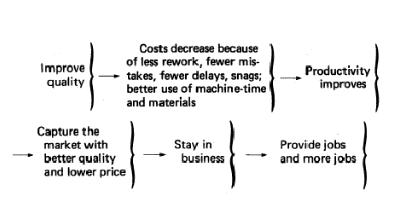
Ohno’s lesson of the pursuit of quality to yield value struck a chord with me. This concept is similar to Dr. Deming’s chain reaction model. Dr. Deming taught us that improvement of quality begets the natural and inevitable improvement of productivity. His entire model is shown below (from his book “Out of the Crisis”).

Deming Chain reaction

Dr. Deming taught the Japanese workers that the defects and faults that get into the hands of the customer lose the market and cost him his job. Dr. Deming taught the Japanese management that everyone should work towards a common aim – quality.

Steve Jobs Story:

I will finish with a story I heard from Tony Fadell who worked as a consultant for Apple and helped with the creation of the IPod. Tony said that Steve Jobs did not like the “Charge Before Use” sticker on all of the electronic gadgets that were available at that time. Jobs argued that the customer had paid money anticipating using the gadget immediately, and that the delay from charging takes away from the customer satisfaction. The normal burn-in period used to be 30 minutes for the IPod. The burn-in is part of the Quality/Reliability inspection where the electronic equipment runs certain cycles for a period of time with the intent of stressing the components to weed out any defective or “weak” parts. Jobs changed the burn-in time to two hours so that when the customer got the IPod, it was fully charged for him to use right away. This was a 300% increase in the inspection time and would have impacted the lead time. Traditional thinking would argue that this was not a good decision. However, this counterintuitive approach was welcomed by the customers and nowadays it is the norm that electronic devices come charged so that the end user can start using it immediately.

Always keep on learning…

In case you missed it, my last post was Challenge and Kaizen.

Challenge and Kaizen:

Comfort Zone/ Challenge Sign Concept

Toyota describes the two pillars of the Toyota Way as “Continuous Improvement” and “Respect for People”. Of this, the continuous improvement pillar is comprised of;

  1. Challenge
  2. Kaizen (change for the better), and
  3. Genchi Genbutsu (Go to the source and grasp the actual facts)

In this post, I will be looking at the “Challenge” aspect of the Continuous Improvement pillar.

Challenge – Why?

The secret to Toyota’s success is its ability to maintain itself as a learning organization. In 1967 P. M. Fitts and I. M. Posner identified three progressive phases of learning a new skill;

  • The cognitive stage – we understand the skill, but we make plenty of mistakes in the process. We are identifying strategies to do better.
  • The associative stage – we are getting better and making less mistakes.
  • The autonomous stage – we are pretty good at this point and can do the task on autopilot

The danger of the autonomous stage is that one starts to create a comfort zone for himself and stops “learning”. Thus, he reaches a plateau and his performance begins to degrade. He begins becoming complacent and accepting his performance saying that “this is good enough”. Unfortunately he is in a blind spot at this point and does not realize what is going on. This atmosphere is detrimental to kaizen.

“Challenge” thus becomes an important factor to sustain kaizen. The “challenge” is not necessarily personal as in challenging the employee to work harder. The “challenge” is in asking the employee to do his best and change the status quo – to be outside his comfort zone. The employee is allowed to make mistakes and in turn is expected to learn from mistakes. The employee continues improving through continuous learning.

Final Words:

Yoshio Ishizaka, a Toyota veteran explained challenge as follows;

Challenge guides us to setting higher objectives for achieving an ideal condition and continuously realizing such goals with courage and creativity.

I will finish off with a funny Zen story about learning;

The son of a master thief asked his father to teach him the secrets of the trade. The old thief agreed and that night took his son to burglarize a large house. While the family was asleep, he silently led his young apprentice into a room that contained a clothes closet. The father told his son to go into the closet to pick out some clothes. When he did, his father quickly shut the door and locked him in. Then he went back outside, knocked loudly on the front door, thereby waking the family, and quickly slipped away before anyone saw him. Hours later, his son returned home, bedraggled and exhausted. “Father,” he cried angrily, “Why did you lock me in that closet? If I hadn’t been made desperate by my fear of getting caught, I never would have escaped. It took all my ingenuity to get out!” The old thief smiled. “Son, you have had your first lesson in the art of burglary.”

Always keep on learning…

In case you missed it, my last post was Monument, Dynamo and Suitcase.

Monument, Dynamo and Suitcase:

trunk_2

There is a concept in Lean called a “Monument”. This refers to a large machine, equipment or something similar that cannot be changed right away and so you have to plan your processes around it. This generally impedes the flow and frequently becomes a hindrance to your lean initiatives. A monument is the opposite of the “flow” and “no waste” concepts of lean. Monuments do not always refer to an equipment or similar hardware. The worst kind of monument can sometimes be the culture or the mental models prevalent in the company. This results in the following excuses;

  • It might work in Japan but not here.
  • But we have to do it this way.
  • This is how we have always done it, and this is how I was taught.
  • How does cutting down inventory help with my production?

The Story of the Productivity Paradox – Computer and Dynamo:

Paul David, an economic historian wrote a wonderful paper in 1989 called “Computer And Dynamo: The Modern Productivity Paradox In A Not-Too Distant Mirror”. In the paper, he talked about the first productivity paradox involving steam engines and electrical engines. The steam engine was an outcome of the Industrial Revolution in England. All of the factories were using steam engines as a source of energy. The steam engine required all of the equipment to be clustered around it. This was the most efficient way of running equipment since there was only one major steam engine and all of the equipment ran from the steam power. The electric motor was an outcome of the technological innovations in America.  Electricity was introduced to the factories as early as 1890. Everybody understood that electrical power is far more efficient than steam power. However, this did not result in an increase in productivity. The productivity remained fairly level even with the introduction of electrical power in to the factories. This was later termed as the “productivity paradox”.

The reason for the lack of increase in productivity was due to the factory layouts that were implemented for the steam engines. The Industrial Engineers replaced the steam engines with electrical engines. They did not rearrange the equipment to utilize the flexibility that was offered by the electric motor. They were constrained by their mental models. Even when new factories were built, they followed the layout that was being used with the steam engines. All of the equipment was clustered into one place hindering the flow. It is said that the factory layouts did not change for about 30 years when the old management was replaced with new management personnel. At this point, the layout was rearranged to follow the flow of materials, and this caused a spike in productivity. All of the engines had its own motor and this allowed the equipment to be spread apart from one another. Each operator was now in full control of his equipment. The monument was broken down since the management was not tied down to the old ways of thinking.

Final Words:

Everybody works from their own mental models. A company’s culture is a collection of these mental models at an equilibrium state. The Dynamo story teaches us the importance of learning from experiments and self-reflection. This is part of the “Check” face of the PDCA cycle. The feedback loop is the only way that one learns the best. I have heard that “we are going 70 miles per hour to get this done, and we do not have time to stop and change the tires.” We need to find time to step back and reflect. The system is trying to talk to you and we should heed its words. Sometimes we get caught up in the firefighting and we stay in that mode for a long time even though we keep fighting the same fires on a daily basis. The feeling of déjà-vu is an indication that we need to stop, step back and try to see the big picture. It is time to reflect.

I will finish off with a similar story about suitcases. I heard this first from my brother:

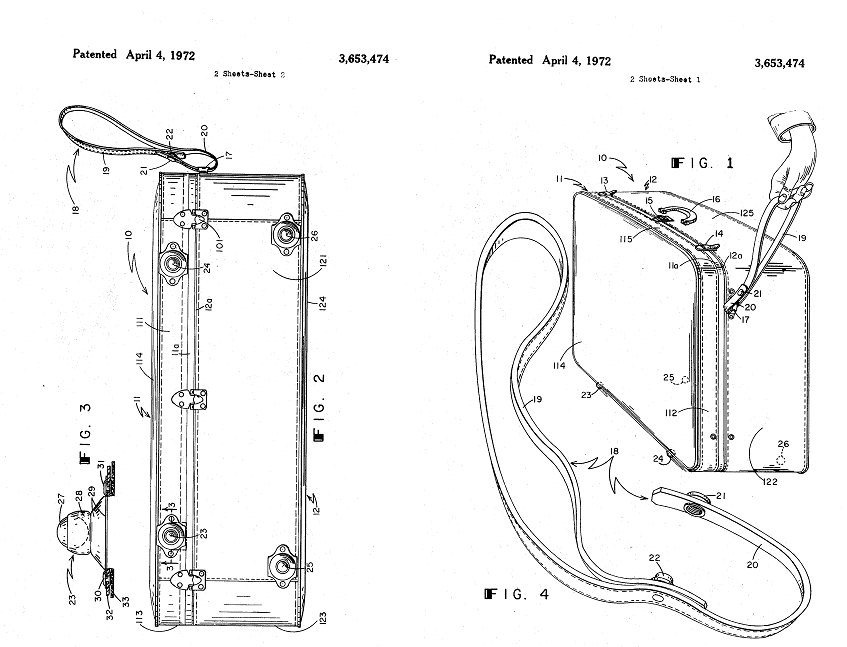
The “trunk” style of suitcases was the prominent form of luggage in the late 1800’s. People started traveling for leisure during the early 1900s which caused manufacturers to come up with new designs. These trunks were heavily built and weighed quite a lot. The term suitcase was introduced since these cases were used for holding suits. The suitcases became prominent in 1930s with the advent of commercial flights. Even at this time, they were not the light weight type that we have today. The addition of a wheel to the suitcase did not come till 1972. Up to that point, the suitcases were carried around by hand. The use of trolleys to transport luggage were seen as a sign of weakness. Even after the wheels were attached to the suitcases, it did not take off immediately. They were seen as mainly for stewardesses or women. Men were seen as wimpy if they used the wheel on the suitcase (talk about men-tal models!).

patent

In about 1989 (after more than ten years of having wheels), a Northwest Airlines pilot named Bob Plath came up with a vertical case with extendable handles and two large wheels on the side.  It took another 15 years to have a 360 degrees spinning wheel to be on the suitcase. Samsonite introduced this model in 2004.

The suitcase is a fairly straightforward design, and it took us about 70 years to achieve our present state.

Always keep on learning…

In case you missed it, my last post was Dr. Deming and Value Stream Mapping.