
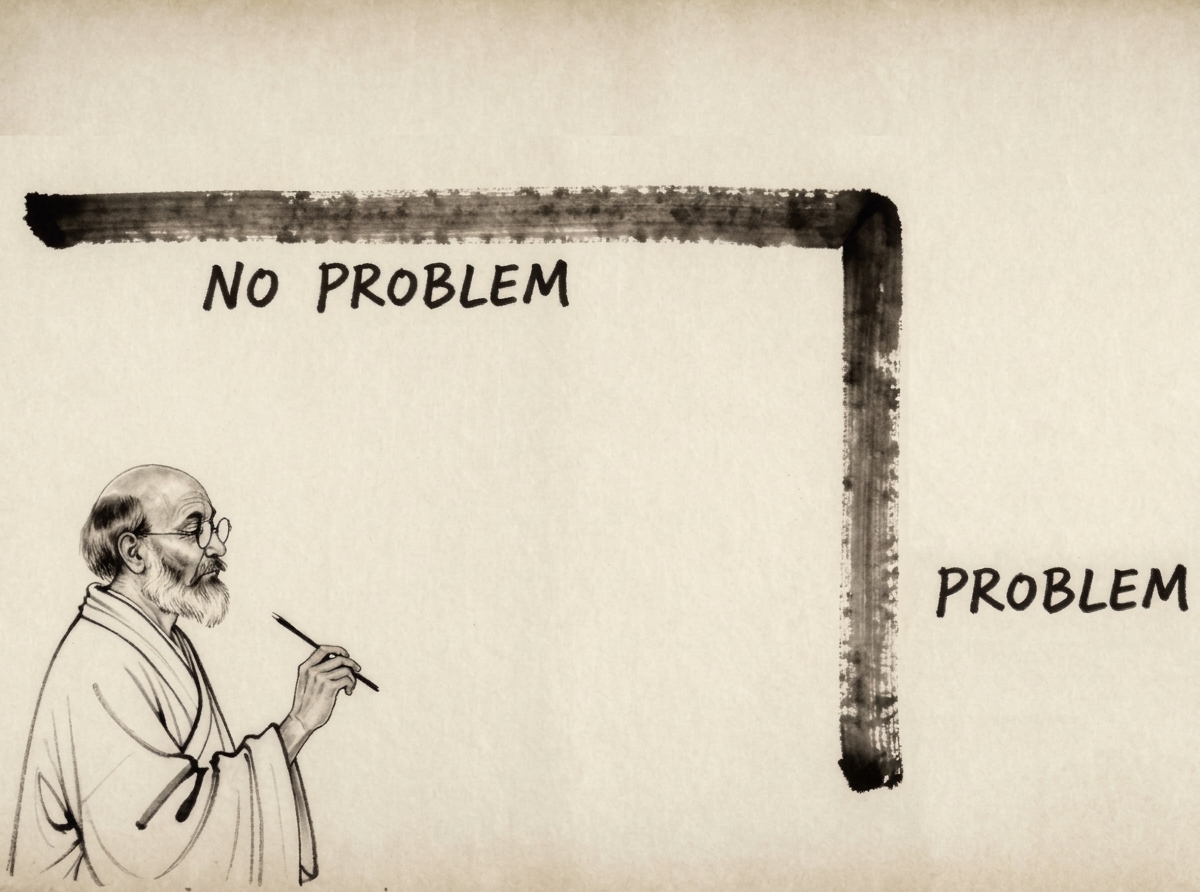
In today’s post, I will be trying to connect a famous Taiichi Ohno lesson with Cybernetics and Laws of Form. The lesson is that having no problem is the biggest problem. I will get to it by way of a hammer. Regular readers have seen this hammer before. I have used it in more than a dozen posts. This time I will pick it up once more and take it back at the end.
Martin Heidegger, the German philosopher, pointed out that a hammer disappears in use. The carpenter does not attend to the hammer, but to the nail, the board, and the house that is taking shape. The hammer is ready-to-hand, present only as part of the work. It shows up only when the head comes loose, and then it becomes present-at-hand, an object standing in front of us that asks for attention. We meet our tools most fully at the moment they fail us.
I have held on to a small principle of my own out of all this, and I wrote about it recently as the invisibility principle. We do not see the structure we depend on until it fails us, or until it stops meeting our needs. The production floor sits closest to this for me. The flow of material, the handoff between shifts, and the way a defect gets caught are never noticed while they work. They are in the background. An organization realizes that there is a problem only when something breaks. My previous post What do you mean by “No problem is a problem” goes into different aspects of the idea. I am focusing only on certain aspects here.
Ross Ashby was one of the pioneers of Cybernetics, and he wrote a line in his private notebooks that I have always liked: when a machine breaks, it changes its mind. In the break, the machine becomes a different machine. That is often the first moment we notice that there was a machine there at all. The hammer and the machine are the same observation, and both of them say that working things are invisible things.
On the production floor, we may refer to this as having no problem. When someone asks how the line is running and the answer is ‘no problem’, the answer is describing the background. Nothing is asking for attention, and the hammer is still in the hand.
The state of no problem is achieved by absorbing the variety thrown at the production floor by the environment. This is explained by Ashby’s Law. Ashby’s Law of Requisite Variety can be stated as: only variety can absorb variety. A process stays steady because something inside it has enough responses to match the disturbances arriving at it. Take the following examples – a lot of resin arrives a little wetter, a fixture has a worn locator, and an order comes in with an odd revision. Each of these arrives at a specific place, at a specific time, and in front of specific people, and the response to counter the gap has to meet it there.
In my view, that is why requisite variety cannot be applied from afar; that variety lives with the people in direct contact with the work. So the no problem state is held in place by people doing work. The operator adjusts the third machine because she knows it runs warm in the afternoon, the inspector knows which supplier to watch, and the material handler swaps a bin before it runs out. Some of the absorbing also lives in buffers, such as extra inventory beside the line, extra time in the schedule, and the rework loop that catches what the first pass missed.
Interestingly, when all of this succeeds, the outcome stays the same, and nothing happens. Successful regulation shows up as an absence, and an absence is easy to mistake for calm. The people who produced the calm disappear into it.
George Spencer-Brown was an English mathematician who wrote Laws of Form, and he gave us a way to draw all of this. Take a single distinction and draw it as a mark. It is a line drawn across a corner of the space, cutting off a small region. The mark indicates the inside of that corner. I am going to draw it so that the inside of the mark is no problem and the outside is problem, and that is the opposite of the way we would normally draw it. I will come back in a moment to why I have drawn it that way.
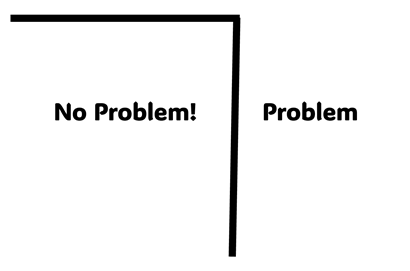
The outside is then the unmarked state, the default space that needs no indication. Nothing inside it calls for a name. One caution about this drawing. The unmarked space looks empty, yet it is full of disturbances that were met and settled before anyone saw them. That is the invisible structure again, now drawn as a form, because everything that works sits unmarked, and sitting unmarked means not being seen.
A break, in this drawing, is a crossing. Something moves out of the mark and into the outside, and it becomes a problem with a name, an owner, a ticket, and a meeting. Then comes the fix, a second crossing, back into the mark. Spencer-Brown calls this the law of crossing: to cross and then cross again is the same as not crossing at all. The two crossings cancel, the problem is solved, and the line returns inside the mark, to the invisibility of no problem.
The form learns nothing from the two crossings. The people who were absorbing variety before the break go back to absorbing it, and that is why the same problem comes back next year under a new name.
Let us go back to where we started to the Ohno lesson: having no problem is the biggest problem. I first came across this saying as a provocation, and I still read it that way. If no problems are visible, then either no disturbances are arriving, and on a working floor that is unlikely, or the disturbances are being absorbed somewhere that nobody is looking. The saying bets on the second possibility. A report of no problem does not tell us that the floor has gone quiet; it tells us where the absorbing is hiding.
Lean practice is built around that notion. Various ideas such smaller lots, less inventory, and the andon, all lower the buffers on purpose. The small breaks then show up early, while the people closest to them can still see the cause. Problems are meant to be solved where they occur, by the people who first meet them. The organization accepts many small crossings so that it never has to wait for one large one. In the language of that Ashby aphorism, it lets itself change its mind a little at a time and close to the work, rather than all at once and from far away.
Now look at the shape of the saying in terms of the form. The saying takes the distinction between problem and no problem and applies it to itself, so that the marked state, no problem, is marked as a problem. The inside is brought into question, and the distinction re-enters its own space. In my earlier posts on re-entry, the move corrected a blind spot inside a concept. Here it does something a little different. Once the saying has marked “no problem” as a problem, the mark cannot simply be uncrossed. That would be a third crossing. This is the essence of Ohno’s lesson.
Re-entry also brings back the one who drew the mark. A distinction needs someone to draw it, and where that someone is standing decides what gets marked. Close to the work, the mark gets drawn early and in small ways. From a distance, the mark gets drawn only when the break has become large enough to be seen from there. On the production floor, the filter creates a green dashboard, and the dashboard tells us nothing about what the filter took out. As Heinz von Foerster, the Socrates of Cybernetics, liked to say, we do not see that we do not see. To say that there is no problem is to report on the observer as much as on the floor.
There is an ethical edge to all of this as well. If successful regulation is invisible, then the people doing it are invisible too, and when things go well, their work disappears along with the calm it produced. Absorbing leaves no record, so when the break finally surfaces, the blame lands on whoever is named nearest to it in the report. Marking the unmarked is not about measuring people into exhaustion. It is about recognizing where the steadiness of the whole is being paid for, and by whom. Then we bring authority and support to the place where the variety is actually met.
Final Arc:
Let us go back to where we started with the hammer. We said that it disappears in use, and that we meet it only when it fails. That is true for the one watching from across the site, and it is not quite true for the carpenter. The carpenter feels the head start to loosen long before it comes off, a slight wobble on the downstroke, a sound that is a little off. She adjusts the grip, taps the head back against the bench, and keeps going.
From across the site it may seem as if there is no problem, but in the hand, at the gemba, there have been small problems here and there all morning, each one met and absorbed and met again. Perhaps the hammer never fully disappears for the one holding it, and perhaps it disappears only for the rest of us. Where does your no problem come from, and who is holding the hammer for you?
Stay curious and always keep on learning…
This post was inspired by my good friend Venky’s post. We discuss similar themes in our book, Connecting the Dots…
If you liked what you have read, please consider my book “Second Order Cybernetics,” available in hard copy and e book formats. https://www.cyb3rsyn.com/products/soc-book
Discover more from Harish's Notebook - My notes... Lean, Cybernetics, Quality & Data Science.
Subscribe to get the latest posts sent to your email.

