
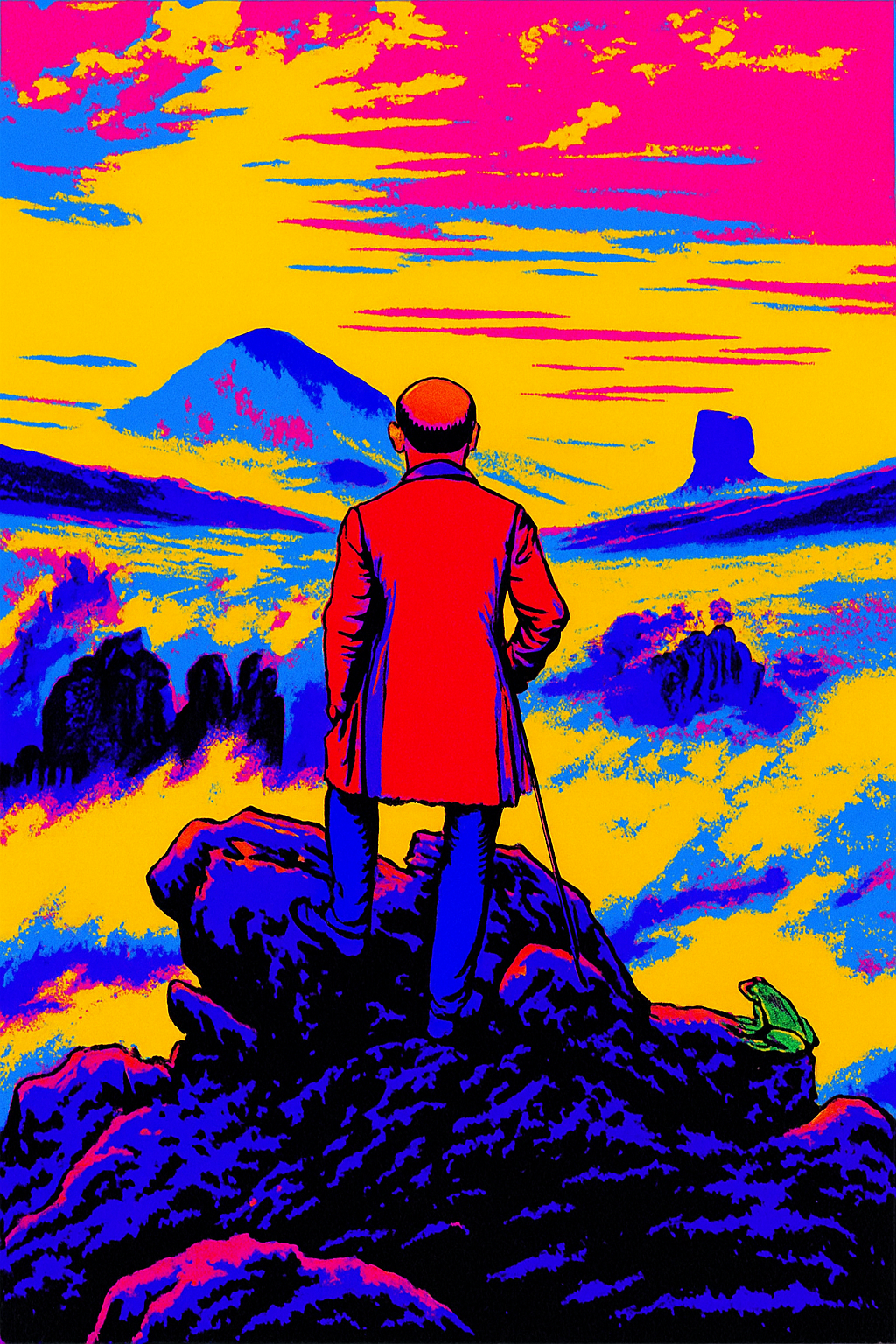
In today’s post I want to spend time with Søren Kierkegaard. I have been interested in his ideas because he occupies an unusual place in the history of thought. He is considered a pioneer of existentialism, and yet he is also a man of faith. Most of the existentialist thinkers who followed him, including Sartre, built their philosophies around radical freedom and human responsibility without any reference to faith at all. Kierkegaard stands in the middle of this tension. He writes from a position of uncertainty and responsibility, but he also lets faith shape his understanding of what it means to be human. This combination gives his work a kind of depth that is difficult to classify. It also gives us a set of ideas that speak directly to the act of thinking, especially when we try to think in ‘systems’.
Thinking in ‘systems’ is often presented as an attempt to arrange the world into a coherent whole. We are encouraged to draw maps, diagrams, and loops that claim to show how everything is connected. These maps have their value, but they also create the illusion that understanding is a matter of fitting pieces together. They invite us to believe that if we only had the right model, the right picture, or the right mission statement, then clarity would follow. But the thinking domain is not the physical domain. Thoughts are not puzzle pieces, and ideas do not snap together neatly. There is no final picture on the box to guide. There is only the ongoing work of trying to understand a world that will not hold still long enough to be captured by a diagram.
Kierkegaard seems to have understood this difficulty quite well. He believed that the greatest danger in human life is self-deception. We long for the comfort of clarity, so we often rush to declare purposes and principles. For Kierkegaard, becoming a self is not a matter of adopting a slogan. It is a lifelong task shaped by inwardness, responsibility, and the willingness to face ambiguity without trying to escape it. Our authenticity comes from this attempt. This is why he would be deeply suspicious of systems that claim to explain everything. For him such ‘systems’ flatten the complexity of human experience. They offer a kind of intellectual reassurance, but they do not help us live.
One of Kierkegaard’s most striking ideas is that life can be understood only by looking backward, but it must be lived forward. Understanding in this regard is a retrospective act. It is something we do when we look back and discover patterns in what has already happened. But living is always forward. It takes place in a stream of uncertainty, where choices must be made without guarantees and where the meaning of those choices often remains unclear until much later. This observation challenges the entire idea of systemic coherence. Systems maps work backward. They create a picture of causality after the fact. They explain what has been, but they do not show us how to live into what is unfolding. They provide a sense of structure, but this structure is largely retrospective.
This backward–forward tension reveals why the search for a perfectly coherent system is misguided. Human life does not unfold according to a diagram. Thinking does not progress by assembling pieces into a single whole. We understand our experiences only after we have lived through them. The clarity we draw from models and mission statements can therefore be misleading. It can be useful as a reflection, but it should not substitute for the lived experience of confronting ambiguity in the moment. Kierkegaard’s insight makes the entire project of declaring a mission or a golden why feel somewhat naive. These declarations claim to give direction, but direction is not something that can simply be proclaimed. Direction must be discovered through the way we participate in the world.
Another of Kierkegaard’s central ideas is that truth becomes meaningful only when it is appropriated inwardly. Truth is not something imposed from above. It must be taken up, lived, wrestled with, and made one’s own. A beautifully crafted mission statement does not create meaning. A polished systems map does not create understanding. These are only starting points. Understanding arises only when individuals confront their own limitations, their own anxieties, and the tensions that shape their experiences. For Kierkegaard, this inward appropriation is the essence of responsible living. It is also the key to responsible thinking.
Kierkegaard’s view of anxiety deepens this idea. Anxiety is not simply fear. It is the feeling that arises when one realizes one must freely choose. It is the dizziness of possibility. In the context of thinking, anxiety shows up when we face the limits of our understanding, when we recognize that we must choose what matters, and when we realize that there is no system neat enough to relieve us of that responsibility. Many organizational declarations are attempts to soothe this anxiety. They create a picture of direction that allows people to avoid the discomfort of thinking for themselves. But Kierkegaard would say that this discomfort is precisely where thinking begins.
This gives us a different language for cognitive blindness. Blindness is not only a matter of not seeing. It is often a refusal to see, a retreat into the comfort of prefabricated clarity. Thinking asks us to approach our blindness with curiosity rather than defensiveness. It invites us to engage with the friction that reveals what we had overlooked. Systems thinking, when practiced responsibly, is not about drawing neat maps. It is about cultivating the openness required to encounter what does not fit and the humility to revise our sense of the world when confronted with surprise.
Final words:
In the end, Kierkegaard helps us see that thinking is not the work of fitting pieces together. It is the work of becoming a self, which requires inwardness, responsibility, and the willingness to live with ambiguity. He reminds us that life unfolds forward while understanding works backward. This simple observation exposes the limitations of any attempt to impose a coherent system on a world that is always in motion. Mission statements and golden whys can be helpful beginnings, but they often promise clarity without cultivating the character and perception that make clarity meaningful.
The point is not to reject purpose or systemic awareness. It is to hold our purposes lightly, to allow our thinking to be shaped by our experiences, and to accept that ambiguity is not a failure of insight but a condition of life. Systems thinking, when grounded in Kierkegaard’s lessons, becomes a stance rather than a diagram. It becomes a way of approaching the world with patience, honesty, and a readiness to see differently. This path is demanding, but it is also the one that keeps us awake to the depth and complexity of being human.
Stay curious and Always keep on learning…
Discover more from Harish's Notebook - My notes... Lean, Cybernetics, Quality & Data Science.
Subscribe to get the latest posts sent to your email.
 Harish's Notebook - My notes... Lean, Cybernetics, Quality & Data Science.
As I have been saying for years: the issue of systems thinking is about thinking and not about systems. A system is a tool – I tend to limity the use of the word system to human made systems, which are easily distinguished (!) from natural or organic “systems” -, while thinking is an intrument. (I’ve borrowed this from a discussion about AI; AI should only be used by experts, like playing a violin doesn’t make you an artist).
Furthermore, we tend to use a concept as-if it actually exists. In physics, “gravitional force” is a concept invented by Newton, proposing “force acting over a distance”. A bit like a Superman, stopping a plane in full flight.
The concepts model or map and are made-up, fictions; but some are useful and the usefulness comes from the structure. That’s why mathematics “works”. (By the way, did I tell you that 0 (zero) is fiction too? The Greek thought that zero means nothing, so there can be no figure 0 – I like the paradox)
All laws of nature are human inventions, human concepts. For instance, there is no “gravity police”. This brings me to the source of self-perception: it’s the law! All concepts are maintained by a community and belonging to a community requires one to accept the use of the words and concepts as prescribed by the leaders of the community. The source of the anxiety is part of the paradoxes of expression (sic): authority, creativity, dependency and courage (or the ability to act despite one’s anxiety).
Interestingly, G’d is also a conceptual metaphor and – like Kierkegaard (funny, his name sounds like church yard), one should behave as-if there’s a G’d or are G’ds. But that doesn’t necessarily entail one should believe in the existence of true G’d. Reality and truth are of different dimensions.
LikeLiked by 1 person
I was replying to a substack by Robert Reich, who quoted a judge from 1830 or so about corporations:
Because we believe in cause-and-effect (I don’t), most people think that real results from an artificial being – products from a corporation – implies the corporation must be real too.
Chat/GPT found a summary of Luhmann on our use of this concept: “When we infer from real effects that a corporation is a real “being,” we are performing an attribution of agency that reifies a social (Italics by me) system—a phenomenon Luhmann treats as a necessary but illusory simplification.”
It’s the same with Systems Thinking” or cybernetics: we attribute agency to a “system” or “steering” towards goals or objectives, which are necessary metaphorical expressions. We treat them as-if real, and the social community reinforces this.
We do this very subtle, by starting with defining the concepts and then creating – what I would call – a tautology. And excluding other descriptions of the concepts. We then become blind to others, who see things differently.
LikeLiked by 1 person