
In today’s post, I want to explore an observation about how we make distinctions and what this reveals about the structure of our thinking. I am inspired by the ideas in Spencer-Brown’s “Laws of Form” and broader themes in cybernetics about how observers construct meaning.
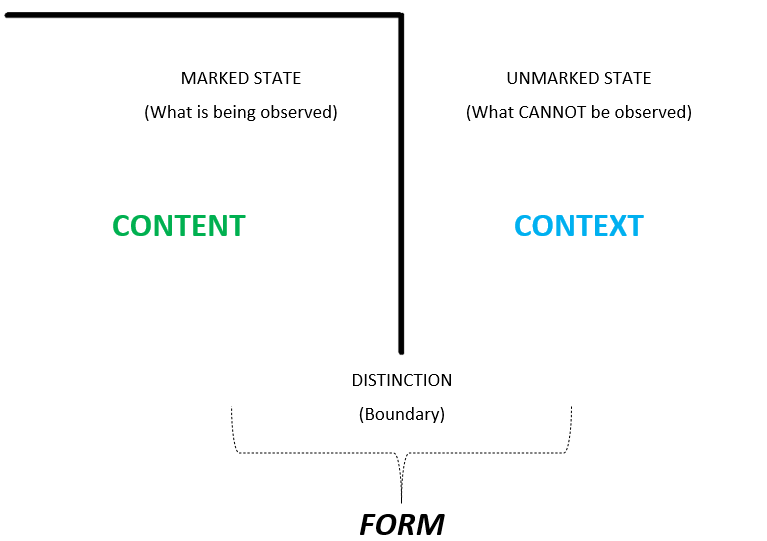
The starting point is simple. When we make a distinction, we create a boundary that separates what is inside from what is outside. Spencer-Brown formalized this with his notation of the Mark, showing how any act of indication simultaneously creates both the indicated and the non-indicated. This is shown below:
As we look closer, things get more interesting.
The Basic Operation of Distinction-Making:
When I make one distinction to mark “A,” I create two states. There is A (the marked state) and not-A (the unmarked state). This seems straightforward enough. We can depict this as below:
(A) not-A
Spencer-Brown showed that this basic operation has interesting algebraic properties. The unmarked state is not simply absence or void. It is the enabling condition that gives the marked state its meaning. Without the background of the unmarked, the mark itself would be meaningless.
This relationship between marked and unmarked is fundamental to how meaning emerges. The marked state exists only in relation to what it excludes.
We can take this further. Consider what happens when we make multiple distinctions. If I distinguish both A and B within the same unmarked space, Spencer-Brown’s notation shows this as ((A)(B)).
This actually creates three categories, not four. There is A, there is B, and there is everything else that is neither A nor B. We can represent this as ((A)(B))X, where X represents the remainder of the unmarked space.
In Spencer-Brown’s system, A and B are mutually exclusive by the nature of how the distinctions are made. They are separate marks within the same unmarked background, not overlapping regions as in classical set theory.
This gives us the pattern that n distinctions create n+1 categories. Three distinctions would create four categories, four distinctions would create five, and so on.
The Persistent Unmarked State:
What interests me most is how something remains unmarked regardless of how many distinctions we make. No matter how extensively we mark up our space with categories and boundaries, there is always an unmarked background that enables those markings to have meaning.
This unmarked background is not just everything else we have not thought of yet. It is the condition that makes thinking and categorizing possible in the first place. When we argue about categories like hot versus cold, we often treat these as exhaustive alternatives, often as dichotomies. But there is always the unmarked space that contains the ideas of moderate temperatures, context-dependent judgments, and the framework of assumptions that makes temperature distinctions seem natural and meaningful.
Connection to Self-Reference Problems:
This observation about the persistent unmarked state connects to well-known problems in formal systems, though the connection is analogical rather than mathematically precise.
Russell discovered that attempts to create completely comprehensive sets run into contradictions when they try to include themselves. The set of all sets that do not contain themselves creates a paradox when we ask whether it contains itself. Gödel showed that formal systems strong enough to express arithmetic cannot prove their own consistency without appealing to principles outside the system.
These results point to a general pattern. Complete self-inclusion appears to be impossible. There is always something outside the system that the system requires but cannot fully capture within its own terms.
The unmarked state in Spencer-Brown’s system suggests a similar limitation. The observer making distinctions cannot fully mark their own position as observer. There is always something unmarked that enables the marking process itself.
Implications for How We Think:
This has practical implications for how we approach knowledge and categories. It suggests epistemic humility. If our categorical frameworks always rest on unmarked assumptions and background conditions, then we should hold our categories lightly. They are tools for navigating experience, not mirrors of an independent reality.
In addition, it points toward the value of examining our own distinction-making processes. When we notice ourselves categorizing something, we can ask what remains unmarked in that process. What assumptions are we making? What alternatives are we not seeing?
And it also suggests why different observers can legitimately make different distinctions. The unmarked background that enables distinctions varies with the observer’s purposes, biological capabilities, and cultural context. The distinctions we make depend entirely on the purpose(s) of the observer. Different observers make different distinctions. This viewpoint supports the idea of pluralism.
Final Words:
Spencer-Brown’s insight about the marked and unmarked states reveals something fundamental about the structure of thought itself. Every act of indication creates both what it marks and what it leaves unmarked. The unmarked is not simply absence but the enabling condition for meaning.
This leads to both epistemic humility and intellectual pluralism. Different ways of making distinctions reveal different aspects of complex situations. No single framework captures everything. The wisdom lies in working skillfully with multiple perspectives while recognizing what each obscures.
Most importantly, the unmarked space always exceeds our attempts to mark it completely. As Heinz von Foerster observed, “Objectivity is a subject’s delusion that observing can be done without him.” The observer making distinctions cannot fully step outside their own process of observation.
This is not a limitation to overcome but a fundamental feature of how minds engage with complexity. “The environment as we perceive it is our invention,” von Foerster also noted, pointing to the active role we play in constructing the realities we inhabit.
Understanding this process of distinction-making is essential for navigating complexity with wisdom. Think about how this affects the popular frameworks with neat triads, 2×2 matrices, etc. that promise to carve up the world into manageable categories. Every one of these frameworks commits the same fundamental error. They erase the observer who created the distinctions and ignore the vast unmarked space of assumptions, context, and excluded possibilities that makes their tidy categories seem meaningful.
The unmarked state reminds us that thinking is always an ongoing process within contexts we can never fully transcend. This recognition opens us to continued learning and the possibility of seeing familiar situations in new ways.
Stay Curious and Always Keep on Learning.
If you found value in this exploration of thinking and categories, check out my latest book on the Toyota Production System, Connecting the Dots…
The soft copy is available here. And the hard copy is available here.
Discover more from Harish's Notebook - My notes... Lean, Cybernetics, Quality & Data Science.
Subscribe to get the latest posts sent to your email.
 Harish's Notebook - My notes... Lean, Cybernetics, Quality & Data Science.
reply – as always – grew and grew. It’s more the way my brain wonders….
It’s more that observers observe (inclusive-or construct, invent, uncover,…) reality than how. An how depends on an observer and cannot be observed by this observer. It is, so to say, “behind a curtain, a veil”, or – I would say, referring to a Markov-blanket (https://en.wikipedia.org/wiki/Markov_blanket) , under a blanket. For all practical purposes, you don’t have to be aware of your awareness.
Spencer-Brown starts with “Draw… ” (p. 3, construction), an injunction, and later “Call…”. This makes sense when you’re thinking of “Laws (of Form)”, a use I can understand, knowing his context (mathematics), but to which I cannot agree. All laws are human laws, decreed by some-one. So forms forming forms, conditions condition conditions and only observing forms derive “laws”. Injunctions have to be observed, if you see what I mean.
This made me think up the following:
Every form forms, (inclusive-)or creates, induces, uncovers, invent “distinctions”, or rather “distinguishes distinctions”. Through relationships, they induce each other. So Spencer-Brown – and any reader (aka observer) – has already been shaped itself in forms of distinctions. We have “formulated” ourselves, in a matter of speaking.
The Merriam-Webster dictionary start with observing meaning to comply (https://www.merriam-webster.com/dictionary/observe), while the Cambridge starts with “to watch carefully” (https://dictionary.cambridge.org/dictionary/english/observe). So my observation would be, that “Laws” are to be observed, while “Forms” are to be observed.
This brings me to adapt Watzlawick’s axioms:
All observing distinguishes, and all distinguishing observes. One cannot not distinguish, not not observe. Everything distinguished observes in their own way. You can distinguish a cell in a body, “observing” – as in ‘noticing’ – both other cells and “observing” – as in ‘complying’ – its “service”.
Every distinguishing has a content and (a) relationship(s) with observing, where relationship classifies content. Thus form emerges (produces, shapes, realises,…) from relating content to relationships. This is equivalent to of a metamorphosis, by the observer. A form becoming a sign through observing. In this way, an observer invents (discovers, intuits, enacts, …) reality. Shaping a form isn’t at will or randomly, as the structure accounts for its usefulness. A fish is a model of its waters, as a human body “models” a savanne.
The nature of the relationship between the observed and the relationship depends on the use of the observed by the observer. It, so to say, “serves its (observer’s) purpose” (purpose, of a sign, follows use). This induces what I like to call “Metaphor-in-Use”. At this point meaning is being invented (discovered, enacted, created, induced, …) . Notice that in my opinion meaning precedes acquiring language. Constructing reality isn’t at will or randomly, as the structure
accounts for its usefulness. It does involve – second and thrird loop – learning, dealing with errors and mistakes. There will always be “unmarked” terrain.
Now finally, I come to use of language . (Human) Beings observe rules of communications codified by a community. All interactions produce sounds and sounds can be distinguished (or observed, heard, listened to, …). Sounds can be natural – see ad 3 – and human-made. Natural sounds can be called “analogue”, like “cuckoo”, the sound of the wind or calls (shouts, cries,…) . Human made sounds can be codified into “digital” languages. “Digital communication refers to words and their symbolic meaning”. It requires human beings to observe rules of communication established by a community they’re belonging to. This is what I like to call “Metaphor-Espoused”.
Meaning of words, is created (arises, emerges, is induced, …) from paradoxical tensions between unity (complementary relationships ) and disunity (symmetrical relationships). We need differences between “marked” and “unmarked” states to be able to communicate. Our current use of language adequately refers to the content of a message (facts, marked/unmarked), but lacks adequate expressions for dealing with the relational aspects (fictions, marking/unmarking), as we tend to use reïfications for relating (distinguishing, observing) to each other.
ad 1. After making a distinction or observation, a second distinction is being made, a qualification (or judgement, evaluation, …) by the observer about the relationship between this observer and the observed, the distinguished and the distinguish-er. You could say, this makes a concrete fact (distinction) into a fiction, if you get my observation.
ad 2. All observing (distinguishing) is also meta-observing. (I didn’t need to go into the notion, as the “square” is difficult to draw, and the re-entry may be observed in using the word re-lationship). I call the content “fact” (“actual”, “give”, “datum”,…) and the relationship “fiction” (“real” as in “real-ized”), “invented”, “made-up”, “discovered”, …) . Notice it may be hard to distinguish fact from fiction, as it depends on the relationships between observer and fact. A relationship could be observed as “context” .
ad 3. The use of the observed produces the form (or shape), for instance pebbles formed through interacting between rocks. We can easily observe differences between natural forms or shapes and human made forms or objects. I’m using the word “object” intentionally, as our objects have purposes of functions. The original function of an object being “to be thrown” towards a subject, “ject” derived from the Latin “iacere”.
ad 4. You may observe we’re using the same lemma “mun” in “human”, “woman”, “men””mind”, “communication”, “meaning”, “community”, in Dutch “gemeenschap”, “mening”, ….. This feature of human communication – based on conditional probabilities – is exploited by the so-called artificial intelligence.
ad 5. Here we see the complexes of truth/false and real/unreal. When processes are being worded as “things” we can pretend they exist as-if they exist truely. Later more.
LikeLiked by 1 person