
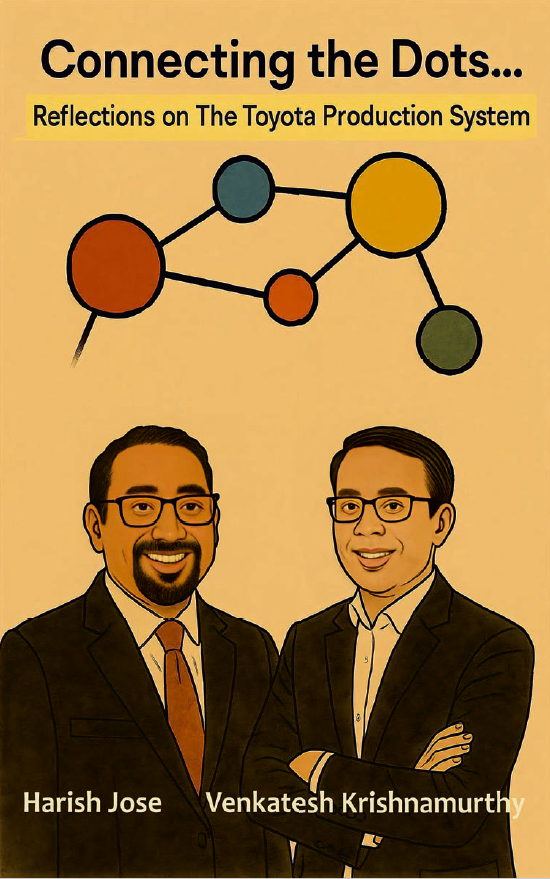
My good friend, Venky and I have completed writing “Connecting the Dots… Reflections on The Toyota Production System.” The book will be available exclusively through Cyb3rSyn (https://www.cyb3rsynlabs.com/feed) next month as an e-book. Hard copies also will be available for order next month.
This book is not another step-by-step manual or toolkit.
We provide a comprehensive exploration of the philosophical underpinnings, historical origins, and cultural roots of TPS, focusing on why Toyota implemented its methods rather than simply what those methods are.
We emphasize the underlying philosophy and spirit of TPS, the principles that give these tools meaning and power. The book covers:
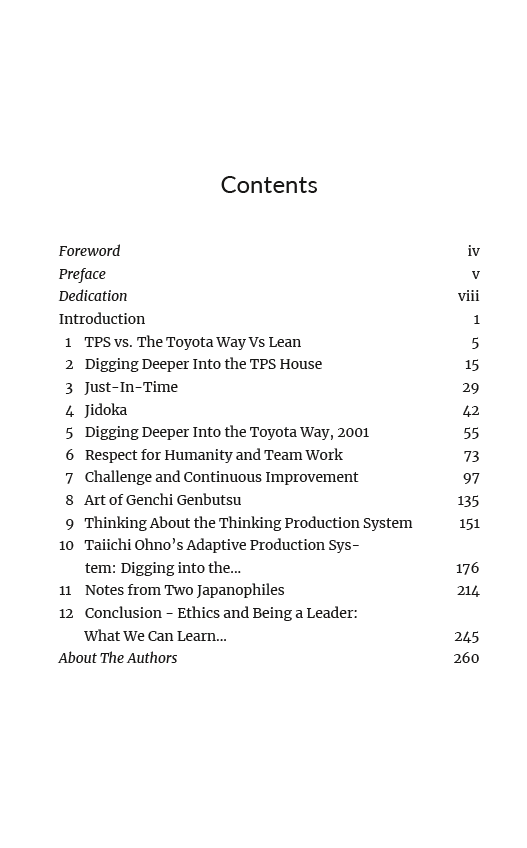
• The two foundational “Houses” of Toyota: the TPS House and The Toyota Way House. The TPS House represents the “what” and “how,” while The Toyota Way represents the “why”
• Two pillars of TPS House: Just-in-Time (JIT) and Jidoka, tracing their origins and detailed explanations of their purpose and evolution
• Core principles of The Toyota Way: Respect for People and Continuous Improvement (Kaizen), exploring their historical context, ethical implications, and practical manifestations
• Other crucial concepts: Genchi Genbutsu (“go and see”), Taiichi Ohno’s adaptive production system, and the Thinking Production System
The detail extends to the influences and rationale behind these concepts, including Kiichiro Toyoda’s “daily bulletin system” for JIT, Sakichi Toyoda’s automatic loom for Jidoka, and the various forms of kaizen.
The title “Connecting the Dots…” describes our methodology and core goal. We recognize similar patterns across different domains to deepen understanding of TPS, drawing parallels from:
• Philosophy: Zen Buddhism, Socratic method, Kantian ethics, Ubuntu
• Science & Systems Theory: Cybernetics (Ross Ashby), Factory Physics (Kingman’s VUT equation), Psychophysics (Weber’s Law), behavioral economics, and the Forth Bridge principle
• Art & Literature: How artists “see,” Chekhov’s Gun, and Japanese arts like Kintsukuroi and Karakuri Ningyō
• Japanese Culture & History: Concepts like Wa, Nemawashi, Mottainai, Hansei, Shisa Kanko, and the historical context of post-WWII Japan
• Training & Development: Insights from TWI programs
• Computer Science: Bootstrap Kaizen and Doug Engelbart’s work
This cross-disciplinary approach supports our argument that TPS is a “way of thinking” that resonates far beyond its immediate manufacturing context.
“Reflections on” captures our purpose. This is a collection of reflections that invites readers to “read slowly, one chapter at a time, and reflect” on the ideas. The book encourages second-order thinking, prompting readers to ask “Why am I using this tool? What problem am I trying to solve?” rather than just “What tool should I use?” This reflective approach aims to provide deeper insight and more ethical guidance compared to interpretations of Lean and TPS that often focus on tools and cost reduction.
The book frames the rise of AI as a “Taiichi Ohno moment” for contemporary leaders, posing critical questions about jobs, ethics, and the preservation of human value in the workplace. It emphasizes that leaders must choose to reimagine work around uniquely human strengths to prevent human potential from becoming the “ultimate Mottainai” (wasted potential), rather than simply designing humans out of the equation.
In essence, what we are trying to achieve is to provide the reader a thoughtful, interdisciplinary journey to uncover the profound wisdom and ethical foundations that make TPS a dynamic and human-centered system, rather than a mere collection of operational techniques.
Interested readers can check out the NLM podcast for Chapter 10 here – https://youtu.be/qWcTVQUltHI.
#ToyotaProductionSystem #LeanThinking
Discover more from Harish's Notebook - My notes... Lean, Cybernetics, Quality & Data Science.
Subscribe to get the latest posts sent to your email.
 Harish's Notebook - My notes... Lean, Cybernetics, Quality & Data Science.
when I worked with AT&T and Philips Telecommunications (or Lucent) I combined JIT with TQ(M), MRP and ToC (Theory of Constraints).
I used the concepts of JIT to determine the batch size (1, making lot for lot, determining when the order/kan ban to release). I had asked for the Toyota formula for kan ban size, and it happened to be in time and not in quantity.
i also used it for synchronization by Tact Time. We restructured four subassembly lines, all units going into the same frame. Their labour content where different, some had a large content, some not. Based on the law that you’ve got a few with large content and many of low, I proposed a U configuration of 4 stations in each leg, with two terminating branches. The unit with the large content would follow the inner lane, the other the outer. Engineers tried to prove it couldn’t work, but had to admit it could work in Theory. As in practice.
At the inauguration, they gave me a book. “Japanese Manufacturing Techniques “, with many pictures. I showed one to my group leader. He said, “I know”. The picture showed a line like ours, but with people working standing up. In ours they were sitting. Expensive chairs.
“People work better standing up”. So we put the whole line on blocks. We put the chairs in the coffee corner.
LikeLiked by 1 person
Thank you, Jan. Was the book you mentioned by Richard Schonberger? I miss the style and structure of the old TPS/Lean books. They were more optimistic. 🙂
-Harsh
LikeLike
No, it was a picture book, Japanese. When I’m back home I’ll try to find it.
LikeLike
Cannot find the book. Probably gave it to our son. I’ll ask him, when I see him.
LikeLiked by 1 person
No worries. Thank you for checking.
LikeLike