
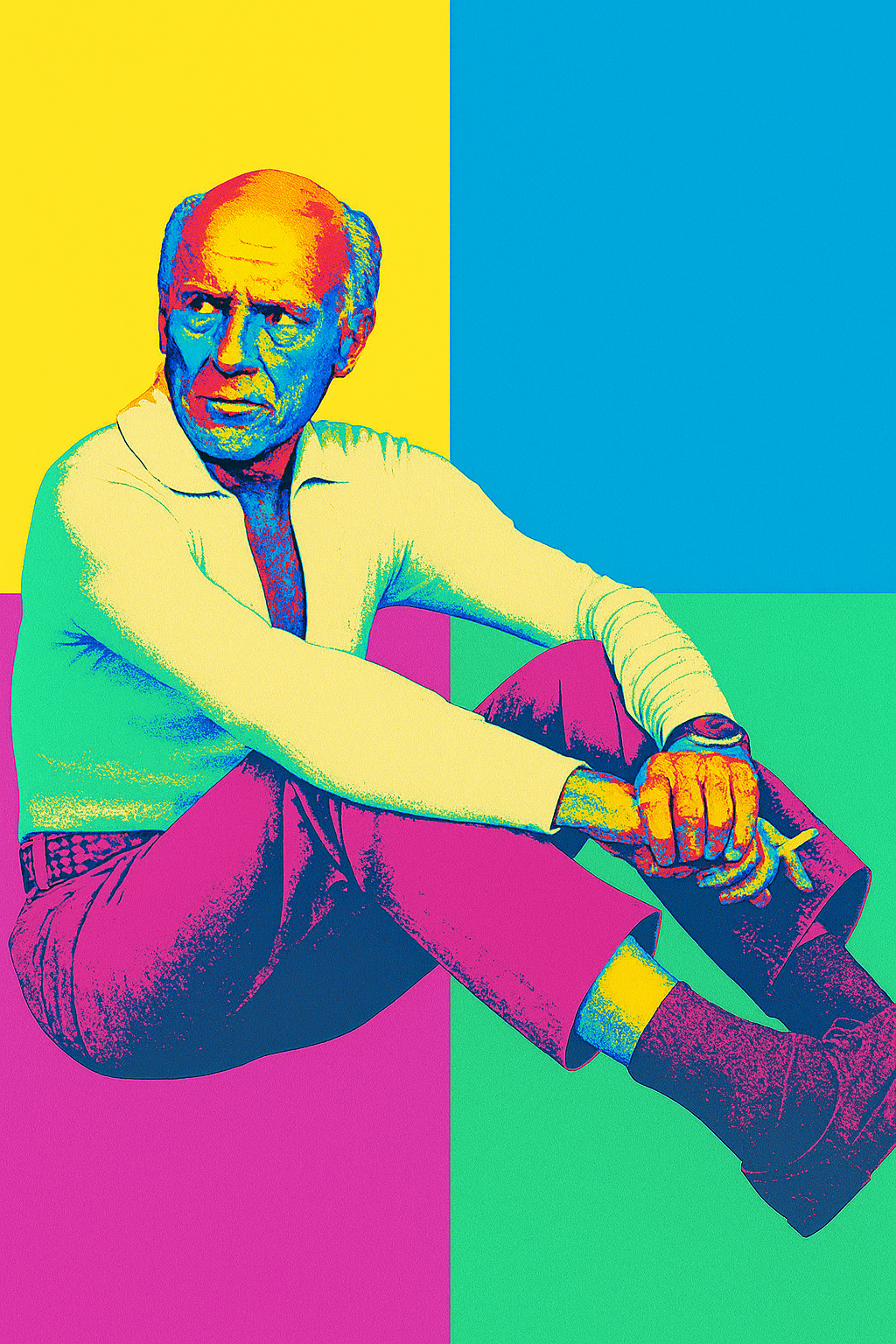
In today’s post, I am exploring one of the most fascinating aspects of Heinz von Foerster’s work: his complete rejection of philosophical labels and -isms. Von Foerster, the Austrian-American physicist and cybernetician, in his later years did not want to be pinned down by any single philosophical position. This was not philosophical indecision but a carefully crafted stance that reflected his deepest insights about observation, responsibility, and the nature of knowledge itself.
Von Foerster’s view that he was an -ist only of the -ism he could laugh at. While there is no definitive record of this exact phrase, in my opinion it perfectly captures his approach to philosophical thinking. He would only commit to philosophical positions that he could maintain with lightness and humor, positions that did not take themselves too seriously. This prevented his thinking from becoming rigid or dogmatic. He treated thought as an ongoing exploration, not a fixed doctrine.
To understand why this matters, let me walk through the major -isms that von Foerster consistently stepped around, and show you how his alternative approach offers something far more powerful than any single philosophical position.
Objectivism – The View from Nowhere:
Objectivism claims there is a world “out there,” independent of us, that we can know through careful observation and measurement. It insists on a sharp separation between the observer and what they observe.
Von Foerster had no patience for this illusion. As he put it:
Objectivity is the delusion that observations could be made without an observer.
This was not just philosophical wordplay. Von Foerster understood something deeper about responsibility:
Objectivity is one of the great tricks to get rid of responsibility.
When we claim to simply observe “what is,” we avoid acknowledging our role in bringing forth what we see. This is particularly important in his work on self-organizing systems. As he demonstrated, “There are no such things as self-organizing systems!” What we observe is always a system in close contact with an environment, in a state of perpetual interaction. The observer and the observed emerge together.
This insight reverses the logic of classical science. Instead of trying to eliminate the observer, von Foerster insisted that the observer must be included in the description of the observing system.
Subjectivism – The Prison of the Self:
You might think that if objectivism is wrong, then subjectivism must be right. Subjectivism is the idea that reality is purely a personal interpretation. Von Foerster rejected this view as well.
Von Foerster explicitly refuted the notion that reality is solely the product of an individual’s imagination. He used what philosophers call a “reductio ad absurdum” argument to show the logical impossibility of pure subjectivism.
As he put it:
If I assume that I am the sole reality, it turns out that I am the imagination of somebody else, who in turn assumes that he is the sole reality.
This paradox is easily resolved, by postulating the reality of the world in which we happily thrive.
He also addressed the idea of isolated experience directly. When people talk about being alone with their thoughts, von Foerster pointed out: “The man alone? He would just have to re-member that he is only alone when compared to others.” Even the concept of being “alone” requires the existence of others as a reference point.
Subjectivism treats knowledge as trapped inside individual minds. But von Foerster understood that knowledge emerges through interaction, not isolation. When discussing cognition, he clarified that subjectivism fundamentally misunderstood what knowing is. As he explained, your nervous activity is just your nervous activity and, alas, not mine. Knowledge and information cannot simply be “passed on” as commodities from one person to another because they are processes of individual nervous systems.
Instead, von Foerster showed us that Reality appears as a consistent reference frame for at least two observers. This is crucial. Meaning does not reside in isolated subjects but arises between them, through their coordinated actions and mutual orientation.
This insight connects to what von Foerster called the fundamental structure of communication. Following Maturana’s theorem that “Anything said is said by an observer,” von Foerster added his corollary: “Anything said is said to an observer.” These two propositions establish what he called a nontrivial connection between three concepts: the observers; second, the language they use; and third, the society they form by the use of their language. He compared this to the chicken, egg, and rooster problem: You need all three in order to have all three.
Human consciousness, including self-awareness and self-reflection, emerges from this social foundation. As von Foerster explained: “Self-awareness and self-reflection arise in ‘languaging’, which is necessarily a social affair.” We are conscious, he argued, because “we ‘know with’ ourselves” precisely because we “‘know with’ others.” This awareness of mutual interdependence is “the root of conscience.” The “other” is what makes us a “self.”
Even the objects we perceive are not pre-existing entities but what von Foerster called “tokens for eigenbehaviors”. They are “indications of processes” that arise from our interactions. “In the process of observation, we interact with ourselves and with the world to produce stabilities that become the objects of our perception.”
Von Foerster distinguished between “the reality” (as confirmed by independent observations) and “a reality” (as constructed through correlations). He preferred the latter approach: “My sensation of touch in correlation with my visual sensation generate an experience that I may describe by ‘here is a table.'”
This is why subjectivism fails. There is no pure inner experience independent of interaction with others and environment. The subject and the world they know arise together through recursive processes of coordination. As von Foerster put it: “without language and outside language there are no objects, because objects only arise as consensual coordinations of actions in the recursion of consensual coordinations of actions that languaging is.”
Relativism – The Collapse of Commitment:
Many people assume that if you reject both objectivism and subjectivism, you must be a relativist. A relativist is someone who thinks all views are equally valid. Von Foerster avoided this trap too.
He did not believe all truths were equal. He believed we are responsible for the truths we construct. This led to his famous ethical imperative:
Act always so as to increase the number of choices.
This was not tolerance born from “anything goes” thinking. It was responsibility born from understanding that we are the ones drawing distinctions, and we must accept responsibility for what those distinctions allow and exclude.
Von Foerster’s approach to education illustrates this perfectly. He distinguished between “legitimate questions” (questions to which the answers are unknown) and “illegitimate questions” (questions to which the answers are already known). Some ways of questioning are simply more generative than others. A relativist might say all questions are equally valid. Von Foerster insisted that only legitimate questions open up new possibilities for learning and growth.
The Constructive Alternative – Cybernetic Constructivism:
So what was von Foerster’s alternative? If we must give it a label, we might call it cybernetic constructivism. But he would probably laugh at that label too.
His key insight was this: “The environment contains no information. The environment is as it is. Information is a cognitive function.”
This leads to a profound recognition. Meaning does not exist “out there” waiting to be discovered, nor is it trapped “in here” within individual minds. It emerges through the recursive process of observation itself.
As von Foerster put it: “If you want to see, learn how to act.”
This brings us to his most challenging statement: “I shall act always as if I were the creator of the world I perceive.”
This is not solipsism. Solipsism is the idea that only your mind exists. It’s about responsibility. The world we bring forth is shaped by our choices, our distinctions, our attention, our participation with others.
The Ethics of Observation:
This is where von Foerster’s approach becomes deeply ethical. If there is no privileged position outside the system, then every observer is responsible for their constructions. There is no place to hide.
Von Foerster expressed this beautifully: “At any moment we are free to act toward the future we desire.”
You are the Copernican revolution. The observer is not the center of the universe, but every observation necessarily has them at its center. That realization is not humbling or arrogant but liberating. Because if you are responsible for your world, you are also free to change how you perceive and engage with it.
This is the deepest insight of von Foerster’s anti-philosophy. In taking responsibility for our constructions, we discover our freedom to construct differently. The future “will be as we wish and perceive it to be” not because we can impose our will on reality, but because future and perceiver arise together through the choices we make and the possibilities we keep open.
Communication as Dance:
Von Foerster understood communication differently too. As he explained:
“Language for me is an invitation to dance… When we are talking with each other, we are in dialogue and invent what we both wish the other would invent with me.”
We are not separate minds trying to transmit fixed meanings, but partners in an ongoing creative process. This view of communication aligns perfectly with his rejection of fixed philosophical positions. Every conversation is an opportunity to create something new together.
Final Words:
Here we encounter the deepest irony. In trying to understand von Foerster’s rejection of -isms, we risk creating the very thing he warned against: a fixed doctrine, a systematic position, an -ism of anti-isms.
But perhaps this is exactly the point. We are free to choose our -ism, and in choosing, we become responsible for what that choice enables and forecloses. Von Foerster would not exempt us from this responsibility, not even when engaging with his own work.
Von Foerster’s approach embodies what we might call epistemic humility. He understood that our knowledge is always partial, always constructed from a particular perspective, always open to revision. This humility does not lead to paralysis but to a productive pluralism. Multiple ways of knowing can coexist without one needing to eliminate the others. His ethics of observation, always acting to increase choices, becomes particularly relevant when our information systems often work to narrow them.
This is why von Foerster’s thinking remains provisional. He demonstrated that thought need not crystallize into fixed positions. We can remain responsive to what emerges in the very act of thinking. This provisionality is not philosophical indecision but intellectual courage. It is the willingness to stay with questions that matter more than the answers they might produce.
In our current moment of polarized certainties, von Foerster reminds us that we are not spectators of the world, but co-creators of it.
Von Foerster would likely laugh at being treated as the final word on anything. His laughter would remind us that the best thinking often begins where our certainties end. And if that insight threatens to become an -ism? Von Foerster might simply smile and remind us that we are only -ists of the -isms we can laugh at.
Stay curious and always keep on learning…
Discover more from Harish's Notebook - My notes... Lean, Cybernetics, Quality & Data Science.
Subscribe to get the latest posts sent to your email.
 Harish's Notebook - My notes... Lean, Cybernetics, Quality & Data Science.
I would even say more: I’m against ‘is-ism’. Our use of language is flooded with statements about what is (or is not) the case. They’re all opinions. “Nothing is”.
You may have noticed I try to avoid saying what something “is”. I won’t say “there is a world out there”. Or “this is true”. I nowadays also refrain from using definitions, as defining might imply what something “is”.
AI found what I thought I remembered from Korzybski
“Alfred Korzybski, the originator of General Semantics, believed that the verb “is” can be problematic, particularly when used to equate two different things, leading to faulty thinking and reactions. He identified this as the “is of identity” and the “is of predication”. Korzybski’s system emphasizes that language is a map, not the territory, and that we should be mindful of the non-identity between words and the things they represent”.
Interestingly he seems to fail to see that “the map is not the territory” also falls in this category. A map is a map, and a mapmaker – the included observer – maps a terrain into a territory.
While at the same time “language is the territory”. Using language we make “terrains” into “territories”. That’s how we use language also to determine “where we belong”, “where we coming from”. You’ve got to talk the talk.
And we also use language to “place” somebody “where the belong”. Like Trump saying to somebody from Liberia, “where did you learn to speak English so perfectly?”.
I also may have remarked we call our current scientific model of thinking in objects with trajectories “Cartesian”, as Descartes comes from a family of cartographers.
—-
I assume, I only have read a few publications by is hands, Von Foerster thinks we’re thinking and communication in language. Even Paul Watzlawick in his “Pragmatics of Human Communication” searches for a meta-language to talk about language. While he clearly knows his paradoxes.
I think (spoken, written) language has to be a meta-language as in using language, I also always say something about myself. (I try not to generalise :-)). I don’t think I’m thinking in language. I’m thinking metaphorically, in images (the Dutch “beelden en voorbeelden” (images and examples) suits me better), imagining metaphors. I only know what I’m thinking about, when I hear myself speak.
As language also invokes territory, the structure of our language (grammar) has been structured into “command and control”. The structure consists of: “object – verb – subject”, where implicitly the object subjects another object into a indirect (cooperating) or direct (suffering) object.
An invitation to dance can be done without language. Usually a look and a gesture would suffice. You may have noticed that music in dancing usually drowns conversations.
LikeLiked by 1 person
I’m reminded of the joke in Weick’s “Social Psychology of Organzing”.
Three baseball referees having a discussion on what to call a ball.
The first one says: “I calls them as they are”
The second says:: “I calls them as I sees them”
The third one says: “They ain’t nothing, until I’ve called them”.
—–
And, just last week in “Avengers Infinity War” at 32:10h
Thor: “No, wrong, we have to go to Nidavellir.”
Drax: “That’s a made-up word.”
Thor: “All words are made up.”
Note: The word Nidavellir was borrowed by the writers from the Norwegian saga, a fictitious land. Or is it a territory?
LikeLiked by 1 person