
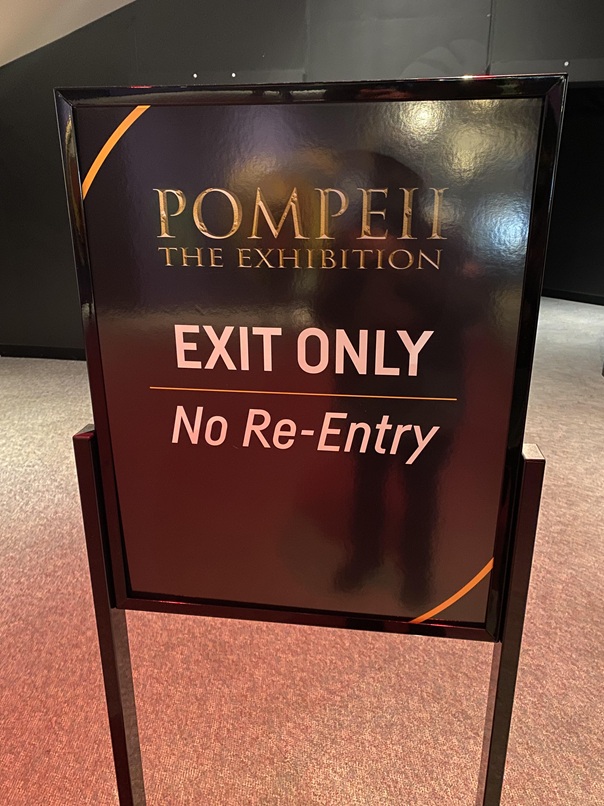
At a recent exhibition, I saw a sign that read: “Exit Only. No Re-Entry.” It seemed not just as a logistical instruction but as a metaphor. Around the same time, I came across a photo of a sign demanding that people speak the local dialect. What struck out to me was that the sign was written in English. These moments echoed something I have long been thinking about: the contradictions that arise when our distinctions fold back on themselves, what George Spencer-Brown called “reentry.”
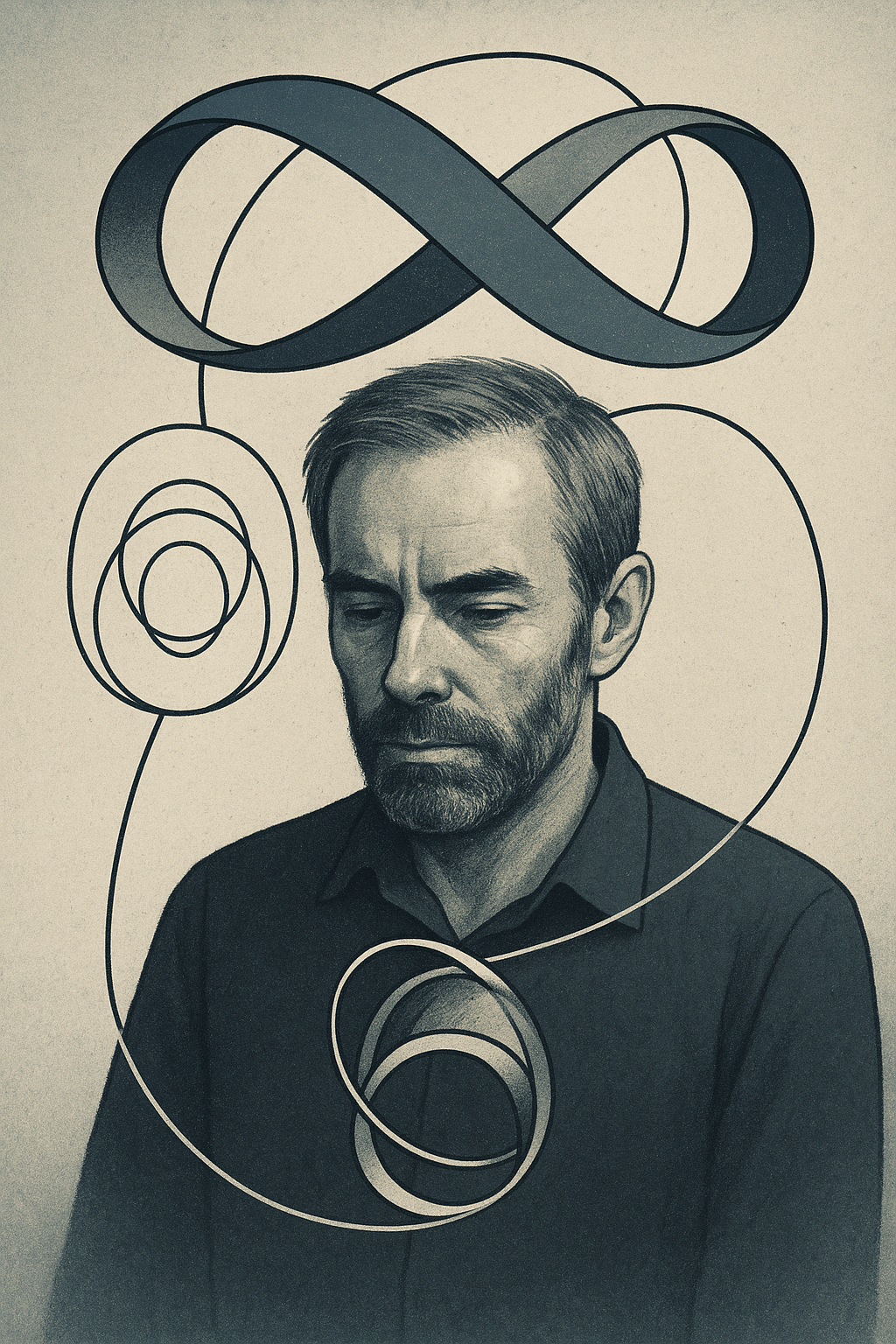
I am a longtime admirer of Spencer-Brown’s Laws of Form, and in today’s post, I explore how his notion of reentry helps illuminate the paradoxes and blind spots in modern ideologies, especially the rise of xenophobia and extreme nationalism. These rigid ideologies depend on distinctions between us versus them, lawful versus unlawful that appear neat but collapse under their own logic when viewed recursively. We pretend we are only exiting, drawing sharp lines, while ignoring the inevitability and necessity of reentry in our sensemaking.
Drawing Distinctions
Spencer Brown opened his mathematical-philosophical treatise with a simple instruction: Draw a distinction. This simple act of marking a boundary between “this” and “that” forms the foundation of how we structure knowledge, meaning, and identity. We create categories and define what is “in” and what is “out.” This is how form arises through distinction.
In Laws of Form, he also introduced the notion of reentry: the act of folding a distinction back into itself. Simply put, this is a self-referential act. By doing this, the tidy separations we created begin to blur. This move, abstract as it sounds, has powerful consequences for how we think, live, and treat each other. Especially in a world torn by polarization, nationalism, and fear of the “other,” reentry reveals the paradoxes that rigid ideologies try to hide and points us toward a more humane way of navigating complexity.
The Pot and the Form
Let us use a simple example to understand the form better. Consider a pot of boiling water. Here, we can make three identifications:
- Pot = the mark, or the distinction
- Water inside the pot = what is indicated, the marked space, the inside
- Outside the pot = the unmarked space, the outside
Together, all three constitute the form. The pot, as a boundary, plays the role of the mark in Spencer-Brown’s terms. It creates a distinction between what is inside and what is outside. The pot itself is not part of what is inside; it is what makes “inside” possible by drawing a boundary. The mark exists in a meta-position: it defines inside and outside but cannot be reduced to either. It is the operation of drawing the distinction. The pot allows us to interact with what is inside and allows what is inside to interact with the surroundings.
We can use the same example to introduce reentry. Imagine placing that pot inside another pot, creating a double boiler. The inner pot is held by the outer one. The boundary remains, but now it is nested and refers to something beyond itself. This is reentry: when a form does not just define something but begins to refer to its own act of defining. This becomes an act of second-order observation. In the double boiler metaphor, the inner pot (the reentered form) exists within the outer pot (the original distinction), creating a ‘system’ that is both distinct and self-contained.
Reentry challenges the simplicity of binary logic, revealing that ‘systems’ can be self-referential and dynamic. This concept is pivotal in understanding complex systems, where elements influence and are influenced by themselves.
The Purpose of Reentry: Revealing Cognitive Blind Spots
We love binaries: true/false, us/them, lawful/unlawful. But reentry destabilizes these neat categories. Who defines what is “lawful”? The law itself. When the law governs the making of laws (as in constitutional law), we enter a recursive loop. What is legal becomes a matter of interpretation, not clarity. The binary collapses into ambiguity. Reentry shows us that binaries are useful simplifications, not absolute truths. Dogmatic ideas rely on such binaries, and reentry becomes an effective tool for challenging dogma.
Similarly, in language, terms like “normal” are defined by cultural norms, which are themselves shaped by collective perceptions of normality. This circularity demonstrates how meanings are not fixed but evolve through self-reference. Reentry is not merely a logical twist. It reveals something crucial about how we construct meaning.
When we draw a distinction between “lawful” and “unlawful,” we assume clarity. But as soon as we ask who defines the law and realize it is the law itself, we see that the boundary is recursive. It defines itself. This is not a flaw but a feature of complexity.
The Second-Order View: Observing Observation
This leads us to second-order thinking: the act of observing the act of observing. In logic, when a ‘system’ includes itself in its model, it can become unstable. However, it also owns its position. Blind spots can be revealed, opening the door to creativity, paradox, and deeper understanding. Reentry is how we shift from first-order systems (clear categories, fixed forms) to second-order ones (reflexivity, contradiction, emergence). It is how we move from saying “we are right” to asking “how do we know?”
As the cybernetician Heinz von Foerster observed: “The observer must be included in the observed system.”
This represents the leap from first-order thinking (observing the world) to second-order thinking (observing how we observe). Reentry is the mechanism of that leap. Recognizing and thinking along the lines of reentry is deeply needed today because some of the most dangerous ideas we face rely on distinctions that collapse under their own logic.
Reentry and the Illogic of Xenophobia
Xenophobic ideologies often define “us” versus “them,” asserting superiority or purity. However, when these distinctions undergo reentry, when the criteria for inclusion are applied to the in-group, they often fail to hold consistently. Similar to the sign that demanded the use of the local dialect but was written in English, xenophobic logic contradicts itself when examined through reentry.
What does it mean to be a person from country “X”? Is it geography? Culture? Language? Legal status? Values? The more we examine these criteria, the fuzzier they become. Yet we use such labels as if they were clean boundaries, pots that perfectly contain identity. Reentry challenges this assumption by turning the form inward.
If being from country “X” means standing for freedom, justice, and decency, how can one uphold those values while treating outsiders with cruelty? If your culture preaches respect, how can you use that culture to justify disrespect? If your national identity is built on moral ideals, then those ideals must apply to how you treat everyone, not just those inside your imaginary boundaries.
Bigotry collapses under reentry. Its internal logic folds in on itself. The principle violates the practice. The mirror reflects itself and reveals the contradiction. Racism, xenophobia, and nationalism, when examined through the lens of reentry, are not just morally wrong. They are logically incoherent.
The Ethical Need for Redundancy
In complex systems, one of the most powerful safeguards is redundancy. In engineering, redundancy prevents collapse. In ethics, it serves the same function.
Hope is redundancy in action, as are other humanistic notions such as kindness, compassion, and forgiveness. These are not luxuries; they are second-order buffers. They activate when logic stalls. They hold the ‘system’ together when paradox threatens to tear it apart. Reentry exposes the instability of our forms. Redundancy helps us live with that instability.
Ethical redundancy functions like the inner pot in a double boiler. It buffers the heat. It allows care to emerge where rigidity would cause harm. It creates space for ambiguity, reflection, and repair. This is why, in the face of bigotry and rigid ideologies, we must design for ethical reentry. We must build in second chances. We must speak gently even when the logic breaks.
Final Words
In a world obsessed with efficiency, clarity, and being right, reentry is a radical act. It turns the ‘system’ inward. It reveals our blind spots. It shows us where our ideals betray themselves. But reentry does more than expose contradictions; it opens pathways to wisdom. When we embrace reentry, we move from the arrogance of first-order certainty to the humility of second-order inquiry.
The rise of extreme nationalism and xenophobia reflects our collective failure to practice reentry. These ideologies thrive on the illusion of clear boundaries, pure identities, and simple answers. They collapse when subjected to their own logic, but only if we have the courage to apply that logic. Only if we are willing to let our mirrors reflect.
Reentry teaches us that our most cherished distinctions are provisional, our certainties are constructed, and our boundaries are more porous than we dare admit. This is not cause for despair but for hope. It means we can rebuild. We can redesign. We can choose compassion over cruelty, and in that act, we can stay human.
In the end, reentry invites us to remain human and to include kindness as a design principle, building ‘systems’ that can reflect on themselves without breaking. It asks us to hold our beliefs lightly enough that they do not harden into weapons, yet firmly enough that they can guide us toward justice. This is the form of decency: recursive and reflective.
Always keep learning…
Discover more from Harish's Notebook - My notes... Lean, Cybernetics, Quality & Data Science.
Subscribe to get the latest posts sent to your email.
 Harish's Notebook - My notes... Lean, Cybernetics, Quality & Data Science.
Reentries are inescapable. When I read Spencer-Brown’s entry “draw a distinction “ I made a reentry, as I’m a distinction myself. Or should I say “selfmade distinction”.
I also thought, “who are you to make me draw a distinction?”. This is also the source of every “xenophobic “ idea: the order to make distinctions in a certain way.
Paradoxically, it is also the foundation of every church (I make a distinction between a religion and an institute (!)), political system, nation and even scientific community.
For instance, the book by Feyerabend in German had the title “Gegen Methodenzang” but was translated into “Against Method”, so the boom could be ridiculed.
For me it was obvious – I studied experimental physics- that time is a natural consequence (or proof) of reentry, as time can be seen as the way nature prevents things from happening all at once. (And space the way she prevents everything happens with me :-))
LikeLike
Methodenzwang, method coercion
LikeLike
Life invokes self reference, literally re-making, and realizes her self. Reality isn’t invented by us, she has invented herself. Of course this is a paradox, excluded from every political system, law and logic. And from every church – G’d cannot be paradoxical- and almost all scientific community.
Even in physics, paradox is ignored. It cannot be that this universe exists, because we observe her. And churches turned this around and invoked the notions that we’re being observed by G’d, the universe.
at the same time, we cannot escape drawing distinctions, boundaries, walls, lines, demarcations, borders, limitations, … and we’ll have to accept that each and every line is also invoking paradoxes. The one, the other, neither and both at the same time.
Spencer-Brown also introduced a notion that can be used as a method to show the reentry. I’ll be back later, to show how this should be added to making a distinction.
LikeLike
I mark the I to distinguish ( , or empty space), then I I marks ( ). So an empty space is both marked and unmarked. Space herself (I prefer she over it) consists of space reentering on herself.
This seems to be a paradox, as a paradox is self referring and induces a so-called ’vicious cycle’ of self-denial. Space, I once read in a thesis about objects, is self organizing non-space, while non-space has no qualities or (and, nor, nand) makes no marks.
space is not the absence of things, nor (and, nand, or) nothing. Space is both positive, as she enables things to exist (and ex-ist :-)) and negative as the absence of things. I give you that.
from this follows that space communicates through selfrefering and, like Watzlawick postulated, all behaving communicates and all communicating behaves. Space enables our communication through giving space to communicating.
you can now easily see the root cause of extremism of all sorts: horror vacui or fear for emptiness. Words to fill the empty space of meaninglessness, if you see what I mean. Existence is basically empty, logically impossible.
I cannot use the notation created by Spencer-Brown in this medium. Funny, “the metaphor of space is like the medium of thought”, Pinker.
LikeLike