
Complexity is a matter of degree and not a kind. – Glenda Eoyang
In today’s post, I am exploring the importance of incorporating diversity when navigating complex environments. I have written previously about the seductive appeal of efficiency and how its blind pursuit can leave us exposed. Efficiency asks us to optimize for known outcomes. It assumes a world where inputs are controlled and variation is minimized. But reality is rarely that generous. It is textured, layered, and in motion. It offers few clean edges and rarely repeats itself in neat loops. As leaders, we are asked to shape structures that can stay viable in this kind of world. The overuse of efficiency in such contexts does not make us leaner or smarter—it often makes us brittle.
We often design as though the ground is level. As if everyone begins from the same place, with the same tools, the same reach, the same slack. But the ground is not level. It has never been. Some people begin with more; more access, more time, more tolerance from the structure. Others begin already contending with friction. Not because they lack capability, but because the design was not shaped with them in mind. This is not just an ethical issue. It is a design one.
In complexity, uniformity fails fast. In simple, symbolic systems—code, logic, procedures—uniformity can be a virtue. The terrain is controlled. The inputs are known. The environment is stable enough to reward sameness. But in complexity—where causes are fuzzy, signals are noisy, and context moves mid-sentence—we need something else. We need grip.
Reality Requires Grip
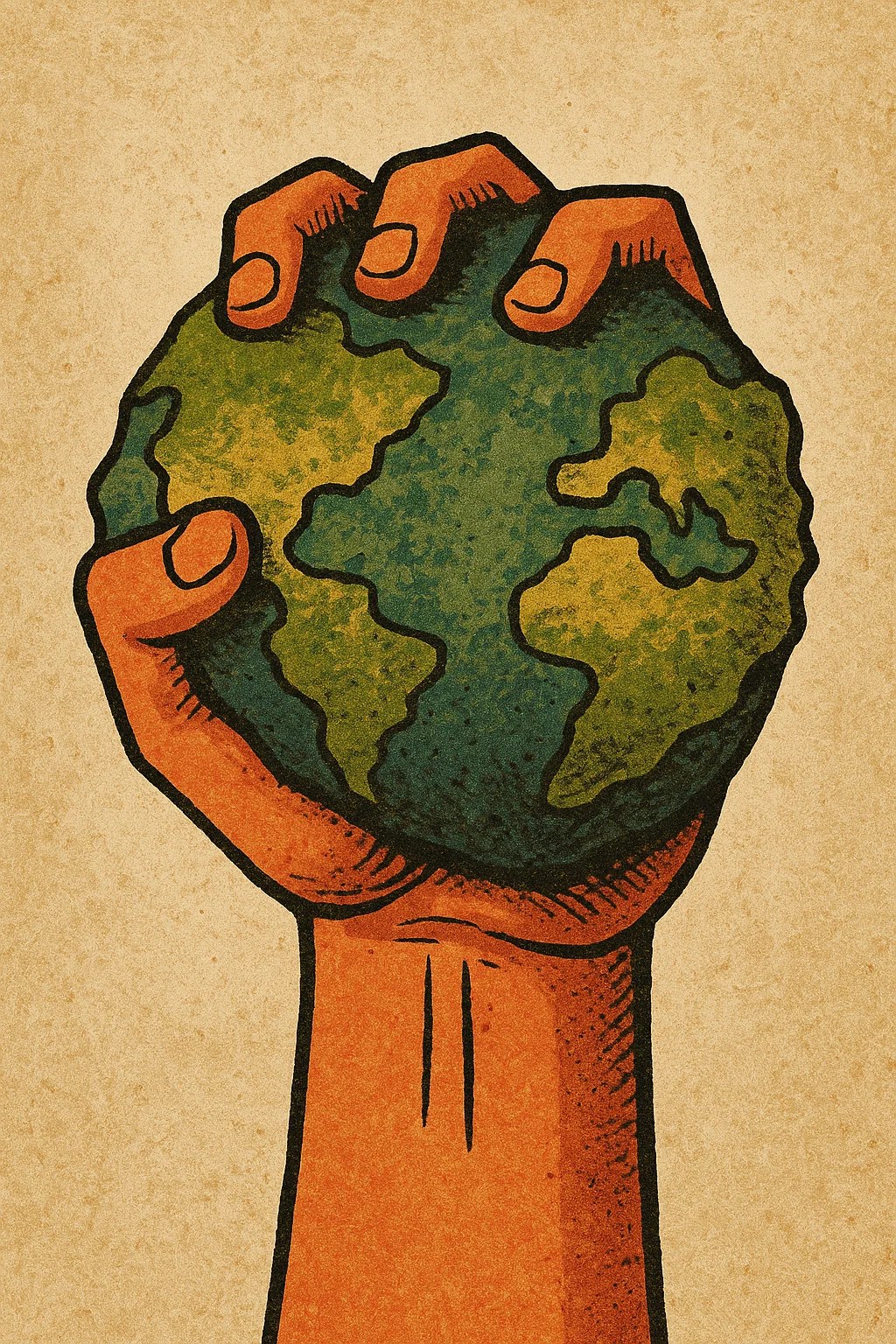
Reality rarely presents itself in tidy ways. It offers no singular handle for us to grab. Instead, it throws contradictions, mismatched signals, and unexpected constraints. We cannot hold it with one kind of mind, one kind of framework, or one kind of experience. The more varied the terrain, the more varied our grasp must be.
That grip—our capacity to make meaningful contact with complexity—comes from difference. It comes from a range of perspectives, a mix of sensibilities, a spread of lived experiences. It comes from people who notice different things, who ask different questions, who move through the world in different ways. This does come with a cost. Uniform structures may look clean and run fast, but they tend to crack under pressure. Diverse structures take longer to build, but they flex, adapt, and hold when things shift.
Ross Ashby reminded us that only variety can absorb variety. If the environment can surprise us in a hundred ways, then our ‘systems’ must be able to respond in at least a hundred ways. If not, the environment ‘wins’.
We often treat diversity as an accessory, something to be added after the main frame is in place. But in complexity, diversity is not decorative. It becomes load-bearing. The differences give the structure grip, not inward but outward, allowing it to hold against the irregularities of reality. They create structural tension and enable edge awareness. This awareness helps us notice early signals, those subtle cues that something is shifting. The presence of difference prevents the system from becoming complacent, blind, or brittle. Diversity introduces stretch that resists premature closure, while expanding the system’s capacity to perceive what is happening at its limits, where breakdowns often tend to begin.
A monoculture in nature may appear efficient. For example, fields of identical crops may offer predictability, ease of control, and optimized yield when conditions remain stable. But this sameness introduces a hidden fragility. A single disease, an unexpected frost, or a sudden shift in climate can cause the entire network to fail, because uniformity amplifies vulnerability. In contrast, a wild field may seem chaotic or inefficient, yet its diversity in root structures, growth patterns, and tolerances create resilience. When conditions change, not everything is affected in the same way. Some parts fail, while others adapt. The ‘system’ bends, but it does not break.
This is more than an ecological insight. It is a way of thinking about how we organize and sustain ourselves. When a team, a community, or a structure relies on sameness, it may function smoothly in predictable conditions, but it lacks the range to respond when reality becomes more complex. Diversity—cognitive, experiential, and demographic—broadens a group’s capacity to interpret change, adjust course, and stay viable over time. In environments where uncertainty is the rule and control is limited, it is this range that gives the whole arrangement a better grip on reality.
Designing From the Blind Spot
We tend to build from what is visible, measurable, and familiar. We optimize for what is easy to test. But what gets left out often matters more than what gets built in. And too often, the people left out are the ones already carrying the most structural friction. We tend to think of inclusion as a moral gesture. A choice to be kind or fair. When we design only for those already well-positioned, we do not just exclude, we weaken the design itself.
We create brittle solutions, ones that quietly assume access, literacy, capacity, forgiveness. We optimize for efficiency and familiarity, and miss the parts that strain under real-world pressure. But when we start from the edges—from those who live with constraint—we see what the structure hides. We start to notice the steps that are too steep, and that the protocols assume too much. Fixing for them is not just being humane. It becomes diagnostic work. It is how we surface the assumptions that compromise integrity. It is how we build arrangements that do not crack when things get uneven, which they always do.
Final Words
Heinz v on Foerster said:
Act always so as to increase the number of choices.
Maybe the corollary to that is:
Design as if you might be the one with the least choice.
That is not a political statement. It is a practical one. When we build for those with the least slack, we tend to uncover the most insight. And when we design from the blind spot, we do not just fill a gap—we often strengthen the whole. Designing for the most vulnerable builds in the redundancy that makes a structure resilient. When you build in space for the person who cannot read the form, who does not have time to wait, who misses the signal the first time—we are not just helping them. We are making the whole arrangement more resilient.
This is because the real world is not clean. Things fail, contexts shift and people miss a step. And if our design cannot bend in those moments, it will break.
In complex arrangements, redundancy is what keeps the structure whole. Not all paths will be smooth. Not all users will match the ideal profile. Not all steps will land perfectly the first time. This means that we should build space for detours, retries, and second chances. That is not inefficiency. That is how we build resilience. Redundancy is not the opposite of elegance or efficiency. It is the thing that lets the design bend without breaking.
I will finish with one of my favorite quotes from Doctor Who:
Human progress is not measured by industry. It is measured by the value you place on a life. An unimportant life. A life without privilege. The boy who died on the river, that boy’s value is your value. That is what defines an age, that is… what defines a species.
Always keep learning…
Discover more from Harish's Notebook - My notes... Lean, Cybernetics, Quality & Data Science.
Subscribe to get the latest posts sent to your email.
 Harish's Notebook - My notes... Lean, Cybernetics, Quality & Data Science.
Complexity and variety are not properties of reality, but of observing. They are – or rather, in constructing reality they are, the horizons of my world. Or understanding of the world.
Complexity and variety are properties of systems thinking in getting a grip on reality. If you understand reality as I do – in Dutch litteraly “having a grip” -, they disappear when you let go of trying to control reality for your own purpose.
Nature, used in the Spinosian sense of naturing nature, is Realizing Reality. She is the only possible Nature, the Real Realization. Only Nature can produce nature, inventing – inducing and realizing – herself. Reality “is” really both in here and out there.
This universe cannot be different from what she “is” (using she as she “produces” herself). Or should I have used “becomes”?
Nature or Miss Universe, behaves – I try to avoid “is” – in the simplest possible way. She cannot be different. I see also no needs for “redundancies” as attributes of nature. Things may seem redundant, like inefficient.
Everything say, only says something about yourself 😉
LikeLiked by 1 person
sorry, “everything said is said by somebody” and “everything I said only says something about me”.
LikeLike