
In today’s post, I am looking at Immanuel Kant’s Thing-in-Itself and Hans Vaihangar’s ideas. In Kant’s philosophy, the “Thing-in-itself” (or Ding an sich) refers to the reality that exists independently of human perception or experience. Kant argued that while we can know phenomena (the appearances of things as they present themselves to us), the “Thing-in-itself” remains inaccessible to human cognition, as our knowledge is always mediated by the structures of our mind (such as space, time, and categories of understanding). The Kantian dichotomy therefore is phenomena (things as they appear to us) and the noumena (the “Things-in-themselves”). For Kant, the Thing-in-itself is something that exists independently of human perception, but it is forever inaccessible to us. We can only know the world as it appears to us, not as it truly is in itself. This creates a separation between appearance and reality, and Kant suggests that this gap is unbridgeable for human beings.
I am not a fan of dichotomies. Most often, dichotomies are created as linguistic tools to aid our thinking. But they form a life of their own and cause confusion in our thinking. There are a few ways to think about the thing-in-itself. One is to take the road that reality is indeed accessible to us. This will be the approach of a naïve realist. This notion can be easily disproven by the use of numerous illusions. The second route is to be an idealist. Loosely put, this approach takes the view that everything is in the mind. This notion is also not very useful. This again is another dichotomy – reality is directly accessible out there versus reality is all inside our minds.
It is more useful to take a middle path. Here also, there are different ways to go. One example is Charles Sanders Peirce, who is a realist American philosopher. He believed that reality does exist out there independent of our perception. We may not have direct access to it, but we can gradually make sense of it. He believed that all knowledge is fallible and subject to revision. Instead of positing an unknowable reality, he focused on the continuous process of inquiry and the gradual approximation of truth. In this view, the notion of the thing-in-itself is not value adding since he is proposing that reality or portions of reality are eventually accessible to us. Peirce was a pragmatist (or a pragmaticist as he called himself). As noted above, pragmaticism supports the idea of truth. If there is a practical or pragmatic observable effect, then that becomes truthful. Truth in this case is not absolute since pragmatists support the idea of fallibilism. Truth is provisional. What we have discussed so far moves towards the realist camp.
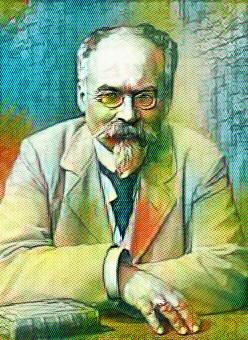
It is here that I want to introduce the ideas of Hans Vaihinger. At this point in time, I side with Vaihinger’s ideas. Vaihinger was a German philosopher who studied Kant vigorously. His ideas have many familiarities with pragmatism. He proposed the philosophy of “as-if”. He came up with the notion of “useful fictions” instead of “truth” in pragmatism. Similar to pragmatism, he was interested in practical applications in the world. Vaihinger argued that the thing-in-itself is not something we can know, but that it functions as a “useful fiction” that helps guide our thinking and practical action. According to Vaihinger, we can use the concept of the thing-in-itself as a heuristic tool, a fiction that helps us organize our experience and navigate the world, even though it does not correspond to anything directly accessible to human cognition.
In a sense, Vaihinger suggests that the thing-in-itself has practical utility, even if it is ultimately unknowable. It provides a framework for understanding reality, even if that framework is not literally true. For Vaihinger, this “fiction” is necessary for guiding human action and thought, even if it is not an accurate representation of an objective reality. He is not interested in “Truth”. Unlike the pragmatists, he calls his ideas fictions.
Vaihinger discussed his ideas in his magnum opus, “The Philosophy of As-If“. He argues that human thought, fundamentally, is geared not towards metaphysical truth or solving abstract problems, but towards survival and fulfilling the “Life-will” (Arthur Schopenhauer’s term for the fundamental drive to live and survive). This perspective leads Vaihinger to conclude that human cognitive faculties are inherently limited, not because they are defective, but because they evolved for very specific, practical, and existential purposes: to help humans navigate the world and satisfy their basic needs.
Vaihinger views human thought as essentially a tool for life, serving the practical ends of survival rather than speculative exploration of ultimate reality. Human cognition was not designed to uncover metaphysical truths or answer the “big questions” about the nature of the universe. Instead, it evolved as a means to manage and react to immediate environmental challenges—finding food, avoiding danger, securing shelter, reproducing, and so on. From this perspective, thought is a functional tool, not a quest for objective knowledge.
In this way, Vaihinger agrees with Kant that human knowledge is bound by certain limits. But Vaihinger takes Kant’s idea further: instead of viewing these limits as a tragic deficiency (i.e., the inability to access noumena or things-in-themselves), Vaihinger argues that they are the natural result of human thought’s biological and practical function. Thought was never intended to grasp the ultimate nature of reality; it evolved to solve problems relevant to human survival and everyday life.
Given that human thought is limited in this way, Vaihinger proposes that we use certain concepts—like the thing-in-itself—as fictions. These fictions are not intended to describe the ultimate nature of reality but to help us organize and navigate our experience of the world. The thing-in-itself, as a fiction, becomes a useful tool for thought, enabling us to conceptualize reality in a way that facilitates practical action and understanding, even if that concept does not correspond to anything we can directly know or experience.
Vaihinger argues that these fictions are essential because they allow us to deal with phenomena that cannot be grasped directly. The thing-in-itself becomes a placeholder or a symbolic construct that helps us maintain coherence in our thinking and practical activities, even though it does not correspond to any knowable “reality”. In this way, Vaihinger’s approach offers a way to work with limitations in thought while still being able to reason, act, and engage with the world meaningfully. Similar to Peirce, Vaihinger maintained that all knowledge is fallible and provisional. He also emphasized the idea of correcting them when they are no longer viable.
The Paradox of Thing-in-itself:
The notion of the thing-in-itself comes with a paradox. If the thing-in-itself is not accessible to us, then how can we even talk about it? How can we ascertain that what we experience is supposed to represent the thing-in-itself? The very act of trying to access the thing-in-itself proves its inaccessibility. Kant acknowledged the limits of human cognition and left us with the concept of the thing-in-itself to indicate that reality exists beyond our perception. Kant insisted that we cannot know the thing-in-itself because our mind imposes its own structures onto the world. So, the thing-in-itself is something that remains, by definition, unknowable. We humans are separated from the “true” nature of things.
Let us use an example to make things clearer. Imagine the reality of a landscape. Kant originally suggested this is a reality we cannot directly touch, like the landscape is behind a thick fog. We can see outlines, but not the detailed terrain itself. Peirce proposed that we have multiple ways to understand that landscape such as signs, instruments, mathematical models etc. It is not that the landscape is unknowable, but that we approach it through creative interpretation. These are not just representations – they are active ways of constructing understanding. Instead of seeing the thing-in-itself as an impenetrable mystery, Peirce suggests it is more like a dynamic puzzle. We do not give up because we cannot see the whole picture immediately. We use every tool we have – mathematical models, technological instruments, logical reasoning – to progressively understand. Peirce claimed we can access reality through signs and mediation.
If we look at Vaihinger’s ideas, Vaihinger would call Peirce’s signs still fictions we have constructed. The mathematical models, instruments, and interpretive frameworks are themselves useful fictions that help us navigate experience. The key distinction between Peirce and Vaihinger is that Peirce believed that we are progressively accessing reality, and Vaihinger saw us as creating increasingly sophisticated, but still fundamentally, fictional frameworks of understanding. In our example, it is like different ways of mapping an unknown territory. Peirce is thinking that we are gradually revealing the actual landscape. Vaihinger is saying that we are creating ever more useful maps, knowing that they are not the territory itself.
In my opinion, there is a Noumenal gap that realism cannot transcend. No matter how sophisticated our signs, instruments, or mediations, we cannot escape the fundamental epistemological limitation. Our cognitive apparatus always interprets, always mediates, always transforms. Any “progress” is still within our conceptual framework. We are not getting closer to the thing-in-itself. We are often simply creating more complex interpretive structures.
Vaihinger’s idea that the thing-in-itself is a “useful fiction” suggests a very different way of thinking. Vaihinger argues that while we may never have direct access to the thing-in-itself (or any ultimate reality), the concept of the thing-in-itself can still be useful for organizing experience and guiding practical action. According to Vaihinger, the idea of the thing-in-itself is a fiction, but one that is necessary for making sense of the world. It is a construct that helps us navigate and interact with our experiences, even if it does not correspond to any objective reality beyond our conceptual framework.
Vaihinger’s view allows us to maintain the utility of concepts like the thing-in-itself without being trapped in the idea that they correspond to something inaccessible in a metaphysical sense. For Vaihinger, the thing-in-itself is not some unreachable essence, but a concept that functions within human thought in a way that allows us to make sense of the world. It is a fiction that helps us act and think meaningfully, even though we know it does not correspond to something we can access directly.
This is a much more flexible and practical stance than Kant’s and Peirce’s, because it allows for the continued use of concepts like the thing-in-itself without needing to assert that they refer to an objective, inaccessible reality. Instead, we can use them for practical reasoning, action, and understanding, while acknowledging their fictional status.
Vaihinger moves beyond the notion that we are limited by a distance from ultimate reality and suggests that the limitations of our understanding do not prevent us from using concepts that guide our actions. He does not need to answer whether we can access the thing-in-itself in any literal sense because he acknowledges that it is a fiction—yet a necessary one. Vaihinger provides a path forward in that sense: we no longer need to grapple with the unknowability of ultimate reality, but instead can work with useful fictions that help us navigate the world. This gives us a much more flexible, non-dogmatic framework for understanding our place in the world and how we think about things like the thing-in-itself.
If we ask for burden of proof for the various ideas we have discussed here, we see that both realism and idealism carry a significant burden of proof because they are making claims. Even with Peirce, there is a significant burden of proof. He must still prove that signs can access reality. Vaihinger on the other hand avoids any metaphysical commitments. By calling the thing-in-itself as a useful fiction, he sidesteps the burden of proof altogether. His focus is only on the viability of an idea.
I will finish with a quote from Vaihinger:
The world of ideas… we generally call “truth” is consequently only the most expedient error, i.e, that system of ideas which enables us to act and to deal with things most rapidly, neatly and safely, and with minimum of irrational elements.
Note: There are of course numerous other schools of philosophy such as critical realism, radical constructivism etc. that I have not looked at here.
Discover more from Harish's Notebook - My notes... Lean, Cybernetics, Quality & Data Science.
Subscribe to get the latest posts sent to your email.
 Harish's Notebook - My notes... Lean, Cybernetics, Quality & Data Science.
I’m a big fan of the Vaihinger’s philosophical ideas and I agree with you on the ideas by Peirce. The idea of language as pragmatics I learned from Watzlawick, “Pragmatics of Human Communication”. He as well as Vaihinger, point at the inherent paradoxical nature of communication as well as concepts.
I gained the insight – or revelation – that this universe is inherently paradoxical while participating in a lecture on Statistical Mechanics II. In proving that this world (from solving the Fokker-Planck equation), or reality, exists, my professor had to use the fact that we exist. I interrupted him on this fact. He replied: “that’s a problem for mathematicians but not fort physicist”. Then and there I realized that this universe is paradoxical and that energy and paradoxes are equivalent. Paradox is always conserved.
All concepts in physics – as in any science – are fictions, made up by the human mind, paradoxical fiction, as-it true. Time, space, causality, gravity, energy, entropy…. if you come up with another paradoxical concept and join the elite, you get a Noble Prize, For instance: “relativity”.
(Actually Einstein got the Noble Prize for Brownian motion, proving the “truth” of molecules. Feynman’s comment on his Nobel Prize was: “it only proves I’m good at winning Nobel Prizes”. He invented a whole now language, Feynmann diagrams, considered by many as “funny drawings”. But the work (= get verifiable results)
By the way, we act as-if “reality” is real. Because of the Thomas and Thomas theorem – https://en.wikipedia.org/wiki/Thomas_theorem, “If men define situations as real, they are real in their consequences?” (I like the ?).
In science, as well as religion, politics and logic, paradoxes are excluded. And in most philosophies. We’ve been trained to think a paradox is something we can solve, like a dilemma. Because we also use language to determine if you belong to “us” or “them”. You’re got to talk the talk, to be accepted.
Vaihinger showed that useful (= pragmatic) concepts are inherently paradoxical. Concepts like gravity, causality, and also quantum (“nur ein mathematical Conception”, Max Planck) are mental, symbolical constructs we need for constructing thoughts (I assume construction or designing precedes thinking).
AI proves we’re constructing thoughts in language by tacitly applying tacit rules or grammars. AI software reverse engineers sentences, which we construct from designing meaning out of reality perceptions. The reverse, AI is intelligent, is not real.
Reality is not real (the territory), but the structure of reality accounts for it’s usefulness (pragmatics).
The results of our thoughts are manifest, manifesting our ideas and concepts. Because the results – a building, a man on the moon – are manifest, “real”, we assume that our concepts mirror reality are “true”.
Truth being one of those concepts. We need truth in for instance judicial system, as a real fiction. While at the same lawyers know truth can only be a legal concept. “The truth, you cannot handle the truth” (A few Good Men). We need truth in our mathematical description of the objects and movement. And when the model of description produces an intended result, works, we’re right, but not really.
Confusing reality – what I’m a saying is true – with actuality – what actually worked or works (or “really real, I also use the word “actuality”) – is necessary to maintain an illusion of coherence in a thought system and a community. That’s why we have to tell the truth, the whole truth and nothing but the truth, because what I’m saying three times is true.
LikeLiked by 1 person
I loved your comment. I look forward to your responses. They are always thought provoking. Thank you!
LikeLiked by 1 person
I got the impression Vaihinger thought Kant knew his Ding-an-sich was paradoxical and that his peers made him change his mind. Even now most people cannot handle paradoxes – keeping two opposing ideas in mind and able to progress.
Paradoxes are not problems, nor fictions. They’re actually real and express themselves through tensions or energies. They cannot be solved, as they transform themselves, like ….. -> sun light —> photo synthesis —> wood —> oil —> gasoline —> driving —>…
Even Max Planck and Einstein didn’t accept paradoxes. “Der Herr Gott würfelt nicht “. Accepting paradoxes means understanding we have to act as-if God exist. And doesn’t.
LikeLike