
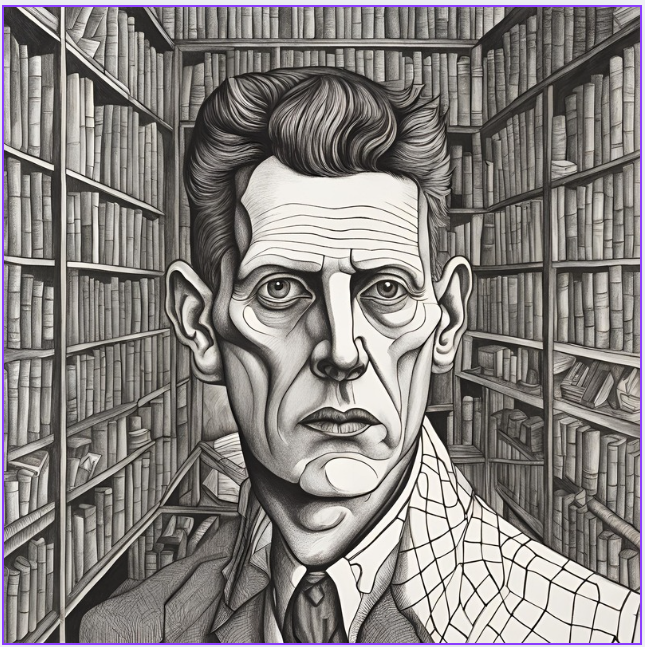
In today’s post, I am looking at the notion of a patron saint of complexity. I have had the question posed to me – why I am a fan of Ludwig Wittgenstein? In fact, I think that today’s post might get some responses similar to how overrated Wittgenstein is. The answer is simple – I have come to see Wittgenstein as the patron saint of complexity. He stands as philosophy’s patron saint of complexity, reminding us that all systems are fundamentally human constructions. While the world simply is, it’s our minds that weave the intricate web of meanings and patterns we call complexity.
I am of the school that complexity is something that we, humans, attribute to the world around us. It is a form of perspective, a form of expression. As Heinz von Foerster, a distant relative of Wittgenstein and the Socrates of Cybernetics, said – the environment as we perceive it is our invention. Wittgenstein’s point is that our understanding of the world is something we construct socially, and it is unique to our ‘human’ understanding. He sought to use philosophy as a means of therapy to find our way around the world.
Complexity emerges not as an inherent property of a ‘system’ but through how an observer interacts with and frames it. Wittgenstein’s insights suggest that the ‘complexity’ of a situation depends on the observer’s language games and forms of life. This perspective aligns with several key ideas from his later work. I encourage the reader to explore these ideas here.
Language games emphasize that meaning arises from context and use within specific activities. Just as words mean different things in different contexts, a situation’s complexity depends on the framing and engagement of the observer. These meanings are tied to the practices and ‘forms of life’ of a community – our background, values, and experiences shape how we perceive and interpret complexity. Wittgenstein’s rejection of fixed structures supports the idea that ‘systems’, and therefore, complexity, are emergent and non-linear, defying reductionist interpretations. His shift to examining ordinary language and everyday practices focuses on the dynamics of interaction. There is no universal viewpoint – only perspectives grounded in specific contexts.
A Thought Experiment:
I invite the reader to engage in a thought experiment – Imagine a world without language. How would that impact the complexity around us?
Without language, much of our socially constructed complexity would disappear. ‘Systems’ like economics, politics, and science – built on linguistic frameworks – would dissolve, leaving only direct, lived experience. A ‘market’ as we understand it, with its web of transactions, expectations, and regulations, would reduce to immediate barter or interaction, lacking the social conceptual scaffolding of ‘value’ or ‘profit’.
Yet paradoxically, individual perception of complexity might increase because the interpretive burden would shift entirely to the individual. Every interaction or phenomenon would need to be understood in real-time, without the benefit of shared categories or explanations. Consider how a pre-linguistic human might experience a tree – they would see its shape, feel its bark, notice its movement in the wind, and understand functionally that it provides shelter and fruit. But they couldn’t categorize it within abstract concepts like ‘ecosystem’ or ‘life cycle’.
This suggests something interesting – Language does not just describe complexity, it also generates complexity. Through language, we create nested layers of abstraction, build shared conceptual frameworks, accumulate and transmit knowledge across generations.
Without language, the world would be both simpler and more ineffable – but not necessarily less complex. We wouldn’t experience this as “simplicity” because the very concept of “simple vs. complex” is itself a linguistic construct. Like a wolf in the forest, we would simply experience raw reality without the mediating layer of linguistic abstraction.
We can see that language is both a magnifier and a creator of complexity. It allows us to construct shared realities that vastly exceed the sum of our individual experiences. Without it, the world would likely feel simpler in its structure but more intricate in its immediacy. This reminds us that complexity is not just ‘out there’, but also deeply entangled with how we communicate and make sense of the world.
The world would continue in all its intricate interactions – weather patterns would still form, ecosystems would still function, quantum particles would still behave in their strange and mysterious ways. We just wouldn’t have the linguistic frameworks to model and discuss these phenomena. Perhaps this reveals our linguistic bias – the assumption that the world must be either ‘more complex’ or ‘more simple’. Without language, such distinctions wouldn’t exist. The world would just be.
I will finish with an apt quote from Wittgenstein:
The sense of the world must lie outside the world. In the world everything is as it is, and everything happens as it does happen: in it no value exists—and if it did exist, it would have no value.
Always Keep Learning…
Discover more from Harish's Notebook - My notes... Lean, Cybernetics, Quality & Data Science.
Subscribe to get the latest posts sent to your email.
 Harish's Notebook - My notes... Lean, Cybernetics, Quality & Data Science.
Wittgenstein,… One of my philosopher visitors in my deep world. Always at my desk Tractatus…, his thoughts about language how impressive and make us to think… This post about him, has been the one of best reading for me. Thank you, I can’t imagine the world without any language… How would have been so boring… But even we wouldn’t have known what the boring was too. Thank you, have a nice day and Happy New Year, Love, nia
LikeLiked by 2 people
Thank you for the wishes, Nia.
-Harish
LikeLiked by 1 person
Wonder what Wittgenstein would have made of being called a saint?! 🙂
LikeLiked by 2 people
😅
LikeLiked by 1 person
Hmmmm. The world just is. Its our language games that create the intricate web of meanings and patterns we call complexity.
Yes, and, though, it is also worth pointing out that humans, like probably all life, are in a constant relationship to and adaptation towards the material world. Furthermore humans, have had a constant fascination with the material world, partly in an attempt to understand it, partly in an attempt to use it, both to gain dominance over other species, and within their own species, but also partly out of the fascination that comes with exploring it.
And that, perhaps the most fundamental tool, for powering and developing a personal and social understanding of the material world, is to use and create a language that helps us describe, test and share our understandings of that material world. Language-ing may be considered some kind of game – and its true to suggest that the scope and limitations of our understanding of the material world – are in some sense encoded in our language, but the complexity exists both in the material world, and the language in which the material world tries to understand and explain.
Complexity, I would suggest, does not emerge, rather it is created in our language, but also as a reflection, and so is reflected in, the complexity of the world the language tries to explain.
You claim that without language, much of our socially constructed complexity would disappear. True, our social constructions would disappear, crumble. But as you have also suggested – the complexity of the world would remain. Furthermore, arguably, like other animals, who don’t have language, we would still have a relationship to that complexity, and still have a social means of sharing our understanding of that complexity, in the way that birds, or lions, or monkeys, or babies, are able to pass on and share their understandings of the material world – through observing each other’s behaviours, for example – and through their behavioural communication – certain sounds have certain meanings for animals. The understanding is there, its just not expressed in language.
I do also wonder too, about AI. It won’t necessarily need language to develop understandings of the material world – instead it will explore and develop understandings via correlations and algorithms – though it will need language to share those understandings with humans – if humans want to understand – or if the AI machines want humans to understand – otherwise those AI machines may simply direct humans to do things based on an understanding of the complexity of the world – which bypasses human language games.
But also, one last thought, we, and our language, are as much a part of the world, as anything and everything else in the world, and so the distinction between the complexity of our language, and the complexity of the world collapses into one. The question then becomes how is is that some part of the material universe, over time evolved into conscious beings with linguistic abilities and the ability to reflect back on itself and wonder about itself. Humans then, and their language, are both fascinated with their own material composition, but they also represent too, the wider material university developing a fascination with its own material composition.
LikeLiked by 2 people
Hi Harish, Here is my sense-making attempt. Complexity is a word. That word describes a concept. A concept is a model, a representation, constructed by thought, of experienced sensations. Thought emerges from memory (i.e., the impressions left in the mind by experience.) What a lifeform experiences depends on and is constrained by its form (i.e., biology). Therefore, what gets encoded in memory is unique to a being. And importantly, it is limited. How a being’s mind represents what is experienced through its senses is its process of sense-making or understanding.
So when we (human) speak of a phenomenon as being complex, embedded in this assessment is our human sense-making process. To a different being the same phenomenon may be trivial. The human sense-making process, dominated by analysis, attempts to pull apart a whole in order to understand it as some combination of simple parts. Depending on how we disaggregate the whole is how simple or complex the combination of parts will feel. A non-linear system looks chaotic as a time-series, difficult to make sense of. But viewed in phase-space it is perfectly understandable.
So, the world outside our mind just is. How our mind makes sense of the experience we have when we come in contact with it makes it seem more or less complex.
Am I following you?
LikeLiked by 1 person
Pretty close! 😀
LikeLike