
In today’s post, I am exploring the notion of efficiency. The emergence of a new government agency in the US focused specifically on efficiency in the public sector intrigues and challenges me as a cybernetician and systems thinker. I want to examine two critical aspects of this concept.
1) The Delicate Balance of Systemic ‘Fat‘:
The first idea aligns with the principle of Lean, which was developed after Toyota’s Production System (TPS). For those curious about my use of “Toyota’s” instead of Toyota, I invite you to check out a previous post.
TPS was developed by Taiichi Ohno. While the name Lean implies “without fat,” Ohno did not advocate for complete elimination of excess. In a previous post, I explained this nuance further. Instead, Ohno understood the critical importance of carefully planned buffers—what might be called “fat”—to ensure production system resilience. The right amount of redundancy becomes an ally—what in Cybernetics is termed as having the “good” kind of variety to manage external world complexity.
When one fails to understand the nuances of a complex network like the public sector, the idea of efficiency becomes dangerous. Managing high levels of complexity requires maintaining variety at the points where the external environment intersects with the system. Most often, this critical information remains opaque at the executive level—where the rubber meets the road. There is no more perilous individual than one who believes they fully comprehend the complexity of the world around us. Variety engineering in Cybernetics offers an excellent approach to navigating these challenges. Improving our understanding of complexity requires humility and adaptability.
2) The Humans in the ‘System’:
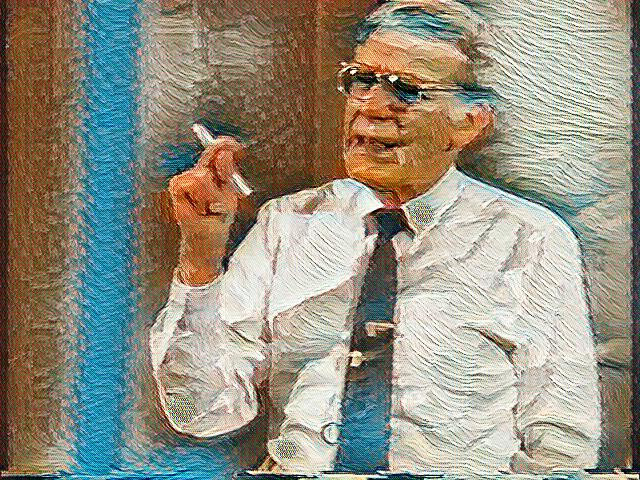
The second idea is perhaps the most important of all. A focus on efficiency alone is a dangerous idea. I will lean on the ‘Socrates of Systems Thinking’, Russel Ackoff for this. Ackoff was a brilliant man with wonderful insights. Ackoff believed that one of the main functions of leadership is an aesthetic function. Leadership in his eyes is fundamentally about creating meaning, beauty and possibility, rather than technical efficiency. [1] Efficiency measures resource utilization in a value-neutral manner, while effectiveness weights these resources against the values of achieved outcomes.
He gave an example to clarify this:
Ackoff on another occasion offered this gem about being careful when pursuing efficiency:
In our metrics-driven world, we reduce everything to measurable data—even human experiences become quantifiable units. Ackoff challenged this reductive approach, emphasizing that the value of an action is inherently personal and subjective.
The efficiency of an act can be determined without reference to those affected by it. Not so for effectiveness. It is necessarily personal. The value of an act may be, and usually is, quite different for different individuals.
Every system is fundamentally a human system, created as a mental construct to make sense of our complex world. Complexity itself is not an objective measure, but a perspective shaped by human values and purposes. Wisdom, as Ackoff eloquently explained, requires expanding our consideration of consequences—both in scope and time. It involves consciously inserting values into decision-making, preventing the sacrifice of long-term potential for short-term gains.
He further elaborated on the value-based approach:
Values are the concern of ethics and aesthetics. Therefore, they are necessarily involved in the conversion of efficiency into effectiveness. The production of data, information, knowledge, and understanding are primarily functions of science. The production of wisdom, which presupposes all four, is primarily a function of ethics and aesthetics because it involves the conscious insertion of values into human decision making and evaluation of its outcomes.
Effectiveness is a product of wisdom which enlarges both the range of consequences considered in making a decision and the length of time over which the decision is believed to have possible consequences. By taking long- as well as shortrun consequences into account, wisdom prevents sacrificing the future for the present… Wisdom is required for the effective pursuit of ideals, and therefore is required of leadership. Leaders must also have a creative and recreative role in the pursuit of ideals, and these are aesthetic functions.
The pursuit of effectiveness is an art form—requiring wisdom, empathy, and a profound understanding of human complexity. It demands that we look beyond the numbers, recognize the subjective nature of value, and create systems that serve not just productivity, but human potential. In an age obsessed with efficiency, our greatest leadership skill may be the capacity to see beyond the metrics—to understand that the most meaningful progress is rarely the most measurable.
I will conclude with another memorable quote from Ackoff:
A good deal of the corporate planning I have observed is like a ritual rain dance; it has no effect on the weather that follows, but those who engage in it think it does. Moreover, it seems to me that much of the advice and instruction related to corporate planning is directed at improving the dancing, not the weather.
Always keep on learning.
[1] A Systemic View of Transformational Leadership – Russell L. Ackoff
Discover more from Harish's Notebook - My notes... Lean, Cybernetics, Quality & Data Science.
Subscribe to get the latest posts sent to your email.
 Harish's Notebook - My notes... Lean, Cybernetics, Quality & Data Science.
Thanks for setting this out Harish. Always nice to be reminded of Russ Ackoff and his brilliant work.
LikeLike
Mr. Ackoff was an optimist.
When I studied Biophysics, we had lectures on photosynthesis (very interesting, by the way, plants using quantum mechanical effects). A fellow student ask our professor: “how efficient is the photosynthesis?”.
Professor Amesz, who was always a bit nervous in front of a group, started to look for his cigarettes – see how long ago it was – and asked: “…how…how do you mean? In spring or in autumn?“.
Plants aren’t interested in efficiency. Nature works through abundance. Nor in effectivity too, by the way. What works, works. And, given enough time, every coding system will become an error correcting system (Shannon).
—-
For the past 40 years, I always have to explain the difference between observables and system variables. Observables one can observe, independently of any model, theory or system. You can count the number of acorns from a oak, without knowing about photosynthesis. Counting. Numbers.
A system variable, we use to explain the working of a model, theory or system. It requires using a model, theory or system and so a “measure”, a “rule”, a “mark”. Measuring. Figures.
(I still have to figure out the subtle difference between numbers (Dutch, “getal” or counted) and figures (Dutch, “cijfers”, or figure 🙂 Who tells (in Dutch “tellen” is used for “to count”) the difference.)
We can use our models, theories or systems with variables to estimate (some call it calculate) the observables. An oak converts sunlight, water and coal-dioxide into acorns. We can model photosynthesis and calculate the efficiency, defining “quantum”, “energy” as productive and “heat” as “waste”, “loss”. Yard sticks.
(As I narrated, I’ve studied experimental physics. I came aware of the difference between observables (results) and variables (assumptions). When your assumptions predict the results, you succeed and get a PhD. If not, you go for an MBA.)
As we’re using the same tokens, digits, figures (1, 2, 3, …), most people confuse variables – which we can vary – with observables – which we cannot vary (except for counting errors).
—
In one of my first projects we had to halve the lead time of a factory. I asked how long it actually took to buy, produce, assemble and test the products (a telephone switch). They said about 24 weeks. The lead time in the planning (MRP, material requirement planning) was 14 months. So I said: “divide all your lead times by two, next project.”
My managing director said we couldn’t because the factory would have nothing to do for 3 months, as the factory lead time was 6 months. I said: “Now also, but they spread out over 6 months”.
One cannot count time, only measure it (this is the source about philosophical debate about the nature (and culture) of time between Einstein – clocks, culture – and Bergson – durée, duration, nature. “It is both, Jim, but not at the same time”).
I proposed to use observables. One can count inventory, work in process. And one count the numbers (!) of products delivered during a period, let’s say, a week. The first I called I, Inventory, the latter T, throughput (or SOLD output, not counting finished products which were not paid by customers. Like “safety” stock).
This observable had another advantage: it could be applied and self-managed (!) on every part and level of the organization. And T/I has the unit of measure of “time” without the properties. .
So, in the end, I accepted “Total Quality Improvement” projects on a promise to halve T/I within a year (it took me 6 months :-)).
(I also introduced steering on “release date” of an order and not on “due date”. You can observe the release date, but not the due date, until it is too late :-)).
—
These man-made problems are aggravated by using a system variable called “money“. One can count coins, conchs, cents, cash, … but one has to define and calculate money: pound, dollar, euro, yen, … . It’s a great tool, but fiction, concept, invented.
It has become a dangerous system by introducing “accounts” and “cost accounting”, where coins have become a number on paper. And are treated as-if real, while people don’t acknowledge the made up, fictional “nature” of money.
This has become the ritual rain dance Ackoff is talking about. Figures before facts.
—
Organizations (also systems, fictions) – and governments – are failing “us”, because we’re keep on steering on system variables (“costs”, “efficiency”, … ) and not on observables (“expenses”, “effects”, … ). Blaming errors, mistakes and faults in the predicted results (“losses”, a system variable, just like “profits”) on things and people outside their system.
I’m reminded of the watch (!) at the Mad Hatter Tea party:
`I told you butter wouldn’t suit the works!’ he added looking angrily at the March Hare. `It was the best butter,’ the March Hare meekly replied.
—-
And, brace yourself, it is going from bad to worse through using “bitcoin”, virtual virtual money, a system within a within a system within a system of thought, treated as-if real. You don’t have to work fro your money any more.
But then again, I’m an optimist too. Give us a billion years, and we’ll come up with photosynthesis too. Probably sooner.
LikeLiked by 1 person