
In today’s brief post, I’ll explore Ontology and Epistemology. Simply put, Ontology is the study of what exists, while Epistemology explores how we come to know what exists. I view this distinction similarly to Cartesian duality, which separates mind and body. Just as the embodied mind concept unites mind and body into a single, complex entity, I believe Ontology and Epistemology should also be seen as interconnected.
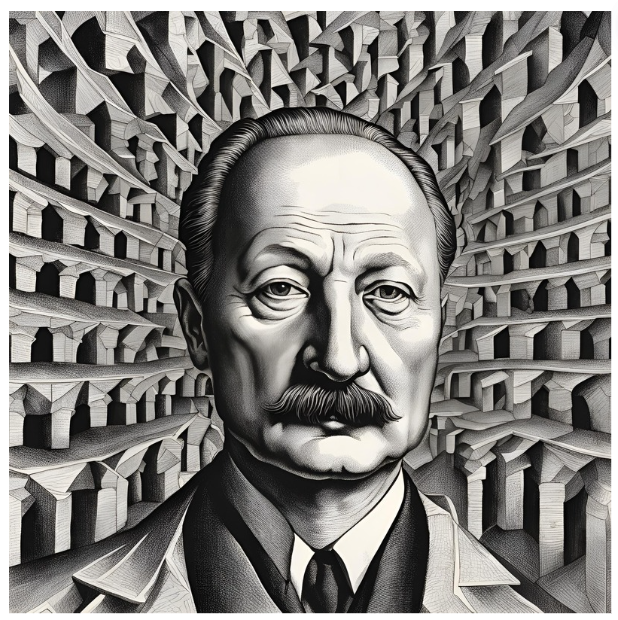
To explore this connection, I’ll draw on the ideas of the controversial German philosopher Martin Heidegger. Heidegger challenged traditional views on ontology by suggesting that before we understand “what” something is, we should first consider “being” itself. His concept of “Dasein” emphasizes that understanding starts with our experience of being and who is doing the experiencing. This inquiry reflects our human existence, shaped by our specific time, place, and culture.
Heidegger introduced several key ideas, including the modes of interaction with our world: ready-to-hand and present-at-hand. In the ready-to-hand mode, we engage with the world as a seamless part of our existence, using it naturally. In contrast, the present-at-hand mode involves studying the world as if it is separate from us, aligning more with the subject-object dichotomy.
In his seminal work Being and Time, Heidegger wrote:
“…‘Nature’ is not to be understood as that which is just present-at-hand, nor as the power of Nature. The wood is a forest of timber, the mountain a quarry of rock; the river is water-power, the wind is wind ‘in the sails’. As the ‘environment’ is discovered, the ‘Nature’ thus discovered is encountered too. If its kind of Being as ready-to-hand is disregarded, this ‘Nature’ itself can be discovered and defined simply in its pure presence-at-hand. But when this happens, the Nature which ‘stirs and strives’, which assails us and enthralls us as landscape, remains hidden. The botanist’s plants are not the flowers of the hedgerow; the ‘source’ which the geographer establishes for a river is not the ‘springhead in the dale’.”
“The senses do not enable us to cognize any entity in its Being; they merely serve to announce the ways in which ‘external’ Things within-the-world are useful or harmful for human creatures encumbered with bodies….they tell us nothing about entities in their Being.”
Heidegger suggests that our default mode is to be immersed in and interact with our environment. While we may try to objectify and categorize the world, this approach often leads to confusion. Heinz von Foerster captures this idea well: we are not apart from the world; we are a part of it. Our experience of the world is inherently social, and its meanings are co-created with others.
Dasein implies that our understanding is not about abstract, systematic explanations but about practical, lived experiences. Attempting to fit our understanding into rigid categories misses the point that our primary way of making sense of reality is through direct, immersive interaction. The second-order nature of sensemaking involves reflecting on our understanding itself. This highlights why understanding the second-order nature of sensemaking is crucial—our initial engagement with the world is practical and lived, and only later do we reflect on it abstractly.
I encourage readers to explore this further here.
I will finish with a philosophical joke:
Ontology and Epistemology walk into a bar.
Ontology asks Epistemology, “What are you having?”
The bartender replies, “Still talking to yourself, huh?”
Always keep on learning…
Discover more from Harish's Notebook - My notes... Lean, Cybernetics, Quality & Data Science.
Subscribe to get the latest posts sent to your email.
 Harish's Notebook - My notes... Lean, Cybernetics, Quality & Data Science.