
In today’s post, I am looking again at the idea of constraints in relation to Ross Ashby’s ideas and the ideas of second order cybernetics. As far as I know, Ashby did not go into the differentiation of first and second order cybernetics. A lot of what he wrote can be filed away under “First order cybernetics”. But to do so will be missing the forest for the trees. A lot of Ashby’s ideas were ahead of his time and resonate with the ideas of complexity and systems thinking.
Ashby tied the idea of constraints to variety and the observer. Variety, as I have written here before, can be loosely put as the number of possible states differentiated by an observer. So, for example, an analog light switch can be said to have a variety of two – ON and OFF. Constraint is the relational part between an observer and a “system”. A “system” here is a select number of variables chosen by an observer to represent a phenomenon of interest. To elaborate these ideas, I am taking the example of an observer who chooses a Christmas tree as an area of interest. Further, let’s consider that the tree is connected to an analog switch with a variety of two as stated before. The observer can decide they would like to leave the tree ON for the entire Christmas season to reflect the Christmas spirit. The variety of the switch is now reduced to one, barring any unforeseen incidents. The switch is always kept in the ON position. Out of the two possibilities, a constraint was applied so that there is only one possibility.
Ashby was very clear that Cybernetics is about looking at what something is doing, instead of looking at what that “something” is. From this standpoint, we are looking at possibilities, which is a “black box” view. We are looking at how something is behaving and are not really interested in the intricacies of how things are connected together.
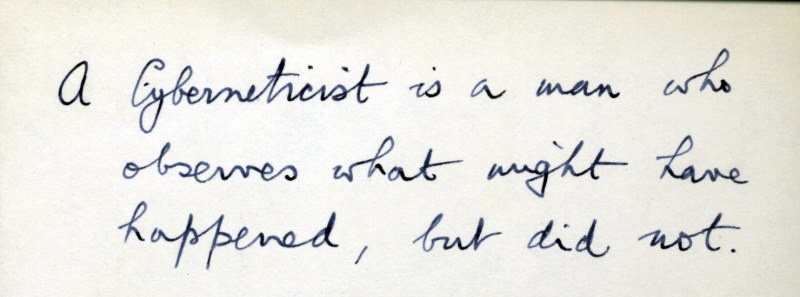
Ashby noted in his private notebook that “A Cyberneticist is a man[sic] who observes what might have happened, but did not.”
This idea of “something that might have happened, but did not” is related to the notion of constraints. Cybernetics is often depicted as a science of teleology. This is the first order Cybernetics. For example, we often depict the idea of a steersman moving towards a goal, where a clear path is set. From the idea of constraints, we should be looking at negative explanations. We may choose the destination, but the path is set by the constraints. Gregory Bateson, another intellectual giant in Cybernetics, noted the following about negative explanation:
Negative explanation is an aspect of cybernetic theory that emphasizes restraints. According to negative explanation, events take a particular course because they are constrained from taking other courses. Alternatively, positive explanation seeks to determine the causes of particular events. Rather than focusing on “Why?”, negative explanation involves describing the constraints under which systems operate.
We consider what alternative possibilities could conceivably have occurred and then ask why many of the alternatives were not followed, so that the particular event was one of those few which could, in fact, occur.
In a similar fashion, Ashby wrote:
Cybernetics looks at the totality, in all its possible richness, and then asks why the actualities should be restricted to some portion of the total possibilities.
The real world gives the subset of what is; the product space represents the uncertainty of the observer. The product space may therefore change if the observer changes; and two observers may legitimately use different product spaces within which to record the same subset of actual events in some actual thing. The “constraint” is thus a relation between observer and thing; the properties of any particular constraint will depend on both the real thing and on the observer. It follows that a substantial part of the theory of organization will be concerned with properties that are not intrinsic to the thing but are relational between the observer and thing.
We often emphasize on having a goal or direction, but we neglect the importance of constraints. Some constraints can be physical such as a ball rolling down a chute. The ball will always follow the same path. Now compare this to a rock falling down a hill. It may not follow the same path if you repeat rolling it down a hill. Some paths are more likely than others. And no matter how many times you roll it down a hill, some paths are never taken due to the physical constraints of the hill. These can be understood from a first order Cybernetics standpoint. From the second order Cybernetics standpoint, it is very important to understand the relational nature of constraints to the observer. What is limiting to one person can be nurturing for another. From the second order Cybernetics standpoint, the constraints are our biases and other epistemic constraints that limit or enable our actions.
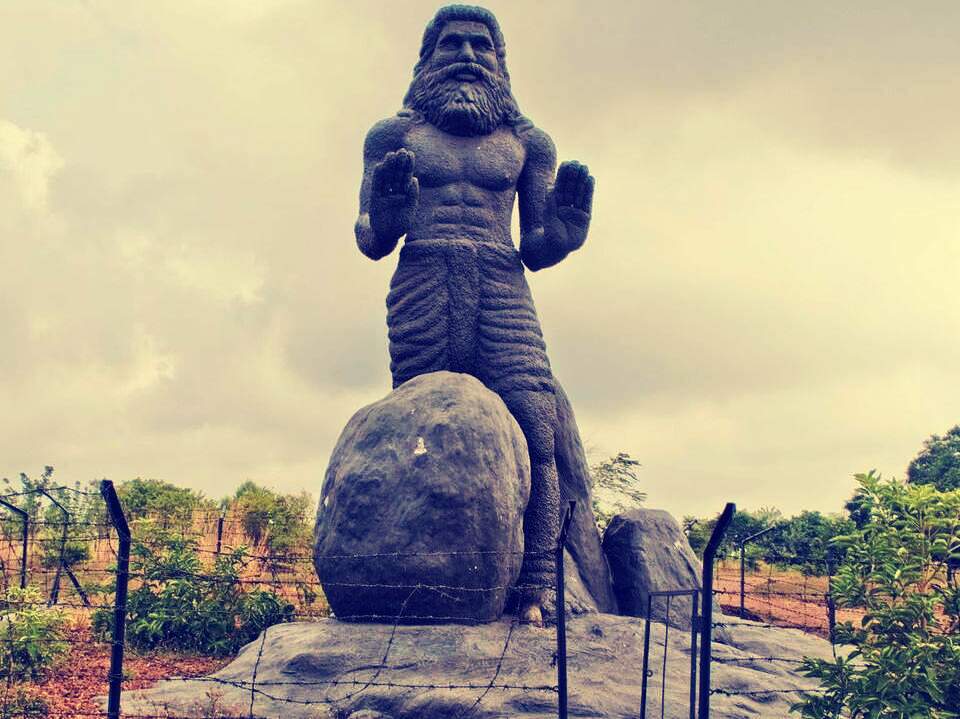
According to Greek mythology, Sisyphus was made to roll a large rock up a hill and have it roll down; only to repeat this exercise again and again for eternity. He was made to do this as a punishment. Curious enough, in another part of the world, in Kerala (India), there is another mythology that talks about another character who rolled a large rock up a hill only to have it roll down. Naranath Branthan (The madman of Naranam) would roll a large rock up a hill and have it roll down. He would repeat this again and again. His reason for doing this was entirely different than Sisyphus. Naranath Branthan was not doing it for punishment. But, he was doing it for fun. The stories about him said that he would laugh with joy and clap his hands as he watched the rock roll down the hill. If Sisyphus would had found joy in what he did, the Gods would have been forced to free him from the punishment since it would cease to be a punishment.
I will finish with a wonderful story about Naranath Brandan.
One day he met Kali, an Indian goddess, as he was retiring for the night. Kali was impressed by the madman and told him that she will give him a boon (blessing).
“I do not want any boons”, the madman said. He just wanted to get on with his night and go to sleep.
Kali informed him that she has to give a boon or a curse, and she insisted that he take a boon.
“I want to increase my life time by a second”, the madman replied. Kali told him that she could not do that.
“Then I want to decrease my life time by a second”, the madman said. Kali told him she could not do that either.
The madman thought for a while and asked Kali to move the elephantiasis from his left leg to the right leg. Kali complied, and the madman lived happily with elephantiasis on his right leg from that day onwards.
Stay safe and always keep on learning…
In case you missed it, my last post was Cybernetics and the Stoics:
Discover more from Harish's Notebook - My notes... Lean, Cybernetics, Quality & Data Science.
Subscribe to get the latest posts sent to your email.
 Harish's Notebook - My notes... Lean, Cybernetics, Quality & Data Science.
Reblogged this on Systems Community of Inquiry.
LikeLike