
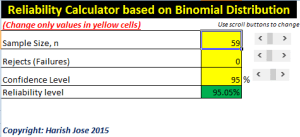
The reliability/Confidence level sample size calculation is fairly known to Quality Engineers. For example, with 59 samples and 0 rejects, one can be 95% confident that the process is at least 95% reliable or that the process yields at least 95% conforming product.
I have created a spreadsheet “calculator”, that allows the user to enter the sample size, number of rejects and the desired confidence level, and the calculator will provide the reliability result.
It is interesting to note that the reliability/confidence calculation, LTPD calculation and Wilk’s first degree non-parametric one sided tolerance calculation all yield the same results.
I will post another day about LTPD versus AQL.
The spreadsheet is available here Reliability calculator based on Binomial distribution.
I have a new post in this topic. Check out https://harishsnotebook.wordpress.com/2019/10/19/aql-rql-ltpd-oc-curve-reliability-and-confidence/
Keep on learning…
Discover more from Harish's Notebook - My notes... Lean, Cybernetics, Quality & Data Science.
Subscribe to get the latest posts sent to your email.
 Harish's Notebook - My notes... Lean, Cybernetics, Quality & Data Science.
With regards to the confidence /reliability calculator what equation are you using to calculate the sample size?
LikeLike
Hi Stephen,
I use an inverse beta function to calculate the sample size based on c, Aql, alpha, Rql and beta values.
Sincerely,
Harish
LikeLike
Harish,
Normally I would use the Successful Run Theorem to calculate sample size because a=0, based on a reliability and confidence value. I now want to have a=1, is there an equation or reference you could point me towards.
The calautor works great, but I need to be able to link it back to an equation or book reference.
Here is the normal equation I use.
[cid:image001.png@01D1FD2D.D54109A0]
Thanks
Stephen
LikeLike
Hi Stephen,
I had blogged about the relationship between Rql and reliability here. https://harishsnotebook.wordpress.com/2015/06/28/relationship-between-aqlrql-and-reliabilityconfidence/
There is an equation in the post between beta and Rql. The reliability value is (1-Rql)% at the desired beta value. We can solve for n from this equation. When c=0, the equation becomes the success run theorem.
-Harish
-Harish
LikeLike