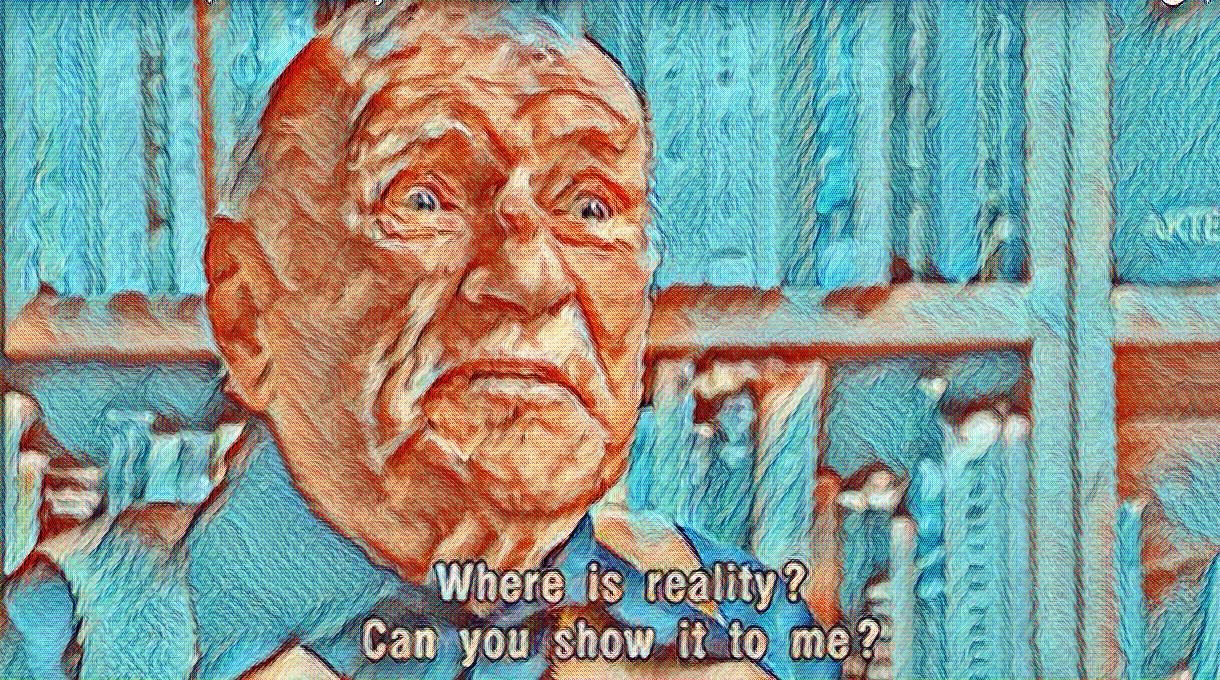

When Does a System Exist? The Myth of the Given System:

In today’s post, I want to look at a question that seems almost too simple to ask: when does a system exist? For this I will be drawing on ideas from Wilfrid Sellars, Ludwig Wittgenstein, Heinz von Foerster, and Martin Heidegger.

We talk about “systems” all the time. The healthcare system. The education system. The traffic system. We speak as though these are objects sitting in the world, waiting to be observed, measured, and fixed.

Let’s try a thought experiment. Reach out your hand and try to touch the healthcare system. You can touch a hospital bed. You can hear a monitor beeping. You can speak to a nurse. You can shake a doctor’s hands. But where is the system? You cannot knock on it. You cannot hold it in your palm.

And yet we speak about it as if it were an object in front of us. We say things like “The system is broken” or “The system needs fixing.” The language gives it a kind of independent standing, as if it were a malfunctioning engine sitting somewhere, waiting for a repair technician.

This way of speaking rests on a hidden assumption, the assumption that there are structures in the world simply waiting to be perceived and described. The philosopher Wilfrid Sellars called this the “Myth of the Given”.

Wilfrid Sellars:

The “Myth of the Given” is the idea that the world presents itself to us in raw, pre-interpreted form. That before language, before concepts, before any act of distinction-making, there are simply facts delivered to the mind. Knowledge, on this view, is built upward from this unmediated foundation.

Sellars argued that this is a fallacy. He noted that sensing is not the same as knowing. A sensation may trigger a belief, but it does not justify one. Knowledge belongs to what he called the space of reasons. This is a shared space where claims can be offered, challenged, and revised.

He used the example of a tie shop clerk to make this point. Under the store’s electric lighting, the clerk says “This tie is blue.” Later, when another clerk points out the effect of the lighting, he revises his claim to “It looks blue.” The sensation itself has not changed. What has changed is his understanding of the norms governing correct description. There is no raw, unmediated given beneath our experience. There is already a learned practice of making and correcting distinctions.

This matters for how we talk about “systems”. When someone says “The system is broken,” that statement is not a neutral observation. It presupposes standards. It implies that something is failing relative to shared expectations. The claim invites agreement, disagreement, and justification. It is a normative claim, not a factual report.

Ludwig Wittgenstein:

Ludwig Wittgenstein made a related point in his reflections on rule-following and meaning. He asked whether meaning could be grounded in something purely private, such as an inner sensation. His answer was that it cannot. Without shared, public criteria for correctness, there would be no way to distinguish between actually following a rule and merely believing one is doing so.

Meaning lives in shared forms of life, not in private inner episodes. When we describe something as a system, we are not reporting a neutral fact. We are placing ourselves within a shared field of expectations and norms. The word “system” already carries commitments about what ought to be happening.

Heinz von Foerster:

Heinz von Foerster made a parallel observation about cognition. He pointed to what he called “undifferentiated encoding”. The interpretative framework does not encode categories like red or green directly. It encodes differences in stimulation. The differentiation into meaningful categories happens inside the organism itself.

This is due to what cybernetics calls “operational closure”. An entity responds according to its own structure, not according to instructions delivered from the outside. Von Foerster noted that the environment contains no information as such. Information arises only through the distinctions the organism is capable of making.

Sellars shows there is no raw knowledge. Wittgenstein shows there is no private anchor for meaning. Von Foerster shows there is no raw information. Each, in a different register, removes the idea of a pre-given foundation beneath our experience of the world.

But even together, they leave something unaddressed. Even if knowledge and information are constructed, we might still imagine ourselves as observers standing outside the world, organizing it from a neutral distance. This is where Martin Heidegger becomes essential.

Martin Heidegger:

Heidegger does not begin with perception or information. He begins with care.

For Heidegger, we do not encounter the world as neutral spectators. We are already involved. We are embedded in projects, concerns, and purposes. The world shows up in relation to what matters to us.

His example of the hammer is well known and I have written about it before. When you are skillfully hammering a nail, the hammer withdraws into the activity. It is ready-to-hand, transparent to your purpose. So is the nail, and the wood. None of them present themselves as objects. You are simply absorbed in the task.

The hammer only becomes visible as an object when something goes wrong. It breaks. It slips. It is missing. At that moment it becomes present-at-hand. You step back and look at it.

The object appears through breakdown.

The Myth of the Given System:

Now consider: what if systems work in exactly the same way?

You do not experience the healthcare system while care flows smoothly. You experience patients, conversations, treatments, and nurses. The coordination is ongoing and transparent. The practices are simply happening. Nobody says “the system.”

Now imagine a bed is unavailable. Or an insurance policy blocks a treatment. Or a drug is out of stock. Suddenly someone says: “The system is broken.”

Notice what has happened. A concern has been frustrated. And from that frustration, a boundary is drawn. A pattern of practices is gathered together and named. What was ready-to-hand, invisible in its smooth functioning, has become present-at-hand. The system has appeared.

The system is not given. It is disclosed through breakdown.

The traffic jam is another good illustration of this. Physically, there are cars and asphalt. But the system only appears relative to care. To the commuter, it is a failure of punctuality. To a vendor walking between the vehicles, it is an opportunity. To a city planner, it may be evidence of demand exceeding capacity. The cars are real. The asphalt is real. But the system is not the same kind of thing as the cars. It is a configuration that becomes visible when care encounters resistance.

To speak of the system as though it were an independently existing object, like the cars or the asphalt, is to extend the Myth of the Given into organizational life itself.

Once we see this, the ethical implications are hard to avoid. If systems arise through care, then system boundaries reflect what we care about. When we define healthcare in terms of efficiency, we foreground throughput. When we define it in terms of community wellbeing, we foreground relationships and continuity. Every articulation reveals some concerns and conceals others.

Second Order Cybernetics:

Second order cybernetics has always insisted on this point. The observer cannot be separated from the observed. When we define a system, we are not pointing at something that already existed independently of us. We are making a distinction. And as George Spencer-Brown noted, to draw a distinction is to create a world.

This is the shift that second order thinking invites. We do not ask “What is the system?”

but:

“What do I care about such that this shows up as a system at all?”

That is not a technical question. It is an existential one. Every system in this regard is a human system.

Final Words:

When we draw a boundary and call it the “system”, we are not pointing to a thing that exists independently of our distinctions. We are organizing experience around what matters to us. We chose to draw the boundary there, instead of here. We chose include that, instead of this. And we do so because our care was interrupted at that point, and not somewhere else.

This does not mean the consequences are unreal. When care is blocked, when treatment is denied, when livelihoods are threatened, when exhaustion becomes chronic, viability is genuinely at stake. To say that systems are articulated through concern is not to dismiss suffering. It is to take it more seriously.

If one’s care is endangered, one cannot remain in abstraction. Action then becomes necessary. But what kind of action?

If we treat the system as an external machine, we search for mechanical fixes. We adjust policies, change incentives, replace personnel. These may be necessary. Yet they often operate within the same set of distinctions that produced the difficulty in the first place.

Second order thinking asks a question in a deeper dimension. What distinctions are we relying on that make this outcome appear inevitable? What counts as success in this configuration? What has been excluded from the circle of relevance?

Instead of saying “The system is broken,” we might say “The current way we are coordinating our practices is undermining viability.” That wording does not place us outside the problem. It acknowledges participation without assigning simplistic blame.

Participation does not mean individual control. Many structures are vast and historically sedimented. But even within constraint, we contribute through compliance, resistance, redesign, conversation, refusal, and collaboration.

Ethics enters precisely here. Not as a moral add-on, but at the level of boundary drawing itself. Every time we define what the system is, we define what matters. Every time we measure performance, we privilege certain forms of viability over others.

Second order cybernetics does not provide a formula for what to do when care is threatened. It does not eliminate conflict between competing concerns. What it does is remove the illusion that responsibility lies elsewhere.

If viability is at risk, the task is not simply to repair an external object. It is to examine, collectively, how we are distinguishing, organizing, and sustaining the patterns that shape our shared world.

That work is slower. It is less dramatic. It requires conversation rather than diagnosis.

It keeps us inside the picture.

Stay Curious and Always keep on learning…

If you liked what you have read, please consider my book “Second Order Cybernetics,” available in hard copy and e book formats. https://www.cyb3rsyn.com/products/soc-book

Note:

In referencing the work of Martin Heidegger, I want to acknowledge the deeply troubling fact of his affiliation with the Nazi party. This aspect of his life casts a long and painful shadow over his legacy. While I draw on specific philosophical ideas that I find thought-provoking or useful, this is not an endorsement of the man or his actions. Engaging with his work requires ethical vigilance, and I remain mindful of the responsibility to not separate ideas from the broader context in which they were formed.

References:

  1. Heidegger, M. Being and Time (1927)
  2. Sellars, W. Empiricism and the Philosophy of Mind (1956)
  3. Wittgenstein, L. Philosophical Investigations (1953)
  4. von Foerster, H. Understanding Understanding (2003)
  5. Spencer-Brown, G. Laws of Form (1969)

Minimizing Harm, Maximizing Humanity:

In today’s post, I am looking at a question that is rarely asked in management. What if the most responsible course of action is not to maximize benefit, but to minimize harm? In decision theory, this is expressed as the minimax principle. The idea is that one should minimize the worst possible outcome. In human systems, that outcome is best understood as harm to people, relationships, and the invisible infrastructure that sustains collective work.

The language of management is often dominated by the pursuit of gains. Leaders are taught to ask what is the best that can happen. They are told to optimize, to scale, and to seek advantage. The minimax principle turns this question around. It asks instead what is the worst that can happen and how do we prevent it. Every decision about maximization must be evaluated through the lens of minimizing harm. Harm minimization is not a boundary condition but the primary ethical directive that governs all other management decisions.

Russell Ackoff once observed that the more efficient you are at doing the wrong thing, the wronger you become. This statement captures the ethical inversion at the heart of many managerial failures. The pursuit of maximum gain often blinds organizations to the quiet forms of loss that accumulate in the background. Human systems depend on tacit networks of trust, communication, and mutual adjustment. When efficiency cuts too deeply, these invisible infrastructures collapse. The system loses its ability to adapt.

To minimize maximum harm is not to resist change. It is not an invitation to stand still. Rather, it is a recognition that progress and ethics operate according to different logics. Progress concerns improvement and expansion. Ethics concerns the protection of dignity, agency, and reversibility. Once we place harm minimization at the center of our decisions, progress becomes sustainable because it no longer depends on exploitation or exclusion.

The primary ethical directive to minimize harm requires a clear operational principle. Heinz von Foerster provided this principle with remarkable clarity- I shall act always so as to increase the number of choices. This is not a secondary value. This is how harm minimization is operationalized.

Consider what happens when choices are available. When options remain open, people retain the capacity to move in different directions. They can experiment, observe the results, and if those results prove harmful or undesirable, they can try a different direction. This is reversibility. It is not that decisions are undone but that people are not locked into a single path with no way out. Reversibility means the system retains the capacity to self-correct. This becomes an integral part of being viable.

When choices are removed, a different logic takes hold. A decision made under constraint, with no alternatives available, becomes irreversible. The person cannot change course because there is no other path to take. The harm accumulates and cannot be addressed through adaptation or choice. This is an important distinction. To minimize harm is to preserve the optionality that allows people to respond when things go wrong. When you increase the number of choices available to people, you prevent harm from becoming locked in place. You maintain the possibility of recovery. You keep open the horizon of possibilities. The person is not left to say I had no choice, which is the expression of the deepest form of harm, the harm from which there is no escape.

This means that every decision about maximization or progress must be evaluated through this lens. Does it increase or decrease the number of choices available to people? Does it preserve reversibility or does it close off futures? Does it prevent irreversible harm or does it create conditions from which recovery is impossible? This is how we operationalize the primary ethical directive in practice.

Werner Ulrich’s Critical Systems Heuristics extends this insight into a framework for reflective practice. Ulrich reminds us that every system boundary includes some and excludes others. Those excluded often bear the consequences of decisions without having had a voice in making them. Ethics therefore requires that we identify who loses in the system we design. Ethics requires that we act in ways that allow their participation and emancipation. To preserve choice is to protect those at the margins of decisions. It is to recognize that moral responsibility lies in how boundaries are drawn. When we ask who loses, we are asking a minimax question. We are asking what is the worst that can happen for those at the margins.

To some, the minimax principle might sound like a cautious philosophy, one that restrains progress. This would be a misunderstanding. The aim is not to prevent change but to cultivate conditions under which change can occur without catastrophic harm. Here the insights of Magoroh Maruyama are valuable. In his work on second cybernetics, he distinguished between negative feedback processes that regulate deviation and positive feedback processes that amplify it. He noted that deviation amplification is the essence of morphogenesis. Not all deviations are errors to be corrected. Some are the sources of new order and innovation. Ethical design therefore should not eliminate deviation but create conditions in which positive deviation can be generative without catastrophic harm. To minimize maximum harm is not the same as to minimize deviation. It is about preserving the space in which positive deviation can arise safely.

Von Foerster’s imperative and Maruyama’s insight converge here. Both point toward the idea that ethics in complex systems must not suppress variety. Von Foerster’s view was that more freedom comes with more responsibility. When we create systems that expand choice, we simultaneously increase the responsibility of those who act within them. The ethical task is not to eliminate risk but to manage it in a way that nurtures diversity and growth while protecting the conditions of future choice. To design ethically is to create the space in which deviation, learning, and emergence can unfold without irreversible harm.

Behind every visible structure of management lies an invisible infrastructure. It consists of relationships, trust, informal knowledge, and the tacit coordination that keeps work alive. This infrastructure is often taken for granted. It is noticed only when it breaks down. In the pursuit of efficiency, organizations frequently erode these invisible supports. Staff reductions, rigid procedures, and mechanistic control can destroy the very human capacities that enable adaptability and resilience. The question therefore is not what can be gained but what can be lost without recovery. True resilience depends on maintaining the conditions that allow the system to heal itself. When we ask this question, we are asking what choices we are removing from people. We are asking what futures we are closing off.

It is important to distinguish ethics from progress. Ethics does not belong to the domain of progress. Progress concerns the expansion of capability. Ethics concerns the preservation of humanity. The two may coexist, but they are not the same. Progress without ethical constraint risks creating conditions from which recovery is impossible. Ethics without openness to change risks paralysis. The minimax principle, interpreted through von Foerster and Ulrich, provides a way to hold both. It calls for action that reduces maximum harm while sustaining the capacity for continued evolution.

Maruyama’s perspective deepens this understanding. By allowing positive deviation, we cultivate the potential for new forms of order. By preserving choice, we protect against harm that would close the future. The task of management therefore is not to optimize the present but to sustain the possibility of better futures without destroying the diversity from which they may emerge.

Ackoff’s view was that the future is not something to be predicted but something to be designed. The ethical responsibility of design is to ensure that this future remains open. To minimize maximum harm is to recognize the fragility of what is human in our systems. To preserve choice is to keep open the horizon of possibility. To embrace positive deviation is to invite emergence without destruction. Ethics in management is not about perfection or certainty. It is about maintaining the delicate balance between care and change.

Final Words:

When compromises are inevitable in human systems, the most humane path is to protect what allows us to begin again. The minimax principle is an invitation to ask different questions in our organizations. It is an invitation to be aware of who loses in the systems we design. It is an invitation to increase the number of choices available to people. It is an invitation to preserve reversibility and to protect the invisible infrastructure that sustains our collective work. We are responsible for our construction of these systems. We are responsible for the futures we foreclose and the futures we keep open. To be an authentic manager is to be aware of this responsibility and to strive, always, to minimize the harm we might do while creating conditions for emergence and learning.

Stay curious and always keep on learning.

The -isms of a Man Who Rejected -isms:

In today’s post, I am exploring one of the most fascinating aspects of Heinz von Foerster’s work: his complete rejection of philosophical labels and -isms. Von Foerster, the Austrian-American physicist and cybernetician, in his later years did not want to be pinned down by any single philosophical position. This was not philosophical indecision but a carefully crafted stance that reflected his deepest insights about observation, responsibility, and the nature of knowledge itself.

Von Foerster’s view that he was an -ist only of the -ism he could laugh at. While there is no definitive record of this exact phrase, in my opinion it perfectly captures his approach to philosophical thinking. He would only commit to philosophical positions that he could maintain with lightness and humor, positions that did not take themselves too seriously. This prevented his thinking from becoming rigid or dogmatic. He treated thought as an ongoing exploration, not a fixed doctrine.

To understand why this matters, let me walk through the major -isms that von Foerster consistently stepped around, and show you how his alternative approach offers something far more powerful than any single philosophical position.

Objectivism – The View from Nowhere:

Objectivism claims there is a world “out there,” independent of us, that we can know through careful observation and measurement. It insists on a sharp separation between the observer and what they observe.

Von Foerster had no patience for this illusion. As he put it:

Objectivity is the delusion that observations could be made without an observer.

This was not just philosophical wordplay. Von Foerster understood something deeper about responsibility:

Objectivity is one of the great tricks to get rid of responsibility.

When we claim to simply observe “what is,” we avoid acknowledging our role in bringing forth what we see. This is particularly important in his work on self-organizing systems. As he demonstrated, “There are no such things as self-organizing systems!” What we observe is always a system in close contact with an environment, in a state of perpetual interaction. The observer and the observed emerge together.

This insight reverses the logic of classical science. Instead of trying to eliminate the observer, von Foerster insisted that the observer must be included in the description of the observing system.

Subjectivism – The Prison of the Self:

You might think that if objectivism is wrong, then subjectivism must be right. Subjectivism is the idea that reality is purely a personal interpretation. Von Foerster rejected this view as well.

Von Foerster explicitly refuted the notion that reality is solely the product of an individual’s imagination. He used what philosophers call a “reductio ad absurdum” argument to show the logical impossibility of pure subjectivism.

As he put it:

If I assume that I am the sole reality, it turns out that I am the imagination of somebody else, who in turn assumes that he is the sole reality.

This paradox is easily resolved, by postulating the reality of the world in which we happily thrive.

He also addressed the idea of isolated experience directly. When people talk about being alone with their thoughts, von Foerster pointed out: “The man alone? He would just have to re-member that he is only alone when compared to others.” Even the concept of being “alone” requires the existence of others as a reference point.

Subjectivism treats knowledge as trapped inside individual minds. But von Foerster understood that knowledge emerges through interaction, not isolation. When discussing cognition, he clarified that subjectivism fundamentally misunderstood what knowing is. As he explained, your nervous activity is just your nervous activity and, alas, not mine. Knowledge and information cannot simply be “passed on” as commodities from one person to another because they are processes of individual nervous systems.

Instead, von Foerster showed us that Reality appears as a consistent reference frame for at least two observers. This is crucial. Meaning does not reside in isolated subjects but arises between them, through their coordinated actions and mutual orientation.

This insight connects to what von Foerster called the fundamental structure of communication. Following Maturana’s theorem that “Anything said is said by an observer,” von Foerster added his corollary: “Anything said is said to an observer.” These two propositions establish what he called a nontrivial connection between three concepts: the observers; second, the language they use; and third, the society they form by the use of their language. He compared this to the chicken, egg, and rooster problem: You need all three in order to have all three.

Human consciousness, including self-awareness and self-reflection, emerges from this social foundation. As von Foerster explained: “Self-awareness and self-reflection arise in ‘languaging’, which is necessarily a social affair.” We are conscious, he argued, because “we ‘know with’ ourselves” precisely because we “‘know with’ others.” This awareness of mutual interdependence is “the root of conscience.” The “other” is what makes us a “self.”

Even the objects we perceive are not pre-existing entities but what von Foerster called “tokens for eigenbehaviors”. They are “indications of processes” that arise from our interactions. “In the process of observation, we interact with ourselves and with the world to produce stabilities that become the objects of our perception.”

Von Foerster distinguished between “the reality” (as confirmed by independent observations) and “a reality” (as constructed through correlations). He preferred the latter approach: “My sensation of touch in correlation with my visual sensation generate an experience that I may describe by ‘here is a table.'”

This is why subjectivism fails. There is no pure inner experience independent of interaction with others and environment. The subject and the world they know arise together through recursive processes of coordination. As von Foerster put it: “without language and outside language there are no objects, because objects only arise as consensual coordinations of actions in the recursion of consensual coordinations of actions that languaging is.”

Relativism – The Collapse of Commitment:

Many people assume that if you reject both objectivism and subjectivism, you must be a relativist. A relativist is someone who thinks all views are equally valid. Von Foerster avoided this trap too.

He did not believe all truths were equal. He believed we are responsible for the truths we construct. This led to his famous ethical imperative:

Act always so as to increase the number of choices.

This was not tolerance born from “anything goes” thinking. It was responsibility born from understanding that we are the ones drawing distinctions, and we must accept responsibility for what those distinctions allow and exclude.

Von Foerster’s approach to education illustrates this perfectly. He distinguished between “legitimate questions” (questions to which the answers are unknown) and “illegitimate questions” (questions to which the answers are already known). Some ways of questioning are simply more generative than others. A relativist might say all questions are equally valid. Von Foerster insisted that only legitimate questions open up new possibilities for learning and growth.

The Constructive Alternative – Cybernetic Constructivism:

So what was von Foerster’s alternative? If we must give it a label, we might call it cybernetic constructivism. But he would probably laugh at that label too.

His key insight was this: “The environment contains no information. The environment is as it is. Information is a cognitive function.”

This leads to a profound recognition. Meaning does not exist “out there” waiting to be discovered, nor is it trapped “in here” within individual minds. It emerges through the recursive process of observation itself.

As von Foerster put it: “If you want to see, learn how to act.”

This brings us to his most challenging statement: “I shall act always as if I were the creator of the world I perceive.”

This is not solipsism. Solipsism is the idea that only your mind exists. It’s about responsibility. The world we bring forth is shaped by our choices, our distinctions, our attention, our participation with others.

The Ethics of Observation:

This is where von Foerster’s approach becomes deeply ethical. If there is no privileged position outside the system, then every observer is responsible for their constructions. There is no place to hide.

Von Foerster expressed this beautifully: “At any moment we are free to act toward the future we desire.”

You are the Copernican revolution. The observer is not the center of the universe, but every observation necessarily has them at its center. That realization is not humbling or arrogant but liberating. Because if you are responsible for your world, you are also free to change how you perceive and engage with it.

This is the deepest insight of von Foerster’s anti-philosophy. In taking responsibility for our constructions, we discover our freedom to construct differently. The future “will be as we wish and perceive it to be” not because we can impose our will on reality, but because future and perceiver arise together through the choices we make and the possibilities we keep open.

Communication as Dance:

Von Foerster understood communication differently too. As he explained:

“Language for me is an invitation to dance… When we are talking with each other, we are in dialogue and invent what we both wish the other would invent with me.”

We are not separate minds trying to transmit fixed meanings, but partners in an ongoing creative process. This view of communication aligns perfectly with his rejection of fixed philosophical positions. Every conversation is an opportunity to create something new together.

Final Words:

Here we encounter the deepest irony. In trying to understand von Foerster’s rejection of -isms, we risk creating the very thing he warned against: a fixed doctrine, a systematic position, an -ism of anti-isms.

But perhaps this is exactly the point. We are free to choose our -ism, and in choosing, we become responsible for what that choice enables and forecloses. Von Foerster would not exempt us from this responsibility, not even when engaging with his own work.

Von Foerster’s approach embodies what we might call epistemic humility. He understood that our knowledge is always partial, always constructed from a particular perspective, always open to revision. This humility does not lead to paralysis but to a productive pluralism. Multiple ways of knowing can coexist without one needing to eliminate the others. His ethics of observation, always acting to increase choices, becomes particularly relevant when our information systems often work to narrow them.

This is why von Foerster’s thinking remains provisional. He demonstrated that thought need not crystallize into fixed positions. We can remain responsive to what emerges in the very act of thinking. This provisionality is not philosophical indecision but intellectual courage. It is the willingness to stay with questions that matter more than the answers they might produce.

In our current moment of polarized certainties, von Foerster reminds us that we are not spectators of the world, but co-creators of it.

Von Foerster would likely laugh at being treated as the final word on anything. His laughter would remind us that the best thinking often begins where our certainties end. And if that insight threatens to become an -ism? Von Foerster might simply smile and remind us that we are only -ists of the -isms we can laugh at.

Stay curious and always keep on learning…

The Right Thing and the Right Reason:

In today’s post, I am exploring the notion of “doing the right thing.”

We encounter this expectation everywhere in workplaces, personal relationships, and civic life. The phrase appears in mission statements, performance reviews, and everyday conversations. At first glance, it feels simple and reassuring. Of course we should do the right thing.

In regulated industries, this mantra becomes even more clearly pronounced. Every procedure, every record, and every audit echoes that expectation. It appears in training sessions, quality policies, and compliance frameworks.

I want to add an important layer: do the right thing for the right reason.

The distinction may seem subtle, yet it initiates a reflexive turn. It moves us from mechanical compliance to ethical responsibility.

A statement by itself carries no value. “Do the right thing” means nothing until someone makes it their own. The phrase appears to describe a fact, but it actually expresses a value judgment. Value enters only when a person acts from conviction, not from blind obligation. The second part, “for the right reason,” is where responsibility begins. It asks a crucial question about why I am doing this. That question transforms an empty slogan into a deliberate act grounded in personal values.

If I follow orders or check boxes without reflection, I might appear to do the right thing. But in truth, I have surrendered ownership. From the perspective of cybernetic constructivism, meaning is not handed down from the outside. It emerges within the observer. As Heinz von Foerster showed in his work on observing systems, we do not simply receive reality but construct it through our interactions and decisions.

When we speak of “the right thing,” the phrase suggests precision, as if a decision could fit reality without error. In practice, this rarely happens. Thought and reality belong to different domains. A decision formed in thought appears complete because ideas do not encounter resistance until they are acted out. The flaws surface only when they meet real conditions.

This is the illusion of completeness in the right thing, the comforting belief that something can be fully correct. It persists because thought gives us a sense of closure that reality cannot guarantee.

Here is where the phrase “for the right reason” matters. It does not make the decision perfect; it acknowledges that it never was. Adding this second part challenges the belief in absolute correctness and invites humility about what we can know. It says you cannot guarantee the outcome, but you can own the reasoning. That ownership gives the action its integrity. The emphasis shifts from claiming completeness to accepting responsibility. This matters because it prevents us from confusing the clarity of thought with the complexity of life.

I want to focus on this more with a question: When the time comes, can I do the right thing? This question seems simple, but it hides a deeper issue. What exactly is the right thing? We often talk as if the right thing exists “out there,” waiting for us to discover, a fixed fact like the boiling point of water. But this assumes that what appears complete in thought will remain complete in practice. That assumption is an illusion.

In many situations, the right thing is not given. It is what von Foerster calls an undecidable.

The Nature of the Undecidable:

Von Foerster introduced this term for questions that cannot be answered by logic, rules, or computation alone. An undecidable resists algorithmic resolution. Regulations provide structure and consistency, and they are essential. Yet they do not eliminate undecidables. They never will.

Undecidables exist because the variety of real-world situations far exceeds what any rulebook can anticipate. In cybernetics, variety means the number of possible states a system can take. The more possible situations, the greater the variety. And the world does not just throw edge cases at us. It quite often generates entirely new scenarios. Each innovation, each unique user context, and every unexpected failure mode creates conditions no standard procedure can fully capture.

No rulebook, whether corporate policy or government regulation, can provide ready-made answers to every question. Rules may reduce some complexity and provide crucial guidance, but they cannot close the gap between their finite scope and the indefinite creativity of reality. That gap is where undecidables live, and where human judgment becomes indispensable.

Von Foerster put it clearly:

“Only those questions that are in principle undecidable, we can decide.”

This is not a logical contradiction. It is an ethical imperative. The undecidable is not an error to fix or a loophole to close. It is an invitation to take responsibility. And responsibility cannot be delegated to systems or rules.

Many people resist this truth. We want the comfort of certainty. We prefer to believe the right thing exists as a fixed point, like a law of physics. If that were true, we would not bear the weight of decision. But ethics begins where algorithmic certainty ends. When we say “Just tell me the rule,” we try to trade agency for comfort. And in doing so, we risk betraying the very principles we claim to uphold.

The uncomfortable insight is this: the right thing has validity only as something we decide and own.

A Practical Question:

In the medical device industry, when I encounter an undecidable, my first question is always:

“How does this help or hurt the end user?”

That question brings the undecidable into focus. Regulations cannot cover every nuance. They can only guide. The decision remains mine. The responsibility cannot be outsourced.

Doing the right thing for the right reason is not about perfection. It is not about moral grandstanding. It is about intentionality, the choice to act from internal commitment rather than external command. It is the courage to decide when certainty is impossible and when existing protocols do not apply.

Von Foerster understood this deeply. When he spoke of undecidables, he was not describing a flaw in logic or a failure of system design. He was describing the essence of ethical life: that there are decisions no one can make for us. This insight formed the heart of his second-order cybernetics, which places the observer and their responsibility at the center of any system.

The Ladder We Must Throw Away:

Here I must acknowledge an irony. In adding the phrase “for the right reason,” I am still using the word “right.” By doing so, I risk introducing the very assumption I wanted to question: that rightness exists as something fixed and pre-given. This reflects a pattern throughout the article, where language itself hints at the various complexities we grapple with in an attempt to grasp or cope with the external world.

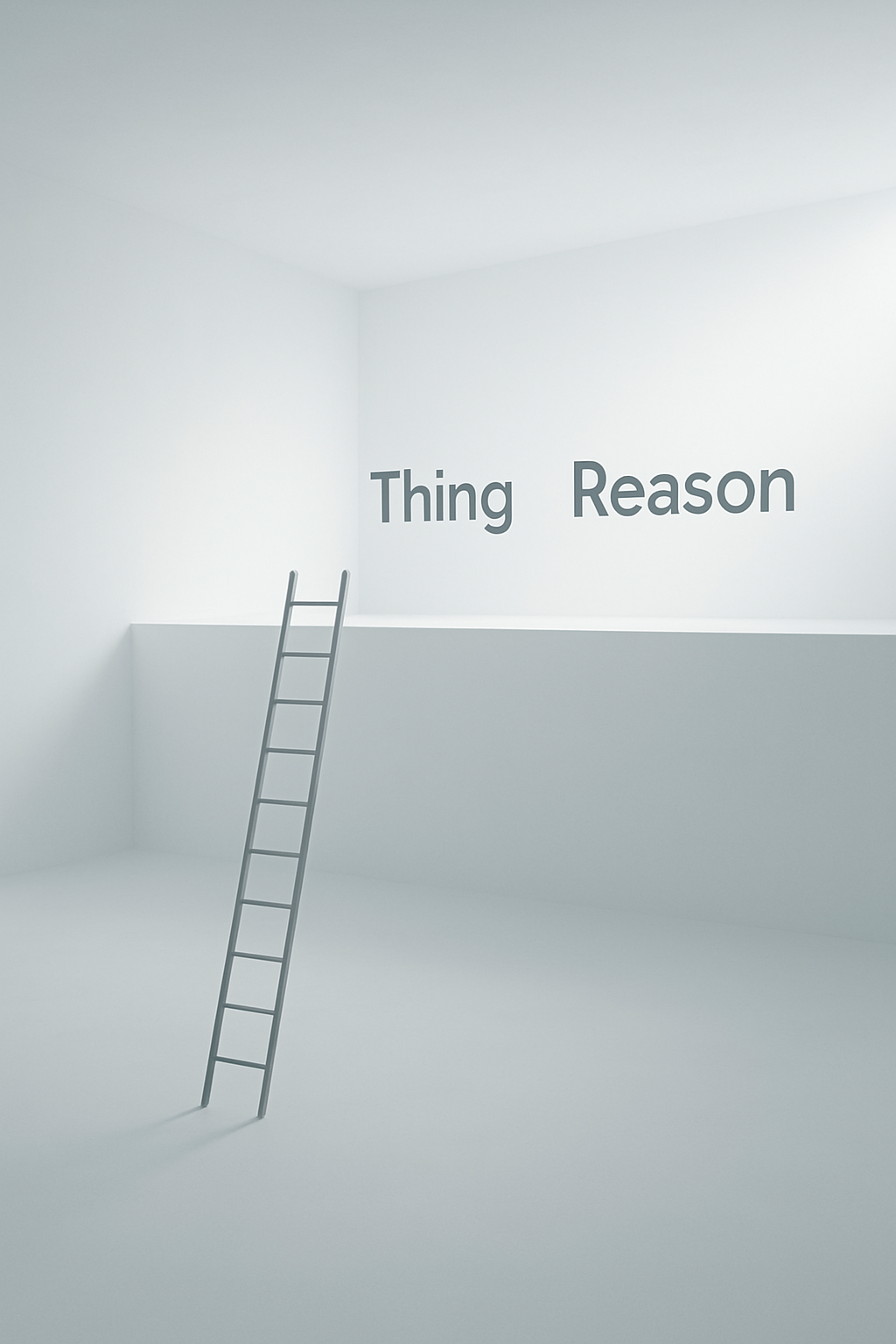
This is where Wittgenstein helps. In the Tractatus Logico-Philosophicus, he wrote that the propositions in his book were like a ladder. Once you have climbed it, you must throw it away. These propositions were tools, not eternal truths. They guide you to a vantage point, and then you move beyond them.

The phrase “do the right thing,” and even my expanded version, “do the right thing for the right reason,” works the same way. These are useful as orienting principles in regulated industries. They provide direction in moments of uncertainty. But if we cling to them as ultimate truths, we miss their purpose.

Like Wittgenstein’s ladder, their role is pragmatic and temporary. They guide us to a place where we can make responsible decisions. Once we understand that responsibility cannot be outsourced to a phrase or a rule, we can discard the ladder, not by abandoning the principle, but by letting go of the illusion that the phrase absolves us of thinking.

The deeper insight is this: the right thing does not exist as a given. It exists as something we must decide. And that decision, by its very nature, will always belong to us.

The next time you hear the phrase “do the right thing,” pause and ask:

What undecidable am I facing, and will I have the courage to decide it for the right reason, knowing that even the word “right” is only a ladder?

Final Words:

The tension between following rules and taking responsibility is not a flaw to fix. It is a fundamental condition of ethical life in complex systems. Von Foerster’s cybernetics teaches us that we cannot escape this tension by creating better rules or more comprehensive procedures. The variety of situations we face will always exceed the variety our systems can anticipate.

This does not diminish the value of regulations. They provide the backbone of responsible practice and create the conditions for ethical decisions. But they cannot substitute for judgment when the genuinely novel situation arises.

The courage to decide undecidables belongs to every professional who encounters the limits of the rulebook. When we recognize that meaning emerges within the observer, we are called to decide thoughtfully, with full awareness of our role in shaping the meaning of our actions.

This is neither comfortable nor easy. But it is the price of genuine ethical responsibility. The ladder remains useful until we no longer need it. The goal is to reach the place where we can make decisions worthy of the trust placed in us.

Always keep on learning…

If you enjoyed this post and find my work valuable, I would appreciate your support. You can explore more of my ideas in my latest book, Second Order Cybernetics, Essays for Silicon Valley, hard copy available at the Lulu Store.

The Arbitrariness of Objectivism:

The readers of my blog might be aware that I appreciate the nuances of cybernetic constructivism. Cybernetic constructivism rejects the idea that we have access to an objective reality. It does not deny that there is an external reality independent of an observer. However, we do not have direct access to it. Additionally, the external world is more complex than us. As part of staying viable, we construct a version of reality that is unique to our interpretative framework. This takes place in a social realm, and error corrections happen because the construction occurs in the social realm.

Heinz von Foerster, the Socrates of Cybernetics, formulated two imperatives that provide insight into this framework. The first is the ethical imperative that states “act so as to increase the number of choices.” The second is the aesthetical imperative that states “if you desire to see, learn how to act.” I welcome the reader to check out previous posts on these concepts. This worldview supports pluralism, the idea that there can be multiple valid versions of reality. This emerges primarily because the external world being more complex than our cognitive apparatus, we maintain viability by constructing particular versions of reality rather than accessing reality directly.

Common Mischaracterizations:

A primary criticism I encounter involves misrepresenting this worldview as relativism or solipsism. Critics suggest that acknowledging multiple perspectives means that anything goes, or that nothing is shared between observers. This represents a caricature rather than a substantive critique.

Precision is necessary here. Some forms of relativism claim that all views are equally valid, including contradictory ones. In that model, if claim A asserts “only A is valid,” then relativism must also treat that assertion as valid. It has no mechanism for comparison or critique. The result is a flattening of all claims into mere equivalence, where strength, coherence, or context carry no weight.

Solipsism advances an even more extreme position. It claims that only one’s own mind is knowable, denying shared reality altogether. It discards the very possibility of meaningful intersubjectivity. No systems thinker, and certainly no pluralist, takes this position seriously.

Pluralism as a Distinct Position:

Pluralism is neither relativism nor solipsism. It does not claim all views are valid. Rather, it asserts that no view is valid by default. Pluralism insists that perspectives must be made visible, situated in context, and evaluated through dialogue. It resists automatic authority, including authority derived from its own assertions.

Consider what objectivism accomplishes by contrast. It selects a single claim and declares that only this claim is valid while all others are not. But on what basis does it make this selection? Often, no external justification is offered. The grounding remains internal, context-bound, or inherited, yet it is presented as if it were neutral, universal, and self-evident.

This selection process reveals a potential arbitrariness of objectivist claims. The view appears arbitrary because its assumptions may remain hidden from examination. Without transparent justification for why one view should be privileged, objectivism risks the appearance of arbitrariness. What presents itself as necessity may simply be preference in disguise. From a pluralist standpoint, this represents concealment rather than clarity.

The Paradox of Objectivist Authority:

Paradoxically, this form of objectivism begins to mirror the very relativism it claims to oppose. Relativism declares that all claims are valid, including any particular claim A. Objectivism declares that only claim A is valid while offering no method to interrogate why this should be so. Each approach shuts down evaluation through different mechanisms. Relativism dissolves differences into sameness. Objectivism excludes all but one view from consideration at the outset.

This dynamic reveal what objectivism risks becoming, not solipsism in the strict philosophical sense, but functional solipsism. When a worldview refuses to acknowledge its own perspective and denies legitimacy to all others, it ceases to see the world. It sees only itself, reflected and reinforced. This represents the erasure of other ways of seeing under the illusion that one’s own interpretative lens is the world itself.

The Hidden Nature of Objectivist Claims:

The danger of objectivism lies in its method: selecting a single view, designating it as truth, and treating alternatives as error, noise, or confusion. It dresses up a personal, historical, and situated position as universal and eternal. This approach is not more objective than pluralism. It is simply better concealed.

Frameworks that prioritize ontology over epistemology tend to overlook the epistemic humility that characterizes pluralism. When we claim to know what reality is before examining how we come to know it, we bypass the very process of inquiry that might reveal the limitations and situatedness of our perspective. This ontological presumption becomes particularly problematic when it denies its own epistemological foundations.

Pluralism does not collapse into solipsism. Objectivism risks this collapse precisely when it denies that it operates from a particular perspective. The refusal to acknowledge one’s interpretative framework does not eliminate that framework. It merely renders it invisible to examination.

Pluralism is not weakness, indecision, or relativistic drift. It represents a disciplined humility and a refusal to collapse complexity into certainty prematurely. It does not reject standards but demands that they be made visible, questioned, and held accountable to the context in which they arise.

Pluralism increases the space for dialogue, choice, and possibility. It reminds us that what we do not question becomes invisible, not because it is true, but because it hides within the taken-for-granted assumptions of our frameworks.

In a world increasingly polarized between loud certainties and quiet disillusionment, pluralism offers something increasingly rare: the courage to remain open, to ask how we know what we claim to know, and to stay in conversation with perspectives we might otherwise reject.

Final Words:

Not everything is permissible under pluralism. But no single view should escape questioning. The cybernetic constructivist position maintains that our constructions of reality emerge from our particular biological, cognitive, and social constraints. These constructions prove viable not because they correspond to an objective reality we cannot access, but because they enable us to navigate the complexity we encounter.

I will finish with a quote from Heinz von Foerster:

Objectivity is the delusion that observations could be made without an observer.

The task before us is not to eliminate the observer but to acknowledge the observer’s role in every observation. This acknowledgment does not lead to relativism or solipsism. It leads to a more rigorous understanding of how knowledge emerges from the interaction between observer and observed within particular contexts and constraints.

Always keep learning.

The Ethics of Choice: Ackoff Meets von Foerster

In today’s post I am exploring the need for ethics in Systems Thinking using the ideas of Heinz von Foerster and Russell Ackoff. Russell Ackoff and Heinz von Foerster came from different traditions within systems thinking. Ackoff comes from operations research and organizational design, and von Foerster comes from physics and second-order cybernetics. Yet, in their mature work, they both arrived at a strikingly similar ethical stance: that “systems” ought to be structured in ways that expand the capacity of their parts to choose, act, and develop.

Von Foerster’s ethical imperative is deceptively simple: “Act always so as to increase the number of choices“. It is easy to misread this as a general appeal to openness, ambiguity, or liberal tolerance. But that would miss its depth. For von Foerster, the notion of “choices” is rooted in constructivism. We are not passive recipients of a pre-given world. We are active participants in the construction of our realities. Therefore, every action we take contributes to shaping the world that others, too, will inhabit.

I have written about my corollary to Heinz von Foerster’s ethical imperative before: always opt for situations that preserve and expand future possibilities.

To increase the number of choices is not merely to keep options open. It is to take responsibility for the kind of world we are helping bring into being. It is to recognize that our models, narratives, and designs are not neutral. They create constraints or possibilities. The ethical dimension emerges from this constructivist insight. If we are the ones constructing meaning and order, then we are also responsible for ensuring that others can participate in that construction.

Russell Ackoff, coming from a different intellectual lineage, spoke in similar terms about purposeful systems. In his view, a social system, unlike a machine or an organism, is composed of parts that have purposes of their own. This is not just a descriptive claim. It is a normative one. To treat an enterprise as a social system is to treat its people as agents. That means enabling them to select both ends and means relevant to them. It means expanding the variety of behaviors available to the parts of the system. And it means refusing to reduce individuals to roles, procedures, or interchangeable units.

As Ackoff said: [1]

An enterprise conceptualized as a social system should serve the purposes of both its parts and the system of which it is a part. It should enable its parts and its containing systems to do things they could not otherwise do. They enable their parts to participate directly or indirectly in the selection of both ends and means that are relevant to them. This means that enterprises conceptualized as social systems increase the variety of both the means and ends available to their parts, and this, in turn, increases the variety of behavior available to them.

Ackoff does not describe freedom in abstract terms. Instead, he frames it in terms of viable behavior. If systems are to be purposeful and adaptive, they must support the ability of their parts to choose and act. This is not a luxury. It is an imperative in turbulent environments. Ackoff continues:

The parts of a completely democratic system must be capable of more than reactive or responsive behavior. They must be able to act. Active behavior is behavior for which no other event is either necessary or sufficient. Acts, therefore, are completely self-determined, the result of choice. Choice is essential for purposeful behavior. Therefore, if the parts of a system are to be treated as purposeful, they must be given the freedom to choose, to act.

This parallels von Foerster’s call to increase choices. It also deepens it. Ackoff is not only speaking of choice as a moral principle. He is showing that without choice, systems cannot act purposefully. They can only react. In complex systems, where change is constant, such reactivity is insufficient.

Though Ackoff and von Foerster rarely cited one another, their parallel conclusions suggest a convergence shaped by a shared moral sensitivity to the role of agency in system design.

Von Foerster’s imperative finds its most serious grounding in historical trauma. His insistence on the responsibility of the observer was not theoretical. He lived through the Nazi era when many claimed they “had no choice”. His ethical imperative arose in opposition to this very notion. The idea that one was simply “following orders” was, to him, a denial of personhood. To say “I had no choice” is not merely an evasion. It is a collapse of moral responsibility. It turns the observer into an automaton and ethics into compliance.

Ackoff, like von Foerster, saw how ethical collapse begins when systems are designed to remove agency under the guise of order. When systems are designed to remove or suppress choice, they not only become unethical but also incapable of long-term success. The suppression of choice results in stagnation, in the inability to deal with novelty, and in the eventual failure to match the variety of the environment.

As he explained:

Enterprises conceptualized and managed as social systems, and their parts, can respond to the unpredictable changes inherent in turbulent environments and can deal effectively with increasing complexity. They can expand the variety of their behavior to match or exceed the variety of the behavior of their environments because of the freedom of choice that pervades them. They are capable not only of rapid and effective passive adaptation to change but also of active adaptation. They can innovate by perceiving and exploiting opportunities for change that are internally, not externally, stimulated.

This ability to innovate from within is exactly what von Foerster meant by ethical action. It is not enough to survive. We must be able to imagine alternatives, to create futures. That can happen only when participants are seen as observers and constructors, not as passive components.

Ackoff takes this one step further by reminding us that systems have multiple levels of purpose.

The social-systemic view of an enterprise is based on considering three ‘levels’ of purpose: the purposes of the larger system of which an enterprise is a part, the purposes of the enterprise itself, and the purposes of its parts.

The ethical task is not to enforce alignment but to cultivate conditions where these levels support and enhance one another. That means making space for new forms of participation. It means resisting the urge to simplify or to eliminate tensions.

Both thinkers were concerned with the future. Ackoff warned:

Today, however, we frequently make decisions that reduce the range of choices that will be available to those who will occupy the future.

For example, future options are significantly reduced by destruction and pollution of our physical environment, extinction of species of plants and animals, and exhaustion of limited natural resources. War – perhaps the most destructive of human activities – removes some or all future options for many. We have no right to deprive future generations of the things they might need or desire, however much we may need or desire them.

Here again, von Foerster would agree. The responsibility of the observer extends through time. Ethics is primarily oriented toward the future. To act ethically is to preserve and enlarge the set of future choices, not just present ones.

This is the intersection between Ackoff and von Foerster. It is not primarily about designing for freedom, as Stafford Beer might have framed it, but about cultivating the ethical awareness that we are always shaping what freedom becomes. Ethical systems are not those that impose order from above. They are those that create the conditions for others to choose, to act, and to become.

To act ethically, then, is to act in a way that enlarges the scope of agency around us. It is to refuse the claim that “there was no other way.” It is to question not only the actions of individuals but also the design of systems that make those actions seem inevitable. Von Foerster challenges us to build systems that do not foreclose choice but rather multiply it. Ackoff challenges us to design organizations in which people can act with purpose, both their own and that of the larger system.

The convergence of these two thinkers gives us a powerful way to think about ethics in complexity. It is not about controlling outcomes. It is about enabling emergence. It is not about defending what is. It is about creating the conditions for what could be.

What is common between them is not method, but ethos. They both believed that how we think about systems shapes how we act within them. And how we act, in turn, shapes what becomes possible for others. In a world increasingly constrained by the consequences of past decisions, we must always opt for situations that preserve and expand future possibilities.

Final Words:

Heinz von Foerster knew too well the cost of systems that suppress choice. His ethical imperative was not a poetic suggestion but a moral demand born from lived experience. For him, the statement “I had no choice” was a warning sign. It was a marker of ethical blindness. To live ethically, he believed, was to remain aware that we are always constructing reality, whether we recognize it or not.

Ethics, then, is not a separate layer added to action. It is embedded in every decision, every design, every interpretation. By increasing the number of choices for others, we resist systems that close down alternatives and silence difference. We push back against the machinery of obedience. We make space for novelty, for learning, and for the dignity of self-determined action.

Von Foerster did not ask us to design perfect “systems”. He asked us to remain awake to our role within them. To be a responsible observer is to see how our ways of seeing shape what is possible. That is the ethical task he left us. Not to necessarily control the future, but to leave it open.

I will finish with a very wise quote from Ackoff:

The righter we do the wrong thing, the wronger we become.

Always keep learning…

[1] The Democratic Corporation, Russell L. Ackoff (1994)

Cybernetics of Kindness – 2

In today’s post, I want to explore what I have been thinking of as the Cybernetics of Kindness. In my recent reflections, I have been drawn to the quiet power of compassion and kindness, particularly in a world increasingly fascinated by toughness, dominance, and the mythology of machismo. I want to step back from all that noise, and spend some time examining what actually helps us hold together. What allows systems to remain viable. What allows people to remain human.

Ross Ashby, one of the early pioneers of Cybernetics, gave us the Law of Requisite Variety (LRV). LRV states only variety can absorb variety. Variety, in this context, refers to the number of distinguishable states a system can occupy. A coin, for instance, has a variety of two: heads or tails. It can help resolve a binary choice. But if the number of options increases, say to six, a single coin is no longer sufficient. You need more variety, such as a six-sided die.

This idea anchors a fundamental principle in cybernetics: in order to regulate a system, the controller must match or exceed the complexity of the disturbances it encounters. Otherwise, essential variables, those tied to the survival of the system, start to drift beyond safe limits.

Ashby’s insight was later extended by Aulin-Ahmavaara, who formalized the dynamics of regulation as follows:

H(E) ≥ H(D) − H(A) + H(A|D) − B

Here:

H(E) is the entropy of the essential variables, representing the uncertainty we seek to minimize.

H(D) is the entropy of external disturbances, representing the variety the system must absorb.

H(A) is the entropy of the actions available to the controller.

H(A|D) represents the uncertainty in selecting the right action for a given disturbance, reflecting our ignorance, in a sense.

B is the buffering capacity, representing our passive resilience, such as slack or social safety nets.

Setting aside the formal nature of the equation, this inequality makes something quite clear. If we want to maintain low H(E), to keep our core variables stable and viable, we must either reduce external disturbances H(D), increase the range of available actions H(A), reduce the uncertainty in choosing the appropriate response H(A|D), or increase our buffer (B). When H(E) rises, we begin to lose grip on the things that matter most.

So what does all of this have to do with compassion and kindness?

Kindness as a Variety Amplifier:

There is often a temptation to reach for control by enforcing uniformity through rules, rigid processes, standardization or exclusion. It can offer a sense of order, especially in the short term. But over time, such enforced uniformity reduces H(A), the range of meaningful action within the system. What emerges may appear efficient, but it is brittle. It lacks depth and cannot adapt when disturbances grow or shift. This brittleness becomes visible in bureaucracies that crumble under stress, in supply chains that falter when pushed, in institutions that sacrificed resilience for efficiency.

Systemically speaking, callousness acts as a suppressor of H(A). It narrows the range of potential responses, disconnects individuals, and isolates perspectives. And when we limit the possibilities available to others, we also limit the future options available to ourselves. The adjacent possible, the wellspring of creativity, regeneration, and learning, starts to shrink.

Compassion, in contrast, expands H(A). When we approach others with care, humility, and openness, we create space for more configurations of interaction. This means more ways to respond and more chances to adapt. This kind of engaged kindness also reduces H(A|D), the uncertainty in deciding what to do, because trust and mutual respect improve our collective sensemaking. In addition, compassionate action builds B. It contributes to buffering. A kind gesture, a moment of patience, a willingness to listen: these are not just social niceties. They accumulate into a resilient web of support that makes systems more robust.

Compassion is not soft in the sense of being weak. It is structural. It is a systemic resource that allows viable systems to emerge and sustain themselves without relying on dominance or top-down control.

When we encourage horizontal variety, diversity distributed across people, perspectives, and functions, we enable innovation and responsiveness.

In the Viable System Model (VSM), systems must manage variety along both horizontal and vertical dimensions. Horizontally, we encounter differences between teams, roles, or individuals. Vertically, we deal with differences between operational reality and strategic guidance. Compassion has a place in both. Horizontally, it enables coordination without coercion. Vertically, it allows for meaningful feedback from the front lines to reach decision-makers, and for leadership to guide with empathy and contextual awareness.

Rigid hierarchies may seem to reduce complexity, but they do so at the cost of resilience. They simplify often by silencing. Compassionate engagement, by contrast, helps absorb variety rather than suppressing it. It preserves individuality while allowing for coherence. It creates a connective tissue that allows people to remain distinct without becoming divided.

This is a subtle but important distinction in the VSM. Horizontal variety contributes to richness and adaptability without overloading the center. Vertical variety, meanwhile, requires a capacity for transduction, the ability to translate and make sense of signals across levels of the system. Here again, compassionate attention matters. It reduces the friction and distortion that often creep into communication. It allows transduction to occur more fluidly, because when people feel heard and valued, they are more likely to share what matters, and more likely to hear what is offered in return. Compassion, in this framing, enhances coherence.

A Reentry Perspective: Second-Order Responsibility:

In Spencer-Brown’s Laws of Form, the act of drawing a distinction is the basic move through which meaning arises. But once distinctions reenter their own space, the system becomes reflexive. It observes itself. This is the moment where second-order cybernetics begins, when the observer becomes part of the system.

From this perspective, callousness often begins when we treat people as problems to be solved, rather than as observers with their own valid distinctions. Callousness denies reentry. It insists on fixed categories. It treats systems as closed, and boundaries as final. This increases H(A|D) not only by generating fear or confusion, but by disabling the our ability to learn from observing ourselves. It blinds us to emergent intelligence.

Compassion, in contrast, is a form of second-order responsibility. It allows reentry to take place with integrity. It treats others not as objects to be managed, but as co-observers. It creates space for us to learn from the distinctions others draw. It is, at its core, an epistemic stance, an ethics of perception.

Final Words:

Heinz von Foerster’s ethical imperative states – act always so as to increase the number of choices. My corollary to this is – always opt for situations that preserve and expand future possibilities.

When we increase H(A), we are expanding our collective capacity to act. This is not just about having more tools; it is about having more meaningful responses under pressure. Compassionate leadership creates conditions where people are more likely to contribute, collaborate, and improvise. In a team where people feel psychologically safe, resilience emerges naturally. In a society where people are not afraid to speak up or to try something new, new pathways remain available. Kindness encourages shared authorship. It distributes ownership and allows us to carry forward together rather than collapse under the weight alone.

When we reduce H(A|D), we decrease collective uncertainty. When people are isolated, fearful, or in survival mode, they second-guess themselves. Even when the right response is available, it may go unrecognized or unused. Compassionate engagement, through listening, transparency, and acknowledgment, cuts through this fog.

When we build B, we create shared capacity to absorb the shocks that are always coming. Buffering is not about hoarding resources. It is about building slack and forgiveness into our relationships and institutions. It is the margin that allows recovery. Acts of kindness add this margin. They offer redundancy that may appear inefficient in the short term, but becomes critical when crises hit. You do not build the buffer when the blow arrives. You build it in advance, through everyday acts of care and connection.

And when we keep H(E) low, we protect what we cannot afford to lose. Essential variables like trust, legitimacy, health, and integrity are not self-sustaining. They require ongoing attention. Compassion helps anchor these values. It reduces volatility, grants time to recalibrate, and holds the space within which people and systems can breathe. We do not wait for collapse. We act now, in small, steady ways, to keep the core intact.

Compassion and kindness, in this light, are not optional. They are strategic capacities.

It is how we expand our range of action, instead of retreating into helplessness. It is how we align perception, rather than drown in confusion. It is how we absorb impact, instead of breaking under it. It is how we hold on to what matters, even when the terrain is shifting. It is how we remain in relationship with the future.

I will finish with a quote from Heinz von Foerster:

A is better off, when B is better off.

Always keep learning…

Applying Second Order Cybernetics to Voting:

On November 5th, it’s Election Day in the United States! If you are eligible, please go and vote. Whether you vote in person or by mail, participating in our democracy is crucial. Don’t miss this opportunity to shape the future of our community and country. Remember, every vote counts! Visit vote.gov for more information.

In today’s post, I will explore voting through the lens of cybernetics. In the United States, the president is elected based on the number of electoral votes, which are allocated by each state. This means that a candidate can win the popular vote yet fail to become president if they lack sufficient electoral votes. This often leads to the feeling that my vote doesn’t count, particularly if I’m not from a swing state. A swing state typically fluctuates between the two major political parties. Voting is our means of expressing our voices and participating in democracy. In today’s post, I am highlighting the importance of voting and hope to persuade readers that every vote truly matters.

The term ‘Cybernetics’ is derived from the Greek word for ‘steersman.’ Cybernetics focuses on goal-oriented processes and error correction through feedback loops. In a cybernetic system, a controller establishes the goal, while a control mechanism uses a comparator to measure deviations and an actuator to modify the course as needed. The field distinguishes between first and second order cybernetics. First order cybernetics is the cybernetics of observed systems. In this, we have the observer who is separated from the system they are observing. Here, there is a clear distinction between the subject and the object. Second order cybernetics, on the other hand, is the cybernetics of cybernetics. The self-referential nature means that the observer is now part of the system they are observing.

This distinction becomes crucial when we consider voting. Through first order cybernetics, we might simply ask, “Does my vote really matter?” But second order cybernetics prompts us to ask, “How am I part of what makes my vote matter or not?” The first order view sees the voting system as fixed and unchangeable. The second order perspective recognizes that we are part of the system we’re observing – the patterns exist because of how people (including ourselves) act. We construct this reality, and by understanding our role in this construction, we can identify opportunities to break cycles.

When we choose not to vote based on a first order view, we actively maintain the status quo, fulfilling our own prophecy about votes not mattering. Our belief in the system’s immutability contributes to its rigidity. Conversely, by voting, we participate in collective construction – not predicting outcomes, but helping to create them. This shift from seeing the voting system as external (first order) to recognizing our role in shaping it (second order) empowers voters as active participants rather than passive bystanders.

This type of thinking does not just promote voting; it offers a framework for thinking about participation in any system where individual and collective actions feed back into the system itself. It encourages a dynamic, participatory outlook which can potentially lead to a change from the current stable state.

Second order cybernetics promotes ethical considerations. Heinz von Foerster, the Socrates of Cybernetics, developed the ethical imperative. This states that “I shall act always so as to increase the total number of choices.” I am responsible for my own actions as well as inactions. Not voting reduces the possible states of the future. The future is yet to be determined. By voting, we are ensuring that the future has the capacity for more options. By voting, we are not just being observers; we are actively creating it with other participants. My actions are creating possibilities for myself and others. We are all connected in creating choices. My choices should promote kindness and the wellbeing of all. Everyone should be able to make choices for themselves, and this includes bodily autonomy. I am reminded of the following quote from one of my favorite TV characters, Doctor Who:

“Human progress isn’t measured by industry. It’s measured by the value you place on a life… an unimportant life… a life without privilege. The boy who died on the river, that boy’s value is your value. That’s what defines an age. That’s… what defines a species.”

Von Foerster also said, “If you desire to see, learn how to act.” By this, he meant that observation is not passive. We can only understand a situation by actively engaging with it. Action and perception are circularly linked. To understand the political system, we must participate in it. Not participating in it reduces our ability to see possibilities. Acting in it creates new ways to see and understand. If we do not engage by not voting, we allow ourselves to have cognitive blind spots. We cannot see how the political system can be different because we are not acting within it. We cannot understand the situation from the outside alone. Our actions create new ways of seeing.

We should exercise our civic duty of voting in all elections, including local elections. This allows us to notice the small changes within our community. We learn how close elections can be. The local elections elect individuals who can, in turn, have a large impact on our community. We are not trying to predict whether our vote matters; instead, we are making it matter through consistent participation.

Another important idea in second order cybernetics is that of recursion. No election cycle is independent. Each builds upon the previous cycles. Stable patterns can emerge from recursive operations. The current voting patterns emerge from historical patterns, but those patterns persist only because people continue to act based on the very same patterns. These patterns can be broken when enough people challenge their assumptions about what is possible. The observer (voter) is circularly connected to the observed. The voter’s perception of the system’s responsiveness is part of the system. The belief in the futility of voting is itself a crucial system component. Breaking this circular belief can lead to moving away from the current stable pattern. These stabilities are products of recursive operations and not some fixed laws.

I will finish with this wonderful quote attributed to Margaret Mead, whose 1968 paper inspired Heinz von Foerster to develop “Cybernetics of Cybernetics”:

“Never doubt that a small group of thoughtful, committed citizens can change the world; indeed, it’s the only thing that ever has.”

Always keep on learning.

The Authentic Cybernetician:

In today’s post, I am looking at the idea of “authenticity” in relation to existentialism. I am inspired by the ideas of Kierkegaard, Heidegger, Sartre and De Beauvoir. The title of this post may be misleading. From an existentialist standpoint, to talk about an authentic person is contradicting the very ideas it stands for. An existentialist believes that existence precedes essence. This means that our essence is not pregiven. Our meaning is something that we create. It is an ongoing construction. I do admit that I find the idea of an authentic cybernetician quite fascinating. I am exploring the idea of “authenticity” in existentialism with relation to cybernetics. As Varga and Guignon note:

The most familiar conception of “authenticity” comes to us mainly from Heidegger’s Being and Time of 1927. The word we translate as ‘authenticity’ is actually a neologism invented by Heidegger, the word Eigentlichkeit, which comes from an ordinary term, eigentlich, meaning ‘really’ or ‘truly’, but is built on the stem eigen, meaning ‘own’ or ‘proper’. So the word might be more literally translated as ‘ownedness’, or ‘being owned’, or even ‘being one’s own’, implying the idea of owning up to and owning what one is and does. Nevertheless, the word ‘authenticity’ has become closely associated with Heidegger as a result of early translations of Being and Time into English, and was adopted by Sartre and Beauvoir as well as by existentialist therapists and cultural theorists who followed them.

From an existentialist standpoint, authenticity has come to be associated with freedom and responsibility. Authenticity is about freedom – of self and others. We are responsible for our actions. Our existence is contingent on many things such as the time and place where we live, the society we live in etc. This is referred to as “facticity” in existentialism. We are not limited by this and we cannot live a life as defined by others. We are autonomous beings and we are able to unfold our lives based on our choices. Having said that we are always existing in relation to others. The “I” is in relation to others. I am a husband and a father; I am also an employee; I am also a friend and so on. The “I” is a stable construction that is continuously unfolded. I am continuously constructing a stable presentation of who I am to other people and to myself. Authenticity comes in when we become aware of all this, and when we strive for the freedom of others.

The idea of unfolding is an interesting idea. It has an undertone of potentiality. The term ‘potentiality’ refers to possibilities. At any given point in time, there are a large number of possibilities, some that we are aware of and many that we are not aware of. We have the freedom to choose the specific possibility and we have to be responsible for that choice. The notion of possibilities aligns with the notion of variety in cybernetics. Variety is the number of possible states of a ‘system’. When a ‘system’ has requisite variety, it is able to stay viable. As Ross Ashby, one of the key pioneers of cybernetics, put it – only variety can absorb variety. When the ‘system’ is able to use one of the many possible states it has, to tackle a specific demand imposed on it by the external world, it is able to stay viable. This is what is referred to as the “absorption” of variety. The ‘system’ should be able to identify the available possible states it has at its disposal. This requires the ‘system’ to have some knowledge of what each possible state can do or not do. This knowledge comes from previous experiences or past interactions. The states that worked will be retained by the ‘system’, and in some cases the ‘system’ will modify certain states while interacting with the external world through a learning situation. All these notions are part of first order cybernetics. I believe that the ‘authentic cybernetician’ should be more interested in second order cybernetics. As Heinz von Foerster put it, first order cybernetics is the cybernetics of observed systems, and second order cybernetics as the cybernetics of observing systems.

From the second order cybernetics standpoint, we are aware of the observing process itself. This means that we are aware of the observation of our act of observing – being aware that we have blind spots and that our observation is a construction based on our biases, experiential reality etc. This would also mean that we realize that there are others also involved in similar observations and constructions. Authenticity in existentialism is being aware of our facticity and the freedom that we have to make choices, and being responsible for our actions. The idea that we are constructing a version of reality, and that we are responsible for that construction is a key point in second order cybernetics. When I talk about ‘authentic cybernetician’, there might be an expectation that I should put forth a prescribed step-by-step formula for being an authentic cybernetician. This would be a first order viewpoint. Being authentic however, requires a second order approach. There is no prescribed methodology here. We are invited to be aware of how we are thrown into this world, and how we are situated here; how we are somewhat defined by our past actions and yet somehow, we are not necessarily bound by those actions. It is about improving our interpretative framework so that we can afford requisite variety.

I will finish with some wise words we should heed from Simone de Beauvoir:

We have to respect freedom only when it is intended for freedom, not when it strays, flees itself, and resigns itself. A freedom which is interested only in denying freedom must be denied. And it is not true that the recognition of the freedom of others limits my own freedom: to be free is not to have the power to do anything you like; it is to be able to surpass the given toward an open future; the existence of others as a freedom defines my situation and is even the condition of my own freedom.

Stay safe and always keep on learning…

In case you missed it, my last post was Affording What’s In Your Head: