Information from a Cybernetic Viewpoint:

In today’s post, I want to revisit the notion of information from a cybernetic viewpoint, drawing primarily from Gregory Bateson’s well known formulation that information is the difference that makes a difference. This definition does not merely redefine information. It quietly displaces where information is assumed to reside and how it is assumed to function. This post is part of a series examining a cybernetic approach to tackling misinformation.

In everyday discourse, information is commonly treated as a thing. We speak of information being transmitted, stored, corrupted, lost, or controlled. This language suggests that information exists independently of those who encounter it, as if it were a commodity that can be packaged and delivered. Cybernetics has long resisted this framing, not by denying the existence of data in the form of signals or messages, but by insisting that information cannot be separated from the consequences it produces within a system.

Bateson’s phrasing forces a pause because it contains two differences, not one. These two differences are often collapsed into a single gesture, which obscures what cybernetics is trying to put more light on. To understand information cybernetically, these differences must be held apart and examined in relation to the observer, the context, and the viability of the system involved.

The first difference concerns distinguishability, or the ability to make distinctions. For a difference to exist as a difference, it must be generated or recognized by an observer. This does not mean that the world lacks structure or regularity. It means that distinctions do not announce themselves independently of the capacities and concerns of the cognitive observer encountering them. An observer must be able to draw a distinction for it to count as a difference at all.

This ability to distinguish is not abstract or universal. It is shaped by history, embodiment, training, and present need. In cybernetic terms, this is a question of variety. An observer with limited internal variety cannot register certain distinctions, regardless of how obvious they may appear to another observer. What fails to be noticed is a mismatch between the variety available and the variety required.
This immediately situates information within the notion of context. A difference that matters in one situation may be invisible or irrelevant in another. The same signal can be richly informative for one observer and entirely inert for another. From this perspective, the problem of information overload is often misdiagnosed. What overwhelms is not the quantity of differences but the absence of appropriate distinctions and filtering mechanisms within the observer.

The second difference concerns consequence. Not every distinction that can be made will matter. A difference becomes information only when it participates in altering the state, orientation, or activity of the cognizing “system”. This is where the second difference enters, the difference made by the difference.
Cybernetically, this is best understood in terms of viability. A difference matters when it bears upon the conditions under which a cognizing “system” continues to operate. It may support stability, signal threat, invite adaptation, or require reorganization. A distinction that does not affect viability may still be noticed, but it does not rise to the level of information in Bateson’s sense.

In a pragmatic turn, this reframing moves information away from correctness and toward consequence. It is not enough for a distinction to be accurate or well formed. It must matter in practice. Information is therefore tied directly to action potential, even when that action takes the form of restraint, delay, or reconsideration.

Between these two differences sits transduction. Whatever perturbation occurs in the environment does not arrive as meaning. It must be transformed through the structures of the observer. This transformation is neither passive nor optional. It is how a system turns disturbance into significance.

Transduction is deeply contextual and personal, without being arbitrary. It reflects the ways in which a system has learned to respond to its surroundings. Two observers may be perturbed by the same event, yet transduce it differently because their histories, expectations, and responsibilities differ. Meaning is not extracted from the world. It is enacted through ongoing structural coupling.

This is why information cannot be cleanly separated from the observer. What appears as the same input can lead to entirely different informational outcomes. To speak of information without speaking of transduction is to quietly reintroduce representational assumptions that cybernetics sought to set aside.
This leads naturally to the notion of informational closure. As Heinz von Foerster put it, the environment is as it is. It does not contain information waiting to be picked up. It contains events, regularities, and disturbances. Information arises only within operationally closed systems as a result of their internal changes in response to perturbation.

From this viewpoint, information is not transmitted. Signals may pass between systems, but information happens only when a system changes in a way that matters to it from the perturbation. What is stored are not information units but traces that may later participate in new acts of distinction. This undermines the idea of information as a substance that can be accumulated or depleted independently of the systems involved.

Human communication introduces an additional layer through language and social coordination. For a difference to make a difference in a social context, participants must be engaged in overlapping language games. Meaning does not reside in words alone but in shared practices, expectations, and forms of life.
Error correction, in this sense, does not occur in the signal but in interaction. A message is understood not because it is decoded correctly, but because the receiver anticipates what is likely to be meant and adjusts that anticipation through feedback. Reading a doctor’s cursive prescription is a familiar example. The pharmacist does not decipher letters in isolation. They draw upon knowledge of past interactions with the doctor, medications, dosages, and common medical practice. Understanding emerges from participation, not from transmission.

All of this brings us to a final consideration that is often neglected because it does not present itself as information at all. This is the question of slack. For a difference to make a difference, there must be sufficient room within the system for it to be taken up. This slack can appear in several forms. It may take the form of redundancy, where a distinction is encountered through multiple channels or repetitions. It may appear as amplification, where the manner of presentation gives the difference sufficient weight to register. It may also appear as relaxation time, where the system is afforded the temporal space to digest what has occurred.

Without some degree of slack, even meaningful distinctions fail to become information. When perturbations arrive faster than they can be transduced, the system does not become more informed. It becomes saturated. What follows is not heightened responsiveness but withdrawal. The system in many regards learns that responding no longer contributes to viability.

Relaxation time is particularly important in this regard. There was a period when news arrived with built in pauses. A morning paper or an evening broadcast created a rhythm that allowed distinctions to settle. Between these moments, there was time for discussion, reflection, and forgetting. That rhythm provided slack and maybe allowed for a more congenial political climate.

The continuous, twenty four hour cycle of today’s media, in which opinion often masquerades as news, has steadily eroded this condition and altered the political landscape in ways that reward polarization and immediacy. Nowadays, perturbations arrive without pause, and the responsibility for digestion has been shifted entirely onto the observer. The result is a familiar paradox. As reports of suffering increase, the capacity to respond meaningfully diminishes. Perturbations may accumulate, but few of them make a difference.

This is often described as complacency or moral failure. From a cybernetic viewpoint, it is more accurately described as a collapse of the conditions under which information can occur. The system is overwhelmed beyond its capacity to transduce, and indifference emerges as a protective response. This leads to the conditions for the medium to become the message.


Final Words:
If information is not a commodity, then neither is attention. Both depend on proportion, timing, and care. Environments that destroy slack while demanding responsiveness do not produce better informed observers. They erode the very capacities required for differences to make a difference.

Seen this way, the preservation of informational conditions is not merely a technical concern. It is an ethical one, bound up with how we design systems, share responsibility, and allow meaning the time and space it requires to emerge.

Stay curious and Always keep on learning…


If you liked what you have read, please consider my book “Second Order Cybernetics,” available in hard copy and e book formats. https://www.cyb3rsyn.com/products/soc-book
When is a Model Not a Model?

Ross Ashby, one of the pioneers of Cybernetics, started an essay with the following question:

I would like to start not at: How can we make a model?, but at the even more primitive question: Why make a model at all?

He came up with the following answer:

I would like then to start from the basic fact that every model of a real system is in one sense second-rate. Nothing can exceed, or even equal, the truth and accuracy of the real system itself. Every model is inferior, a distortion, a lie. Why then do we bother with models? Ultimately, I propose. we make models for their convenience.

To go further on this idea, we make models to come up with a way to describe “how things work?” This is done for us to also answer the question – what happens when… If there is no predictive or explanatory power, there is no use for the model. From a cybernetics standpoint, we are not interested in the “What is this thing?”, but the “What does this thing do?” We never try to completely understand a “system”. We understand it in chunks, the chunks that we are interested in. We construct a model in our heads that we call a “system” to make sense of how we think things work out in the world. We only care about certain specific interactions and its outcomes.

One of the main ideas that Ashby proposed was the idea of variety. Loosely put, variety is the number of available states a system has. For example, a switch has a variety of two – ON or OFF. A stop light has a variety of three (generally) – Red, Yellow or Green. As we increase the complexity, the variety also increases. The variety is dependent on the ability of the observer to discern them. A keen-eyed observer can discern a higher number of states for a phenomenon than another observer. Take the example of the great fictional characters, Sherlock Holmes and John Watson. Holmes is able to discern more variety than Watson, when they come upon a stranger. Holmes is able to tell the most amazing details about the stranger that Watson cannot. When we construct a model, the model lacks the original variety of the phenomenon we are modeling. This is important to keep in mind. The external variety is always much larger than the internal variety of the observer. The observer simply lacks the ability to tackle the extremely high amount of variety. To address this, the observer removes or attenuates the unwanted variety of the phenomenon and constructs a simpler model. For example, when we talk about a healthcare system, the model in our mind is pretty simple. One hospital, some doctors and patients etc. It does not include the millions of patients, the computer system, the cafeteria, the janitorial service etc. We only look at the variables that we are interested in.

Ashby explained this very well:

Another common aim that will have to be given up is that of attempting to “understand” the complex system; for if “understanding” a system means having available a model that is isomorphic with it, perhaps in one’s head, then when the complexity of the system exceeds the finite capacity of the scientist, the scientist can no longer understand the system—not in the sense in which he understands, say, the plumbing of his house, or some of the simple models that used to be described in elementary economics.

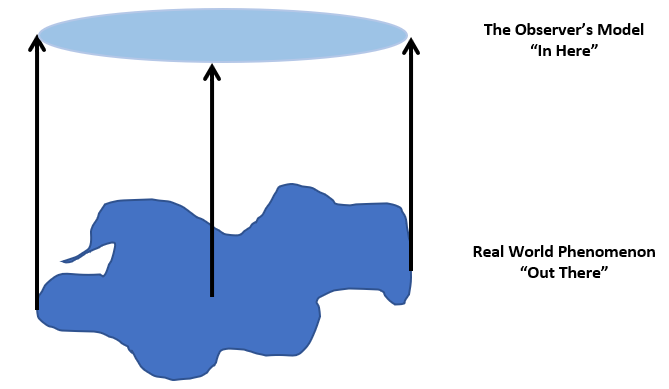
A crude depiction of model-making is shown below. The observer has chosen certain variables that are of interest, and created a similar “looking” version as the model.

Ashby elaborated on this idea as:

We transfer from system to model to lose information. When the quantity of information is small, we usually try to conserve it; but when faced with the excessively large quantities so readily offered by complex systems, we have to learn how to be skillful in shedding it. Here, of course, model-makes are only following in the footsteps of the statisticians, who developed their techniques precisely to make comprehensible the vast quantities of information that might be provided by, say, a national census. “The object of statistical methods, said R. A. Fisher, “is the reduction of data.”

There is an important saying from Alfred Korzybski – the map is not the territory. His point was that we should take the map to be the real thing. An important corollary to this, as a model-maker is:

If the model is the same as the phenomenon it models, it fails to serve its purpose. 

The usefulness of the model is in it being an abstraction. This is mainly due to the observer not being able to handle the excess variety thrown at them. This also answers one part of the question posed in the title of this post – A model ceases to be a model when it is the same as the phenomenon it models. The second part of the answer is that the model has to have some similarities to the phenomenon, and this is entirely dependent on the observer and what they want.

This brings me to the next important point – We can only manage models. We don’t manage the actual phenomenon; we only manage the models of the phenomenon in our heads. The reason being again that we lack the ability to manage the variety thrown at us.

The eminent management cybernetician, Stafford Beer, has the following words of wisdom for us:

Instead of trying to specify it in full detail, you specify it only somewhat. You then ride on the dynamics of the system in the direction you want to go.

To paraphrase Ashby, we need not collect more information than is necessary for the job. We do not need to attempt to trace the whole chain of causes and effects in all its richness, but attempt only to relate controllable causes with ultimate effects.

The final aspect of model-making is to take into consideration the temporary nature of the model. Again, paraphrasing Ashby – We should not assume the system to be absolutely unchanging. We should accept frankly that our models are valid merely until such time as they become obsolete.

Final Words:

We need a model of the phenomenon to manage the phenomenon. And how we model the phenomenon depends upon our ability as the observer to manage variety. We only need to choose certain specific variables that we want. Perhaps, I can explain this further with the deep philosophical question – If a tree falls in a forest and no one is around to hear it, does it make a sound? The answer to a cybernetician should be obvious at this point. Whether there is sound or not depends on the model you have, and if you have any value in the tree falling having a sound.

Please maintain social distance and wear masks. Stay safe and Always keep on learning…

In case you missed it, my last post was The Maximum Entropy Principle:

Storytelling at the Gemba:

SuperVariety

In today’s post, I am looking at storytelling. We are sometimes referred to as Homo Narrans or humans who tell stories. Storytelling, oral or otherwise, is part of our culture, and part of who we are. Joseph Campbell, the American literary professor, talks about the universal nature of all stories in his famous book, The Hero with a Thousand Faces.  Campbell’s thesis, like those of the ancients—and as put forth also, but in different ways, by Freud, Jung, and others—is that by entering and transforming the personal psyche, the surrounding culture, the life of the family, one’s relational work, and other matters of life can be transformed too. Campbell’s ideas have been distilled into the famous Hero’s Journey. Loosely put, this story structure describes a hero who starts off as ordinary, faces adversities, goes through a transformation, and in the end becomes triumphant. I am inspired by Campbell’s work, but I am looking at the ideas I learned in Cybernetics.

Variety:

One of the most important ideas in Cybernetics is that of variety, a brainchild of the brilliant Ross Ashby. Ashby described variety as:

Given a set of elements, its variety is the number of elements that can be distinguished.

For example, if we consider a set of elements in {g b c g g c}, the variety is 3. Another easy example to consider is that of a light switch. A light switch has a variety of two (ON or OFF). Ashby created his most famous Law of Requisite Variety from this simple idea. The Law of Requisite Variety can be simply stated as “only variety can destroy variety.” If the regulatory agency of a system does not have the requisite variety to match the variety of its environment, it will not be able to adapt and survive. Ashby explained this using the example of a fencer:

If a fencer faces an opponent who has various modes of attack available, the fencer must be provided with at least an equal number of modes of defense if the outcome is to have the single value: attacked parried.

How does this come into play with stories? Stories are interesting only if there are conflicts. The villain is shown to have more variety than the hero. This puts the villain in control of the situation because to be in control means to have the appropriate amount of variety over the situation. The hero has to somehow overcome the lack of variety he has. In a superhero movie, if the superhero has more variety than the supervillain, then the story is not at all interesting. Per the Hero’s Journey structure, the superhero has to face adversities to make the story more interesting. This brings up the idea of variety engineering, proposed by another brilliant mind, Stafford Beer.

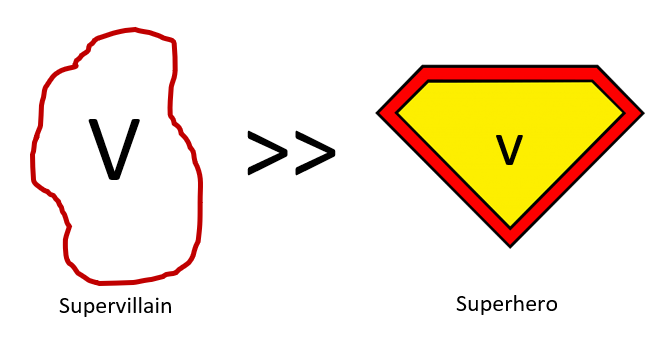
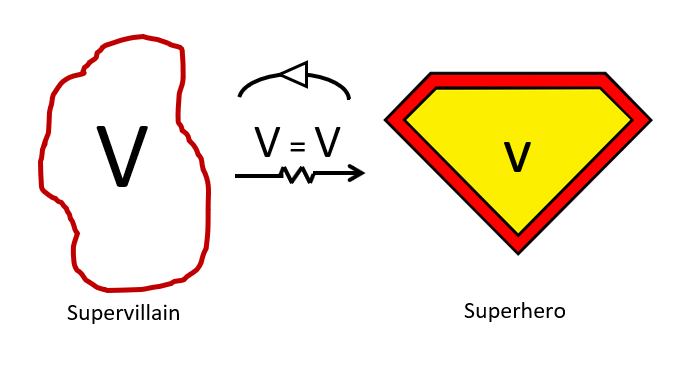
We can depict the varieties as below. The supervillain has much more variety than the superhero. This is shown by the larger font size for “v” depicting the variety. We can see that the variety of the supervillain is much more (>>) than that of the superhero. This is the major adversity that the superhero must overcome. This conflict makes the story interesting.

Hero1

As Stafford Beer might say, the superhero has to find ways to attenuate or reduce the variety of the supervillain, and at the same time find ways to amplify his own variety. This allows him to have the requisite variety to overcome the supervillain. The squiggly line towards right in the schematic below shows the attenuation of the variety coming from the supervillain, while the curved line with the triangle on it shows the amplification of the variety from the superhero. In the below schematic, the varieties are shown to match, as indicated by the same font size for “v” in the middle. This also is an important part of the story since the final fight should not be easy for the superhero. Now we have a good superhero story. The attenuation of the variety may be achieved by not getting scared by the antics shown by the villain. The amplification may be achieved by the use of valuable information that the villain does not have access to, or by coming up with a plan that allows the hero to use his special skill.

Hero2

The same structure can be seen across many of the blockbuster movies or TV shows. The interesting part is always how the variety engineering is done, and how the requisite variety is achieved by the hero, whether it is a Marvel superhero movie or “The Last Kingdom” or “Rick and Morty.”

Role of the Observer:

Ross Ashby gives further insight into this. He brings in the importance of the observer. He noted:

If two observers differ in the distinctions they can make, then they will differ in their estimates of the variety.

An easy example is to consider the set, {b a c c C a B a}. Depending on the observer, the variety of the set can be said as 3 (3 letters) or 5 (3 lowercase letters and 2 uppercase letters). The idea is easily illustrated in a Sherlock Holmes story, where the same crime scene is witnessed by Holmes and Watson. Holmes is able to make more distinctions than Watson, allowing him to achieve the requisite variety needed to solve the crime. One of the most important definitions of information in the light of distinctions come from Gregory Bateson, who described information as the difference that makes the difference. Bateson noted:

What gets onto the map, in fact, is difference, be it a difference in altitude, a difference in vegetation, a difference in population structure, difference in surface, or whatever. Differences are the things that get onto a map.

Bateson’s idea of difference that makes a difference was possibly introduced as part of an Alfred Korzybski lecture. And of course, the observer determines which differences are meaningful to be selected, and which selected differences must be further amplified. Uncertainty can be described as the lack of useful information. With this idea, the observer can reduce uncertainty by making useful distinctions.

Abstractions, an act of attenuating variety, allow an observer to identify that two things are similar, or that the two same things are different. There is no contradiction here because abstractions are not equivalencies. All we have and can have access to are abstractions. Thus, two observers can come to two different conclusions while witnessing the same phenomenon. Both may have some access to the same phenomenon but not to each other’s abstractions. This is exemplified in the Alfred Korzybski’s quote – “The map is not the territory” or the Alan Watts’ quote – “The menu is not the meal.”

We can use a great piece of advice from the German philosopher Hans-Georg Gadamer to further understand variety and uncertainty:

“Reality” always stands in a horizon of desired or feared or, at any rate, still undecided future possibilities. Hence it is always the case that mutually exclusive expectations are aroused, not all of which can be fulfilled. The undecidedness of the future permits such a superfluity of expectations that reality necessarily lags behind them.

From the observer’s standpoint, we realize that the most powerful tool to manage variety becomes the control of information. If one is able to not allow or hinder the other person’s ability to make distinctions, he can control the narrative and be in charge. We see this played out in real life too often.

People Principle:

Another important idea that comes from all of this is that the requisite variety always come from the people on the front, in the midst of facing adversities. We can notate this as:

People Principle: In any organization, the requisite variety always come from the people.

The organizational structures lack the variety needed. The requisite variety is provided as needed by the front-end employees, if they are able to.

Final Words:

“Story can mend, and story can heal.” (Joseph Campbell – The Hero with a Thousand Faces)

We are storytellers. We live and live on in stories. Make yours a good one.

I will finish with excellent advice on tackling writer’s block from one of my favorite storytellers, O. Henry (William Sydney Porter). He puts a nice “Go to the Gemba” touch:

Yes, I get dry spells. Sometimes I can’t turn out a thing for three months. When one of those spells comes on, I quit trying to work and go out and see something of life. You can’t write a story that’s got any life in it by sitting at a writing table and thinking. You’ve got to get out into the streets, into the crowds, talk with people, and feel the rush and throb of real life–that’s the stimulant for a story writer.

For those interested, I have shared some of my really short stories or Flash fiction here.

I also welcome the readers to check out the following posts that are applicable to the topic on hand:

Purpose of a System in Light of VSM:

Exploring The Ashby Space:

OODA Loop at the Gemba: (OODA loop also looks at how preventing the adversary to generate new useful information puts you in control)

Stay safe and Always keep on learning…

In case you missed it, my last post was Hermeneutics at the Gemba: