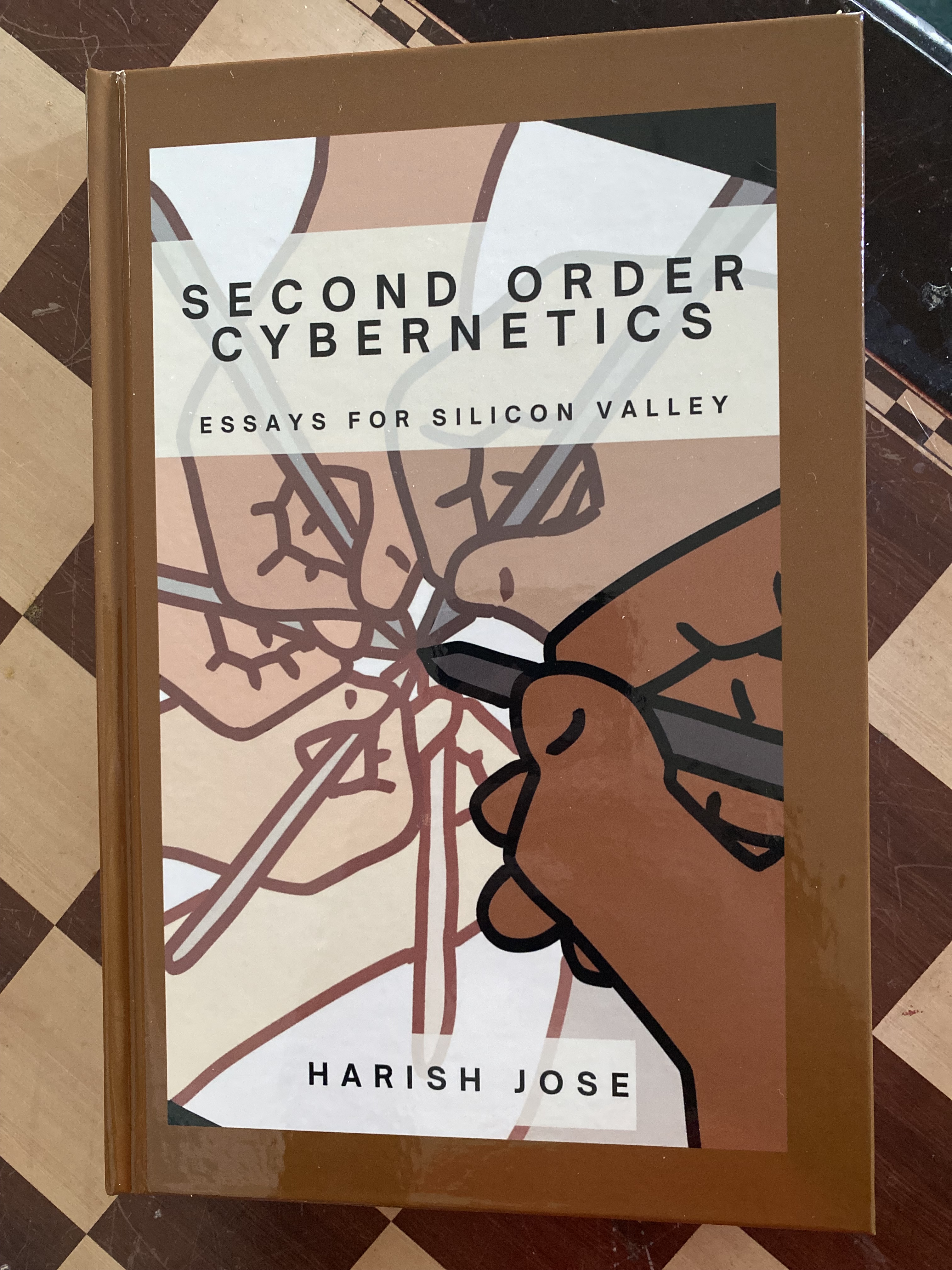
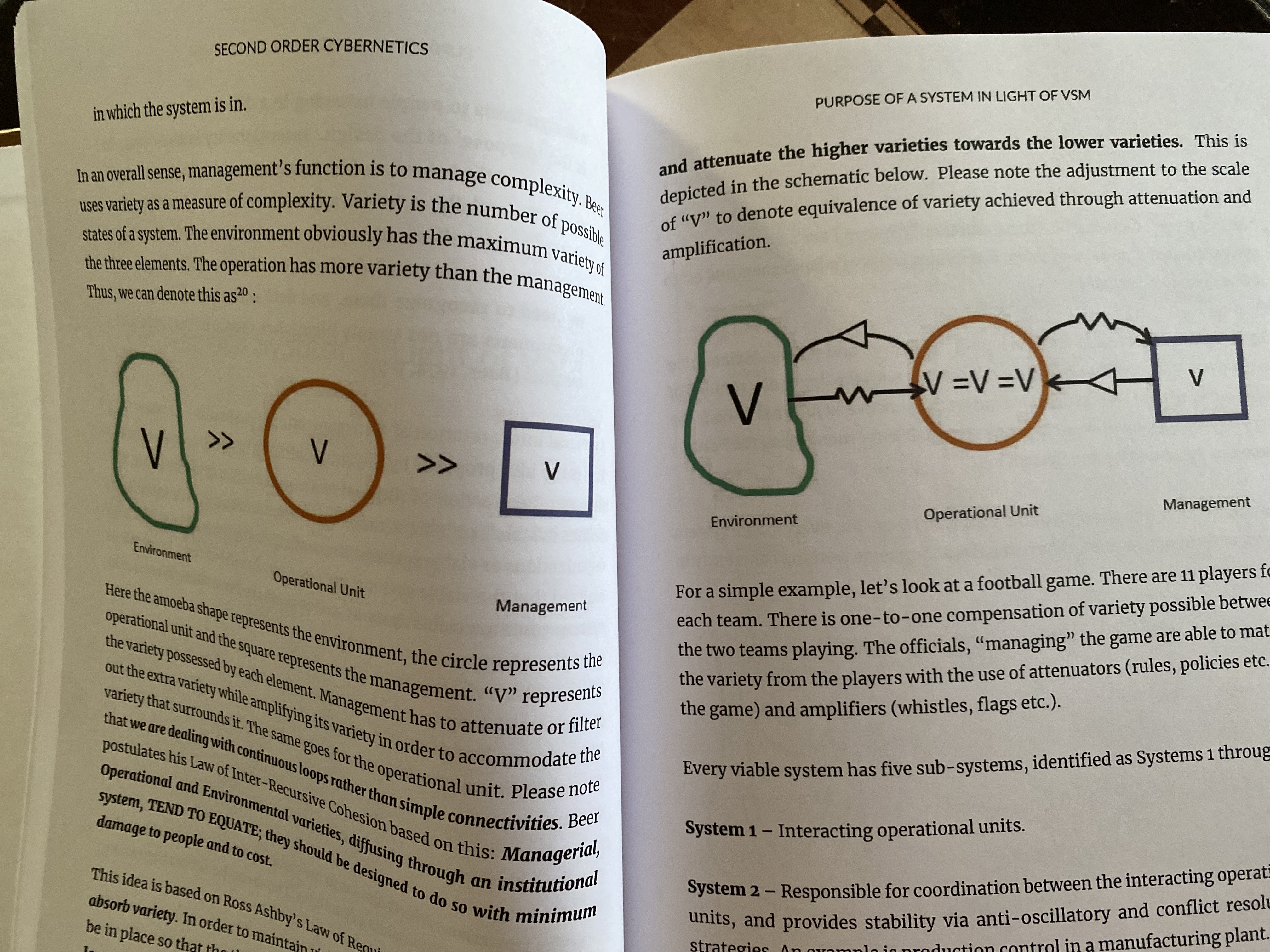
Last month, my first book was published. The book is a collection of essays that was written over the course of five years and covers ideas in second order cybernetics. The book is aptly titled – “Second Order Cybernetics”. The cover art is done by my lovely daughter, Audrey Jose. The book is published by Laksh Raghavan as part of Cyb3rSyn Labs Community offering. The hardcover of the book is available at this link. The hard cover copy is a beautifully typeset deluxe edition. I am thankful for my readers and Laksh for his trust in my ideas.
The venture by Laksh represents a great opportunity to mingle with people from different backgrounds to pursue cross-disciplinary learning in themes such as cybernetics, systems thinking, philosophy, and more. I am excited to be part of this intellectual community and ongoing dialogue.
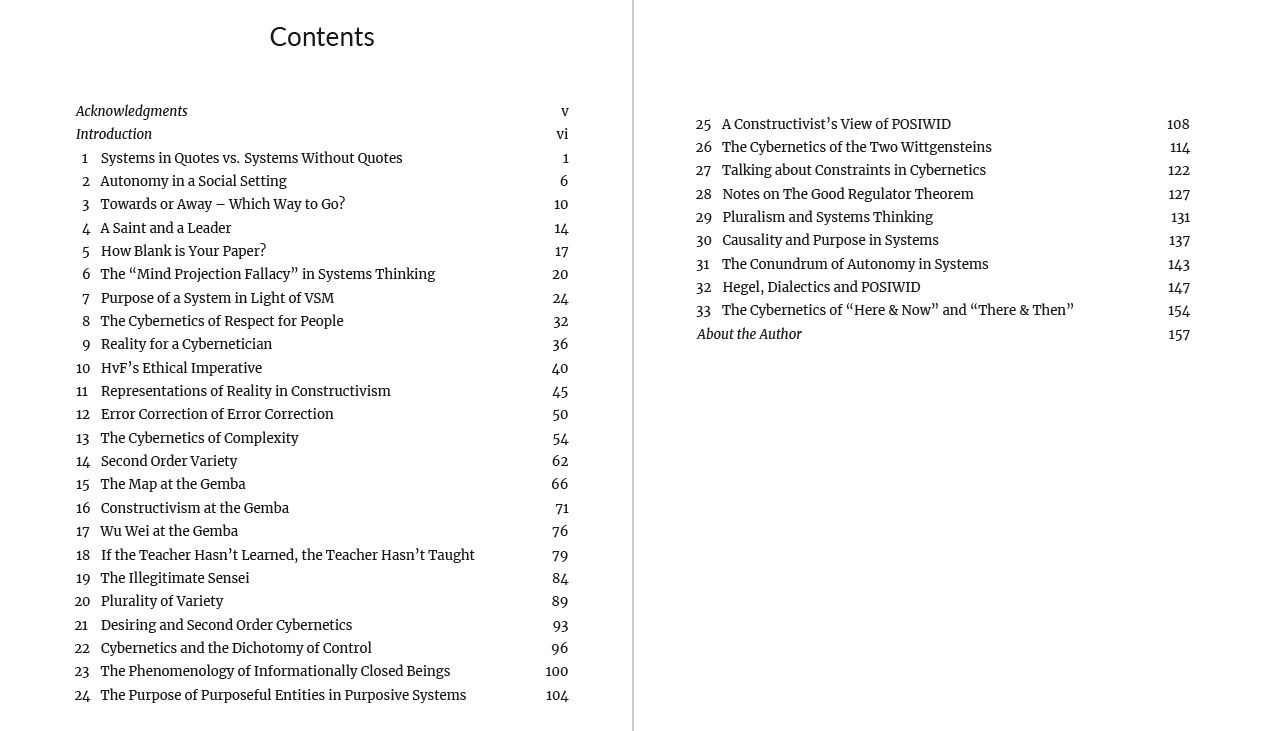
The table of contents of the book is given below:
The Recursive Mirror: Why I Write
I write to make sense of the world and my place in it. Moreover, I write to find myself. Writing gathers my scattered thoughts, helping me wrestle with ideas and shape them into something coherent. It is a way to lay out the pieces of a puzzle, to see where they fit and where they do not. By externalizing my thoughts through writing, I can spot flaws in my thinking, correct errors, and refine my understanding.
I understand that my ideas might be fallible. Writing is a form of error correction, a way to surface hidden assumptions and test them. The act of translating thoughts into words forces me to confront contradictions and gaps in my reasoning. However, error correction does not end with me. By putting my ideas out into the world, I invite others to scrutinize them, to challenge and refine my thinking in ways I might not achieve alone.
Concepts, unlike physical objects, do not reveal their mismatches as easily. You know when an oversized peg will not fit into a hole, but conceptual contradictions and paradoxes linger in cognitive blind spots. Writing becomes a tool to illuminate those hidden contradictions, to test ideas and see if they truly hold. Each iteration of thought, refined through reflection and external feedback, sharpens understanding.
I strive to be able to find differences among apparently similar things and similarities among apparently different things. Writing is my way of exploring those connections, of noticing patterns that might otherwise stay buried. Maturana spoke of “aesthetic seduction“, the idea that we should not seek to convince others but to attract them to our way of seeing. I write not to persuade, but to offer my thoughts as an invitation. As informationally closed entities, readers must convince themselves; my role is simply to present the ideas in their most compelling form.
Baltasar Gracián wrote, “The best skill at cards is knowing when to discard.” [1]Writing teaches me this skill, knowing which ideas to keep and which to let go of. It clears the mental clutter, revealing what truly matters. Error correction itself is recursive, an ongoing cycle of questioning, refining, and discarding what no longer serves understanding.
Ultimately, I write first for myself. It is a way to think, to question, and to grow. And by putting my words out into the world, I open the door for unexpected connections, corrections, and conversations. Writing, then, becomes not just a means of expression but an evolving dialogue; with myself, with others, and with the ever-changing nature of truth. I write so that I can keep learning.
References:
[1] The Art of Worldly Wisdom: A Pocket Oracle. – Baltasar Gracián
In today’s post, I am exploring the notion of efficiency. The emergence of a new government agency in the US focused specifically on efficiency in the public sector intrigues and challenges me as a cybernetician and systems thinker. I want to examine two critical aspects of this concept.
1) The Delicate Balance of Systemic ‘Fat‘:
The first idea aligns with the principle of Lean, which was developed after Toyota’s Production System (TPS). For those curious about my use of “Toyota’s” instead of Toyota, I invite you to check out a previous post.
TPS was developed by Taiichi Ohno. While the name Lean implies “without fat,” Ohno did not advocate for complete elimination of excess. In a previous post, I explained this nuance further. Instead, Ohno understood the critical importance of carefully planned buffers—what might be called “fat”—to ensure production system resilience. The right amount of redundancy becomes an ally—what in Cybernetics is termed as having the “good” kind of variety to manage external world complexity.
When one fails to understand the nuances of a complex network like the public sector, the idea of efficiency becomes dangerous. Managing high levels of complexity requires maintaining variety at the points where the external environment intersects with the system. Most often, this critical information remains opaque at the executive level—where the rubber meets the road. There is no more perilous individual than one who believes they fully comprehend the complexity of the world around us. Variety engineering in Cybernetics offers an excellent approach to navigating these challenges. Improving our understanding of complexity requires humility and adaptability.
2) The Humans in the ‘System’:
The second idea is perhaps the most important of all. A focus on efficiency alone is a dangerous idea. I will lean on the ‘Socrates of Systems Thinking’, Russel Ackoff for this. Ackoff was a brilliant man with wonderful insights. Ackoff believed that one of the main functions of leadership is an aesthetic function. Leadership in his eyes is fundamentally about creating meaning, beauty and possibility, rather than technical efficiency. [1] Efficiency measures resource utilization in a value-neutral manner, while effectiveness weights these resources against the values of achieved outcomes.
In our metrics-driven world, we reduce everything to measurable data—even human experiences become quantifiable units. Ackoff challenged this reductive approach, emphasizing that the value of an action is inherently personal and subjective.
The efficiency of an act can be determined without reference to those affected by it. Not so for effectiveness. It is necessarily personal. The value of an act may be, and usually is, quite different for different individuals.
Every system is fundamentally a human system, created as a mental construct to make sense of our complex world. Complexity itself is not an objective measure, but a perspective shaped by human values and purposes. Wisdom, as Ackoff eloquently explained, requires expanding our consideration of consequences—both in scope and time. It involves consciously inserting values into decision-making, preventing the sacrifice of long-term potential for short-term gains.
He further elaborated on the value-based approach:
Values are the concern of ethics and aesthetics. Therefore, they are necessarily involved in the conversion of efficiency into effectiveness. The production of data, information, knowledge, and understanding are primarily functions of science. The production of wisdom, which presupposes all four, is primarily a function of ethics and aesthetics because it involves the conscious insertion of values into human decision making and evaluation of its outcomes.
Effectiveness is a product of wisdom which enlarges both the range of consequences considered in making a decision and the length of time over which the decision is believed to have possible consequences. By taking long- as well as shortrun consequences into account, wisdom prevents sacrificing the future for the present… Wisdom is required for the effective pursuit of ideals, and therefore is required of leadership. Leaders must also have a creative and recreative role in the pursuit of ideals, and these are aesthetic functions.
The pursuit of effectiveness is an art form—requiring wisdom, empathy, and a profound understanding of human complexity. It demands that we look beyond the numbers, recognize the subjective nature of value, and create systems that serve not just productivity, but human potential. In an age obsessed with efficiency, our greatest leadership skill may be the capacity to see beyond the metrics—to understand that the most meaningful progress is rarely the most measurable.
I will conclude with another memorable quote from Ackoff:
A good deal of the corporate planning I have observed is like a ritual rain dance; it has no effect on the weather that follows, but those who engage in it think it does. Moreover, it seems to me that much of the advice and instruction related to corporate planning is directed at improving the dancing, not the weather.
Always keep on learning.
[1] A Systemic View of Transformational Leadership – Russell L. Ackoff
In today’s post, I am looking at the idea of “sweeping-in” in Systems Approach. “Sweeping-in” can be described as the process of opening up the inquiry of a system by expanding its boundaries. Churchman discussed sweeping-in in several works, including “Thought and Wisdom” [1] and “The Design of Inquiring Systems” [2]. Churchman credited his teacher, E. A. Singer, for the concept of sweeping-in.
The “sweeping-in” process was introduced as a method for incorporating diverse concepts and variables from various sciences to resolve inconsistencies in measurements or observations. Churchman wrote:
the problems we humans face are so closely interconnected so that the only way we can study a system is to recognize the need to be comprehensive. [1]
there are no simple questions and the process of addressing a specific question will eventually require answers to more and more questions, i.e., require the “sweep-in” process. [1]
The sweeping-in process consists of bringing concepts and variables… into the model to overcome inconsistencies… [2]
In Systems Approach, sweeping-in requires us to expand our inquiry to incorporate a wide range of perspectives and variables. It demands that we examine the larger system and understand the ethical implications of our approach. This is a continual process that necessitates a cross-disciplinary approach. When addressing a situation, we must bring in knowledge and perspectives from multiple stakeholders and look at broader contexts. This means looking beyond the immediate problem to understand the larger systems and contexts in which our system exists.
Singer argued against the idea of simple and directly knowable facts from observation. He thought that there are no simple facts of nature that we can know directly, and that even seemingly simple observations are actually complex. In this regard, when we set out to find an answer to any question of fact, we realize that we must learn more and more about the situation. The original question becomes increasingly complicated, not simpler. Singer advocated not trying to reduce observations to simple elements, but instead following a sweeping-in process where our inquiry expands to include more context and interconnected systems.
The sweeping-in process is anti-reductionistic. Churchman explained this when he wrote about the strategies of inquiry [2]:
Which is better, to reduce the system to its elements or to expand the system? A system-science reply would be that since there are no simple, elementary questions, the first strategy is based on illusion and the second is the one to be followed.
The sweeping-in process requires us to embrace the complexity of the situation at hand. This demands epistemic humility. Reality is already complex, which means that our initial framing of the situation is often too narrow, resulting in premature solutions that are not effective and may cause more harm than good in the long run. We may ignore important interactions and relationships, leading to unintended consequences.
Sweeping-in involves examining our current system from the perspective of the larger systems it is part of. This is one of the basic ideas in systems approach – to understand the function of a part, we must look at it from the standpoint of the larger whole. There is a hint of Godelian thinking here. A great example from Russell Ackoff, a renowned Systems Thinker and student and friend of Churchman, is that of the automobile. No matter how much we understand an automobile and its parts, we will never understand why we drive on the right side of the road in the U.S. unless we consider the larger context—the historical, social, and cultural norms that shape American driving practices.
The reader might now wonder about the use of cybernetics in the title of the post. Churchman wrote that sweeping-in is a process of adding in and adjusting the results to improve our understanding of a problem [1]. This is a means to perform error correction in our understanding. This will be a never-ending process since we lack the variety to completely understand the external world.
Sweeping-in cautions against over-simplification. This does not mean that we need to make a situation artificially more complex for the sake of it. As I mentioned before, reality is already complex. We need to acknowledge our limitations and account for enough perspectives and variety to match the variety of the situation at hand. In Cybernetics, complexity is explained via variety. To achieve a requisite understanding of the situation, we need to have requisite variety. One of the most important ideas in cybernetics is Ross Ashby’s law of requisite variety. I welcome the reader to explore this further here.
The complexity that we are “adding” through sweeping-in is not arbitrary. We are attempting to include aspects that are needed but might not have been considered in the initial framing. This could include perspectives from other stakeholders, longer-term consequences, ethical considerations, or the influence of broader contexts such as social, political, or environmental factors.
Our basic instinct is to simplify when faced with situations that seem complex. This process is known as attenuating external variety in cybernetics. While simplification can effectively achieve requisite variety, excessive attenuation signals ignorance, which in cybernetics is referred to as the “lethal attenuator.” Our attempts to simplify can often create blind spots, causing us to overlook less obvious but influential factors. Therefore, sweeping-in serves as a reminder to deliberately resist oversimplification.
Having epistemic humility and being aware of our cognitive blind spots are important notions in second-order cybernetics. Second-order cybernetics reminds us that any system’s functioning includes the observer and their interactions with the system. Here, the feedback loops include the observer as a participant, influencing the dynamics and adding new layers of complexity to the situation. This recursive process highlights the interdependence of the system and the observer, making it illogical to separate the two.
This reflexive approach means that reality is constructed on an ongoing basis through the interaction between the observer and the system. Most importantly, this approach incorporates ethics, one of the key points of Systems Approach, by recognizing that the observer’s involvement in a system carries responsibility. Since observers influence systems and construct reality through their interactions, they must be aware of the consequences of their actions. This promotes a constructivist view, where knowledge and reality are not discovered as objective facts but are constructed through interaction in a social realm. Observers are responsible for the realities they help construct. This practical aspect challenges the implications of relativism. While multiple perspectives may exist, the ethical responsibility of observers grounds our understanding of “truth” and “reality”, emphasizing that our participation in systems has meaningful consequences.
Churchman used the examples of a prison and a hospital to explain the ethical considerations further[1]:
The planner should search not for ways to make the prison or the hospital run more smoothly, but for the reasons why we have things like badly run prisons and hospitals. The reasons turn out to be political, as much as economic; hence, the planner needs to “sweep-in” the causes of the existence of the troubled organization, and these causes like in other systems.
Another notion in sweeping-in is the need for challenging assumptions. Here we should ask questions such as WHO defines the system, WHOSE perspectives are included or excluded, and WHAT ethical considerations should be taken into account etc. The path forward, as advised by Churchman, is to utilize idealistic thinking. We must look at what an ideal solution would look like, not just accepting the current “realities”.
There are no final solutions in this approach, only provisional solutions. There is only continuous feedback and adaptation. This is also an important aspect of second-order cybernetics. The emphasis is on “less wrong” solutions rather than correct solutions. Each action taken informs the next round of understanding and action. Thus, the emphasis is on improving our understanding, or “understanding understanding”, another notion in second-order cybernetics.
Churchman was a pragmatist. From this perspective, the practical payoff comes from improving the depth and quality of decision making by acknowledging our limitations and inherent complexity of the situation. The goal is better informed action. I will finish with a great passage from Churchman that shows his true pragmatist spirit [2]:
When all is going well, and data and hypothesis are mutually compatible, then is the time to rock the boat, upset the apple cart, encourage revolution and dissent. Professors with well-established theories should encourage their students to attack them with equally plausible counter-theories. This is the only pathway to reality: whenever we are confident that we have grasped reality, then begins the new adventure to reveal our illusion and put us back again in the black forest.
But the process is dialectical, which means that two opposing processes are at work… One is the process of defending the status quo, the existing “paradigm” of inquiry, with its established methods, data, and theory. The other is the process of attacking the status quo, proposing radical but forceful paradigms, questioning the quality of the status quo.
Singer… called the “real” an “ideal” and we can see why. The idealist is a restless fellow who sees evil in complacency; he regards the realist as a hypocrite at times because his realism is unrealistic. The realist, on the other hand, accuses the idealist of being impractical, because his insistence on destroying the value of the present way of life precludes positive action. The Singerian inquiring system does not seek to resolve the philosophical dispute, but, on the contrary seeks to intensify it.
Always keep on learning.
[1] Thought and Wisdom, C. West Churchman (1982)
[2] The design of inquiring systems, C. West Churchman (1971)
In today’s post, I am exploring the concept of alethic unfolding, drawing upon ideas from the controversial German philosopher, Martin Heidegger. “Aletheia” is a Greek word often interpreted as truth. Heidegger used it to mean uncovering or unconcealment. In Greek mythology, Aletheia is the goddess of truth. The word originates from “lethe,” which means “concealment” or “forgetfulness.” According to myth, the dead were required to drink from the Lethe river to forget everything about their earthly life. Thus, a-letheia stands for un-covering or un-concealment.
Heidegger employed this word to describe how things are revealed to us in a given context. For instance, when we interact with an object such as a hammer, its properties, previously hidden, become unconcealed to us. These properties are what define a hammer for us. In everyday life, we don’t think about objects theoretically; we simply use them. A hammer makes sense to us as something for hammering, not as an abstract concept.
Another example Heidegger provides is that of a picture hanging askew on a wall. When we encounter the askew picture, its misalignment is uncovered to us. We may not notice the contents of the picture itself, but what becomes apparent is its askewness. This stems from our general understanding that pictures on walls should remain straight. This example also highlights another important aspect of aletheia according to Heidegger – aletheia, or unconcealment, is a happening or an event, not a static phenomenon. Moreover, when something is unconcealed, something else becomes concealed. In the case of the picture, as its askewness is revealed, other aspects such as the content of the picture or the color of the wall recede from our attention.
To expand further on the interplay between concealment and unconcealment in the case of the askew picture, as the misalignment becomes unconcealed, our normal, unthinking relationship with the room becomes concealed. We’re no longer just inhabiting the space; we’re now consciously observing and analyzing it. The functionality of the picture as an artwork or decorative piece becomes concealed as its status as a physical object that can be misaligned comes to the forefront. Our habitual ways of perceiving become unconcealed to us (we realize we expect pictures to be straight), while in normal circumstances, these expectations remain hidden.
We make sense of things through an ongoing interplay of unconcealment and concealment. Finding meaning in this regard is entirely contextual. It is an ongoing process and will always remain incomplete. Reality, in this sense, is a tease. Things are covered and uncovered in a dynamic interplay. This requires us to interact with the phenomenon. It is not an abstract exercise completed from afar, but rather an experiential activity. The phenomenological approach emphasizes that our experience of reality is always from a particular perspective, necessarily limiting what we can perceive at any given moment. Heidegger’s concept of unconcealment suggests that reality is not a static, fully accessible entity, but rather a dynamic process of revealing and concealing.
Heidegger wrote:[1]
The unconcealment of beings (entities) is never a merely existent state, but a happening. Unconcealment (truth) is neither an attribute of factual things in the sense of beings, nor one of propositions.
This quote encapsulates Heidegger’s view of aletheia as an active process of revelation rather than a static state. It emphasizes that unconcealment is a “happening” or an event, highlighting the dynamic nature of the emergence of meaning. Heidegger’s concept suggests that as certain aspects of a phenomenon are revealed (unconcealed), others necessarily recede (become concealed). This ongoing process of revealing and concealing is central to how we understand and interact with the world around us.
Reality, or making sense of reality, for Heidegger has some dependence on the observer and their context surrounding the phenomenon in question. The sense of the phenomenon emerges in the interaction between the observer and the phenomenon. In this sense, reality or depiction of reality requires an observer who provides the context and has practical engagement with the world. Here, reality unfolds itself gradually but not wholly. Heidegger’s view of aletheia as an event challenges us to think beyond traditional notions of truth as correspondence or coherence, and to consider how our understanding of the world is shaped by an ongoing process of revealing and concealing. It’s crucial to understand that for Heidegger, the way we encounter and understand entities is always contextualized within our being-in-the-world. Entities/objects aren’t just neutral, present things, but are enmeshed in a web of significance and practical engagement.
Heidegger didn’t believe we needed an internal “model” of reality in the way cognitive scientists might describe it. Instead, he believed we’re always already involved in the world, making sense of it through our interactions and practical engagements. Reality for Heidegger is not a fixed set of things, but a process of unfolding or revealing. We don’t need an internal “model” of reality; we’re always already involved in the world, understanding it through our practical engagements. Our understanding is shaped by our cultural context and prior experiences. We primarily make sense of things by using them and dealing with them, not by abstract thinking. Heidegger’s view challenges us to think about reality not as something “out there” to be modeled, but as something we’re always already a part of and engaged with. Reality is understood or made sense of in a space of possibilities.
With this, I would like to present the idea of alethic unfolding in Systems Thinking. We have seen that we make sense of the world as a space of possibilities. We interact with the world around us, and reality unfolds to us in a dynamic interplay of concealment and unconcealment. The world discloses differently to different people because reality is multidimensional and dependent on the observer. But this does not mean that anything goes from a relativistic standpoint. It is still weighed down by the actuality of the possibilities from a practical standpoint. This aligns more closely with pragmatic philosophy.
Alethic unfolding is making sense of the world around us as a communal activity. It refers to understanding the world as a process that emerges within specific contexts, rather than merely corresponding to isolated facts. This aligns with the principles of soft systems thinking, where knowledge is collectively constructed through dialogue and collaboration among diverse stakeholders. By acknowledging and integrating multiple perspectives, we can navigate complex human situations more effectively, leading to a richer and more practical understanding of the “system” we engage with.
We can look at an example to further illustrate the idea of alethic unfolding. This will combine Heidegger’s concepts of concealment and unconcealment with systems thinking, focusing on the role of perspectives. We’ll use the example of a city’s transportation system. Imagine a busy urban environment with various modes of transportation such as cars, buses, bicycles, and pedestrians. The alethic unfolding in this context involves the revelation and hiding of different aspects of the transportation system as various perspectives come into play. There are of course more perspectives in play than what is explored here.
1. Car Driver’s Perspective:
– Unconcealment: The efficiency or lack thereof of road networks, traffic flow, and parking availability become apparent.
– Concealment: The experiences of pedestrians, cyclists, and public transport users remain hidden or secondary.
2. Cyclist’s Perspective:
– Unconcealment: The presence (or absence) of bike lanes, air quality, and the physical effort required for commuting come to the forefront.
– Concealment: The concerns of car drivers about parking or long-distance travel fade into the background.
3. Urban Planner’s Perspective:
– Unconcealment: The complexities of their work – interconnectedness of various transportation modes, long-term sustainability, and social equity issues in transportation access are revealed.
– Concealment: Individual daily experiences of commuters might be obscured by numbers and long-term projections of complicated models.
4. Environmental Scientist’s Perspective:
– Unconcealment: The environmental impact of different transportation modes, air quality data, and carbon emissions become prominent.
– Concealment: The economic benefits of certain transportation industries might be less visible.
5. Public Health Official’s Perspective:
– Unconcealment: The health impacts of active transportation (walking, cycling) and air pollution from vehicles come to light.
– Concealment: The economic necessities driving certain transportation choices might be less apparent.
The alethic unfolding occurs as these different perspectives interact and shift. A systems thinking approach might reveal (unconceal) the interconnectedness of these perspectives, showing how changes in one area affect others. For example:
When a city decides to implement more bike lanes, it brings forth (unconceals) the needs of cyclists and environmental concerns. This decision might conceal the preferences of car drivers who lose road space.
A public health campaign highlighting the benefits of walking might unconceal the city’s walkability issues, leading to improvements in pedestrian infrastructure. This could conceal other priorities, like rapid transit development.
In this example, the truth of the city’s transportation system is never fully revealed or fully hidden. Instead, it unfolds through the interplay of different perspectives, each bringing certain aspects to light while obscuring others. This alethic process is ongoing, with new unconcealment leading to new forms of concealment, and vice versa.
The key insight from a systems thinking perspective is that no single viewpoint can capture the entire truth of the transportation system. The “truth” emerges through the dynamic interplay of these various perspectives, constantly shifting between concealment and unconcealment. This alethic unfolding helps us understand the complexity of the system and the importance of considering multiple viewpoints in decision-making and analysis.
Always keep on learning.
[1] The Origin of the Work of Art, Martin Heidegger (1950)
I have been revisiting Churchman’s writings on Systems Thinking recently. In today’s post, I am looking at his book, The Systems Approach. It is a wonderful book that examines the systems approach from multiple viewpoints and walks the reader through Churchman’s thinking on the subject. Churchman was heavily inspired by philosophy and was considered to be a pragmatist. This shows up in his writings.
He notes that:
Systems are made up of sets of components that work together for the overall objective of the whole. The systems approach is simply a way of thinking about these total systems and their components.
He notes that there are several systems approaches. He considered four such advocates to these approaches.
The advocates of efficiency – they claim that the best approach to a system is to identify the trouble spots, and especially the places where there is waste, e.g., unnecessarily high costs, and then proceed to remove the inefficiency.
The advocates of the use of science in approaching a system – they claim that there is an objective way to look at a system and to build a “model” of the system that describes how it works. The science that is used is sometimes mathematics, sometime economics, sometimes “behavioral”.
The advocates of the use of human feelings, i.e., the humanists – they claim that systems are people, and the fundamental approach to systems consists of first looking at the human values; freedom, dignity, privacy. Above all, they say the systems approach should avoid imposing plans, i.e., intervention of any kind.
The anti-planners – who believe that any attempt to lay out specific and “rational” plans is either foolish or dangerous or downright evil. The correct “approach” to systems is to live in them, to reach in terms of one’s experience, and not to try to change them by means of some grandiose scheme or mathematical model. Most of them believe that experience and cleverness are hallmarks of good management.
In the following chapters, Churchman discusses the problems with these approaches.
In one of the chapters, Churchman utilizes the age-old story of the group of blind men and an elephant to slowly poke holes in the idea of systems thinking itself. He noted:
There is a story often told in logic texts about a group of blind mean who are assigned the task of describing an elephant. Because each blind man was located at a different part of the body, a horrendous argument arose in which each claimed to have a completed understanding of the total elephantine system.
What is interesting about this story is not so much the fate of the blind men but the magnificent role that the teller had given himself – namely, the ability to see the whole elephant and consequently observe the ridiculous behaviors of the blind systems describers. The story is in fact a piece of arrogance. It assumes that a very logically astute wise man can always get on top of a situation, so to speak, and look at the foolishness of people who are incapable of seeing the whole.
Churchman challenges the whole notion of what is meant by a system, and what is considered to be its parts, environment, and objectives. He challenges the notion of how we claim to measure the performance of a system. One example he gives is that of a medical laboratory that tests specimens which doctors send in. He asks – what is the objective of the laboratory? He states that the obvious answer might be to make the test results as accurate as possible. Then he points out that the test results being accurate may not actually improve the accuracy of the doctor’s diagnosis. Another example he gives is that of a student trying to achieve the highest grade possible in a course as if the measure of that system’s performance is the grade achieved. He points out that their stated purpose is to learn, but their real measure of performance is the grade.
Churchman also challenges the notion of environment for a system. The environment of the system is what lies “outside” of the system. This also is no easy matter to determine. When we look at an automobile we can make a first stab at estimating what’s inside the automobile and what’s outside of it. We feel like saying what lies beyond the paint job is the environment of the automobile. But is this correct? Is it correct to say, for example, that what lies beyond the paint job of a factory is necessarily outside of the factory as a system? The factory may have agents in all parts of the country who are purchasing raw materials or selling its products. These are surely “part” of the total system of the factory, and yet they are not usually within its walls. In a more subtle case, the managers of the factor may belong to various political organizations through which they are capable of exerting various kinds of political pressures. Their political activities in this case certainly “belong” to the system, although again they hardly take place within the “shell” of the system. And, returning to the automobile and considering what it is used for, we can doubt whether its paint is the real boundary of its system.
In the book, Churchman wisely notes that we are deceived by our ideas of the system. We come to believe that what we perceive is the reality and get deceived by our model of the system. But these models seldom capture the basic human values. These models also deceive us by hiding our own inability to truly understand all the aspects of what we call a system, and the complexity of its internal politics. At the same time, Churchman also remarks that each of these solutions may also make improvements. He notes:
And yet when one looks at the solution and sees its wrongness, one is also deceived, because, in searching for the wrongness, one misses the progressive aspect of the solution. We have to say that the advocate of the solution both deceives and perceives. We have to say that the solution is ridiculous and serious. We have to maintain the contradiction or else we allow ourselves to be overwhelmed by the consistent.
The ultimate meaning of the systems approach, therefore, lies in the creation of a theory of deception and in a fuller understanding of the ways in which the human being can be deceived about his world and in an interaction between these different viewpoints… What is in the nature of systems is a continuing perception and deception, a continuing re-viewing of the world, of the whole system, and of its components. The essence of the systems approach, therefore, is confusion as well as enlightenment.
With this, Churchman parts us with his four principles for his systems approach:
The systems approach begins when first you see the world through the eyes of another.
The systems approach goes on to discovering that every world view is terribly restricted.
There are no experts in the systems approach.
The systems approach is not a bad idea.
Churchman is asking us to welcome multiple perspectives. Our notion of the system is provisional. So is everyone else’s. It is based on our worldviews and value systems. When we blame the system, we engage in a fictional undertaking. What we call a system is entirely our creation and is very limited. Every system is based on a terribly restricted worldview. There are no experts who can see the whole and “fix” the system. There is no whole system since every system is embedded in an even larger system. Even with all this, the systems approach is not a bad idea. We need to utilize empathy and perspective-taking when it comes to the systems approach. We need to have epistemic humility by understanding that our viewpoints are limited. Churchman’s ideas promote a humble, inclusive, and multifaceted approach to understanding and addressing complex problems. He wanted ethics to be an important part of systems approach.
In today’s post, I will explore Systems Thinking from a pragmatist viewpoint. I will draw on the ideas of the great American pioneer pragmatist philosopher, C. S. Peirce and the pragmatist systems thinker, Charles West Churchman.
Pragmatism can be viewed as a push against the idea that there are fundamental, unchanging “Truths”. Pragmatism emphasizes experience and observable consequences rather than abstract notions of certainty. There is a hint of utilitarianism in pragmatism in that both philosophies prioritize practical outcomes and the consequences of actions as measures of value. Perhaps, one of the attractive notions in pragmatism is the idea of fallibilism, the view that any claim to knowledge could be mistaken and therefore, we need a means for error correction. This is mostly achieved in the form of social consensus. In this regard, pragmatism also supports the idea of pluralism, the recognition that there may be multiple valid ways of seeing a phenomenon or approaching a phenomenon.
As Philip Campbell noted [1]:
Pragmatism is the proposal that the value and meaning of any concept is the set of its possible effects… If a concept has no possible effects, then it has no value and no meaning. If two concepts have the same set of possible effects, then the two concepts are the same… Pragmatism is utilitarianism with long-range goals.
This idea brings up a core maxim in pragmatism that is attributed to Peirce. This is called the “pragmatic maxim”. The maxim basically states that to further our understanding of a concept or a thing, we need to also understand the practical consequences to us of that concept or thing. Peirce noted in 1878 essay, “How to Make Our Ideas Clear?” [2]:
If one can define accurately all the conceivable experimental phenomena which the affirmation or denial of a concept could imply, one will have therein a complete definition of the concept, and there is absolutely nothing more in it.
In that essay, Peirce presented three grades of clarity for a concept. Loosely put, they are in the increasing order:
The user has a general familiarity with the concept.
The user can provide a working definition for the concept.
The user knows the conceivable practical effects of the concept.
The last step focuses on the pragmatic maxim. Peirce argued that to fully understand an idea, we must examine what experiences or actions it would lead to if it were true. Peirce gave the example of the concept of hardness to explain this. We have a general understanding that a rock is hard, while a pillow is not hard (soft). This allows us to define hardness as the ability to withstand deformation. Therefore, we realize that a hard object resists deformation and can be used to deform relatively softer objects.
Peirce’s maxim teaches us that understanding a concept is not fully developed until we grasp its practical consequences and how it influences our interactions and expectations in the world. In other words, the meaning of an idea is linked to its practical effects. In social contexts, this introduces the notion of pluralism. Different individuals can interpret a concept based on their unique perspectives and worldviews, all of which can be valid. In this sense, knowledge becomes provisional and always evolving. Pragmatism encourages epistemic humility, as well as continuous inquiry and revision of beliefs. Truth is multifaceted and shaped by multiple contexts and practical consequences. This represents a soft view on the complexities of truth rather than a dogmatic hard view.
With this background, let us look at the idea of a system. A “system” is generally construed as a collection of interconnected parts working together to represent a whole. This leads to the common notion that systems are real and present everywhere and can be fixed or changed to achieve a desired outcome. This type of thinking is based on faulty pretense that whole system can be modeled accurately to represent the complex situation. They might argue that the outcomes of the systems can be designed, and their view is the accurate representation. As David Matthews wrote [3]:
Undoubtedly, the early systems theorists were uncritically committed to both foundationalism and representationalism. They aimed to produce models that corresponded with reality (representationalism) and, moreover, assumed that it was feasible to justify the outcomes of their studies by claiming to always model the ‘whole system’ (foundationalism).
It is here that we can introduce Charles West Churchman. At heart, Churchman was a pragmatist who challenged the notion of the hard systems approach. He did not see that the boundaries of a system are given by the structure of reality in favor of a pragmatic understanding that what is ‘given’ and what is ‘constructed’ are irreducibly intertwined. The system became a constructed notion to represent a phenomenon based on multiple perspectives and value systems. Matthews continued:
Accordingly, traditional distinctions between subject and object (and for that matter ontology and epistemology) are undone and boundary definition becomes an issue not of systems modelling but of practical philosophy. That is, it becomes an ethical issue. Something that appears to be an improvement from a narrow point of view may not be seen as such if the boundaries are extended or arranged in a different way. According to Churchman, systems approaches too often have us analyze ‘the problem’ as if it represented the total system.
Multiple perspectives stem from the pluralistic approach in pragmatism. This means there is not one representation of what a system means; the meaning can change depending on who the participant is. This highlights the importance of ethics in systems thinking. My narrow view of what a system should do and what the outcomes should be may not align with another participant’s perspective. For example, what a transportation system means to a train driver can differ significantly from what it means to a passenger. Each participant has their own perspectives and cultural nuances that can drastically affect practical consequences. To understand what the system is, we must consider these different perspectives. Churchman’s famous maxim states that a systems approach begins when first you see the world through the eyes of another.
Churchman also teaches us that if we come to view our own version of system as the correct one, we are deceiving ourselves. We may not be aware of our cognitive biases and other blind spots. He wrote, the ultimate meaning of the systems approach, therefore, lies in the creation of a theory of deception and in a fuller understanding of the ways in which the human being can be deceived about his world.
His systems approach was rooted in pragmatism. He advocated listening to our ‘enemies’ so that we can challenge our own assumptions. Matthews noted that he suggested pitting alternative options (based on alternative a priori metaphysical assumptions) against each other. By listening to the arguments of our ‘enemies’ we become aware of the assumptions in our own thinking and both are better for it.
Churchman’s Social System Design aimed at ‘surfacing’ the implicit worldviews (a priori assumptions) of the systems designer and/or decision maker. Once these assumptions are brought to the surface an alternative set of assumptions are developed. From this alternative set, different proposals (courses of action, decisions, systems designs etc.) are derived that, because of their different foundational assumptions, challenged the former ones. The aim is to develop a more critical understanding of the complex problem (or system) by seeing aspects of the problem that would have remained hidden by the uncritical implementation of policy founded on a single worldview.
In my view, the core maxim of systems thinking is same as the pragmatic maxim. To understand the system, we should grasp its practical consequences. In social contexts, there are multiple participants and, therefore, multiple perspectives on what the system is and what they desire from it. What a system does is emergent and contextually dependent. We should not seek to optimize without first understanding the pluralistic nature of the system and its practical consequences.
I will end with a quote from one of Churchman’s students, Werner Ulrich:
It is not the reality ‘out there’ that determines the boundary between the system and the environment, but rather the inquirers standpoint, the purpose of his mapping effort, his personal preconceptions of the reality to be mapped and the values he associates with it.
Always keep on learning…
[1] Peirce, Pragmatism, and The Right Way of Thinking, Philip L. Campbell, Sandia Report
[2] How to Make Our Ideas Clear?, Charles Sanders Peirce
[3] Pragmatism Meets Systems Thinking: The Legacy of C. West Churchman, David Matthews
One of the common expressions depicting holistic thinking is – “the whole is larger/greater than the sum of its parts.” In today’s post I would like to look at this expression from a few different perspectives.
Kurt Koffka:
Kurt Koffka (1886 – 1941), the brilliant Gestalt psychologist said, “the whole is other than the sum of its parts.” Koffka was adamant to not misstate him as the whole being larger than the sum of its parts. He was pointing out that the whole is not merely an addition of parts, and that the whole has a separate existence. We humans tend to organize our percepts into wholes. Our mental shortcuts first make us see the whole, rather than the parts. The term “gestalt” itself refers to form or pattern. We are prone to identifying larger patterns from partial data.
Andras Angyal:
Andras Angyal (1902 – 1960) was an American psychiatrist and a Systems Theorist. He emphasized the importance of positional values of parts within a system. He did not view the whole being more than the sum of its parts.
Summation, however, is not organization, but it is of little help simply to say that a system is more than the sum of its parts…“A system is a distribution of constituents with positional values in a dimensional domain.” Functional relationship is the key concept of the reductive approach. For a systems approach a different concept, such as that of positional value, is required which expresses arrangement and compels reference of the parts back to the whole. The value of parts is what they do for the whole. Their function is its maintenance. Only a whole maintained in this way can relate to an environment. To make possible relations with an environment is the function of the whole.
An easy example is to put together three sticks of different lengths. The order of the sticks does not matter for the total length of the three sticks put together. For contrast, let’s look at a car. For a car, the positional value or the order of the parts are of utmost importance. They have to go together in a specific manner for the car to be a car.
Edgar Morin:
Edgar Morin, the brilliant French philosopher says that “the whole is less than the sum of its parts.” This is a powerful statement. The parts lose its freedom when it is constrained to be in a specific form of organization. The whole is more constrained, or has less freedom than the sum of freedoms of the parts put together. The parts give up some of its properties when it organizes to be a whole. At the same time, the whole is also more than the sum of its parts. Morin says:
In order to understand the apparent contradiction of a whole that is simultaneously more and less than the sum of its parts, I claim the heritage of the Greek philosopher Heraclitus, from the 6th century BC: when you reach a contradiction, it doesn’t necessarily mean an error, but rather that you have touched on a fundamental problem. Therefore, I believe that these contradictions should be recognized and upheld, rather than circumvented.
Additionally, Morin stated:
The whole is greater than the sum of the parts (a principle which is widely acknowledged and intuitively recognized at all macroscopic levels), since a macro-unity arises at the level of the whole, along with emergent phenomena, i.e., new qualities or properties.
The whole is less than the sum of the parts, since some of the qualities or properties of the parts are inhibited or suppressed altogether under the influence of the constraints resulting from the organization of the whole.
The whole is greater than the whole, since the whole as a whole affects the parts retroactively, while the parts in turn retroactively affect the whole (in other words, the whole is more than a global entity-it has a dynamic organization).
Morin had strong words about just using holism:
Holism is a partial, one-dimensional, and simplifying vision of the whole. It reduces all other system-related ideas to the idea of totality, whereas it should be a question of confluence. Holism thus arises from the paradigm of simplification (or reduction of the complex to a master-concept or master-category).
Final Words:
The idea that the whole is different or other than the sum of its parts is a different way of thinking. Holism can be as limiting as reductionism. One might say that thinking in terms of wholes is very much thinking in terms of parts since the whole can be construed to be a part of a larger system. The emphasis is on the observer and the purpose that the observer has with the specific perspective that he or she is taking. All humans are purposeful creatures. What one observes, depends upon the properties of the observer. This also means that the other observers, the cocreators or the participants in the system, have their own purposes. We cannot stipulate the purpose(s) for a fellow being. To paraphrase West Churchman, systems thinking begins when one sees through the eyes of another.
The idea that the whole is more important than the part should be challenged, especially when it comes to human systems. All human systems are in a delicate balance with each other, which can tip one way or the other based on emerging attractors. The individual strives for autonomy, while the larger human systems the individual is part of, strive for homonomy. One should not ignore the other.
I will finish with another lesson from Morin:
The parts are at once less and greater than the parts. The most remarkable emergent phenomena within a highly complex system, such as human society, occur not only at the level of the whole (society), but also at the level of the individuals (even especially at that level-witness the fact that self-consciousness only emerges in individuals). In this sense: The parts are sometimes greater than the whole. As Stafford Beer has noted: “[T]he most profitable control system for the parts does not exclude the bankruptcy of the whole.” “Progress” does not necessarily consist in the construction of larger and larger wholes; on the contrary, it may lie in the freedom and independence of small components. The richness of the universe is not found in its dissipative totality, but in the small reflexive entities-the deviant and peripheral units-which have self-assembled within it…
In today’s post, I will be looking at automation. Stephen Hawking, perhaps the most famous Scientist alive today, warned us about automation and Artificial Intelligence (AI) in his column on The Guardian. He said;
The automation of factories has already decimated jobs in traditional manufacturing, and the rise of artificial intelligence is likely to extend this job destruction deep into the middle classes, with only the most caring, creative or supervisory roles remaining.
Bill Gates recently talked about the concept of taxing robots who are taking away the manufacturing jobs. Interestingly, these concerns are not new. Lillian Gilbreth talked about “The Human Side of Automation” in a 1957 speech at the Society of Women Engineers National Convention. She put forth the need to evaluate the responsibilities of the engineers doing the automation. She advised relying on the scientific method and ethics, and proposed adding “human resources” to the definition of automation. Her concept of automation is about the removal of “drudgery” from work. However, she warned that there are different ways someone views what drudgery is.
In my mind, the main question that needs to be answered is the effectiveness of automation. The aspect of making a job easier to do is part of continuous improvement activities. Frederick Taylor, often cited as the father of Scientific Management, changed the manufacturing world by pushing the concept of finding the one standard way of doing the job. He pushed the concept of time and motion studies with the help of the Gilbreths. The wasted motions were eliminated and this surged the productivity in the plants. The pursuit of wasted motions is as valid today as it was back when Taylorism was around. The consequences of Taylorism were the focus on only efficiency and the reliance on a small group of experts, which paved the way to mass manufacturing with the assembly lines. The “experts” designed the manufacturing floors and the work, sometimes with minimal input from the operators. This continued until, Toyota came into the picture with the ideas of Toyota Production System. Toyota also pursued efficiency; however they realized the lessons of Lillian Gilbreth as well. The employees are invaluable resources, and they focused on the Thinking Production System (TPS) where the employees were asked to bring not only their pairs of hands but also their brains. The Toyota Way, Toyota’s attempt to codify the implicit knowledge, was written with the two pillars of Toyota as “Continuous Improvement” and “Respect for People”. Unfortunately, when TPS was reinterpreted as Lean, sometimes the focus was put back on efficiency alone which led to the pejorative definition of LEAN as “Less Employees Are Needed” or what Mark Graban calls as LAME. Lillian Gilbreth, in her 1957 speech advises us to keep this in mind when improvement activities are performed – What happens to the employees? This impacts the company culture.
Russell Ackoff, the great American Systems Thinker, when talking about Toyota asked an important question about effectiveness. He asked why the focus is not on improving the environment since cars can cause pollution. This is the big picture question. Toyota has been working on zero emissions and recently launched Mirai, which is a hydrogen fuel cell vehicle. The question of effectiveness is about the betterment of human kind.
Automation can replace only those portions of the jobs which are ordered or complicated – which means there are strong cause and effect relationships, and have repeatable operations. This is almost as if following a script- if this happens, then do this. Automation cannot handle complexity at this point in time. In Complex situations, there are no straightforward cause and effect relationships. Every situation is unique. Artificial Intelligence has not been able to make strides in these areas. The concept of efficiency is strong in complicated regions and the concept of effectiveness is strong in the complex regions. Creativity and continuous improvement are not repeatable activities. A robot with a melted candy bar in its pocket next to a magnetron cannot invent the next microwave oven, at least not yet.
The push for automation can again put us back into the mass manufacturing era. We can start making things for the sake of not keeping the robot idle. We can start making things that people do not want to purchase. We can keep making the wrong things. The push for automation for the sake of cost reduction which leads to loss of jobs is not pursuing effectiveness. There is no easy answer to this. We do need automation to replace “drudgery”. However, the betterment of humanity must be the focus at all times.
I will finish off with a story that Mrs. Lillian Gilbreth told in her speech;
Lillian was at a factory with her husband Frank. Frank had arranged for a trolley to move the iron back and forth so that the woman operator did not have not to do any heavy lifting. Frank asked the operator, “Mary, how do you do like this nice little trolley I made for your iron?”
The operator looked at him straight in the eyes and asked, “Do you really want me to tell you?”
Lillian knew the answer was not going to be good and wanted to move on. But Frank persisted for an answer.
Mary said, “Well, I think it is the work of a big, fat, lazy man.”
Lillian concluded in her speech that by creating the trolley, Frank had taken away all the satisfaction from Mary’s work. Mary was the only one strong enough to do what she did and she took pride in what she did. Now it was a job anybody could do. Lillian also noted that they should have been “intelligent” enough to notice that what seemed drudgery to them was not necessarily the case to Mary. They should had asked for input and better defined what drudgery actually was.
In today’s post, I will be looking at Entropy in the Manufacturing world. Entropy is generally defined as disorder. This general definition can sometimes be inadequate. Let’s look at the example of a desk in an office; One could say that if the desk appears to be in order (neat and tidy), then it has low entropy. However, the concept of orderliness is very subjective. Entropy can be referred to as the measure of disorderliness. To me, if I am able to know where everything is, and I can access each item quickly, then my desk has low entropy. It may not seem “ordered” to an outsider, and he may conclude that my desk has high entropy. The second law of Thermodynamics can be loosely stated as – the entropy always increases. Thus, a desk will always get messier. There is a probability aspect to entropy. There are many different ways the things on my desk can be arranged, and only a very small number of those arrangements can be concluded as “ordered”. There is a multitude of more ways a desk can be seen more disorderly than the small number of ways it can be seen as orderly. Thus, from a probability standpoint, it is always likely that a desk is messy unless there is a consistent process in place to keep it back to the “ordered” state at frequent intervals. This line of thinking also shows that the more things you have on your desk, your desk is always most likely to be in a state of “messiness”. Interestingly, 5S in Lean requires you to limit the number of items in an area to only those items that are needed. All of the extra items are encouraged to be removed.
Entropy can also be explained in terms of the element of surprise. For example, a brand new deck of playing cards in order has low entropy because one knows exactly where every card is. There is minimal element of surprise. If one were to riffle shuffle the cards once, there is still some form or order maintained in the cards. For example, the order of the cards from Ace to King is not disturbed. There may be some different cards in between, but the Three of Hearts is still above Four of Hearts, even though there may be other suit cards in between them. This concept is known to magicians and used in several magic tricks. When the cards are shuffled again and again, the knowledge of any form of order is lost, and the entropy thus increases. With a good shuffled deck of cards, any card presents an element of surprise – new information. With the same logic used in the previous paragraph, it is very unlikely that continuous shuffling will bring a deck back to the original new deck order. There is always more ways for the deck to be in a different order than a new deck order. In the new deck order, if you are required to produce the King of Hearts, it is simple to do it since you know the order of the cards. You can do this fairly quickly. However, when the deck is shuffled, this becomes harder. You will need more time to look through every single card until you get to the King of Hearts. Although it is not exactly the same, it is stated that as entropy increases, it causes decaying of energy. In other words, the useable energy becomes less and less. Thus if one were to put the concept of value with regards to entropy, one could say that high entropy states do not yield value. Jeremy Campbell, in his wonderful book “Grammatical Man” states;
“At the heart of the second law (of Thermodynamics) is the insight has order has value.”
From this light, one can understand the need to maintain order in the manufacturing plant. The management strives to maintain low entropy within the manufacturing system, and they surely do not appreciate elements of surprises. From their viewpoint, painting all cars black does make sense. Producing the same item in big numbers using the principles of mass manufacturing is an attractive proposition for management. More number of products and components bring disorder and increase in entropy. Thus minimizing the variety of products manufactured also will be an attractive proposition for management.
However, the world has become smaller globally, and the market is asking for variety. From a Complexity Science standpoint, one can say that the manufacturing processes are ordered or complicated. There are good cause and effect relationships, and these can be easily controlled. However, the complexity outside a manufacturing plant is increasing with the advent of the information age. A manufacturer in China can sell his goods in America, and vice-versa easier. The demand for variety from the market is increasing and the manufacturer cannot make only black cars anymore to stay in business.
The management has to realize that the organizations are not technical systems, but sociotechnical systems. When you treat an organization as a technical system you assume that direct, linear cause and effect relationships exist, and that it is able to control the system through hierarchy. The most important requirement in this case becomes to minimize entropy. Entropy has a negative relationship with efficiency in mechanical (technical) systems. The goal of a sociotechnical system is not primarily to lower the entropy at all times. Complexity lies between low entropy and high entropy. Complex problems require complex dynamic solutions. Organizations should become complex adaptive systems and be able to move between phases in order to thrive. “Everything changes” is the reality, and thus the organization should be able to change and adapt the actions to meet the needs posed by the environment. The idea of order implies a state of permanence. The organization has to go through phases of permanence and impermanence to be able to thrive. Analogically, this is similar to the idea of kaizen in the Toyota Production System, where kaizen requires standards. Kaizen, the idea of change to improve, requires order (standards). This is also the going back and forth between permanence and impermanence. In the complex world today, nothing should be set in stone.
I will finish with a wonderful lesson from Shunryū Suzuki-roshi;
“Suzuki Roshi, I’ve been listening to your lectures for years,” a student said during the question and answer session following a lecture, “but I just don’t understand. Could you just please put it in a nutshell? Can you reduce Buddhism to one phrase?”
Everyone laughed. Suzuki laughed.
“Everything changes,” he said. Then he asked for another question.
The world of Systems is very wide and deep. This article does not claim to be perfect and all encompassing. The goal of this article is to emphasize that solutions based on incomplete models lead to incomplete solutions. I am not calling it incorrect solution- just incomplete solution. Every problem model is a mental construct. Unfortunately, this means that the problem “reality” and the problem “model” are not identical. The mental construct of the problem model depends very much on the person constructing the model. This is impacted by his mental models, heuristics, knowledge, wisdom and biases. This leads to what I am calling “the Incomplete Solution”.
The system model must be as close to the actual system as possible. The problem model must be as close to the actual problem as possible. However, this cannot be done. Thus the problem model is an incomplete construct. Furthermore, the solution must match the problem construct. Thus the solution derived from the incomplete problem model is also incomplete.
The concept that a model of the system is required before regulating it comes from Conant and Ashby who said;
“Every good regulator must be a model of that system.”
They identified thatany regulator that is maximally both successful and simple must be isomorphic with the system being regulated. Making a model is thus necessary.Daniel L. Scholten has stated this in terms of problem and solution as;
“Every Good Solution Must be a Model of the Problem it Solves.”
And
“Every Good Key Must Be A Model Of The Lock It Opens.”
However, humans are terrible at creating accurate models of systems due to limitations of the mental capabilities. This idea was put forward by Herb Simon, the great American thinker who won Nobel Prize for Economics in 1978, with the concept of “Bounded Rationality”. Wikipedia currently defines “Bounded Rationality” as the idea that when individuals make decisions, their rationality is limited by the tractability of the decision problem, the cognitive limitations of their minds, and the time available to make the decision. The complete knowledge of all the details, and the consequences of the actions cannot be known. This indicates that a mental construct of a system is incomplete.
This concept is further echoed by the American statistician George Box who stated in the proceedings of a 1978 statistics workshop;
“All models are wrong but some are useful”.
And
“Remember that all models are wrong; the practical question is how wrong do they have to be to not be useful.”
The notion of “cause and effect” is paramount in the problem solving process. However, this idea cannot be as simple as that. One can use the idea of “cause and effect” to determine the complexity of the system. In an ordered system, the cause and effect is direct, and thus a problem statement is very straightforward. For example, turning the switch does not turn the light on, because the bulb is burned out. Replacing the bulb thus solves the problem.
In a complicated system, there are more layers and the cause and effect relationship is not straightforward. However, with the help of experts and solid problem solving processes, a good solution can be found. There will be several solutions that can work. The ordered and complicated systems use the approach of hard systems. They are deterministic in nature. An example of the complicated system might be the entire electrical wiring in a house. The cause and effect relationship may not be direct for inexperienced, but it can be established. In some regards, in the manufacturing world the processes are dealt as ordered or complicated, and there is a desire for high predictability from their operations.
In a complex system, there are several interwoven parts that make the cause and effect relationships murky. There are definitely no linear cause and effect relationships. Here the hard systems approach cannot be used. Moreover, the problem(s) in a complex system might be messes. One problem is most likely linked to other problems. Russell Ackoff, the great American Systems Thinker called this a mess. Ackoff said;
Managers are not confronted with problems that are independent of each other, but with dynamic situations that consists of complex systems of changing problems that interact with each other. I call such situations messes. Problems are abstractions extracted from messes by analysis; they are to messes as atoms are to tables and charts … Managers do not solve problems, they manage messes.
Thus focusing on one problem may not show the whole picture. There can be hidden portions not visible to the team. For instance in Soft Systems Methodology, Peter Checkland advises not forming the problem statement until the rich picture is understood. Analysis, in soft systems approaches should consist of building up the richest possible picture of the problem situation rather than trying to capture it in system models. (Source: Systems Thinking, Mike Jackson.)
In ordered and complicated systems, the incomplete solutions may be adequate. In complex systems, this can have unintended consequences. Hard systems are based on a paradigm for optimization where as soft systems embrace a paradigm of learning. A good reference quote for this concept is – “In preparing for battle I have always found that plans are useless, but planning is indispensable.” by Dwight D. Eisenhower.
Final Words:
Incomplete solutions may be adequate in systems where the cause and effect relationships are linear and direct. However, in systems where the cause and effect relationships are murky and non-linear, the incomplete solutions can have unintended consequences and moreover, this detrimental impact may not be understood even in hindsight. Some of the ways we can improve our system models are;
Involve the people close to the system,
Go to the Gemba,
Encourage opposing and diverse worldviews and perspectives,
Understand that the solutions are incomplete, and thus never “done”,
Build in feedback systems,
Encourage diversity,
Understand long term thinking,
Complexity of the solution must match the complexity of the problem. Using a simple checklist or more training as the solution for a complex problem will not work.
Do not go for shortcuts and fast solutions (silver bullets). In some regards, this also explains why silver bullets do not exist. Simply copying and pasting methods (lean, six sigma etc.) without understanding your systems and the problems do not work. It can actually cause more harm in the long run.
Understand the cause and effect relationships,
Stay curious and always keep on learning.
The corollary to the incomplete solution is that – there is almost always a better solution than the one on hand. Thus there is always room for improvement.
I will finish off with one of my favorite Zen koans that looks at the dynamic nature of perspectives;
Two monks were watching a flag flapping in the wind. One said to the other, “The flag is moving.”
The other replied, “The wind is moving.”
Huineng overheard this. He said, “Not the flag, not the wind; mind is moving.”
Koans are beautiful because they raise questions in your mind when you hear them. There are no correct or wrong answers to the questions. They are meant to make you think. In this koan, the question might be – what did Huineng mean by the mind is moving? Perhaps Huineng is saying that the two monks’ minds are like the wind and the flag – not settled. The monks are fighting over who is right or wrong. The monks, who should be able to control their minds and focus on a still mind, are letting their minds flutter in the wind like the flag. The reality is that there is flag, there is wind, and the flag is moving.








 Harish's Notebook - My notes... Lean, Cybernetics, Quality & Data Science.