Leadership as Condition Creation and Boundary Critique:

Part 2: Boundary Critique and Condition Creation

Refer to my previous post here.

In today’s post, I am exploring following up on what leadership means when we recognize that organizations do not have purposes, but people do. If we cannot simply align everyone to an organizational purpose, what does it mean to lead? How do we create conditions where diverse human purposes can interact productively?

I am drawing on insights from Critical Systems Heuristics, second order cybernetics, and systems thinking. The ideas here continue from my previous post on organizational purpose.

Leaders as Condition Creators Within the System:

If organizations do not have purposes, what does leadership mean? I believe leaders are people who take up the responsibility to create conditions so that desired patterns of behavior and interaction emerge.

But here is the crucial point from second order cybernetics that I find fascinating. Leaders are not neutral architects standing outside the system. They are participants whose own purposes drive their condition-creating. When a leader decides what outcomes are desired, they make that determination based on their own purposefulness, their own constructed sense of what matters.

This creates recursive loops that traditional leadership thinking ignores. I picture this as a spiral of mutual influence. Leaders create conditions based on their purposes. These conditions interact with others’ purposes. The resulting patterns influence what the leader observes as working or failing. This changes the leader’s purposes and their condition-creation. The cycle continues.

I should note that this recursive leadership operates at multiple time scales. Leaders need to maintain day-to-day viability by preserving conditions that allow current purpose interactions to function. This is the frequent work of maintaining operational stability. But they must also monitor whether environmental changes threaten the essential variables that enable people to maintain their purposefulness and adaptive capacity.

When environmental shifts make current conditions unsustainable, leaders need to engage in what Ashby called ultrastable adaptation. For instance, when sudden regulatory changes undermine existing processes, stability requires maintaining day-to-day viability, but adaptation might mean restructuring the whole feedback system. The challenge is knowing when to maintain stability and when adaptation requires breaking and rebuilding the very conditions they have been protecting.

The leader is simultaneously observer and observed, designer and designed. Their responsibility does not come from some organizational mandate. It emerges from their own purposefulness and their relationships with other purposeful people in the system.

This raises critical ethical questions that I find compelling. Given that leaders’ individual purposes inevitably shape condition-creation, how do they prevent their strong personal purposes from overshadowing the genuine emergence of diverse patterns?

From a cybernetic constructivism standpoint, I believe the answer lies in the recursive nature of their role. As they create conditions for others to observe and influence the system, they must also create conditions for others to observe and influence their own condition-creating behavior. The leaders should engage in systematic practices for self-critique. They also need a means for regular feedback loops about how their condition-creating affects others’ viability. They need structured processes for others to question their boundary-drawing decisions.

Aiming for Betterment Through Boundary Critique:

Rather than imposing abstract organizational goals, I see leadership as creating conditions to maximize the viability and flourishing of as many participants as possible. This includes ensuring transparent and just processes for navigating inevitable trade-offs.

I acknowledge the reality that in complex systems with genuinely conflicting purposes, achieving betterment for absolutely everyone may be impossible. Some purposes can prove incompatible. Some trade-offs can disadvantage certain participants. Some conflicts may require difficult choices about whose viability takes priority in specific contexts.

This is where Critical Systems Heuristics becomes essential. I believe the leader’s purpose becomes systematically questioning boundaries and stakeholder perspectives to prevent falling into benevolent paternalism. The focus turns to identifying who is not being served by current arrangements. Whose voices are not being heard? Who are the “losers in the game”?

Instead of “I will identify the losers and make their lives better”, the approach becomes “I will create conditions where people can identify when they are losing and have agency to change that”. This requires ongoing boundary critique. This might involve facilitated reflection sessions where excluded stakeholders name their concerns, or governance mechanisms where power asymmetries are explicitly surfaced.

Questions such as these become essential. Who ought to belong to the system of stakeholders? What ought to be the purpose of the system? Who is not being served by this system? Whose voices are not being heard? But these questions require systematic, repeated processes to prevent them from becoming empty rituals.

When purposes prove genuinely incompatible, I believe the leader’s role is not to force resolution but to create transparent processes for making trade-offs and supporting those whose purposes cannot be accommodated within the current system. This might involve restructuring teams. It might mean creating parallel tracks for different approaches. It could include helping people find more compatible contexts for their purposes, or providing transition support for those who need to leave.

Through this process, what we observe through POSIWID analysis becomes more aligned with supporting individual viability and collective flourishing. This is not because “the system” changes its behavior, but because the patterns of human interaction shift.

Purpose and Profit as Emergent Outcomes:

When conditions support individual recursive viability through ongoing boundary critique, when people can maintain their own purposefulness while engaging productively with others, the patterns of behavior often transcend simple profit maximization. Innovation, resilience, creativity, sustainability, and quality of life all emerge as natural expressions of viable recursive interactions. These become part of what we can observe through POSIWID analysis.

The profit motive does not disappear. It becomes one element in the larger emerging patterns of collective viability that arise from supporting individual viability. Profit becomes a signal that people are creating value that others want to exchange for. But through our refined POSIWID approach we can see it is a lagging indicator of the health of human interactions rather than the primary driver of behavioral patterns.

When we apply POSIWID to this approach, we can observe whether the conditions actually support individual viability and produce emergent collective benefit. Or do they just generate new forms of rhetoric while the same problematic patterns of interaction continue?

The question is not whether to choose profit or purpose. This is a false dichotomy. The question is this – How do we create conditions where human flourishing and value creation emerge together? How do we support people pursuing what matters to them in relationship with others, while systematically questioning who gets to define what flourishing and value mean?

Final Thoughts:

Leadership in this light requires epistemic humility and acceptance of pluralism. This approach exposes the myth of the benevolent paternalistic leader. The leader cannot be all knowing and all powerful. Leadership in complex human systems requires epistemic humility. No single person can understand all the purposes at play or predict how they will interact under different conditions.

Epistemic humility means acknowledging the limits of what any observer can know. When we recognize that our observations are shaped by our own purposes and position, we become more cautious about imposing our view of what is best for others. We focus instead on creating conditions where people can pursue their own definitions of flourishing while engaging constructively with others who have different purposes.

Acceptance of pluralism means recognizing that people legitimately hold different purposes and values. These differences are not problems to be solved but realities to be worked with. The art lies in creating conditions where diverse purposes can interact without requiring false unity or artificial harmony.

I find it meaningful that humans evolved as a species to rely on each other. As Heinz von Foerster observed, “A is better off when B is better off“. This insight from second-order cybernetics points toward creating conditions where mutual viability becomes possible. We should focus on building conditions where we can rely on each other rather than trying to control each other.

A wise leader focuses on minimizing harm first before maximizing benefits. In complex systems with genuinely conflicting purposes, I believe the first priority is ensuring that our condition-creating does not undermine the viability of those we claim to serve. Only then can we work toward enhancing collective capability.

When we work with the actual agency of actual people, guided by epistemic humility and acceptance of pluralism, we discover possibilities for organizing that honor both individual viability and collective capability.

Stay Curious, and Always Keep on Learning…
On Probability…

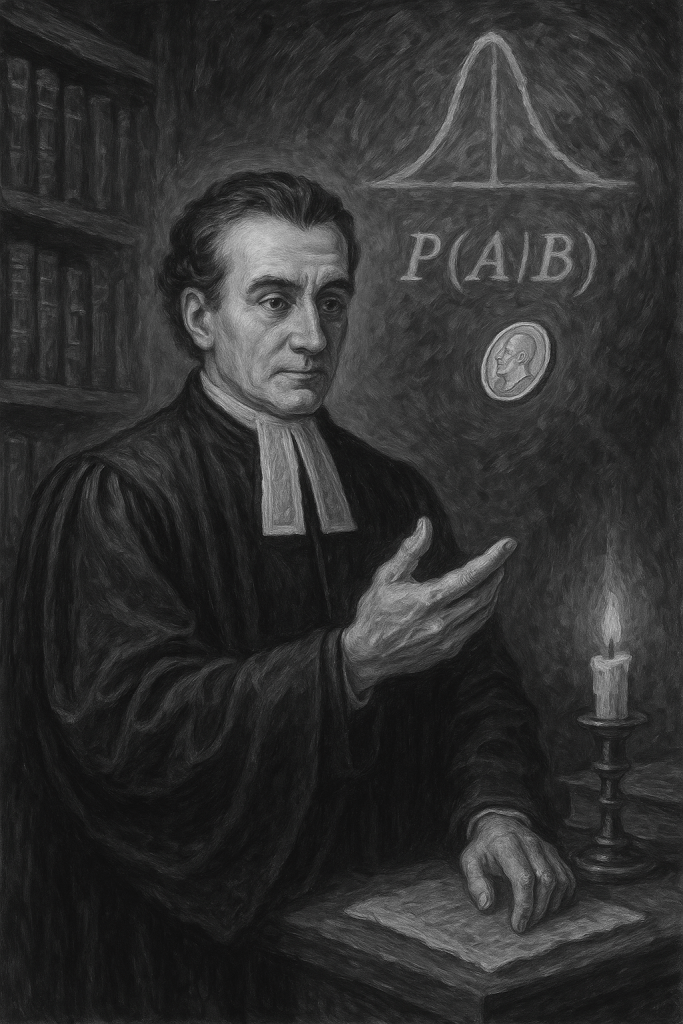
In today’s post, I am exploring the nature of probability. Is probability an intrinsic feature of events that evolves over time, or is it something else entirely? My view is that probability is best understood as a measure of an observer’s uncertainty that can change as new information becomes available, rather than as a property that events themselves possess.

Probability is not an intrinsic property of events that evolves over time. It is a measure of an observer’s uncertainty that changes as the observer gains new information.

This insight becomes clear when we consider what happens before and after an event of interest occurs. You might assign a 35% probability that your favorite team will win their championship match in 2025 based on their team, coaching staff, recent performance, and other factors. When your team does indeed win the championship in 2025, you no longer speak of a 35% chance afterward. You know they won, so your uncertainty about whether your team would capture the 2025 title is gone. The event itself has not changed. What has changed is simply your information about it.

This example reveals something fascinating. The event does not have a probability that flows through time. Your favorite team winning the 2025 championship does not possess an inherent “35% chance property” that somehow transforms into a “100% chance property” when they claim victory. Rather, probability expresses your epistemic state. It expresses what you know and do not know about the event. As your knowledge updates, so does the probability you assign.

Before the season, the probability of 35% captured your uncertainty given incomplete information about how this specific championship race would unfold. After they win, your uncertainty about whether your team won the 2025 championship disappears because you have complete information about this particular outcome. The players were competing and making decisions throughout the season, but your knowledge of the final result was incomplete and then became complete. Probability tracks this change in knowledge, not a change in the event itself.

Your favorite team winning the 2025 championship is a singular, unrepeatable event. This singularity principle applies to every event, whether it is the outcome of a coin toss or whether you miss a train. Even when we consider the 2026 championship, that represents a completely separate event requiring its own probability assessment. You might again assign some probability to your team winning in 2026, but this concerns a different season with different players, different opponents, and different circumstances. The fact that your team won in 2025 provides information that might influence your assessment of their 2026 chances, but each championship stands as a distinct event with its own associated uncertainty.

Different philosophical schools interpret probability in various ways. Frequentists focus on long-run patterns, while others emphasize physical propensities in systems. I adopt the Bayesian perspective here, which treats probability as quantifying an observer’s degree of belief about uncertain outcomes. This framework excels at handling partial information and belief updating as new evidence arrives.

The Bayesian approach formalizes how rational observers should revise their beliefs. You start with a prior probability based on available information. When new evidence arrives, Bayes’ theorem shows how to calculate an updated posterior probability, which then serves as the prior for the next update. Certainty represents probability at its extremes (belief of 1 or 0), but most real-world knowledge involves intermediate probabilities reflecting justified but incomplete information.

Let us return to the championship example with this framework in mind. Your initial 35% probability assignment reflects partial knowledge about the 2025 season that remains open to revision. When your favorite team wins the championship, your belief updates to certainty: probability 1. This transition represents a shift in your epistemic state, not a change in some objective property of the championship outcome. The probability assigned to the event changes only because your information changes.

Your team winning the 2025 championship might influence how you assess their chances for future seasons, but each championship represents a separate event. The 2026 championship is not the same event as the 2025 championship because it involves different circumstances, different player development, different opponents, and different strategic decisions that create their own uncertainty. Your experience from the 2025 season provides information for assessing future championship races, but the probability you assign to the 2026 contest addresses a distinct event with its own epistemic challenges.

Once an event’s outcome becomes known, assigning forward-looking probabilities to that specific completed event loses predictive meaning. However, probabilities retain important roles in other contexts. We use explanatory probabilities to reason about hidden causes of observed effects, and counterfactual probabilities to explore alternative scenarios for learning and decision-making. These applications all involve managing uncertainty about things we do not fully know.

Some philosophers argue for objective chances embedded in physical reality, claiming that the world itself has genuine probabilistic features. Even these can be understood through a Bayesian lens as rational betting odds conditioned on our best current knowledge about physical laws and initial conditions. From this epistemic perspective, probability fundamentally reflects our relationship to knowledge and uncertainty, not immutable features of external events.

Understanding probability as observer-dependent rather than event-dependent has practical implications. It explains why different people can reasonably assign different probabilities to the same event because they possess different information. It clarifies why probabilities can seem to “change” as we learn more: our knowledge evolves while events themselves follow deterministic or genuinely random processes. Most importantly, it positions probability as a dynamic tool for rational reasoning under uncertainty rather than a mysterious property that events carry through time.

Finally, it is important to recognize that while our beliefs may remain probabilistic, our decisions in the real world must ultimately resolve into binary choices. We decide to carry an umbrella or not, to take the highway or not, to treat a patient or not. Practical action demands that we collapse our probabilistic beliefs into definitive commitments. This reinforces that probability serves as a bridge between uncertainty and action, not as a property that events carry through time.

Final Words:

This epistemic view of probability transforms how we think about uncertainty and prediction. Rather than searching for probabilities “out there” in the world, we recognize them as tools for managing our own knowledge and ignorance.

As Pierre Simon Laplace eloquently put it: “Probability theory is nothing but common sense reduced to calculation.”

Once we embrace probability as a measure of what we know rather than what events are, we can use it more effectively as the rational tool it was always meant to be.

Always keep learning…

Ubuntu At the Gemba:

Ubuntu

“My humanity is tied to yours. I am because you are.” 

In today’s post I will be looking at the African philosophical concept of Ubuntu. The word “Ubuntu” is best explained by the Nguni aphorism – Umuntu Ngumuntu Ngabantu, which means “a person is a person because of or through others.” Ubuntu is a key African philosophy and can be translated as humanity. It emphasizes the group solidarity, sharing, caring and the idea of working together for the betterment of everybody. Ubuntu has many derivatives in Bantu languages and this concept is spread across the many nations in Africa.

Ubuntu is the humanness in us. It is said that a solitary human being is a contradiction. We remain human as part of a community. We get better through the betterment of our community. Our strength comes from being part of a community. To quote Archbishop Desmond Tutu:

One of the sayings in our country is Ubuntu – the essence of being human. Ubuntu speaks particularly about the fact that you can’t exist as a human being in isolation. It speaks about our interconnectedness. You can’t be human all by yourself, and when you have this quality – Ubuntu – you are known for your generosity. 

We think of ourselves far too frequently as just individuals, separated from one another, whereas you are connected and what you do affects the whole world. When you do well, it spreads out; it is for the whole of humanity. 

An interesting part about African philosophy is that most of it was not written down. The ideas were transmitted through oral traditions, which depended upon having strong communal roots. Some of the key ideas that are part of the Ubuntu philosophy are:

  • Always aim for the betterment of the community over self.
  • When we treat others with dignity, all of us are able to perform and contribute better.
  • The strength of the community lies in the interconnectedness of the members.
  • The survival of one person is dependent upon the survival of the community.
  • Ubuntu philosophy aims for harmony and consensus in decision making.
  • Ubuntu requires us to be open and make ourselves available to others.
  • Ubuntu requires us to coach and mentor those younger than us. This also helps us become better at what we do.
  • Respect and dignity, as part of ubuntu, ensure that we provide an environment where everybody is able to contribute and bring value.
  • Ubuntu is a philosophy focused on people, and promotes working together as a team towards the common goal. At the same time, it promotes healthy competition and challenges people to keep growing.
  • Ubuntu points out that aiming for individual goals over common goals is not good. System optimization is the end goal.
  • Ubuntu facilitates a need to have a strong communication system.
  • As a management system, Ubuntu puts the focus on local conditions and context. How does what we do impact those around us? How does what we do impact our environment? How does what we do impact our society?
  • Another key concept is the Ubuntu philosophy is forgiveness or short memory of hate!

As I was researching and learning about Ubuntu, I could not help but compare it against the concept of “Respect for Humanity” in Toyota Production System.  I see many parallels between the two concepts. Respect for Humanity (People) is one of the two pillars of the Toyota Way. The other pillar being Continuous Improvement. Japan is an island with limited resources, and the concept of harmony is valued in the Japanese culture. Toyota Production System and Lean are famous for its many tools. Tools are easy to identify since they have physical attributes like kanban, Visual work place, standard work etc. However, respect for people was not understood or looked at by the Toyota outsiders. Most of the Japanese literature about Toyota Production System mentioned Respect for Humanity (people) while it took a while for the western authors to start discussing Respect for Humanity.

Toyota’s view of Respect for People is to ensure that its employees feel that they are bringing value and worth to the organization. Fujio Cho, the pioneer of the Toyota Way 2001, expressed Respect for People as:

Creating a labor environment “to make full use of the workers’ capabilities.” In short, treat the workers as human beings and with consideration. Build up a system that will allow the workers to display their full capabilities by themselves.

Toyota has built up a system of respect for human, putting emphasis on the points as follows: (1) elimination of waste movements by workers; (2) consideration for workers’ safety; and (3) self-display of workers’ capabilities by entrusting them with greater responsibility and authority.

Final Words:

Paul Bate, Emeritus Professor of Health Services Management in University College London, said:

Nothing exists, and therefore can be understood, in isolation from its context, for it is context that gives meaning to what we think and we do.

Our context is in the interconnectedness that we share with our fellow beings. It is what gives meaning to us. In this regard, Ubuntu sheds light on us as humans. Respect for people begins by developing them and providing them an opportunity to grow so that they can help with the common goal and causes.

I will finish with the great Nelson Mandela’s explanation of Ubuntu:

A traveler through a country would stop at a village and he didn’t have to ask for food or for water. Once he stops, the people give him food and attend him. That is one aspect of Ubuntu, but it will have various aspects. Ubuntu does not mean that people should not enrich themselves. The question therefore is:

Are you going to do so in order to enable the community around you to be able to improve?

Always keep on learning…

In case you missed it, my last post was Clausewitz at the Gemba:

Is Lean the Medium or the Message?

IMG_7255

In today’s post, I am looking at the profound phrase of Marshall McLuhan, “The medium is the message.” Marshall McLuhan was a Canadian philosopher and a media theorist. McLuhan noted that: [1]

Each medium, independent of the content it mediates, has its own intrinsic effects which are its unique message… The message of any medium or technology is the change of scale or pace or pattern that it introduces into human affairs… It is the medium that shapes and controls the scale and form of human association and action.

The simplest understanding of the phrase, “the medium is the message”, is that it does not matter what we say, it matters how we say it. However, this is a simplistic view. McLuhan’s insight was that any medium is an extension of ourselves. For example, the telephone is an environment, and it affects everybody. The smartphone, which is a further advancement of the telephone, has a much larger impact on us and what we do. McLuhan realized that as we shape the media, the media shapes us. It is a complex interactive phenomenon. McLuhan said that it does not matter what you print, as long as you keep going with that activity. Every medium helps us to do much more that what we can do physically. For example, McLuhan talked about language being an extension of our thoughts, and written language is a further extension of our speech. The ability to print replaced the need for us to be there physically to extend our thoughts via speech. The ability to print had a profound impact on us much more than all the printed media combined. The medium is the message simply because the impact the media has on our social life.

McLuhan realized that media has an impact on our environment, and sadly we are most of the time unaware of our changing environment. He noted that people in any environment are less privileged to observing themselves than those slightly outside. McLuhan explained this phenomenon with a catchy phrase – the fish did not discover water. He postulated that fish may not be aware of the water, the very thing their life depend on. Another way to look at this is by looking at tweets from a politician. The tweets themselves are beside the point. The medium of Twitter has a far reaching impact on our social media. McLuhan would ask us to look beyond the obvious content in a tweet and look at the social impact the medium is generating.

I wanted to view this idea with Lean. As Lean Leaders, we are trying to propagate the good messages of Lean – “Banish waste”, “respect for Humanity”, “kaizen” etc. We need to realize that the message is not the content, but the medium and the context of our actions. As the aphorism goes, our actions speak louder than our words. The medium, as extensions of us, reaches into our lives and shape ourselves. We should concentrate on the medium to make a larger favorable impact. A good example is kanban. Kanban is a simple mechanism for a pull system, a paper slip that triggers production in a quantity that is needed at the time it is needed. However, the use of kanban leads to an awareness of the problems at the gemba, which leads to a need for a kaizen culture.

The ideas of revealing waste as it occurs, challenging ourselves to continuously improve by elimination of waste and develop people as part of a value adding function are integral to any Lean implementation. This complex intermingled set of ideas cannot be made understood by an edict top down from the CEO – “implement Lean.” What is needed is an understanding of the medium and the environment. The medium of daily board meetings for example has an impact on the social aspects in an organization because of involvements at different levels. The medium of QC circles or daily or weekly kaizen groups are another example. The content of fixing problems is not as important as the medium itself and the long-lasting impact it has by developing people to see wastes and improving their own ability to fix problems.

Sometimes we focus more on the content of the message, as in implementing “Lean”, without trying to understand what is the need that we are trying to address. McLuhan explained this focus on the content as a juicy piece of meat carried by the burglar to distract the watchdog of the mind. We are focusing on the wrong thing. The top down push for lean, six sigma etc. without changing medium may not have a lasting effect. The medium itself has to be changed to change the meaning and impact. The medium is the message, which is context driven! If you want to make “change”, don’t just change the message, change the medium itself. Hence, the title of this post – Is Lean the Medium or the Message?

Final Words:

It is said that the typesetters mistakenly printed, “The medium is the massage” on the cover of his book [2]. McLuhan loved the changed phrasing because it had additional interpretations that he appreciated. He said, “Leave it alone! It’s great, and right on target!” [3]

I will finish with a great insight that McLuhan made in 1964 [1], that foreshadowed the medium of internet and social media:

Archimedes once said, “Give me a place to stand and I will move the world.” Today he would have pointed to our electric media and said, “I will stand on your eyes, your ears, your nerves, and your brain, and the world will move in any tempo or pattern I choose.” We have leased these “places to stand” to private corporations.

Always keep on learning…

In case you missed it, my last post was Purpose of a System in Light of VSM:

[1] Understanding Media, Marshall McLuhan

[2] The Medium is the Massage, Marshall McLuhan

[3] https://www.marshallmcluhan.com/common-questions/

Herd Structures in ‘The Walking Dead’ – CAS Lessons:

zombie_PNG64

The Walking Dead is one of the top-rated TV shows currently. The show is about survival in a post-apocalyptic zombie world. The zombies are referred to as “walkers” in the show. I have written previously about The Walking Dead here. In today’s post, I want to briefly look at Complex Adaptive Systems (CAS) in the show’s backdrop. A Complex Adaptive System is an open non-linear system with heterogenous and autonomous agents that have the ability to adapt to their environment through interactions between themselves and with their environment.

The simplest example to get a grasp of CAS is to look at an ant colony. Ants are simple creatures without a leader telling what each ant should do. Each ant’s behavior is constrained by a set of behavioral rules which determine how they will interact with each other and with their environment. The ant colony taken as a whole is a complex and intelligent system. Each ant works with local information, and interacts with other ants and the environment based on this information. The different tasks that the ants do are patrol, forage, maintain nest and perform midden work. The local information available to each ant is the pheromone scent from another ant. As a whole, their interactions result in a collective intelligence that sustains their colony. In presence of perturbations in their environment, the ants are able to switch to specific tasks to maintain their system. The ants decide the task based on the local information in the form of perturbation to their environment and their rate of interaction with other ants performing the specific tasks. The ants go up in the ranks eventually becoming a forager in the presence of need. A forager ant always stays a forager. The ant colony carries a large amount of “reserve ants” who do not perform any function. This reserve allows for specific task allocation as needed based on perturbations to their environment.

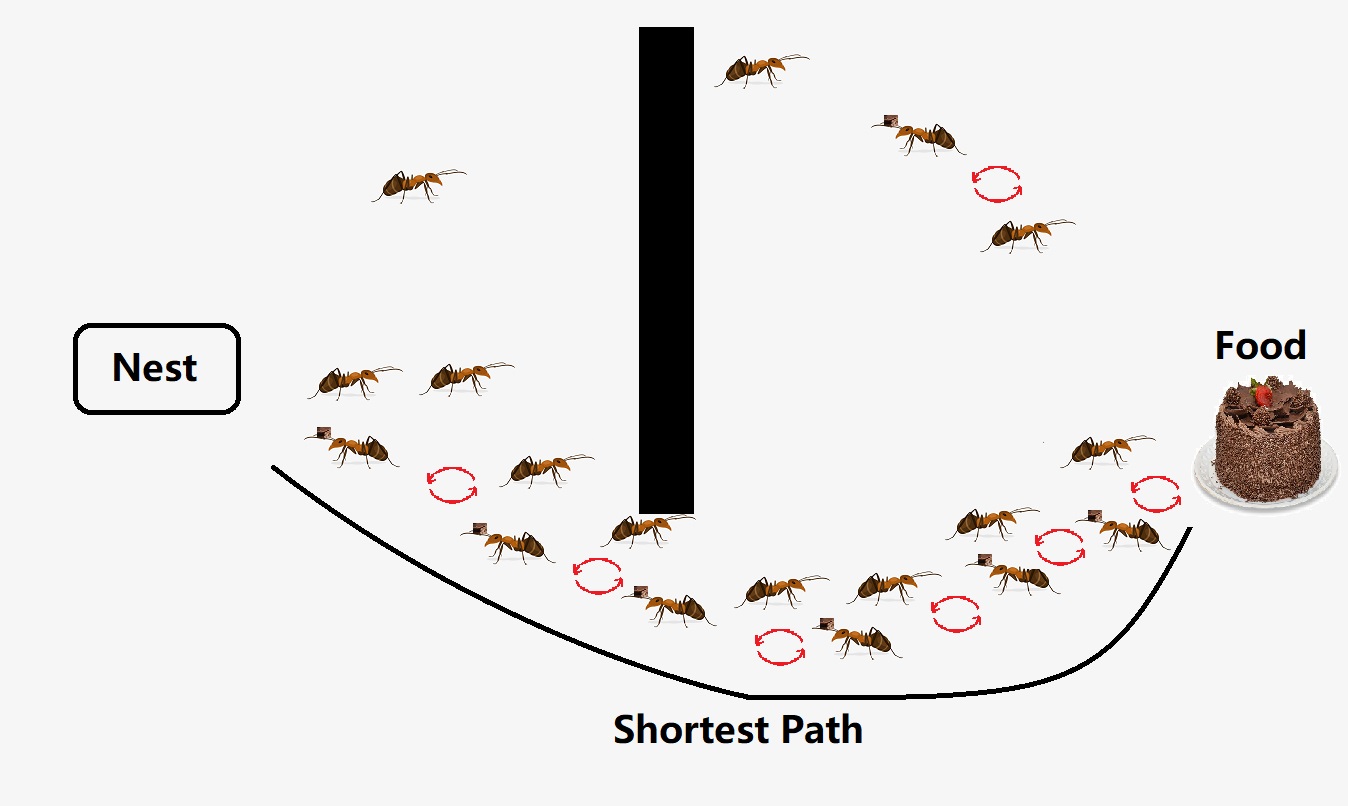
To further illustrate the “self-organizing” or pattern forming behavior of ants, let’s take for example, their foraging activity. The ants will set out from the colony in a random fashion looking for food. Once an ant finds food, it will bring it back to the nest leaving a pheromone trail on its way back. The other ants engaged in the foraging activity will follow the pheromone trail and bring back food while leaving their pheromone scent on the path. The pheromone scent will evaporate over a short amount of time. The ants that followed the shortest path would go back for more food and their pheromone trail will stay “fresh” while a longer path will not remain as “fresh” since the pheromone has more time to evaporate. This means that the path with the strongest pheromone trail is the shortest path to the food. The shortest path was a result of positive feedback loops from more and more ants leaving pheromone at a faster rate. Here the local information available to each ant is the rate of pheromone release from the other ants. The faster the rate, the stronger the trail. This generally corresponds to the shortest trail to the food source. Once the food source is consumed, another food source is identified and a new short path is established. This “algorithm” called as Ant Colony Optimization Algorithm is utilized by several transportation companies to find the shortest routes.

Foraging

In the show, The Walking Dead, a similar collective behavior is shown by the zombies. The zombies exhibit a herding behavior where a large number of zombies will move together as a herd in search for “food”. The zombies in The Walking Dead world are devoid of any intelligence and there is no one in charge similar to the ants. The zombies however do not have a nest. They just wander around. The zombies in the show are attracted by sound, movement and possibly absence of “zombie smell”. The zombies do not attack each other possibly due to the presence of “zombie smell”. In fact, in the show several characters were able to survive zombie attack by lathering themselves in the “zombie goo”.

The possible explanation for the formation of herd structures is the hardwired attribute that we all have – copying others. We tend to follow what others are doing when we are not sure what is happening. We go with the flow. A good example is the wave we do in a sports stadium. We could develop a model where a few zombies are attracted by a stimulus and they walk toward the stimulus. The other zombies simply follow them, and soon a large crowd forms due to the reinforced loops with more and more followers. This is similar to the positive reinforcing feedback of pheromone trail in the example of ants.

The show recently introduced an antagonist group called the “Whisperers”. The Whisperers worship the dead and adorn the zombie skins and walk amongst the zombies. They learned to control the herd and make them go where they want. The Whisperers themselves a CAS, adapted to survive by being with the walkers. Possibly, they are able to guide the walkers by first forming a small crowd themselves and then getting more walkers to join them as they move as a group. Since they have the “zombie smell” on them, the walkers do not attack them.

How Does Understanding CAS Help Us?

We are not ants and certainly not zombies (at least not yet). But there are several lessons we can get from understanding CAS. We all belong to a CAS at work, and in our community. The underlying principle of CAS is that we live in a complex world where we can understand the world only in the context of our environment and our local interactions with our neighbors and with the environment. Every project we are involved in is new and not identical to any previous project. This could be the nature of the project itself, or the team members or the deadlines or the client. Every part of the project can introduce a new variation that we did not know of. Given below are some lessons from CAS.

  1. Observe and understand patterns:

Complex Adaptive Systems present patterns due to the agents’ interactions. You have to observe and understand the different patterns around you. How do others interact with each other? Can you identify new patterns forming in the presence of new information or perturbations in your environment? Improve your observation skills to understand how patterns form around you. Look and see who the “influencers” are in your team.

  1. Understand the positive and negative feedback loops:

Observe and understand the positive and negative feedback loops that exist around. A pattern forms based on these loops. The awareness of the positive and negative loops will help us nurture the required loops.

  1. Be humble:

Complexity is all around us and this means that we lack understanding. We cannot foresee or predict how things will turn out every time. Complex systems are dispositional, to quote Dave Snowden. They may exhibit tendencies but we cannot completely understand how things work in a complex system. Edicts and rules do not always work and they can have unintended consequences. Every event is possibly a new event and this means that although you can have insights from your past experiences, you cannot control the outcomes. You cannot simply copy and paste because the context in the current system is different.

  1. Get multiple perspectives always (reality is multidimensional and constructed):

Get multiple perspectives. To quote the great American organizational theorist, Russell Ackoff, “Reality is multidimensional.” To add to this, it is also constructed. The multiple perspectives help us to understand things a little better and provide a new perspective that we were lacking. Systems are also constructed and can change how it appears depending on your perspective.

  1. Go inside and outside the system:

We cannot try to understand a system by staying outside it all of the time. Similarly, we cannot understand a system by staying inside it all of the time. Go to the Gemba (the actual workplace) to grasp the situation to better understand what is going on. Come away from it to reflect. We can understand a system only in the context of the environment and the interactions going on.

  1. Have variety:

Similar to #4, variety is your friend in a complex system. Variety leads to better interactions that will help us with developing new patterns. If everybody was the same then we would be reinforcing the same idea that would lack the requisite variety to counter the variety present in our environment. Our environment is not homogenous.

  1. Aim for Effectiveness and not Efficiency:

In complex systems, we should aim for effectiveness. Here, the famous Toyota heuristic, “Go slow to go fast” is applicable. Since each event is novel, we cannot aim for efficiency always.

  1. Use Heuristics and not Rules:

Heuristics are flexible and while rules are rigid. Rules are based on past experiences and lack the variety needed in the current context. Heuristics allow flexing allowing for the agents to change tactics as needed.

  1. Experiment frequently with safe to fail small experiments:

As part of prodding the environment, we should engage in frequent and small safe to fail experiments.  This helps us improve our understanding.

  1. Understand that complexity is always nonlinear, thus keep an eye out for emerging patterns:

Complexity is nonlinear and this means that a small change can have an unforeseen and large outcome. Thus, we should observe for any emerging patterns and determine our next steps. Move towards what we have identified as “good” and move away from what we have deemed as “bad”. Patterns always emerge bottom-up. We may not be able to design the patterns, but we may be able to recognize the patterns being developed and potentially influence them.

Final Words:

My post has been a very simple look at CAS. There are lot more attributes to CAS that are worth pursuing and learning. Complexity Explorer from Santa Fe institute is a great place to start. I will finish with a great quote from the retired United States Army four-star general Stanley McChrystal, from his book, Team of Teams:

“The temptation to lead as a chess master, controlling each move of the organization, must give way to an approach as a gardener, enabling rather than directing. A gardening approach to leadership is anything but passive. The leader acts as an “Eyes-On, Hands-Off” enabler who creates and maintains an ecosystem in which the organization operates.”

Always keep on learning…

In case you missed it, my last post was Conceptual Metaphors in Lean:

The Confirmation Paradox:

albino raven

In today’s post I will be looking at Confirmation Paradox or Black Raven Paradox by Carl Hempel. Let’s suppose that you have never seen a raven in your life. You came across a raven one fine morning, and observe that it is black in color. Now that you have seen one, you suddenly start paying more attention and you start seeing ravens everywhere. Each time you see a raven, you observe that its color is black. Being the good scientist that you are, you come to a hypothesis – All ravens are black. This is also called induction, coming to a generalization from many specific observations.

Now you would like to confirm your hypothesis. You ask your good friend, Carl Hempel, to help. Carl suggests that you start looking at things around his house that are not black and not raven, like his red couch, the yellow tennis ball etc. He suggests that each of those observations support your hypothesis that all ravens are black. You are rightfully puzzled by this. This is the confirmation paradox. Carl Hempel was a German born philosopher who later immigrated to America.

Carl Hempel is correct with this claim. Let’s look at this further. All ravens are black can be restated as “Whatever is not black is not a raven”. This is a logical equivalence of your hypothesis. This would mean that if you observe something that is not black and is not a raven, it would support your hypothesis. Thus, if you observe a red couch, it is not black and it is also not a raven, therefore it supports your hypothesis that all ravens are black.

How do we come in terms with this? Surely, it does not make sense that a red couch supports the hypothesis that all ravens are black. The first point to note here is that one can never prove a hypothesis via induction. Induction requires the statement to be provided with a level of confidence or certainty. This would mean that the level of “support” that each observation makes depends upon the type of information gained from that observation.

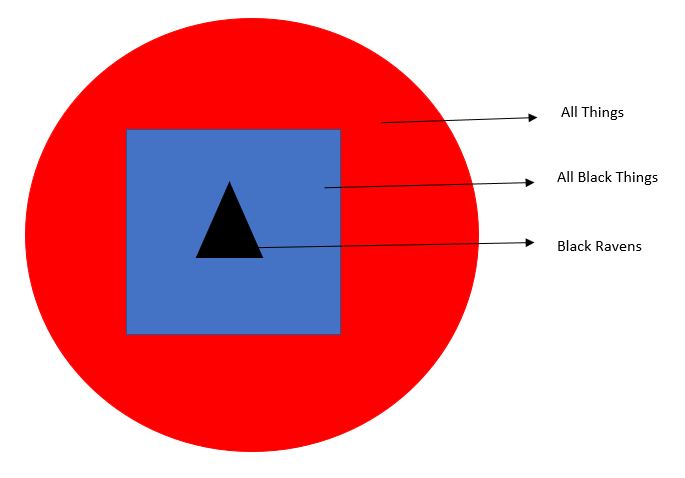
I will explain this further with the concept of information from Claude Shannon’s viewpoint. Information is all around us. Where ever you look, you can get information. Claude Shannon quantified this in terms of entropy with the unit as a bit. He described this as the amount of surprise or reduction of uncertainty. Information is inversely proportional to probability of an event. The less probable an event is, the more information it contains. Let’s look at the schematic below:

ravens

The black triangle represents all the black ravens in our observable universe. The blue square represents all of the black things in our observable universe. The red circle represents all the things in the observable universe. Thus, the set of black ravens is a subset of all black things, which in turn is a subset of all things. From a probability standpoint, the probability of observing a black raven is much smaller than the probability of observing a black thing since there are proportionally a lot more black things in existence. Similarly, the probability of observing a non-black thing is much higher since there are lot more non-black things in existence. Thus, from an information standpoint, the information you get from observing a non-black thing that is not a raven is very very small. Logically, this observation does provide additional support, however, the information content is miniscule. Please note that, on the other hand, observing a black raven is also supporting the statement that all non-raven things are non-black.

When you first saw a black raven, you had no idea about such a thing existing. The information content of that observation was high. After you started observing more ravens, the information you got from each observation started diminishing. Even if you made 10,000 observations of black ravens, you cannot prove (100% confirm) that all ravens are black. This is the curse of induction. This is where Karl Popper comes in. Karl Popper, an Austrian-British philosopher, had the brilliant insight that good hypotheses should be falsifiable. We should try to look for observations that would fail our hypothesis. His insight was in the asymmetry of falsifiability. You may have 100,000 observations supporting your hypothesis. All you need is a single observation to fail it. The most popular example for this is the case of the black swan. The belief that all swans are white was discredited when black swans were discovered in Australia. To come back to the information analogy, the observation of a white raven has lot more information content that is powerful enough to break down your hypothesis since the occurrence of a white raven(albino) is very low in nature. Finding a white raven is quite rare and thus have the most information or surprise.

This also brings up the concept of Total Evidence. The concept of Total Evidence was put forth by Rudolf Carnap, a German born philosopher. He stated that in the application of inductive logic to a given knowledge situation, the total evidence available must be taken as basis for determining the degree of confirmation. Let’s say that as we learned more about ravens and other birds, we came across the concept of albinism in other animals and birds. This should make us challenge our hypothesis since we know that albinism can occur in nature, and thus it is not farfetched that it can occur in ravens as well. The concept of Total Evidence is interesting because even though it has the term “Total” in it, it is beckoning us to realize that we cannot ever have total information. It is a reminder for us to consider all possibilities and to understand where our mental models break down. In theory, one could also make whimsical statements such as “All unicorns are rainbow colored”, and say that the observation of a white shoe supports it based on the confirmation paradox. Total evidence in this case would require us to have made at least one observation of a rainbow colored unicorn.

I will finish with another paradox that is similar to the confirmation paradox – the 99-foot (feet) man paradox by Paul Berent. Up to this point, we have been looking at qualitative data (black versus not black, or raven versus not raven). Let’s say that you have a hypothesis that says all men are less than 100 feet. You surveyed over 100,000 men and found all of them to be less than 100 feet. One day you heard about a new circus company coming to town. Their main attraction is a 99-foot man. You go to see him in person and sure enough, he is 99 feet tall. Now, your hypothesis is still intact since the 99-foot man is technically less than 100 feet. However, this adds doubt to your mind. You realize that if there is a 99-foot man, then the occurrence of a 100-foot man is not farfetched. The paradox occurs since the observation of a 99-foot man strengthens your hypothesis, but at the same time it also weakens it.

Always keep on learning…

In case you missed it, my last post was Know Your Edges:

Know Your Edges:

jigsaw

In today’s post I will start with a question, “Do you know your edges?

Edges are boundaries where a system or a process (depending upon your construction) breaks down or changes structure. Our preference, as the manager or the owner, is to stay in our comfort zone, a place where we know how things work; a place where we can predict how things go; a place we have the most certainty. Let’s take for a simple example your daily commute to work – chances are high that you always take the same route to work. This is what you know and you have a high certainty about how long it will take you to get to your work. Counterintuitively, the more certainty you have of something, the less information you have to gain from it. Our natural tendency is to have more certainty about things, and we hate uncertainty. We think of uncertainty as a bad thing. If I can use a metaphor, uncertainty is like medicine – you need it to stay healthy!

To discuss this further, I will look at the concept of variety from Cybernetics. Variety is a concept that was put forth by William Ross Ashby, a giant in the world of Cybernetics. Simply speaking, variety is the number of states. If you look at a stop light, generally it has three states (Red, Yellow and Green). In other words, the stop light’s variety is three (ignoring flashing red and no light). With this, it is able to control traffic. When the stop light is able to match the ongoing traffic, everything is smooth. But when the volume of traffic increases, the stop light is not able to keep up. The system reacts by slowing down the traffic. This shows that the variety in the environment is always greater than the variety available internally. The external variety also equates with uncertainty. Scaling back, let’s look at a manufacturing plant. The uncertainty comes in the form of 6M (Man, Machine, Method, Material, Measurement and Mother Nature). The manager’s job is to reduce the uncertainty. This is done by filtering the variety imposed from the outside, magnifying the variety that is available internally or looking at ways to improve the requisite variety. Ashby’s Law of Requisite Variety can be stated as – “only variety can absorb variety.

All organizations are sociotechnical systems. This also means that in order to sustain, they need to be complex adaptive systems. In order to improve the adaptability, the system needs to keep learning. It may be counterintuitive, but uncertainty is required for a complex adaptive system to keep learning, and to maintain the requisite variety to sustain itself. Thus, the push to stay away from uncertainty or staying in the comfort zone could actually be detrimental. Metaphorically, staying the comfort zone is staying away from the edges, where there is more uncertainty. After a basic level of stability is achieved, there is not much information available in the center (away from the edges). Since the environment is always changing, the organization has to keep updating the information to adapt and survive. This means that the organization should engage in safe to fail experiments and move away from their comfort zone to keep updating their information. The organization has to know where the edges are, and where the structures break down. Safe to fail experiments increases the solution space of the organization making it better suited for challenges. These experiments are fast, small and reversible, and are meant to increase the experience of the organization without risks. The organization cannot remain static and has to change with time. The experimentation away from the comfort zone provides direction for growth. It also shows where things can get catastrophic, so that the organization can be better prepared and move away from that direction.

This leads me to the concept of “fundamental regulator paradox”. This was developed by Gerald Weinberg, an American Computer scientist. As a system gets really good at what it does, and nothing ever goes wrong, then it is impossible to tell how well it is working. When strict rules and regulations are put in place to maintain “perfect order”, they can actually result in the opposite of what they are originally meant for. The paradox is stated as:

The task of a regulator is to eliminate variation, but this variation is the ultimate source of information about the quality of its work. Therefore, the better job a regulator does, the less information it gets about how to improve.

This concept also tells us that trying to stay in the comfort zone is never good and that we should not shy away from uncertainty. Exploring away from the comfort zone is how we can develop the adaptability and experience needed to survive.

Final Words:

This post is a further expansion from my recent tweet. https://twitter.com/harish_josev/status/1055977583261769728?s=11

Information is most rich at the edges. Information is at its lowest in the center. Equilibrium also lies away from the edges.

The two questions, “How good are you at something?” and “How bad are you at something?” may be logically equivalent. However, there is more opportunity to gain information from the second question since it leads us away from the comfort zone.

I will finish with a lesson from one of my favorite TV Detectives, D.I Richard Poole from Death in Paradise.

Poole noted that solving murders were like solving jigsaw puzzles. One has to work from the corners, and then the edges and then move towards the middle. Then, everything will fall in line and start to make sense.

Always keep on learning…

In case you missed it, my last post was Bootstrap Kaizen:

Bootstrap Kaizen:

bootstrap

I am writing today about “bootstrap kaizen”. This is something I have been thinking about for a while. Wikipedia describes bootstrapping as “a self-starting process that is supposed to proceed without external input.” The term was developed from a 19th century adynaton – “pull oneself over a fence by one’s bootstraps.” Another description is to start with something small that overtime turns into something bigger – a compounding effect from something small and simple. One part of the output is feedback into the input loop so as to generate a compounding effect. This is the same concept of booting computers, where a computer upon on startup starts with a small code that is run from the BIOS which loads the full operating system. I liked the idea of bootstrapping when viewed with the concept of kaizen or “change for the better” in Lean. Think about how the concept of improvement can start small, and eventually with iterations and feedback loops can make the entire organization better.

As I was researching along these lines, I came across Doug Engelbart. Doug Engelbart was an American genius who gave us the computer mouse and he was part of the team that gave us internet. Engelbart was way ahead of his time. Engelbart was also famous for the Mother of All Demos, which he gave in 1968 (way before Windows or Apple Events). Engelbart’s goal in life was to help create truly high performance human organizations. He understood that while population and gross product were increasing at a significant rate, the complexity of man’s problems were growing still faster. On top of this, the urgency with which solutions must be found became steadily greater. The product of complexity and urgency had surpassed man’s ability to deal with it. He vowed to increase the effectiveness with which individuals and organizations work at intelligent tasks. He wanted better and faster solutions to tackle the “more-complex” problems. Engelbart came up with “bootstrapping our collective IQ.”

He explained:

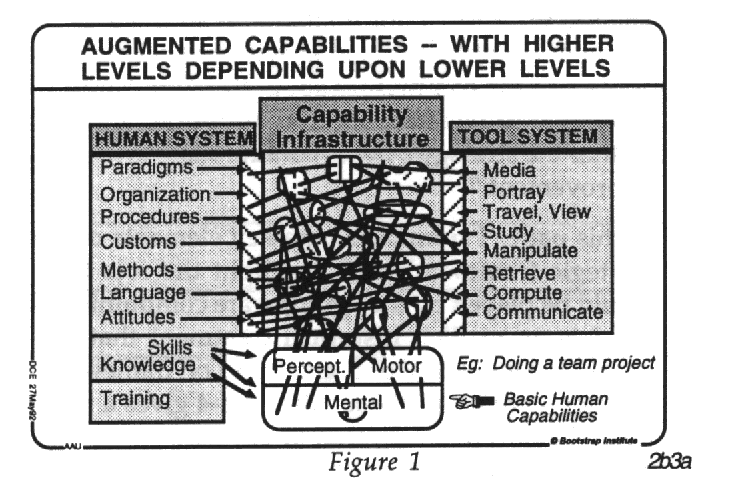
Any high-level capability needed by an organization rests atop a broad and deep capability infrastructure, comprised of many layers of composite capabilities. At the lower levels lie two categories of capabilities – Human-based and Tools-based. Doug Engelbart called this the Augmentation System.

Augmentation system

The human-based capability infrastructure is boosted by the tool-based capability infrastructure. As we pursue significant capability improvement, we should orient to pursuing improvement as a multi-element co-evolution process of the Tool System and Human System. Engelbart called this a bootstrapping strategy, where multi-disciplinary research teams would explore the new tools and work processes, which they would all use immediately themselves to boost their own collective capabilities in their lab(s).

Doug Engelbart’s brilliance was that he identified the link between the human system and the tool system. He understood that developing new tools improves our ability to develop even more new tools. He came up with the idea of “improving the improvement process.” I was enthralled by this when I read this because I was already thinking about “bootstrap kaizen.” He gave us the idea of “ABC model of Organizational Improvement.” In his words:

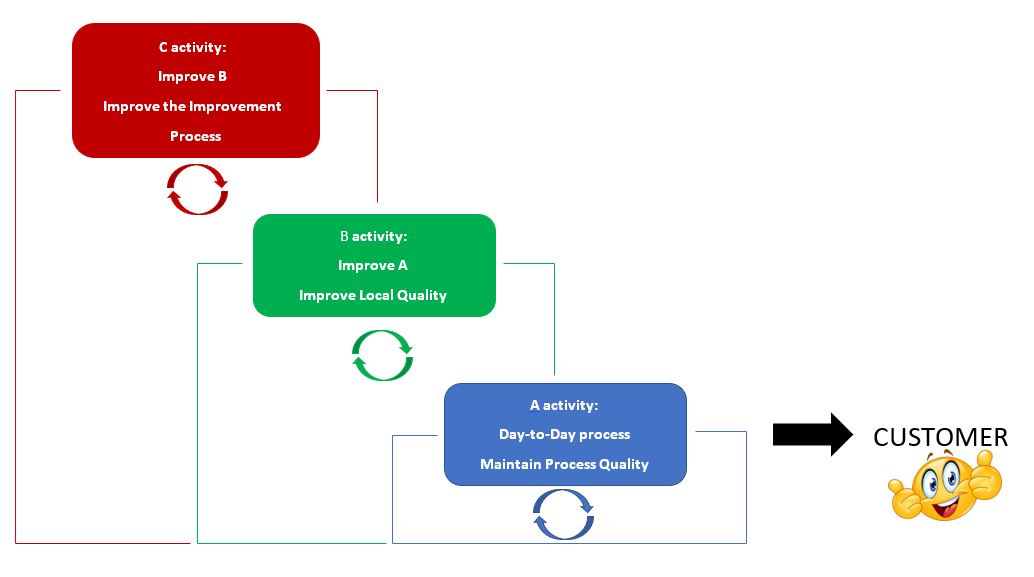
    A Activity: ‘Business as Usual’. The organization’s day to day core business activity, such as customer engagement and support, product development, R&D, marketing, sales, accounting, legal, manufacturing (if any), etc. Examples: Aerospace – all the activities involved in producing a plane; Congress – passing legislation; Medicine – researching a cure for disease; Education – teaching and mentoring students; Professional Societies – advancing a field or discipline; Initiatives or Nonprofits – advancing a cause.

    B Activity: Improving how we do that. Improving how A work is done, asking ‘How can we do this better?’ Examples: adopting a new tool(s) or technique(s) for how we go about working together, pursuing leads, conducting research, designing, planning, understanding the customer, coordinating efforts, tracking issues, managing budgets, delivering internal services. Could be an individual introducing a new technique gleaned from reading, conferences, or networking with peers, or an internal initiative tasked with improving core capability within or across various A Activities.

    C Activity: Improving how we improve. Improving how B work is done, asking ‘How can we improve the way we improve?’ Examples: improving effectiveness of B Activity teams in how they foster relations with their A Activity customers, collaborate to identify needs and opportunities, research, innovate, and implement available solutions, incorporate input, feedback, and lessons learned, run pilot projects, etc. Could be a B Activity individual learning about new techniques for innovation teams (reading, conferences, networking), or an initiative, innovation team or improvement community engaging with B Activity and other key stakeholders to implement new/improved capability for one or more B activities.

This approach can be viewed as a nested set of feedback loops as below:

ABC

Engelbart points out that, Bootstrapping has multiple immediate benefits:

1) Providers grow increasingly faster and smarter at:

  • Developing what they use – providers become their own most aggressive and vocal customer, giving themselves immediate feedback, which creates a faster evolutionary learning curve and more useful results
  • Integrating results – providers are increasingly adept at incorporating experimental practices and tools of their own making, and/or from external sources, co-evolving their own work products accordingly, further optimizing usefulness as well as downstream integratability
  • Compounding ROI – if the work product provides significant customer value, providers will start seeing measurable results in raising their own Collective IQ, thus getting faster and smarter at creating and deploying what they’re creating and deploying – results will build like compounding interest
  • Engaging stakeholders – providers experience first-hand the value of deep involvement by early adopters and contributors, blurring the distinction between internal and external participants, increasing their capacity to network beneficial stakeholders into the R&D cycle (i.e. outside innovation is built in to the bootstrapping strategy)
  • Deploying what they develop – as experienced users of their own work product, providers are their own best customers engaging kindred external customers early on, deployment/feedback becomes a natural two-way flow between them

2) Customers benefit commensurately:

  • End users benefit in all the ways customers benefit through outside innovation
  • Additionally, end users can visit provider’s work environment to get a taste and even experience firsthand how they’ve seriously innovated the way they work, not in a demo room, but in their actual work environment
  • Resulting end products and services, designed by stakeholders, and rigorously co-evolved, shaken down and refined by stakeholders, should be easier and more cost-effective to implement, while yielding greater results sooner than conventionally developed products and services

Final Notes:

I love that Engelbart’s Augmentation System points out that tools are to be used to augment the human capability, and that this should be ultimately about the system level development. His idea of bootstrapping explains how the “kaizen” thinking should be in Lean.

Interestingly, Engelbart understood that the Human side of the Augmentations System can be challenging. A special note on the Human System: Of the two, Engelbart saw the Human System to be a much larger challenge than the Tool System, much more unwieldy and staunchly resistant to change, and all the more critical to change because, on the whole, the Human System tended to be self-limiting, and the biggest gating factor in the whole equation. It’s hard for people to step outside their comfort zone and think outside the box, and harder still to think outside whatever paradigm or world view they occupy. Those who think that the world is flat, and science and inquiry are blasphemous, will not consider exploring beyond the edges, and will silence great thinkers like Socrates and Gallileo.

As I was researching for this post, I also came across the phrase “eating your own dog food.” This is an idea made famous by the software companies. The idea behind the phrase is that we should use our own products in our day-to-day business operations (Deploying what they develop). In a similar vein, we should engage in improvement activities with tools that we can make internally. This will improve our improvement muscles so that we may be able to tweak off-the-shelf equipment to make it work for us. This is the true spirit of the Augmentation System.

When you are thinking about getting new tools or equipment for automation, make sure that it is to strictly to augment the human system. Unless we think in these terms, we will not be able to improve the system as a whole. We should focus more on the C activities. I highly encourage the reader to learn more about Doug Engelbart. (http://www.dougengelbart.org/)

Always keep on learning…

In case you missed it, my last post was A “Complex” View of Quality:

Distrust Simplicity:

whitehead_painting

In today’s post, I will be looking at the famous quote from the famous English mathematician and philosopher, Alfred Whitehead.

Seek simplicity, and then distrust it.

This quote comes from his 1920 collection of lectures, The Concept of Nature. The quote is embedded in the paragraph below:

Nature appears as a complex system whose factors are dimly discerned by us. But, as I ask you, Is not this the very truth? Should we not distrust the jaunty assurance with which every age prides itself that it at last has hit upon the ultimate concepts in which all that happens can be formulated? The aim of science is to seek the simplest explanations of complex facts. We are apt to fall into the error of thinking that the facts are simple because simplicity is the goal of our quest. The guiding motto in the life of every natural philosopher should be, Seek simplicity and distrust it.

I like this idea a lot. We are all asked to keep things simple, and to not make things complicated. Whitehead is asking us to seek simplicity first, and then distrust it. Whitehead talks about “bifurcation of nature” – nature as we perceive it, and the nature as it is. Thus, our perception of reality is an abstraction or a simplification based on our perceptions. We need this abstraction to start understanding nature. However, once we start this understanding process, we should not stop. We should build upon it. This is the scientific method – plan the prototype, build it, assess the gap, and continue improving based on feedback.

As I was reading The Concept of Nature, several other concepts came to my mind. The first one was Occam’s razor – the idea that Entities should not be multiplied unnecessarily. Seek the simplest explanation, when all things are equal. At the same time, we should keep Epicurus’ Principle of Multiple Explanations in mind – If more than one theory is consistent with the observations, keep all theories. I also feel that Whitehead was talking about systems and complexity. As complexity increases, our ability to fully understand the numerous relationships decreases. As the wonderful American Systems thinker Donella Meadows said:

We can’t impose our will on a system. We can listen to what the system tells us and discover how its properties and our values can work together to bring forth something much better than could ever be produced by our will alone.

Seeking simplicity is about the attempt to have a starting point to understand complexity. We should continue to evolve our understanding and not stop at the first abstraction we developed. One of the famous Zen story is about the teacher pointing his finger at the moon. I have talked about this here. We should not look at the finger and stop there. We should look at where the finger is pointing. The finger is the road sign and not the destination itself. The simplicity is a representation and not the real thing. We should immediately distrust it because it is a weak copy. Seeking simplicity is not a bad thing but stopping there is. Simplicity is our comfort zone, and Whitehead is asking us to distrust it so that can keep improving our situation – continuous improvement. Whitehead in his later 1929 book, The Function of Reason, states:

The higher forms of life are actively engaged in modifying their environment… (to) (i) to live, (ii) to live well, (iii) to live better.

Final Words:

In seeking simplicity, we are trying to be “less wrong”. In distrusting our simplified abstraction, we are seeking to be “more right”. I will finish with a Zen story.

A Zen master lay dying. His monks had all gathered around his bed, from the most senior to the most novice monk. The senior monk leaned over to ask the dying master if he had any final words of advice for his monks.

The old master slowly opened his eyes and in a weak voice whispered, “Tell them Truth is like a river.”

The senior monk passed on this bit of wisdom in turn to the monk next to him, and it circulated around the room from one monk to another.

When the words reached the youngest monk he asked, “What does he mean, ‘Truth is like a river?’”

The question was passed back around the room to the senior monk who leaned over the bed and asked, “Master, what do you mean, ‘Truth is like a river?’” Slowly the master opened his eyes and in a weak voice whispered, “OK, truth is not like a river.”

Always keep on learning…

In case you missed it, my last post was Cannon’s Polarity Principle:

Cannon’s Polarity Principle:

arrows

I recently read the wonderful book “On the Design of Stable Systems”, by Jerry Weinberg and Daniela Weinberg. I came across a principle that I had not heard of before called “Cannon’s Polarity Principle”. Cannon’s Polarity Principle can be stated as the strategy that a system can use to overcome noise by supplying its own opposing actions. If a system relies on an uncertain environment to supply the opposing factor to one of its regulatory mechanisms, that mechanism must have a much more refined model. By supplying its own opposing factor, it can get away with a much simpler model of the environment.

This principle is one of those things that is profound yet very simple. The Weinbergs give the example of a sticky knob on a gas stove to explain this idea. If the knob is sticky then it is tricky to raise the flame to the precise point we would like it to be. Due to the “stickiness” we will try to apply much more force than needed and inadvertently overshoot, going past the desired point. The result is that the flame is at a much higher setting. When we try to turn the flame down we are still in the same situation and again go past the point where we would like to be.

What we can do instead is to use one hand to push against the direction we would like and then slowly try to turn the knob with our other hand. With this approach we can be much more refined and be at our desired position. By working “against” our own goal, we make precise adjustment possible in the face of an unknown, but small, amount of stickiness.

This got me thinking. There are several times where we apply opposing forces to slow us down, to take the time to reach the correct decision (precise adjustment). One of my favorite Toyotaism is – Go slow to go fast. This makes a lot of sense in the light of the Polarity Principle. Any time we are doing a root cause analysis, we are prone to a plethora of biases including confirmation bias – selectively looking for ideas that reinforce our thinking, and availability bias – latching on to the first idea because that was the immediate idea we came up with. These biases might make us jump to unwarranted conclusions to address symptoms, and not addressing the root problem(s). The Polarity Principle would advise us to slow down.

I will finish this short and sweet with an apt Zen saying:

The one who is good at shooting does not hit the center of the arrow.

Always keep on learning…

In case you missed it, my last post was Contextual Why: