

In today’s post, I am exploring Ashby’s Law of Requisite Variety and why it might be both more necessary and more slippery than most presentations suggest. Ashby’s Law might not be just another management principle. It could be a window into how we navigate complexity when the world refuses to be pinned down by our desire for certainty.
Stafford Beer once wrote something that might be more profound than it first appears:
Instead of trying to specify a system in full detail, specify it only somewhat. You can then ride on the dynamics of the system in the direction you want to go.
That word ‘somewhat’ could be carrying more weight than we realize. It might signal a kind of intellectual humility that most management theories avoid. It suggests that our relationship with complex systems is not one of mastery but of skillful navigation. Perhaps it is more like learning to surf than trying to control the ocean.
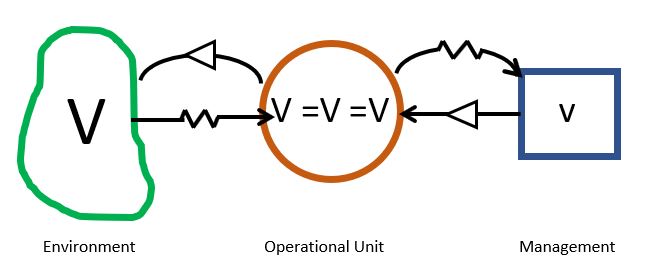
This brings us to Ashby’s Law of Requisite Variety, which is a simple statement. “Only variety can absorb variety.” This looks simple, clean, and mathematical. This is the kind of principle that promises hard tangible answers in a soft world. We need to attenuate excess external variety so that we focus on only the relevant variety, and we need to amplify our internal variety so that we can adequately respond to the external variety.
Let us look at the nuances of this law more.
Ashby’s Law tells us that a regulator can only control outcomes it can distinguish and respond to. If environmental disturbances exceed the regulator’s response capacity, some disturbances will pass through uncontrolled. This is presented as a logical necessity. It appears as inevitable as gravity.
And in one sense, it is. Given any finite set of regulatory responses, there will always be environmental states that cannot be adequately handled. Mathematics seems to be unforgiving. The logic seems to be airtight.
But mathematics operates within assumptions, and assumptions are where humans enter the picture. Most presentations of Ashby’s Law miss this. The law is simultaneously necessary and observer-dependent. It might be a constraint that applies absolutely, but only within the frames we construct.
The Indefinite World:
There is a distinction that might change how we see everything. The external variety is not infinite. It is something else entirely. It is indefinite.
Infinite means without limits. It is a mathematical concept that extends forever. Indefinite here means without defined limits. It requires someone to do the defining.
This might not be academic hairsplitting. It could be the key to understanding why Ashby’s Law feels both rock-solid and frustratingly slippery to grasp.
The world contains countless differences, but only some matter for any given purpose. Gregory Bateson captured this. “Information is a difference that makes a difference.” The same principle applies to variety. Variety is not a raw count of states “out there.” It is a relational property that emerges when an observer draws distinctions that serve a purpose.
Think about managing a parking lot as an example. How many “states” might this system have? If you only care about full or empty, there are two states. If you track individual spaces, there might be hundreds. If you include weather patterns, time of day, driver behavior, and maintenance schedules, there could be thousands. The world contains all these potential distinctions simultaneously. But variety for control purposes might depend entirely on which distinctions you choose to make matter.
This creates a fundamental tension. Ashby’s Law holds as a logical necessity. If your frame ignores differences that turn out to matter, your system will fail. But the application of the law depends entirely on how you frame the situation.
When Frames Collide with Reality:
The COVID-19 pandemic might have given us a natural experiment in how different frames handle the same underlying reality.
Some governments approached the crisis with what we might call a narrow medical frame. The pandemic was fundamentally a healthcare capacity problem for them. The focus was on hospital beds, ventilators, testing infrastructure, and transmission control. Their variety management attempted to attenuate viral spread while amplifying medical response capacity. From this perspective, lockdowns might be seen as a straightforward attenuation strategy, and field hospitals as variety amplification.
This frame had a certain elegant simplicity. The problem was clearly defined, the metrics were measurable, and the interventions had precedent in public health history.
But other governments adopted what we could call a broad socio-economic-health frame. From this perspective, the pandemic was not just a medical crisis. It might be a system-wide disruption that threatened social cohesion, economic stability, and political legitimacy simultaneously. Their variety management involved coordinated interventions across multiple domains. Public health measures, economic support packages, mental health services, educational continuity, and social solidarity initiatives.
Both approaches were tested against the same underlying reality. The virus did not care about our framing preferences. But the broader frame generally proved more viable because it might have acknowledged more of the variety that actually mattered for maintaining social stability during the crisis.
The narrow medical frame was not wrong in many regards. It might have been incomplete. It failed to account for economic disruption, compliance fatigue, mental health deterioration, and social unrest. When these unacknowledged varieties of disturbance began overwhelming the system, control failures cascaded in directions the frame could not anticipate.
This might be where Ashby’s Law reveals its true nature. The law did not prescribe which frame to use. It simply ensured that inadequate frames would reveal themselves through control failures.
The Observer Inside the System:
Here is where the story might deepen into something more complex than most management textbooks are comfortable acknowledging.
Traditional cybernetics, what we might call first-order cybernetics, treats the observer as outside the system being controlled. From this perspective, variety could be objective. You count the states, build matching responses, and apply the law mechanically.
But second-order cybernetics recognizes something that might be more unsettling. The observer is always inside the system. The regulator is part of what is being regulated. Variety is not given. It might be constructed through distinctions that reflect purpose, context, and the observer’s own limitations.
This might mean Ashby’s Law operates at two levels simultaneously. At the operational level, your responses must match the variety you have acknowledged as relevant. If you identify ten types of disturbances, you might need at least ten different responses. This could be the familiar version of the law.
But at a deeper level, your capacity to make useful distinctions must itself be adequate to the situation’s demands. If your frame excludes crucial differences, operational control might fail regardless of how well you handle the differences you do recognize.
The law does not fail when you frame poorly. Your framework fails. The law simply describes what happens when your variety is inadequate, regardless of whether that inadequacy comes from poor responses or poor framing.
Back to Riding the Dynamics:
This brings us back to Beer’s insight about specification. If the world might be indefinite rather than infinite, if variety could depend on the distinctions we draw rather than existing independently, then total specification becomes not just impossible but potentially counterproductive.
The goal is not to capture all possible variety in advance. It is to develop the capacity to recognize when your current framing is failing and to generate alternatives before failure becomes catastrophic.
This reflexivity can be viewed as a type of variety amplification. Instead of just amplifying operational responses, we can amplify our capacity to reframe situations when current framings prove inadequate.
What might this look like in practice? Running scenario exercises that stress-test your assumptions. Monitoring for weak signals that could indicate emerging types of disturbance your current frame does not recognize. Institutionalizing checkpoints where teams question basic premises. Building relationships with people who might frame problems differently.
These are not just theoretical exercises but insurance policies against the kind of frame failure we saw in the early pandemic response.
The Paradox of Precision:
Here is something that might bother us about how Ashby’s Law is usually presented. It gets dressed up in mathematical clothing similar to formal models, game theory, Bayesian analysis, etc. These might make the approach feel objective and precise.
But precision might be exactly what we need to be suspicious of. Those models feel rigorous because, once you set the assumptions, the math is unforgiving. But who might define the players in your game theory model? Who sets the priors in your Bayesian analysis? Who decides what payoffs could matter?
Those are framing decisions. Ashby’s Law might apply before your math begins. If your framing excludes relevant variety, even perfect calculations could fail when they meet reality.
The law might remind us that objectivity begins after assumptions are set, but assumptions are never neutral. They could reflect purpose, context, and the inevitable limitations of the framers.
Living with Indefiniteness:
All this might be making the reader wonder… Are we condemned to relativism, where any frame could be as good as any other?
The answer in my opinion is – Not quite. The test of a frame might not be whether it is objectively true. That is not necessarily available to us. The test is whether it enables viable action in pursuit of purposes we care about.
This provides a practical discipline. You cannot retroactively change your frame to explain away failure. Either your original frame enabled adequate control or it did not. The test could be prospective viability, not post-hoc rationalization.
And frames do get tested. Reality pushes back. Systems fail in ways that might reveal the blind spots in our framing. The pandemic was particularly instructive because it tested everyone’s frames simultaneously against the same underlying dynamics.
The countries that performed best were not necessarily those with the most resources or the smartest experts. They might have been those with the most adaptive framing capacity. The ability to recognize when initial approaches were not working and to generate alternatives. It also means the ability to use multiple approachesinstead of adhering to one or the other. Variety gives you the grip needed to grasp the situation to manage it.
The Art of Somewhat:
Which brings us full circle to Beer’s notion of specifying “only somewhat.”
This might not be about being vague or uncommitted. It could be about building systems that can evolve their own specifications as they encounter unexpected variety. It might be about designing for frame flexibility rather than frame optimization.
In practical terms, this means designing feedback loops that can detect when current framings are failing. Building redundancy not just in operational responses but in framing capacity. Distributing the work of making distinctions across multiple agents. Creating safe spaces for questioning fundamental assumptions before those assumptions might lead to failure.
Most importantly, it means accepting that our relationship with complexity could be more like navigation than engineering. We might influence direction, but we cannot control destination with the precision our engineering metaphors suggest.
The question is not whether we can master complexity. The question is whether we can learn to move skillfully within it, specifying only somewhat and riding the dynamics in directions we care about.
That might not be a limitation of Ashby’s law. That could be its gift. It might free us from the impossible burden of total specification while preserving the discipline of logical constraint. It is inviting epistemic humility because we can never ever have complete information, especially when the external world has indefinite variety and is dynamic.
Final Words:
Ashby’s Law teaches us something deeper than just variety management. It shows us how to live with indefiniteness without abandoning the pursuit of viable action. In a world that refuses to hold still for our theories, the art of somewhat might be the most important skill we can develop.
The law is neither a rigid formula nor empty relativism. It is a constraint that operates within human-constructed frames, testing whether those frames prove adequate for achieving intended purposes. Its power lies not in prescribing solutions but in revealing inadequacies. It forces us to confront the relationship between our conceptual maps and the territories we are trying to navigate.
Stay Curious and Always Keep Learning…


 Harish's Notebook - My notes... Lean, Cybernetics, Quality & Data Science.