Please maintain social distance, wear masks and take vaccination, if able. Stay safe and always keep on learning… In case you missed it, my last post was The Open Concept of Systems:
In today’s post, I am looking at a simple idea – Loops, and will follow it up with Heinz von Foerster’s ideas on second order Cybernetics. A famous example of a loop is “PDCA”. The PDCA loop is generally represented as a loop – Plan-Do-Check-Act-Plan-Do…, and the loop is represented as an iterative process where it goes on and on. To me, this is a misnomer and misrepresentation. These should be viewed as recursions. First, I will briefly explain the difference between iteration and recursion. I am using the definitions of Klaus Krippendorff:
Iteration – A process for computing something by repeating a cycle of operations.
Recursion – The attribute of a program or rule which can be applied on its results indefinitely often.
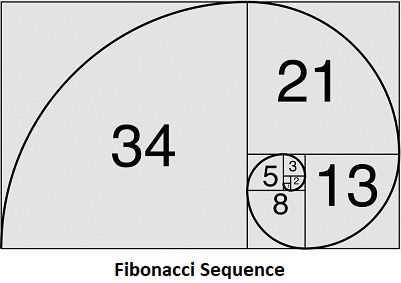
In other words, iteration is simply repetition. In a program, I can say to print the word “Iteration” 5 times. There is no feedback here, other than to keep count of the times the word was printed on screen. On the other hand, in recursion, the value of the first cycle is fed back into the second cycle, the output of which is fed into the third cycle and so on. Here circular feedback is going on. A great example of a recursive function is the Fibonnaci sequence. The Fibonacci sequence is expressed as follows:
Fn = Fn-1 + Fn-2, for n > 1
Fn = 1, for n = 0 or 1
Here, we can see that the previous value is fed into the equation to create a new value, and this is an example of recursion.
From the complexity science standpoint, recursions lead to interesting phenomenon. This is not an iterative non-feedback loop any longer, where you come back to the same point again and again. With recursion, you get to circular causality with each loop, and you enter a new state altogether. Each loop is directly impacted by the previous loop. Anything that leads back to its original starting point doesn’t lead to emergence and can actually lead to a paradox. A great example is the liar paradox. In a version of this, a card has a statement written on both sides of a card. They are as follows:
The statement on the other side of this card is FALSE.
The statement on the other side of this card is TRUE.
This obviously leads to a paradox when you follow it along a loop. You do not get to a new state with each iteration. Douglas Hofstadter wonderfully explained this as a mirror mirroring itself. However, with recursion, a wonderful emergence can happen, as we see in complexity science. Circular causality and recursion are ideas that have strong footing in Second Order Cybernetics. A great example of this is to look at the question – how do we make sense of the world around us? Heinz von Foerster, the Socrates of Cybernetics, has a lot to say about this. As Bernard Scott notes:
For Heinz von Foerster, the goal of second-order cybernetics is to explain the observer to himself, that is, it is the cybernetics of the cybernetician. The Greek root of cybernetics, kubernetes, means governor or steersman. The questions asked are; who or what steers the steersman, how is the steersman steered and, ethically, how does it behoove the steersman to steer himself? Von Foerster begins his epistemology, in traditional manner, by asking, “How do we know?” The answers he provides-and the further questions he raises-have consequences for the other great question of epistemology, “What may be known?” He reveals the creative, open-ended nature of the observer’s knowledge of himself and his world.
Scott uses von Foerster’s idea of undifferentiated coding to explore this further. I have written about this before here.
Undifferentiated coding is explained as below:
The response of a nerve cell encodes only the magnitude of its perturbation and not the physical nature of the perturbing agent.
Scott continues:
Put more specifically, there is no difference between the type of signal transmitted from eye to brain or from ear to brain. This raises the question of how it is we come to experience a world that is differentiated, that has “qualia”, sights, sounds, smells. The answer is that our experience is the product of a process of computation: encodings or “representations” are interpreted as being meaningful or conveying information in the context of the actions that give rise to them. What differentiates sight from hearing is the proprioceptive information that locates the source of the signal and places it in a particular action context.
Von Foerster explained the circular relationship between sense data and experiences as below:
The motorium (M) provides the interpretation for the sensorium (S) and the sensorium provides the interpretation for the motorium.
How we make sense depends on how we experience, and how we experience depends upon how we make sense. As Scott notes, we can explain the above relationship as follows:
S = F(M). Sensorium, S, is a function of motorium, M.
M = G(S). Motorium, M, is a function of sensorium, S.
Von Foerster pointed out that this is an open recursive loop, since we can replace M with G(S).
S=F(G(S))
With more replacements for the “S”, this equation becomes an open recursive loop as follows:
S=F(G(F(G(F(G(…………G(S)))))……
Scott continues:
Fortunately, the circularity is not vicious, as in the statement “I am a liar”. Rather, it is virtuous or, as von Foerster calls it, it is a creative circle, which allows us to “transcend into another domain”. The indefinite series is a description of processes taking place in sequence, in “time”, with steps t, t+1, t+2 and so on. (I put “time” in quotes as a forward marker for discussion to come). In such indefinite recursive expressions, solutions are those values of the expression which, when entered into the expression as a base, produce themselves. These are known as Eigen values (self-values). Here we have the emergence of stabilities, invariances. The “objects” that we experience are “tokens” for the behaviors that give rise to those experiences. There is an “ultimate” base to these recursions: once upon a “time”, the observer came into being. As von Foerster neatly puts it, “an observer is his own ultimate object”.
The computations that give rise to the experience of a stable world of “objects” are adaptations to constraints on possible behaviors. Whatever else, the organism, qua system, must continue to compute itself, as a product. “Objects” are anything else it may compute (and recompute) as a unitary aspect of experience: things, events, all kinds of abstraction. The possible set of “objects” it may come to know are limited only by the organism’s current anatomy and the culture into which she is born.
Heinz von Foerster said – The environment contains no information; it is as it is. We are informationally closed entities, which means that information cannot come from outside to inside. We make meanings out of the perturbations and we construct a reality that our interpretative framework can afford.
I will finish with a great observation from the Cybernetist philosopher Yuk Hui:
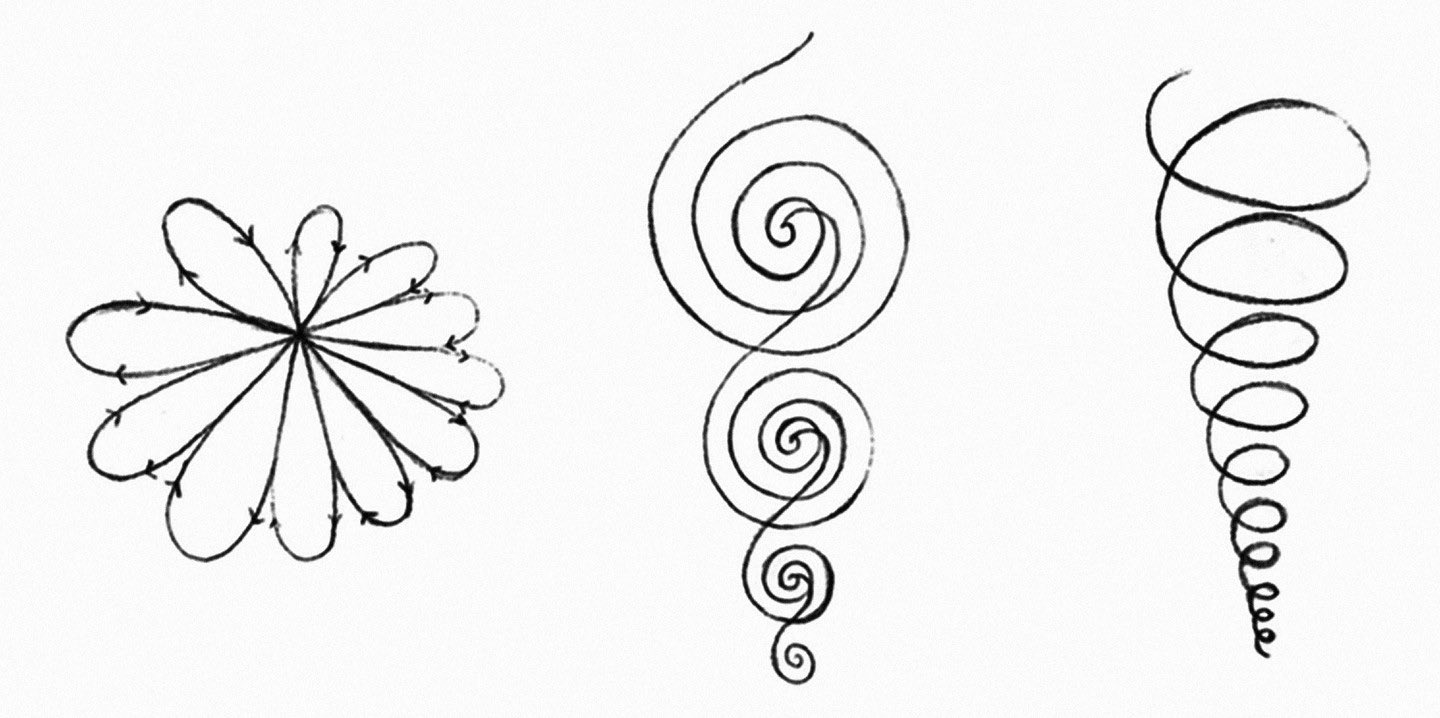
Recursivity is a general term for looping. This is not mere repetition, but rather more like a spiral, where every loop is different as the process moves generally towards an end, whether a closed one or an open one.
Please maintain social distance and wear masks. Stay safe and Always keep on learning…
In today’s post, I am looking at the idea of complexity from a second order Cybernetics standpoint. The phrase “only when you realize you are blind, can you see”, is a paraphrase of a statement from the great Heinz von Foerster. I have talked about von Foerster in many of my posts, and he is one of my heroes in Cybernetics. There is no one universally accepted definition for complexity. Haridimos Tsoukas and Mary Jo Hatch wrote a very insightful paper called “Complex Thinking, Complex Practice”. In the paper, they try to address how to explain complexity. They refer to the works of John Casti and C. H. Waddington to further their ideas:
Waddington notes that complexity has something to do with the number of components of a system as well as with the number of ways in which they can be related… Casti defines complexity as being ‘directly proportional to the length of the shortest possible description of [a system]’.
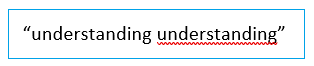
Casti’s views on complexity are particularly interesting because complexity is not viewed as being intrinsic to the phenomenon. This is a common idea in Cybernetics, mainly second order cybernetics. There are two ‘classifications’ of cybernetics – first order and second order cybernetics. As von Foerster explained it, first order cybernetics is the study of observed systems, where the basic assumption is that the system is objectively knowable. The second order cybernetics is the study of observing systems, where the basic assumption is that the observer is included in the act of observing, and thus the observer is part of the observed system. This leads to second order thinking such as understanding understanding or observing observing. It is interesting because, as I am typing, Microsoft Word is telling me that “understanding understanding” is syntactically incorrect. This obviously would be a first order viewpoint. The second order cybernetics is a meta discipline and one that generates wisdom.
When we take the observer into consideration, we realize that complexity is in the eyes of the beholder. Complexity is observer-dependent; that is, it depends upon how the system is described and interpreted. If the observer is able to make more varying distinctions in their description, we can say that the phenomenon or the system is being interpreted as complex. In their paper, Tsoukas and Jo Hatch brings up the ideas of language in describing and thus interpreting complexity. They note that:
Chaos and complexity are metaphors that posit new connections, draw our attention to new phenomena, and help us see what we could not see before (Rorty).
This is quite interesting. When we learn the language of complexity, we are able to understand complexity better, and we become better at describing it, in a reflexive manner.
What complexity science has done is to draw our attention to certain features of systems’ behaviors which were hitherto unremarked, such as non-linearity, scale-dependence, recursiveness, sensitivity to initial conditions, emergence (etc.)
From this standpoint, we can say that complexity lies in the interactions we have with the system, and depending on our perspectives (vantage point) and the interaction we can come away with a different interpretation for complexity.
Heinz von Foerster remarked that complexity is not in the world but rather in the language we use to describe the world. Paraphrasing von Foerster, cognition is computation of descriptions of reality. Managing complexity then becomes a cognitive task. How well you can interact or manage interactions depends on how effective your description is and how well it aligns with others’ descriptions. The complexity of a system lies in the description of that system, which entirely rests on the observer/sensemaker. The idea that complexity is in the eyes of beholder is to point out the importance of second order cybernetics/thinking. The world is as it is, it gets meaning only when we assign meaning to it through how we describe/interpret it. To put differently, “the logic of the world is the logic of the descriptions of the world” (Heinz von Foerster)
The idea of complexity not being intrinsic to a system is also echoed by one of the pioneers of cybernetics, Ross Ashby. He noted – “a system’s complexity is purely relative to a given observer; I reject the attempt to measure an absolute, or intrinsic, complexity; but this acceptance of complexity as something in the eye of the beholder is, in my opinion, the only workable way of measuring complexity”.
The ideas of second order cybernetics emphasize the importance of observers. The “system” is a mental construct by an observer to make sense of a phenomenon. The observer based on their needs draw boundaries to separate a “system” from its environment. This allows the observer to understand the system in the context of its environment. At the same time, the observer has to understand that there are other observers in the same social realm who may draw different boundaries and come out with different understandings based on their own needs, biases, perspectives etc.
A phenomenon can have multiple identities or meanings depending on who is describing the desired phenomenon. Let’s use the Covid 19 pandemic as an example. For some people, this has become a problem of economics rather than a healthcare problem, while for some others it has become a problem of freedom or ethics. If we are to attempt tackling the complexity of such an issue, the worst thing we can do is to attempt first order thinking- the idea that the phenomenon can be observed objectively. Issues requiring second order approach get worse by the application of first order methodologies. The danger in this is that we can fall prey to our own narrative being the whole Truth.
As the pragmatic philosopher Richard Rorty points out:
The world does not speak. Only we do. The world can, once we have programmed ourselves with a language, cause us to hold beliefs. But it cannot propose a language for us to speak. Only other human beings can do that.
If we are to understand complexity of a phenomenon, we need to start with realizing that our version of complexity is only one of the many. Our ability to understand complexity depends on our ability to describe it. We lack the ability to completely describe a phenomenon. The different descriptions that come about from the different participants may be contradictory and can point out apparent paradoxes in our social realm.
In complexity, if we are to tackle it, we need to have coherence of multiple interpretations. As Karl Weick points out, we need to complicate ourselves. By generating and accommodating multiple inequivalent descriptions, practioners will increase the complexity of their understanding and, therefore, will be more likely to match the complexity of the situation they attempt to manage. In complexity, coherence – the idea of connecting ideas together, is important since it helps to create a clearer picture and affords avoiding blind spots. This co-construted description itself is an emergent phenomenon.
In second order Cybernetics, there are two statements that might shed more light on everything we have discussed so far:
Anything said is said BY an observer. (Maturana)
Anything said is said TO an observer. (von Foerster)
A lot can be said between these two statements. The first points out that the importance of the observer, and the second points out that there are other observers, and we coconstruct our social reality.
Our descriptions are abstractions since we are limited by our languages. All our biases, fears, misunderstandings, ignorance etc. lie hidden in the “systems” we construct. We get into trouble when we assume that these abstractions are real things. This is the first order approach, where we are not aware that we do not see due to our cognitive blind spots. When we realize that all we have are abstractions, we get to the second order approach. We include ourselves in our observation and we start looking at how we make these abstractions. We also become aware of other autonomous participants of our social reality engaging in similar constructions of narratives. As we seek their understanding, we become aware of our cognitive blind spots. We realize that everything is on a spectrum, and our thinking of “either/or” is actually a false dichotomy.
At this point, Heinz von Foerster would say that we start to see when we realize that we are blind.
Please maintain social distance and wear masks. Stay safe and Always keep on learning…
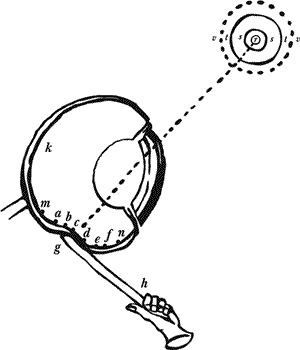
I work in the field of ophthalmic medical devices. I recently came across one of Sir Isaac Newton’s set of notes at the Newton project. In the notes, one particular experiment stood out to me. Newton pushed against his eye ball using a bodkin (a blunt needle) and recorded the optical sensations produced by the pressure on the eye. The schematic below drawn by Newton himself denotes the experiment. He noted:
I took a bodkin gh and put it between my eye & the bone as near to the backside of my eye as I could: and pressing my eye with the end of it (soe as to make the curvature a, bcdef in my eye) there appeared several white dark & colored circles r, s, t, &c. Which circles were plainest when I continued to rub my eye with the point of the bodkin, but if I held my eye & the bodkin still, though I continued to press my eye with it yet the circles would grow faint & often disappear until I renewed them by moving my eye or the bodkin.
He went on to note that there were different colors and types of sensations depending on if he was in a dark room or a well-lit room. I enjoyed reading through his notes because of my profession and also because it was an opportunity to peek inside a genius mind such as Newton. The experiment remined me of another great idea in Cybernetics called ‘the principle of undifferentiated coding’. This idea was proposed by another brilliant mind and one of my heroes, Heinz von Foerster. Von Foerster said:
The response of a nerve cell does not encode the physical nature of the agents that caused its response. Encoded is only ‘how much’ at this point in my body, but not what.
The brain does not perceive light, sound, heat, touch, taste or smell. It receives only neuronal impulses from sensory organs. Thus, the brain does not “see light,” “hear sounds,” etc.; it can perceive only “this much stimulation at this point on my body.” The practical consequence is that all perceptions, let alone “thoughts,” are deductions from sensory stimuli. They cannot be otherwise. All observations are therefore partly the function of the observer. This situation renders complete objectivity impossible in principle.
Ernst von Glasersfeld, the proponent of Radical Constructivism stated:
In other words, the phenomenological characteristics of our experiential world – color, texture, sounds, tastes and smells – are the result of our own computations based on co-occurrence patterns of signals that differ only with regard to their point of origin in the living system’s nervous network.
Cognition is an autonomous activity of the observer. The state of agitation of a nerve cell only codifies the intensity, not the nature of its cause. What is understood or constructed is unique to the observer. This goes against the idea that if we provide information to a person, he or she will understand what is being provided. Von Foerster would say that the hearer not the utterer determines what is being said. In Newton’s experiment, the sensations were not caused by the eye seeing lights, but due to the physical interaction on the eye. This idea is further explored by Humberto Maturana and Francisco Varela with the idea of autopoiesis. As an autopoietic being, we are all organizationally closed and any information generated is an autonomous activity of our cognitive apparatus.
Bernard Scott expands this idea further:
Von Foerster begins his epistemology, in traditional manner, by asking, “How do we know?” The answers he provides-and the further questions he raises-have consequences for the other great question of epistemology, “What may be known?”
there is no difference between the type of signal transmitted from eye to brain or from ear to brain. This raises the question of how it is we come to experience a world that is differentiated, that has “qualia”, sights, sounds, smells. The answer is that our experience is the product of a process of computation : encodings or “representations” are interpreted as being meaningful or conveying information in the context of the actions that give rise to them. What differentiates sight from hearing is the proprioceptive information that locates the source of the signal and places it in a particular action context.
Another key aspect to add to this is the idea of circularity, where the output is fedback into the cognitive apparatus. We continue to learn based on what we already know. Thus, we can say that learning is a recursive activity. What we learn now helps further our learning tomorrow. There is no static nature when it comes to knowledge and learning. The great French philosopher Montesquieu said, “If triangles made a god, they would give him three sides.” The properties of the world (seen and unseen) are dependent on the constructor/observer. The construction/observation is ongoing and reflexive. Montesquieu also said, “You have to study a great deal to know a little.” In other words, the more you learn, the more you realize how less you know. Or simply put, “the more you know, the less you know.”
I will finish with a wonderful von Foerster story from Maturana.
Maturana tells of a time when Heinz von Foerster and the famous anthropologist, Margaret Mead went to visit Russia. While there, they went to visit a museum. Mead was using a walking stick at that time. At the entrance they learned that she could not carry her walking stick inside. Mead decided that she would not go in since she could not walk long without using the walking stick. Von Foerster convinced her to go with him. He suggested that he would hide the stick in his clothing, and once inside he would give the stick back to her. His thinking was as follows:
ln this country, whether by perfection or by design, people do not commit mistakes, therefore, any guard that sees us Inside with the walking stick will be forced to admit that we were granted a special permit because otherwise we would not be Inside with it.’
As the story goes, they were able to visit the museum without any problems. Maturana concluded:
Heinz, by not asking beyond the entrance whether they could or not carry a walking stick, behaved as if he considered that through his interactions with the guards he could either interact with the protection system of the museum as a whole, or with its components as Independent entities, and as if he had chosen the latter. He, thus, revealed that he understood that the guards realized through their properties two non-intersecting phenomenal domains, and that they could do this without contradiction because they operated only on neighborhood relations. This allowed Heinz and Margaret Mead to move through the museum carrying what a meta- observer would have called an invisible forbidden walking stick.


 Harish's Notebook - My notes... Lean, Cybernetics, Quality & Data Science.