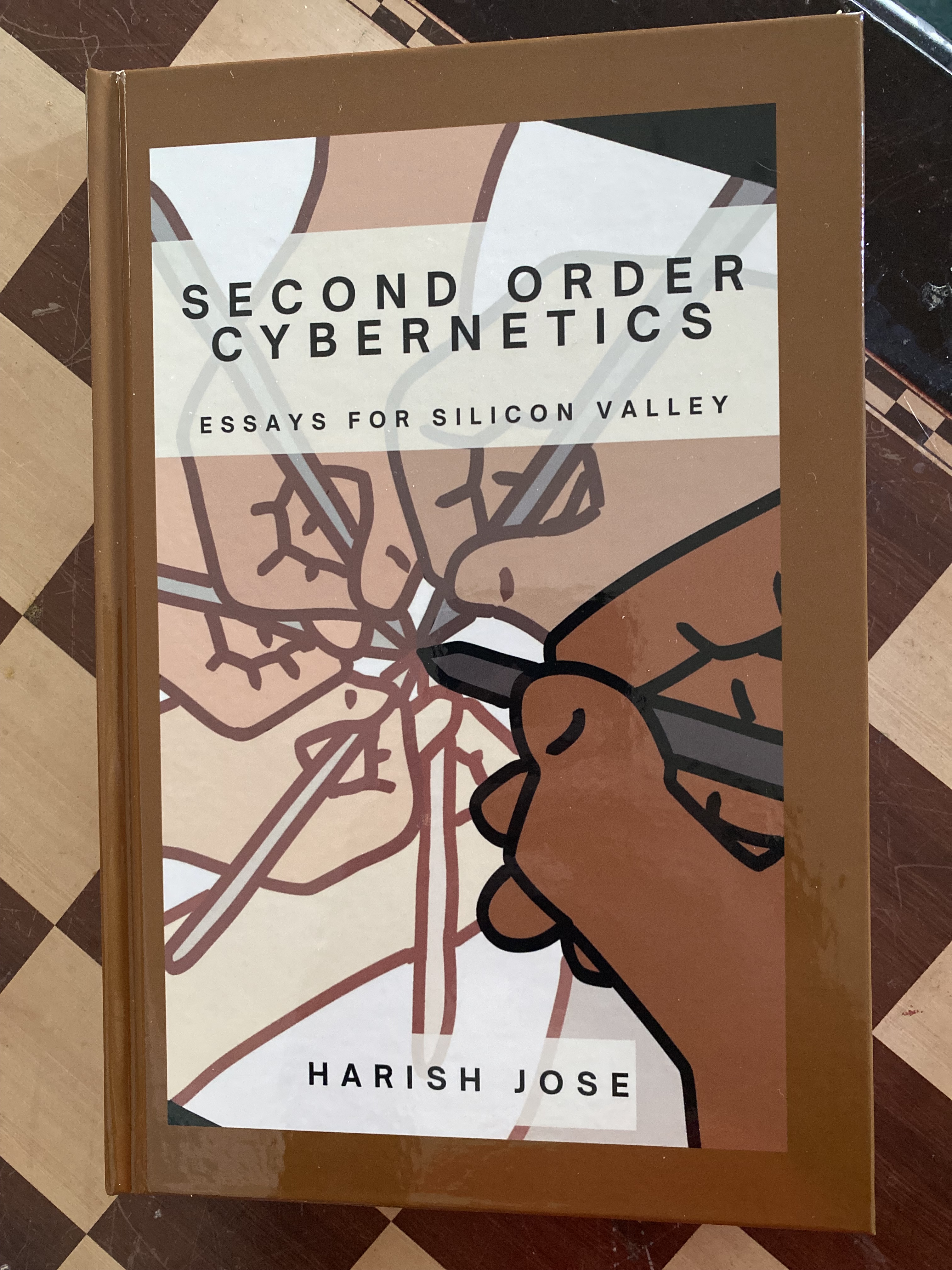
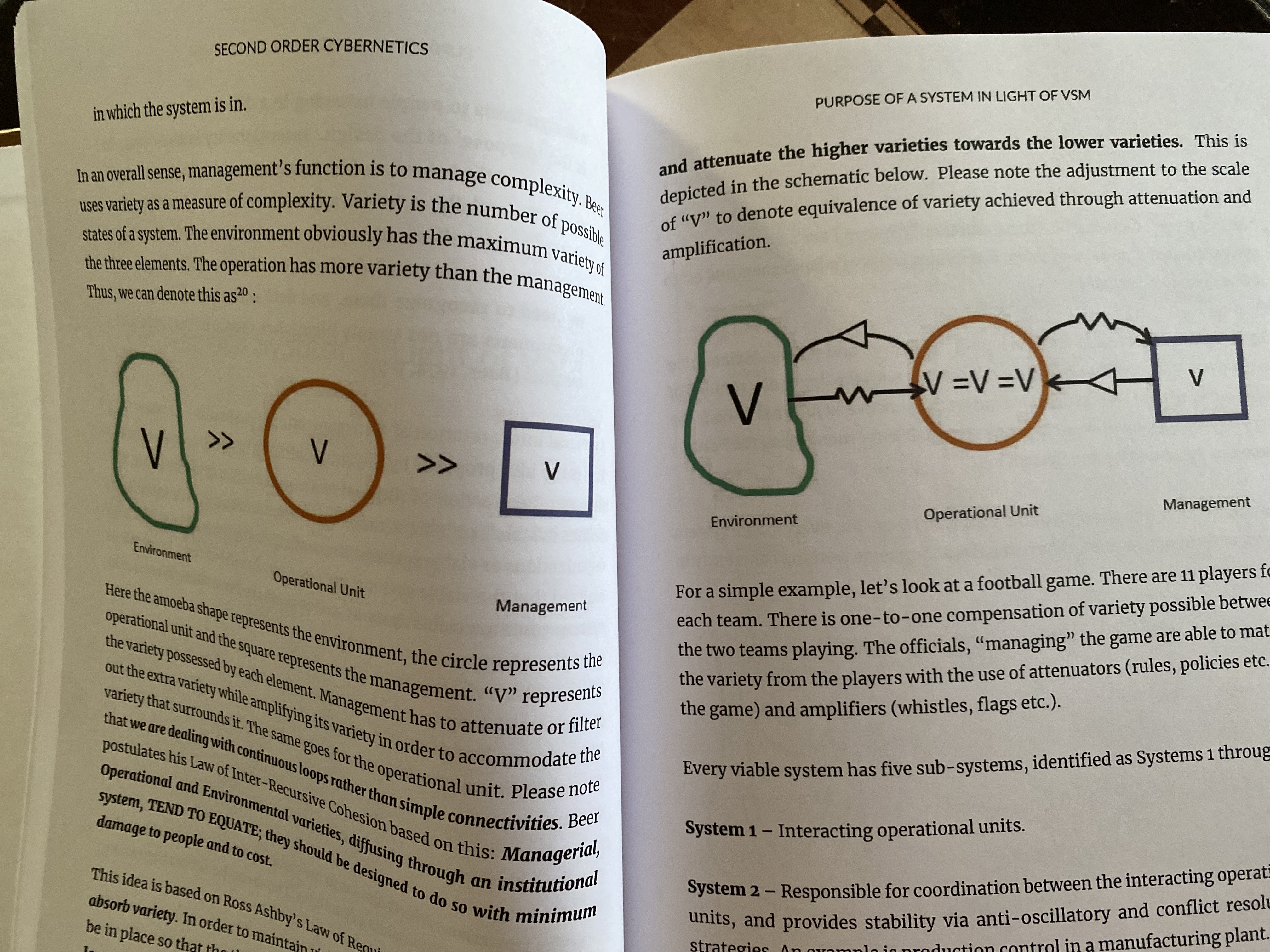
Last month, my first book was published. The book is a collection of essays that was written over the course of five years and covers ideas in second order cybernetics. The book is aptly titled – “Second Order Cybernetics”. The cover art is done by my lovely daughter, Audrey Jose. The book is published by Laksh Raghavan as part of Cyb3rSyn Labs Community offering. The hardcover of the book is available at this link. The hard cover copy is a beautifully typeset deluxe edition. I am thankful for my readers and Laksh for his trust in my ideas.
The venture by Laksh represents a great opportunity to mingle with people from different backgrounds to pursue cross-disciplinary learning in themes such as cybernetics, systems thinking, philosophy, and more. I am excited to be part of this intellectual community and ongoing dialogue.
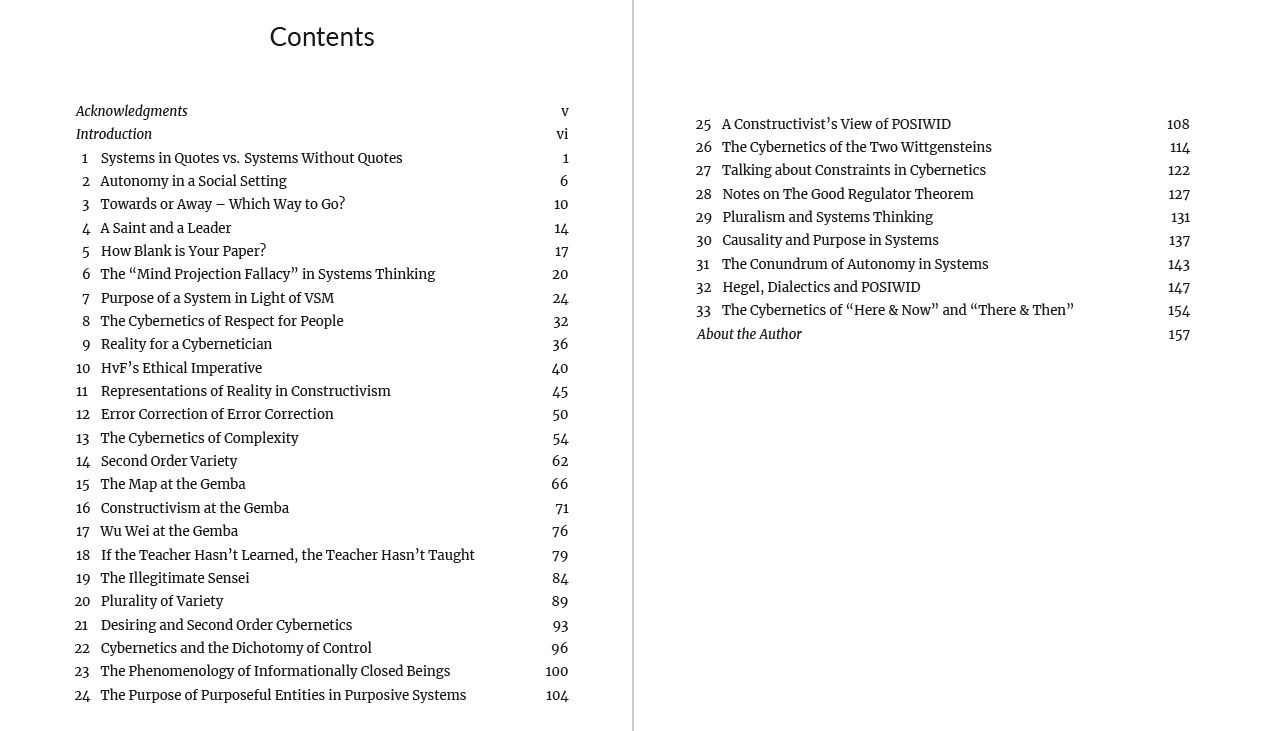
The table of contents of the book is given below:
The Recursive Mirror: Why I Write
I write to make sense of the world and my place in it. Moreover, I write to find myself. Writing gathers my scattered thoughts, helping me wrestle with ideas and shape them into something coherent. It is a way to lay out the pieces of a puzzle, to see where they fit and where they do not. By externalizing my thoughts through writing, I can spot flaws in my thinking, correct errors, and refine my understanding.
I understand that my ideas might be fallible. Writing is a form of error correction, a way to surface hidden assumptions and test them. The act of translating thoughts into words forces me to confront contradictions and gaps in my reasoning. However, error correction does not end with me. By putting my ideas out into the world, I invite others to scrutinize them, to challenge and refine my thinking in ways I might not achieve alone.
Concepts, unlike physical objects, do not reveal their mismatches as easily. You know when an oversized peg will not fit into a hole, but conceptual contradictions and paradoxes linger in cognitive blind spots. Writing becomes a tool to illuminate those hidden contradictions, to test ideas and see if they truly hold. Each iteration of thought, refined through reflection and external feedback, sharpens understanding.
I strive to be able to find differences among apparently similar things and similarities among apparently different things. Writing is my way of exploring those connections, of noticing patterns that might otherwise stay buried. Maturana spoke of “aesthetic seduction“, the idea that we should not seek to convince others but to attract them to our way of seeing. I write not to persuade, but to offer my thoughts as an invitation. As informationally closed entities, readers must convince themselves; my role is simply to present the ideas in their most compelling form.
Baltasar Gracián wrote, “The best skill at cards is knowing when to discard.” [1]Writing teaches me this skill, knowing which ideas to keep and which to let go of. It clears the mental clutter, revealing what truly matters. Error correction itself is recursive, an ongoing cycle of questioning, refining, and discarding what no longer serves understanding.
Ultimately, I write first for myself. It is a way to think, to question, and to grow. And by putting my words out into the world, I open the door for unexpected connections, corrections, and conversations. Writing, then, becomes not just a means of expression but an evolving dialogue; with myself, with others, and with the ever-changing nature of truth. I write so that I can keep learning.
References:
[1] The Art of Worldly Wisdom: A Pocket Oracle. – Baltasar Gracián
On November 5th, it’s Election Day in the United States! If you are eligible, please go and vote. Whether you vote in person or by mail, participating in our democracy is crucial. Don’t miss this opportunity to shape the future of our community and country. Remember, every vote counts! Visit vote.gov for more information.
In today’s post, I will explore voting through the lens of cybernetics. In the United States, the president is elected based on the number of electoral votes, which are allocated by each state. This means that a candidate can win the popular vote yet fail to become president if they lack sufficient electoral votes. This often leads to the feeling that my vote doesn’t count, particularly if I’m not from a swing state. A swing state typically fluctuates between the two major political parties. Voting is our means of expressing our voices and participating in democracy. In today’s post, I am highlighting the importance of voting and hope to persuade readers that every vote truly matters.
The term ‘Cybernetics’ is derived from the Greek word for ‘steersman.’ Cybernetics focuses on goal-oriented processes and error correction through feedback loops. In a cybernetic system, a controller establishes the goal, while a control mechanism uses a comparator to measure deviations and an actuator to modify the course as needed. The field distinguishes between first and second order cybernetics. First order cybernetics is the cybernetics of observed systems. In this, we have the observer who is separated from the system they are observing. Here, there is a clear distinction between the subject and the object. Second order cybernetics, on the other hand, is the cybernetics of cybernetics. The self-referential nature means that the observer is now part of the system they are observing.
This distinction becomes crucial when we consider voting. Through first order cybernetics, we might simply ask, “Does my vote really matter?” But second order cybernetics prompts us to ask, “How am I part of what makes my vote matter or not?” The first order view sees the voting system as fixed and unchangeable. The second order perspective recognizes that we are part of the system we’re observing – the patterns exist because of how people (including ourselves) act. We construct this reality, and by understanding our role in this construction, we can identify opportunities to break cycles.
When we choose not to vote based on a first order view, we actively maintain the status quo, fulfilling our own prophecy about votes not mattering. Our belief in the system’s immutability contributes to its rigidity. Conversely, by voting, we participate in collective construction – not predicting outcomes, but helping to create them. This shift from seeing the voting system as external (first order) to recognizing our role in shaping it (second order) empowers voters as active participants rather than passive bystanders.
This type of thinking does not just promote voting; it offers a framework for thinking about participation in any system where individual and collective actions feed back into the system itself. It encourages a dynamic, participatory outlook which can potentially lead to a change from the current stable state.
Second order cybernetics promotes ethical considerations. Heinz von Foerster, the Socrates of Cybernetics, developed the ethical imperative. This states that “I shall act always so as to increase the total number of choices.” I am responsible for my own actions as well as inactions. Not voting reduces the possible states of the future. The future is yet to be determined. By voting, we are ensuring that the future has the capacity for more options. By voting, we are not just being observers; we are actively creating it with other participants. My actions are creating possibilities for myself and others. We are all connected in creating choices. My choices should promote kindness and the wellbeing of all. Everyone should be able to make choices for themselves, and this includes bodily autonomy. I am reminded of the following quote from one of my favorite TV characters, Doctor Who:
“Human progress isn’t measured by industry. It’s measured by the value you place on a life… an unimportant life… a life without privilege. The boy who died on the river, that boy’s value is your value. That’s what defines an age. That’s… what defines a species.”
Von Foerster also said, “If you desire to see, learn how to act.” By this, he meant that observation is not passive. We can only understand a situation by actively engaging with it. Action and perception are circularly linked. To understand the political system, we must participate in it. Not participating in it reduces our ability to see possibilities. Acting in it creates new ways to see and understand. If we do not engage by not voting, we allow ourselves to have cognitive blind spots. We cannot see how the political system can be different because we are not acting within it. We cannot understand the situation from the outside alone. Our actions create new ways of seeing.
We should exercise our civic duty of voting in all elections, including local elections. This allows us to notice the small changes within our community. We learn how close elections can be. The local elections elect individuals who can, in turn, have a large impact on our community. We are not trying to predict whether our vote matters; instead, we are making it matter through consistent participation.
Another important idea in second order cybernetics is that of recursion. No election cycle is independent. Each builds upon the previous cycles. Stable patterns can emerge from recursive operations. The current voting patterns emerge from historical patterns, but those patterns persist only because people continue to act based on the very same patterns. These patterns can be broken when enough people challenge their assumptions about what is possible. The observer (voter) is circularly connected to the observed. The voter’s perception of the system’s responsiveness is part of the system. The belief in the futility of voting is itself a crucial system component. Breaking this circular belief can lead to moving away from the current stable pattern. These stabilities are products of recursive operations and not some fixed laws.
I will finish with this wonderful quote attributed to Margaret Mead, whose 1968 paper inspired Heinz von Foerster to develop “Cybernetics of Cybernetics”:
“Never doubt that a small group of thoughtful, committed citizens can change the world; indeed, it’s the only thing that ever has.”
In today’s post, I am looking at the idea of “sweeping-in” in Systems Approach. “Sweeping-in” can be described as the process of opening up the inquiry of a system by expanding its boundaries. Churchman discussed sweeping-in in several works, including “Thought and Wisdom” [1] and “The Design of Inquiring Systems” [2]. Churchman credited his teacher, E. A. Singer, for the concept of sweeping-in.
The “sweeping-in” process was introduced as a method for incorporating diverse concepts and variables from various sciences to resolve inconsistencies in measurements or observations. Churchman wrote:
the problems we humans face are so closely interconnected so that the only way we can study a system is to recognize the need to be comprehensive. [1]
there are no simple questions and the process of addressing a specific question will eventually require answers to more and more questions, i.e., require the “sweep-in” process. [1]
The sweeping-in process consists of bringing concepts and variables… into the model to overcome inconsistencies… [2]
In Systems Approach, sweeping-in requires us to expand our inquiry to incorporate a wide range of perspectives and variables. It demands that we examine the larger system and understand the ethical implications of our approach. This is a continual process that necessitates a cross-disciplinary approach. When addressing a situation, we must bring in knowledge and perspectives from multiple stakeholders and look at broader contexts. This means looking beyond the immediate problem to understand the larger systems and contexts in which our system exists.
Singer argued against the idea of simple and directly knowable facts from observation. He thought that there are no simple facts of nature that we can know directly, and that even seemingly simple observations are actually complex. In this regard, when we set out to find an answer to any question of fact, we realize that we must learn more and more about the situation. The original question becomes increasingly complicated, not simpler. Singer advocated not trying to reduce observations to simple elements, but instead following a sweeping-in process where our inquiry expands to include more context and interconnected systems.
The sweeping-in process is anti-reductionistic. Churchman explained this when he wrote about the strategies of inquiry [2]:
Which is better, to reduce the system to its elements or to expand the system? A system-science reply would be that since there are no simple, elementary questions, the first strategy is based on illusion and the second is the one to be followed.
The sweeping-in process requires us to embrace the complexity of the situation at hand. This demands epistemic humility. Reality is already complex, which means that our initial framing of the situation is often too narrow, resulting in premature solutions that are not effective and may cause more harm than good in the long run. We may ignore important interactions and relationships, leading to unintended consequences.
Sweeping-in involves examining our current system from the perspective of the larger systems it is part of. This is one of the basic ideas in systems approach – to understand the function of a part, we must look at it from the standpoint of the larger whole. There is a hint of Godelian thinking here. A great example from Russell Ackoff, a renowned Systems Thinker and student and friend of Churchman, is that of the automobile. No matter how much we understand an automobile and its parts, we will never understand why we drive on the right side of the road in the U.S. unless we consider the larger context—the historical, social, and cultural norms that shape American driving practices.
The reader might now wonder about the use of cybernetics in the title of the post. Churchman wrote that sweeping-in is a process of adding in and adjusting the results to improve our understanding of a problem [1]. This is a means to perform error correction in our understanding. This will be a never-ending process since we lack the variety to completely understand the external world.
Sweeping-in cautions against over-simplification. This does not mean that we need to make a situation artificially more complex for the sake of it. As I mentioned before, reality is already complex. We need to acknowledge our limitations and account for enough perspectives and variety to match the variety of the situation at hand. In Cybernetics, complexity is explained via variety. To achieve a requisite understanding of the situation, we need to have requisite variety. One of the most important ideas in cybernetics is Ross Ashby’s law of requisite variety. I welcome the reader to explore this further here.
The complexity that we are “adding” through sweeping-in is not arbitrary. We are attempting to include aspects that are needed but might not have been considered in the initial framing. This could include perspectives from other stakeholders, longer-term consequences, ethical considerations, or the influence of broader contexts such as social, political, or environmental factors.
Our basic instinct is to simplify when faced with situations that seem complex. This process is known as attenuating external variety in cybernetics. While simplification can effectively achieve requisite variety, excessive attenuation signals ignorance, which in cybernetics is referred to as the “lethal attenuator.” Our attempts to simplify can often create blind spots, causing us to overlook less obvious but influential factors. Therefore, sweeping-in serves as a reminder to deliberately resist oversimplification.
Having epistemic humility and being aware of our cognitive blind spots are important notions in second-order cybernetics. Second-order cybernetics reminds us that any system’s functioning includes the observer and their interactions with the system. Here, the feedback loops include the observer as a participant, influencing the dynamics and adding new layers of complexity to the situation. This recursive process highlights the interdependence of the system and the observer, making it illogical to separate the two.
This reflexive approach means that reality is constructed on an ongoing basis through the interaction between the observer and the system. Most importantly, this approach incorporates ethics, one of the key points of Systems Approach, by recognizing that the observer’s involvement in a system carries responsibility. Since observers influence systems and construct reality through their interactions, they must be aware of the consequences of their actions. This promotes a constructivist view, where knowledge and reality are not discovered as objective facts but are constructed through interaction in a social realm. Observers are responsible for the realities they help construct. This practical aspect challenges the implications of relativism. While multiple perspectives may exist, the ethical responsibility of observers grounds our understanding of “truth” and “reality”, emphasizing that our participation in systems has meaningful consequences.
Churchman used the examples of a prison and a hospital to explain the ethical considerations further[1]:
The planner should search not for ways to make the prison or the hospital run more smoothly, but for the reasons why we have things like badly run prisons and hospitals. The reasons turn out to be political, as much as economic; hence, the planner needs to “sweep-in” the causes of the existence of the troubled organization, and these causes like in other systems.
Another notion in sweeping-in is the need for challenging assumptions. Here we should ask questions such as WHO defines the system, WHOSE perspectives are included or excluded, and WHAT ethical considerations should be taken into account etc. The path forward, as advised by Churchman, is to utilize idealistic thinking. We must look at what an ideal solution would look like, not just accepting the current “realities”.
There are no final solutions in this approach, only provisional solutions. There is only continuous feedback and adaptation. This is also an important aspect of second-order cybernetics. The emphasis is on “less wrong” solutions rather than correct solutions. Each action taken informs the next round of understanding and action. Thus, the emphasis is on improving our understanding, or “understanding understanding”, another notion in second-order cybernetics.
Churchman was a pragmatist. From this perspective, the practical payoff comes from improving the depth and quality of decision making by acknowledging our limitations and inherent complexity of the situation. The goal is better informed action. I will finish with a great passage from Churchman that shows his true pragmatist spirit [2]:
When all is going well, and data and hypothesis are mutually compatible, then is the time to rock the boat, upset the apple cart, encourage revolution and dissent. Professors with well-established theories should encourage their students to attack them with equally plausible counter-theories. This is the only pathway to reality: whenever we are confident that we have grasped reality, then begins the new adventure to reveal our illusion and put us back again in the black forest.
But the process is dialectical, which means that two opposing processes are at work… One is the process of defending the status quo, the existing “paradigm” of inquiry, with its established methods, data, and theory. The other is the process of attacking the status quo, proposing radical but forceful paradigms, questioning the quality of the status quo.
Singer… called the “real” an “ideal” and we can see why. The idealist is a restless fellow who sees evil in complacency; he regards the realist as a hypocrite at times because his realism is unrealistic. The realist, on the other hand, accuses the idealist of being impractical, because his insistence on destroying the value of the present way of life precludes positive action. The Singerian inquiring system does not seek to resolve the philosophical dispute, but, on the contrary seeks to intensify it.
Always keep on learning.
[1] Thought and Wisdom, C. West Churchman (1982)
[2] The design of inquiring systems, C. West Churchman (1971)
In today’s post, I am looking again at the idea of constraints in relation to Ross Ashby’s ideas and the ideas of second order cybernetics. As far as I know, Ashby did not go into the differentiation of first and second order cybernetics. A lot of what he wrote can be filed away under “First order cybernetics”. But to do so will be missing the forest for the trees. A lot of Ashby’s ideas were ahead of his time and resonate with the ideas of complexity and systems thinking.
Ashby tied the idea of constraints to variety and the observer. Variety, as I have written here before, can be loosely put as the number of possible states differentiated by an observer. So, for example, an analog light switch can be said to have a variety of two – ON and OFF. Constraint is the relational part between an observer and a “system”. A “system” here is a select number of variables chosen by an observer to represent a phenomenon of interest. To elaborate these ideas, I am taking the example of an observer who chooses a Christmas tree as an area of interest. Further, let’s consider that the tree is connected to an analog switch with a variety of two as stated before. The observer can decide they would like to leave the tree ON for the entire Christmas season to reflect the Christmas spirit. The variety of the switch is now reduced to one, barring any unforeseen incidents. The switch is always kept in the ON position. Out of the two possibilities, a constraint was applied so that there is only one possibility.
Ashby was very clear that Cybernetics is about looking at what something is doing, instead of looking at what that “something” is. From this standpoint, we are looking at possibilities, which is a “black box” view. We are looking at how something is behaving and are not really interested in the intricacies of how things are connected together.
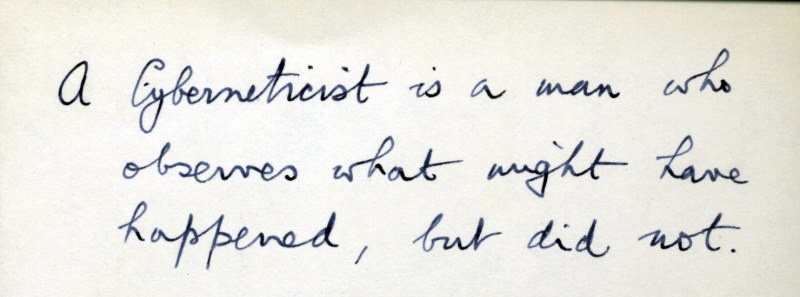
Ashby noted in his private notebook that “A Cyberneticist is a man[sic] who observes what might have happened, but did not.”
This idea of “something that might have happened, but did not” is related to the notion of constraints. Cybernetics is often depicted as a science of teleology. This is the first order Cybernetics. For example, we often depict the idea of a steersman moving towards a goal, where a clear path is set. From the idea of constraints, we should be looking at negative explanations. We may choose the destination, but the path is set by the constraints. Gregory Bateson, another intellectual giant in Cybernetics, noted the following about negative explanation:
Negative explanation is an aspect of cybernetic theory that emphasizes restraints. According to negative explanation, events take a particular course because they are constrained from taking other courses. Alternatively, positive explanation seeks to determine the causes of particular events. Rather than focusing on “Why?”, negative explanation involves describing the constraints under which systems operate.
We consider what alternative possibilities could conceivably have occurred and then ask why many of the alternatives were not followed, so that the particular event was one of those few which could, in fact, occur.
In a similar fashion, Ashby wrote:
Cybernetics looks at the totality, in all its possible richness, and then asks why the actualities should be restricted to some portion of the total possibilities.
The real world gives the subset of what is; the product space represents the uncertainty of the observer. The product space may therefore change if the observer changes; and two observers may legitimately use different product spaces within which to record the same subset of actual events in some actual thing. The “constraint” is thus a relation between observer and thing; the properties of any particular constraint will depend on both the real thing and on the observer. It follows that a substantial part of the theory of organization will be concerned with properties that are not intrinsic to the thing but are relational between the observer and thing.
We often emphasize on having a goal or direction, but we neglect the importance of constraints. Some constraints can be physical such as a ball rolling down a chute. The ball will always follow the same path. Now compare this to a rock falling down a hill. It may not follow the same path if you repeat rolling it down a hill. Some paths are more likely than others. And no matter how many times you roll it down a hill, some paths are never taken due to the physical constraints of the hill. These can be understood from a first order Cybernetics standpoint. From the second order Cybernetics standpoint, it is very important to understand the relational nature of constraints to the observer. What is limiting to one person can be nurturing for another. From the second order Cybernetics standpoint, the constraints are our biases and other epistemic constraints that limit or enable our actions.
According to Greek mythology, Sisyphus was made to roll a large rock up a hill and have it roll down; only to repeat this exercise again and again for eternity. He was made to do this as a punishment. Curious enough, in another part of the world, in Kerala (India), there is another mythology that talks about another character who rolled a large rock up a hill only to have it roll down. Naranath Branthan (The madman of Naranam) would roll a large rock up a hill and have it roll down. He would repeat this again and again. His reason for doing this was entirely different than Sisyphus. Naranath Branthan was not doing it for punishment. But, he was doing it for fun. The stories about him said that he would laugh with joy and clap his hands as he watched the rock roll down the hill. If Sisyphus would had found joy in what he did, the Gods would have been forced to free him from the punishment since it would cease to be a punishment.
I will finish with a wonderful story about Naranath Brandan.
One day he met Kali, an Indian goddess, as he was retiring for the night. Kali was impressed by the madman and told him that she will give him a boon (blessing).
“I do not want any boons”, the madman said. He just wanted to get on with his night and go to sleep.
Kali informed him that she has to give a boon or a curse, and she insisted that he take a boon.
“I want to increase my life time by a second”, the madman replied. Kali told him that she could not do that.
“Then I want to decrease my life time by a second”, the madman said. Kali told him she could not do that either.
The madman thought for a while and asked Kali to move the elephantiasis from his left leg to the right leg. Kali complied, and the madman lived happily with elephantiasis on his right leg from that day onwards.
In today’s post, I am continuing on my thoughts on stoicism through the lens of cybernetics. In Cybernetics, we call regulation the act (art) of responding to external disturbances in order to maintain selected internal variables in a range. For example, our body maintains the internal temperature in a specific range. We have internal regulations built in through evolution to ensure that this is done. In the language of cybernetics, regulation refers to the act of countering the external variety. In order to counter the external variety, we must have requisite variety. As noted in the last post, only variety can absorb variety. If the external temperature goes up or goes down, our body should have a mechanism to react so that the internal temperature is maintained in a specific range. If it is not able to do this, we will not stay viable. The goal of requisite variety in this instance is about maintaining the status quo.
There are mainly two types of regulations in cybernetics as Ross Ashby noted – direct and indirect regulation. Direct regulation is the type of regulation where there is an established framework of counteractions that the agent can use. In the case of body temperature, heat loss can be promoted in a hot environment by many different mechanisms such as sweating or by reduction of muscular activities. Similarly, heat loss can be minimized in a cold environment using several mechanisms such as shivering or other activities to improve body insulation (reducing blood flow to the skin). There are several other mechanisms used by our bodies that are not listed here. These activities come under direct regulation because these happen without any oversight from us. Our bodies have evolved to do these things. Direct regulation is obviously limited in what it can do. For a low complex organism such as a wasp, direct regulation is adequate for survival. When the environmental conditions change or become extreme, direct regulation will no longer be able to provide requisite variety. In this case, we need indirect regulation. Indirect regulation refers to our ability to achieve requisite variety through second order activities. This involves learning mechanisms. For example, when it gets cold, we learn to move to a warmer location or to put on more clothes or to start a fire. We learned to create warm clothes or generate fire at will. This type of regulation did not come through evolution. What did come through evolution is our ability to learn to adapt. The second order refers to the ability to learn. Direct regulation is first order in nature. Second order is where you realize that the current specification is not working and that we need to change what we are doing or change the specification altogether. First order is simply realizing that there is a gap between the current state and where we want to be, and upon this realization continue on an already prescribed path.
We can see that indirect regulation has much more impact for our continued survival than direct regulation. Both types of regulation involve attenuation and amplification of variety in order to achieve requisite variety. As noted before, external variety is always higher than internal variety. Variety is directly correlated to complexity. The impact that the complexity in the world can have on us is ever increasing mainly because we are getting connected to the world in unprecedented ways. What I am typing here at my home can reach someone else in the farthest corners of the world in a matter of seconds. Something that happens locally in one location can have a direct impact on the entire world, as evidenced by the Covid 19 pandemic. How can we ensure our viability in these conditions?
Stoicism provides a lot of guidance for us in this regard. Stoicism provides us guidelines for us to improve our indirect regulatory activities. I am not discussing the dichotomy of control here since I discussed it last time. Instead, I will look at what Stoicism says about adversities in life. Most of our trouble comes from the fact that we do not orient ourselves properly. We give into direct regulation such as freeze, flight or fight. This worked for our ancestors, but this will not work, say for example, in a workplace environment. It is not easy for us to orient because we are not expecting the variety of the adversity that was thrown at us. It could be that we were put in a challenging situation where we have put ourselves or our company at a huge risk condition. Or something drastic happened that requires immediate action or our lives are in danger. How does one improve our internal variety in these conditions? How does one learn to attenuate the external variety so that we don’t focus on the noise? How do we amplify our variety so that we concentrate only on what is needed?
Stoics talk of a great tool that will help us here. It is called “premeditatio malorum”. This stands for “negative visualization”. When we start our day, think of the many ways, the day could go wrong. Think of driving in the traffic and someone cutting us off or getting into an accident. What can we do in this situation? Think of going into the important meeting and you saying something that would be perceived as silly. What would you do in this situation? Meditating on this is in many regards a way to prepare ourselves to better prepare in case such things do happen. It is obviously easy to go wild with this exercise, so we should keep it as practical as possible.
Another key insight from the stoics is the idea of seeing every experience as an opportunity. Every adversity or challenge that we face is an opportunity to learn. The big project that we are embarking upon work is an opportunity to improve ourselves. The challenges that are thrown at us actually make us better when we welcome them as challenges to finetune our skills. Many a time, stoicism is badly represented as being detached from reality. When something bad happens, the stoics are expected to be emotionless. On the contrary, stoicism is about being able to ground ourselves to reality and reorient ourselves so that we can use every experience as a learning opportunity. As with the premeditation malorum, we must exercise caution and not go out of our way looking for challenges. Instead we must take on the challenges that come our way and not run away from them. We must learn to be practical with the theory.
Seneca presents us with a paradox of fortune and laments those who were not fortunate enough to have gone through any misfortunes:
I judge you unfortunate because you have never lived through misfortune. You have passed through life without an opponent—no one can ever know what you are capable of, not even you.
Epictetus asks us who Hercules might have been without any of his adversities:
“What would have become of Hercules do you think if there had been no lion, hydra, stag or boar – and no savage criminals to rid the world of? What would he have done in the absence of such challenges?
Obviously he would have just rolled over in bed and gone back to sleep. So, by snoring his life away in luxury and comfort he never would have developed into the mighty Hercules.
And even if he had, what good would it have done him? What would have been the use of those arms, that physique, and that noble soul, without crises or conditions to stir into him action?”
Perhaps, at this juncture the reader is reminded of resilience and maybe of antifragility. From a cybernetics standpoint, resilience is a matter of maintaining status quo after a setback. This can be done mainly through first order activities and through second order activities as needed. Antifragility, on the other hand requires second order activities which leads to post traumatic growth (PTG).
I will finish with some wise words from the philosopher king, Marcus Aurelius:
Our actions may be impeded . . . but there can be no impeding our intentions or dispositions. Because we can accommodate and adapt. The mind adapts and converts to its own purposes the obstacle to our acting. The impediment to action advances action. What stands in the way becomes the way.
If you are interested in Stoicism, you might like:
In today’s post, I am looking at the idea of “authenticity” in relation to existentialism. I am inspired by the ideas of Kierkegaard, Heidegger, Sartre and De Beauvoir. The title of this post may be misleading. From an existentialist standpoint, to talk about an authentic person is contradicting the very ideas it stands for. An existentialist believes that existence precedes essence. This means that our essence is not pregiven. Our meaning is something that we create. It is an ongoing construction. I do admit that I find the idea of an authentic cybernetician quite fascinating. I am exploring the idea of “authenticity” in existentialism with relation to cybernetics. As Varga and Guignon note:
The most familiar conception of “authenticity” comes to us mainly from Heidegger’s Being and Time of 1927. The word we translate as ‘authenticity’ is actually a neologism invented by Heidegger, the word Eigentlichkeit, which comes from an ordinary term, eigentlich, meaning ‘really’ or ‘truly’, but is built on the stem eigen, meaning ‘own’ or ‘proper’. So the word might be more literally translated as ‘ownedness’, or ‘being owned’, or even ‘being one’s own’, implying the idea of owning up to and owning what one is and does. Nevertheless, the word ‘authenticity’ has become closely associated with Heidegger as a result of early translations of Being and Time into English, and was adopted by Sartre and Beauvoir as well as by existentialist therapists and cultural theorists who followed them.
From an existentialist standpoint, authenticity has come to be associated with freedom and responsibility. Authenticity is about freedom – of self and others. We are responsible for our actions. Our existence is contingent on many things such as the time and place where we live, the society we live in etc. This is referred to as “facticity” in existentialism. We are not limited by this and we cannot live a life as defined by others. We are autonomous beings and we are able to unfold our lives based on our choices. Having said that we are always existing in relation to others. The “I” is in relation to others. I am a husband and a father; I am also an employee; I am also a friend and so on. The “I” is a stable construction that is continuously unfolded. I am continuously constructing a stable presentation of who I am to other people and to myself. Authenticity comes in when we become aware of all this, and when we strive for the freedom of others.
The idea of unfolding is an interesting idea. It has an undertone of potentiality. The term ‘potentiality’ refers to possibilities. At any given point in time, there are a large number of possibilities, some that we are aware of and many that we are not aware of. We have the freedom to choose the specific possibility and we have to be responsible for that choice. The notion of possibilities aligns with the notion of variety in cybernetics. Variety is the number of possible states of a ‘system’. When a ‘system’ has requisite variety, it is able to stay viable. As Ross Ashby, one of the key pioneers of cybernetics, put it – only variety can absorb variety. When the ‘system’ is able to use one of the many possible states it has, to tackle a specific demand imposed on it by the external world, it is able to stay viable. This is what is referred to as the “absorption” of variety. The ‘system’ should be able to identify the available possible states it has at its disposal. This requires the ‘system’ to have some knowledge of what each possible state can do or not do. This knowledge comes from previous experiences or past interactions. The states that worked will be retained by the ‘system’, and in some cases the ‘system’ will modify certain states while interacting with the external world through a learning situation. All these notions are part of first order cybernetics. I believe that the ‘authentic cybernetician’ should be more interested in second order cybernetics. As Heinz von Foerster put it, first order cybernetics is the cybernetics of observed systems, and second order cybernetics as the cybernetics of observing systems.
From the second order cybernetics standpoint, we are aware of the observing process itself. This means that we are aware of the observation of our act of observing – being aware that we have blind spots and that our observation is a construction based on our biases, experiential reality etc. This would also mean that we realize that there are others also involved in similar observations and constructions. Authenticity in existentialism is being aware of our facticity and the freedom that we have to make choices, and being responsible for our actions. The idea that we are constructing a version of reality, and that we are responsible for that construction is a key point in second order cybernetics. When I talk about ‘authentic cybernetician’, there might be an expectation that I should put forth a prescribed step-by-step formula for being an authentic cybernetician. This would be a first order viewpoint. Being authentic however, requires a second order approach. There is no prescribed methodology here. We are invited to be aware of how we are thrown into this world, and how we are situated here; how we are somewhat defined by our past actions and yet somehow, we are not necessarily bound by those actions. It is about improving our interpretative framework so that we can afford requisite variety.
I will finish with some wise words we should heed from Simone de Beauvoir:
We have to respect freedom only when it is intended for freedom, not when it strays, flees itself, and resigns itself. A freedom which is interested only in denying freedom must be denied. And it is not true that the recognition of the freedom of others limits my own freedom: to be free is not to have the power to do anything you like; it is to be able to surpass the given toward an open future; the existence of others as a freedom defines my situation and is even the condition of my own freedom.






 Harish's Notebook - My notes... Lean, Cybernetics, Quality & Data Science.