Throwing the Fish Back into the Water:

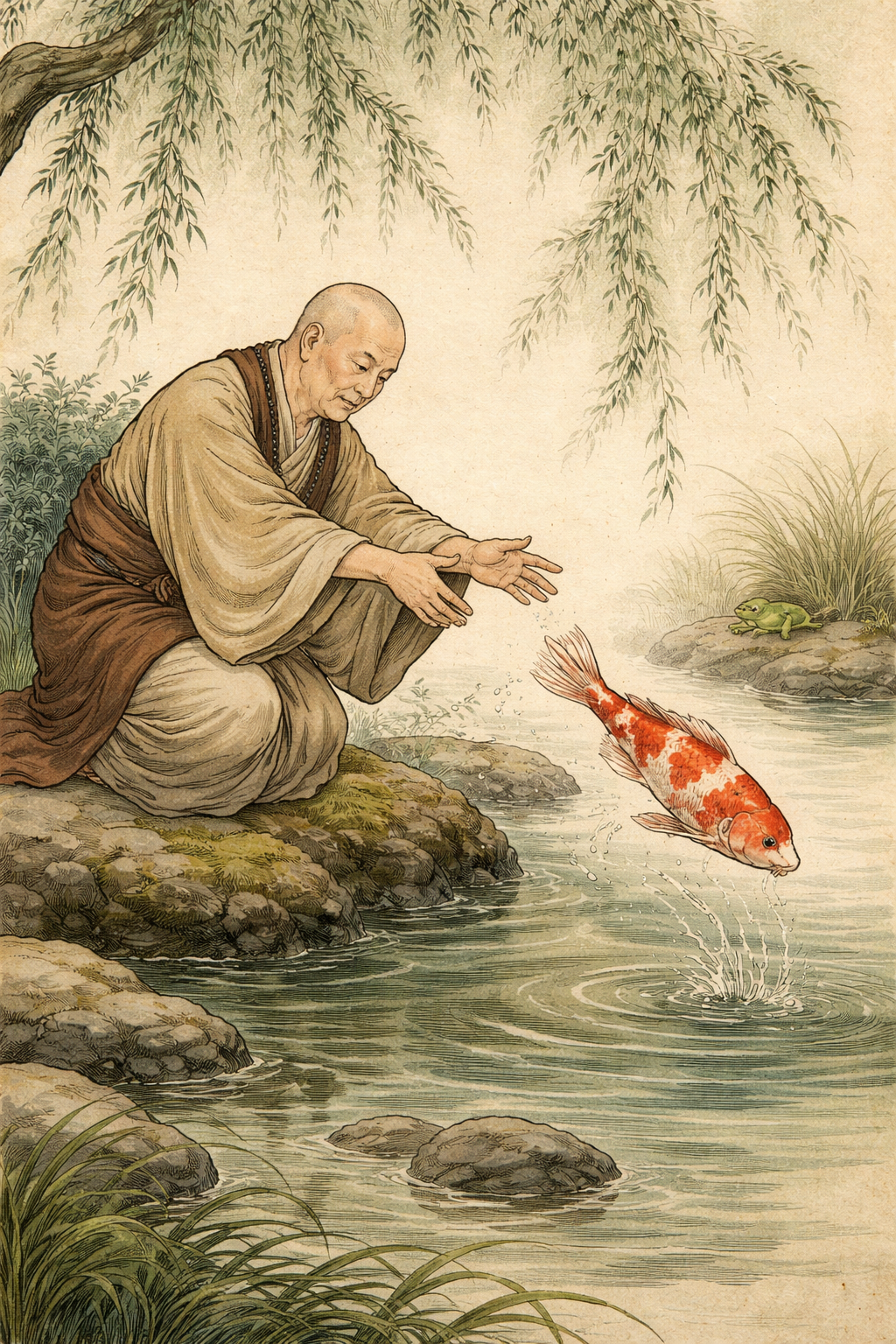
In today’s post, I am refining my thoughts on reentry as a wonderful tool to tackle cognitive blind spots. A common saying goes that a fish does not know it is in water. The phrase is usually offered as a comment on unexamined assumptions. The fish is fully immersed in a medium that makes its life possible, and yet that very immersion renders the medium invisible. We the observers, standing outside the water, can easily point to what the fish cannot see.

The metaphor is useful, but only if we do not misunderstand what it implies. The problem is not ignorance in the sense of missing information. The problem is immersion, being inside the loop and not being aware of it. In other words, I am positing that cognitive blind spots arise not because we lack data, but because we fail to notice the conditions under which noticing itself takes place. We assume that observation is independent of the observer, and in doing so, we negate the very act that makes observation possible.

This negation is not accidental. It is built into many of our conceptual frameworks.

Cognitive Blind Spots and the Negated Observer:

In this view, a cognitive blind spot appears when a distinction is treated as if it exists independently of the act that produced it. We speak as though there is an object “out there” and an observer “in here,” and as though the observer merely reports what is already the case. This framing quietly removes the observer from the scene by denying that the act of description must re-enter the conditions it describes.

Once the observer is negated, the distinction hardens and begins to appear as a feature of the world itself. What began as a practical cut in experience is mistaken for something given rather than constructed. At that point, the blind spot is complete. There is nothing left to question because the conditions of questioning have disappeared.

This is precisely where re-entry becomes relevant.

Re-entry as a Mechanism for Error-correction:

Spencer-Brown’s notion of re-entry does not simply add complexity for its own sake. It forces a distinction to turn back upon itself. A form re-enters the space it distinguishes. The marked state is no longer allowed to pretend that the unmarked state is irrelevant or absent. Reentry is an attempt to bring the act of distinction itself into view.

Re-entry is uncomfortable because it breaks the illusion of a clean separation. It exposes the fact that every distinction carries its own conditions inside it. What we thought was a stable category now reveals its dependence on an operation. This is why re-entry is such a powerful tool for revealing cognitive blind spots. It does not offer a better description of the world. It shows how our descriptions are made, and what they quietly exclude in order to function. Once this lens is applied, certain familiar structures begin to look less secure.

The Subject/Object Split and Being in the Water:

The subject/object dichotomy is one such structure that we can use to expand on this line of thinking. It assumes that there is a knowing subject on one side and a known object on the other, connected by representation. From a Heideggerian perspective, this is already a distortion. We are not subjects standing over against a world of objects. We are always already being in the world.

The fish is not first a subject and then later related to water as an object. Fish and water show up together. The relation is not secondary. It is constitutive. Remove the water and the fish does not remain as a fish that merely lacks an environment. It ceases to be what it is.

Re-entry makes this visible. When the observing system is reintroduced into the observation, the subject object split begins to collapse. What remains is participation, involvement, and structural coupling. Observation is no longer a neutral act. It is an activity performed from within the medium it seeks to describe. We will use this line of thinking to examine another familiar idea in philosophy from Charles S. Peirce.

The Triad and the Problem of Firstness:

Peirce’s triad of firstness, secondness, and thirdness is frequently described as dynamic and non-linear. However, when examined through the logic of distinction and re-entry, the triad reveals a fundamental instability. That instability is most clearly exposed in the notion of firstness.

Consider a simple example: a red apple. Its redness is firstness, the immediate quality that appears without reference or comparison. The apple itself, as a physical object that resists gravity and interacts with us, illustrates secondness. The recognition that the apple is a fruit, part of a category, and meaningful within a broader system of relations exemplifies thirdness. Even here, we see the dependence of firstness on context; its pure quality only becomes intelligible through interaction and relation.

Firstness is described as pure quality, pure possibility, or pure feeling, intended to stand prior to relation, reaction, or mediation. What follows from this is not only an empirical difficulty but also a logical one.

From a Spencer-Brown standpoint, nothing can appear without a distinction. A distinction simultaneously produces a marked state and an unmarked state. There is no marked state by itself, just as there is no distinction that does not also imply what it excludes. When one speaks of “good,” the notion of “not good” is already present as its context. “Good” by itself has no meaning. Even our most absolute categories depend on what they deny, as the invention of God quietly presupposes the invention of Evil.

If firstness is spoken of at all, it has already been marked. The moment one says “firstness,” one has drawn a boundary around something and set it apart from what it is not. That act already presupposes contrast. It already invokes relation. It already smuggles in what Peirce would later call secondness and thirdness. The triad never leaves the water it claims to describe.

If there is no distinction, there is no information. Without contrast, there is nothing to register. Pure undifferentiated “information” is not information. It does not inform. It does not appear. It does not function. In that sense, pure firstness is not just unreachable in practice, it becomes incoherent in principle.

The problem is not one of interpretation but of structure. The triad depends on a move that collapses under re-entry. Firstness cannot exist in isolation, yet the triad requires it to.

Re-entry Exposes the Blind Spot:

Here is where the cognitive blind spot becomes “visible”. The triad purports to articulate the conditions of experience while remaining blind to the operation that makes them appear. Firstness is treated as if it could exist prior to distinction, while the very articulation of firstness performs the distinction it denies.

Re-entry forces the concept to confront its own conditions. When firstness re-enters the space of its own description, it collapses into relation. It cannot remain alone. It cannot stay pure. It cannot avoid invoking what it claims to precede.

In this sense, the triad is flatter than it appears. Not because it lacks movement, but because its movement never quite escapes the logic of classification. Re-entry reveals that the flow Peirce gestures toward is already constrained by the need to name and separate what is being described.

Final Words:

The point of this critique is not to replace one framework with another. It is to show how certain blind spots persist even in sophisticated theories. When distinctions are treated as if they precede the act of distinction, the observer disappears. When the observer disappears, responsibility disappears with it.

Re-entry restores that responsibility. It reminds us that our concepts are not mirrors of reality, but tools we use from within the world we inhabit. Like the fish in water, we do not escape the medium by describing it. We only learn to see it by noticing how our seeing works. That seems to be the deeper utility of re-entry. The goal is not to produce better categories, but to cultivate a deeper awareness of how categories emerge. It is not purity, but participation. It is not firstness untouched by relation, but the recognition that relation is always already present. Seeing the water does not mean leaving it. It means acknowledging that one was never outside it to begin with.

Stay curious and Always keep on learning…

Post script:

Further clarification on the following statement – Re-entry reveals that the flow Peirce gestures toward is already constrained by the need to name and separate what is being described.

Peirce presents the triad as something dynamic and flowing rather than static. Firstness flows into secondness, secondness into thirdness, and so on. However, when you apply re-entry, you see that this apparent flow is already limited by the act of naming the categories in the first place. The moment you say “firstness,” “secondness,” and “thirdness,” you have already separated what you claim is flowing. The movement is therefore happening inside a framework that has already been cut up by distinctions.

So the “flow” Peirce gestures toward is not free movement within experience itself. It is movement between pre-named compartments. Re-entry exposes that the triad cannot escape the logic of distinction because it depends on that logic to exist at all.

In other words, the triad looks process-oriented, but it still operates as a classificatory scheme. The flow is real only insofar as the categories have already been stabilized by naming and separation. That is the constraint.
The Thing About ‘Thing-in-Itself’:

In today’s post, I am looking at Immanuel Kant’s Thing-in-Itself and Hans Vaihangar’s ideas. In Kant’s philosophy, the “Thing-in-itself” (or Ding an sich) refers to the reality that exists independently of human perception or experience. Kant argued that while we can know phenomena (the appearances of things as they present themselves to us), the “Thing-in-itself” remains inaccessible to human cognition, as our knowledge is always mediated by the structures of our mind (such as space, time, and categories of understanding). The Kantian dichotomy therefore is phenomena (things as they appear to us) and the noumena (the “Things-in-themselves”). For Kant, the Thing-in-itself is something that exists independently of human perception, but it is forever inaccessible to us. We can only know the world as it appears to us, not as it truly is in itself. This creates a separation between appearance and reality, and Kant suggests that this gap is unbridgeable for human beings.

I am not a fan of dichotomies. Most often, dichotomies are created as linguistic tools to aid our thinking. But they form a life of their own and cause confusion in our thinking. There are a few ways to think about the thing-in-itself. One is to take the road that reality is indeed accessible to us. This will be the approach of a naïve realist. This notion can be easily disproven by the use of numerous illusions. The second route is to be an idealist. Loosely put, this approach takes the view that everything is in the mind. This notion is also not very useful. This again is another dichotomy – reality is directly accessible out there versus reality is all inside our minds.

It is more useful to take a middle path. Here also, there are different ways to go. One example is Charles Sanders Peirce, who is a realist American philosopher. He believed that reality does exist out there independent of our perception. We may not have direct access to it, but we can gradually make sense of it. He believed that all knowledge is fallible and subject to revision. Instead of positing an unknowable reality, he focused on the continuous process of inquiry and the gradual approximation of truth. In this view, the notion of the thing-in-itself is not value adding since he is proposing that reality or portions of reality are eventually accessible to us. Peirce was a pragmatist (or a pragmaticist as he called himself). As noted above, pragmaticism supports the idea of truth. If there is a practical or pragmatic observable effect, then that becomes truthful. Truth in this case is not absolute since pragmatists support the idea of fallibilism. Truth is provisional. What we have discussed so far moves towards the realist camp.

It is here that I want to introduce the ideas of Hans Vaihinger. At this point in time, I side with Vaihinger’s ideas. Vaihinger was a German philosopher who studied Kant vigorously. His ideas have many familiarities with pragmatism. He proposed the philosophy of “as-if”. He came up with the notion of “useful fictions” instead of “truth” in pragmatism. Similar to pragmatism, he was interested in practical applications in the world. Vaihinger argued that the thing-in-itself is not something we can know, but that it functions as a “useful fiction” that helps guide our thinking and practical action. According to Vaihinger, we can use the concept of the thing-in-itself as a heuristic tool, a fiction that helps us organize our experience and navigate the world, even though it does not correspond to anything directly accessible to human cognition.

In a sense, Vaihinger suggests that the thing-in-itself has practical utility, even if it is ultimately unknowable. It provides a framework for understanding reality, even if that framework is not literally true. For Vaihinger, this “fiction” is necessary for guiding human action and thought, even if it is not an accurate representation of an objective reality. He is not interested in “Truth”. Unlike the pragmatists, he calls his ideas fictions.

Vaihinger discussed his ideas in his magnum opus, “The Philosophy of As-If“. He argues that human thought, fundamentally, is geared not towards metaphysical truth or solving abstract problems, but towards survival and fulfilling the “Life-will” (Arthur Schopenhauer’s term for the fundamental drive to live and survive). This perspective leads Vaihinger to conclude that human cognitive faculties are inherently limited, not because they are defective, but because they evolved for very specific, practical, and existential purposes: to help humans navigate the world and satisfy their basic needs.

Vaihinger views human thought as essentially a tool for life, serving the practical ends of survival rather than speculative exploration of ultimate reality. Human cognition was not designed to uncover metaphysical truths or answer the “big questions” about the nature of the universe. Instead, it evolved as a means to manage and react to immediate environmental challenges—finding food, avoiding danger, securing shelter, reproducing, and so on. From this perspective, thought is a functional tool, not a quest for objective knowledge.

In this way, Vaihinger agrees with Kant that human knowledge is bound by certain limits. But Vaihinger takes Kant’s idea further: instead of viewing these limits as a tragic deficiency (i.e., the inability to access noumena or things-in-themselves), Vaihinger argues that they are the natural result of human thought’s biological and practical function. Thought was never intended to grasp the ultimate nature of reality; it evolved to solve problems relevant to human survival and everyday life.

Given that human thought is limited in this way, Vaihinger proposes that we use certain concepts—like the thing-in-itself—as fictions. These fictions are not intended to describe the ultimate nature of reality but to help us organize and navigate our experience of the world. The thing-in-itself, as a fiction, becomes a useful tool for thought, enabling us to conceptualize reality in a way that facilitates practical action and understanding, even if that concept does not correspond to anything we can directly know or experience.

Vaihinger argues that these fictions are essential because they allow us to deal with phenomena that cannot be grasped directly. The thing-in-itself becomes a placeholder or a symbolic construct that helps us maintain coherence in our thinking and practical activities, even though it does not correspond to any knowable “reality”. In this way, Vaihinger’s approach offers a way to work with limitations in thought while still being able to reason, act, and engage with the world meaningfully. Similar to Peirce, Vaihinger maintained that all knowledge is fallible and provisional. He also emphasized the idea of correcting them when they are no longer viable.

The Paradox of Thing-in-itself:

The notion of the thing-in-itself comes with a paradox. If the thing-in-itself is not accessible to us, then how can we even talk about it? How can we ascertain that what we experience is supposed to represent the thing-in-itself? The very act of trying to access the thing-in-itself proves its inaccessibility. Kant acknowledged the limits of human cognition and left us with the concept of the thing-in-itself to indicate that reality exists beyond our perception. Kant insisted that we cannot know the thing-in-itself because our mind imposes its own structures onto the world. So, the thing-in-itself is something that remains, by definition, unknowable. We humans are separated from the “true” nature of things.

Let us use an example to make things clearer. Imagine the reality of a landscape. Kant originally suggested this is a reality we cannot directly touch, like the landscape is behind a thick fog. We can see outlines, but not the detailed terrain itself. Peirce proposed that we have multiple ways to understand that landscape such as signs, instruments, mathematical models etc. It is not that the landscape is unknowable, but that we approach it through creative interpretation. These are not just representations – they are active ways of constructing understanding. Instead of seeing the thing-in-itself as an impenetrable mystery, Peirce suggests it is more like a dynamic puzzle. We do not give up because we cannot see the whole picture immediately. We use every tool we have – mathematical models, technological instruments, logical reasoning – to progressively understand. Peirce claimed we can access reality through signs and mediation.

If we look at Vaihinger’s ideas, Vaihinger would call Peirce’s signs still fictions we have constructed. The mathematical models, instruments, and interpretive frameworks are themselves useful fictions that help us navigate experience. The key distinction between Peirce and Vaihinger is that Peirce believed that we are progressively accessing reality, and Vaihinger saw us as creating increasingly sophisticated, but still fundamentally, fictional frameworks of understanding. In our example, it is like different ways of mapping an unknown territory. Peirce is thinking that we are gradually revealing the actual landscape. Vaihinger is saying that we are creating ever more useful maps, knowing that they are not the territory itself.

In my opinion, there is a Noumenal gap that realism cannot transcend. No matter how sophisticated our signs, instruments, or mediations, we cannot escape the fundamental epistemological limitation. Our cognitive apparatus always interprets, always mediates, always transforms. Any “progress” is still within our conceptual framework. We are not getting closer to the thing-in-itself. We are often simply creating more complex interpretive structures.

Vaihinger’s idea that the thing-in-itself is a “useful fiction” suggests a very different way of thinking. Vaihinger argues that while we may never have direct access to the thing-in-itself (or any ultimate reality), the concept of the thing-in-itself can still be useful for organizing experience and guiding practical action. According to Vaihinger, the idea of the thing-in-itself is a fiction, but one that is necessary for making sense of the world. It is a construct that helps us navigate and interact with our experiences, even if it does not correspond to any objective reality beyond our conceptual framework.

Vaihinger’s view allows us to maintain the utility of concepts like the thing-in-itself without being trapped in the idea that they correspond to something inaccessible in a metaphysical sense. For Vaihinger, the thing-in-itself is not some unreachable essence, but a concept that functions within human thought in a way that allows us to make sense of the world. It is a fiction that helps us act and think meaningfully, even though we know it does not correspond to something we can access directly.

This is a much more flexible and practical stance than Kant’s and Peirce’s, because it allows for the continued use of concepts like the thing-in-itself without needing to assert that they refer to an objective, inaccessible reality. Instead, we can use them for practical reasoning, action, and understanding, while acknowledging their fictional status.

Vaihinger moves beyond the notion that we are limited by a distance from ultimate reality and suggests that the limitations of our understanding do not prevent us from using concepts that guide our actions. He does not need to answer whether we can access the thing-in-itself in any literal sense because he acknowledges that it is a fiction—yet a necessary one. Vaihinger provides a path forward in that sense: we no longer need to grapple with the unknowability of ultimate reality, but instead can work with useful fictions that help us navigate the world. This gives us a much more flexible, non-dogmatic framework for understanding our place in the world and how we think about things like the thing-in-itself.

If we ask for burden of proof for the various ideas we have discussed here, we see that both realism and idealism carry a significant burden of proof because they are making claims. Even with Peirce, there is a significant burden of proof. He must still prove that signs can access reality. Vaihinger on the other hand avoids any metaphysical commitments. By calling the thing-in-itself as a useful fiction, he sidesteps the burden of proof altogether. His focus is only on the viability of an idea.

I will finish with a quote from Vaihinger:

The world of ideas… we generally call “truth” is consequently only the most expedient error, i.e, that system of ideas which enables us to act and to deal with things most rapidly, neatly and safely, and with minimum of irrational elements.

Note: There are of course numerous other schools of philosophy such as critical realism, radical constructivism etc. that I have not looked at here.

The Core Maxim for Systems Thinking:

In today’s post, I will explore Systems Thinking from a pragmatist viewpoint. I will draw on the ideas of the great American pioneer pragmatist philosopher, C. S. Peirce and the pragmatist systems thinker, Charles West Churchman.

Pragmatism can be viewed as a push against the idea that there are fundamental, unchanging “Truths”. Pragmatism emphasizes experience and observable consequences rather than abstract notions of certainty. There is a hint of utilitarianism in pragmatism in that both philosophies prioritize practical outcomes and the consequences of actions as measures of value. Perhaps, one of the attractive notions in pragmatism is the idea of fallibilism, the view that any claim to knowledge could be mistaken and therefore, we need a means for error correction. This is mostly achieved in the form of social consensus. In this regard, pragmatism also supports the idea of pluralism, the recognition that there may be multiple valid ways of seeing a phenomenon or approaching a phenomenon.

As Philip Campbell noted [1]:

Pragmatism is the proposal that the value and meaning of any concept is the set of its possible effects… If a concept has no possible effects, then it has no value and no meaning. If two concepts have the same set of possible effects, then the two concepts are the same… Pragmatism is utilitarianism with long-range goals.

This idea brings up a core maxim in pragmatism that is attributed to Peirce. This is called the “pragmatic maxim”. The maxim basically states that to further our understanding of a concept or a thing, we need to also understand the practical consequences to us of that concept or thing. Peirce noted in 1878 essay, “How to Make Our Ideas Clear? [2]:

If one can define accurately all the conceivable experimental phenomena which the affirmation or denial of a concept could imply, one will have therein a complete definition of the concept, and there is absolutely nothing more in it.

In that essay, Peirce presented three grades of clarity for a concept. Loosely put, they are in the increasing order:

  • The user has a general familiarity with the concept.
  • The user can provide a working definition for the concept.
  • The user knows the conceivable practical effects of the concept.

The last step focuses on the pragmatic maxim. Peirce argued that to fully understand an idea, we must examine what experiences or actions it would lead to if it were true. Peirce gave the example of the concept of hardness to explain this. We have a general understanding that a rock is hard, while a pillow is not hard (soft). This allows us to define hardness as the ability to withstand deformation. Therefore, we realize that a hard object resists deformation and can be used to deform relatively softer objects.


Peirce’s maxim teaches us that understanding a concept is not fully developed until we grasp its practical consequences and how it influences our interactions and expectations in the world. In other words, the meaning of an idea is linked to its practical effects. In social contexts, this introduces the notion of pluralism. Different individuals can interpret a concept based on their unique perspectives and worldviews, all of which can be valid. In this sense, knowledge becomes provisional and always evolving. Pragmatism encourages epistemic humility, as well as continuous inquiry and revision of beliefs. Truth is multifaceted and shaped by multiple contexts and practical consequences. This represents a soft view on the complexities of truth rather than a dogmatic hard view.

With this background, let us look at the idea of a system. A “system” is generally construed as a collection of interconnected parts working together to represent a whole. This leads to the common notion that systems are real and present everywhere and can be fixed or changed to achieve a desired outcome. This type of thinking is based on faulty pretense that whole system can be modeled accurately to represent the complex situation. They might argue that the outcomes of the systems can be designed, and their view is the accurate representation. As David Matthews wrote [3]:

Undoubtedly, the early systems theorists were uncritically committed to both foundationalism and representationalism. They aimed to produce models that corresponded with reality (representationalism) and, moreover, assumed that it was feasible to justify the outcomes of their studies by claiming to always model the ‘whole system’ (foundationalism).

It is here that we can introduce Charles West Churchman. At heart, Churchman was a pragmatist who challenged the notion of the hard systems approach. He did not see that the boundaries of a system are given by the structure of reality in favor of a pragmatic understanding that what is ‘given’ and what is ‘constructed’ are irreducibly intertwined. The system became a constructed notion to represent a phenomenon based on multiple perspectives and value systems. Matthews continued:

Accordingly, traditional distinctions between subject and object (and for that matter ontology and epistemology) are undone and boundary definition becomes an issue not of systems modelling but of practical philosophy. That is, it becomes an ethical issue. Something that appears to be an improvement from a narrow point of view may not be seen as such if the boundaries are extended or arranged in a different way. According to Churchman, systems approaches too often have us analyze ‘the problem’ as if it represented the total system.

Multiple perspectives stem from the pluralistic approach in pragmatism. This means there is not one representation of what a system means; the meaning can change depending on who the participant is. This highlights the importance of ethics in systems thinking. My narrow view of what a system should do and what the outcomes should be may not align with another participant’s perspective. For example, what a transportation system means to a train driver can differ significantly from what it means to a passenger. Each participant has their own perspectives and cultural nuances that can drastically affect practical consequences. To understand what the system is, we must consider these different perspectives. Churchman’s famous maxim states that a systems approach begins when first you see the world through the eyes of another.

Churchman also teaches us that if we come to view our own version of system as the correct one, we are deceiving ourselves. We may not be aware of our cognitive biases and other blind spots. He wrote, the ultimate meaning of the systems approach, therefore, lies in the creation of a theory of deception and in a fuller understanding of the ways in which the human being can be deceived about his world.

His systems approach was rooted in pragmatism. He advocated listening to our ‘enemies’ so that we can challenge our own assumptions. Matthews noted that he suggested pitting alternative options (based on alternative a priori metaphysical assumptions) against each other. By listening to the arguments of our ‘enemies’ we become aware of the assumptions in our own thinking and both are better for it.

Churchman’s Social System Design aimed at ‘surfacing’ the implicit worldviews (a priori assumptions) of the systems designer and/or decision maker. Once these assumptions are brought to the surface an alternative set of assumptions are developed. From this alternative set, different proposals (courses of action, decisions, systems designs etc.) are derived that, because of their different foundational assumptions, challenged the former ones. The aim is to develop a more critical understanding of the complex problem (or system) by seeing aspects of the problem that would have remained hidden by the uncritical implementation of policy founded on a single worldview.

In my view, the core maxim of systems thinking is same as the pragmatic maxim. To understand the system, we should grasp its practical consequences. In social contexts, there are multiple participants and, therefore, multiple perspectives on what the system is and what they desire from it. What a system does is emergent and contextually dependent. We should not seek to optimize without first understanding the pluralistic nature of the system and its practical consequences.

I will end with a quote from one of Churchman’s students, Werner Ulrich:

It is not the reality ‘out there’ that determines the boundary between the system and the environment, but rather the inquirers standpoint, the purpose of his mapping effort, his personal preconceptions of the reality to be mapped and the values he associates with it.

Always keep on learning…

[1] Peirce, Pragmatism, and The Right Way of Thinking, Philip L. Campbell, Sandia Report

[2] How to Make Our Ideas Clear?, Charles Sanders Peirce

[3] Pragmatism Meets Systems Thinking: The Legacy of C. West Churchman, David Matthews

The Constraint of Custom:

I have written a lot about the problem of induction before. This was explained very well by the great Scottish philosopher, David Hume. Hume looked at the basis of beliefs that we hold such as:

  1. The sun will rise tomorrow; or
  2. If I drop this ball, it will fall to the ground

Hume noted that there is no uniformity in nature. In other words, it is not rational to believe that what has happened in the past will happen again in the future. Just because, we have seen the sun rise every single day of our lives, it does not guarantee that it will rise again tomorrow. We are using our experience of the sun rising to believe that it will rise again tomorrow. Even though, this might be irrational, Hume does not deny that we may see the belief of the sun rising as a sensible proposition. He notes:

None but a fool or madman will ever pretend to dispute the authority of experience, or to reject that great guide of human life.

It’s just that we cannot use logic to back this proposition up. We cannot conclude that the future is going to resemble the past, no matter how many examples of the past we have. We cannot simply use experience of the past because the only experience we have is of the past, and not of the future. Hume noted that to propose that the next future event will resemble the past because our most recent “future event” (the last experience event) resembled the past is circular:

All our experimental conclusions proceed upon the supposition that the future will be conformable to the past. To endeavor, therefore, the proof of this last supposition by probable arguments, or arguments regarding existence, must be evidently going in a circle, and taking that for granted, which is the very point in question.

Hume concluded that we fall prey to the problem of induction because we are creatures of habits:

For wherever the repetition of any act or operation produces a propensity to renew the same act or operation, without being impelled by any reasoning or process of the understanding, we always say, that this propensity is the effect of Custom. By employing this word, we pretend not to have given the ultimate reason of such a propensity. We only point out a principle of human nature, which is universally acknowledged, and which is well known by its effects.

In other words, it is our human nature to identify and seek patterns, use them to make predictions of the future. This is just how we are wired. We do this unconsciously. Our brains are prediction engines. We cannot help but do this. I will go further with this idea by utilizing a brilliant example from the wonderful American philosopher Charles Sanders Peirce. Peirce in 1868 wrote about an experiment to reveal the blind spot in the retina:

Does the reader know of the blind spot on the retina? Take a number of this journal, turn over the cover so as to expose the white paper, lay it sideways upon the table before which you must sit, and put two cents upon it, one near the left-hand edge, and the other to the right. Put your left hand over your left eye, and with the right eye look steadily at the left-hand cent. Then, with your right hand, move the right-hand cent (which is now plainly seen) towards the left hand. When it comes to a place near the middle of the page it will disappear—you cannot see it without turning your eye. Bring it nearer to the other cent, or carry it further away, and it will reappear; but at that particular spot it cannot be seen. Thus, it appears that there is a blind spot nearly in the middle of the retina; and this is confirmed by anatomy. It follows that the space we immediately see (when one eye is closed) is not, as we had imagined, a continuous oval, but is a ring, the filling up of which must be the work of the intellect. What more striking example could be desired of the impossibility of distinguishing intellectual results from intuitional data, by mere contemplation?

I highly encourage the reader to check this out, if they have not heard of this experiment. In fact, I welcome the reader to draw a line and then place the coin on the line. Doing so, the reader will see that the coin vanishes, however the line still remains visible in the periphery. This means that even though, our eye “sees” a ring, the brain actually fills it out and makes us see a “whole” picture. To add to this wonderful capability of our interpretative framework, the image that falls on our retina is actually upside-down. Yet, our brain makes it the “right-side” up. This would mean that newborn babies may actually see the world upside down and with voids, but at some point, the interpretative framework changes to correct it so that we see the world “correctly”.

How does our brain know to do this? The answer to this is that it was evolutionarily beneficial for our ancestors to do this, just like our custom to look for patterns. This is what Lila Gatlin would refer to as a D1 constraint. This is a context-free constraint that was evolutionarily passed down from generation to generation. This is a constraint that acts in any situation. In other words, to quote Alicia Juarrero, it is context free.

To go past this constraint, we have to use second order thinking. In other words, we have to think about thinking; we have to learn about learning; we have to look at understanding understanding. I welcome the reader to look at the posts I have written on this matter. I will finish with two quotes to further meditate on this:

Only when you realize you are blind, can you see. (Paraphrasing Heinz von Foerster)

The quieter you become, the more you can hear. – Ram Dass

Please maintain social distance, wear masks and take vaccination, if able. Stay safe and always keep on learning…

In case you missed it, my last post was The Cybernetics of “Here & Now” and “There & Then”