Does Lean = the Elimination of Waste?

muda

I have been reading several posts about Lean and Six Sigma. The way the two philosophies apparently differentiate is that Lean is all about eliminating waste, and Six Sigma is all about eliminating variation. As with many concepts in Eastern philosophy, things appear simple at first sight, and as we learn more about it, the concept gets deeper and deeper. In today’s post, I will look at the Toyota Production System in the light of “waste”.

Waste (Muda):

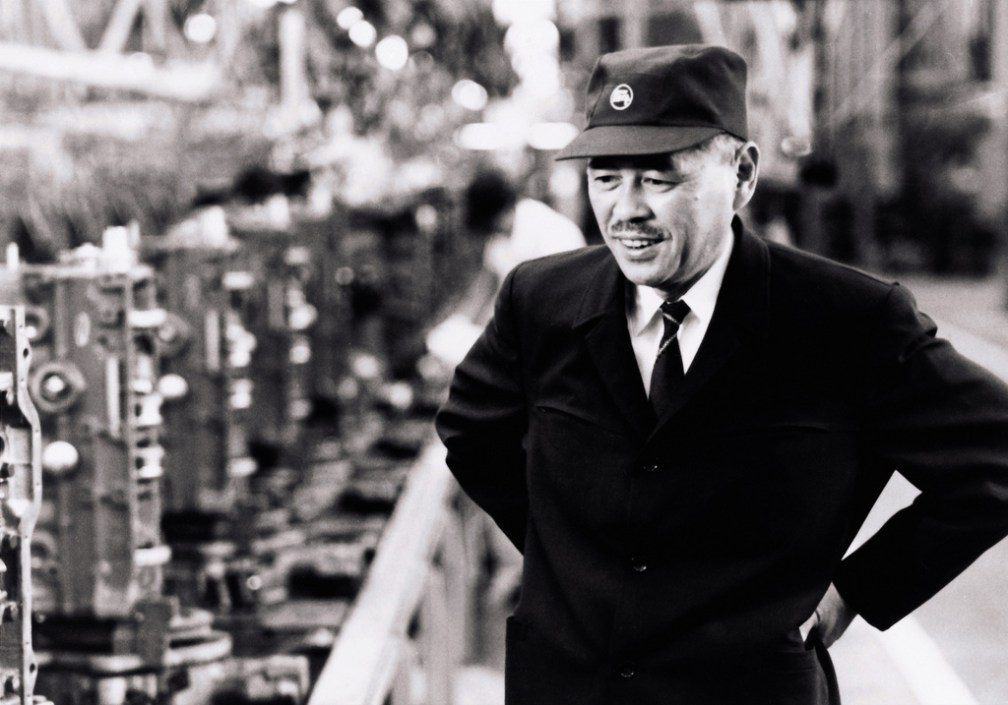
The Japanese word for waste is “muda”. Muda literally means no value. Mu = no or lack of, and da = value. The idea that Toyota Production System is based on the principle of eliminating waste was put forth by Taiichi Ohno, the father of Toyota Production System. Ohno identified seven types of wastes as follows;

  • Waste of overproduction
  • Waste of time on hand (waiting)
  • Waste in transportation
  • Waste of processing itself
  • Waste of stock on hand (inventory)
  • Waste of movement
  • Waste of making defective products.

A close review of these wastes shows that many of these wastes are interconnected. If you have inventory, you will also have transportation. Waste of processing can also lead to waste of movement. Waste of overproduction is sometimes called as the mother of all wastes since it can lead to all of the other types of wastes. Several practitioners have identified more types of wastes, of which the most popular is the “under utilization of human talent”.

Let’s Go Deeper:

I do not agree with the generalization that lean is about eliminating waste. Toyota speaks about 3 “Mu”s. They are as follows;

  • Muda = waste
  • Muri = overburden
  • Mura = unevenness

Muda:

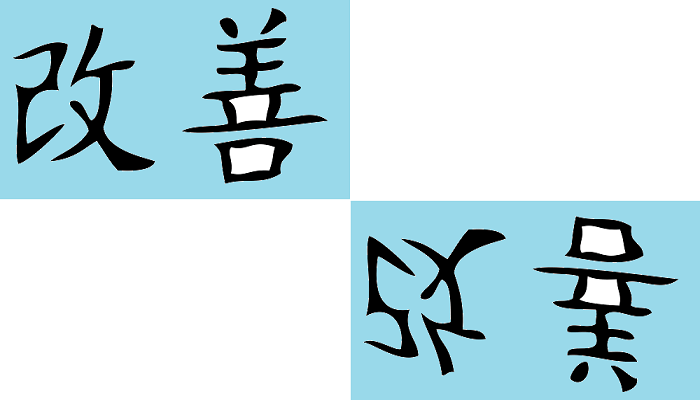
Things get complicated when we learn that Toyota uses Muda in 3 different meanings. The Japanese language has several writing systems. Muda has roots in Chinese language. Japanese can write Muda in 3 different writing styles to add particular nuances.

Muda in kanji (based on Chinese scripts) means waste that was created by existing management policies. Muda in hiragana (based on native or naturalized Japanese words) means waste that cannot be eliminated right now. Muda in katakana (based on foreign words or words used with emphasis) means waste that can be eliminated immediately. (Source: Kaizen Express, Toshiko Narusawa and John Shook)

Taiichi Ohno defined the Toyota Production System as follows;

“The fundamental doctrine of Toyota Production System is the total elimination of waste”.

Muri:

Muri literally means “unreasonable” in Japanese. Mu = No or lack of, and Ri = reason. Both muda and muri can be explained in Japanese as a “lack of something” or as “no + something”. Muri also has several nuanced meanings in Japanese. “Muri suru” in Japanese means “to take things too far” or “to overdo”. In TPS, muri refers to overburdening the operator so that it can result in injuries or defective products. This is akin to saying work harder to produce more products while not improving the process. The standard work is often used as a means to tackle muri.

Mura:

Mura is defined as “uneven”. I have not seen mura explained as a “lack of evenness” (Mu + evenness) in Japanese. For example, the unevenness is in how we manufacture products. We should produce products so that we can meet the customers’ demands. From a producer’s standpoint, producing product of one type makes the most sense since it maximizes efficiency. This is akin to the famous Ford quote “as long as it is black”. However, each customer is unique. He may want “red” instead of black. He may want a different model than what you want to make. The unevenness is in how the units are being produced without keeping the end picture in mind. TPS utilizes both kanban and heijunka to level production.

Taiichi Ohno defined the Toyota Production System in light of this as follows;

“The goal of the Toyota Production System is to level the flows or production and goods.”

The 3 Mu’s:

The keen learner can see that muda, muri and mura are closely intertwined. Toyota has even defined muri and mura as two forms of muda!

“Both mura and muri are thought of as types of muda, or waste, and should be eliminated.”

Mikio Kitano, former President of Toyota Motor Manufacturing of North America Inc, has identified the order to approach the 3 Mu’s for a new process. (Muri -> Mura -> Muda)

“First, Muri focuses on the preparation and planning of the process, or what can be avoided proactively. And, then, Mura focuses on implementation and the elimination of fluctuation at the operations level, such as quality and volume. The third — Muda — is discovered after the process is in place and is dealt with reactively. It is seen by variation in output. It is the role of Management to examine the Muda, or waste, in the processes and eliminate the deeper causes by considering the connections to Muri and Mura of the system. The Muda – waste – and Mura – inconsistencies – must be fed back to the Muri, or planning, stage for the next project.

The continuous cycle of self-examination allows for the outcomes to continuously improve. This brings in Management’s responsibility:

  • to provide and improve a flexible system, and
  • to connect the workforce and the customer.”

My thoughts:

As I have already stated, I do not believe in the generalization that TPS or Lean is about the elimination of waste. This makes it a tool based system. TPS is a holistic management system. Once we look deeper at how the “waste” is viewed, we understand that this does not mean just seven types of waste.

There is a counter-intuitive aspect to muri. Taiichi Ohno was famous for asking to produce the same amount of products by utilizing fewer employees. He would say to remove one operator and then try to meet the same production numbers. Would this be not adding muri? My understanding on this is that Ohno was very good at identifying all of the non-value adding activities in the process. He was able to see that the production can be run with fewer operators. He wanted to challenge the supervisor and the operators in kaizen by studying their standard work and improving their process.

I will finish off with a zen story about “mu” that I like a lot. This story is similar to this post in that it appears straightforward at first.

A monk asked Joshu, “Does a dog have the Buddha-nature or not?”

Joshu replied, “Mu.”

In this koan/story, Joshu is breaking the conventional thinking of the monk. In Mahayana Buddhism, the Buddha-nature is present in all beings including humans and dogs. The answer to the monk’s question should have been “yes”. But the monk’s perspective of nature of existence was one-sided and tunnel-visioned. Joshu challenged this and broke the monk’s mold of thinking by saying the answer “no”.

If Ohno was alive today and one were to ask him whether TPS was about eliminating waste, the master might have replied, “Mu”.

Always keep on learning…

In case you missed it, my last post was Respect for Humanity in the Light of Quality Control (QC).
Don’t Be an Expert at the Gemba:

Expert

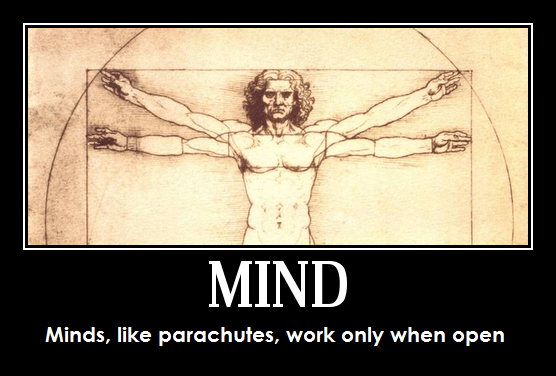
In today’s post I will be talking about being open-minded at the gemba. I heard a wise saying;

“Minds, like parachutes, only work when open.”

parachute

I am sometimes guilty assuming that I know completely about the matter at hand – that I am an expert. I would be at the gemba and instead of listening to the operator talk, I would be talking to the operator, and trying to find solutions on my own. This type of thinking results in three things;

  • I am not respecting the operator or his expertise by not being open to his suggestions. The operator is truly the expert since he has been doing this, day in and day out.
  • By rushing to solutions, I am wasting the opportunity to develop the operator. By providing the solutions, I am taking away the privilege for the operator to think and come up with solutions.
  • I may not get his buy-in for what I am planning on implementing. Things will go back to the way they were once I leave that area.

Being an “expert” makes one close minded. It puts the blinders on for the person, and prevents them from seeing the whole. There is another side effect to being an “expert”. You become very comfortable at something and will not want to steer away from your comfort zone.

I have been reading books by Bruce Lee, the famed martial artist. Apart from being a great martial artist, Bruce was also a deep thinker. He talked about the great analogy of a cup that is applicable to this post:

“The usefulness of a cup is that it is empty.”

If a cup is not empty, it is not useful. The emptier the cup, the more useful it is!

Ohno and Experts:

Taiichi Ohno used to say that experts are not good for kaizen. “They would just get in the way”, he said. Ohno’s point about this statement is that experts would not be open to going outside their comfort zones, and they would not allow others to speak or be open to their ideas. Kaizen needs for you to be outside of your comfort zones. Comfort zones are the playgrounds for status-quos. This is against the spirit of kaizen.

In Toyota, there is a great concept called “chie”. Chie stands for “wisdom of experience”. If experience equates to expertise, then chie equates to wisdom that comes from experience. Toyota views their production system as a “Thinking Production System”. Toyota’s goal is to increase chie of all their workers so that their thinking leads to improved processes and this ultimately improves Toyota altogether. This type of thinking is against “experts” on the floor. Experience may result in improved efficiency, however this does not equate to improved effectiveness.

Final Words:

This post is more a reminder for me to be open minded at the gemba, and to listen to the operator, and to encourage them to ask questions and come up with solutions. This allows for developing the operator. This also allows you to learn from the operator as well. I will finish off with a short story from Leo Tolstoy about someone who thought he was an expert:

There once were three hermits on a remote island. They were known in the region for performing miracles. They were very simple, and did not know complicated prayers. The only prayer they knew was “We are three, Thou art Thee, have mercy on us.” 

One day the local bishop came to hear about the three hermits and their prayer. He thought to himself that he should pay them a visit so that he can teach them prayers that were “more correct”.

He arrived at the island and taught them the “state of the art” prayers. The three hermits recited the prayers after the bishop. The bishop was quite pleased with himself. He bid them good bye and left. His boat was sailing away from the island. It was getting dark. The bishop looked back at the island, and saw a radiant light slowly approaching the boat from the direction of the island. To his surprise, he saw that the three hermits were holding hands and running towards the boat, over the water.

“Bishop, we have forgotten the prayers you taught us”, they said, and asked him if he would please repeat them.

The bishop shook his head in awe at the miracle he was witnessing. “Dear ones”, he replied humbly, “Please forgive me, and continue to live with your old prayer!”

Always keep on learning…

In case you missed it, my last post was The Opposite of Kaizen.

The Opposite of Kaizen:

opposite_kaizen

“Kaizen” is the Japanese word that means “change for good”. Kaizen is probably the most used word in lean today. Kaizen has come to mean many things including “Kaizen events” – a week long group activity to improve a process. In today’s post, I am going to look at kaizen – the simple idea of “change for better” and look at what could be the opposite of kaizen. Kaizen is also translated as “continuous improvement”.

What is the Opposite of Kaizen? – Kaiaku

This is an interesting philosophical question. From a Japanese language standpoint, the opposite of kai-zen is kai-aku. In Japanese, Kai means “to change”, zen means “better” or “good” and aku means “bad” or “evil”. Thus kaizen literally means “change to be better” and kaiaku means “change to be worse”.

From a philosophical viewpoint, I do not agree that kaiaku is the opposite of kaizen. A person engaged in the kaizen mindset learns from failures as well. The fear of failure does not stop him from trial and error. Sometimes this activity can result in terrible failures – kaiaku. However, the mindset of kaizen is still alive. In fact, it is said that one learns the most from failures. Thus, kaiaku cannot be the opposite of kaizen. Failures which result in worse-of scenarios act as an impetus to make things even better.

What is the Opposite of Kaizen? – Kaikaku

Kaikaku translates from Japanese to English as “revolutionary change”. This is generally a large scale transformation. The intent behind kaikaku is that it is not a simple small scale change like kaizen. Toyota achieves improvement through both small scale and large scale improvements. They embrace both types. Toyota also embraces innovation (kakushin). From Toyota’s perspective any change that ultimately makes things better is always good! In this regard, the opposite of kaizen cannot be kaikaku either.

What would Ohno Say?

Taiichi Ohno, father of Toyota Production System, said the following about how to begin kaizen:

“You’ve got to assume that things are a mess.”

Ohno’s point behind this is that if you are happy and satisfied with where you are and what you are doing; you will never want to change. You have to be dissatisfied with what you are doing to motivate yourself in order to improve your process. The opposite of kaizen is complacency!

Being complacent means that you are happy where you are, and your goal is to maintain status-quo. In fact, Merriam Webster defines complacency as follows;

Complacency = self-satisfaction especially when accompanied by unawareness of actual dangers or deficiencies

This is the exact opposite of the intent behind kaizen – to improve/make things better. Complacency leads to stagnation, and ultimately this hinders survival. Dr. Deming is often misquoted with “It is not necessary to change. Survival is not mandatory.” His actual quote is;

“Learning is not compulsory; it’s voluntary. Improvement is not compulsory; it’s voluntary. But to survive, we must learn.”(Source: The Age of Stagnation, Satyajit Das)

There is an interesting anecdote in the Harvard Business Review article “What Working for a Japanese Company Taught Me by John E Rehfeld. John talked about his friend who was in charge of two factories, one in America and one in Japan. The Japanese factory always outperformed the American factory. His friend’s rationale was as follows:

“They both set the same target, and they both may hit it. But when the Japanese hit it, they keep going, whereas the Americans tend to stop and rest on their laurels before pursuing the next goal. So in the end, the Japanese achieve more.” They continuously strive for perfection with the goal of achieving excellence.

Final Words:

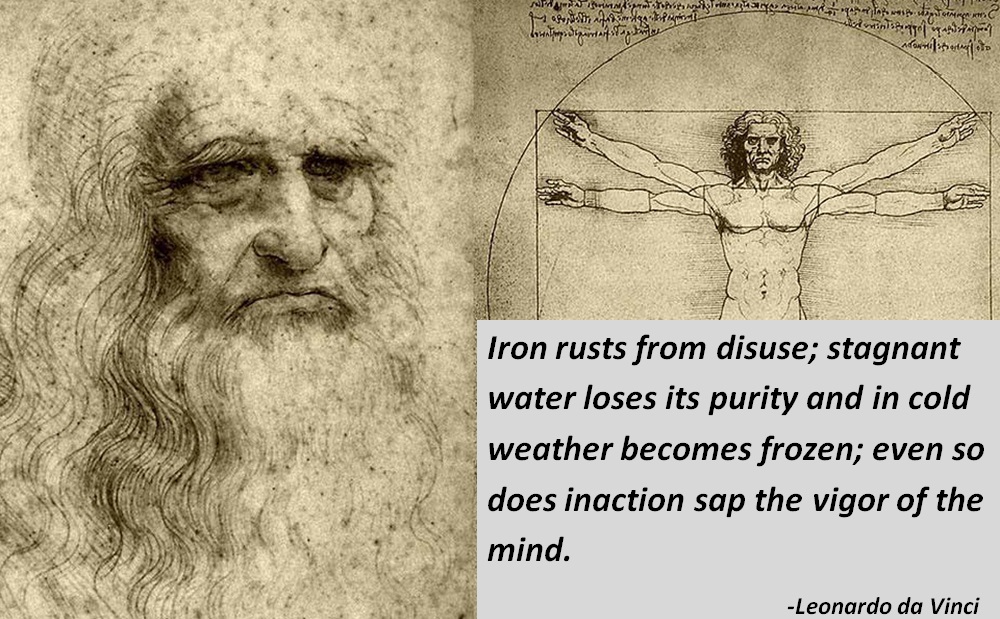
It is my view that although the opposite of kaizen from a linguistic standpoint is kaiaku, from a philosophical standpoint it is complacency. Complacency leads to stagnation, and makes one ignorant of the perils around. I talked about Leonardo da Vinci last time. I will finish off with a quote from him, and an anecdote involving Henry Kissinger and Winston Lord.

davinci

Iron rusts from disuse; stagnant water loses its purity and in cold weather becomes frozen; even so does inaction sap the vigor of the mind. (Source:The Notebooks of Leonardo da Vinci, Richte, 1888)

Winston Lord was working under the then National Security Advisor, Henry Kissinger. There were a lot of high priority national security projects going on at that time. Winston Lord was writing a special report for Henry Kissinger. He worked on it for days knowing how picky and critical Kissinger can be. Lord submitted the report to Kissinger. The report was immediately returned to Lord with a notation by Kissinger – “Is this the best you can do?”

Lord rewrote the report and polished it a little more. The report was again submitted, and almost immediately the report was sent back by Kissinger, again with the same question – “Is this the best you can do?”

Lord rewrote the report one more time and the report was again sent back with the same question. This time Lord snapped at Kissinger, “Damn it, yes, it’s the best I can do.”

“Fine. Then I guess I will read it this time”, Kissinger replied back.

Always keep on learning…

In case you missed it, my last post was Qualities of a Lean Leader.

Dorothy’s Red Shoes and Toyota:

Silver red shoes

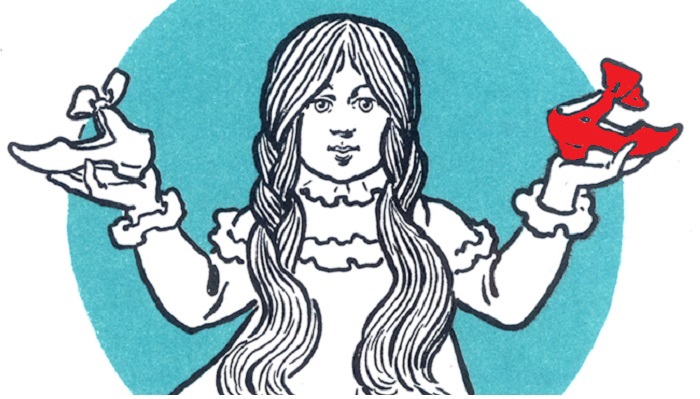
Today’s post is about the theme of adapting and not blindly copying something. Lean is the Western cultural interpretation of what is known as Toyota Production System (TPS). Many companies try to implement TPS by simply copying the tools without understanding the context behind them.

Dorothy’s red ruby shoes are cultural icons from the movie “The Wizard of Oz”. All Dorothy had to do to go home was click the heels three times and command to go home. Poof, like magic she returned home. It is not a widely known fact that Dorothy’s shoes in the actual L Frank Baum’s 1900 book were Silver. The shoes’ color got changed to look “iconic” using the new technology in those days – Technicolor. The shoes appeared extra magical when they were ruby red in the movie. In other words, the movie makers adapted the story to the new technology in order to bring out the best.

What did Toyota Do?

Toyota started off as a Loom Company. Kiichiro Toyoda, son of the founder of the Toyoda Automatic Loom Works, was interested in automobiles. Kiichiro started the Toyota Motor Corporation with little experience in large scale manufacturing. Toyota Production System has been tremendously studied and almost everybody tries to emulate Toyota. In those days, the best production system was Ford’s Mass Production System. It was very much akin to the lean manufacturing system today. In fact, Toyota sent Engineers to study the Ford Production System so that they could come back and implement it. One of the two Engineers sent was Eiji Toyoda, Kiichiro’s cousin, and later the Chairman of Toyota. Eiji was a strong supporter of Taiichi Ohno, the father of Toyota Production System.

Toyota was founded from the very beginning with aspirations to become the “Ford of Japan”.(Source: The Toyota Leader, Masaaki Sato 2008)

Toyota discovered that the Ford System as a whole did not work for them. The idea of a moving assembly line and the idea of an employee suggestion system were two concepts that Toyota adopted and started using. However, Toyota could not implement the “large scale” production practices that Ford was using. The Ford System was focusing on producing a limited product line in large quantities. It also focused on increasing the efficiency of each operation by making the lot sizes as large as possible. Inventory was considered as a buffer and a blessing to cover any production interruptions. Toyota simply did not have the capabilities to maintain a large scale production.

Taiichi Ohno found two main flaws in the Ford’s Mass Production System:

  • Only the final assembly line achieved anything resembling continuous production flow. At the component level, there were piles of inventory and very limited flow.
  • Ford was unable to accommodate customer preferences for product diversity. This is akin to the famous quote attributed to Ford – “You can have any color as long as it’s black.”

Source: The Japanese Automobile Industry, Michael Cusumano 1985.

Taiichi Ohno created the Toyota Production System by adapting ideas from Henry Ford, Sakichi Toyoda, Kiichiro Toyoda, and numerous others, including the inventor of the Supermarket System. He learned from failures and the production system evolved through numerous trials and errors. The Toyota Production System is a custom fit tailored suit that fits only Toyota, and nobody else. However, like Ohno did, we can certainly learn and adapt from it.

Why Should I Copy Toyota?

The short answer is – you should not blindly copy Toyota. You have to understand your problems, and then adapt the Toyota Production System and address the solutions to your problems. In an interview in 2001, Hajime Oba, a retired TPS Sensei said the following about blindly copying Toyota:

Big Three managers, he says, use lean techniques simply as a way to slash inventory and are satisfied with that. “What the Big Three are doing is creating a Buddha image and forgetting to inject soul in it,” he says.

My Final Words:

I will finish off with a lesson from the famous martial artist Bruce Lee and a funny story about the dangers of blindly copying. Bruce Lee is also considered to be a great philosopher as well.

His four steps for efficiency were;

  • Research your own experience
  • Absorb what is useful
  • Reject what is useless
  • Add what is essentially your own.

And now the story I heard as a kid in India;

A father was worried about his son’s lack of ability when it came to the English language. English was his son’s second language and he always had trouble with essay writing in the test. The father made his son memorize a short essay “My Best Friend”, since he was sure it would be part of the essay component of the test. The son learned the essay verbatim, and felt good about writing his essay for the test.

Unfortunately, the essay topic was “My Father”. The boy thought for a bit, and then started writing based on what he had memorized.

“I believe I have many fathers. Shankar Pramod is my best father. He lives a few blocks from my house. He comes to visit us every day. My mother loves him very much. A father in need is a father indeed.”

Always keep on learning…

In case you missed it, my last post was The Anatomy of an Isolated Incident.

Toyota Production System House – Just-in-Time (JIT) and Jidoka (Part 2):

jidoka

I talked about the two conceptual houses of Toyota last week. In today’s post we will look JIT and Jidoka, the two pillars of the Toyota Production System house. The two pillars of the TPS house are actually based on the ideas of Sakichi Toyoda (Jidoka) and Kiichiro Toyoda (JIT). Ohno built his production system on the shoulders of these two giants.

Sakichi Toyoda, father of Kiichiro Toyoda, founded Toyoda Automatic Loom Works in 1926. Sakichi was an inventor and considered to be an eccentric (Source: Fifty Years in Motion, Eiji Toyoda 1985). His greatest invention was perhaps the Type G Automatic Loom, a non-stop shuttle change automatic loom. Sakichi sold the license to the Platt Brothers and Co. in England.

There is a great story about Sakichi Toyoda in Eiji Toyoda’s book, regarding the automatic loom invention. The looms used to be manually operated and were made of wood. Sakichi wanted to create a loom that ran on power. The best power source in his days was steam. He purchased a used steam engine to understand how it worked and to use that to power his looms. The looms however did not move because the steam kept leaking. Sakichi took the engine apart and found that the problem was worn down piston rods that caused the steam to leak. This would be an easy fix to have new rods turned down on a lathe. Sakichi, however, did not have access to a lathe. So Sakichi and his team spent a whole night manually filing the rods down! When they put the rods in the engine, it worked.

Kiichiro Toyoda, Sakichi’s son, formed an automotive division under Toyoda Automatic Loom Works. He later spun this off, and created Toyota Motor Company in 1937. He calculated that with a population of one hundred million people in Japan, a car-to-people ratio of 1:10 would equate to ten million cars. If there was a 10 percent replacement per year, this would equate to one million cars. He thought that this was a good reason to start a car company.

Just-in-Time:

Kiichiro Toyoda, who founded the Toyota Motor Corporation, had come up with the idea of making the right parts at the right time, and in the right amount. In those days, the norm was to use a lot production system. This is based on producing parts according to what the operation can produce. Thus, there was a disjoint between what is actually needed, and what the operation produced. The operation tended to produce as much as it could to be efficient. This led to high inventories, which led to large stock rooms to store these inventories. Kiichiro understood that this automatically increased the cost to run the business, something that Toyota struggled with tremendously in the beginning. He decided to switch over entirely to a flow-type production system. He called this the “just-in-time” concept:

“I believe that the most important thing is to ensure that there is neither shortage nor excess, that is, to ensure that there is no excess labor and time for the designated production. There is no waste and there is no excess. It means not having to wait for parts to be circulated around. For Just-in-Time, it is important that each part be ready ‘just in time’. This is the first principle of increasing efficiency.” (Source: July 1938 issue of Motor, Toyota-Global website)

Just make what is needed in time, but don’t make too much.” (Source: Fifty Years in Motion, Eiji Toyoda 1985)

Kiichiro wrote a four inch binder manual detailing his ideas for JIT. His ideas were used at Toyoda Automatic Loom Works, which is where Taiichi Ohno first joined Toyota at. Kiichiro tried to implement this at the Koroma plant, Toyota’s second automotive manufacturing facility. It did not take hold at the Koromo plant due to part shortages when the war with China (2nd Sino-Japanese War and World War II) expanded into the Pacific. It is said that Eiji Toyoda, Kiichiro Toyoda’s cousin, requested Ohno’s help to implement Just-in-Time at the Koroma plant.

Mr. Ohno”, Eiji said, “this plant looks like a storeroom. Can you do something to take care of this?” Eiji wanted to pleasantly surprise the big man (Kiichiro Toyoda) and show that Just-in-Time was already in operation at the Koroma plant. (Source: The Toyota Leaders, Massaki Sato.)

It should be noted that Eiji Toyoda was a strong supporter of Taiichi Ohno, and stood behind him when he was developing the system. In Taiichi Ohno’s words – “Our approach has been to investigate one by one the causes of various unnecessaries in manufacturing operations and to devise methods for their solution, often by trial and error.”

Ohno would later on create the Kanban system to incorporate the Just-in-Time philosophy.

Jidoka:

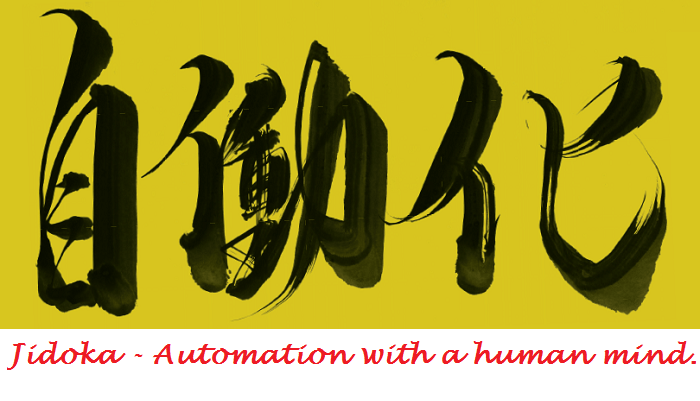
Jidoka in Japanese stands for “automation”. Toyota added an extra character representing “human” in Japanese to mean “autonomation” or “automation with a human mind”. In Japanese, both words can be expressed as “Jidoka”. The word autonomation comes from joining “autonomous” and “automation”.

There are two approaches to autonomation at Toyota. The first approach is to separate the operator’s work from the machine’s work. This means to treat the operator as being independent of the machine, or in other words the operator can operate multiple machines simultaneously. The norm had been to have one operator dedicated to one machine only. The operator had to watch the machine work, while not creating value at the same time. In his mind, he was creating value by simply watching the machine operate. The second approach is to have the machine detect an anomaly and stop by itself. This would prevent the machine from producing more defects. Additionally this will also force the operator to fix the problem immediately to maintain the flow of the process. Both of these ideas belonged to Sakichi Toyoda, father of Kiichiro Toyoda. His Type G loom was an automatic loom that stopped on its own when any of the threads broke. Thus, the loom did not continue producing defectively. Sakichi had successfully implemented the two approaches at the Toyoda Automatic Loom Works. At the Toyoda Automatic Loom Works, one operator could operate 25 automatic looms at the same time.

Soon after World War II, Kiichiro declared the company goal of catching up with America’s productivity within 3 years. In order to do this, Taiichi Ohno used the idea of having an operator in charge of multiple machines at a time. This increased the productivity by many fold. However, this came with its own problems. The machines were not aligned properly so that when the machine was done with its operation, instead of stopping it kept on making parts. Additionally, if the machine malfunctioned, it continued making defective parts. Thus, even though the productivity increased, it put a strain on process flow and quality.

In order to counter the flow problems, Ohno utilized machine layout and limit switches so that the machine stopped producing when the required amount of parts were produced. For the quality problems, Taiichi Ohno utilized the second approach of Jidoka, to have the machine stop production on its own when there is a problem or when the required quantity is made. This idea of Jidoka is to build in quality, ensuring that defective parts are not passed to the next station. This theme evolved into empowering the operator and giving him the authority and responsibility to stop the line if they identified a problem on the line. The operator would pull on the andon cord which would trigger an audio and visual signal for the lead or supervisor to come and help in fixing the problem. If the problem is not fixed in the allotted time, the entire line will stop until it is fixed.  Jidoka develops the operators to look for problems and then solve it. Jidoka thus evolved into a strong training tool and an employee empowerment tool for Toyota. Jidoka placed a spotlight on problems.

Final Words:

Ohno created the Toyota Production System based on the ideas from Kiichiro Toyoda (Just-in-Time) and Sakichi Toyoda (Stop on Defect).  It should be noted that all of the “tools” in TPS were created for the two pillars to work effectively. At first, the goal of TPS was to increase productivity to catch up with Detroit. However, as the productivity increased, it became necessary to maintain quality, and to ensure that the employees are challenged to continuously improve their processes.

I will finish off with an Ohno story. This was told by Michikazu Tanaka in the 2009 book “The Birth of Lean.”

Ohno was very interested in the Supermarket system that was in America. Ohno explained with passion to Tanaka how Toyota can utilize the concept of a Supermarket. Tanaka could not quite grasp the concept since supermarkets were still a foreign concept in Japan, where the shopkeepers fetched the items for the customers. Tanaka was amazed that the shopkeepers would let the customers freely pick what they want from the display, and pay as you go out.

“What would happen,” he asked Ohno, “if someone went in and ate a bunch of food without paying?”

Ohno was stumped and he did not have a good answer for Tanaka. He thought for a while, and said “I suppose that Americans are a people of integrity and they would know not to do that!”

Later on when Ohno implemented kanbans, he told the people on the floor Kanban is like money; if you take out parts without kanban, you are stealing the parts”. (Source: The Evolution of a Manufacturing System at Toyota, Fujimoto)

Always keep on learning…

In case you missed it, my last post was The Two Houses of Toyota.

The Two Houses of Toyota (part 1):

2

Toyota is famous for manufacturing automobiles. You may not know that Toyota also builds residential houses. You can learn more about it here. I will not be talking about the real livable Toyota houses today. I will be talking about the “conceptual” Toyota houses.

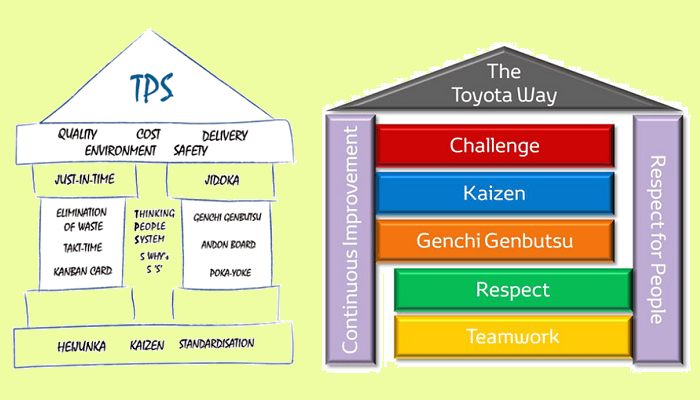
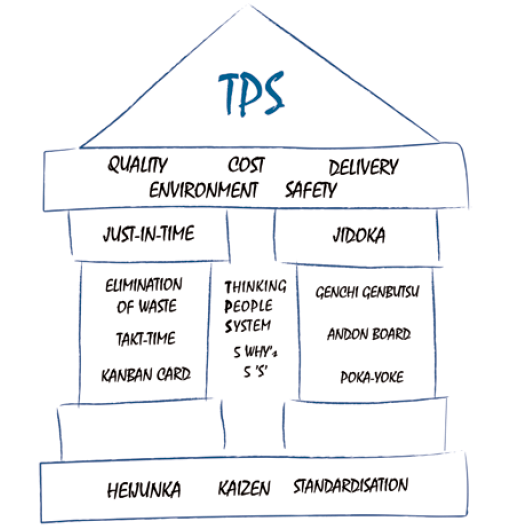
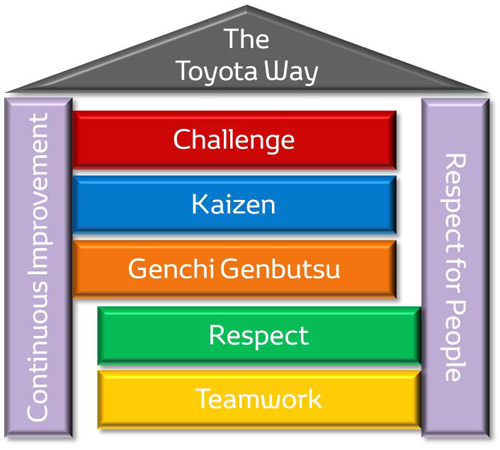
A lean enthusiast is familiar with the Toyota Production House. The house has two pillars – Jidoka and Just-in-Time. In 2001, Toyota revealed their organization’s guiding principles known as the Toyota Way. The Toyota Way also has two pillars – Continuous Improvement and Respect for People. There are literally thousands of depictions of the Toyota houses available online. The majority of these were created by non-Toyota people. I wanted to use only the depictions from a Toyota website.

The first house is the “Toyota Production House”. The picture below is taken from a Toyota Europe Forklift brochure. The reader can click on the picture to open the link to the brochure.

TPS

The second house is the “Toyota Way” house. The house below is taken from the Toyota Italy website. The reader can click on the picture to open the link.

way

First Descriptions of the Pillars:

From what I could find, the two pillars of TPS were first described officially in the “The first book of Toyota Production System”, an internal document released in 1973. The two pillars were later described in Taiichi Ohno’s 1978 book – “Toyota Production System”. Detailed descriptions of Respect for People and Continuous Improvement can also be found in the “The first book of Toyota Production System.” However, the Toyota Way house was not described in these earlier documents as it is currently.

It is interesting to note that starting in 1945, Taiichi Ohno began developing the Toyota Production System, but did not have the system documented until later. Norman Bodek, in his Foreword to Taiichi Ohno’s book “Toyota Production System” speculated that Ohno had feared Americans would discover his ideas and use them against the Japanese.

Fujio Cho, who was one of the people behind “The first book of Toyota Production System”, co-authored the 1977 paper “Toyota production system and Kanban system, Materialization of just-in-time and respect-for-human system”. This paper is available here. The roots of Toyota Way can be found in the paper. The section below is taken from the paper, and it is evident that Fujio Cho, the main architect of the Toyota Way 2001, had been thinking about the strategy for Toyota Production System:

Toyota is planning and running its production system on the following two basic concepts. First of all, the thing that corresponds to the first recognition of putting forth all efforts to attain low cost production is “reduction of cost through elimination of waste”. This involves making up a system that will thoroughly eliminate waste by assuming that anything other than the minimum amount of equipment, materials, parts, and workers (working time) which are absolutely essential to production are merely surplus that only raises the cost. The thing that corresponds to the second recognition of Japanese diligence, high degree of ability, and favoured labour environment is ” to make full use of the workers’ capabilities”. In short, treat the workers as human beings and with consideration. Build up a system that will allow the workers to display their full capabilities by themselves.

The Relationship Between the Two Houses:

Simon Dorrat, Manager of Toyota’s Business Intelligence function (2008 – 2013), has succinctly summed up the relationship between the two houses:

“The Toyota Production System is a practical expression of The Toyota Way – principles that guide everything we do in Toyota, based on Continuous Improvement and Respect for People.”

The Toyota Way 2001 represents the “What” and the “Why”, while the TPS House represents the “How”. In some ways this is akin to strategy and tactics.

Final Words – Even Ohno is fallible:

I will be exploring the pillars of the two Toyota houses in the future. I will finish this post with an Ohno story about Jidoka, one of the two pillars of the TPS house.

Even though Taiichi Ohno was a proponent of Genchi Genbutsu (Going to Gemba to learn actual facts), he was not infallible at this. Taiichi Ohno opened up in an interview with Michael Cusumano, author of the 1985 book – “The Japanese Automobile Industry – Technology and Management at Nissan and Toyota”. Ohno revealed that he had never tried to operate more than one machine at a time to see if it is easy or hard.

As part of implementing Jidoka at the Toyota automobile facility (Koroma plant), Ohno separated the operator’s work from the machine’s work. He treated the operator as being independent of the machine, and he had the operator work multiple machines simultaneously. The norm had been to have one operator dedicated to one machine only. The operator felt that he was creating value by simply watching the machine operate. Ohno understood that the operator is not adding value by watching over the machine. However, the operators hated operating several machines at once. Ohno admitted to Michael that he never felt the need to try operating several machines simultaneously to see how easy or hard it was. (Source: The Japanese Automobile Industry – Technology and Management at Nissan and Toyota, Michael Cusumano). Perhaps, it was because Ohno knew that the technique of one operator managing multiple machines was already successfully implemented at Toyoda Automatic Loom Works by Sakichi Toyoda, father of the founder of Toyota Motor Corporation. Ohno started at Toyota by working for the Loom Plant.

Ohno would later add in the interview that “Had I faced the Japan National Railways union or an American Union, I might have been murdered.” Ohno did have the support of the employee union at Toyota, as well as the upper management. Thus there was no immediate danger to Ohno’s life.

Always keep on learning…

In case you missed it, my last post was Wizard of Oz, Camel’s Nose and Being a Change Agent.

Be an Amateur at the Gemba:

ohno

In my last post, I talked about being like a Samurai warrior at the gemba. Today, I am posting about being an amateur at the gemba.

The word “amateur” has roots in the Latin word “amare” which means to love. “Amateur” used to mean someone who is pursuing something out of pure love or passion. Once the word “amateur” entered the English language, it got associated with a negative connotation. Today being an amateur means that one is a mere hobbyist, and may lack experience and knowledge. Today, its meaning does not encompass the meaning of passion that it once used to have.

Taiichi Ohno was a man of passion and was new to the automobile world when he heard Kiichiro Toyoda, the then leader of Toyota, talking about the need for Toyota to catch up with American car manufacturing in three years to survive. Ohno was not an expert in auto manufacturing, and the Toyota Production System did not exist at that time. Ohno called himself a “layman” when it came to the auto industry. However, he did have a tremendous amount of love and passion for the manufacturing world. He was an amateur in the classic and modern sense.

Taiichi Ohno- What would Ohno Do?

Taiichi Ohno graduated from the Department of Mechanical Technology of Nagoya Technical High School in the spring of 1932. He then got a job at Toyota Textiles through his father, who was an acquaintance of Kiichiro Toyoda. He later got transferred to Toyota Motor Company in 1943, when Toyota Textiles was dissolved. At this time, it was declared that the Japanese worker’s efficiency was only 1/9th of that of an American worker. Kichiiro Toyoda gave Toyota the clear vision of catching up to America in three years.

Ohno correctly concluded that the high efficiency of the American operator was not due to him exerting ten times more physically than the Japanese operator. His only logical explanation was that there was a lot of waste in what the Japanese operator was doing. Ohno started experimenting and began planting the seeds of Toyota Production System (TPS). This was where the passion or love of the “amateur” came in. The amateur was not afraid to fail. Each step was a learning step for him. In my eyes, the turning point of TPS came when Ohno realized that he can have one operator take care of more than one machine at a time. The norm in those days was that one operator managed only one machine. The operator was not doing anything while the machine was operating. Ohno put the operator in charge of more than one machine. He had to ensure that the labor content remained the same. The operator was not being required to work harder! Ohno instead focused on the flow of operations. The machines were operated in the order as dictated by the flow of operations. In Ohno’s words;

The first step was to establish a flow system in the machine stop.

Ohno proposed to implement work improvement first, and then to do facility improvement. Ohno experimented with different layouts to improve the flow. Some of them are shown below (U-shape/Bracket, Triangle, Square and Diamond).

huki03

Ohno also introduced the idea that to manufacture beyond what is needed is to create waste (waste of over-production). He also introduced the idea of using kanban as a way to ensure a pull system and continuous flow.

One would imagine that Ohno’s ideas would be welcomed with open arms. Instead, he faced a lot of resistance. In fact, his ideas were first called “Ohno’s System” instead of “Toyota Production System”. Gandhi famously stated the following;

“First they ignore you. Then they laugh at you. Then they fight you. Then you win.”

This was true in Ohno’s case. Ohno was called “Mr. Mustache”. The operators thought of Ohno as an eccentric. They used to joke that military men used to wear mustaches during World War II, and that it was rare to see a Japanese man with facial hair afterward. “What’s Mustache up to now?” became a common refrain at the plant as Ohno carried out his studies. (Source: Against All Odds, Togo and Wartman)

His ideas were not easily understood by others. He had to tell others that he will take responsibility for the outcomes, in order to convince them to follow his ideas. To his credit, he taught his ideas at the top and bottom simultaneously.

Ohno could not completely make others understand his vision since his ideas were novel and not always the norm. His style of production was not being practiced anywhere. Ohno was persistent, and he made improvements slowly and steadily. He would later talk about the idea of Toyota being slow and steady like the tortoise. Many of his ideas were based on trial and error, and were thus perceived as counter-intuitive by others. Ohno loved what he did, and he had tremendous passion pushing him forward with his vision. For this reason, Ohno was truly an “amateur”.

Final Words:

I have cited the example of Ohno, the father of Toyota Production System, to propose that one should try to be like him, an amateur – one who has tremendous passion and love for what he does and one who does not mind trying out his ideas even if they might fail. I will finish off with a story I read about Ohno,

As I mentioned above, Ohno’s methods were counter-intuitive in nature. Ohno wanted to increase productivity, and yet not over produce! Ohno in fact called Over-production as the biggest waste of all.

Ohno had started implementing Just-in-Time in the plant. The operators became insecure with this. They felt secure having extra in-process inventory so that they can keep working if there were line stoppages.

Ohno understood this, and became angry about this. He decided to combat this by making the operators take the unneeded material home with them.

“Since the company does not need these things”, he would tell the men as he filled their arms with parts at the end of the day, “you must take them home.”

(Source: Against All Odds, Togo and Wartman)

Always keep on learning…

In case you missed it, my last post was Be a Samurai Warrior at the Gemba.

The Myth of Sisyphus and Respect for People:

sisyphus

Sisyphus was the king of Ephyra in Greek mythology. The Gods punished him for tricking them. His punishment was to push a boulder to the top of the hill, upon which the boulder would then roll down the hill to the starting point. He had to push the boulder back up again, and the boulder would again roll down. This continued for eternity. Sisyphus was engaged in an endless task of futile effort. Do you feel like Sisyphus at work? What Sisyphus is trying to do is to push the boulder to the top of the hill. There is no value in this. What he is accomplishing is heavy labor and no progress. Sisyphus is a perfect metaphor for non-valued added work.

The myth of Sisyphus is closely related to respect for people. Sisyphus is engaged in a 100% non-value added activity. No matter how much kaizen he does, his activity would still remain 100% non-value added. Perhaps, he can come up with a cart with wheels to improve his work; still what he is doing ultimately does not add any value. He is going through a punishment. Is this comparable to an operator spending 10 minutes to an hour looking for tools or making parts that are poor quality such that they have to be reworked immediately?

Labor Density – Toyota:

Taiichi Ohno, the father of Toyota Production System has stated the following about work and motion;

Moving about quite a bit does not mean working. To work means to let the process move forward and to complete a job. In work there is very little waste and only high efficiency. Managers and foremen must endeavor to transform mere motion into work!

Here, work indicates value added activity. Ohno talks about ugoki, which in Japanese means wasted motion and tenuki, which in Japanese means an act of omission. Ugoki is when an operator is merely moving material from one location to the other. Tenuki is when an operator is carelessly performing an operation such as tightening a bolt half way. Hataraki, on the other hand in English can be translated as value added work.

Toyota describes Labor Density as follows;

   Work/Motion = Labor Density

The goal is to increase the Labor Density as much as possible. There are two ways this can be done. The first way is to increase the numerator (Work) by making the operators work harder. One way of increasing the numerator is when the work load is increased without improving the process itself. The second way, prescribed by Ohno, is to reduce the denominator (Motion) by eliminating waste.

The Counterintuitive Nature of Respect for People and TPS:

Employees at an organization give their valuable time and energy to the organization. Sometimes, it may be perceived that TPS is about getting the maximum benefit out of the employees. This is against respecting them, as taught by TPS. However, TPS is not all about numbers. Toyota’s goal has always been to reduce the overall man hours required by eliminating wasted motions. This concept eliminates those actions that do not produce profit and do not let the process to move forward. This concept utilizes the energy of the employees to effective and useful work. This is stated in an internal Toyota document from 1970’s as an expression for respect for humanity (or respect for people as it is termed now):

If the organization does not create an environment where the work performed by the employee is not value added, it is against the principle of respect for humanity.

The following is taken from Toyota no Genba Kanri,(the title of English translation was changed as Kanban – Just in Time at Toyota);

People’s sense of value cannot be satisfied unless they know they are doing something worthwhile.

island

Source: The first book Toyota Production System, Ministry of Education 1973.

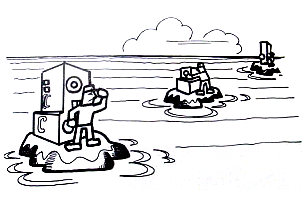
Respect for People is not about making the employees work harder, but increasing the value in what they do. Another way that Ohno talked about this was by introducing the idea of “work floating” and “work flowing”. The process can only progress when things flow. This is the concept of “work flowing”. Everything is connected, and work is pulled by the subsequent operation. However, when material is transported from one operation to another in batches, work is not flowing. It is now “floating”! Ohno called the different stations as remote islands.

Final Words:

Respect for people’s impact on productivity is also backed up by science. Dan Ariely, a professor of Psychology and Behavioral Economics at Duke University, has shown that making work meaningful increases productivity. More on this in a later post.

The Engineer in me tells me that with time, Sisyphus would have cut through the hill due to the constant rolling of the boulder. The boulder would turn into a small pebble from the constant rolling as well. Thus, maybe the moral of the story is to be persistent at what you do, and in the end you will succeed. There is also another explanation that the story is about the sun rising and setting. The sun is the boulder that gets pushed at the break of dawn, and reaches the top at noon time, and then rolls down to cause the night.

I will finish this post with a story I heard as a kid. Strangely enough, there is a character in Kerala’s mythology that is similar to Sisyphus. Kerala is a state in India, and I hail from there. The character of the story is called Naranathu Branthan, the madman of Naranathu. He is regarded as a very wise man today, but was seen by others as a madman in those days. One of his characteristics was that he had elephantiasis (a deformation caused by disease where the leg is swollen up) on his left leg. He used to roll a boulder up a hill every day, and then would let it roll down for his own enjoyment. He would clap his hands and laugh with glee as he watched the rock roll down. Unlike Sisyphus, the madman of Naranathu did it just for pure enjoyment. One day he met Kali, an Indian goddess, as he was retiring for the night. Kali was impressed by the madman and told him that she will give him a boon (blessing).

“I do not want any boons”, the madman said.

Kali informed him that she has to give a boon or a curse, and she insisted that he take a boon.

“I want to increase my life time by a second”, the madman replied.

Kali told him that she could not do that.

“Then I want to decrease my life time by a second”, the madman said.

Kali told him she could not do that either.

The madman thought for a while and asked Kali to move the elephantiasis from his left leg to the right leg. Kali complied, and the madman lived with elephantiasis on his right leg from that day onwards.

Always keep on learning…

In case you missed it, my last post was Stop Asking Why!

Would Ohno Change the Term “Lean”?

vlcsnap-2016-01-10-15h31m11s593

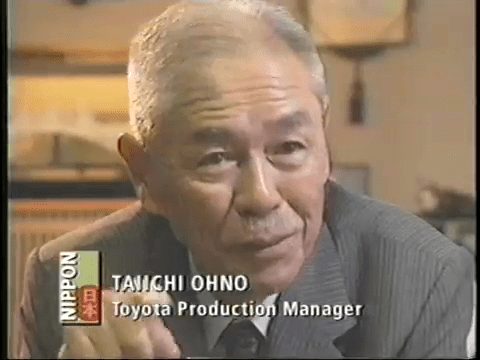
Taiichi Ohno is the father of Toyota Production System. Lean Manufacturing is based on Toyota Production System. The term “Lean” was coined by John Krafcik in his MIT Sloan 1988 Fall paper “Triumph of the Lean Production System”. His terminology was “Lean Production” or simply “Lean”. He noted that;

“Plants operating with a “lean” production policy are able to manufacture a wide range of models, yet maintain high levels of quality and productivity”.

There have been many discussions about whether “Lean” is the correct terminology or not. Lean is supposed to have a negative connotation with it. There is a tendency to assume that Lean indicates reduction – reduction in inventory, reduction in cycle time, reduction in costs etc.

I was pleasantly surprised when I came across Taiichi Ohno’s thoughts on “Lean” Management. As indicated in my last post, Ohno started a consultancy group soon after leaving Toyota. This group was called the New Production System Research Association. Isao Shinohara wrote a book on this called “New Production System – JIT Crossing Industry Boundaries”, in 1985. The main theme of this book is that the TPS ideas are applicable across multiple industries. This book also had a section with an interview with Taiichi Ohno.

Limited, Not Leaner, Management:

In Ohno’s words;

“The idea is to produce only what can be sold and no more. The idea is to limit, not necessarily to reduce, the quantity. The important thing is to keep production costs low whle limiting the production level. It is meaningless to say that producing 15,000 units will reduce production costs when you can only sell 10,000 units.”

He continues;

“The essence of limited management (genryo keiei) and limited production (genryo seisan) is to produce what can be sold at the lowest possible cost.”

My favorite section of the interview was when Ohno was asked about reducing or eliminating inventory.

“Shinohara – Many people think that Toyota Production System is a method for reducing inventory or eliminating inventory altogether.

Ohno – That is not right. I’ve said this so many times, but people don’t seem to understand. The Toyota production system is a philosophy of changing the production and management flows.”

Analogy of a Boxer:

boxer

Taiichi Ohno compares limited production to the regimen of a boxer in his book “Workplace Management”. The boxer has to be in a specific weight classification. If he misses a few training sessions and he puts on weight, he can no longer compete in his class. He would then have to diet to slim down and maintain his weight. This is akin to a company trying to reduce inventory. If he loses more than his intended weight, he will run out of energy and lose the fight. This sort of slimming down is undesirable. Ohno advises against going on a diet for a company without thorough understanding. He calls it a dangerous idea to trim down so much that the essential meat of the company is cut into.

Always keep on learning…

In case you missed it, my last post was “Don’t Strive for Perfection – 60% is good enough”.

60% is Good Enough

AN00222094_001_m

It is 2016! It is a new year and it is time for New Year’s resolutions.

I have been thinking about what I should write for New Year’s. I wanted this post to be something personal.

Pursuit of Rationality:

I came across the phrase “Pursuit of Rationality” in “Toyota Production System – First Textbook”, an internal document at Toyota from the 1970’s. The loose English translation of the relevant section is given below;

“Through thorough observation and pursuit of rationality, we can lay the strong foundation upon which we can build the strong castle of improvement”.

My interest piqued at the phrase “pursuit of rationality”. This has a strong resemblance to “pursuit of excellence or perfection”. It is explained in Taiichi Ohno’s book, Toyota Production System – Beyond Large Scale Production, that rationalization in Japanese writings indicate activities undertaken to upgrade technology, improve quality, and reduce costs. Being rational is being value adding, and not producing waste.

My message to myself and to the readers of my blog is also about pursuit – the pursuit of excellence while pursuing rationality. This may be better explained in Ohno’s thought process as well. Soon after leaving Toyota, Ohno founded the New Production System Research Association, a consulting group with his friends. This group had 25 doctrines that they also pursued. I am focusing on one of these for this New Year!

 Don’t seek perfection. 60 percent is good enough!

We spend a lot of time sharpening our axes, and never strike the tree. We try to get everything just perfect to start doing something, write a post, write a book, start coding etc. We wait and wait, and we end up never doing what we wanted. So let’s pursue rationality this year, and take action. We can always make it better, once we have started it. Let’s plan a little and then DO a little.

Step by Step:

The following is a story I heard from India.

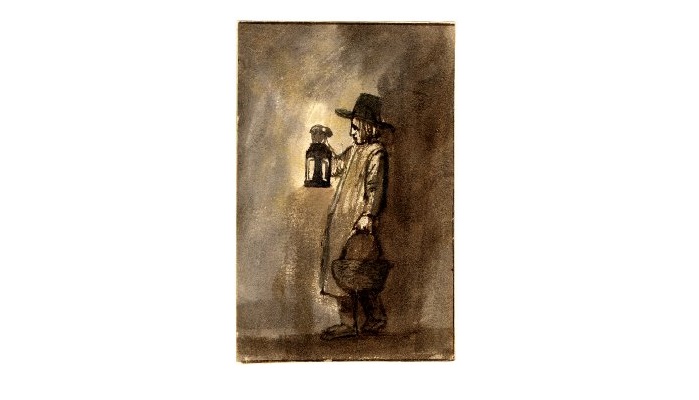
It was pitch dark, and a man had to go to the next town miles away. All he had was a small lantern, and this could light only a few steps in front of him. The man just stood there not knowing what to do. The journey seemed so long and the night seemed very dark. He became sad and depressed.

A monk saw the man standing in front of his house, and asked the man what he was doing.

“I have to go to the next town, and I am packed for the trip. I do not know what to do. The journey seems long, and the night seems dark,” the man responded. “All I have is this small lantern.”

“You do not need a big lamp to illuminate the whole way,” the monk explained. “As you move, the light will move in front of you so that the next few steps are always clear. All you need to do is to hold on to this light and start walking. As the darkness clears with the rising of the sun, if you keep walking you will reach your destination”.

Always keep on learning…

I wish all my readers a prosperous and a rational 2016!

In case you missed it, my last post was about The Rashomon Effect at the Gemba.”