Own Your Lean Journey:

147277400344480

One of my favorite quotes by Taiichi Ohno came when he was scolding a supervisor for not coming up with his own ideas to solve the problem at hand. The supervisor was trying to do just as he was told. Ohno remarked;

“You are a fool if you do just as I say. You are a greater fool if you don’t do as I say. You should think for yourself and come up with better ideas than mine.”

If we are to heed Ohno’s words, he is asking us to “own” our lean journey and avoid copying Toyota because Toyota’s solutions are specific to Toyota’s problems. If we do not have Toyota’s problems, their solutions might not work. Even Toyota has evolved and adapted to continue being the leader of the automotive world.

In a similar vein Ohno said the following;

“Defend your own castle by yourself!” (Source: Tom Harada)

Ohno wants us to take charge and be in control of our own destiny. These are strong words for a Lean Leader. Ohno’s teachings and sayings are very similar to several of the Zen koans – not everything is straightforward, and they have rich and deep meaning. Ohno’s quotes remind me of a quote from Buddha;

“Don’t blindly believe what I say. Don’t believe me because others convince you of my words. Don’t believe anything you see, read, or hear from others, whether of authority, religious teachers or texts. Don’t rely on logic alone, nor speculation. Don’t infer or be deceived by appearances. Find out for yourself what is true and virtuous.”

Buddha’s words add a deeper understanding to what Ohno said.

Final Words:

The essence of Ohno’s advice is about understanding our problem at hand and going outside our comfort zone. Being inside our comfort zone means that we are not venturing out on our own, we are copying what we have heard or seen. By understanding the problem at hand, we can propose countermeasures, experiment with ideas and break the mental models holding us back.

I will finish this off with a story about Buddha;

Buddha was teaching his disciples one morning.

A man came up to him and asked Buddha. “Does God exist?”

“He does,” Buddha responded.

About noon time, another man came to Buddha and asked, “Does God exist?”

“No, he does not,” Buddha replied.

Later that day, a third man came to Buddha and asked the same question, “Does God exist?”

“That is for you to decide,” was Buddha’s answer.

After the man left, Buddha’s disciples started questioning him. “Master, why did you give  such varying answers to the same question?”

Buddha smiled and replied, “Because they are all different people, and each one of them will reach God by his own path. The first man will believe what I say. The second will do everything he can to prove me wrong. The third will only believe in what he is allowed to choose for himself.”

Always keep on learning…

In case you missed it, my last post was Aim for System Optimization with Kaizen.
Aim for System Optimization with Kaizen:

Local

Kaizen is often translated as “Continuous Improvement” in Japanese and is identified as one of the core themes in lean. In today’s post I am looking at the question – can kaizen ever be bad for an organization?

In order to go deeper on this question, first we have to define kaizen as a focused improvement activity. The question at this point is whether we are optimizing the process. Merriam-Webster defines Optimization as;

Optimization – an act, process, or methodology of making something (as a design, system, or decision) as fully perfect, functional, or effective as possible.

In my opinion, kaizen does not mean to optimize the process to 100% perfection. My point of contention on this is that kaizen should not be about local optimization. Local optimization means to optimize a process so that it is fully optimized without taking the whole system into consideration. This leads to tremendous waste. The local improvement should not cause a problem to an upstream or downstream activity. My best analogy is to work out the upper body without taking the lower body into consideration. This leads to a disproportionately developed body. In a similar vein, Prof. Emiliani views kaizen as a non-zero-sum activity – “everybody wins’!

Let’s look at an example. As part of a kaizen event at a hospital, the intake staff was able to make the client intake process very efficient. They were able to show that their improvement activities resulted in a much shorter time for client intake and they were able to get more clients in through the door. However, this caused more problems at the downstream processes. The staff at these processes were not able to serve the higher number of clients adequately which resulted in higher customer dissatisfaction and staff burn-outs.

Kaizen is a gradual and small incremental change towards the ideal state. The key point here is “ideal state”. How would you define “ideal state”? The “ideal state” means the ideal situation for the organization as a whole. Taiichi Ohno, the creator of Toyota Production System, said that “No standard = no kaizen.” The standard defines the process at its current goal and has three elements;

  1. Takt time – the defined rate of production to meet customer demand
  2. Sequence of work – the defined sequence of work to ensure safety, quality and efficiency
  3. Standard Work in Process – the defined inventory required to ensure that the takt time goal is met

Toyota’s goal is to improve overall efficiency and not local efficiency. This defines the goal of kaizen. Break the current state and create the new standard – while keeping the overall efficiency in mind. Ohno’s favorite way to challenge the current standard is by asking to use fewer operators to achieve the same required output.

Management’s Role:

What is Management’s role in all of this? Management has to lay the framework for everything to function properly. Dr. Deming, the pioneer of continuous improvement activities, says the following;

It is management’s job to direct the efforts of all components toward the aim of the system. The first step is clarification: everyone in the organization must understand the aim of the system, and how to direct his efforts toward it. Everyone must understand the danger and loss to whole organization from a team that seeks to become a selfish, independent, profit center.

Source: The New Economics, Dr. Deming.

Final Words:

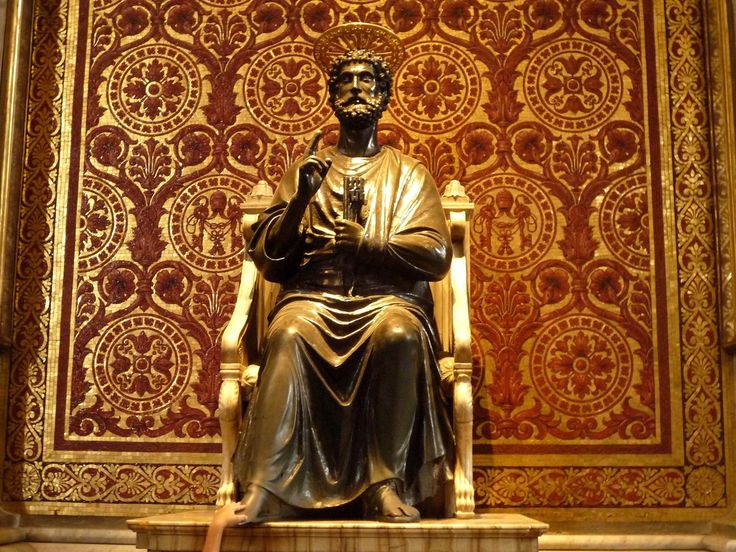
It is important to view the improvement activities from a big picture standpoint. Viewing kaizen from a system standpoint is essential. I have always been curious about how the small incremental improvement activities would make a big difference in the end.  I will finish this post talking about the 800 year old Bronze statue of St. Peter holding the keys to Heaven in St. Peter’s Basilica in Rome.

St Peter

It looks like St. Peter is wearing shoes on his right foot and sandals on the left foot. Over eight centuries, pilgrims have been touching his right foot that is more accessible (it sticks out more) and asking for blessings. No one has been rubbing on the foot or sanding it down.  There has been no complaint of vandalism or apparent damage to the statue. The simple act of touching and kissing over time worn the bronze statue down – that St. Peter lost all his toes on his right foot. It is said that the Church started requesting visitors to start touching the left foot more. It appears that the left foot has got a lot of catching up to do.

StPeter-feet

Always keep on learning…

If you enjoyed this post, you can read more here.

In case you missed it, my last post was Seneca’s “On Shortness of Life”.

Seneca’s “On Shortness of Life”:

Time- Life is Long

Lucius Seneca (4 BC- AD 65) was a Roman Stoic philosopher and statesman. He was Emperor Nero’s tutor and unfortunately was forced by the emperor to take his own life. One of Seneca’s famous works is “On Shortness of Life”, a collection of letters and essays he wrote. Seneca’s ideas and thoughts on time gel very well with the concepts in Toyota Production System, and are still appropriate today.

There are two concepts that stuck out to me in reading the collection “On Shortness of Life”, and these both have the underlying theme of “personal time”. The first concept is about learning the value of personal time. Seneca said;

  • I am always surprised to see some people demanding the time of others and meeting a most obliging response. Both sides have in view the reason for which the time is asked and neither regards the time itself — as if nothing there is being asked for and nothing given. They are trifling with life’s most precious commodity, being deceived because it is an intangible thing, not open to inspection and therefore reckoned very cheap — in fact, almost without any value.
  • Nobody works out the value of time: men use it lavishly as if it cost nothing… We have to be more careful in preserving what will cease at an unknown point.

Along the same vein, the second concept is about productivity and improving productivity by spending your time wisely. People often complain about “not having enough time”. Seneca said;

  • It is not that we have a short space of time, but that we waste much of it. Life is long enough, and it has been given in sufficiently generous measure to allow the accomplishment of the very greatest things if the whole of it is well invested.
  • Life is long if you know how to use it.

The Value of Time in the Toyota Production System:

One of the core themes in the Toyota Production System is time – respecting other’s time and reducing the time spent in getting the product in to the customer’s hands from the factory floor. In a similar vein to Seneca’s view on the value of time, Eiiji Toyoda, a strong supporter of Taiichi Ohno, said;

  • A person’s life is an accumulation of time – just one hour is equivalent to a person’s life. Employees provide their precious hours of life to the company, so we have to use it effectively; otherwise, we are wasting their life.

This is a strong statement as Michel pointed out in his post, and it exemplifies the idea of Respect for People. Respect for People is about respecting the person’s time – not allowing him to squander it away on non-value adding activities. Wasting others’ time is a cruel activity.

Taiichi Ohno has said the following about productivity;

Measure your performance based on productivity and not by how busy you are.

Ohno’s first challenge to anybody on the floor was to find a way to get the job done with fewer operators. I should point out that Ohno never wanted to get rid of the operators. His view was that every operation or process is full of waste and this leads to operators being engaged in non-value adding activities. Being busy and getting things done are not always the same.

Similar to Seneca, Ohno pushed the supervisors and operators to use their time well and find ways to eliminate waste. It was not about working longer or bringing in more people to get the job done. It was about eliminating the waste in the operation – thus increasing the value of the operation. Toyota challenged every employee to view their production system as the Thinking Production System. This challenges people to spend their time wisely and not squander it. It is about knowing how to wisely use time in your life.

These two ideas align very well with the two pillars of the Toyota Way;

  1. Respect for People – value other’s time
  2. Continuous Improvement – learning how to use time wisely

Final Words:

I will finish off with an Ohno story that clearly shows an appreciation for others’ time (source: Pascal Dennis);

Taiichi Ohno was visiting a supplier’s plant in the early 1950’s. He spent his time observing the operators on the floor. He observed one particular operator on a machine. The operator stood in front of the machine, watching it. Ohno observed him for a few cycles of the machine.

He then asked the operator, “How often does this machine break down?”

“Never”, the operator replied.

“So what do you do all day”, Ohno continued.

“Well, I watch this machine, Ohno-san”, was the response.

“So you watch this machine all day, and it never breaks down?”

“Yes”, the operator responded, “that is my job.”

“What a terrible waste of humanity”, Ohno exclaimed to himself.

Always keep on learning…

In case you missed it, my last post was The Colors of Waste.

The Colors of Waste:

dr who

Doctor Who, a British TV show started in 1963, is the longest running Science Fiction show today and I am a big fan. There is a cool gadget in the Whovian Universe called the “Perception Filter”. This is a gadget that renders something unnoticeable. It does not make it invisible like the “Invisible Cloak” in Harry Potter’s world. It just alters your perception so that you do not pay attention to it. As one of the characters said in the show;

“I know it is there but I do not want to know it is there.”

This is a brilliant concept and I love how it applies to Lean as well. You can eliminate waste only when you start to see waste. Ohno categorized waste in to seven buckets and this makes it easier for us to “see” waste. When mass production was the norm and inventory was considered to be an ideal thing to have, Ohno was able to “see” it for what it truly was – a waste. It was almost as if there was a perception filter around the waste that nobody wanted to truly see it for what it really was.

The first step of people development in TPS is to train them to see waste. Ohno famously did this through his “Ohno Circle” – a hand drawn chalk circle on the factory floor in which the supervisor or manager was made to stay in until he started to see the waste that Ohno was seeing. This act of observation was breaking down the “perception filters” so that the waste was made visible. Once the waste is seen, the second step of people development is to put countermeasures in place while completely eliminating the waste by fixing the root cause.

Homer’s Wine Dark Sea:

There is a great Radiolab podcast called “Colors”. This podcast asked the question – To what extent is color a physical thing in the physical world, and to what extent is it created in our minds? The podcast talked about William Gladstone, a famous British politician (1809-1898) who later became Prime Minister. Gladstone was the first to notice that in the famous Greek author Homer’s works, there were many discrepancies regarding colors. Homer described the color of sea as “wine-dark”, honey as “green”, and sheep as “violet”. Gladstone came to the conclusion that the Greeks were color blind! Perhaps a better explanation would be that there was only a limited vocabulary when it came to colors in the ancient world. They had to explain multiple colors using the same words. The interesting question is whether or not having a specific word for a color acts as a “perception filter” – you know it is there but you do not want to see it.

Jules Davidoff, a researcher, went to Namibia to study the Himba tribe on their abilities to perceive different colors. A similar study was part of the 2011 BBC documentary called “Do you see what I see?” Himba tribe does not have a separate word for “blue”. Their “blue” is part of the word for the color “green”. The Himba tribe took a long time to distinguish between a quite striking blue square from other green squares. This is because they did not have a word for that specific color of blue. They could not perceive it immediately as being different from the other green squares.

vlcsnap-2016-08-20-10h23m52s177

In another experiment, the Himba people were asked to distinguish between very similar shades of green, and they were able to quickly point out the odd color square because they had a separate word to distinguish that characteristic of shade. This task would be very difficult for others because all of the squares were “light green”. Thus our brains would not be able to immediately perceive the different square. Try this test for yourself. Can you pick the odd color out?

2

The right answer is below.

3

Final Words:

It may not be necessary that we have a word for each waste. We should also make effort to understand it. This can only be done by going to the Gemba, and observing. We become more perceptive to the different wastes only through the regular practice of observation at the Gemba.

I will finish off with a Zen story attributed to David Foster Wallace.

“..There are these two young fish swimming along and they happen to meet an older fish swimming the other way, who nods at them and says “Morning, boys. How’s the water?” And the two young fish swim on for a bit, and then eventually one of them looks over at the other and goes “What in the world is water?”

Always keep on learning…

In case you missed it, my last post was Naikan and Respect for People.

The Pursuit of Quality – A Lesser Known Lesson from Ohno:

Ohno

In today’s post, I will be looking at a lesser known lesson from Taiichi Ohno regarding the pursuit of Quality.

“The pursuit of quantity cultivates waste while the pursuit of quality yields value.”

Ohno was talking about using andons and the importance of resisting mass production thinking. Andon means “lantern” in Japanese, and is a form of visual control on the floor. Toyota requires and requests the operators to pull the andon cord to stop the line if a defect is found and to alert the lead about the issue. Ohno said the following about andons;

“Correcting defects is necessary to reach our goal of totally eliminating waste.”

Prior to the oil crisis, in the early 1970’s in Japan, all the other companies were buying high-volume machines to increase output. They reasoned that they could store the surplus in the warehouse and sell them when the time was right. Toyota, on the other hand, resisted this and built only what was needed. According to Ohno, the companies following mass-production thinking got a rude awakening in the wake of the oil crisis since they could not dispose off their high inventory. Meanwhile Toyota thrived and their profits increased. The other companies started taking notice of the Toyota Production System.

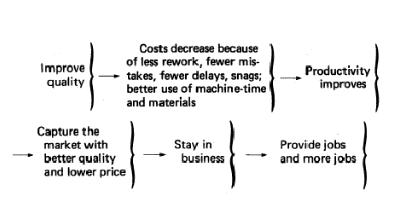
Ohno’s lesson of the pursuit of quality to yield value struck a chord with me. This concept is similar to Dr. Deming’s chain reaction model. Dr. Deming taught us that improvement of quality begets the natural and inevitable improvement of productivity. His entire model is shown below (from his book “Out of the Crisis”).

Deming Chain reaction

Dr. Deming taught the Japanese workers that the defects and faults that get into the hands of the customer lose the market and cost him his job. Dr. Deming taught the Japanese management that everyone should work towards a common aim – quality.

Steve Jobs Story:

I will finish with a story I heard from Tony Fadell who worked as a consultant for Apple and helped with the creation of the IPod. Tony said that Steve Jobs did not like the “Charge Before Use” sticker on all of the electronic gadgets that were available at that time. Jobs argued that the customer had paid money anticipating using the gadget immediately, and that the delay from charging takes away from the customer satisfaction. The normal burn-in period used to be 30 minutes for the IPod. The burn-in is part of the Quality/Reliability inspection where the electronic equipment runs certain cycles for a period of time with the intent of stressing the components to weed out any defective or “weak” parts. Jobs changed the burn-in time to two hours so that when the customer got the IPod, it was fully charged for him to use right away. This was a 300% increase in the inspection time and would have impacted the lead time. Traditional thinking would argue that this was not a good decision. However, this counterintuitive approach was welcomed by the customers and nowadays it is the norm that electronic devices come charged so that the end user can start using it immediately.

Always keep on learning…

In case you missed it, my last post was Challenge and Kaizen.

If the Learner Has Not Learned, Point at the Moon:

point at the moon

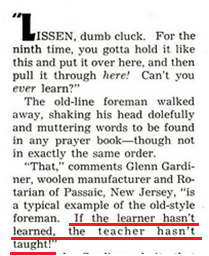
In today’s post I will be looking at the role of teaching in lean and I will try to look at the role of the student in learning. “If the learner has not learned, then the teacher has not taught.” This has come to be a common expression in Lean. This saying was introduced as part of Training Within Industry’s Job Instruction (JI) program. The original expression in the JI Program manual was “If the worker hasn’t learned, the instructor hasn’t taught.” The JI card carried the statement “If the learner hasn’t learned, the teacher hasn’t taught.”

My favorite record of this statement is from the 1942 November issue of “The Rotarian” magazine. The Albert E Wiggam’s article was titled “Foremen in 10 hours” and it talked about the Job Instruction Training program (JIT). According to the article, The purpose of the JI program was to enable the foremen to have the “show’em how” – the ability to pass the “know-how” to the new-comers in ten hours.

Rotarian

The implication in the statement “If the learner hasn’t learned…” is that the responsibility of the student’s learning rests solely with the instructor. It is my view that the student has the responsibility to be willing as well. My favorite quote regarding this comes from the most famous Japanese Samurai Miyamoto Musashi (1584 – 1645).

“Let the teacher be as a needle, the student as a thread.”

The student has to follow the teacher like a thread that follows the needle. This is a beautiful expression. The focus of the JI program is to show how to prepare the student and how to explain “the why” and “the how” of each step. It also focused on having the student repeat the operation, and to ensure that the instructor follows-up and provides the required feedback creating a closed learning loop.

 “The Ackoff Model”:

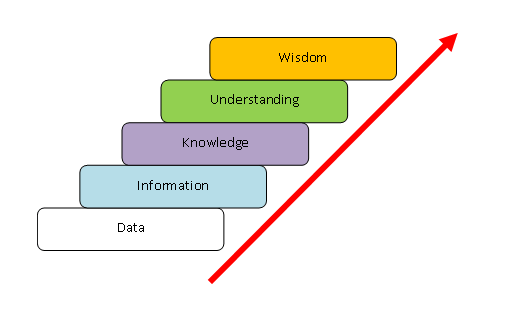
My favorite model of Knowledge Management is the DIKUW model made popular by the famous Management Science professor Russell Ackoff. This is shown below:

ackoff

The five components in the order of importance are;

  1. Data – discrete packets or values. An example for this is just a set of numbers and nouns.
  2. Information – data with context. Answers to questions such as Who, What, When, How many etc.
  3. Knowledge – answer to the question How?
  4. Understanding – answer to the question Why in a global level?
  5. Wisdom – ability to understand the situation to know what to do and execution with results

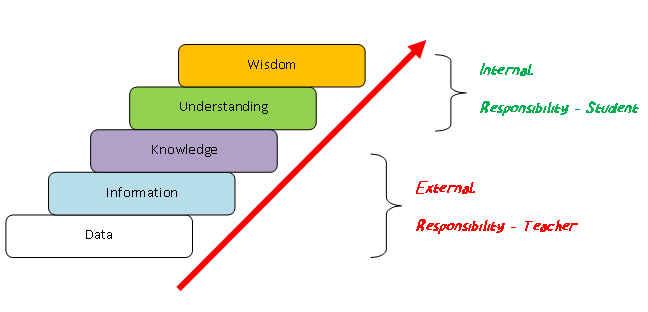
I will be using this model to further explain my thoughts. Data, information and knowledge can be imparted, and are external to the student. However, understanding and wisdom cannot be imparted and are internal to the student. The teacher can only guide the student and it is the student’s responsibility to practice and learn on his own to achieve understanding and wisdom. Perhaps, the intent of the JI is to impart knowledge to the worker on how to properly perform the operation. But the understanding and wisdom to improve one’s work (kaizen thinking) should come from the operator.

The teacher has to ensure that the student has achieved knowledge, and the student has to ensure that he achieves understanding and wisdom.

My favorite expression describing the difference between knowledge and wisdom (inspired by Peter Drucker) is;

Knowledge is doing things right and wisdom is doing the right things.

The above expression indicates that knowledge has to do with being efficient, and wisdom has to do with being effective.

The Role of the Sensei:

“Sensei” is a Japanese word that has roots in Chinese and the literal meaning in Japanese is “lives (born) before”. Sensei has come to mean “Teacher”. The term is connected with martial arts training. There are four criteria that a sensei should possess;

  1. Technical ability – understanding of the technical aspects of the subject and ability to keep on polishing/learning
  2. Taking Responsibility – ensuring that the sensei passes along his knowledge so that the “chain” does not get broken
  3. Ability to communicate – the sensei must be able to communicate his mastery to his students of all levels of aptitude
  4. Understanding – the sensei should be understanding of his students

The Role of the Student:

There is a notion in Zen that “when the student is ready, the teacher will appear”. The implication here is that the student has to be ready first and pursuing learning, only then will the teacher appear. The student can learn from everything around him only if he is receptive to learning. The student has the responsibility to present himself with humility and determination to understand and practice the skill. The student must be eager to learn and willing to “forget” what he has learned before.  My favorite account for this is an anecdote I have heard before:

A student went to a teacher and asked him “can you teach me how to meditate” and the teacher said “No. I might let you learn under me.”

 My Final Words:

It is the responsibility of the teacher to help the student attain knowledge, and it is the responsibility of the student to reach wisdom from there. Both the teacher and student have to be willing to give and receive learning. The student has to surpass the teacher. The student cannot do this simply by copying the teacher. The student has to build upon the teacher’s teachings and find wisdom on his own, leapfrogging the teacher.

teacher - student

I will finish this off with a Zen story about pointing at the moon – don’t mistake the finger for the moon.

The Buddha says “my teaching is not a dogma or a doctrine, but no doubt some people will take it as such.” The Buddha goes on to say “I must state clearly that my teaching is a method to experience reality and not reality itself, just as a finger pointing at the moon is not the moon itself. A thinking person makes use of the finger to see the moon. A person who only looks at the finger and mistakes it for the moon will never see the real moon.”

To see the moon you have to look beyond the finger.

Always keep on learning…

You may like my newer post on the cybernetic aspects of teaching and learning. If the teacher hasn’t learned, the teacher hasn’t taught.

In case you missed it, my last post was The Many Flavors of Kaizen.

The Many Flavors of Kaizen:

flavors

In today’s post I will be writing about the many flavors of kaizen. I have been writing for over a year now. It seems that I keep coming back to kaizen. Kaizen is the spirit of lean, and can be translated from Japanese as “change for the better”. What is today is not good enough, and everything can be improved in small or big steps.

There are mainly five flavors that I have identified regarding kaizen. They are;

  1. Kaizen – small incremental improvement activities
  2. Kaizen Teian – Employee Suggestion Program
  3. QC Circles
  4. Jishuken
  5. Kaizen Blitz/Event or Rapid Improvement Activity

Kaizen – Small Incremental Improvement:

Taiichi Ohno said “where there is no standard, there can be no kaizen”. His intent was that you keep improving your standard towards the ideal state. This is the essence of the Job Method program that was taught as part of the Training Within Industry program. This is where employees are encouraged to ask why a step is done in a specific manner and how an operation can be improved. Job Method program provides specific steps to do this. Ohno modified this to suit Toyota. The Job Method program was replaced by Shigeo Shingo’s P-Courses that had time and motion studies, and process and operation analysis. These courses were derived strongly from the courses taught by the Gilbreths in the early 1900’s. This type of activity is generally performed at the individual level and is thus local. These can be viewed as bottom-up kaizen.

Kaizen Teian – Employee Suggestion Program:

Eiji Toyoda went to America to learn from Ford in the 1950’s. Although he was not impressed with many things, one thing really caught his attention. This was Ford’s employee suggestion program. He brought that back to Japan and implemented it at Toyota. This really took hold in Toyota. Toyota became famous for the company with 20 million ideas in 40 years. The ideas that the employees suggest are specific to their jobs, and everybody participates in this. This type of activity is generally at the individual level and is thus local. These can be viewed as bottom-up kaizen.

QC Circles:

QC Circles are small groups of employees who voluntarily meet after work to focus on specific problems related to quality or processes. QC Circles were developed as part of the Total Quality Movement. Masao Nemoto, who is considered to be the strong force behind establishing the Quality Control program at Toyota, has indicated that the goal of QC Circles was to raise consciousness of line workers towards quality. There were a lot of improvement activities that resulted from the QC Circle activities. This type of activity is team based and generally led by a local leader like a supervisor. These can be viewed as bottom-up kaizen.

Jishuken:

Jishuken started off as a program by Toyota around 1975 for teaching suppliers how to do kaizen or implement TPS. This became a medium for training managers and other leaders in middle management. Jishuken is loosely translated as “self-study groups”. This activity generally tackles a hard project, and is seen as way to provide learning and being exposed to the gemba.  Jishuken events are also sometimes referred to as management driven kaizen activities. There is some flexibility regarding the duration of the event. There are some similarities to Kaizen events – these are team based and cross-functional in nature. These can be viewed as top-down kaizen.

Kaizen Events:

This is perhaps the most common “kaizen” identified by lean practitioners outside of Toyota. As with many things in Lean, Toyota does not practice kaizen events. This is generally a weeklong event comprising of a cross-functional team. This can be viewed as top-down kaizen.

Final Words:

It is an interesting question as to whether kaizen should be top-down or bottom-up. My thinking on this is that top management should lay the framework for kaizen to be present across the organization. The responsibility and duty for ensuring bottom-up kaizen lies with top management. Ultimately, the end goal is to get everybody to execute improvement activities so that the organization itself improves systematically. Every improvement activity should align with the organization goals and vision.I will finish off with an anecdote from Taiichi Ohno that looks at the unique relationship of top-down and bottom-up management and the need for a strong change-agent who is also a visionary.

Taiichi Ohno is the father of Toyota Production System. He first started implementing his ideas locally in his department. He faced a lot of resistance. His ideas were very counterintuitive and were against the common wisdom at that time.

Ohno was just a middle level manager. In this regard, what he did can be considered to be bottom-up. However, he had strong support from Eiji Toyoda and Saito Naichi, under whom Ohno worked for 35 years. Ohno later on talked about the positive phenomenon of the silent relationship between them in his book “Just-In-Time For Today and Tomorrow”.

There were a lot of people, including those in management who were against Ohno. However, all this anger and resentment were absorbed by Eiji and Saito. They acted as a buffer between Ohno and the factory. They never mentioned anything to Ohno. They wanted Ohno to keep on going with his improvement activities to reduce manufacturing costs. It was initially called as Ohno System since “Toyota” was not completely on board yet.  Eiji, Saito and Ohno were bound by an invisible thread of mutual trust. Ohno said the following about this;

“I knew all too well how they worried about me and what I was doing. Yet they never said “Do this!” or “Do that!”. For my part, I never had to say “I’d like to do this” or “Please let me do that.” I just did everything I thought had to be done. Had I asked permission, my resolve would have weakened because of the pressure to prove what I was doing. Had either side said anything, the relationship would have collapsed.”

Always keep on learning…

In case you missed it, my last post was Reflecting on Hansei.

Time and TPS:

tardis

I am intrigued by the concept of time. I am a big Doctor Who fan, and I quite enjoy the time paradoxes presented in the Whovian universe. In today’s post, I am exploring the theme of time, and some quotations by Henry Ford, Shigeo Shingo and Taiichi Ohno.

Henry Ford:

Taiichi Ohno, the father of Toyota Production System, has said that if Henry Ford was still alive, he would have eventually created a production system similar to Toyota. Ford has written about the concept of time in his 1926 book, Today and Tomorrow.

“The easiest of all wastes, and the hardest to correct, is the waste of time.”

Ford’s point was that time waste is different from material waste. Material can usually be reworked. However time wasted cannot be salvaged. Ford thought of time as human energy.

Shigeo Shingo:

Shingo was probably one of the best Industrial Engineers in the world. He studied Frederick Taylor and the Gilbreths, and was heavily influenced by them. One of the most cryptic things I read from Shingo was the quotation below;

“Time is the shadow of motion”.

Shingo attributed this to the Gilbreths. Shingo explained this statement better in his 1988 book, “Non-Stock Production”. His point is that time can be explained in terms of motion, as in “it takes a long time to do this” or “it can be done faster”. He urges the lean leaders to understand the “structure” of motion, and understand the most efficient way to do motion. Shingo advises us to understand what it means when a task takes a long time and not complain about the duration. We should instead look at the motions that make the task take longer. As Shingo says;

“It may be necessary to restructure the task to which the motions are tailored”.

The translator may not have intended the pun behind “tailored”/”Taylored”. Toyota uses time and motion studies as the basis for creating standard work.

Taiichi Ohno:

The most common expression attributed to Taiichi Ohno regarding time is;

“All we are doing is looking at the time line, from the moment the customer gives us an order to the point when we collect the cash. And we are reducing the time line by reducing the non-value adding wastes.”

Ohno is often described as a mean and tough sensei. He is also said to have been hard on the supervisors asking to produce more with less people. Ohno has talked a lot about “Respect for Humanity” and the need for ensuring that the operator is engaged in only value added activities. I am going to look at another saying by Ohno.

“Valueless motions are equal to ‘shortening one’s life.’”

Ohno had a way with words and he could explain his ideas beautifully. Not engaging the operator in value added activities, and not allowing him to improve his process is not being respectful. Ohno has also said that motion does not equate to working. Ohno stated it the best.

Final Words:

One of the two pillars of TPS is Just-in-Time. The idea behind this is to produce the right parts in the right amount, and at the right time.  I will finish this off with a story about Just-in-Time from Masaaki Sato’s book, “The Toyota Leaders”. The term Just-in-Time was coined by Kiichiro Toyoda, the founder of Toyota Motor Corporation.

Kiichiro went on a trip to England with some relatives to visit several cotton production facilities and textile factories. He was going to the Platt plant by himself to receive training. He arrived at Saint Pancras station to catch the Manchester-bound train. Unfortunately, by the time he arrived, the train had already left the station. He had an out-of-date train schedule.

“If a train leaves on time, then you miss your train even if you are only a minute late. Now I have to wait for a few hours until the next train comes”, he said to himself.

Kiichiro was taken aback by this incident and he kept on thinking about it to find a way to apply this to plant operations. He then came up with the idea of Just-in-Time. He did not coin the phrase in Japanese, but in English (perhaps as a reminder to himself of the incident in England).

He explained Just-in-Time to his employees as follows;

“I will bet everyone here has missed a train before. If a train leaves on time, you will miss it even if you are just a second late, let alone an entire minute. ‘Just-in-Time’ does not refer only to being on time. It means ‘supplying the right parts at the right time and in the right amount’”.

Always keep on learning…

If you enjoyed this post, you can read more here.

In case you missed it, my last post was The Order for Kaizen.

The Order for Kaizen:

kaizen order

In today’s post, I will be talking about Kaizen and specifically the order for kaizen. Kaizen has come to mean “continuous improvement” today. Kaizen originally translates from Japanese as “change for better”. I will be presenting three different views on approaching kaizen. These are;

  • Taiichi Ohno’s view,
  • Shigeo Shingo’s view, and
  • Hiroyuki Hirano’s view

Taiichi Ohno’s View (Semi-Strategic in nature):

Taiichi Ohno is the father of Toyota Production System (TPS). He has stated that there is a proper order for kaizen. These are;

  • Sagyo kaizen (Operations improvement),
  • Setsubi kaizen (Equipment improvement), and
  • Kotei kaizen (Process improvement)

I believe that Ohno wanted to focus on developing the abilities of people first since this is the lowest level where kaizen is possible. As Hirano says, “The starting point of manufacturing is always people.” Any production system should be people oriented. The first step of all kaizen is to raise the awareness of the people. This allows them to view the waste as a lean leader would. This is achieved only through operations kaizen. The operators involved are finding ways to make their work easier with what they have. This has minimal cost impact of all the kaizen. Ohno has also said;

“People with no capacity for improving operations are a problem because they like to buy new machines all the time.”

Ohno has also said;

“First improve operations. If you start out by bringing in the latest machines people with no capacity for improvement simply end up being slaves to the machines.”

The next in line is Equipment kaizen. Ohno challenges us to find new and creative ways of using the current equipment. Ohno advises us;

“You must have the ability to tinker with and improve the machines you already have.”

Ohno recommends buying new equipment when you have made the maximum use of current equipment and when it is no longer possible to increase effectiveness without new equipment. Purchasing new equipment should result in an improvement of quality. Ohno cautions against purchasing costly specialized equipment and advises going for flexible and low cost equipment. Equipment kaizen alone without operation kaizen results in extreme waste. Now the organization can make waste much better, and lot more of it. Machines cannot see waste, and machines cannot improve anything on their own. Machine kaizen alone foster status quo and invites complacency.

The last in line is Process Kaizen. His view was;

“Making things extremely well by turning the process upside down is Process Improvement.”

With process kaizen, you are looking at rearranging equipment or operations, changing layout, or improving the flow by linking processes.

Shigeo Shingo’s View (Tactical in nature):

Shigeo Shingo has provided us four targets for improvement. They are, in the order of priority;

  • Easier,
  • Better,
  • Faster, and
  • Cheaper

I was watching a Paul Akers (FastCap) video on YouTube and I made a connection to what Shingo said. “Easier” is an improvement from the point of the operator. This also means that it is safer for the operator to do. Any improvement activity should be first focused on Safety. “Better” is an improvement activity resulting in an improvement in quality of the operation/product. “Faster” is an improvement activity that increases efficiency. The final level is “cheaper”, and this should be the last target of all improvement activities. The goal of kaizen is not necessarily to first make the process cheaper.

Hiroyuki Hirano’s view (Strategic in Nature):

Hirano has pointed out the following as the normal progression of kaizen;

  • Point kaizen,
  • Line kaizen,
  • Plane kaizen, and
  • Cubic kaizen

“Point kaizen” is very similar to the operations improvement. This is the basic small improvement activity at the operations level. The next level is “line kaizen”. This is where a lot of the point kaizens merge together to result in flow manufacturing, as in an assembly line. Hirano calls this a vertical development. This is akin to selecting a model line and transforming it to make the process flow better. Once we have line kaizen, the next progression is through “plane kaizen”. This is the idea of “yokoten” or horizontal deployment. This is where the ideas and learning from the model line is used to create more model lines across the plant.  Thus this results in horizontal development. The final level is “cubic kaizen” where the development is made across multiple departments and even the supply chain of the enterprise.

My thoughts:

As with any other buzzword, kaizen has come to mean many things. My goal has been to provide a little more structure to the wonderful idea of kaizen. I would encourage the reader to also read my previous post on this topic here (A brief look at kaizen in the light of the Toyota Way). I will finish this off with a great story on Equipment kaizen from Hitoshi Yamada, a student of Ohno from the book Forging a Kaizen Culture (Japanese version 2009):

Yamada was at a large component manufacturer, Stanley Electric’s Tsuruoka plant. They were looking at a machine that assembled extremely small light bulbs. The cost of the machine was $150,000. The machine had two turn tables, and several robot arms. Due to the high cost of the machine, the factory manager felt that he should rely on mass production to make the maximum use of the machine.

Yamada told the manager to study the machine and find areas of wasted movement. And even better- to build a smaller and better machine.

This improvement activity took several weeks of trial and error. The final machine was $5,000 and 1/27th the size of the old machine. Since the machine was much smaller in size, it was also more efficient.

Always keep on learning…

In case you missed it, my last post was Ohno and the Gemba Walk.

Ohno and the Gemba Walk:

g_walk.png

Taiichi Ohno, the father of the Toyota Production System, was a firm believer in “Gemba Kanri” which translates from Japanese as “workplace management”. Taiichi Ohno and Setsuo Mito wrote a conversation-style book called “Why Not Do It Just-In-Time”. This was translated and released in English as “Just-In-Time For Today and Tomorrow”. Taiichi Ohno talked about the essence of gemba walks in the book. He did not call them gemba walks but he used what was well known at that time; Managing by Walking Around (MBWA) to explain his thoughts on gemba walks.

Gemba Walk:

Gemba is the actual place of action. Gemba Walk is thus a walk to and in the gemba. Ohno clearly explained the purpose of going to the gemba: You go to the gemba to understand and grasp the facts. Ohno said the following;

For the manager wandering around the work place, signs, charts, data and standards that accurately measure current work place conditions are indispensible.

Ohno emphasized that doing gemba walks without established standards is not worthwhile. Ohno viewed problems as deviations from the standards, and if the standards are not established, you will not know what to look for. The standards (also called as Standard Work) represent the most effective combination of human activity, equipment activity and the product being produced. The standards are visual and convey three vital pieces of information;

  • Takt time – the rhythm of production. This explains how often a part should come out.
  • Work Sequence – this shows the sequence of how operations are to be performed. The sequence is created with input from the operators, and this is the easiest and the current best sequence of steps to perform the operation.
  • Standard WIP (Work in Process) – this is the quantity of product allowed in the work station, and this also includes the part the operator is working on. Any extra parts are an indication of disruptions.

The idea of Managing by Walking Around was put forth by Tom Peters and Nancy Austin. The intent of MBWA was proposed as a “technology for implementing the obvious.” Mr. Peters and Ms. Austin proposed that MBWA would enable figuring out exactly what needs to be done. MBWA would help finding out the information that is not readily available otherwise. From this aspect, gemba walks also have the same goal – to implement the obvious. MBWA did not explain what to look for or how to find out the information where as Ohno clearly laid out the “what” and the “where”.

Ohno advises to post the standards in each production areas that everyone can see at a glance;

  • What type of work place it is,
  • What the production amount is,
  • What the sequence of operations should be.

This (posting standards) is fundamental and the model for visual control.

Ohno brilliantly described that the production plant is simultaneously a free and generous creature, and an insidious and mischievous nuisance. We should be fascinated by the challenges of discovering ways to deal with this entity. Ohno goes on to explain that for a production plant to properly operate, people should assume leadership and bring out the best in the machines and the system. To do so, people must utilize their intelligence and imagination to improve their work environment as well as investigate problems in the production plant. This is the main idea behind Ohno’s teaching for continuously improving the standards. He would scold the supervisors if the standards are not changed frequently.

The gemba walks often open doors to develop the operators. The first step of kaizen is to teach people how to identify and see waste. This is akin to teaching a person to fish rather than giving him fish every day.

Another aspect that Ohno described was something new to me- he explained that everybody has a principal work place (gemba). However, several of us also have multiple sub-workplaces (sub-gembas). He then stated another reason for doing the gemba walks;

To generate new information and trigger the imagination, a critical mind needs different environments.

My thoughts:

The Gemba Walks provides the meeting ground for top-down and bottom-up management systems. The standards make it easier for management from top-down. The employees are also enabled to make bottom-up proposals since they understand the common goal.

The main purposes of the gemba walks are to identify deviations from the standard, and to look for opportunities to change (improve) the standard.

The following are the desirable outcomes of gemba walks.

  • Self development by observing and learning
  • Developing others to observe and learn
  • Process improvement to establish the next standard
  • Harmony (bringing out the best)

The following are things to keep in mind doing gemba walks;

  • Do not immediately show them how to fix a problem
  • Do not have preconceived notions
  • Show respect, do not be an expert
  • Challenge the status quo
  • Always ask questions as “what should be the ideal state (standards) and what is the current state?” Explain problems always as deviations from the standard.

I will finish this off with a neat Ohno story from the book, “Just-In-Time For Today and Tomorrow”;

Setsuo Mito approached Ohno and asked about the origin of his name – Taiichi.

“Your father probably named you hoping that you would become a ‘patient’ child (nin T AIno)”, Mito said.

Ohno simply replied, “My father named me after his job in Dairen, where he worked with ‘firebricks’ (TAIkarenga)”.

Always keep on learning…

In case you missed it, my last post was Does Lean = the Elimination of Waste?