
Continuous Improvement Inhibitors and ‘Respect for People’:

respect

I recently reread Deming’s Out of Crisis book. I came across a list that caught my eye – perhaps I overread it last time, or did not pay enough attention to it. This list is based on a conversation with 45 production workers. According to them, these inhibitors stood in their way to improvement of quality and productivity. Bear in mind that this book came out first in 1982. After more than thirty years, how many of the items in the list are still valid today? How many of these inhibitors do you have at your workplace?

  • Inadequate training
  • Delays and shortages of components
  • Inadequate documentation on how to do the job
  • Rush jobs (bad planning)
  • Outdated drawings
  • Inadequate design
  • Foremen do not have sufficient knowledge to give leadership
  • Inadequate and wrong tools and instruments
  • No lines of communication between production and management
  • Poor working environment
  • Poor performance measurements
  • Defective components at incoming
  • Struggle to get technical help from Engineers

It is said that Deming helped complete Toyota Production System with the introduction of the PDCA cycle as part of Kaizen. If I look at the list above, I realize that majority of the items are to do with Respect for People.

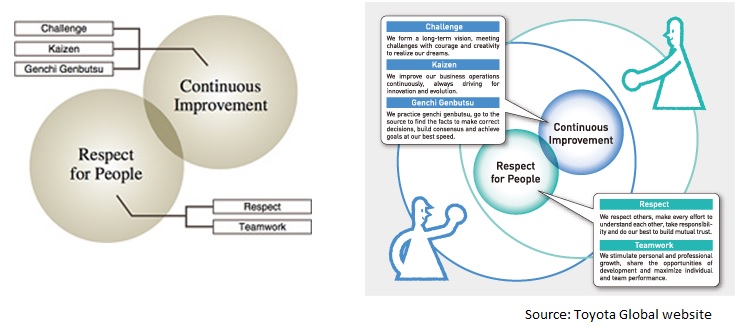
Maybe it is not by accident that the Toyota Way consists of ‘Continuous Improvement’ and ‘Respect for People’.
respect2

The Toyota Global website states the following;

The Toyota Way is supported by two main pillars: ‘Continuous Improvement’ and ‘Respect for People’. We are never satisfied with where we are and always work to improve our business by putting forward new ideas and working to the best of our abilities. We respect all Toyota stakeholders, and believe the success of our business is created by individual effort and good teamwork.

http://www.toyota-global.com/company/history_of_toyota/75years/data/conditions/philosophy/toyotaway2001.html

There is a saying from Toyota “Monozukuri wa hitozukuri,” which roughly translates to “making things is about making people.”

Deming did not talk specifically about ‘Respect for People’. However, his fourteen key principles to managers for transforming business effectiveness were very much about ‘Respect for People’. I have highlighted the sections that I believe applies to ‘Respect for People’.

  1. Create constancy of purpose toward improvement of product and service.
  2. Adopt the new philosophy. We are in a new economic age.
  3. Cease dependence on mass inspection.
  4. End the practice of awarding business on the basis of a price tag alone(This is about long-term relationship of loyalty and trust with your supplier base).
  5. Improve constantly and forever the system of production and service.
  6. Institute training.
  7. Adopt and institute leadership.
  8. Drive out fear.
  9. Break down barriers between staff areas
  10. Eliminate slogans, exhortations, and targets for the work force.
  11. Eliminate numerical quotas for the work force. Eliminate numerical goals for people in management.
  12. Remove barriers that rob people of pride of workmanship.
  13. Encourage education and self-improvement for everyone.
  14. Take action to accomplish the transformation. The transformation is everybody’s job.

Final Thoughts:

A lot of people before me have tried to define what ‘Respect for People’ mean to them. Jon Miller at GembaPantarei has further clarified that a better translation is Respect for Humanness or Humanity.

http://gembapantarei.com/2008/02/exploring_the_respect_for_people_principle_of_the/

To me, ‘Respect for People’ determines why I come to work today and tomorrow. My view is that by creating the equation making things is making people, Toyota has placed people development as a value added activity.

My view is that by creating the equation making things is making people, Toyota has placed people development as a value added activity.

If you agreed with the list of continuous improvement inhibitors, and if you believe that all, if not some, of the inhibitors are applicable to your organization, you may need to look at ‘Respect for People’.

Always keep on learning…
Rethinking Tortoise and Hare fable:

01hare

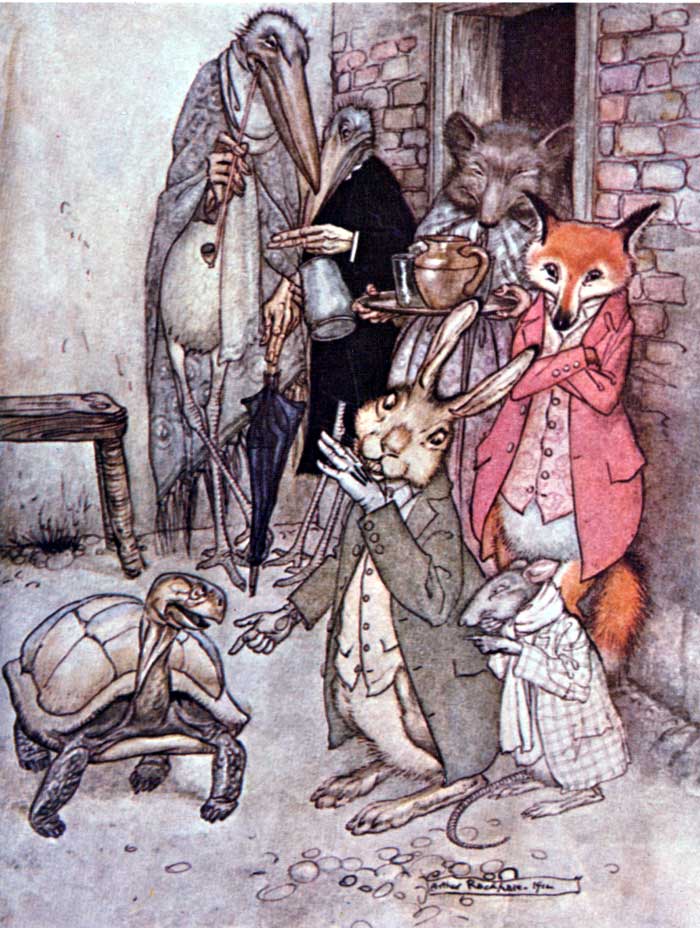
Taiichi Ohno, creator of the Toyota Production System wrote in his book “Toyota Production System – Beyond Large-Scale Production” that “The Toyota Production System can be realized only when all the workers become tortoises”. He was referencing the Tortoise and the Hare fable.

There are more references to this in Toyota Production System. Some of them are given below:

  • Heijunka – Leveling the load. The heijunka system uses the theme of “steady”. The production schedule is rearranged where daily production matches daily demand. This allows flexibility in your plant and reduces your inventory. Most importantly, it reduces Muri (overburdening) on your people.
  • Go slow to go fast” – unknown. Taiichi Ohno has stated “The slower but consistent tortoise causes less waste and is much more desirable than the speedy hare that races ahead and then stops occasionally to doze” in his book “Toyota Production System – Beyond Large-Scale Production.” The idea is that slowing down helps to see the big picture, and eliminates making mistakes and reworks. Thus in the long run, going slow and steady makes you fast. A corollary to this quote is “Haste makes waste.”

I remember reading the Aesop’s fable about the Tortoise and the Hare, and trying to understand the moral “Slow and steady wins the race”. I did not get the moral from the story. In my eyes, the hare lost simply because he slept during the race. The tortoise did not do anything special. As an adult, I feel that a better moral would be “Do not sleep at your job” or “Keep your eye on the goal”.

I did some research on the origins of the fable, and came across “Fables of Aesop and other Eminent Mythologists: With Morals and Reflections” written by Sir Roger L’Estrange (1669). Interestingly, the moral of the fable was a little different.

moral

Up and be doing, is an edifying text; for action is the business of life, and there’s no thought of ever coming to the end of our journey in time, if we sleep by the way.

The last section of “Reflection” is indeed a little more familiar.

reflection

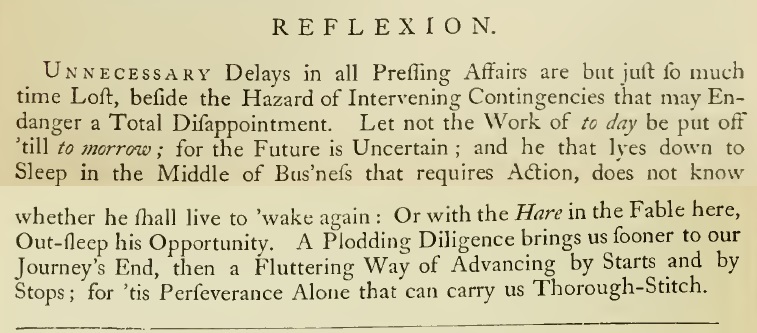
A plodding diligence brings us sooner to our journey’s end than a fluttering way of advancing by starts and stops; for it is perseverance alone that can carry us through stitch.”

My take:

My take on the fable is that the race was actually a “long” race and the persistent tortoise had a long term plan (get to the end of the race at any cost), while the hare only was looking at short term gains (food, sleep etc.). Curiously, this aligns with the first principle in Jeff Liker’s Toyota Way.

“Base your management decisions on a long-term philosophy, even at the expense of short-term financial goals.”

Thus, in my view, the moral of the Tortoise and the Hare fable is to operate from a long term philosophy to win the race, without looking at short term gains.

Always keep on learning…

Meditating with the Cat and Toyota Production System

bodhidharma.350

There once lived a Zen master who was renowned for his profound wisdom. He had many disciples under him. He was said to be a great teacher of meditation.

One day, one of his disciples brought him a kitten. The master was pleased with such a gentle, curious creature. That day, it was time for the meditation class, and the master started his meditation.

Just then, the kitten jumped on his lap and started purring. This distracted the master. He ordered the cat to be tied to the chair next to him. The kitten being the gentle creature that it was, thought it was a good time to sleep while being tied to the chair. This continued every day and every day, the kitten would disrupt the master during meditation, and would get tied to the chair.

Years went by, and the cat was now regularly tied to the chair during meditation time. People from all over would come to learn from the master, and would notice the cat being tied to the chair during meditation.

The master soon died, and the new master continued this practice. Soon the cat died as well. The monastery then got a new kitten, and it got tied to the chair as well. Scholars started writing about this superior method of meditation and how this was better than “regular meditation”. People everywhere started buying cats to improve their meditation skills…

I read this story a while back, and rewrote it for this post. This post is similar to the “Spirit of Buddha” post I made earlier. It has become common to start off lean journeys by mindlessly copying the tools that are used at Toyota. Toyota has crafted the Toyota Production System over decades of trial and error. Each tool they developed or borrowed was to address a specific problem they faced. One should not copy Toyota. The cat was tied to the chair to address a specific problem faced by the master. The cat story is a good example of how we sometimes blindly follow methodologies without understanding the origins.

Shigeo Shingo, in one of the best books on Toyota Production System – “A Study of the Toyota Production System” states the following;

“It must be understood, though, one of its (Toyota Production Management System) prime features is that it is permeated with its own advanced concepts and special techniques. This does not necessarily mean, however, that one can simply copy the distinctive external techniques of the Toyota Production System in another manufacturing environment.

In the same light, Satoshi Hino in his book, “Inside the mind of Toyota” has written the following;

“Unless we could grasp the structure of their minds, then even though we might be able to copy the Toyota Production System, we wouldn’t be able to work out methods for going beyond it and we would never prevail.”

To paraphrase Alan Mulally, former President and CEO of Ford, “If you copy someone, you can only come second. You cannot come first.”

Always keep on learning…

Spirit of Buddha – Why do lean implementations fail?

tiffin box

There have been multiple studies about why lean implementations fail. Why is it so hard for organizations to replicate Toyota’s success when implementing its Toyota Production System?

Hajime Oba, a Toyota veteran was once asked why other organizations cannot replicate Toyota’s success. He responded with an analogy that it is like trying to create a Buddha image without having the spirit of Buddha inside. In other words, other companies are trying to create a system of Lean or Toyota Production System that appears the same but does not have “the soul” in it. They recreate the elements including Kanban, JIT, Jidoka, one piece flow etc. but they simply cannot recreate the spirit or the soul. This is a great analogy.

What is the spirit or the soul of lean implementation? In my thinking, this is the culture. The culture is the cement that brings all the elements of the system together, completely aligned in one direction, which is the company’s vision. This is homogenous in nature, meaning that if you take a sample from anywhere in the company (upper management, middle management, etc.), you will get the same vision. The common goal is engrained in everybody’s mind. If you ask the operator on the floor or the CEO, you get the same answer. Everybody has the spirit within them. They do not strive for local optimization. They strive for the system optimization.

This can be also explained, in a way, with correlation and causation. As it is repeated again and again, correlation does not imply causation. There is a high correlation  with the presence of all the tools like Kanban, JIT, Jidoka, Kaizen thinking etc. with many successful companies. However, this does not imply that the success is caused by those tools. In other words, a correlation marked by the presence of the tools does not imply causation for success. What is missing? The culture, or the spirit, or as Mr. Oba put it – the spirit of Buddha. This is like having the body of a car without its engine, the driving force.

This brings to my mind the accomplishments of one amazing organization. This organization performs 400,000+ transactions a day. The total number of employees is approximately 5000. They have not had any strike in their 120+ years of existence. They have a minimal attrition rate. Their error rate is 1 in 16 million (better than six sigma). They do not use any of the new technologies like an ERP system or bar coding. What they do have is a manual coding of all containers. They get a 100% customer satisfaction rating, year after year. This is the Mumbai Dabbawala Association. They are as they call themselves, a flat organization with no silos. The spirit is very much alive in their organization. Their goal is bring the “lunch box” to the customer and back, on a daily basis at the specified time and location. Come rain or shine, traffic or no traffic in one of the most populated cities in the world. Each employee knows their vision and purpose, and works towards that. You can learn about them more here and here or here.

Keep on learning and keep the spirit alive…

Calculating Lead Times in a Value Stream Map

I was asked a question recently about the lead time calculations in a Value Stream Map. The question was specifically how the lead time is calculated.

There are two ways, that I have seen, of calculating lead times for value stream mapping. They both produce different results.

1) The first one is the one in “Learning to See”. Here the lead time is calculated as follows. Lead Time = Inventory/Daily Demand. There is no relationship with the consumption rate at the subsequent station. If the WIP is 1000 and the daily demand is 100, the lead time is 10 days. The assumption is that the inventory will be used up in only 10 days. This produces an inflated value for lead time and is not the true current state.

2) Calculation of Lead Time based on Little’s Law. To me, this is more realistic. Here the lead time is calculated as follows. Lead Time = WIP * Cycle Time of subsequent station. I know there is a lot of confusion regarding this.  Think of lead time calculation as the future tense. With the same example above, if the WIP is 1000 and cycle time at the station is 60 seconds, the lead time is 60000 seconds or 1000 minutes. Assuming 460 minutes in a day, this equates to 2.17 days (1000/460). In other words, lead time calculation is based on consumption rate.

The only thing to keep in mind with the second calculation is with the inventory we have at the last stage (Finished Goods). The lead time for this will be calculated as Inventory/Daily Requirement. This is because the customer is going to consume this at the rate of daily requirement.

In the end, please note that, “By overanalyzing the tool, don’t overlook the purpose of the tool.”

Keep on learning…