Be an Amateur at the Gemba:

ohno

In my last post, I talked about being like a Samurai warrior at the gemba. Today, I am posting about being an amateur at the gemba.

The word “amateur” has roots in the Latin word “amare” which means to love. “Amateur” used to mean someone who is pursuing something out of pure love or passion. Once the word “amateur” entered the English language, it got associated with a negative connotation. Today being an amateur means that one is a mere hobbyist, and may lack experience and knowledge. Today, its meaning does not encompass the meaning of passion that it once used to have.

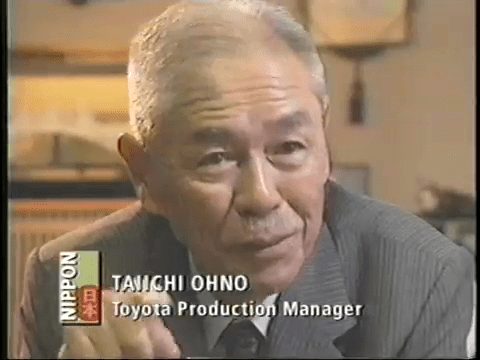
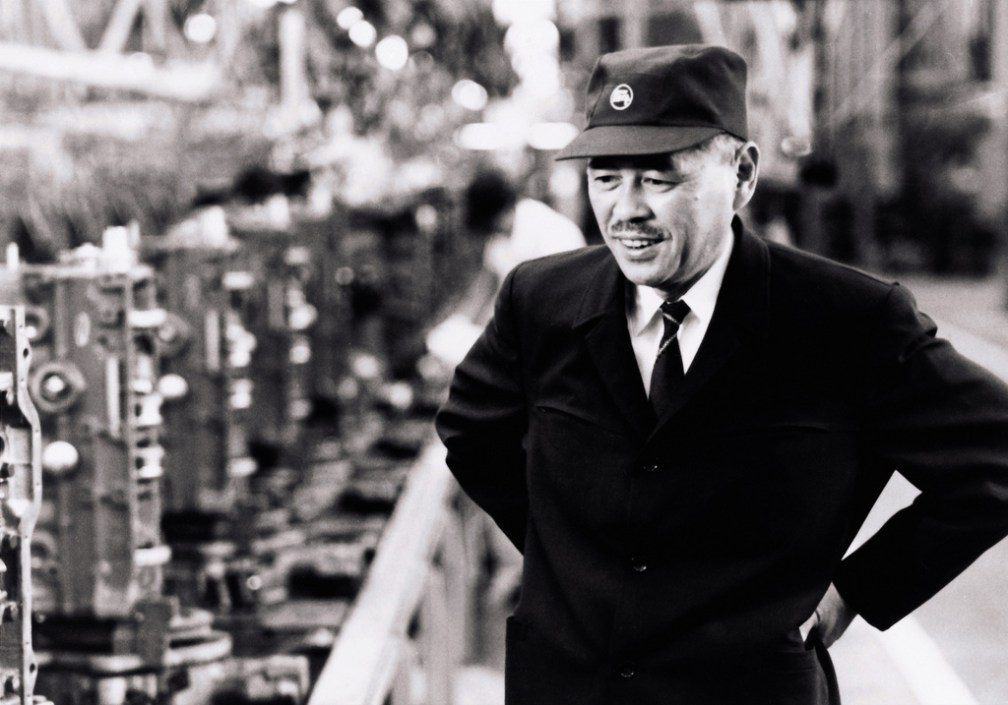
Taiichi Ohno was a man of passion and was new to the automobile world when he heard Kiichiro Toyoda, the then leader of Toyota, talking about the need for Toyota to catch up with American car manufacturing in three years to survive. Ohno was not an expert in auto manufacturing, and the Toyota Production System did not exist at that time. Ohno called himself a “layman” when it came to the auto industry. However, he did have a tremendous amount of love and passion for the manufacturing world. He was an amateur in the classic and modern sense.

Taiichi Ohno- What would Ohno Do?

Taiichi Ohno graduated from the Department of Mechanical Technology of Nagoya Technical High School in the spring of 1932. He then got a job at Toyota Textiles through his father, who was an acquaintance of Kiichiro Toyoda. He later got transferred to Toyota Motor Company in 1943, when Toyota Textiles was dissolved. At this time, it was declared that the Japanese worker’s efficiency was only 1/9th of that of an American worker. Kichiiro Toyoda gave Toyota the clear vision of catching up to America in three years.

Ohno correctly concluded that the high efficiency of the American operator was not due to him exerting ten times more physically than the Japanese operator. His only logical explanation was that there was a lot of waste in what the Japanese operator was doing. Ohno started experimenting and began planting the seeds of Toyota Production System (TPS). This was where the passion or love of the “amateur” came in. The amateur was not afraid to fail. Each step was a learning step for him. In my eyes, the turning point of TPS came when Ohno realized that he can have one operator take care of more than one machine at a time. The norm in those days was that one operator managed only one machine. The operator was not doing anything while the machine was operating. Ohno put the operator in charge of more than one machine. He had to ensure that the labor content remained the same. The operator was not being required to work harder! Ohno instead focused on the flow of operations. The machines were operated in the order as dictated by the flow of operations. In Ohno’s words;

The first step was to establish a flow system in the machine stop.

Ohno proposed to implement work improvement first, and then to do facility improvement. Ohno experimented with different layouts to improve the flow. Some of them are shown below (U-shape/Bracket, Triangle, Square and Diamond).

huki03

Ohno also introduced the idea that to manufacture beyond what is needed is to create waste (waste of over-production). He also introduced the idea of using kanban as a way to ensure a pull system and continuous flow.

One would imagine that Ohno’s ideas would be welcomed with open arms. Instead, he faced a lot of resistance. In fact, his ideas were first called “Ohno’s System” instead of “Toyota Production System”. Gandhi famously stated the following;

“First they ignore you. Then they laugh at you. Then they fight you. Then you win.”

This was true in Ohno’s case. Ohno was called “Mr. Mustache”. The operators thought of Ohno as an eccentric. They used to joke that military men used to wear mustaches during World War II, and that it was rare to see a Japanese man with facial hair afterward. “What’s Mustache up to now?” became a common refrain at the plant as Ohno carried out his studies. (Source: Against All Odds, Togo and Wartman)

His ideas were not easily understood by others. He had to tell others that he will take responsibility for the outcomes, in order to convince them to follow his ideas. To his credit, he taught his ideas at the top and bottom simultaneously.

Ohno could not completely make others understand his vision since his ideas were novel and not always the norm. His style of production was not being practiced anywhere. Ohno was persistent, and he made improvements slowly and steadily. He would later talk about the idea of Toyota being slow and steady like the tortoise. Many of his ideas were based on trial and error, and were thus perceived as counter-intuitive by others. Ohno loved what he did, and he had tremendous passion pushing him forward with his vision. For this reason, Ohno was truly an “amateur”.

Final Words:

I have cited the example of Ohno, the father of Toyota Production System, to propose that one should try to be like him, an amateur – one who has tremendous passion and love for what he does and one who does not mind trying out his ideas even if they might fail. I will finish off with a story I read about Ohno,

As I mentioned above, Ohno’s methods were counter-intuitive in nature. Ohno wanted to increase productivity, and yet not over produce! Ohno in fact called Over-production as the biggest waste of all.

Ohno had started implementing Just-in-Time in the plant. The operators became insecure with this. They felt secure having extra in-process inventory so that they can keep working if there were line stoppages.

Ohno understood this, and became angry about this. He decided to combat this by making the operators take the unneeded material home with them.

“Since the company does not need these things”, he would tell the men as he filled their arms with parts at the end of the day, “you must take them home.”

(Source: Against All Odds, Togo and Wartman)

Always keep on learning…

In case you missed it, my last post was Be a Samurai Warrior at the Gemba.

Lean, Six Sigma, Theory of Constraints and the Mountain:

Matterhorn_Riffelsee_2005-06-11 - Copy.jpg

Recently there have been a lot of discussions about which is best – Lean, Six Sigma or Theory of Constraints? Is Lean Six Sigma better than Lean or Six Sigma?

In this brief post, I will try to view this question from my viewpoint. There is a saying based on the 9th century Zen Buddhist teacher Qingyuan Weixin which I have paraphrased loosely below;

“At first I saw the mountain as a mountain. Then when I learned more and more, I realized that the mountain is not a mountain. But now that I have learned it even more, I see that the mountain is a mountain again.”

If you change the term mountain with “Lean” and “a set of tools”, we can paraphrase it as follows;

“At first I saw Lean as a set of tools. Then I learned more and more, I realized that Lean is not a set of tools. But now that I have learned it even more, I see Lean as a set of tools again.”

You can change Lean to any other philosophy in the above saying. I was taken aback by the saying when I first read it. But gradually it made more sense.

When we first learn about Lean, you hear about the tools. You perceive it as a solid and fixed set of tools. This could include 5S, SMED, Poka Yoke, VSM etc. This kind of categorization and labeling makes us believe that Lean is a set of tools and something that is static. It makes us feel that we know it.

Lean = 5S + SMED + Poka-yoke + VSM +…….

Once we learn more and more, we come to realize that it is not static but dynamic. There is no “one size fits all” solution. There is no magic bullet. The strategy that worked for one company does not work for the other. Then we start to see Lean as not a set of tools.

Lean = Eliminate Waste

However, once we learn more and more, and start applying Lean, we gain a new awareness. We realize that Lean has an overall form and yet is free flowing. You realize that you need to understand the problem first, and then address the problem using the appropriate tool. You become spontaneous and you just know which tool to use when and how. Now, Lean has become a set of tools again.

Lean = Understand the context of the problem, and address the problem using the right tool

Always keep on learning…

In case you missed it, my last post was Chewbacca, Poka-Yoke and Respect for People.

Would Ohno Change the Term “Lean”?

vlcsnap-2016-01-10-15h31m11s593

Taiichi Ohno is the father of Toyota Production System. Lean Manufacturing is based on Toyota Production System. The term “Lean” was coined by John Krafcik in his MIT Sloan 1988 Fall paper “Triumph of the Lean Production System”. His terminology was “Lean Production” or simply “Lean”. He noted that;

“Plants operating with a “lean” production policy are able to manufacture a wide range of models, yet maintain high levels of quality and productivity”.

There have been many discussions about whether “Lean” is the correct terminology or not. Lean is supposed to have a negative connotation with it. There is a tendency to assume that Lean indicates reduction – reduction in inventory, reduction in cycle time, reduction in costs etc.

I was pleasantly surprised when I came across Taiichi Ohno’s thoughts on “Lean” Management. As indicated in my last post, Ohno started a consultancy group soon after leaving Toyota. This group was called the New Production System Research Association. Isao Shinohara wrote a book on this called “New Production System – JIT Crossing Industry Boundaries”, in 1985. The main theme of this book is that the TPS ideas are applicable across multiple industries. This book also had a section with an interview with Taiichi Ohno.

Limited, Not Leaner, Management:

In Ohno’s words;

“The idea is to produce only what can be sold and no more. The idea is to limit, not necessarily to reduce, the quantity. The important thing is to keep production costs low whle limiting the production level. It is meaningless to say that producing 15,000 units will reduce production costs when you can only sell 10,000 units.”

He continues;

“The essence of limited management (genryo keiei) and limited production (genryo seisan) is to produce what can be sold at the lowest possible cost.”

My favorite section of the interview was when Ohno was asked about reducing or eliminating inventory.

“Shinohara – Many people think that Toyota Production System is a method for reducing inventory or eliminating inventory altogether.

Ohno – That is not right. I’ve said this so many times, but people don’t seem to understand. The Toyota production system is a philosophy of changing the production and management flows.”

Analogy of a Boxer:

boxer

Taiichi Ohno compares limited production to the regimen of a boxer in his book “Workplace Management”. The boxer has to be in a specific weight classification. If he misses a few training sessions and he puts on weight, he can no longer compete in his class. He would then have to diet to slim down and maintain his weight. This is akin to a company trying to reduce inventory. If he loses more than his intended weight, he will run out of energy and lose the fight. This sort of slimming down is undesirable. Ohno advises against going on a diet for a company without thorough understanding. He calls it a dangerous idea to trim down so much that the essential meat of the company is cut into.

Always keep on learning…

In case you missed it, my last post was “Don’t Strive for Perfection – 60% is good enough”.

The Rashomon Effect at the Gemba

R

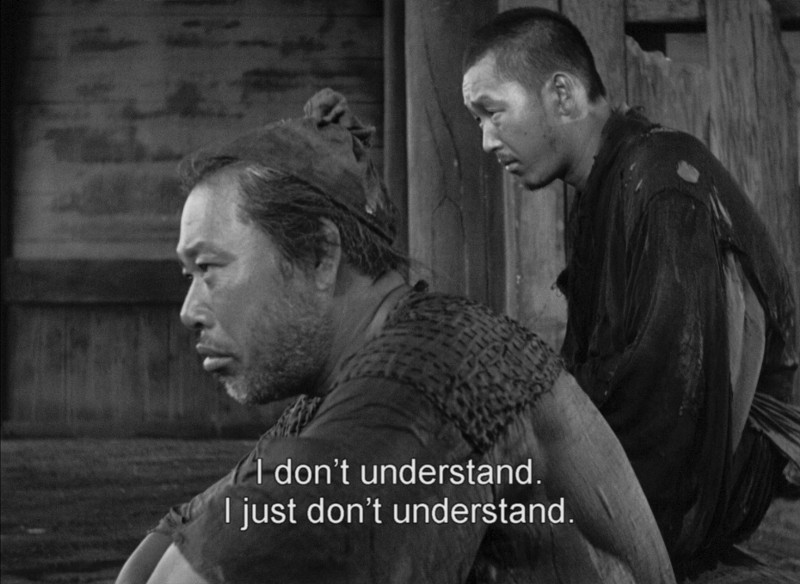
“Rashomon” is a classic Akiro Kurosawa film, based on the story “In a Grove” by Ryūnosuke Akutagawa. In the movie, the same series of events are described by four people from different backgrounds. Each version of the story varies differently than the others. All of the four characters saw and experienced the same events, yet they all tell different versions of how things unfolded and who did what. This has come to be called as “Rashomon Effect” in pop culture. The opening line of the movie is “I don’t understand. I just don’t understand”, and this lays the groundwork of the whole movie.

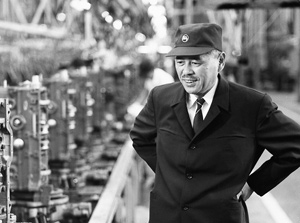
This type of “Rashomon Effect” can also happen at the gemba. One of the great stories about Taiichi Ohno, the father of Toyota Production System, is about the Ohno Circle. The story goes that Taiichi Ohno would take the Engineer or the supervisor to the floor, and if Ohno feels that the supervisor does not see what he sees or that the supervisor does not understand his viewpoint, he would draw a circle on the production floor and ask the supervisor to stand inside it. The supervisor has to stand inside the circle until he starts to see the operational wastes. Then his job is to immediately fix the problems. Ohno is seeing all the waste and problems on the floor. The same activity is also being seen by the engineer. He does not see any of the wastes that Ohno sees. Ohno is said to have been short tempered with this and would scold the engineers. Ohno would return to the floor sometimes 6-8 hours later and would ask what they saw after standing in the circle.

ohno

As I was reading through “Toyota Production System (Kanban) Book”, an internal Toyota document from 1970’s, I came across a paragraph about the Ohno Circle. The rough translation is as follows;

It is expected that the supervisors were scolded by Ohno on the floor. Ohno would make them stand on the floor by drawing a circle. This is similar to being scolded by teacher at school as in “go stand in the hallway!” At school, the purpose is quite different, which is to exclude the student from the classroom. On the floor, the supervisor has to see the problem and improve it. This problem can come into view only by continuous observation in that position, inside the circle.

“Why, why, why, why, why”, ask why five times. This is therefore referred to as the observation method.

I enjoyed that the document tries to differentiate between standing in the hallway and standing on the production floor.

The Ohno Circle exercise is just that – an exercise to strengthen your waste sensors. The more you look, the more you observe. The more you observe, the more you become aware of things differently. Why are there three bins of components on the table? Why does the operator spend time picking the “right” component for assembly? Why does the operator check the component 4-5 times? And so on. Pretty soon the Rashomon effect erodes away. Now the waste becomes visible. Once the waste is identified, then Ohno instructs to ask why again and again, until the root cause can be identified and the issue is fixed.

Bicycle Riders – a Zen Story:

The Rashomon effect reminds me of a Zen story I heard:

A Zen Teacher saw five of his students return from the market, riding their bicycles. When they had dismounted, the teacher asked the students,

“Why are you riding your bicycles?”

The first student replied, “The bicycle is carrying this sack of potatoes. I am glad that I do not have to carry them on my back!”

The teacher praised the student, saying, “You are a smart boy. When you grow old, you will not walk hunched over, as I do.”

The second student replied, “I love to watch the trees and fields pass by as I roll down the path.”

The teacher commended the student, “Your eyes are open and you see the world.”

The third student replied, “When I ride my bicycle, I am content to chant.”

The teacher gave praise to the third student, “Your mind will roll with the ease of a newly tuned wheel.”

The fourth student answered, “Riding my bicycle, I live in harmony with all beings.”

The teacher was pleased and said, “You are riding on the golden path of non-harming.”

The fifth student replied, “I ride my bicycle to ride my bicycle.”

The teacher went and sat at the feet of the fifth student, and said, “I am your disciple”.

Always keep on learning…

In case you missed it, my last post was about “Brooks’ Law – Mythical Man Month”.

Respect for Humanity (An early theme in Toyota Production System):

people1

This post is mainly about Respect for People in Toyota Production System, to show that this idea has been an integral part of Toyota Production System from the early days on.

“Toyota Production System – The foundation is respect for human rights”.

This is a quotation from a Toyota Production System book. Respect for people got famous with the famous Toyota Way document in 2001. This principle has been included within Toyota Production System for a long a time. In fact, the quotation I have cited is from “Toyota Production System First Textbook”. This is one of the early documents created within Toyota in the early 1970’s. An interesting trivia is that some of the text was written by Fujio Cho, the very person behind the Toyota Way 2001 document.

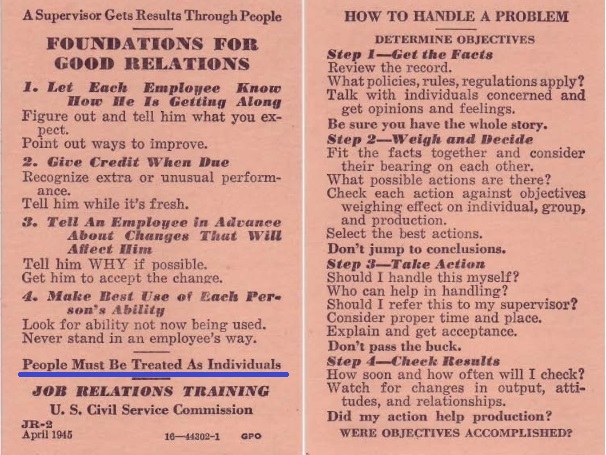
Section 5 of this document is titled “Man-Hour Reduction and Human Relations”. This section calls out TWI (Training Within Industry) Job Relations manual and cites “People must be treated as individuals” phrase from the Job Relations manual.

JR

I have written about TWI previously here. TWI was an emergency service by US to help nation’s war contractors and essential production. There was a need to produce a lot in a short amount of time, and this required training operators to be better within a short amount of time. C R Dooley, the Director of TWI, stated the following; “TWI’s objectives were to help contractors to get out better war production faster, so that the war might be shortened, and to help industry to lower the cost of war materials.” Job Relations is one of the manuals of the TWI program. In the foreword of this manual, C R Dooley stated that “Giving workers technical skill alone is not enough. Supervisors must give every man and woman at work the leadership that enlists cooperation and teamwork.” Toyota added Job Relations to its internal training curriculum in 1951.

The “Toyota Way 2001” document made “Respect for People” the new thing in lean. This theme was not at all present in any of the western books on Lean or Toyota Production System. Naturally, this theme got a lot of attention fast.

Yasuhiro Monden’s Write-up on Respect for Humanity:

Respect for people also goes by Respect for Humanity. In my opinion, this was best described by Prof. Yasuhiro Monden in his 1983 book “Toyota Production System”. He wrote;

“At Toyota, respect for humanity is a matter of allying human energy with meaningful, effective operations by abolishing wasteful operations. If a worker feels that his job is important and his work significant, his morale will be high; if he sees that his time is wasted on insignificant jobs, his morale will suffer as well as his work.”

Prof. Monden also links to the ability of the worker to stop the line in case of a problem with Respect for Humanity. He states “Since quality control based on autonomation (Jidoka) calls immediate attention to defects or problems in the production process, it stimulates improvement activities and thus increases respect for humanity.”

Prof. Monden also gives two rules to follow when making job improvements;

  • Give the worker valuable jobs – the job performed by the worker (operator) should not be riddled with non-value added activities.
  • Keep the lines of communication within the organization open – A relationship of trust and credibility needed for improvement activities need open lines of communication.

One of the mantras at Toyota is “Monozukuri wa hitozukuri” or “Developing products is about developing people”. This idea is underlined by Prof Monden. He has identified three sub-goals for Toyota Production System. They are:

  • Quantity Control – The ability of the system to adapt to daily and monthly fluctuations in demand in terms of quantity and variety.
  • Quality Assurance – Assurance that each process will supply only good units to subsequent processes.
  • Respect for Humanity – Cultivating Respect for Humanity while the system utilizes the human resources to attain its cost objectives.

Final Thoughts:

I will finish with an amusing article on Walmart. In this year’s shareholder meeting, Wal-Mart announced that they will stop playing Celine Dion and Justin Beiber in an effort to boost employee morale. Apparently, the stores were playing a CD with Celine Dion and Justin Beiber non-stop driving the employees crazy. This notorious playlist has been replaced with Wal-Mart Radio. This announcement received the most cheers from the crowd! This was based on multiple feedback from the employees.

Always keep on learning…

Innovation and Kaizen are not oil and water:

main

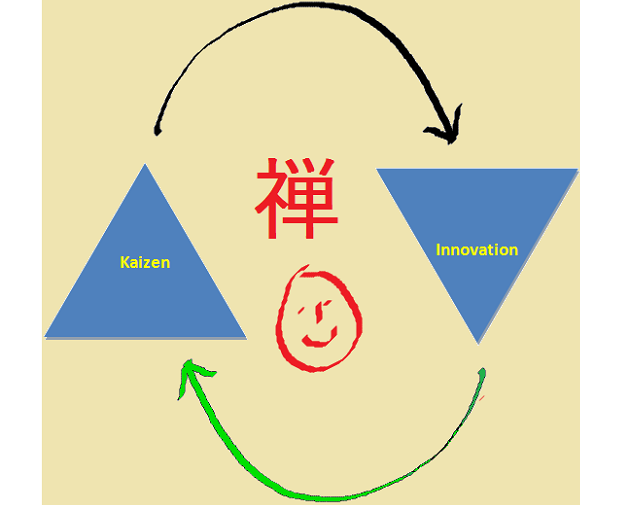
Kaizen is likely the most used Japanese word in the world of manufacturing. Kaizen simply means to improve for better. The “zen” part of Kaizen is not the same as the commonly known word “Zen”.

zen = virtue or good

Zen = literal meaning is “meditation”. This Japanese word has roots in the Sanskrit word “dhyan”.

It is quite possible to achieve Zen through kaizen. 🙂

This post is about the relationship between kaizen and innovation. Kaizen is often described as continuous improvement through small changes while innovation is described as a big change, or a complete breakthrough. The current paradigm is completely destroyed. From afar, these two concepts seem different – almost like oil and water.

What is the relationship between innovation and kaizen?

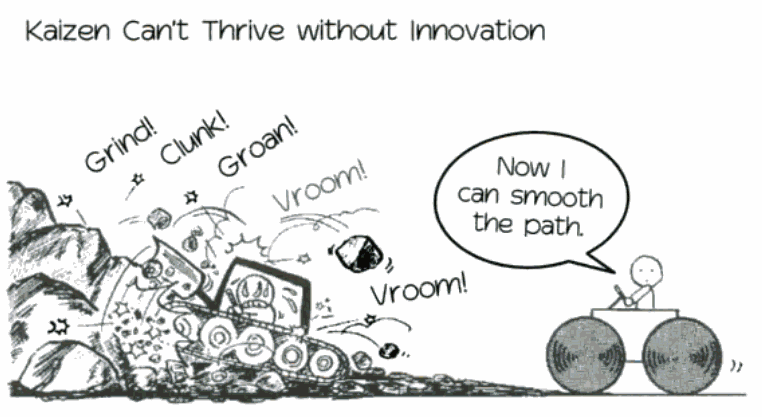
The book Kaizen Teian III (later published as The Improvement Engine) by the Japan Human Relations Association, states that kaizen cannot thrive without innovation.

This is an interesting concept – if kaizen is continuous improvement through small changes, how can a company stay competitive just by making minor improvements? The book describes innovation as a bulldozer cutting a path through a rough terrain. Improvement activities are described as a means to leveling the path cut by the bulldozer, and paving it into a smooth road!

KIFigure taken from Kaizen Teian III.

The book further states that there is nothing more wasteful than trying to activate a kaizen system in a company that is not engaged in innovation! Trying to clear a path in a rough terrain with a pick and shovel will not do when you competitors are using a bulldozer.

My thoughts:

What is the purpose of kaizen?

There are two objectives for kaizen;

  • Continuous improvement to make work better
  • Development of employees so they can be better at problem solving and developing others.

If kaizen can be described as a bottom-up process, then innovation can be described as a top-down process. You cannot move towards your ideal state (true north) without one or the other. You need both bottom-up and top-down forces to move towards your ideal state. They both create the perfect recipe for kaizen culture.

Always keep on learning…

In case you missed it, my previous post was about ESP and statistics.

Is Inspection Value Added?

pass fail

In popular Lean circles, the idea of value-added is represented by the following two criteria;

  • Is your customer willing to pay for the activity?
  • Is the activity physically changing the shape or character of the product so that it increases the product’s value in the eyes of the customer?

In lieu of these criteria, is inspection value added? Before answering, please be aware that this is a loaded question. Also understand that the question is not “should we inspect product?”

Inspection generally does not alter the physical attributes of a product. Inspection in the traditional sense accepts or rejects the product. In this aspect, inspection should prevent a bad product from reaching the hands of the customer. Does this mean that then the inspection activity is value added?

As a customer, I would love it if the product is inspected, and reinspected ten times. But I would not want to pay for such an activity. Are we as a society of consumers wrongfully trained to think that inspection somehow increases the quality of the product?

Deming’s view:

Dr. Deming’s view of inspection is as follows;

Cease dependence on inspection to achieve quality. Eliminate the need for inspection on a mass basis by building quality into the product in the first place.

In fact, this is the third principle of his 14 key principles for management to follow for significantly improving the effectiveness of a business or organization. Deming’s view is clearly stated in his “Out of Crisis” book. “Inspection does not improve the quality, nor guarantee quality. Inspection is too late. The quality, good or bad, is already in the product.”

Shigeo Shingo’s View:

Shigeo Shingo is considered by many a powerful force behind Toyota Production System. He trained Toyota employees with his “P-courses”. Shingo was the person behind Poka-yoke (Error proof) and SMED (Single Minute Exchange of Dies). In his views, there were three types of inspection:

  • Judgment Inspection – inspections that discover defects
  • Informative Inspection – inspections that reduce defects
  • Source Inspection – inspections that eliminate defects

Judgment inspection is an inspection that is performed after the fact. The lot is produced, and then inspection is performed to determine if the lot is acceptable or not. In Shingo’s words “It (Judgment Inspection) remains inherently a kind of postmortem inspection, however, for no matter how accurately and thoroughly it is performed, it can in no way contribute to lowering the defect rate in the plant itself.” Shingo continues to state that the Judgment Inspection method is consequently of no value, if one wants to bring down defect rates within plants.

Informative Inspection is an inspection that helps in reducing defects. This method feedbacks information to the work process involved, thus allowing actions to take place to correct the process. Shingo describes three types of Informative Inspections.

  1. Statistical Quality Control Systems – This is the system with control charts where one can identify trends or out of control processes, aiding in getting the process back to stability.
  2. Successive Check Systems – This is the system where the component gets inspected by the next operator in the line. Any defect is identified and corrected almost immediately by letting the previous operator know. Please note that ideally this system uses 100% inspection.
  3. Self-check systems – This is the system where the operator can inspect the work that he/she did, and fix the problem immediately. Please note that ideally this system uses 100% inspection.

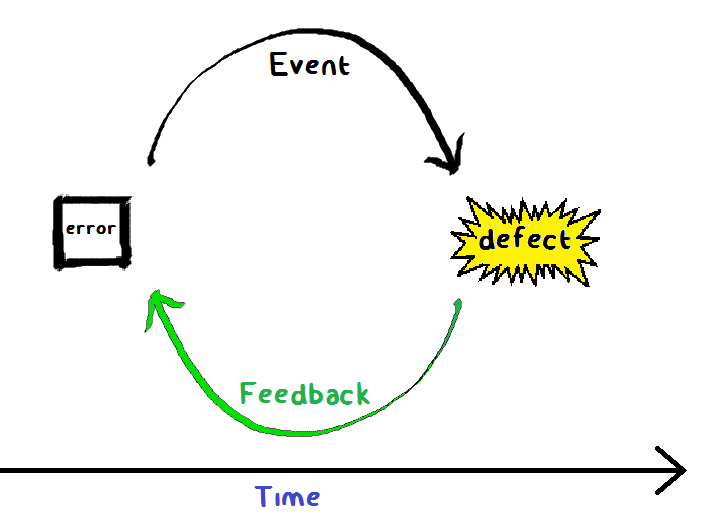
The final category is Source Inspection. In this category, the feedback loop is so short that as soon as the error occurs, the feedback kicks in preventing the error from becoming a defect.

Feedback Loop – The Key:

The key in determining value in the inspection process is the length of the feedback loop. Judgmental Inspection is the least value adding in this regards because the product lot is already built and completed. Informative Inspection is value adding, since the feedback loop is considerably shorter. Finally, the source inspection is the most value adding since the feedback loop is the shortest.

The feedback loop is shown below.

feedback loop

Thus, the shorter the feedback loop, the higher the inspection method’s value.

Final Words:

This post started with a question, Is inspection value added? Errors are inevitable. Drifts in processes are inevitable. Learning from errors is also becoming inevitable. Inspection activities that increase the system’s value are definitely value added. I used to wonder, whether kaizen is value added. Is a customer willing to pay for an organization to be a learning organization? I came to the realization that kaizen is based on a long term principle. The real value is in cultivating the long term trustful relationship with the customer.

Inspection activities that allow the organization to grow and learn are definitely value added. The table below summarizes this post.

table

Always keep on learning…

How do I do Kaizen?

kaizen

Kaizen is most likely one of the most misused words in lean. There is a strong precedence in the lean community to call a “Kaizen Event” or “Kaizen Blitz” as “Kaizen”.

Kaizen just means incremental and continuous improvement towards the ideal state.

A Kaizen Event on the other hand, means generally a week long team-based rapid improvement activity. Thus, there is a definite start and a stop to Kaizen Events, making this almost an oxymoron since Kaizen implies a continuous and never stopping state. This post is about Kaizen and not Kaizen events.

A lot of people talk about the need for doing Kaizen. This post hopefully provides nuts and bolts on how to perform improvement activities. Please note that the first step for Kaizen is to nurture your employees so that they become aware of problems. This is a post for another day.

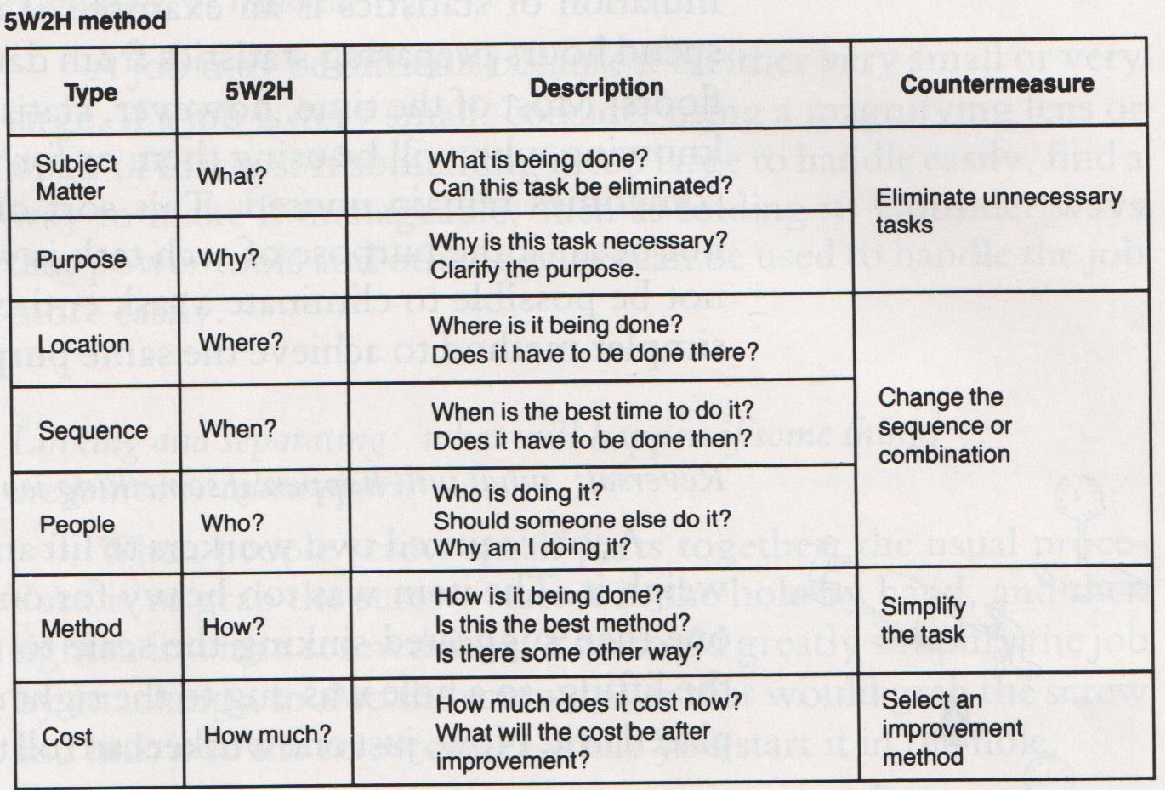
The following figure is taken from The Idea Book, edited by the Japan Human Relations Association (1980). The original title was “Kaizen Teian Handobukku” which roughly translates to “Kaizen through (Employee) Suggestions Handbook”. This figure shows how to approach improving your process. The right column is also known as the ECRS method. Going through these questions under the Description column and then following through the steps in the Countermeasure column is how one can improve a process.

tei

Figure 1 : How to Improve a process?

  • Eliminate Unnecessary Tasks: The ultimate improvement is eliminating a task altogether. The What and Why questions help us with this.
  • Combine the Steps: What are the steps that need to be done in series? Are there any steps that can be done in parallel? The Where, When and Who questions help us with combining steps to eliminate waste. Additionally, combining also reduces the number of discrete steps in the process.
  • Rearrange the Steps: Sometimes changing the sequence also allows us to take away waste from the process. The Where, When and Who questions help us with this. Can we do the current step# 3 before Step# 1? Is there any logic to the current sequence of steps? Can we rearrange to create a better sequence.
  • Simplify: Is there any task that can be simplified to make the whole process faster and better? Does the operator spend a lot of time trying to sort things or fumble with things? Can we ultimately simplify all the steps?

Please note that the steps are carried out in the order described above.

The reader should also be aware that the ECRS process and the questions have roots in USA’s Training Within Industry (TWI) movement that got started near the era that led to World War II. TWI was an emergency service by US to help nation’s war contractors and essential production. There was a need to produce a lot in a short amount of time, and this required training operators to be better within a short amount of time. C R Dooley, the Director of TWI, stated the following; “TWI’s objectives were to help contractors to get out better war production faster, so that the war might be shortened, and to help industry to lower the cost of war materials.

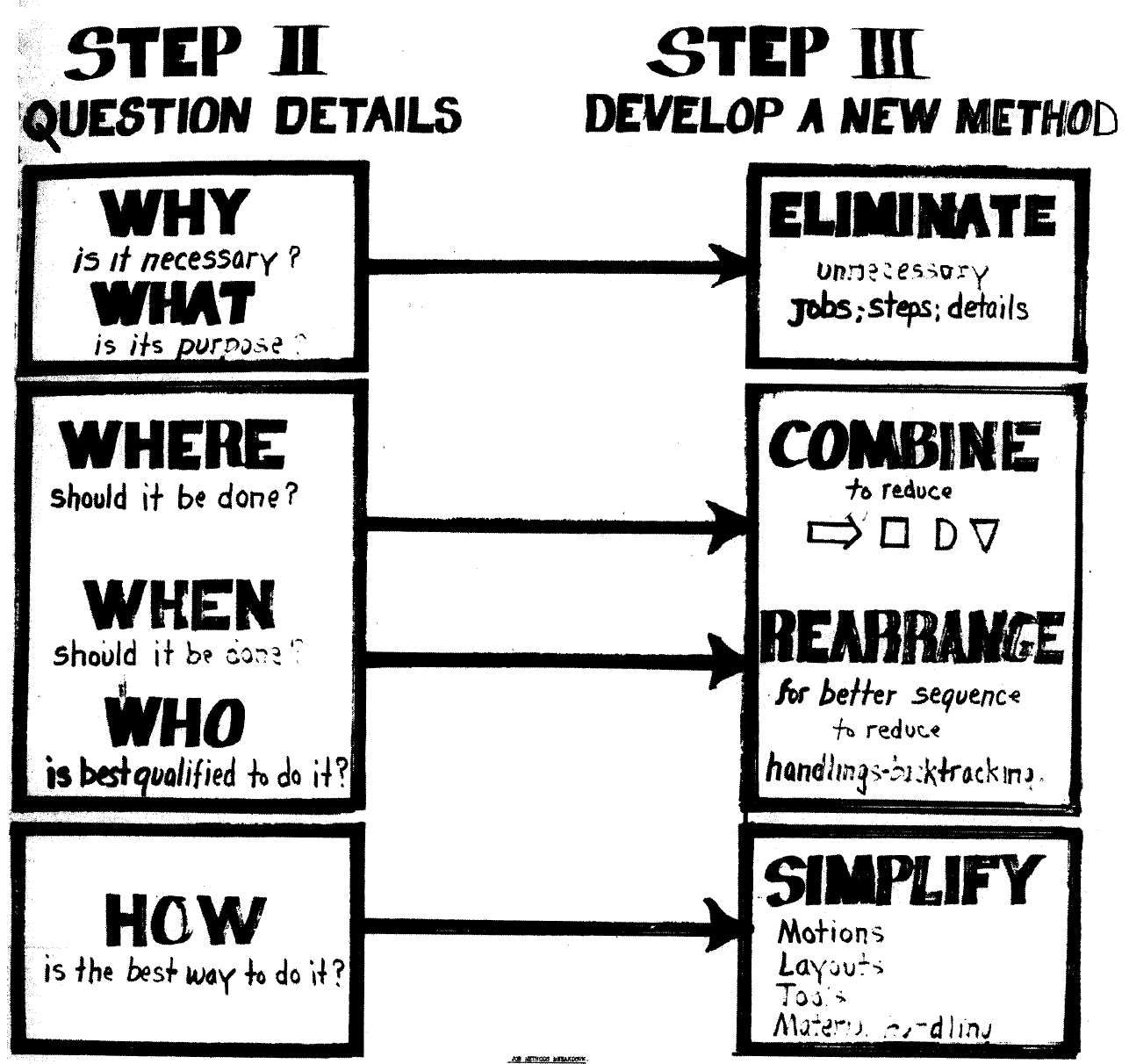
The following figure is taken from the Problem Solving Manual from TWI. The following is also part of Job Methods program.

psmanual

Figure 2: Steps 2 and 3 of Job Methods (TWI)

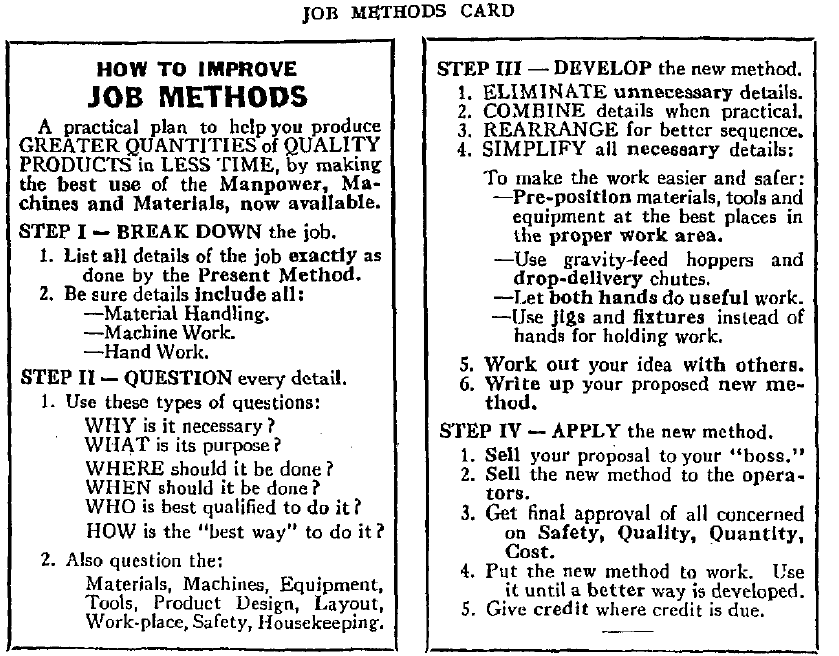
The following is a pocket card that was supplied as part of Job Methods program.

JMcard

Figure 3: Job Methods Card

A keen observer of the Job Methods can find the scientific approach of PDCA (Plan-Do-Check-Act) in it. Additionally, I would also like to bring attention to “Use the new method until a better way is developed” statement. This clearly shows that this is a continuous process.

I encourage the reader to study the Job Methods manual to get a better grasp. You can find a lot more about TWI here. http://chapters.sme.org/204/TWI_Materials/TWIPage.htm

As a side note, Toyota implemented the TWI programs in the early 1950’s. Surprisingly the first of the TWI programs that was dropped was the Job Methods program. This was replaced by Shigeo Shingo’s P-courses that added the Industrial Engineering elements to process improvement activities. Taiichi Ohno wanted to add the importance of takt time, Standard WIP, flow, and pull style production to the idea of Kaizen. (Source: Art Smalley, Isao Kato)

Nugget from the Problem Solving Manual:

The Problem Solving Manual from TWI also identified “Make Ready” and “Put Away” as “movements of material without definite work accomplishment”.

The manual also identified these as the “greatest opportunities for improvement”. It is also noteworthy that “Less than 50% of the total time is usually consumed by the ‘DO’ part of the job.” Current thinking is that the true value added activities equate to less than 5% of a general process that is untouched by any improvement activities.

value

Figure 4: Value (Problem Solving Manual)

Final Words:

Maybe it is ironic that I am going to use the introductory words of C R Dooley, the then Director of TWI, from the Job Methods manual as my final words for this post. You can clearly see the undercurrents of Respect for People and Kaizen in his words.

Most of the men with whom you will work have had years of experience. They have latent ideas which, if properly developed, will increase production, reduce lost time, prevent waste of material, and increase the use of machinery and equipment. These men command your respect because of their knowledge.

Always keep on learning…

What do you mean by “No problem is a problem”:

giphy

When I first heard of “No problem is a problem”, I thought that it was a pretty deep philosophical statement. I could understand what it meant, but I realized at that time that there is something more to that statement, some deeper layers that still need to be understood.

Taiichi Ohno, the father of Toyota Production System is behind this quote. His original version is “Having no problems is the biggest problem of all.” This idea was engrained in the TPS senseis by their senseis.

Three interpretations come to surface when you look at the quote “Having no problems is the biggest problem of all.”

  • We are always surrounded by problems.
  • We are not looking hard enough.
  • By saying “there is no problem”, we are trying to hide problems.

Actually there is more to this basic idea. How would you define the concept of “problem”? Merriam-Webster defines problem as;

  • something that is difficult to deal with : something that is a source of trouble, worry, etc.
  • difficulty in understanding something
  • a feeling of not liking or wanting to do something

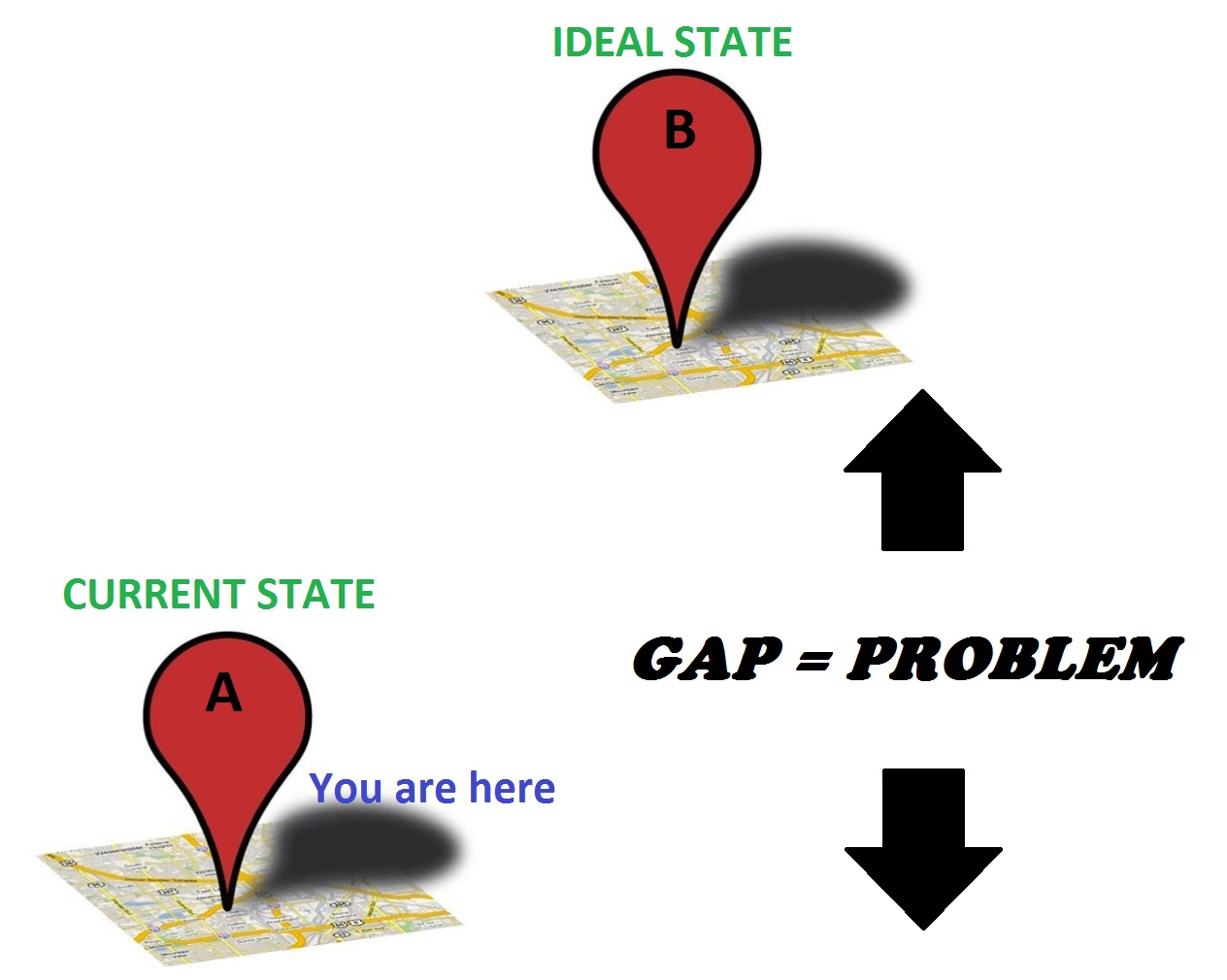
The book Kaizen Teian 2 defines “problem” as the gap between Ideal State and Current State. This is the gold nugget that will provide the deeper meaning to the statement “no problem is a problem”.

problem

At Toyota, you are trained to think of a problem as the gap between the current state and the ideal state. This way, you can start proposing countermeasures to reach the ideal state and thus address the problem. The thought process can be summarized as below.

  • What is your ideal state (goal)?
  • What is your current state?
  • Define the problem as the gap.
  • Suggest countermeasures with an understanding of the cause.
  • Implement and study the new current state.
  • If you have not reached your ideal state go back to step 4.

As you can see, this is the scientific thinking of PDCA (Plan – Do – Check – Act). With this light, and with the new definition of a problem as the gap, if you say there is no problem, it would mean that you have reached your ideal state, which is never the case.

One can thus see Kaizen (continuous improvement) as a problem solving methodology. Kaizen is the engine that chugs along towards the ideal state. This represents slow and incremental progress towards the ideal state. The reader should be aware that Kaizen does not equate fixing things. Fixing things is firefighting. Firefighting is associated with maintaining the status quo. This does not let you move towards your ideal state.

The traditional thinking is viewing problems as the fires that need to be put out. There is no continuous improvement thinking here. Putting out fires just mean that we are back where we started. This is the essence of “no problem is a problem”. By saying “I have no problems”, one is giving up on continuous improvement. By viewing “problem” as the gap, it gives motivation for continuous improvement. Think of this as Pull and putting out fires as Push. Thus, you have a better flow towards your ideal state.

The scientific method detailed above is also taught as genchi genbutsu at Toyota. This roughly translates to “go to the actual place of activity, and grasp the facts”. Interestingly, Honda uses a similar theme under san genshugi. This roughly translates to the three actualities. Honda requires their employees to go to the actual place of activity to gain firsthand information, look at the actual situation, and decide on countermeasures based on actual facts. The “gen” component of the Japanese word means real or actual. Sometimes this is spoken as “gem” as well. For example, gemba means actual place of action.

Final words:

I am at fault for not always using this thinking process. Looking at problems as what should be versus what is right now, helps us understand the problem better. Being at the actual location where the problem happened, and talking to the operator, looking at the equipment or the raw materials, and understanding the facts helps us in moving towards addressing the problem. View problems as the gap between ideal state and current state, and understand that your purpose is to move towards the ideal state. Under this idea of “problem”, you will always have opportunities to move towards the ideal state.

Always keep on learning…

Respect for People – Kin Test:

respect

I work in the field of medical devices. We use a thought experiment in our field that I like to call “the kin test”. It goes something like this. Would you let your kin, your mother, your child or your father, use this medical device we manufacture? Is the quality of this device good enough that it can be used on your dearest kin?

After writing the post about Respect for People last week, I pondered about this kin test and wondered if it is applicable for Respect for People as well.

How would you answer the question, “Would you let your kin, your mother, your child or your father, work at where you are working?” If there is a hesitation in answering this, maybe the Respect for People is something that your company needs to look at.

Everything depreciates with time or so we learn from our accounting counterparts. The equipment you just bought, the building you are in, all these have lost value since day 1. There is something that actually gains value with time – people. People actually gain value with time, their experience and knowledge increases their value with time. This is all the more reason why you should invest in your people.

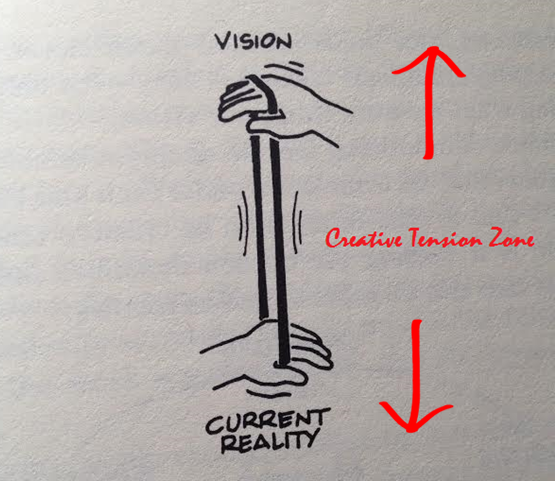
Not a lot is out there about this subject. The following interpretations are based on my research and thinking. Respect for People is not about being nice. It is not about saying “hello”. Respect for people is about nurturing accountability and ownership. Peter Senge, in his book The Fifth Discipline, talks about creative tension.

Creative tension exists when there are two opposing realities,

1) vision – where we should be, and

2) current reality – the status quo, where we are right now.

Creative tension resides in the zone between these two opposing forces. My thinking is that Respect for People also resides in this zone. This is one that nurtures accountability and ownership.

respect - creative tension

This Creative Tension idea actually aligns really well with Toyota Production System (TPS). In TPS, one is asked to understand the current state, the ideal state and the gap. This allows creation of countermeasures to reach the ideal state.

The current reality represents the struggle from middle management and lower management to maintain the status quo. The vision represents the struggle from the upper management and some portion of the middle management to recreate the status quo. This zone is ideal for Kaizen or continuous improvement. The continuous improvement is an everlasting march towards betterment and is incremental in nature.

A key point that I want to shed light on is that, in this zone, answers are never provided. The manager provides coaching and training, and nudges in the right direction such that the employee is able to reach the goal on his own. Giving the answer takes away the accountability; instead the manager mentors the employee to find the ideal solution by giving him thinking tools. This can happen only in the Creative Tension zone. Providing suggestions or answers and not getting involved is not the answer either. The manager is required to mentor the employee and advise him of things to consider to reach the vision state.

The first step for this is to coach the employee to start noticing problems. Taiichi Ohno, the creator of TPS is said to have drawn chalk circles on the factory floor and made his subordinates stand inside it and watch the process to identify problems. They were made to stand inside the circle until their list of problems matched Ohno’s.

Once the problems are identified, the employee is coached to find causes and propose countermeasures. The final step is empowering the employees to make decisions and implement the countermeasures.

These steps are very well described in the book Kaizen Teian 1, as four levels of employee involvement in continuous improvement.

  • Level 0 – Zero energy, zero interest and zero responsibility
  • Level 1 – Noticing and pointing out problems
  • Level 2 – Finding causes of problems, raising ideas and proposing countermeasures
  • Level 3 – Making decisions, implementation and effects

Final Thoughts:

Creating a culture of Respect for People is everybody’s job. What level would you say you are in at your current job?

ct2

As indicated in the figure above, the Respect for People increases as the number of levels goes up. Level 3 clearly results in a culture of Respect for People, and a path well aligned to reach the Vision State. This does not represent a workplace where the employee is asked to leave his brains outside. Nor does it represent a workplace where the employee does not feel empowered. You are creating the most value in a level 3 workplace. This in turn will make the employees feel valued. The level 3 workplace is a workplace that will pass the kin test with flying colors.

Always keep on learning…