
Throwing the Fish Back into the Water:

In today’s post, I am refining my thoughts on reentry as a wonderful tool to tackle cognitive blind spots. A common saying goes that a fish does not know it is in water. The phrase is usually offered as a comment on unexamined assumptions. The fish is fully immersed in a medium that makes its life possible, and yet that very immersion renders the medium invisible. We the observers, standing outside the water, can easily point to what the fish cannot see.

The metaphor is useful, but only if we do not misunderstand what it implies. The problem is not ignorance in the sense of missing information. The problem is immersion, being inside the loop and not being aware of it. In other words, I am positing that cognitive blind spots arise not because we lack data, but because we fail to notice the conditions under which noticing itself takes place. We assume that observation is independent of the observer, and in doing so, we negate the very act that makes observation possible.

This negation is not accidental. It is built into many of our conceptual frameworks.

Cognitive Blind Spots and the Negated Observer:

In this view, a cognitive blind spot appears when a distinction is treated as if it exists independently of the act that produced it. We speak as though there is an object “out there” and an observer “in here,” and as though the observer merely reports what is already the case. This framing quietly removes the observer from the scene by denying that the act of description must re-enter the conditions it describes.

Once the observer is negated, the distinction hardens and begins to appear as a feature of the world itself. What began as a practical cut in experience is mistaken for something given rather than constructed. At that point, the blind spot is complete. There is nothing left to question because the conditions of questioning have disappeared.

This is precisely where re-entry becomes relevant.

Re-entry as a Mechanism for Error-correction:

Spencer-Brown’s notion of re-entry does not simply add complexity for its own sake. It forces a distinction to turn back upon itself. A form re-enters the space it distinguishes. The marked state is no longer allowed to pretend that the unmarked state is irrelevant or absent. Reentry is an attempt to bring the act of distinction itself into view.

Re-entry is uncomfortable because it breaks the illusion of a clean separation. It exposes the fact that every distinction carries its own conditions inside it. What we thought was a stable category now reveals its dependence on an operation. This is why re-entry is such a powerful tool for revealing cognitive blind spots. It does not offer a better description of the world. It shows how our descriptions are made, and what they quietly exclude in order to function. Once this lens is applied, certain familiar structures begin to look less secure.

The Subject/Object Split and Being in the Water:

The subject/object dichotomy is one such structure that we can use to expand on this line of thinking. It assumes that there is a knowing subject on one side and a known object on the other, connected by representation. From a Heideggerian perspective, this is already a distortion. We are not subjects standing over against a world of objects. We are always already being in the world.

The fish is not first a subject and then later related to water as an object. Fish and water show up together. The relation is not secondary. It is constitutive. Remove the water and the fish does not remain as a fish that merely lacks an environment. It ceases to be what it is.

Re-entry makes this visible. When the observing system is reintroduced into the observation, the subject object split begins to collapse. What remains is participation, involvement, and structural coupling. Observation is no longer a neutral act. It is an activity performed from within the medium it seeks to describe. We will use this line of thinking to examine another familiar idea in philosophy from Charles S. Peirce.

The Triad and the Problem of Firstness:

Peirce’s triad of firstness, secondness, and thirdness is frequently described as dynamic and non-linear. However, when examined through the logic of distinction and re-entry, the triad reveals a fundamental instability. That instability is most clearly exposed in the notion of firstness.

Consider a simple example: a red apple. Its redness is firstness, the immediate quality that appears without reference or comparison. The apple itself, as a physical object that resists gravity and interacts with us, illustrates secondness. The recognition that the apple is a fruit, part of a category, and meaningful within a broader system of relations exemplifies thirdness. Even here, we see the dependence of firstness on context; its pure quality only becomes intelligible through interaction and relation.

Firstness is described as pure quality, pure possibility, or pure feeling, intended to stand prior to relation, reaction, or mediation. What follows from this is not only an empirical difficulty but also a logical one.

From a Spencer-Brown standpoint, nothing can appear without a distinction. A distinction simultaneously produces a marked state and an unmarked state. There is no marked state by itself, just as there is no distinction that does not also imply what it excludes. When one speaks of “good,” the notion of “not good” is already present as its context. “Good” by itself has no meaning. Even our most absolute categories depend on what they deny, as the invention of God quietly presupposes the invention of Evil.

If firstness is spoken of at all, it has already been marked. The moment one says “firstness,” one has drawn a boundary around something and set it apart from what it is not. That act already presupposes contrast. It already invokes relation. It already smuggles in what Peirce would later call secondness and thirdness. The triad never leaves the water it claims to describe.

If there is no distinction, there is no information. Without contrast, there is nothing to register. Pure undifferentiated “information” is not information. It does not inform. It does not appear. It does not function. In that sense, pure firstness is not just unreachable in practice, it becomes incoherent in principle.

The problem is not one of interpretation but of structure. The triad depends on a move that collapses under re-entry. Firstness cannot exist in isolation, yet the triad requires it to.

Re-entry Exposes the Blind Spot:

Here is where the cognitive blind spot becomes “visible”. The triad purports to articulate the conditions of experience while remaining blind to the operation that makes them appear. Firstness is treated as if it could exist prior to distinction, while the very articulation of firstness performs the distinction it denies.

Re-entry forces the concept to confront its own conditions. When firstness re-enters the space of its own description, it collapses into relation. It cannot remain alone. It cannot stay pure. It cannot avoid invoking what it claims to precede.

In this sense, the triad is flatter than it appears. Not because it lacks movement, but because its movement never quite escapes the logic of classification. Re-entry reveals that the flow Peirce gestures toward is already constrained by the need to name and separate what is being described.

Final Words:

The point of this critique is not to replace one framework with another. It is to show how certain blind spots persist even in sophisticated theories. When distinctions are treated as if they precede the act of distinction, the observer disappears. When the observer disappears, responsibility disappears with it.

Re-entry restores that responsibility. It reminds us that our concepts are not mirrors of reality, but tools we use from within the world we inhabit. Like the fish in water, we do not escape the medium by describing it. We only learn to see it by noticing how our seeing works. That seems to be the deeper utility of re-entry. The goal is not to produce better categories, but to cultivate a deeper awareness of how categories emerge. It is not purity, but participation. It is not firstness untouched by relation, but the recognition that relation is always already present. Seeing the water does not mean leaving it. It means acknowledging that one was never outside it to begin with.

Stay curious and Always keep on learning…

Post script:

Further clarification on the following statement – Re-entry reveals that the flow Peirce gestures toward is already constrained by the need to name and separate what is being described.

Peirce presents the triad as something dynamic and flowing rather than static. Firstness flows into secondness, secondness into thirdness, and so on. However, when you apply re-entry, you see that this apparent flow is already limited by the act of naming the categories in the first place. The moment you say “firstness,” “secondness,” and “thirdness,” you have already separated what you claim is flowing. The movement is therefore happening inside a framework that has already been cut up by distinctions.

So the “flow” Peirce gestures toward is not free movement within experience itself. It is movement between pre-named compartments. Re-entry exposes that the triad cannot escape the logic of distinction because it depends on that logic to exist at all.

In other words, the triad looks process-oriented, but it still operates as a classificatory scheme. The flow is real only insofar as the categories have already been stabilized by naming and separation. That is the constraint.
The Persistent Unmarked Space:

In today’s post, I want to explore an observation about how we make distinctions and what this reveals about the structure of our thinking. I am inspired by the ideas in Spencer-Brown’s “Laws of Form” and broader themes in cybernetics about how observers construct meaning.

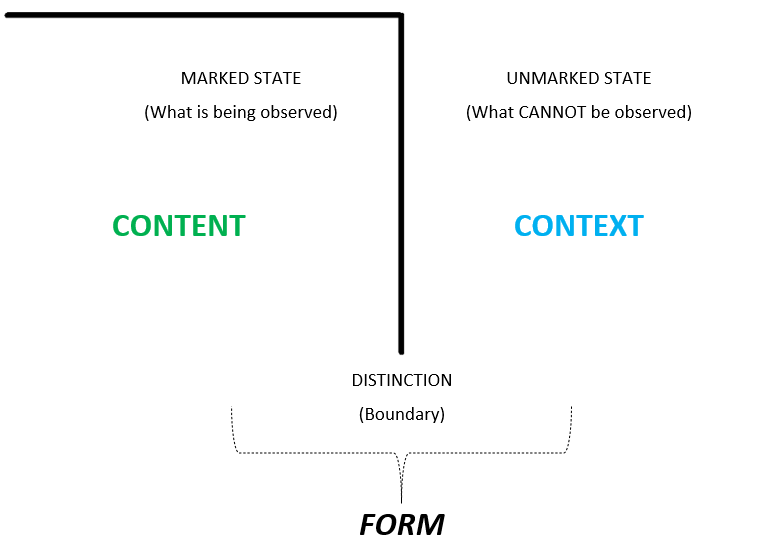
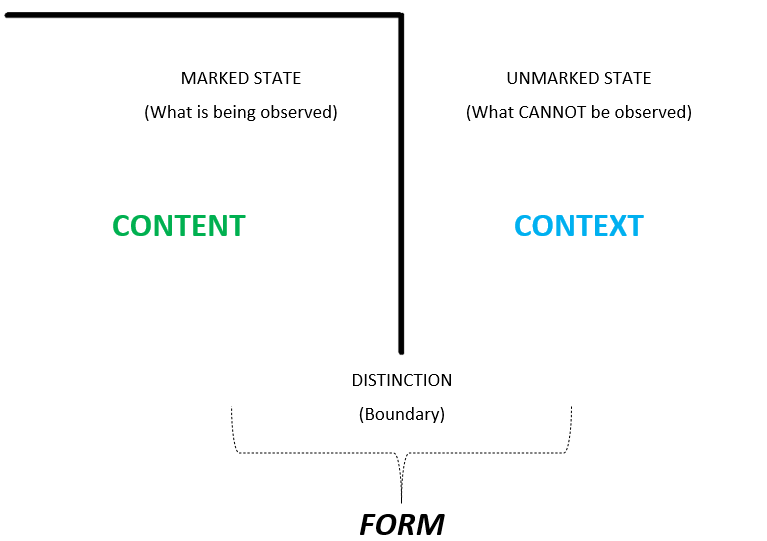
The starting point is simple. When we make a distinction, we create a boundary that separates what is inside from what is outside. Spencer-Brown formalized this with his notation of the Mark, showing how any act of indication simultaneously creates both the indicated and the non-indicated. This is shown below:

As we look closer, things get more interesting.

The Basic Operation of Distinction-Making:

When I make one distinction to mark “A,” I create two states. There is A (the marked state) and not-A (the unmarked state). This seems straightforward enough. We can depict this as below:

(A) not-A

Spencer-Brown showed that this basic operation has interesting algebraic properties. The unmarked state is not simply absence or void. It is the enabling condition that gives the marked state its meaning. Without the background of the unmarked, the mark itself would be meaningless.

This relationship between marked and unmarked is fundamental to how meaning emerges. The marked state exists only in relation to what it excludes.

We can take this further. Consider what happens when we make multiple distinctions. If I distinguish both A and B within the same unmarked space, Spencer-Brown’s notation shows this as ((A)(B)).

This actually creates three categories, not four. There is A, there is B, and there is everything else that is neither A nor B. We can represent this as ((A)(B))X, where X represents the remainder of the unmarked space.

In Spencer-Brown’s system, A and B are mutually exclusive by the nature of how the distinctions are made. They are separate marks within the same unmarked background, not overlapping regions as in classical set theory.

This gives us the pattern that n distinctions create n+1 categories. Three distinctions would create four categories, four distinctions would create five, and so on.

The Persistent Unmarked State:

What interests me most is how something remains unmarked regardless of how many distinctions we make. No matter how extensively we mark up our space with categories and boundaries, there is always an unmarked background that enables those markings to have meaning.

This unmarked background is not just everything else we have not thought of yet. It is the condition that makes thinking and categorizing possible in the first place. When we argue about categories like hot versus cold, we often treat these as exhaustive alternatives, often as dichotomies. But there is always the unmarked space that contains the ideas of moderate temperatures, context-dependent judgments, and the framework of assumptions that makes temperature distinctions seem natural and meaningful.

Connection to Self-Reference Problems:

This observation about the persistent unmarked state connects to well-known problems in formal systems, though the connection is analogical rather than mathematically precise.

Russell discovered that attempts to create completely comprehensive sets run into contradictions when they try to include themselves. The set of all sets that do not contain themselves creates a paradox when we ask whether it contains itself. Gödel showed that formal systems strong enough to express arithmetic cannot prove their own consistency without appealing to principles outside the system.

These results point to a general pattern. Complete self-inclusion appears to be impossible. There is always something outside the system that the system requires but cannot fully capture within its own terms.

The unmarked state in Spencer-Brown’s system suggests a similar limitation. The observer making distinctions cannot fully mark their own position as observer. There is always something unmarked that enables the marking process itself.

Implications for How We Think:

This has practical implications for how we approach knowledge and categories. It suggests epistemic humility. If our categorical frameworks always rest on unmarked assumptions and background conditions, then we should hold our categories lightly. They are tools for navigating experience, not mirrors of an independent reality.

In addition, it points toward the value of examining our own distinction-making processes. When we notice ourselves categorizing something, we can ask what remains unmarked in that process. What assumptions are we making? What alternatives are we not seeing?

And it also suggests why different observers can legitimately make different distinctions. The unmarked background that enables distinctions varies with the observer’s purposes, biological capabilities, and cultural context. The distinctions we make depend entirely on the purpose(s) of the observer. Different observers make different distinctions. This viewpoint supports the idea of pluralism.

Final Words:

Spencer-Brown’s insight about the marked and unmarked states reveals something fundamental about the structure of thought itself. Every act of indication creates both what it marks and what it leaves unmarked. The unmarked is not simply absence but the enabling condition for meaning.

This leads to both epistemic humility and intellectual pluralism. Different ways of making distinctions reveal different aspects of complex situations. No single framework captures everything. The wisdom lies in working skillfully with multiple perspectives while recognizing what each obscures.

Most importantly, the unmarked space always exceeds our attempts to mark it completely. As Heinz von Foerster observed, “Objectivity is a subject’s delusion that observing can be done without him.” The observer making distinctions cannot fully step outside their own process of observation.

This is not a limitation to overcome but a fundamental feature of how minds engage with complexity. “The environment as we perceive it is our invention,” von Foerster also noted, pointing to the active role we play in constructing the realities we inhabit.

Understanding this process of distinction-making is essential for navigating complexity with wisdom. Think about how this affects the popular frameworks with neat triads, 2×2 matrices, etc. that promise to carve up the world into manageable categories. Every one of these frameworks commits the same fundamental error. They erase the observer who created the distinctions and ignore the vast unmarked space of assumptions, context, and excluded possibilities that makes their tidy categories seem meaningful.

The unmarked state reminds us that thinking is always an ongoing process within contexts we can never fully transcend. This recognition opens us to continued learning and the possibility of seeing familiar situations in new ways.

Stay Curious and Always Keep on Learning.

If you found value in this exploration of thinking and categories, check out my latest book on the Toyota Production System, Connecting the Dots…

The soft copy is available here. And the hard copy is available here.

The Form of Batesonian Abduction:

In today’s post, I am looking at Batesonian abduction through the lens of George Spencer Brown’s Laws of Form (LoF). I have written about LoF here, here and here. Spencer Brown came up with an elegant algebra mechanism to capture the thinking process using a notation called as “mark”. I welcome the reader to explore the ideas in the links given above.

Laws of Form (LoF):

I will go through the basic calculations and notations needed for this post. I am going to use parentheses to capture the notion of the mark. For example, the distinction of an idea ‘A’ can be notated as:

(A)

The first principle in LoF is the Law of Condensation. This basically means that when an idea is repeated, it condensates into the original idea itself. For example, if I make a distinction of an apple, and I repeat the distinction again, I have not added anything new if the two concepts are identical to each other. The original concept remains the same.  This is shown below:

(Apple) (Apple) → (Apple)

However, distinct ideas maintain their separation.

(Apple) (Orange) → (Apple) (Orange)

Through contrast and comparison of different ideas, we can achieve deeper understanding. This is shown below where we gain a better understanding of fruits in terms of Apples and Oranges:

(Fruits ((Apple) (Orange)))

Abduction:

With the basic notations of LoF out of the way, let us look at abduction. Abduction is a reasoning process introduced by Charles S. Peirce. It is a way of coming up with hypotheses to explain surprising or puzzling observations. It is different from induction (generalizing from observations) and deduction (deriving conclusions from general principles).

Peirce saw abduction as important in the context of discovery, the stage in science where new theories or ideas are generated. The modern notion of abduction has become more focused. Modern views of abduction often focus on finding the “best” explanation for a given observation. Peirce did not emphasize choosing the best hypothesis among many possibilities. He was more focused on generating hypotheses that could later be tested and refined. Peirce thought that while the hypothesis might be influenced by existing knowledge, abduction is still important because it leads you to consider new possibilities you have not fully explored yet.

For example, if a scientist notices that certain plants grow better near a specific type of soil, they might abduce the hypothesis that certain nutrients in the soil are helpful for growth. This hypothesis can later be tested through experiments and predictions.

Batesonian Abduction:

Gregory Bateson, the renowned anthropologist and cybernetician, developed a more nuanced interpretation of abduction. His approach emphasized understanding relationship patterns rather than linear cause-and-effect explanations. Bateson positioned abduction within the broader context of pattern recognition in networks, viewing it as a cognitive process for interpreting systemic patterns.

For Bateson, abduction was about seeing how different elements in a system relate to each other in a non-linear way. Instead of finding a single cause, Bateson was interested in contexts and feedback loops — how an element can be part of a larger dynamic pattern or system. Bateson, while acknowledging abduction as a method of forming hypotheses, placed it more broadly within the context of pattern recognition in networks. He saw abduction not just as a logical operation but as a cognitive process that helps us interpret and make sense of patterns in the world. For Bateson, abduction was related to the way humans and animals perceive and respond to relationships between elements in a ‘system’, not simply in relation to surprising observations or hypotheses.

Bateson asked in Mind and Nature:

What pattern connects the crab to the lobster and the orchid to the primrose and all the four of them to me? And me to you? And all the six of us to the amoeba in one direction and to the backward schizophrenic in another?… What is the pattern which connects all the living creatures?

His central thesis proposed that the connecting pattern is itself a metapattern—a pattern of patterns that defines the broader generalization of connectivity through patterns.

Bateson explained his take on abduction as:

Every abduction may be seen as a double or multiple description of some object or event or sequence.

The idea of double or multiple descriptions is very profound. In simple words, it is better to have multiple perspectives of a situation to have a better understanding of the situation. This represents a pluralistic framework. A simple example is the binocular vision we have. Each eye captures a slightly different image because they are located on opposite sides of the face. The brain combines these two images to create a single, three-dimensional perception of the world. Using our LoF notation, this can be described as follows:

(3-dimensional perception of the world ((Left eye image) (Right eye image)))

In terms of abduction, the brain “abductively” connects these two different descriptions (the views from each eye) to create a unified perception. The brain interprets the difference between the two flat images to infer depth – how far away objects are. This is similar to how abduction works by generating an explanation (in this case, the perception of depth) based on two related but distinct pieces of information (the two images).

The pluralistic aspect is the most important idea that I want to bring to the readers. In order to improve our understanding of a situation in complexity science or systems thinking or thinking in general, we should have epistemic humility and welcome different perspectives. Bateson also defined information as the difference that makes the difference. If the two descriptions are identical, we do not generate a new understanding. This would be very similar to being in an echo chamber. Now, this does not of course mean that you need to welcome ideas that are demonstrably absurd. The gist is that you need to be open to other perspectives and take a pluralistic approach.

Final Words:
The etymology of “abduction” means to lead away. It suggests leading away from our current knowledge to new explanations. It represents a movement away from what we already know. It is about being led away to new understanding.

A profound connection from Bateson’s Double Description suggests that real learning is not about accumulating single descriptions, but about developing the ability to see patterns across contexts. Using LoF helps us see why – the form (pattern((A)(B))) shows how understanding emerges from relationship rather than from things themselves. The Metapattern structure suggests that what we are really doing in double description is learning to recognize “patterns that connect” – metapatterns. This is why Bateson saw it as crucial for understanding complex situations like ecosystems or minds.

The LoF notation reveals something profound about abduction itself – it’s not just inference, but a leap to a new logical type. When we write (pattern ((A )(B))), we’re showing how abduction creates new knowledge by seeing across levels.

The use of LoF notation perhaps gives us a new way to look at things. I will finish with another example of improving our understanding utilizing a pluralistic approach. The paper, An update on Inuit perceptions of their changing environment, Qikiqtaaluk (Baffin Island, Nunavut) by Sansoulet, Therrien et al, offers an example of a pluralistic approach to understanding climate change, as it incorporates indigenous knowledge and perspectives alongside scientific observations. A LoF notation might be:

(climate-understanding ((scientific-models) (indigenous-knowledge) (economic-analysis)))

There are several examples in the paper that talks to the changes that the Inuit have seen as part of climate change. With respect to Inuit perceptions on climate change, including weather, climate impacts on the ice, and invasive/disappearing species, Inuit report the change in the ice as the main and most widespread change to have occurred in the last decades, with adaptation to this change being increasingly difficult and unsafe for hunters.

This integration of different ways of knowing exemplifies Bateson’s vision of abduction as a tool for understanding complex systems. It shows how the marriage of traditional knowledge and scientific observation can lead to richer, more nuanced understanding – exactly the kind of “difference that makes a difference” that Bateson emphasized. Through this lens, we see that addressing complex challenges like climate change requires not just multiple sources of data, but the ability to recognize and connect patterns across different domains of knowledge.

The application of Batesonian abduction and LoF notation thus offers not just a theoretical framework, but a practical approach to understanding and addressing complex challenges in our interconnected world. It reminds us that a nuanced and better understanding emerges from our ability to recognize and integrate the patterns that connect diverse ways of knowing.

Always Keep on Learning…

Observations on Observing, The Case Continues:

Art by Audrey Jose

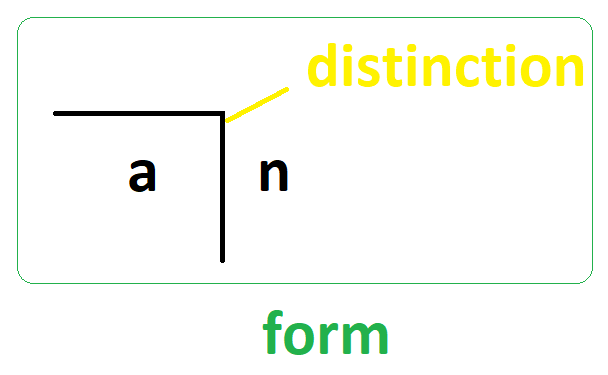
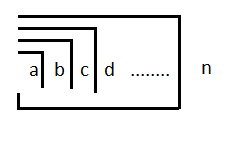
In today’s post, I am continuing from the last post, mainly using the ideas of Dirk Baecker. We noted that every observation is an operation of distinction, where an observer crosses a line, entering a marked state. This is shown in the schematic below. Here “a” refers to the marked state that the observer is interested in. The solid corner of a square is the distinction that was used by the observer, and “n” refers to the unmarked state. The entire schematic with the two sides and the three values (“a”, “n” and the distinction) are notated as a “form”. The first order observer is observing only the marked state “a”, and is not aware of or paying attention to the distinction(s) utilized. They are also not aware of the unmarked state “n”. When a second order observer enters the picture, they are able to see the entire form including the distinction employed by the first order observer.  

However, it is important to note that the observation made by the second order observer is also a first order observation. This means that they also have a distinction and an unmarked state, another “n” that they are not aware of. Baecker explains this:

We have to bring in second-order observers in order to introduce consciousness or self-observation. Yet to be able to operate at all, these second-order observers must also be first-order observers… Second-order observers intervene as first-order observers, thereby presenting their own distinction to further second-order observation.

We also discussed the idea of “reentry” in our last post. Reentry is a means to provide closure so that the first order and second order observations taken together leads to a stable meaning.

So, to recap, the first order observer is interested in “a”.

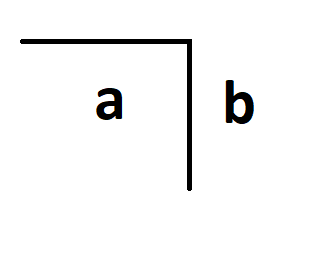
The second order observer observes the first order observer, and understands that the first order observer made a distinction. They see where the first order observer is coming from, and the context of their observation. Let’s call the context as “b”. This will be the unmarked state for the first observer.

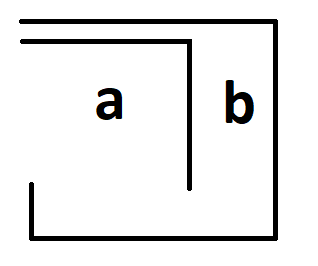
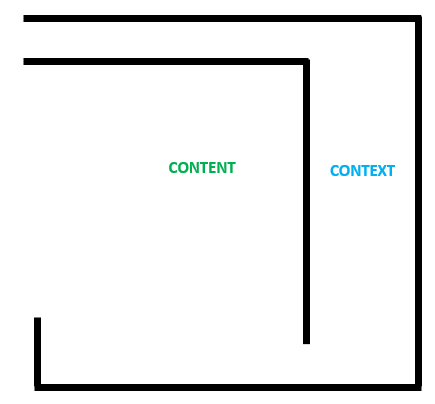
The second order observer engages with the first order observer in an ongoing back and forth discussion. The second order observer is able to combine both their “dealing with the world” approaches and come together to a nuanced understanding. This understanding is an effect of distinguishing “a” from “b”, and also combining “a” and “b” – an action of implication and negation taken together. This is an operation of sensemaking in the medium of meaning. This is depicted as the reentry in the schematic below.

Baecker explains reentry further:

Any operation that is able to look at both sides of the distinction – that is, at its form – is defined by Spencer Brown as an operation of reentry. It consists of reentering the distinction into the distinction, thereby splitting the same distinction into one being crossed and the same one being marked by another distinction that is deferred. The general idea of the reentry is to note and use the fact that distinctions occur in two versions: the distinction actually used, and the distinction looked at or reflected on.

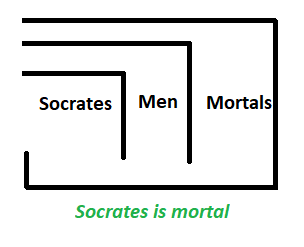
Let’s look further at the form by using a famous syllogism from philosophy to further enhance our understanding:

All Men are Mortals;

Socrates is a man;

Therefore, Socrates is a mortal.

 This can be depicted as a form as shown below:

By distinguishing Socrates from Men, and Men from Mortals, and by putting it all together, we get to “Socrates is Mortal”. In this case, we did not have to do a lot of work to come to the final conclusion. However, as the complexity increases, we will need to perform reentry on an ongoing basis to bring forth a stable meaning. Reentry introduces temporality to the sensemaking operation. No matter how many distinctions we employ, we can only get to a second order observation. All observations are in all actuality first order observations. And what is being distinguished is also dependent entirely on the observer.

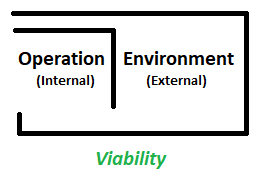
I will also look at another example. A manager is required to maintain the operations of a plant while at the same time they need to make modifications to the operations to ensure that the plant can stay viable in an everchanging environment. In other words, the operations are maintained as consistent as possible until it needs to be changed. This can be depicted as shown below:

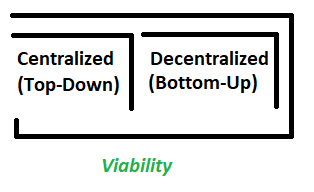
Another way to look at this is to view a plant as needing centralized structure as well as decentralized structure or top-down and bottom-up structure. This can be depicted as shown below. Here the two states are not shown as nested, but adjacent to each other.

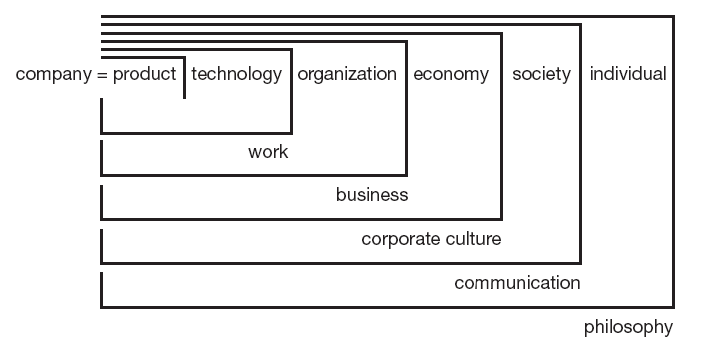
Dirk Baecker saw a firm as follows:

Baecker notes that the product is the first distinction that we have to make. Our first distinction is the distinction of the product. Whatever else the firm may be doing, it has to recursively draw the distinction of which product it is to produce. This may be a material or immaterial, a tangible or intangible, an easy or difficult to define product, but it has to be a product that tells employees, managers and clients alike just what the firm is about. He continues- The technology is part of the form of the first distinction. Indeed, it is the outside or the first context of the first distinction, as observed by a second-order observer who may be the first-order observer observing him/herself. This means that a firm distinguishes only those products for which it has, or hopes to acquire, the necessary technology. Technology here means all kinds of ways of making sure that we can do what we want to do. This includes material access to resources, knowledge of procedures, technologies, availability of people to do the job and ways to convince society that you are doing what you are doing in the proper way.

Baecker explains “work” as follows:

We add the assumption of communication between first-order observers who at the same time act as second-order observers. The firm observes itself. By working, it relates products to technology and technology back to products.

Additional information can be found on Dirk Baecker’s The Form of the Firm.

In all that we have seen so far, we have not yet talked about the unmarked state. The unmarked state “n” is always present in the form and is not accessible to the observer. The observation can have as many distinctions as needed, dependent on the observer. The “n” represents everything that can be further added to the distinctions to improve our “meaning” as needed. The more distinctions there are, the more complex the observations. The observers deal with the complexity of the phenomena to be understood by applying as many or as few distinctions as needed.

We are able to better help with someone else’s problems because we can engage in second order observations. As second order observers, we can see the distinctions they made which are not accessible to them in the first order observation. The second order observer is able to understand the distinctions that the first order observer was able to make. The distinctions lay in the blind spots for the first order observer. The second order observation can be completed by the first order observer themselves as an operation of self-reflection. As cognitive beings, we must reproduce existing patterns by continually engaging with the external world, our local environment. We have to keep evaluating and adjusting these patterns on an ongoing self-correcting basis.

The basic structure of what we have discussed so far can be depicted as the following form:

We need to be mindful that there is always “n” that is not part of our observation. We may gain a better understanding of our distinctions if we engage in second order observation, but we will still not be able to access the unmarked state. We will not be able to access the unmarked state unless we create a new distinction in the unmarked state cutting “n” to a marked state and an unmarked state, yielding a new “n”. Second-order observation, noting one’s own distinctions, can lay the groundwork for epistemic humility.

This brings into question – how many distinctions are really needed? We will answer this with going to the first distinction we made. The first cross that we started with leading to the first distinction is the most important thing that we care about. Every other distinction is based on this first one. To answer – how many distinctions are really needed? – we need as many distinctions as needed until we are fully satisfied with our understanding. This includes understanding our blind spots and the distinctions we have made.

I will finish with a Peter Drucker story from Baecker. Peter Drucker was working with a hospital to improve their Emergency Room. Baecker noted that it took the hospital staff two days to come up with the first distinction, their “a”. Their “a” was to bring immediate relief to the afflicted. The afflicted needing relief may not always be the patient. In Drucker’s words:

Many years ago, I sat down with the administrators of a major hospital to think through the mission statement of the emergency room. It took us a long time to come up with the very simple, and (most people thought) too obvious statement that the emergency room was there to give assurance to the afflicted.

To do that well, you have to know what really goes on. And, much to the surprise of the physicians and nurses, it turned out that in a good emergency room, the function is to tell eight out of ten people there is nothing wrong that a good night’s sleep won’t take care of. You’ve been shaken up. Or the baby has the flu. All right, it’s got convulsions, but there is nothing seriously wrong with the child. The doctors and nurses give assurance.

We worked it out, but it sounded awfully obvious. Yet translating that mission statement into action meant that everybody who comes in is now seen by a qualified person in less than a minute. That is the mission; that is the goal. The rest is implementation.

Some people are immediately rushed to intensive care, others get a lot of tests, and yet others are told: “Go back home, go to sleep, take an aspirin, and don’t worry. If these things persist, see a physician tomorrow.” But the first objective is to see everybody, almost immediately — because that is the only way to give assurance.

This post is also available as a podcast – https://anchor.fm/harish-jose/episodes/Observations-on-Observing–The-Case-Continues-e15kpc1

Please maintain social distance and wear masks. Please take vaccination, if able. Stay safe and Always keep on learning…

In case you missed it, my last post was The Case of the Distinguished Observer:

The Case of the Distinguished Observer:

In today’s post, I am looking at observation. This will be a general overview and I will follow up with more posts in the future. I am inspired by the ideas of George Spencer-Brown (GSB), Niklas Luhman, Dirk Baecker and Heinz von Foerster. In Cybernetics, observation does not mean just to utilize your eyes and look at something. It has a deeper “sensemaking” type meaning. Observation in Cybernetics does not follow the rigid subject-object relationship. Toth Benedek explains this:

Heinz von Foerster tried to develop a point of view that replaces the linear and rigid structure of the object-subject (observer-observed) distinction. According to von Foerster, the observer is really constructed by the observed and vice versa: ‘observation’ is nothing else but the circular relation between them. Observation as a relation defines the observer and the observed, so the observer refers not only to the observed, but also to himself by the act of observation.

Observation is an operation of distinction. The role of an observer is to generate information. If no information is being generated, then no observation has been made. An observation is an act of cognition. GSB in his seminal work, Laws of Form noted:

A universe comes into being when a space is severed or taken apart. The skin of a living organism cuts off an outside from an inside. So does the circumference of a circle in the plane. By tracing the way we represent such a severance, we can begin to reconstruct, with an accuracy and coverage that appear almost uncanny, the basic forms underlying linguistic, mathematical, physical, and biological science, and can begin to see how the familiar laws of our own experience follow inexorably from the original act of severance.

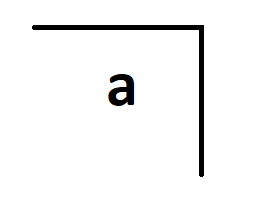
GSB advises us to draw a distinction. He proposed a notation called as “mark” to do this. A basic explanation of a mark is shown below. It separates a space into two sections; one part that is observed and the other that is not observed. We can look at a space, and identify a difference, a distinction that allows us to identify a part of the space as something and the remaining of that space as NOT that something. For example, we can distinguish a part of a house as kitchen and everything else is “not kitchen”. At that point in time, we are looking only at the kitchen, and ignoring or not paying attention to anything else. What is being observed is in relation to what is not being observed. A kitchen is identified as “kitchen” only in the context of the remaining of the house.

Dirk Baecker explains this:

Spencer-Brown’s first propositions about his calculus is the distinction being drawn itself, considered to be “perfect continence”, that is to contain everything. A distinction can only contain everything when one assumes that it indeed contains (a) its two sides, that is the marked state and the unmarked state, (b) the operation of the distinction, that is the separation of the two sides by marking one of them, and (c) the space in which all this occurs and which is brought forth by this occurrence.

From the context of GSB, we can view a distinction as a first order observation. We can only see what is inside the box, and not what is outside the box. What is outside the box is our “blind spot.”

Hans-Georg Moeller explains this very well:

A first-order observation can simply observe something and, on the basis of this, establish that thing’s factuality: I see that this book is black—thus the book is black. Second-order observation observes how the eye of an observer constructs the color of this book as black. Thus, the simple “is” of the expression “the book is black” becomes more complex—it is not black in itself but as seen by the eyes of its observer. The ontological simplicity is lost and the notion of “being” becomes more complex. What is lost is the certainty about the “essential” color of this book.

The first order observer is confident about the observation he makes. He may view his observation as necessary and not contingent. However, a second order observer is able to also see what the first order observer is not. The second order observer is able to understand to an extent how the first order observer is making his distinctions. The second order observer thus comes to the conclusion that the distinction made by the first order observer is in fact contingent and somewhat arbitrary.

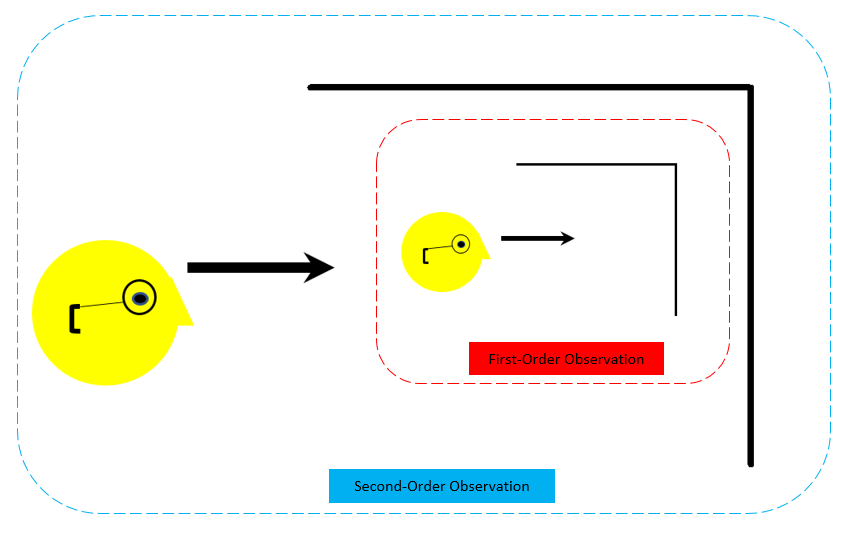
The most important point about the first order observation is that the first order observer cannot see that he does not see what he does not see. In other words, the first order observer is unaware that he has a blind spot. A second order observer observing a first order observer is able to see what the first order observer is not able to see, and he is also able to see that the first order observer has a blind spot. This is depicted in the schematic below:

As the schematic depicts, the second order observer is also making a distinction. In other words, what he is doing is also a first order observation! This means that the second order observer also has a blind spot, and he not aware that he has a blind spot! As Benedek further notes:

the first order of observation (our eye’s direct observation) is unable to get a coherent and complete image about the world out there. What we can see is something we learnt to see: the image we “see” is a result of computing processes.

The second order observation can also be carried out as a self-observation, where the observer doing the first order observation is also the observer doing the second order observation. This may appear paradoxical. GSB talked about an idea called “reentry” in Laws of Form. Reentry is the idea of reentering the form again. In other words, we are re-introducing the distinction we used onto the form again. The reentry is depicted in the schematic below:

Dirk Baecker explains:

Spencer-Brown’s calculus of form consists in developing arithmetic with distinctions from a first instruction—”draw a distinction”—to the re-introduction (“re-entry”) of the distinction into the form of distinction, in order to be able to show in this way that the apparently simple, but actually already complex beginning involved in making a distinction can only take place in a space in which the distinction is for its part introduced again. The observer who makes this distinction through it becomes aware of the distinction, to which he is himself indebted.

Self-observation requires a reentry. In order to become aware that we have cognitive blind spots, we have to perform reentry. The re-entry includes what was not part of the original distinction. This allows us to understand (to a point) how we make and utilize distinctions. To paraphrase Heinz von Foerster, we come to see when we realize that we cannot see.

The reentry is a continuous operation that is self-correcting in nature. There is no end point to this per-se and it oscillates between the inside and the outside. This leads to an emergent stability as an eigenform. As noted before, the second order observation is still a form of first order observation even with reentry. There are still cognitive blind spots and we are still subject our biases and limitations of our interpretative framework. We are affected by what we observe and we can only observe what our interpretative framework can afford. As noted at the start of the post, the role of the observer is to generate information. If the observer is not able to make a distinction, then no information can be generated. This has the same effect as us being in a closed system where the entropy keeps on increasing. Borrowing a phrase from Stafford Beer, this means that observers are negentropic pumps. We engage in making dynamic distinctions which allows us to gather the requisite information/knowledge to remain viable in an everchanging environment.

The discussion about first order and second order observations may bring up the question – is it possible to have a third order observation? Heinz von Foerster pointed out that there is no need for a third order observation. He noted that a reflection of a reflection is still a reflection. Hans-Georg Moeller explains this further:

While second-order observation arrives at more complex notions of reality or being, it still only observes—it is a second-order observation, because it observes as a first-order observation another first-order observation. It is, so to speak, the result of two simultaneous first-order observations. A third-order observation cannot transcend this pattern—for it is still the first-order observation of a first-order observation of a first-order observation… No higher-order observation—not even a third-order observation—can observe more “essentially” than a lower-order observation. A third-order observation is still an observation of an observation and thus nothing more than a second-order observation. There is no Platonic climb towards higher and higher realities—no observation brings us closer to the single light of truth.

I will finish with some wise words from Dirk Baecker:

Draw a distinction.

Watch its form.

Work its unrest.

Know your ignorance.

Please maintain social distance and wear masks. Please take vaccination, if able. Stay safe and Always keep on learning… In case you missed it, my last post was The Cybernetics of Magic and the Magic of Cybernetics: