The Thing About ‘Thing-in-Itself’:

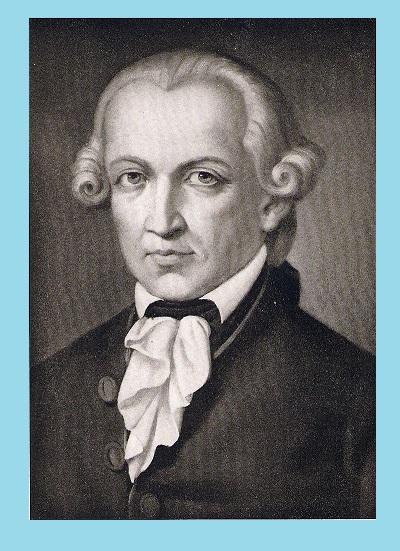
In today’s post, I am looking at Immanuel Kant’s Thing-in-Itself and Hans Vaihangar’s ideas. In Kant’s philosophy, the “Thing-in-itself” (or Ding an sich) refers to the reality that exists independently of human perception or experience. Kant argued that while we can know phenomena (the appearances of things as they present themselves to us), the “Thing-in-itself” remains inaccessible to human cognition, as our knowledge is always mediated by the structures of our mind (such as space, time, and categories of understanding). The Kantian dichotomy therefore is phenomena (things as they appear to us) and the noumena (the “Things-in-themselves”). For Kant, the Thing-in-itself is something that exists independently of human perception, but it is forever inaccessible to us. We can only know the world as it appears to us, not as it truly is in itself. This creates a separation between appearance and reality, and Kant suggests that this gap is unbridgeable for human beings.

I am not a fan of dichotomies. Most often, dichotomies are created as linguistic tools to aid our thinking. But they form a life of their own and cause confusion in our thinking. There are a few ways to think about the thing-in-itself. One is to take the road that reality is indeed accessible to us. This will be the approach of a naïve realist. This notion can be easily disproven by the use of numerous illusions. The second route is to be an idealist. Loosely put, this approach takes the view that everything is in the mind. This notion is also not very useful. This again is another dichotomy – reality is directly accessible out there versus reality is all inside our minds.

It is more useful to take a middle path. Here also, there are different ways to go. One example is Charles Sanders Peirce, who is a realist American philosopher. He believed that reality does exist out there independent of our perception. We may not have direct access to it, but we can gradually make sense of it. He believed that all knowledge is fallible and subject to revision. Instead of positing an unknowable reality, he focused on the continuous process of inquiry and the gradual approximation of truth. In this view, the notion of the thing-in-itself is not value adding since he is proposing that reality or portions of reality are eventually accessible to us. Peirce was a pragmatist (or a pragmaticist as he called himself). As noted above, pragmaticism supports the idea of truth. If there is a practical or pragmatic observable effect, then that becomes truthful. Truth in this case is not absolute since pragmatists support the idea of fallibilism. Truth is provisional. What we have discussed so far moves towards the realist camp.

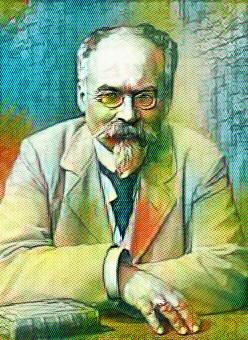
It is here that I want to introduce the ideas of Hans Vaihinger. At this point in time, I side with Vaihinger’s ideas. Vaihinger was a German philosopher who studied Kant vigorously. His ideas have many familiarities with pragmatism. He proposed the philosophy of “as-if”. He came up with the notion of “useful fictions” instead of “truth” in pragmatism. Similar to pragmatism, he was interested in practical applications in the world. Vaihinger argued that the thing-in-itself is not something we can know, but that it functions as a “useful fiction” that helps guide our thinking and practical action. According to Vaihinger, we can use the concept of the thing-in-itself as a heuristic tool, a fiction that helps us organize our experience and navigate the world, even though it does not correspond to anything directly accessible to human cognition.

In a sense, Vaihinger suggests that the thing-in-itself has practical utility, even if it is ultimately unknowable. It provides a framework for understanding reality, even if that framework is not literally true. For Vaihinger, this “fiction” is necessary for guiding human action and thought, even if it is not an accurate representation of an objective reality. He is not interested in “Truth”. Unlike the pragmatists, he calls his ideas fictions.

Vaihinger discussed his ideas in his magnum opus, “The Philosophy of As-If“. He argues that human thought, fundamentally, is geared not towards metaphysical truth or solving abstract problems, but towards survival and fulfilling the “Life-will” (Arthur Schopenhauer’s term for the fundamental drive to live and survive). This perspective leads Vaihinger to conclude that human cognitive faculties are inherently limited, not because they are defective, but because they evolved for very specific, practical, and existential purposes: to help humans navigate the world and satisfy their basic needs.

Vaihinger views human thought as essentially a tool for life, serving the practical ends of survival rather than speculative exploration of ultimate reality. Human cognition was not designed to uncover metaphysical truths or answer the “big questions” about the nature of the universe. Instead, it evolved as a means to manage and react to immediate environmental challenges—finding food, avoiding danger, securing shelter, reproducing, and so on. From this perspective, thought is a functional tool, not a quest for objective knowledge.

In this way, Vaihinger agrees with Kant that human knowledge is bound by certain limits. But Vaihinger takes Kant’s idea further: instead of viewing these limits as a tragic deficiency (i.e., the inability to access noumena or things-in-themselves), Vaihinger argues that they are the natural result of human thought’s biological and practical function. Thought was never intended to grasp the ultimate nature of reality; it evolved to solve problems relevant to human survival and everyday life.

Given that human thought is limited in this way, Vaihinger proposes that we use certain concepts—like the thing-in-itself—as fictions. These fictions are not intended to describe the ultimate nature of reality but to help us organize and navigate our experience of the world. The thing-in-itself, as a fiction, becomes a useful tool for thought, enabling us to conceptualize reality in a way that facilitates practical action and understanding, even if that concept does not correspond to anything we can directly know or experience.

Vaihinger argues that these fictions are essential because they allow us to deal with phenomena that cannot be grasped directly. The thing-in-itself becomes a placeholder or a symbolic construct that helps us maintain coherence in our thinking and practical activities, even though it does not correspond to any knowable “reality”. In this way, Vaihinger’s approach offers a way to work with limitations in thought while still being able to reason, act, and engage with the world meaningfully. Similar to Peirce, Vaihinger maintained that all knowledge is fallible and provisional. He also emphasized the idea of correcting them when they are no longer viable.

The Paradox of Thing-in-itself:

The notion of the thing-in-itself comes with a paradox. If the thing-in-itself is not accessible to us, then how can we even talk about it? How can we ascertain that what we experience is supposed to represent the thing-in-itself? The very act of trying to access the thing-in-itself proves its inaccessibility. Kant acknowledged the limits of human cognition and left us with the concept of the thing-in-itself to indicate that reality exists beyond our perception. Kant insisted that we cannot know the thing-in-itself because our mind imposes its own structures onto the world. So, the thing-in-itself is something that remains, by definition, unknowable. We humans are separated from the “true” nature of things.

Let us use an example to make things clearer. Imagine the reality of a landscape. Kant originally suggested this is a reality we cannot directly touch, like the landscape is behind a thick fog. We can see outlines, but not the detailed terrain itself. Peirce proposed that we have multiple ways to understand that landscape such as signs, instruments, mathematical models etc. It is not that the landscape is unknowable, but that we approach it through creative interpretation. These are not just representations – they are active ways of constructing understanding. Instead of seeing the thing-in-itself as an impenetrable mystery, Peirce suggests it is more like a dynamic puzzle. We do not give up because we cannot see the whole picture immediately. We use every tool we have – mathematical models, technological instruments, logical reasoning – to progressively understand. Peirce claimed we can access reality through signs and mediation.

If we look at Vaihinger’s ideas, Vaihinger would call Peirce’s signs still fictions we have constructed. The mathematical models, instruments, and interpretive frameworks are themselves useful fictions that help us navigate experience. The key distinction between Peirce and Vaihinger is that Peirce believed that we are progressively accessing reality, and Vaihinger saw us as creating increasingly sophisticated, but still fundamentally, fictional frameworks of understanding. In our example, it is like different ways of mapping an unknown territory. Peirce is thinking that we are gradually revealing the actual landscape. Vaihinger is saying that we are creating ever more useful maps, knowing that they are not the territory itself.

In my opinion, there is a Noumenal gap that realism cannot transcend. No matter how sophisticated our signs, instruments, or mediations, we cannot escape the fundamental epistemological limitation. Our cognitive apparatus always interprets, always mediates, always transforms. Any “progress” is still within our conceptual framework. We are not getting closer to the thing-in-itself. We are often simply creating more complex interpretive structures.

Vaihinger’s idea that the thing-in-itself is a “useful fiction” suggests a very different way of thinking. Vaihinger argues that while we may never have direct access to the thing-in-itself (or any ultimate reality), the concept of the thing-in-itself can still be useful for organizing experience and guiding practical action. According to Vaihinger, the idea of the thing-in-itself is a fiction, but one that is necessary for making sense of the world. It is a construct that helps us navigate and interact with our experiences, even if it does not correspond to any objective reality beyond our conceptual framework.

Vaihinger’s view allows us to maintain the utility of concepts like the thing-in-itself without being trapped in the idea that they correspond to something inaccessible in a metaphysical sense. For Vaihinger, the thing-in-itself is not some unreachable essence, but a concept that functions within human thought in a way that allows us to make sense of the world. It is a fiction that helps us act and think meaningfully, even though we know it does not correspond to something we can access directly.

This is a much more flexible and practical stance than Kant’s and Peirce’s, because it allows for the continued use of concepts like the thing-in-itself without needing to assert that they refer to an objective, inaccessible reality. Instead, we can use them for practical reasoning, action, and understanding, while acknowledging their fictional status.

Vaihinger moves beyond the notion that we are limited by a distance from ultimate reality and suggests that the limitations of our understanding do not prevent us from using concepts that guide our actions. He does not need to answer whether we can access the thing-in-itself in any literal sense because he acknowledges that it is a fiction—yet a necessary one. Vaihinger provides a path forward in that sense: we no longer need to grapple with the unknowability of ultimate reality, but instead can work with useful fictions that help us navigate the world. This gives us a much more flexible, non-dogmatic framework for understanding our place in the world and how we think about things like the thing-in-itself.

If we ask for burden of proof for the various ideas we have discussed here, we see that both realism and idealism carry a significant burden of proof because they are making claims. Even with Peirce, there is a significant burden of proof. He must still prove that signs can access reality. Vaihinger on the other hand avoids any metaphysical commitments. By calling the thing-in-itself as a useful fiction, he sidesteps the burden of proof altogether. His focus is only on the viability of an idea.

I will finish with a quote from Vaihinger:

The world of ideas… we generally call “truth” is consequently only the most expedient error, i.e, that system of ideas which enables us to act and to deal with things most rapidly, neatly and safely, and with minimum of irrational elements.

Note: There are of course numerous other schools of philosophy such as critical realism, radical constructivism etc. that I have not looked at here.

The Purpose of Purposeful Entities in Purposive Systems:

This is available as part of a book offering that is free for community members of Cyb3rSynLabs. Please check here (https://www.cyb3rsynlabs.com/c/books/) for Second Order Cybernetics Essays for Silicon Valley. The ebook version is available here (https://www.cyb3rsyn.com/products/soc-book)

Stay safe and always keep on learning…

In case you missed it, my last post was HvF’s Ethical Imperative:

The Conundrum of Autonomy in Systems:

This is available as part of a book offering that is free for community members of Cyb3rSynLabs. Please check here (https://www.cyb3rsynlabs.com/c/books/) for Second Order Cybernetics Essays for Silicon Valley. The e-book version is available here (https://www.cyb3rsyn.com/products/soc-book)

Wear a mask, stay safe and Always keep on learning…

In case you missed it, my last post was Copernican Revolution – Systems Thinking:

Copernican Revolution – Systems Thinking:

In today’s post, I am looking at “Copernican Revolution”, a phrase used by the great German philosopher, Immanuel Kant. Immanuel Kant is one of the greatest names in philosophy. I am an Engineer by profession, and I started learning philosophy after I left school. As an Engineer, I am trained to think about causality in nature – if I do this, then that happens. This is often viewed as the mechanistic view of nature and it is reliant on empiricism. Empiricism is the idea that knowledge comes from experience. In contrast, at the other end of knowledge spectrum lies rationalism. Rationalism is the idea that knowledge comes from reason (internal). An empiricist can quickly fall into the trap of induction, where you believe that there is uniformity in nature. For example, if I clapped my hand twenty times, and the light flickered each time, I can then (falsely) conclude that the next time I clap my hand the light will flicker. My mind created a causal connection to my hand clapping and the light flickering.

David Hume, another great philosopher, challenged this and identified this approach as the problem of induction. He suggested that we, humans, are creatures of habit that we assign causality to things based on repeat experience. His view was that causality is assigned by us simply by habit. His famous example of challenging whether the sun will rise tomorrow exemplifies this:

That the sun will not rise tomorrow is no less intelligible a proposition, and implies no more contradiction, than the affirmation, that it will rise.

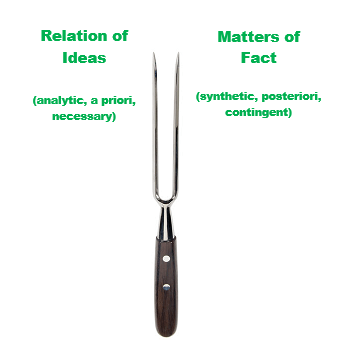
Hume came up with two main categories for human reason, often called Hume’s fork:

  1. Matters of fact – this represents knowledge that we gain from experience (synthetic), and this happens after the fact of experience (denoted by posteriori). An example is – the ball is heavy. Thinking cannot provide the knowledge that the ball is heavy. One has to interact with the ball to learn that the ball is heavy.
  2. Relation of ideas – this represents knowledge that does not rely on experience. This knowledge can be obtained simply through reason (analytic). This was identified as a priori or from before. For example – all bachelors are unmarried. No experience is needed for this knowledge. The meaning of unmarried is predicated in the term “bachelor”.

All the objects of human reason or enquiry may naturally be divided into two kinds, to wit, relations of ideas, and matters of fact. Of the first kind are the sciences of Geometry, Algebra, and Arithmetic … [which are] discoverable by the mere operation of thought … Matters of fact, which are the second object of human reason, are not ascertained in the same manner; nor is our evidence of their truth, however great, of a like nature with the foregoing.

Hume’s fork stipulates that all necessary truths are analytical, the meaning is predicated in the statement. Similarly, knowledge regarding matters of fact indicate that the knowledge is contingent on the experience gotten from the interaction. This leads to further ideas such as – there is a separation between the external world and the knowledge about the world. The knowledge about the world would come only from the world through empiricism. One can view this as the human mind revolving around the world.

Immanuel Kant challenged the idea of Hume’s fork and came up with the idea of a priori synthetic knowledge. Kant proposed that we, humans, are bestowed with a framework for reasoning that is a priori and yet synthetic. Kant synthesized ideas from rationalism and empiricism, and added a third tine to Hume’s fork. Kant famously stated – That all our knowledge begins with experience there can be no doubt. Kant clarified that it does not follow that knowledge arises out of experience. What we come to know is based on our mental faculty. The mind plays an important role in our knowledge of the world. The synthetic a priori propositions say something about the world, and yet at the same time they say something about our mind.

How the world is to us depends on how we experience it, and thus the knowledge of the external world is dependent on the structure of our mind. This idea is often described as a pair of spectacles that we are born with. We see the world through this pair of spectacles that we cannot take off. What we see forms our knowledge of the world, but it is dependent on the pair of spectacles that is a part of us. Kant’s great idea is that our knowledge of the world does not conform to the world. Our knowledge of the world conforms not to the nature of the world, but to the nature of our internal faculties. To paraphrase Heinz von Foerster, we do not see the world as is, it is as we see it.

Nicholas Copernicus, the Polish astronomer, came up with a heliocentric view of the world. The prevalent idea at the time was that the celestial bodies, including the sun, revolved around the earth. Copernicus challenged this, and showed that the earth actually revolves around the sun. Kant, in a similar fashion, suggested that the human minds do not revolve around the world with the meanings coming into our minds. Instead, the world revolves around our minds, and we assign meanings to the objects in the world. This is explained wonderfully by Julie. E. Maybee:

Naïve science assumes that our knowledge revolves around what the world is like, but, Hume’s criticism argued, this view entails that we cannot then have knowledge of scientific causes through reason. We can reestablish a connection between reason and knowledge, however, Kant suggested, if we say—not that knowledge revolves around what the world is like—but that knowledge revolves around what we are like. For the purposes of our knowledge, Kant said, we do not revolve around the world—the world revolves around us. Because we are rational creatures, we share a cognitive structure with one another that regularizes our experiences of the world. This intersubjectively shared structure of rationality—and not the world itself—grounds our knowledge.

Systems:

We have assumed that the knowledge of the world, our cognition, conforms to the world. Kant proposes that all we have access to is the phenomena, and not the actual world. What we are learning is dependent on us. We use an as-if model to generate meaning based on our interaction with the external world. In this viewpoint, the systems are not real things in the world. The systems are concepts that we construct, and they are as-if models that we use to make sense of the phenomena. What we view as systems are the constructions we make and depends on our need for understanding.  

Alan Stewart uses a similar idea to explain his views on constructivism:

The fundamental premise of constructivism is that we humans are self-regulating organisms who live from the inside out. As a philosophical counterpoint to naive realism, constructivism suggests that we are proactive co-creators of the reality to which we respond. Underlying this concept is that perception is an active process in which we ‘bring forth distinctions’. It is our idiosyncratic distinctions which form the structure of the world(s) which each of us inhabits.”

I will finish with a great lesson from Alan Watts:

“Everything in the world is gloriously meaningless.”

To further elaborate, I will add that all meaning comes from us. From a Hume-ian sense, we are creatures of habit in that we cannot stop assigning meaning. From a Kant-ian sense we are law-makers, not law-discoverers.

From a Systems Thinking perspective, we have unique perspectives and we assign meanings based on this. We construct “systems” “as-if” the different parts work together in a way to have a purpose and a meaning, both of which are assigned by us. The meaning comes inside out, not the other way around. To further this idea, as a human collective, we cocreate an emergent phenomenal world. In this aspect, “reality” is multidimensional, and each one of us has a version that is unique to us.  

Stay safe and Always keep on learning…

In case you missed it, my last post was Hegel, Dialectics and POSIWID:

Karakuri Kaizen:

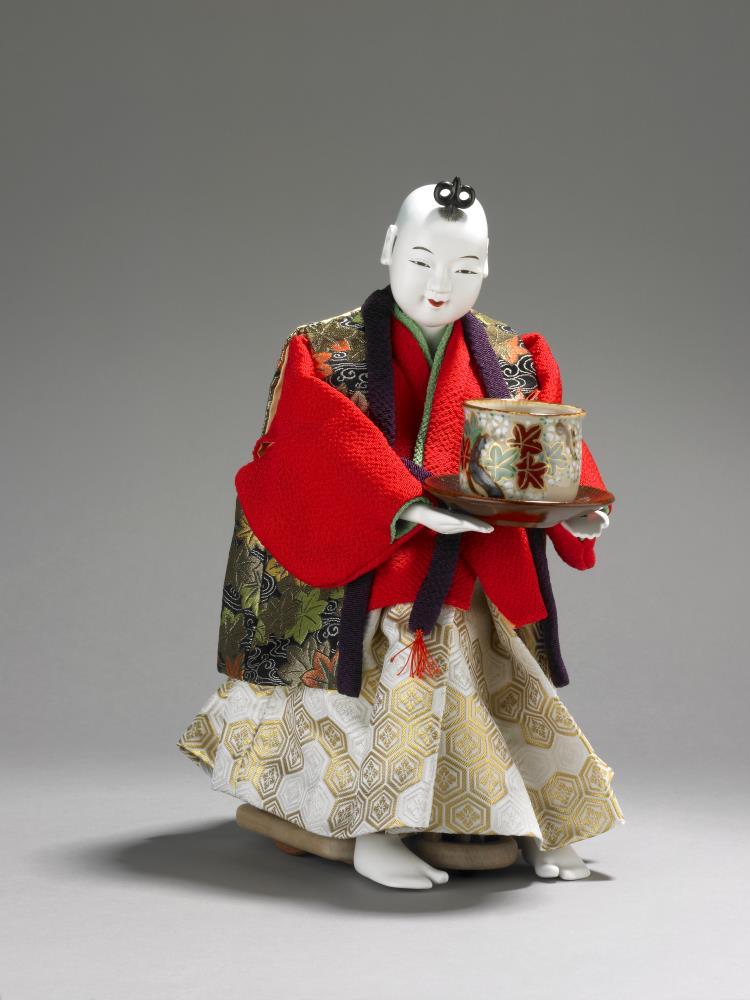
karakuri doll tea

As the readers of my blog know, I am an ardent student of Toyota Production System (TPS). One of the core philosophies of TPS is kaizen, often translated from Japanese as continuous improvement. It is the idea that one should continuously find ways to eliminate non-value adding activities, and in the process develop oneself and others to get better at kaizen. The idea of kaizen begetting more kaizen. Kaizen is a human capital enrichment philosophy. As Eiji Toyoda, Toyota Motor Corporation President from 1967 to 1982, said – “It is people that make things, and so people must be developed before work can start.

One of the ways Toyota inspire their employees to nurture their creativity is Karakuri Kaizen. It is said that in the early seventeenth century, during the Edo period, European clocks were introduced in Japan. This sparked a wide curiosity amongst the Japanese craftsmen. The idea of developing motion mechanisms with elaborate sets of springs and gears was new to them. This led to the development of karakuri ningyō, or mechanized dolls. These were dolls that moved around and did several tasks such as bring tea to a guest and then bring it back to the owner, or climb a set of stairs. There was even a magician doll that performed a cups and balls routine.

What set the karakuri dolls of Japan separate from the European clockwork mechanism was the humanization of the dolls. The dolls were created with high importance to its physical features such as face, movement of head and limbs; in an effort to the make the doll life-like. Aesthetics was of utmost importance. All the mechanisms were cleverly hidden beneath clothing such that no mechanism was visible from outside. The doll moved around as if it is alive. The karakuri dolls brought fascinated delight to its spectators.

All the motion was achieved using simple springs, gravity and gears. No external power source was used. How does this all relate to the manufacturing floor? One of the challenges that is often posed to an organization is to increase its production. This is often tackled by either hiring more employees or by using automation. Automation is highly attractive even though it is sometimes cost prohibitive. It might make sense that the nonvalue added activities such as transportation and repeated motions could be replaced with a robot. Most modern manufacturing operations are riddled with automation. However, this comes with its own problems. The main one is that the automation becomes the focus of manufacturing rather than the employees. The high cost, large equipment becomes a monument that everything has to work around the monument. It is an expensive way to ensure that the status quo is maintained. To get the most out of the high expense, the new machine is run around the clock increasing the unwanted inventory and it raises the cost of the operation.

This is where karakuri kaizen comes in. Karakuri, as explained before, is a low-cost automation that does not utilize external power resources. It is comparatively small and works solely based on gravity, counterweights, springs, gears etc. The key point of karakuri kaizen is that it should inspire more kaizen. Generally, a challenge is posed to the operators to come up with a means to remove unwanted strain and motion, and to eliminate waste. Normally, this would be task where a heavy part(s) is lifted and moved to another location or where a part is turned around and operated on. The first impulse is to automate the process. This would require an expensive piece of equipment. Karakuri kaizen focuses on solving the problem on hand with what is readily available and using minimal resources. This might be construed as pushing to minimize capital expenditure. However, the most important part is that the operators are being challenge to use their wit and brains. As Fujio Cho, Toyota Motor Corporation President from 1999 to 2005, said – “Human ingenuity has no bounds.” The karakuri mechanism does not become the center of focus. Instead, the operator does. The mechanism generally is such that it can easily be modified if needed, and even replaced with another karakuri. Unlike, a heavy piece of machinery, a karakuri does not become a monument. It is built specifically to achieve a purpose, and thus it is highly customized. It is also designed in-house. The “challenge” portion is a core ingredient for kaizen.

When Toyota started car manufacturing, it did not have a lot of capital or resources. They modified existing machinery to achieve its needs. They first used what they had in-house before going outside for solutions. They relied on their employees to come up with ingenious solutions to their problems. This meant that the solutions were made specifically for their problems. Generally, when an equipment or a software is purchased, it is not always made specific to the need of the customer. The customer often has to work with what was offered. Toyota had to come up with ingenious solutions to solve their problems without spending much capital. The only capital they would come up with was human capital. Even after Toyota became successful, this mindset was maintained.

As Toyota veteran Kazuhiko Furui explained:

Toyota has tried to use as little external power as possible in its car manufacturing since its foundation. Karakuri kaizen is one of the Toyota Way values. Karakuri is a mechanism that uses gravity, springs and gears instead of external power sources to manipulate objects. A karakuri does not always work well on the first try. If something breaks, we rebuild it, trying continuously to make it better, always reforming the mechanism. For us, when we succeed, there is a great sense of achievement: “we did it!” And that brings a drive to try making yet another mechanism. Developing karakuri is also about developing people. 

Final Words:

What is the point of kaizen? The simple answer is often to make things better. If kaizen does not beget more kaizen and if it does not improve the thinking of the persons involved, then it is missing the meaning of kaizen. Kaizen should lead the employees to develop their abilities to see and identify waste, and come up with ways to eliminate waste. It should lead them to second order thinking where they don’t just what is my goal, but also ask what is the purpose of my goal. This means that the employee becomes part of the meta-system rather than just doing what they are told.

I will finish with some fine words from the great philosopher, Immanuel Kant:

The human being can either be merely trained, broken in, mechanically instructed, or really enlightened. One trains dogs and horses, and one can also train human beings. Training, however, does little; what matters above all is that they learn to think. The aim should be the principles from which all actions spring.

In case you missed it, my last post was Weber’s Law at the Gemba:


Kant and Respect for Humanity:

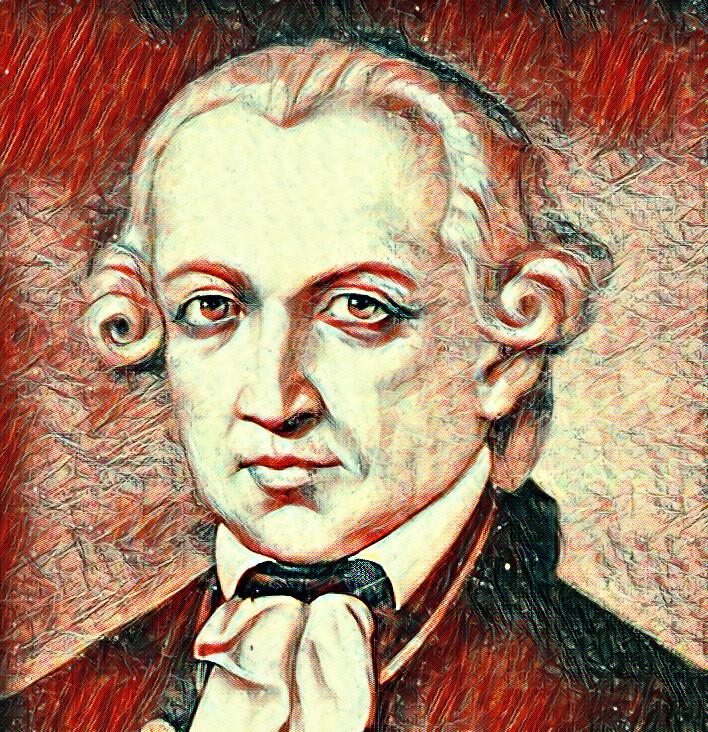
Kant

In today’s post, I will be looking at the concept of Respect of Humanity from a “Kantian philosophy standpoint”. “Respect for Humanity” is one of the two pillars of the “Toyota Way”. Yoshio Ishizaka defined Toyota Way as – Toyota’s implicit knowledge put in statutory form in 2001 [1]. I have written about Respect for People many times in this blog before [2].

Immanuel Kant (1724 – 1804) is a giant in modern philosophy. Kant wrote about the Categorical Imperative in his 1785 book, Groundwork of the Metaphysics of Morals [3]. Kant defined the Categorical Imperative as a universal moral law or principle that must be followed at all times, no matter what the circumstance or what our natural inclinations or desires are. Our focus is on Kant’s second formulation of the Categorical Imperative;

Act so that you use humanity, as much in your own person as in the person of every other, always at the same time as end and never merely as means.’’

Kant viewed humans as rational beings and accordingly rational beings cannot be treated merely (solely) as a means to ends, but as ends themselves.  A rational person will not subject himself to be treated as a mere means to an end, thus it is only rational to treat others the same way, in a universal manner. This thinking is applicable to oneself as well. One of the examples that Kant gave to explain this concept, is of a man who does not try to develop his natural talent. The man in the example is content with where he is, and in Kant’s eyes this means that the man is not respecting himself. Kant said, it is not enough that the action does not conflict with humanity in our person as end in itself; it must also harmonize with it (humanity).

Kant used the term “menschlichkeit”, a German word to explain his ideas regarding humanity. He viewed humanity as possessing a “rational nature” [3]. Humanity, through which we have the rational capacities to set ends, use means to them, and organize them into a whole. And as a rational being, at the heart of this is the capacity for autonomy or the ability to self-govern. The word “autonomy” from Greek means autos = self, nomos = law. This ability for self-governing, morally forces us to view each other with respect.

The concept of Respect for People does not begin or end with “being nice” to others. From a Kantian standpoint, respect is about morality. Morality is not about consequences – what others would think about me, but about intentions – it is rational to be respectful to others. Kant does not have a problem with using a person as a means to an end. For example, when an operator comes to work, he is being used to produce a product (means to an end). Kant’s problem is when a person is used as a “mere means” to an end. If the operator is seen only as a pair of hands, and if his or her input is not valued, then he or she is being used as a “mere means”. This adds a dimensionality to the relationship with the operator. It goes both ways, from the manager to the operator and the operator to the manager. The operator in turn should not view the job as a mere paycheck.

From a Kantian perspective, Respect for People means to ensure that everybody is capable of being valuable. There are opportunities for development of talent, and in Kant’s words, a chance to harmonize with humanity. How does one increase the worth of an employee? You can increase their worth by developing the employee to understand the value in his work. You can increase their worth by training him to look for gaps between the ideal state and the current state. By understanding this gap, you can further develop him to take countermeasures and corrective actions to move closer to the ideal state. Ideally, the employee would now be able to train the employees underneath him. The employee is now at a stage to be making decisions and implementing improvements on his own. In other words, he is empowered.

Final Words:

Kant was ahead of his time with his thinking. Kant spent his entire life in his hometown (Königsberg, the then capital of Prussia), and is said to have never set his foot outside a 100 mile radius from his house. Most of his famous works came later in his life. He famously said that David Hume, the great Scottish philosopher, woke him up from his dogmatic slumber.  As I was reading upon Kant as part of my personal journey through philosophy, I came upon his Categorical Imperative and it struck me how much the second formulation aligned itself well with the Respect of Humanity theme of the Toyota Way.

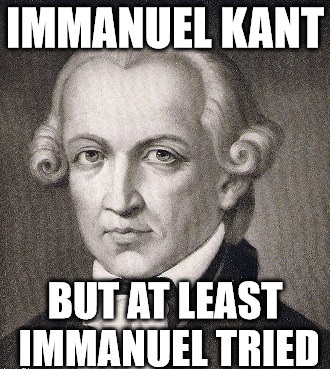
There are many play-on-words with Kant’s name. One of my favorite memes is below:

Kant_Meme

I will finish with an anecdote about Kant.

Kant was a firm believer in rules. He had set a rule for himself to not smoke more than one pipe a day. Smoking was Kant’s time to think and reflect. As time went on, Kant wanted to spend more time smoking. However, he did not want to break his own rule. His way out was to get a larger pipe. It is said that as time went on, the size of the bowls of his pipes grew in size considerably.

Always keep on learning…

In case you missed it, my last post was Process Validation and the Problem of Induction:

[1] https://www.amazon.com/Toyota-Way-Sales-Marketing/dp/1926537084/ref=sr_1_1_twi_pap_2?s=books&ie=UTF8&qid=1494183905&sr=1-1&keywords=The+Toyota+Way+in+Sales+and+Marketing

[2] https://harishsnotebook.wordpress.com/?s=respect+for+people

[3] https://www.amazon.com/Groundwork-Metaphysics-Morals-Immanuel-Kant/dp/0300094868