
Visibilization: Crime Fighting, Magic and Mieruka:

mieruka_main

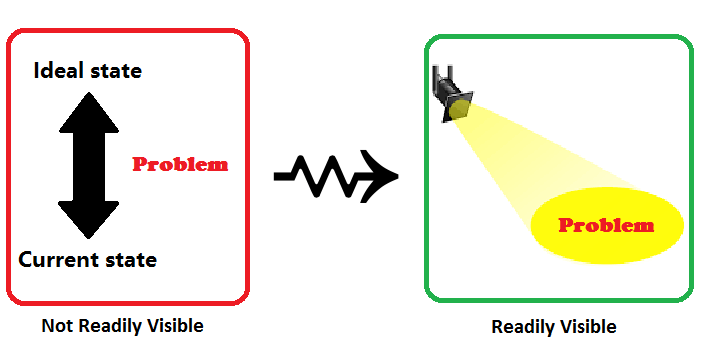
Mieruka” is one of the concepts that Toyota coined as part of the Toyota Production System. Mieruka has been translated as “Visualization” or “Visual Controls”. “Miru” or “Mieru” in Japanese is a verb associated with “to see”. The “-ka” suffix is explained as “-ization” in Ryoji Ihara’s book “Toyota’s Assembly Line”. My understanding is that the “-ka” stands for “kanri” which means “control” or “management”. Thus, Mieruka means “Visual Management” or “Visual Control”. In the book “Toyota’s Assembly Line”, the translator Hugh Clarke puts up a strong case that Mieruka should mean “Visibilization”. His logical point is that the concept of Mieruka is all about making problems/waste visible. This idea is explained below in the graphic.
mieruka

In the “Toyota’s Assembly Line” book, there is an anecdote about the machinery used on the production floor. It was typical to have steel guards in place for safety purposes. Toyota replaced these guards with clear plastic shields. The steel covers hid the machine so that any small problem with the machine was not immediately visible. The new clear covers on the machine allowed the workers to see the internal structure of the machine as part of Mieruka.

The term “visualization” can be misleading as it is a common theme in any self-help book. The term visualization does not transcribe well. However, the term “visibilization” indicates that you are making something visible.

Mieruka is the process of translating live information into visible information so that both problems and kaizen opportunities are identified immediately. The first thing that might come into mind about Mieruka is 5S. 5S is the lean tool for workplace organization so that everything has a place and everything is identified. This increases efficiency since the operator does not have to search for tools and he knows where everything belongs. However, the main intent of 5S is not workplace organization. The main intent is to make problems visible immediately.

Other examples of Mieruka include kanban, daily production boards and the andon cord. Mieruka can create a pull system where resources are applied as the problem arises.

Mieruka and Magic:

I have a strong interest in magic. As I was thinking about Mieruka I came to the realization that Mieruka is the opposite of magic. In magic, the magician is trying to hide something through misdirection. He pretends to transfer a coin to the other hand and pretends that he is holding a coin when he is not holding a coin.

In Mieruka, the lean leader is trying to make problems obvious through visibilization. He wants to make the problem visible to everyone as it happens. A really good example is the andon cord. The andon cord is on the assembly line, and the operator pulls on the andon cord when he faces a problem that he cannot fix in the allotted amount of time. The andon cord lights up with a buzzer sound sometimes, bringing the problem to everybody’s attention. The supervisor or the lead sees the problem and comes to the aid of the operator.
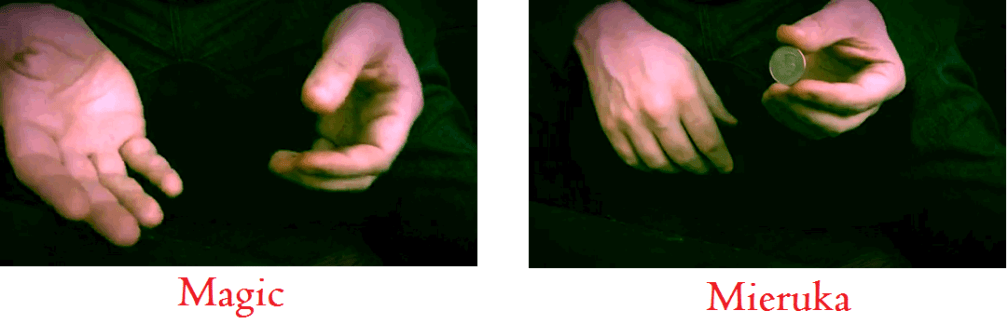
magic

The Crime Fighting Orange Balls:

karaboru

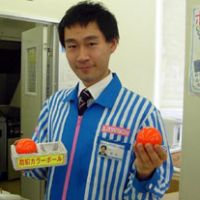
I recently read about “bohan yo kara boru”, translated from Japanese as “anticrime color balls”. These are plastic clear balls filled with bright orange paint. The trend in Japan is to keep these at banks and convenience stores. In case of a robbery, the store clerk can throw the ball on the floor causing the paint to splash all over the floor to a 10 meter radius. This paint would get on the clothes and “mark” the robber, aiding the police in identifying the perpetrator when he is on the run. In one case, the robber left a trail of paint foot prints! They can also throw the ball at the getaway vehicle to mark it for the police. Apparently, the idea came about when tollbooth attendants were resorting to throwing raw eggs at vehicles that did not pay the toll. The idea of using paint caught on and led to the invention of bohan yo kara boru. The “kara boru” part stands for “color ball”. The balls are kept in plain sight and behind the counter for everybody to see. It is also publicized that the store carries the color balls. This Mieruka aids in fighting crime.

Always keep on learning…

In case you missed it, my last post was The Best Kind of Kaizen.

Karaboru Image Source: http://www.sobify.com/japans-anti-crime-orange-balls/
The Best Kind of Kaizen:

dumpling

I have been writing about kaizen a lot recently. It is a simple idea – change for the better. Generally, kaizen stands for small incremental improvements. In today’s post I am going to look at what is the best kind of kaizen.

The Twist in the Dumpling:

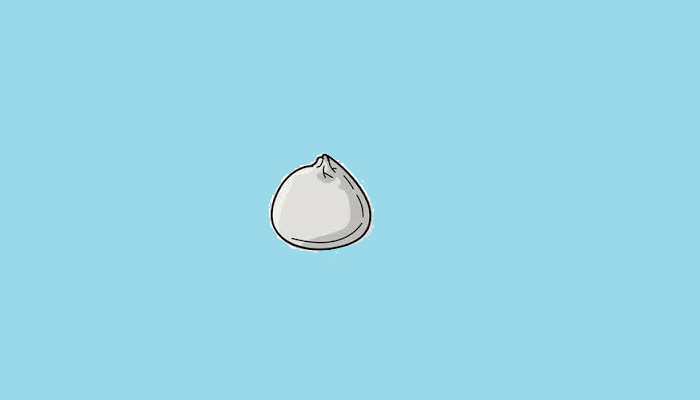
A few posts back, I talked about the order for kaizen. In that post, I talked about the idea of Equipment kaizen or Setsubi kaizen. To introduce the concept of the best kind of kaizen I will share a story from Masayasu Tanaka, dealing with Equipment kaizen. He tells of a plant that manufactured steam dumplings (manju in Japanese). They were trying to automate the entire process of making steamed dumplings. The last step of the dumplings was to make a twist on top of the dumpling. All the previous steps were easily automated, however the twisting of the top stumped them. The directive of automating the entire process came directly from the President of the company. The twisting of the top however threw a curveball at the Engineers. They worked on it for many days and sleepless nights. Finally, they were triumphant in creating a machine that could indeed twist the top of the dumpling. Everybody was very happy, and they cheered the smart Engineers for their hard work.

In the midst of all the celebration, someone asked, “Why is there a twist on the dumpling anyways?”

Silence fell across the floor. Nobody could answer the question. The Engineers involved did not know the answer. Finally, with enough asking around, the answer was that the twist indicated the dumpling had meat inside. It was simply an indication of the meat content. The same result could had been achieved with a dent or cut on the top or a different wrapper. (Source: Kaizen Teian 2)

The best kind of kaizen is eliminating the task altogether. Our first focus should be to understand the purpose of the task, and then seeing if we can eliminate it altogether.

The best kind of kaizen is eliminating the task altogether.

Final Words:

I had written about How Do I Do Kaizen previously. The steps for kaizen have roots in the Problem Solving manual from Training Within Industry. This is called as the ECRS process. These are to be followed in the order shown below.

  • Eliminate Unnecessary Tasks: The ultimate improvement is eliminating a task altogether. The What and Why questions help us with this.
  • Combine the Steps: What are the steps that need to be done in a series? Are there any steps that can be done in parallel? The Where, When and Who questions help us with combining steps to eliminate waste. Additionally, combining also reduces the number of discrete steps in the process.
  • Rearrange the Steps: Sometimes changing the sequence also allows us to take away waste from the process. The Where, When and Who questions help us with this. Can we do the current step# 3 before Step# 1? Is there any logic to the current sequence of steps? Can we rearrange to create a better sequence?
  • Simplify: Is there any task that can be simplified to make the whole process faster and better? Does the operator spend a lot of time trying to sort things or fumble with things? Can we ultimately simplify all the steps?

I will finish off with a story I read on Snopes that begs us to first understand the purpose of anything you are trying to improve.

A more frightened than injured young Seabee electrician was brought into the hospital suffering from electrical burns. Shortly afterward his instructor, a chief electrician, arrived. “Why on earth didn’t you turn off the main power switch before you tried to splice the wires?” asked the chief.
“I wanted to save time, chief, and I’ve seen you stand on one leg, grab the wires and splice without turning off the power.”
“My God, kid,” exclaimed the chief. “Didn’t you know I have a wooden leg?”

Always keep on learning…

In case you missed it, my last post was Time and TPS.

The Order for Kaizen:

kaizen order

In today’s post, I will be talking about Kaizen and specifically the order for kaizen. Kaizen has come to mean “continuous improvement” today. Kaizen originally translates from Japanese as “change for better”. I will be presenting three different views on approaching kaizen. These are;

  • Taiichi Ohno’s view,
  • Shigeo Shingo’s view, and
  • Hiroyuki Hirano’s view

Taiichi Ohno’s View (Semi-Strategic in nature):

Taiichi Ohno is the father of Toyota Production System (TPS). He has stated that there is a proper order for kaizen. These are;

  • Sagyo kaizen (Operations improvement),
  • Setsubi kaizen (Equipment improvement), and
  • Kotei kaizen (Process improvement)

I believe that Ohno wanted to focus on developing the abilities of people first since this is the lowest level where kaizen is possible. As Hirano says, “The starting point of manufacturing is always people.” Any production system should be people oriented. The first step of all kaizen is to raise the awareness of the people. This allows them to view the waste as a lean leader would. This is achieved only through operations kaizen. The operators involved are finding ways to make their work easier with what they have. This has minimal cost impact of all the kaizen. Ohno has also said;

“People with no capacity for improving operations are a problem because they like to buy new machines all the time.”

Ohno has also said;

“First improve operations. If you start out by bringing in the latest machines people with no capacity for improvement simply end up being slaves to the machines.”

The next in line is Equipment kaizen. Ohno challenges us to find new and creative ways of using the current equipment. Ohno advises us;

“You must have the ability to tinker with and improve the machines you already have.”

Ohno recommends buying new equipment when you have made the maximum use of current equipment and when it is no longer possible to increase effectiveness without new equipment. Purchasing new equipment should result in an improvement of quality. Ohno cautions against purchasing costly specialized equipment and advises going for flexible and low cost equipment. Equipment kaizen alone without operation kaizen results in extreme waste. Now the organization can make waste much better, and lot more of it. Machines cannot see waste, and machines cannot improve anything on their own. Machine kaizen alone foster status quo and invites complacency.

The last in line is Process Kaizen. His view was;

“Making things extremely well by turning the process upside down is Process Improvement.”

With process kaizen, you are looking at rearranging equipment or operations, changing layout, or improving the flow by linking processes.

Shigeo Shingo’s View (Tactical in nature):

Shigeo Shingo has provided us four targets for improvement. They are, in the order of priority;

  • Easier,
  • Better,
  • Faster, and
  • Cheaper

I was watching a Paul Akers (FastCap) video on YouTube and I made a connection to what Shingo said. “Easier” is an improvement from the point of the operator. This also means that it is safer for the operator to do. Any improvement activity should be first focused on Safety. “Better” is an improvement activity resulting in an improvement in quality of the operation/product. “Faster” is an improvement activity that increases efficiency. The final level is “cheaper”, and this should be the last target of all improvement activities. The goal of kaizen is not necessarily to first make the process cheaper.

Hiroyuki Hirano’s view (Strategic in Nature):

Hirano has pointed out the following as the normal progression of kaizen;

  • Point kaizen,
  • Line kaizen,
  • Plane kaizen, and
  • Cubic kaizen

“Point kaizen” is very similar to the operations improvement. This is the basic small improvement activity at the operations level. The next level is “line kaizen”. This is where a lot of the point kaizens merge together to result in flow manufacturing, as in an assembly line. Hirano calls this a vertical development. This is akin to selecting a model line and transforming it to make the process flow better. Once we have line kaizen, the next progression is through “plane kaizen”. This is the idea of “yokoten” or horizontal deployment. This is where the ideas and learning from the model line is used to create more model lines across the plant.  Thus this results in horizontal development. The final level is “cubic kaizen” where the development is made across multiple departments and even the supply chain of the enterprise.

My thoughts:

As with any other buzzword, kaizen has come to mean many things. My goal has been to provide a little more structure to the wonderful idea of kaizen. I would encourage the reader to also read my previous post on this topic here (A brief look at kaizen in the light of the Toyota Way). I will finish this off with a great story on Equipment kaizen from Hitoshi Yamada, a student of Ohno from the book Forging a Kaizen Culture (Japanese version 2009):

Yamada was at a large component manufacturer, Stanley Electric’s Tsuruoka plant. They were looking at a machine that assembled extremely small light bulbs. The cost of the machine was $150,000. The machine had two turn tables, and several robot arms. Due to the high cost of the machine, the factory manager felt that he should rely on mass production to make the maximum use of the machine.

Yamada told the manager to study the machine and find areas of wasted movement. And even better- to build a smaller and better machine.

This improvement activity took several weeks of trial and error. The final machine was $5,000 and 1/27th the size of the old machine. Since the machine was much smaller in size, it was also more efficient.

Always keep on learning…

In case you missed it, my last post was Ohno and the Gemba Walk.

A Brief Look at Kaizen in the Light of the Toyota Way:

chie to kaizen

I have talked many times in this blog about the “Toyota Way 2001”. The Toyota Way was an embodiment of Toyota’s management philosophy and values that were passed on to its employees as implicit knowledge. Due to rapid global expansion, Toyota Management decided to write down this implicit knowledge into a booklet – Toyota Way 2001, in order to help expand their production system properly across the globe.

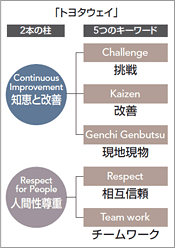
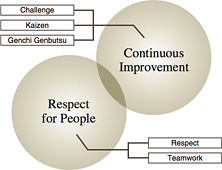
The Toyota Way has two pillars – “Continuous Improvement” and “Respect for People”. The “Continuous Improvement” pillar stands on three principles:

  • Challenge
  • Kaizen
  • Genchi Genbutsu

IMG_1282

All is good up to this point. “Kaizen” is often translated as “Continuous Improvement”. I saw this as a linguistic “chicken or egg situation”: How can kaizen be one of the three principles of “Continuous Improvement” when kaizen itself is “continuous improvement”? Why was the pillar not named simply as “Kaizen”?

Michel Baudin has written about it here. He has shown that the pillar is actually termed “Chie to Kaizen” in the Japanese version of Toyota Way 2001. “Chie to Kaizen” is translated as “Wisdom and Continuous Improvement”. I encourage the readers to check out Michel’s blog post.

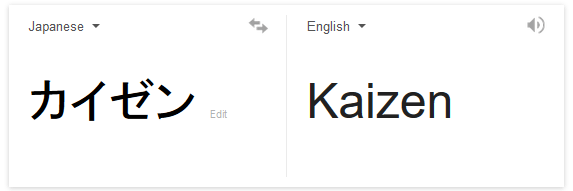
Kaizen in Japanese is not translated literally as “continuous improvement”. The literal meaning is “change for better”. The Japanese word kaizen is derived from the Chinese word gaishan. They both mean “to improve”. Kaizen is written as 改善 in both Chinese and Japanese. This is because Japanese language uses a lot of characters adopted from Chinese language called Kanji. Apparently, to distinguish between “kaizen – improvement” and “kaizen – continuous improvement”, several Japanese writers have started using “カイゼン”, which reads the same. “カイゼン” is written in Katakana script, one of several writing components in the Japanese language, besides Kanji. Katakana is generally used for words imported from foreign languages. Thus when you translate the word “カイゼン” into English through Google Translator, you will find that the word translates to “Kaizen” in English. I am assuming that Kaizen in English means “Continuous Improvement.” 🙂

Kaizen

Wisdom/Intelligence and Continuous Improvement:

The only source where the pillar is not called as “Continuous Improvement” in English by a Toyota personnel that I could find, was “The Toyota Way in Sales and Marketing” by Yoshio Ishizaka. In this book, the first pillar is called as “Intelligence and Kaizen”. In my eyes, this is a better phrasing for the pillar. Ishizaka explains this pillar as follows;

Intelligence and Kaizen describes an attitude in which you are never satisfied with the current condition and continuously develop innovative ideas yielding higher added values.

Kaizen achieves a better meaning when viewed in the light of Challenge and Genchi Genbutsu. There is a sense of continuity towards improvement with this view. This meaning is more synonymous to “Continuous Improvement”. Let’s look at the other two principles: Challenge and Genchi Genbutsu.

Challenge: The key point here is to challenge the status quo. Do not be satisfied with your current state. There is almost always a better way of doing things. This may push you outside your comfort zones. But that is how you can continuously improve. This principle also encourages us to have a long term vision, and to move towards it at all times. As Toyota puts it “Working at Toyota is also an exercise in long-term thinking.”

Genchi Genbutsu: This is described as “going to the actual source and getting the actual facts” so that you can make the correct decisions. It is looked down upon in Toyota to make decisions based on data (on paper) alone. You have to be at the gemba to understand the problem.

My final words:

I will finish this post with a story I read that has the spirit of “chie to kaizen”.

Once upon a time a very strong woodcutter asked for a job from a timber merchant, and he got it. The pay was really good and so were the work conditions. The woodcutter was determined to do his best.
His boss gave him an axe and showed him the area where he was supposed to work. The first day, the woodcutter cut down 18 trees.

“Congratulations,” the boss said. “Go on that way!” Very motivated for the boss’ words, the woodcutter tried harder the next day, but he could only cut down 15 trees.

The third day he tried even harder, but he could only cut down 10 trees. Day after day he was bringing fewer and fewer trees.
“I must be losing my strength”, the woodcutter thought. He went to the boss and apologized, saying that he could not understand what was going on.

“When was the last time you sharpened your axe?” the boss asked.

“Sharpen? I had no time to sharpen my axe. I have been very busy trying to cut trees”, the woodcutter responded.

Always keep on learning…

In case you missed it, my last post was Don’t be an Expert at the Gemba.

Don’t Be an Expert at the Gemba:

Expert

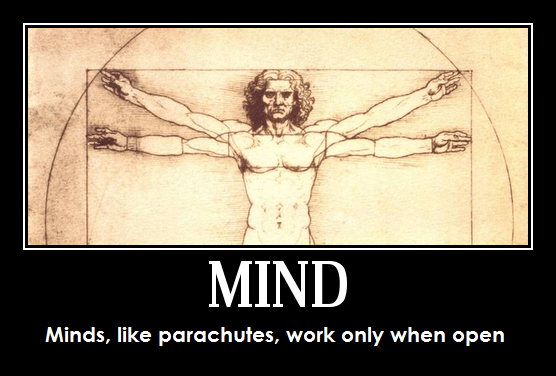
In today’s post I will be talking about being open-minded at the gemba. I heard a wise saying;

“Minds, like parachutes, only work when open.”

parachute

I am sometimes guilty assuming that I know completely about the matter at hand – that I am an expert. I would be at the gemba and instead of listening to the operator talk, I would be talking to the operator, and trying to find solutions on my own. This type of thinking results in three things;

  • I am not respecting the operator or his expertise by not being open to his suggestions. The operator is truly the expert since he has been doing this, day in and day out.
  • By rushing to solutions, I am wasting the opportunity to develop the operator. By providing the solutions, I am taking away the privilege for the operator to think and come up with solutions.
  • I may not get his buy-in for what I am planning on implementing. Things will go back to the way they were once I leave that area.

Being an “expert” makes one close minded. It puts the blinders on for the person, and prevents them from seeing the whole. There is another side effect to being an “expert”. You become very comfortable at something and will not want to steer away from your comfort zone.

I have been reading books by Bruce Lee, the famed martial artist. Apart from being a great martial artist, Bruce was also a deep thinker. He talked about the great analogy of a cup that is applicable to this post:

“The usefulness of a cup is that it is empty.”

If a cup is not empty, it is not useful. The emptier the cup, the more useful it is!

Ohno and Experts:

Taiichi Ohno used to say that experts are not good for kaizen. “They would just get in the way”, he said. Ohno’s point about this statement is that experts would not be open to going outside their comfort zones, and they would not allow others to speak or be open to their ideas. Kaizen needs for you to be outside of your comfort zones. Comfort zones are the playgrounds for status-quos. This is against the spirit of kaizen.

In Toyota, there is a great concept called “chie”. Chie stands for “wisdom of experience”. If experience equates to expertise, then chie equates to wisdom that comes from experience. Toyota views their production system as a “Thinking Production System”. Toyota’s goal is to increase chie of all their workers so that their thinking leads to improved processes and this ultimately improves Toyota altogether. This type of thinking is against “experts” on the floor. Experience may result in improved efficiency, however this does not equate to improved effectiveness.

Final Words:

This post is more a reminder for me to be open minded at the gemba, and to listen to the operator, and to encourage them to ask questions and come up with solutions. This allows for developing the operator. This also allows you to learn from the operator as well. I will finish off with a short story from Leo Tolstoy about someone who thought he was an expert:

There once were three hermits on a remote island. They were known in the region for performing miracles. They were very simple, and did not know complicated prayers. The only prayer they knew was “We are three, Thou art Thee, have mercy on us.” 

One day the local bishop came to hear about the three hermits and their prayer. He thought to himself that he should pay them a visit so that he can teach them prayers that were “more correct”.

He arrived at the island and taught them the “state of the art” prayers. The three hermits recited the prayers after the bishop. The bishop was quite pleased with himself. He bid them good bye and left. His boat was sailing away from the island. It was getting dark. The bishop looked back at the island, and saw a radiant light slowly approaching the boat from the direction of the island. To his surprise, he saw that the three hermits were holding hands and running towards the boat, over the water.

“Bishop, we have forgotten the prayers you taught us”, they said, and asked him if he would please repeat them.

The bishop shook his head in awe at the miracle he was witnessing. “Dear ones”, he replied humbly, “Please forgive me, and continue to live with your old prayer!”

Always keep on learning…

In case you missed it, my last post was The Opposite of Kaizen.

Kintsukuroi and Kaizen:

kintsukuroi_tunasima

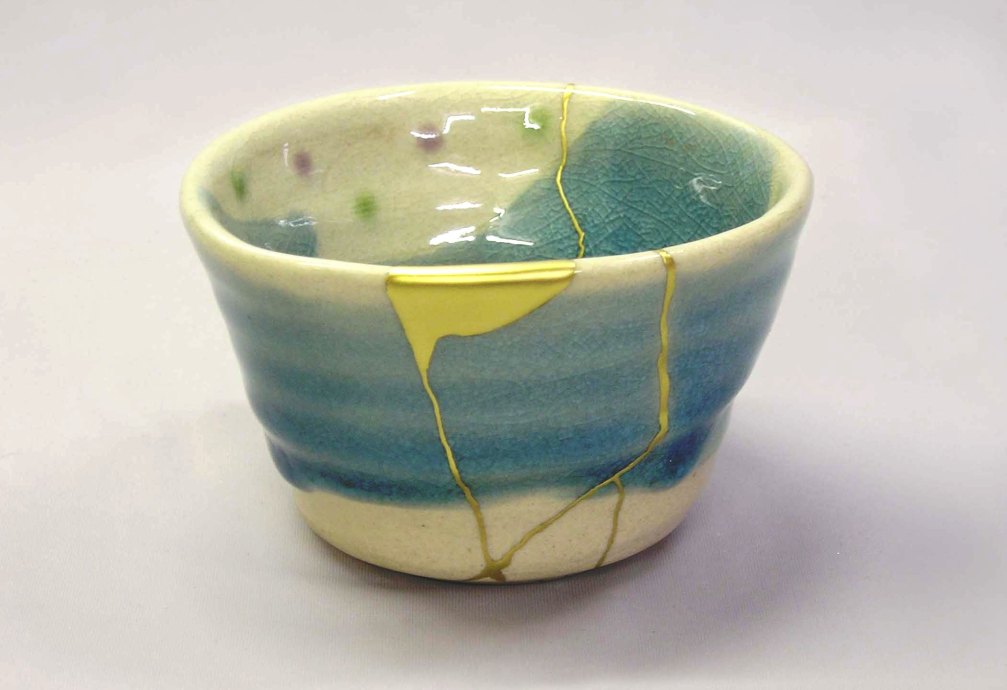
In today’s post, I will look at kintsukuroi and how it applies to lean. Kintsukuroi can be translated from Japanese as “to repair with gold”. This process converts broken ceramic pieces to beautiful art forms. The damaged piece is not thrown away, but is embellished by filling the cracks with a lacquer mixed with gold dust. The final product becomes more valuable than the original.

The Origin Story of Kintsukuroi:

There are several versions of the origin story.

Toyotomi Hideyoshi was a ferocious military ruler in Japan during the 1500’s. He was well known for his quick temper.

He hosted tea ceremonies which were well attended. He was particularly fond of a Korean Ido-style tea bowl. One day, a page handling the bowl accidentally dropped it and it broke into several pieces. Hideyoshi was furious at the page, and everybody feared for the poor page’s life.

One of the guests calmed the military ruler, and went away with the broken pieces of the bowl. He returned after a few days with a fully restored bowl that was “repaired with gold”. Hideyoshi was blown away by the beauty of the restored bowl, and he loved the repaired bowl even more. The repaired bowl was more valuable, more beautiful and became more cherished.

What can we learn from this?

I have been learning about Japanese culture for some time now and the concept of kintsukuroi fascinates me. The readers of my blog know that I enjoy connecting things together. I believe that the concept of kintsukuroi creates a new perspective on Kaizen.

As a lean leader, we should look at breaking the current process, and restoring it through process improvements (Kaizen). We are sometimes too close to the action that we fail to see the wastes in the process. We believe that the current process is adequate as is. We may not see opportunities to improve.

However, we should break apart the bowl, and restore it with gold. We should evaluate the process through the steps of ECRS:

  • Are there any steps we can Eliminate?
  • Are there any steps that we can Combine?
  • Are there any steps that we can Rearrange?
  • Are there any steps we can Simplify?

This is the basic idea of Kaizen. The new process should be more valuable than the old process, in that it has fewer wastes and it utilizes the available resources efficiently and effectively.

Each kintsukuroi process is unique. Similarly each process improvement activity is unique. One should understand the problem first and apply solutions. To understand the problem, one must break apart the process (bowl). Once the process is broken apart, one should utilize Kaizen thinking (gold lacquer mix) and put the process back together.

Always keep on learning…

If you enjoyed this post, you can read more here.

In case you missed it, my last post was What is my purpose?

What is my purpose?

purpose

Peter Drucker declared in his 1954 book “The Practice of Management” that the purpose of a business is to create a customer. In today’s post I will talk about purpose, specifically what do I think my purpose is at work? There is of course the utilitarian answer about my purpose at work – to fulfill my job duties/responsibilities. However, fulfilling the job duties/responsibilities does not always complete my purpose.

The purpose is to create/increase value in anything I do:

Peter Drucker in the book “The Practice of Management” talks about understanding customers. He notes that the manufacturer of gas kitchen stoves should not consider himself to be in competition with only other gas kitchen stove manufacturers. The customer is not just buying a stove. The customer is looking for the easiest way to cook food. There are many forms of stoves/utensils available to the customer that are in direct competition. There are several different ways to cook food including microwave ovens, cooking ranges, grills, etc. Ignoring them will result in loss of business. This example may be outdated. However, the core idea is applicable here. If you are simply fulfilling just your basic job duties/responsibilities, you are like the gas stove manufacturer. You will not grow and develop yourself if you just stick to your defined duties/responsibilities and you will eventually get passed by.

Your purpose is to create/increase value in anything you do. From a Toyotayesque philosophy, this is similar to the Continuous Improvement attitude. You are always trying to improve what you are doing. You are expanding your boundaries and you have a responsibility to develop yourself. One of the two pillars for the Toyota Philosophy identified in the Toyota Way 2001 is “Continuous Improvement”. The first key concept for “Continuous Improvement” is the “Spirit of Challenge”. In Jeffrey Liker’s “The Toyota Way to Lean Leadership”, Liker talks about the Spirit of Challenge as follows;

“Like the two founding Toyoda family members, every Toyota leader is expected not just to excel in his current role but to take on the challenges to achieve a bold vision with energy and enthusiasm.”

toyotaway_img01

The two Toyoda family members are Sakichi Toyoda and Kiichiro Toyoda. I have referenced them in my last two posts. It is likely that Liker meant every Toyota employee when he said Toyota leader. This type of thinking is instilled from an organization standpoint. To quote Peter Drucker again;

“Most people need to feel that they are here for a purpose, and unless an organization can connect to this need to leave something behind that makes this a better world, or at least a different one, it won’t be successful over time.”

Toyota has a core concept of True North. True North is your ideal state. You can never truly achieve this. However, it is your responsibility to strive moving towards your True North.

Final Words and a story on purpose:

I am a firm believer of taking responsibility and authority to do the right thing, and to develop yourself. One must always try to increase/add value in what they do. Increasing value in what you do ultimately increases your value. This is the Spirit of Challenge. This is your inner purpose.

I will finish off with an anecdote, I heard from the Indian author Shiv Khera (in his words).

16 years ago in Singapore I gave a taxi driver a business card to take me to a particular address. At the last point he circled round the building. His meter read 11$ but he took only 10.

I said Henry, your meter reads 11$ how come you are taking only 10.

He said Sir, I am a taxi driver, I am supposed to be bringing you straight to the destination. Since I did not know the last spot, I had to circle around the building. Had I brought you straight here, the meter would have read 10$. Why should you be paying for my ignorance?

He said Sir, legally, I can claim 11$ but ethically I am entitled to only 10. He further added that Singapore is a tourist destination and many people come here for three or four days. After clearing the immigrations and customs, the first experience is always with the taxi driver and if that is not good, the balance three to four days are not pleasant either. He said Sir I am not a taxi driver, I am the Ambassador of Singapore without a diplomatic passport.

In my opinion he probably did not go to school beyond the 8th grade, but to me he was a professional. To me his behavior reflected pride in performance and character. That day I learnt that one needs more than professional qualification to be a professional.

Always keep on learning…

In case you missed it, my last post was Toyota Production System House – Just-in-Time (JIT) and Jidoka (Part 2).

Innovation and Kaizen are not oil and water:

main

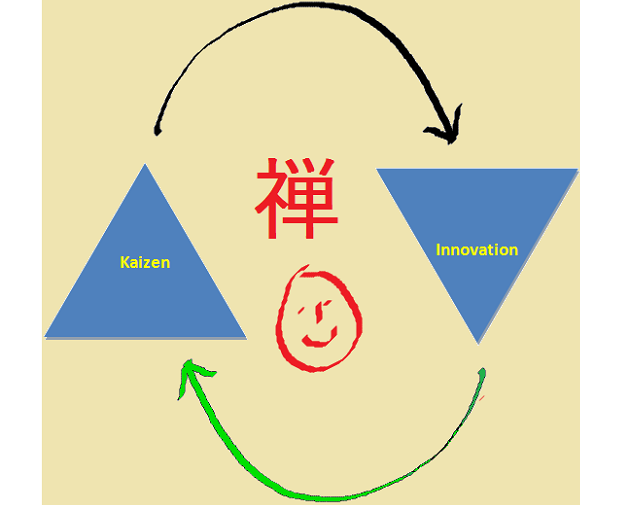
Kaizen is likely the most used Japanese word in the world of manufacturing. Kaizen simply means to improve for better. The “zen” part of Kaizen is not the same as the commonly known word “Zen”.

zen = virtue or good

Zen = literal meaning is “meditation”. This Japanese word has roots in the Sanskrit word “dhyan”.

It is quite possible to achieve Zen through kaizen. 🙂

This post is about the relationship between kaizen and innovation. Kaizen is often described as continuous improvement through small changes while innovation is described as a big change, or a complete breakthrough. The current paradigm is completely destroyed. From afar, these two concepts seem different – almost like oil and water.

What is the relationship between innovation and kaizen?

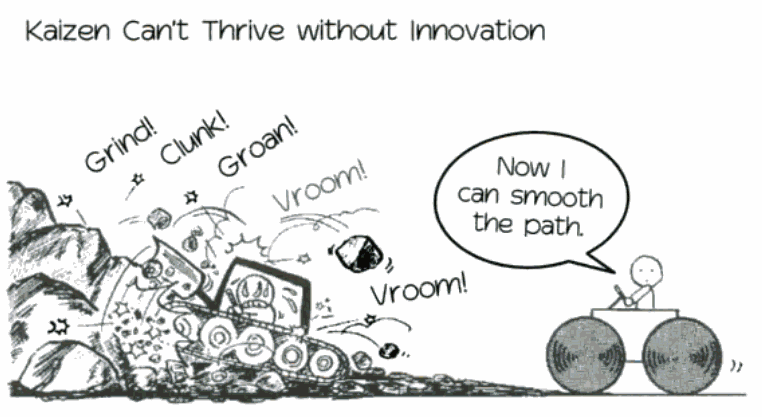
The book Kaizen Teian III (later published as The Improvement Engine) by the Japan Human Relations Association, states that kaizen cannot thrive without innovation.

This is an interesting concept – if kaizen is continuous improvement through small changes, how can a company stay competitive just by making minor improvements? The book describes innovation as a bulldozer cutting a path through a rough terrain. Improvement activities are described as a means to leveling the path cut by the bulldozer, and paving it into a smooth road!

KIFigure taken from Kaizen Teian III.

The book further states that there is nothing more wasteful than trying to activate a kaizen system in a company that is not engaged in innovation! Trying to clear a path in a rough terrain with a pick and shovel will not do when you competitors are using a bulldozer.

My thoughts:

What is the purpose of kaizen?

There are two objectives for kaizen;

  • Continuous improvement to make work better
  • Development of employees so they can be better at problem solving and developing others.

If kaizen can be described as a bottom-up process, then innovation can be described as a top-down process. You cannot move towards your ideal state (true north) without one or the other. You need both bottom-up and top-down forces to move towards your ideal state. They both create the perfect recipe for kaizen culture.

Always keep on learning…

In case you missed it, my previous post was about ESP and statistics.

How do I do Kaizen?

kaizen

Kaizen is most likely one of the most misused words in lean. There is a strong precedence in the lean community to call a “Kaizen Event” or “Kaizen Blitz” as “Kaizen”.

Kaizen just means incremental and continuous improvement towards the ideal state.

A Kaizen Event on the other hand, means generally a week long team-based rapid improvement activity. Thus, there is a definite start and a stop to Kaizen Events, making this almost an oxymoron since Kaizen implies a continuous and never stopping state. This post is about Kaizen and not Kaizen events.

A lot of people talk about the need for doing Kaizen. This post hopefully provides nuts and bolts on how to perform improvement activities. Please note that the first step for Kaizen is to nurture your employees so that they become aware of problems. This is a post for another day.

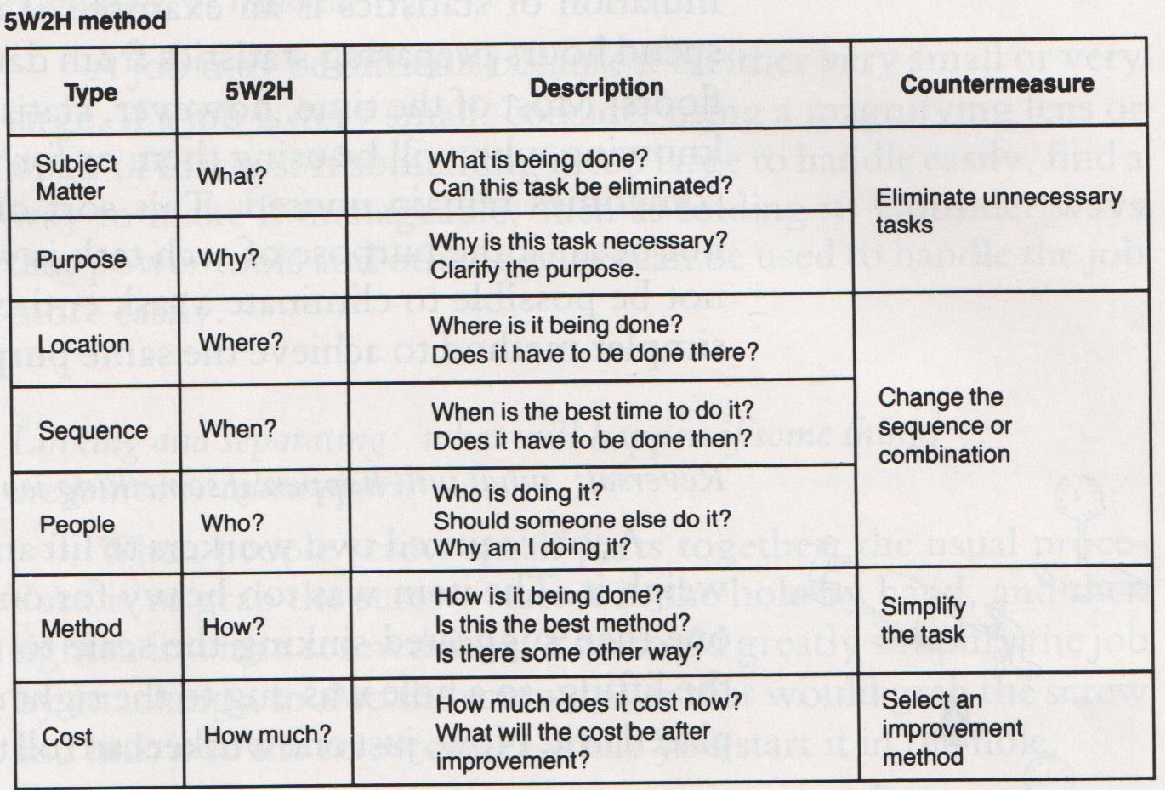
The following figure is taken from The Idea Book, edited by the Japan Human Relations Association (1980). The original title was “Kaizen Teian Handobukku” which roughly translates to “Kaizen through (Employee) Suggestions Handbook”. This figure shows how to approach improving your process. The right column is also known as the ECRS method. Going through these questions under the Description column and then following through the steps in the Countermeasure column is how one can improve a process.

tei

Figure 1 : How to Improve a process?

  • Eliminate Unnecessary Tasks: The ultimate improvement is eliminating a task altogether. The What and Why questions help us with this.
  • Combine the Steps: What are the steps that need to be done in series? Are there any steps that can be done in parallel? The Where, When and Who questions help us with combining steps to eliminate waste. Additionally, combining also reduces the number of discrete steps in the process.
  • Rearrange the Steps: Sometimes changing the sequence also allows us to take away waste from the process. The Where, When and Who questions help us with this. Can we do the current step# 3 before Step# 1? Is there any logic to the current sequence of steps? Can we rearrange to create a better sequence.
  • Simplify: Is there any task that can be simplified to make the whole process faster and better? Does the operator spend a lot of time trying to sort things or fumble with things? Can we ultimately simplify all the steps?

Please note that the steps are carried out in the order described above.

The reader should also be aware that the ECRS process and the questions have roots in USA’s Training Within Industry (TWI) movement that got started near the era that led to World War II. TWI was an emergency service by US to help nation’s war contractors and essential production. There was a need to produce a lot in a short amount of time, and this required training operators to be better within a short amount of time. C R Dooley, the Director of TWI, stated the following; “TWI’s objectives were to help contractors to get out better war production faster, so that the war might be shortened, and to help industry to lower the cost of war materials.

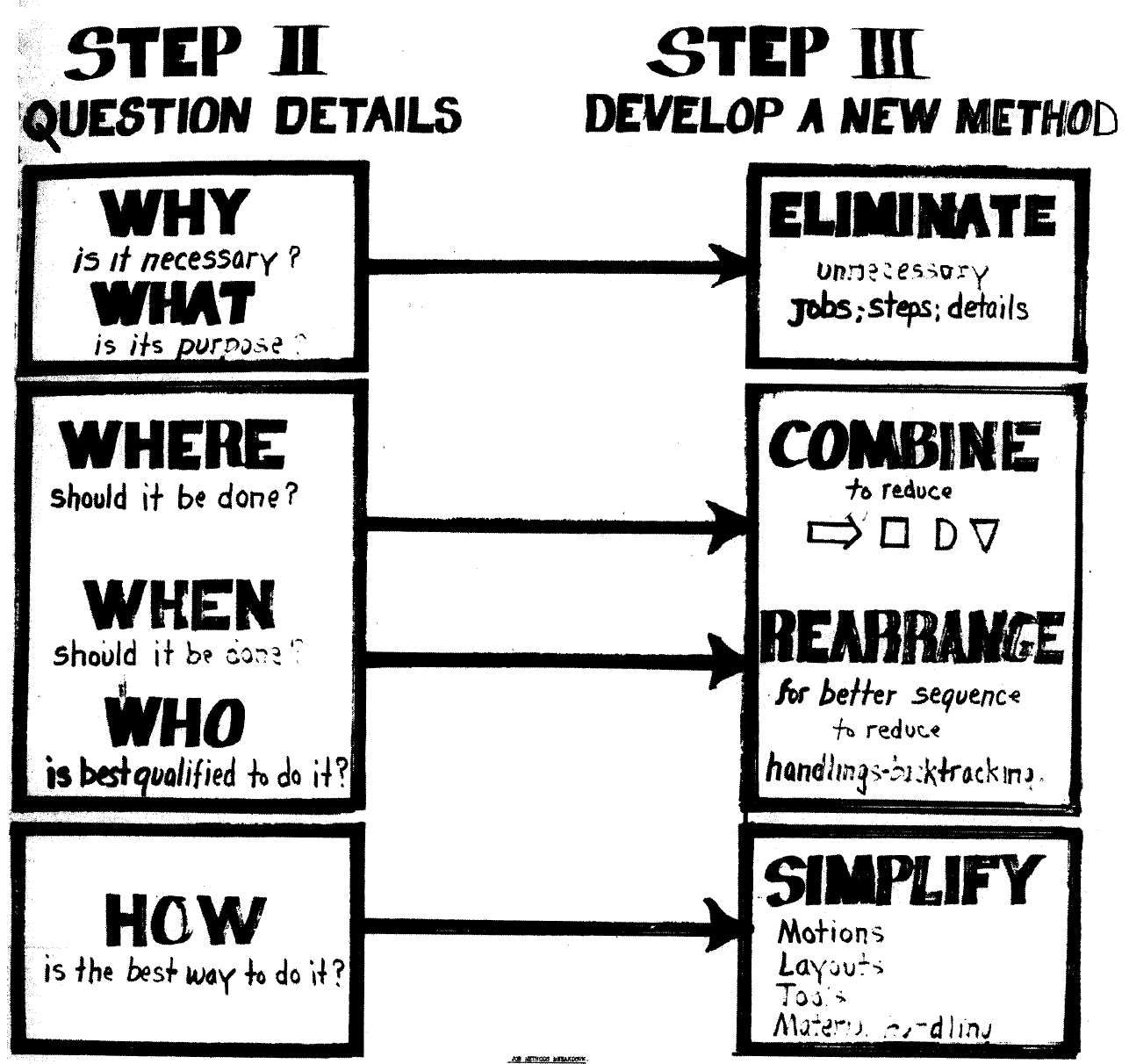
The following figure is taken from the Problem Solving Manual from TWI. The following is also part of Job Methods program.

psmanual

Figure 2: Steps 2 and 3 of Job Methods (TWI)

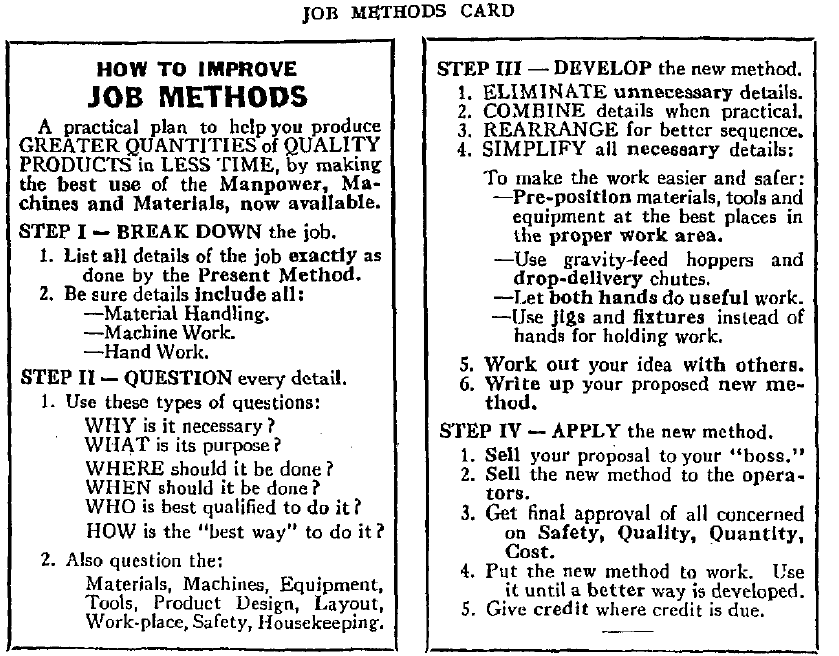
The following is a pocket card that was supplied as part of Job Methods program.

JMcard

Figure 3: Job Methods Card

A keen observer of the Job Methods can find the scientific approach of PDCA (Plan-Do-Check-Act) in it. Additionally, I would also like to bring attention to “Use the new method until a better way is developed” statement. This clearly shows that this is a continuous process.

I encourage the reader to study the Job Methods manual to get a better grasp. You can find a lot more about TWI here. http://chapters.sme.org/204/TWI_Materials/TWIPage.htm

As a side note, Toyota implemented the TWI programs in the early 1950’s. Surprisingly the first of the TWI programs that was dropped was the Job Methods program. This was replaced by Shigeo Shingo’s P-courses that added the Industrial Engineering elements to process improvement activities. Taiichi Ohno wanted to add the importance of takt time, Standard WIP, flow, and pull style production to the idea of Kaizen. (Source: Art Smalley, Isao Kato)

Nugget from the Problem Solving Manual:

The Problem Solving Manual from TWI also identified “Make Ready” and “Put Away” as “movements of material without definite work accomplishment”.

The manual also identified these as the “greatest opportunities for improvement”. It is also noteworthy that “Less than 50% of the total time is usually consumed by the ‘DO’ part of the job.” Current thinking is that the true value added activities equate to less than 5% of a general process that is untouched by any improvement activities.

value

Figure 4: Value (Problem Solving Manual)

Final Words:

Maybe it is ironic that I am going to use the introductory words of C R Dooley, the then Director of TWI, from the Job Methods manual as my final words for this post. You can clearly see the undercurrents of Respect for People and Kaizen in his words.

Most of the men with whom you will work have had years of experience. They have latent ideas which, if properly developed, will increase production, reduce lost time, prevent waste of material, and increase the use of machinery and equipment. These men command your respect because of their knowledge.

Always keep on learning…