
In today’s post, I want to clarify what it means to care as a human being and why that clarification matters for how we think about “systems”. This is a continuation of my previous post, in which I clarify the notion of “care” from a Heideggerian and existential standpoint. I hope this provides further food for thought for system thinkers.
We often speak of care as if it were a choice, a sentiment, or a moral stance that one may adopt. However, if we examine our lived experience more closely, we discover that care is not optional and that it is not something we add to life from the outside. It is the structure through which life shows up for us as meaningful in the first place. To say that we care is not to say that we are kind or benevolent. It is to say that the world already matters to us before we decide that it does. This is not a psychological observation about emotions. It is a clarification of the existential structure within which any emotion, evaluation, or decision becomes possible.
Care as the Structure of Involvement:
We do not first encounter a neutral world and then assign value to selected parts of it. We are always already involved. We wake into concerns, obligations, projects, relationships, unfinished tasks, and implicit expectations that were operative before we began reflecting on them. Even indifference is directed toward something, and even withdrawal is a response to what has already failed to meet our concern. Our lives are therefore not collections of isolated objects but structured fields of relevance within which certain things stand out as significant and others recede into the background.
Let’s consider some simple examples to make this concrete. The floor can trip us, a comment can embarrass us, a machine can fail us, and a relationship can wound us. None of these events are neutral occurrences to which we later attach meaning. They strike us because they intersect with something that is already at stake. Care names this condition of being exposed to what matters, a condition in which our projects, identities, and possibilities can be supported or undermined.
Thrownness – Finding Ourselves Already In Progress:
This exposure is not chosen. Heidegger referred to it as thrownness. We find ourselves already in a world that is underway, shaped by histories, institutions, languages, and practices that we did not select. By the time we begin asking who we are, we have already been formed.
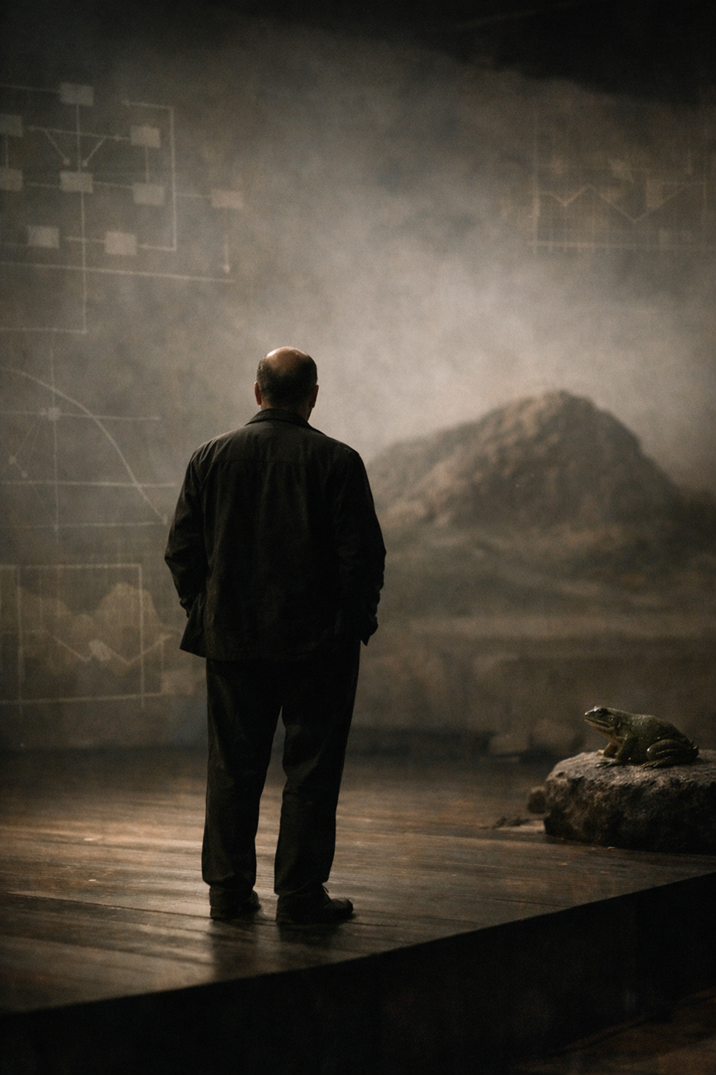
One way to grasp this condition is to imagine being placed under a spotlight on a stage where a play is already in progress. Other actors are speaking, the audience is present, and the plot has been unfolding long before we arrived. We have no script in hand, no rehearsal, and no complete understanding of the role we are expected to play, yet we cannot step off the stage or suspend the performance. We must respond within a scene whose conditions we did not author.
We are thrown into particular families, political orders, economic systems, and cultural expectations, and our responses both inherit and reshape what is already there. Care does not arise after this situation; it is what this situation feels like from within. It is the lived sense that something can go well or badly and that our participation matters.
Finitude and the Logic of Care:
Thrownness alone does not fully explain care. There is a deeper structural condition at work, namely our finitude. Our time is limited, our possibilities can close, opportunities can vanish, relationships can end, bodies can fail, and plans can collapse in ways that cannot always be reversed. The fact that our being is not guaranteed introduces weight into our decisions and seriousness into our commitments.
To clarify this, let’s imagine a being that is all-powerful, all-knowing, and immortal. Such a being could not be surprised, could not be overpowered, and could not ultimately lose anything irretrievably. No possibility would close permanently, no project would be exposed to final failure, and no decision would carry irreversible consequence. In such a condition, urgency would dissolve because everything could be deferred without cost. If nothing can be lost and no time limit constrains action, then nothing presses upon the being with genuine necessity.
Care belongs to creatures for whom something can go wrong and for whom time is not infinite. It emerges from exposure to loss, from the risk of non-being, and from the fragility of our projects. Finitude is not an unfortunate defect added to an otherwise complete existence; it is the condition that gives existence weight. We care because our possibilities are limited and because what we love, build, and pursue can be threatened or taken from us.
Anxiety and the Withdrawal of Meaning:
There are moments when the taken-for-granted coherence of our world loosens and the structures that normally guide us begin to feel uncertain. Projects that once seemed obvious lose their grip, and the background sense of stability that supports everyday action becomes less secure. This experience, often described as anxiety, does not simply signal fear of a specific object. It discloses the fragility of the meaningful framework within which our lives unfold.
In such moments, we recognize that our projects rest on no final guarantee and that the systems we inhabit are sustained only through ongoing commitment and coordination among finite beings. Meaning is not fixed in advance; it must be enacted and maintained. Care becomes visible precisely because what matters can withdraw, because the ground beneath our projects can shift, and because we ourselves are not permanent fixtures in the scene.
The Structural Tendency Toward Forgetting:
Although anxiety can disclose our condition, we do not live in constant existential intensity. Most of the time, we are absorbed in routines and roles that allow coordination to function smoothly. We rely on procedures, metrics, categories, dashboards, and models that stabilize expectations and guide action. This absorption is not a flaw but a practical necessity for collective life.
However, there is a structural tendency toward forgetting embedded in this stabilization. The structures that were originally created to respond to particular concerns can begin to conceal their own contingency. A model that once addressed a specific risk can come to appear as the world itself. A procedure designed to manage uncertainty can harden into inevitability. The “system” can present itself as though it were independent of the concerns and vulnerabilities that gave rise to it.
Let’s think about how this happens. Every “system” begins as a response to care. A policy is written because someone fears injustice or disorder. A metric is created because someone worries about waste or decline. A reporting structure emerges because coordination is fragile and failure is costly. These structures are attempts to stabilize patterns of concern under conditions of finitude. Over time, however, the origin of these structures recedes from view. Care crystallizes into durable forms, and those forms take on the appearance of objective reality.
When we forget this origin, the system appears neutral and self-sufficient. When we remember it, we see that what looks like neutrality is the sedimentation of past judgments about what matters.
Every System Is a Human System:
We often speak of “systems” as if they were external mechanisms that we observe from the outside, as if we could diagram them from a neutral vantage point. Yet every “system” is described from somewhere, and every model is drawn from within a field of concern shaped by thrownness and finitude.
Even the aspiration to objectivity is animated by care. The language of efficiency reflects awareness of limited resources. The language of safety reflects recognition of vulnerability. The language of growth reflects anxiety about stagnation or decline. Consider what this means in practice: when we choose to optimize for speed, we are implicitly saying that time matters more than some other dimension. When we prioritize safety, we are acknowledging that harm is possible and unacceptable. These are not neutral technical choices. They are expressions of what we care about.
The great cybernetician Heinz von Foerster emphasized that the observer is never fully separate from the system observed and that descriptions participate in the very processes they describe. He wrote:
The essential contribution of cybernetics to epistemology is the ability to change an open system into a closed system, especially as regards the closing of a linear, open, infinite causal nexus into closed, finite, circular causality.
Systems thinking is therefore circular in structure. We talk and think about “systems” because we care about certain outcomes, and those “systems” subsequently shape what we notice, measure, and prioritize. In this sense, every system is a crystallization of existential orientation. It stabilizes certain cares while marginalizing others, amplifies some signals while attenuating others, and renders some consequences visible while leaving others in shadow. To design a “system” is to formalize a pattern of care under conditions of limitation.
Boundary Judgments and Responsibility:
Boundary judgments, which determine what counts as relevant and what does not, are never merely technical decisions. Every boundary protects something and leaves something exposed. Every inclusion privileges a perspective. Every exclusion renders something less visible.
Consider a simple example: when we define the boundaries of a project, we decide which stakeholders matter, which outcomes we will measure, and which risks we will monitor. These decisions are made by finite beings trying to navigate a world that resists them. Responsibility is not an external addition to design but an acknowledgment that design is already an act of care structured by finitude.
We cannot step outside care in order to build a neutral system. Even indifference distributes concern elsewhere. To say that we do not care about one dimension is to care more about another. The question is never whether care is present. The question is how it is structured, and whose finitude it protects.
Systems Under Existential Exposure:
If every system is a human system, then systems thinking itself must remain exposed to the fragility it seeks to manage. We build structures to stabilize coordination, create procedures to reduce uncertainty, and develop metrics to guide action because without such efforts collective life would fragment. Yet no structure eliminates finitude, no optimization dissolves vulnerability, and no model exhausts the world it seeks to represent. The territory can still resist the map, time can still close possibilities, and loss can still occur.
To remember that every system is a human system is to remember that it rests on the shoulders of beings who were thrown into a scene they did not script and who will one day leave it. We design nonetheless, not because we are omnipotent, but because we care.
Final Words:
Systems thinking is not a technical escape from the human condition; it is one of its expressions. We build “systems” because we are vulnerable, we measure because we can fail, we optimize because resources are limited, and we coordinate because fragmentation threatens what we care about. The temptation is to imagine that better design will eventually free us from exposure, yet exposure is the source of design itself. If we were all-powerful, all-knowing, and immortal, there would be nothing to manage, nothing to protect, and nothing to lose.
We are finite beings improvising within an unfinished play whose beginning we did not witness and whose end we cannot avoid. In The Myth of Sisyphus, Albert Camus presents the image of a figure condemned to push a stone up a hill only to see it roll back down. He wrote:
The struggle itself toward the heights is enough to fill a man’s heart. One must imagine Sisyphus happy.
The incline does not disappear and the labor does not end, yet the task is not meaningless. It is lucid engagement with a condition that cannot be abolished. Systems thinking resembles this labor. We redraw boundaries knowing they are provisional, we optimize knowing conditions will shift, and we construct maps knowing the territory exceeds them. Finitude does not dissolve, but neither does care. In choosing to care lucidly and without fantasies of omnipotence, we do not escape the human condition. We inhabit it deliberately and responsibly.
Stay curious and Always keep on learning…
I highly recommend the NLM companion video for this post –
https://youtu.be/lxZcn33-NpM
If you liked what you have read, please consider my book “Second Order Cybernetics,” available in hard copy and e book formats. https://www.cyb3rsyn.com/products/soc-book
Note:
In referencing the work of Martin Heidegger, I want to acknowledge the deeply troubling fact of his affiliation with the Nazi party. This aspect of his life casts a long and painful shadow over his legacy. While I draw on specific philosophical ideas that I find thought-provoking or useful, this is not an endorsement of the man or his actions. Engaging with his work requires ethical vigilance, and I remain mindful of the responsibility to not separate ideas from the broader context in which they were formed.

 Harish's Notebook - My notes... Lean, Cybernetics, Quality & Data Science.