The Right Thing and the Right Reason:

In today’s post, I am exploring the notion of “doing the right thing.”

We encounter this expectation everywhere in workplaces, personal relationships, and civic life. The phrase appears in mission statements, performance reviews, and everyday conversations. At first glance, it feels simple and reassuring. Of course we should do the right thing.

In regulated industries, this mantra becomes even more clearly pronounced. Every procedure, every record, and every audit echoes that expectation. It appears in training sessions, quality policies, and compliance frameworks.

I want to add an important layer: do the right thing for the right reason.

The distinction may seem subtle, yet it initiates a reflexive turn. It moves us from mechanical compliance to ethical responsibility.

A statement by itself carries no value. “Do the right thing” means nothing until someone makes it their own. The phrase appears to describe a fact, but it actually expresses a value judgment. Value enters only when a person acts from conviction, not from blind obligation. The second part, “for the right reason,” is where responsibility begins. It asks a crucial question about why I am doing this. That question transforms an empty slogan into a deliberate act grounded in personal values.

If I follow orders or check boxes without reflection, I might appear to do the right thing. But in truth, I have surrendered ownership. From the perspective of cybernetic constructivism, meaning is not handed down from the outside. It emerges within the observer. As Heinz von Foerster showed in his work on observing systems, we do not simply receive reality but construct it through our interactions and decisions.

When we speak of “the right thing,” the phrase suggests precision, as if a decision could fit reality without error. In practice, this rarely happens. Thought and reality belong to different domains. A decision formed in thought appears complete because ideas do not encounter resistance until they are acted out. The flaws surface only when they meet real conditions.

This is the illusion of completeness in the right thing, the comforting belief that something can be fully correct. It persists because thought gives us a sense of closure that reality cannot guarantee.

Here is where the phrase “for the right reason” matters. It does not make the decision perfect; it acknowledges that it never was. Adding this second part challenges the belief in absolute correctness and invites humility about what we can know. It says you cannot guarantee the outcome, but you can own the reasoning. That ownership gives the action its integrity. The emphasis shifts from claiming completeness to accepting responsibility. This matters because it prevents us from confusing the clarity of thought with the complexity of life.

I want to focus on this more with a question: When the time comes, can I do the right thing? This question seems simple, but it hides a deeper issue. What exactly is the right thing? We often talk as if the right thing exists “out there,” waiting for us to discover, a fixed fact like the boiling point of water. But this assumes that what appears complete in thought will remain complete in practice. That assumption is an illusion.

In many situations, the right thing is not given. It is what von Foerster calls an undecidable.

The Nature of the Undecidable:

Von Foerster introduced this term for questions that cannot be answered by logic, rules, or computation alone. An undecidable resists algorithmic resolution. Regulations provide structure and consistency, and they are essential. Yet they do not eliminate undecidables. They never will.

Undecidables exist because the variety of real-world situations far exceeds what any rulebook can anticipate. In cybernetics, variety means the number of possible states a system can take. The more possible situations, the greater the variety. And the world does not just throw edge cases at us. It quite often generates entirely new scenarios. Each innovation, each unique user context, and every unexpected failure mode creates conditions no standard procedure can fully capture.

No rulebook, whether corporate policy or government regulation, can provide ready-made answers to every question. Rules may reduce some complexity and provide crucial guidance, but they cannot close the gap between their finite scope and the indefinite creativity of reality. That gap is where undecidables live, and where human judgment becomes indispensable.

Von Foerster put it clearly:

“Only those questions that are in principle undecidable, we can decide.”

This is not a logical contradiction. It is an ethical imperative. The undecidable is not an error to fix or a loophole to close. It is an invitation to take responsibility. And responsibility cannot be delegated to systems or rules.

Many people resist this truth. We want the comfort of certainty. We prefer to believe the right thing exists as a fixed point, like a law of physics. If that were true, we would not bear the weight of decision. But ethics begins where algorithmic certainty ends. When we say “Just tell me the rule,” we try to trade agency for comfort. And in doing so, we risk betraying the very principles we claim to uphold.

The uncomfortable insight is this: the right thing has validity only as something we decide and own.

A Practical Question:

In the medical device industry, when I encounter an undecidable, my first question is always:

“How does this help or hurt the end user?”

That question brings the undecidable into focus. Regulations cannot cover every nuance. They can only guide. The decision remains mine. The responsibility cannot be outsourced.

Doing the right thing for the right reason is not about perfection. It is not about moral grandstanding. It is about intentionality, the choice to act from internal commitment rather than external command. It is the courage to decide when certainty is impossible and when existing protocols do not apply.

Von Foerster understood this deeply. When he spoke of undecidables, he was not describing a flaw in logic or a failure of system design. He was describing the essence of ethical life: that there are decisions no one can make for us. This insight formed the heart of his second-order cybernetics, which places the observer and their responsibility at the center of any system.

The Ladder We Must Throw Away:

Here I must acknowledge an irony. In adding the phrase “for the right reason,” I am still using the word “right.” By doing so, I risk introducing the very assumption I wanted to question: that rightness exists as something fixed and pre-given. This reflects a pattern throughout the article, where language itself hints at the various complexities we grapple with in an attempt to grasp or cope with the external world.

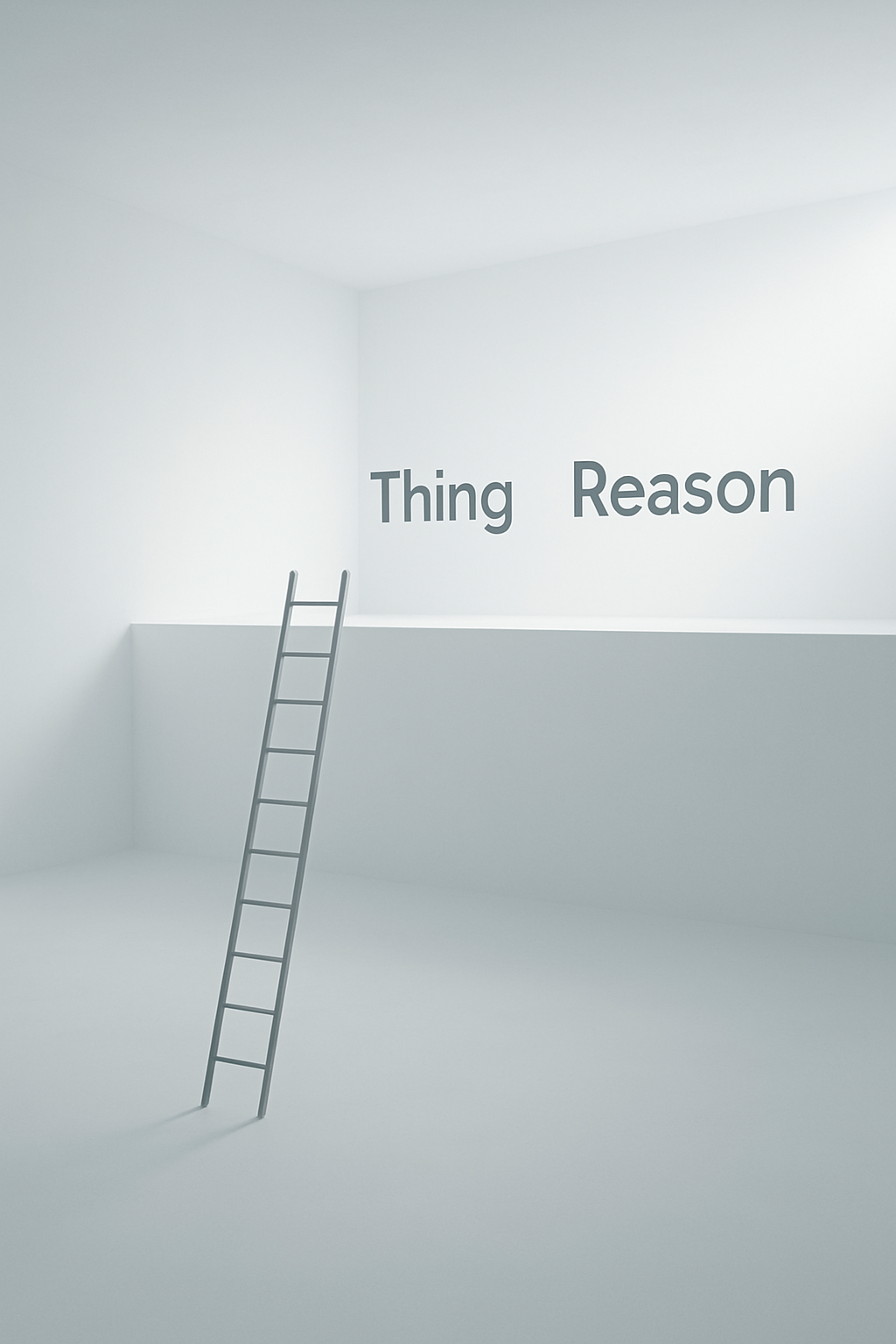
This is where Wittgenstein helps. In the Tractatus Logico-Philosophicus, he wrote that the propositions in his book were like a ladder. Once you have climbed it, you must throw it away. These propositions were tools, not eternal truths. They guide you to a vantage point, and then you move beyond them.

The phrase “do the right thing,” and even my expanded version, “do the right thing for the right reason,” works the same way. These are useful as orienting principles in regulated industries. They provide direction in moments of uncertainty. But if we cling to them as ultimate truths, we miss their purpose.

Like Wittgenstein’s ladder, their role is pragmatic and temporary. They guide us to a place where we can make responsible decisions. Once we understand that responsibility cannot be outsourced to a phrase or a rule, we can discard the ladder, not by abandoning the principle, but by letting go of the illusion that the phrase absolves us of thinking.

The deeper insight is this: the right thing does not exist as a given. It exists as something we must decide. And that decision, by its very nature, will always belong to us.

The next time you hear the phrase “do the right thing,” pause and ask:

What undecidable am I facing, and will I have the courage to decide it for the right reason, knowing that even the word “right” is only a ladder?

Final Words:

The tension between following rules and taking responsibility is not a flaw to fix. It is a fundamental condition of ethical life in complex systems. Von Foerster’s cybernetics teaches us that we cannot escape this tension by creating better rules or more comprehensive procedures. The variety of situations we face will always exceed the variety our systems can anticipate.

This does not diminish the value of regulations. They provide the backbone of responsible practice and create the conditions for ethical decisions. But they cannot substitute for judgment when the genuinely novel situation arises.

The courage to decide undecidables belongs to every professional who encounters the limits of the rulebook. When we recognize that meaning emerges within the observer, we are called to decide thoughtfully, with full awareness of our role in shaping the meaning of our actions.

This is neither comfortable nor easy. But it is the price of genuine ethical responsibility. The ladder remains useful until we no longer need it. The goal is to reach the place where we can make decisions worthy of the trust placed in us.

Always keep on learning…

If you enjoyed this post and find my work valuable, I would appreciate your support. You can explore more of my ideas in my latest book, Second Order Cybernetics, Essays for Silicon Valley, hard copy available at the Lulu Store.

A Good Enough Post:

In today’s post, I am exploring the notion that viability depends on our capacity for action, and that this capacity may not entirely rely on having a perfect grasp of “Truth.” This possibility, drawn from evolutionary theory, invites us to reconsider a deeply rooted assumption in human thought: that knowledge aims to reflect the world as it is. Perhaps organisms do not carry mirrors of an objective environment. Perhaps they generate workable patterns that allow action. If so, truth in the sense of full correspondence might be not only unnecessary for survival but impossible to achieve.

This shift from truth to adequacy might be more than a semantic difference. It suggests we could reconsider how perception, cognition, and action evolve under the pressure of complexity. Our nervous systems may not have emerged to catalog every detail of reality. They might have emerged to enable viable engagement. They filter, reduce, and transform. They make the unmanageable manageable. This economy of attention could be what allowed life to persist in an environment whose complexity always exceeds the capacity of any single organism.

The Evolutionary Logic of Selective Attention

The earliest organisms had comparatively simple structures. Their survival depended on detecting a few vital differences: light and dark, motion and stillness, hunger and satiation. These differences were not representations of reality in its full richness. They were pragmatic distinctions, selected by evolution because they mattered for survival.

As ecosystems diversified, so did the organisms within them. Greater complexity in the environment favored organisms with richer internal structures. These structures allowed them to absorb more variety and generate more flexible responses. But this expansion had limits. No organism could ever match the full complexity of its environment. Every adaptation remained selective.

Yet evolution’s relationship with cognitive economy appears more nuanced than simple efficiency maximization. Many organisms maintain seemingly “wasteful” capacities (elaborate plumage, complex social behaviors, or redundant sensory systems) that prove crucial during rare but catastrophic events. This apparent contradiction might reveal something deeper. Evolution does not eliminate selectivity; it shapes what gets selected and how. The peacock’s tail represents a different kind of cognitive economy, one that trades metabolic efficiency for reproductive advantage. Even redundancy involves choices about what to duplicate and what to ignore.

Here we see why the word “better” seems always contextual. An organism appears better only in relation to its ecological niche and temporal horizon. There may be no universal scale of improvement. Adequacy appears always local, contingent on the demands of the situation, and provisional across time scales.

The Law of Requisite Variety and Regulatory Challenges

This principle finds a formal expression in W. Ross Ashby’s Law of Requisite Variety: only variety can absorb variety. A regulator must have as much variety in its responses as exists in the disturbances it faces. If the environment can vary in ten ways and the organism can respond in only five, some disturbances will remain unchecked, threatening viability.

Ashby’s law applies specifically to regulatory systems maintaining homeostasis, but its insights extend to cognitive systems facing similar challenges. Both must manage variety mismatches between their internal organization and environmental complexity. Yet matching variety does not mean copying the environment. No finite system can track every detail. Instead, regulation depends on attenuation and amplification. Organisms attenuate the vast variety of the environment into a reduced set of distinctions. They amplify the significance of certain cues to prioritize action.

This does not seem to be a flaw in design. It might be a condition of survival. The key point is this: attenuation may not be about discovering truth but about achieving functional adequacy within specific contexts and time frames. And here is a critical implication – what works today may fail tomorrow. Adequacy is dynamic because the variety we face today may not be the variety we face tomorrow. If we are not able to adapt to new disturbances, viability collapses. Our current struggle to integrate artificial intelligence into the workplace illustrates this point. Many organizational models were built on assumptions of human exclusivity in cognitive labor. Those assumptions worked for decades. Today, they are brittle because the environment has changed. Ashby’s law prevails.

The Shortcut Analogy: Logarithms and Cognitive Compression

To appreciate the elegance and risk of attenuation, consider a good enough historical analogy. Before the age of electronic calculators, navigation and astronomy depended on logarithmic tables. Multiplying large numbers was time-consuming and error-prone. Logarithms offered a remarkable shortcut: turn multiplication into addition. By converting numbers into their logarithmic values, sailors could compute distances and bearings quickly, reducing the cognitive load of calculation.

Crucially, these tables were extremely accurate within their domain of application. Lives depended on precise calculations, and navigators understood both the power and limitations of their tools. They built in multiple redundancies and cross-checks. This compression did not deliver the full detail of multiplication, but it delivered enough precision for safe passage across oceans when used with appropriate awareness of its boundaries.

Our minds seem to prefer operating in a linear way. Sequential thinking appears natural most likely because it proves cognitively economical. It reduces overwhelming complexity to manageable sequences we can follow. Like logarithmic tables, our conceptual frameworks trade completeness for efficiency. They allow us to act without drowning in detail. But there is an important difference. It is that logarithmic tables are mathematically precise within their defined limits. Human cognitive shortcuts however are bias-prone and culturally shaped, and they rarely come with warning labels. When we mistake our tools for the territory itself, the cost becomes invisible. Information is lost. Subtleties disappear. And when the environment changes, what once worked can become dangerous. This is the paradox: what enables us to cope also constrains what we can see. Our abstractions could be both our superpower and our vulnerability.

Pragmatism and Cybernetic Constructivism

This brings us to the philosophical dimension of the topic. Pragmatism, particularly as articulated by William James and John Dewey, treats knowledge as a tool for action rather than a mirror of reality. A belief is “true” not because it corresponds to some ultimate fact but because it proves useful in guiding behavior within a specific context. Truth is redefined as what works, but this “working” must be understood across multiple time scales and contexts. Adequacy is not fixed. It requires constant revision as the environment shifts.

This is not a license for arbitrary belief or wishful thinking. Pragmatic truth remains constrained by consequences. A bridge designed on faulty engineering principles will collapse regardless of the designer’s confidence. A medical treatment based on wishful thinking will fail regardless of the practitioner’s intentions. The pragmatic test is whether our frameworks enable effective action in the world as it actually responds to our interventions. Reality provides feedback, even if we cannot access it directly.

Cybernetic constructivism shares this orientation. Heinz von Foerster reminds us that “the environment contains no information”. What we call information arises in the interaction between an organism and its surroundings. The world does not impose meaning; meaning is enacted. Maturana and Varela describe this as structural coupling. Organisms and environments co-determine each other through ongoing interactions.

Seen in this light, our nervous system does not passively record inputs but brings forth distinctions through its own organization, maintaining coherence in continuous interaction with its surroundings. Knowing becomes an adaptive dance rather than a passive recording. The goal is not to represent an independent world but to maintain viability within a world that is partially brought forth by the act of knowing. This does not mean stability is irrelevant. Reliable patterns of interaction matter. Some regularities can be engaged in ways that allow prediction and engineering. Scientific methodology succeeds not because it removes simplification but because it manages it systematically, using feedback processes such as replication and peer review to adjust and refine adequacy over time and in a social realm.

The Double-Edged Sword: Superpower and Kryptonite

The ability to compress complexity seems to have made life possible. Yet this same ability becomes dangerous when compression becomes rigidity. When abstractions are treated as final truths, systems lose their capacity for adaptation. Stafford Beer captured this danger when he observed that ignorance becomes “the lethal attenuator”. When we lose track of what our simplifications exclude, adequacy transforms into vulnerability.

Let’s look at some examples. The use of algorithms in hiring often reduces the complexity of human potential to a few simplified metrics, which can perpetuate bias. Climate models, although highly advanced, still miss certain feedback loops and critical tipping points. Social media recommendation engines compress human interests into engagement-focused categories, which can push users toward more extreme views by filtering out moderating influences. This is evident in the world nowadays.

Heinz von Foerster reminded us that although the map may not be the territory, the map is all we have. Our ways of making sense are always partial and limited, yet they are the only tools we can use to navigate complexity. Recognizing this helps us remain aware of our cognitive blind spots.

In each case, the problem is not the use of shortcuts but forgetting their limits combined with insufficient feedback. The map is never the territory. When we mistake our ways of making sense for reality itself, fragility follows. What helps us stay viable can also make us blind.

Ethical Implications: What Do We Choose to Ignore?

If we accept that knowledge is constructed for adequacy, not truth, then the question of responsibility becomes unavoidable. Every act of attenuation involves a choice about what to include and what to ignore. These choices shape not only individual survival but collective futures.

In social systems, ignoring complexity can marginalize voices that do not fit dominant abstractions. In technological systems, it can produce biases that perpetuate injustice. The ethic of constructivism is not to abandon simplification (without it, we could not act) but to cultivate awareness of its costs and remain open to revision.

At the individual level, deliberate exposure to dissenting views, reflective journaling on hidden assumptions, and iterative sensemaking can help maintain cognitive flexibility.

We can restate Ashby’s law by saying that viability requires variety. A society that suppresses diversity of thought and perspective reduces its internal variety and becomes brittle in the face of unforeseen challenges. To design for resilience, we must design for plurality.

Final Words:

Survival does not seem to require perfect knowledge. It has required workable distinctions, compressed into forms that enable timely action. This logic of adequacy explains why our minds favor shortcuts, why linear thinking feels natural, and why abstraction is indispensable. Yet it also warns us that what we simplify to live by can, in time, limit what we live for.

The challenge, or more precisely the necessity, might be to balance economy with humility. To remember that our conceptual logarithms, like the tables once used by navigators, are tools for a journey, not the journey itself. They serve us best when we keep them provisional, open to correction, and sensitive to the richness they cannot capture.

Managing attenuation wisely is itself a complex adaptive challenge without simple solutions. It requires not just awareness of our limitations but active practices that surface hidden costs and maintain cognitive flexibility. It demands that we ask not whether our ways of making sense mirror reality, but whether they continue to support effective action in the conditions we now face, and whether we have ways to notice when they no longer do.

Engaging with complexity means getting better at being good enough, continuously. Our task is not to eliminate attenuation but to manage it wisely. And that begins with a question we often neglect. What do we choose to ignore, and how do we ensure that choice remains conscious, provisional, and responsive to feedback?

Always keep learning…

If you enjoyed this post and find my work valuable, I would appreciate your support. You can explore more of my ideas in my latest book, Second Order Cybernetics, Essays for Silicon Valley, hard copy available at the Lulu Store.

The Arbitrariness of Objectivism:

The readers of my blog might be aware that I appreciate the nuances of cybernetic constructivism. Cybernetic constructivism rejects the idea that we have access to an objective reality. It does not deny that there is an external reality independent of an observer. However, we do not have direct access to it. Additionally, the external world is more complex than us. As part of staying viable, we construct a version of reality that is unique to our interpretative framework. This takes place in a social realm, and error corrections happen because the construction occurs in the social realm.

Heinz von Foerster, the Socrates of Cybernetics, formulated two imperatives that provide insight into this framework. The first is the ethical imperative that states “act so as to increase the number of choices.” The second is the aesthetical imperative that states “if you desire to see, learn how to act.” I welcome the reader to check out previous posts on these concepts. This worldview supports pluralism, the idea that there can be multiple valid versions of reality. This emerges primarily because the external world being more complex than our cognitive apparatus, we maintain viability by constructing particular versions of reality rather than accessing reality directly.

Common Mischaracterizations:

A primary criticism I encounter involves misrepresenting this worldview as relativism or solipsism. Critics suggest that acknowledging multiple perspectives means that anything goes, or that nothing is shared between observers. This represents a caricature rather than a substantive critique.

Precision is necessary here. Some forms of relativism claim that all views are equally valid, including contradictory ones. In that model, if claim A asserts “only A is valid,” then relativism must also treat that assertion as valid. It has no mechanism for comparison or critique. The result is a flattening of all claims into mere equivalence, where strength, coherence, or context carry no weight.

Solipsism advances an even more extreme position. It claims that only one’s own mind is knowable, denying shared reality altogether. It discards the very possibility of meaningful intersubjectivity. No systems thinker, and certainly no pluralist, takes this position seriously.

Pluralism as a Distinct Position:

Pluralism is neither relativism nor solipsism. It does not claim all views are valid. Rather, it asserts that no view is valid by default. Pluralism insists that perspectives must be made visible, situated in context, and evaluated through dialogue. It resists automatic authority, including authority derived from its own assertions.

Consider what objectivism accomplishes by contrast. It selects a single claim and declares that only this claim is valid while all others are not. But on what basis does it make this selection? Often, no external justification is offered. The grounding remains internal, context-bound, or inherited, yet it is presented as if it were neutral, universal, and self-evident.

This selection process reveals a potential arbitrariness of objectivist claims. The view appears arbitrary because its assumptions may remain hidden from examination. Without transparent justification for why one view should be privileged, objectivism risks the appearance of arbitrariness. What presents itself as necessity may simply be preference in disguise. From a pluralist standpoint, this represents concealment rather than clarity.

The Paradox of Objectivist Authority:

Paradoxically, this form of objectivism begins to mirror the very relativism it claims to oppose. Relativism declares that all claims are valid, including any particular claim A. Objectivism declares that only claim A is valid while offering no method to interrogate why this should be so. Each approach shuts down evaluation through different mechanisms. Relativism dissolves differences into sameness. Objectivism excludes all but one view from consideration at the outset.

This dynamic reveal what objectivism risks becoming, not solipsism in the strict philosophical sense, but functional solipsism. When a worldview refuses to acknowledge its own perspective and denies legitimacy to all others, it ceases to see the world. It sees only itself, reflected and reinforced. This represents the erasure of other ways of seeing under the illusion that one’s own interpretative lens is the world itself.

The Hidden Nature of Objectivist Claims:

The danger of objectivism lies in its method: selecting a single view, designating it as truth, and treating alternatives as error, noise, or confusion. It dresses up a personal, historical, and situated position as universal and eternal. This approach is not more objective than pluralism. It is simply better concealed.

Frameworks that prioritize ontology over epistemology tend to overlook the epistemic humility that characterizes pluralism. When we claim to know what reality is before examining how we come to know it, we bypass the very process of inquiry that might reveal the limitations and situatedness of our perspective. This ontological presumption becomes particularly problematic when it denies its own epistemological foundations.

Pluralism does not collapse into solipsism. Objectivism risks this collapse precisely when it denies that it operates from a particular perspective. The refusal to acknowledge one’s interpretative framework does not eliminate that framework. It merely renders it invisible to examination.

Pluralism is not weakness, indecision, or relativistic drift. It represents a disciplined humility and a refusal to collapse complexity into certainty prematurely. It does not reject standards but demands that they be made visible, questioned, and held accountable to the context in which they arise.

Pluralism increases the space for dialogue, choice, and possibility. It reminds us that what we do not question becomes invisible, not because it is true, but because it hides within the taken-for-granted assumptions of our frameworks.

In a world increasingly polarized between loud certainties and quiet disillusionment, pluralism offers something increasingly rare: the courage to remain open, to ask how we know what we claim to know, and to stay in conversation with perspectives we might otherwise reject.

Final Words:

Not everything is permissible under pluralism. But no single view should escape questioning. The cybernetic constructivist position maintains that our constructions of reality emerge from our particular biological, cognitive, and social constraints. These constructions prove viable not because they correspond to an objective reality we cannot access, but because they enable us to navigate the complexity we encounter.

I will finish with a quote from Heinz von Foerster:

Objectivity is the delusion that observations could be made without an observer.

The task before us is not to eliminate the observer but to acknowledge the observer’s role in every observation. This acknowledgment does not lead to relativism or solipsism. It leads to a more rigorous understanding of how knowledge emerges from the interaction between observer and observed within particular contexts and constraints.

Always keep learning.

The Reality of Informationally Closed Entities:

In today’s post, I am looking at the idea of “informationally closed”. The idea of informational closure was first proposed by Ross Ashby. Ashby defined Cybernetics as a study of systems that are informationally tight. Ashby wanted cyberneticians to look at all the possibilities that a system can be in. Here the system refers to a selection of variables that the observer has chosen. Ashby noted that we should not look at what individual act a system produces ‘here and now’, but at all the possible behaviors it can produce. For example, he asked why does the ovum grows into a rabbit, and not a dog or a fish? Ashby noted that this is strictly related to information, and not energy:

Growth of some form there will be; cybernetics asks “why should the changes be to the rabbit-form, and not to a dog-form, a fish-form or even to a teratoma-form?” Cybernetics envisages a set of possibilities much wider than the actual, and then asks why the particular case should conform to its usual particular restriction. In this discussion, questions of energy play almost no part – the energy is simply taken for granted. Even whether the system is closed to energy or open is often irrelevant; what is important is the extent to which the system is subject to determining and controlling factors. So, no information or signal or determining factor may pass from part to part without its being recorded as a significant event. Cybernetics might, in fact, be defined as the study of systems that are open to energy by closed to information and control – systems that are information-tight.

Ashby’s main point regarding this is that the machine or the system under observation selects its actions from a set of possible actions, and this will remain the same until there is a significant event that causes it to alter the set of possible actions. The action of the system is entirely based on its structure, and not because an external agent is choosing that action for the system. The external agent is only triggering or perturbing the system, and the system in turn reacts. This idea of informational closure was further taken up by Humberto Maturana and Francisco Varela. The idea of “informationally closed” is a strong premise for constructivism – the idea that all knowledge is constructed rather than perceived through senses. They noted that as cognizant beings, we are informationally closed. We do not have information enter us externally. We are instead perturbed by the environment, and we react in ways that we are accustomed to. Jonathan D. Raskin expands on this further:

People are informationally closed systems only in touch with their own processes. What an organism knows is personal and private. In adhering to such a view, constructivism does not conceptualize knowledge in the traditional manner, as something moving from “outside” to “inside” a person. Instead, what is outside sets off, triggers, or disrupts a person’s internal processes, which then generate experiences that the person treats as reflective of what is outside. Sensory data and what we make of it are indirect reflections of a presumed outside world. This is why different organisms experience things quite differently. How Jack’s backyard smells to his dog is different from how it smells to him because he and his dog have qualitatively different olfactory systems. Of course, how Jack’s backyard smells to him may also differ from how it smells to Sara because not only is each of them biologically distinct but each has a unique history that informs the things to which they attend and attribute meaning. The world does not dictate what it “smells” like; it merely triggers biological and psychological processes within organisms, which then react to these triggers in their own ways. The kinds of experiences an organism has depend on its structure and history. Therefore, what is known is always a private and personal product of one’s own processes.

Raskin gives an example of a toaster or a washing machine to provide more clarity on the informational closure.

Maturana asserts that from the point of view of a biologist living systems are informationally closed–that is, things don’t get in and they don’t get out. From the outside, you can trigger a change, but you cannot directly instruct. Think of it as having a toaster and a washing machine. And, the toaster is going to toast no matter what you do. And, the washing machine is going to wash no matter what you do. And they both can be triggered by electricity. But the electricity doesn’t tell the toaster what to do. The toaster’s structure tells the toaster what to do. So similarly, we trigger organisms, but what they do has to do with their internal structure–including their nervous system–and the way it responds to various perturbations.

The idea of informational closure forces us to bring a new perspective to how we view the world. How are we able to know about reality? From a constructivism standpoint, we do not have a direct access to the external reality. What we can truly say is how we experience the world, not how the world really is. We do not construct a representation of the external world. This is not possible, if we are informationally closed. What we do is actually construct how we experience the world. As Raskin points out, the world is not a construction; only our experience of it is. Distinguishing experiential reality from external reality (even a hypothetical, impossible-to-prove-for-sure external reality) is important in maintaining a coherent constructivist stance.

All knowledge from this standpoint is personal, and cannot be passed on as a commodity. In constructivism, there is an idea called as the myth of instructive interaction. This means that we cannot be directly instructed. A teacher cannot teach a student with a direct and exact impact. All the teacher can do is to perturb the student so that the student can construct their personal knowledge based on their internal structure. Raskin notes – once people’s internal systems are triggered, they organize their experiential responses into something meaningful and coherent. That is to say, they actively construe. Events alone do not dictate what people know; constructive processes play a central role as people impose meaning and order on sensory data. 

The more interactions we have with a phenomenon, the better we can experience the phenomenon, and it aids in our construction of the stable experiential reality of that phenomenon. Repetition is an important ingredient for this. Ernst von Glasersfeld notes:

Without repetition there would be no reason to claim that a given experiential item has some kind of permanence. Only if we consider an experience to be the second instance of the self-same item we have experienced before, does the notion of permanence arise.

From this point, I will try to look at some questions that might help to further our understanding of constructivism.

What is the point of constructivism if it means that we cannot have an accurate representation of the real world? The ultimate point about constructivism is not about an ontological stance, it is about viability. It is about being able to continue to survive. All organisms are informationally closed, and they continue to stay viable. The goal is to fit into the real world. Raskin explains – the purpose of this knowledge is not to replicate a presumed outside world but to help the organism survive. In Cybernetics, we say that we need to have a model of what we are trying to manage or control. This “model” does not have to be an exact representation of the “system” we are trying to control. We can treat it as a black box where we have no idea about the inner workings of the system. As long as we are able to come up with a set of possibilities and possible triggers for possible outcomes, we can manage the system. A true representation is not needed.

How would one account for a social realm if we are informationally closed? If each of us are informationally closed, and our knowledge are personal, how we do account for the social realm, where we all acknowledge a version of stable social reality. Raskin provides some clarity on this. He notes:

Von Glasersfeld held that people create a subjective internal environment that they populate with “repeatable objects.” These repeatable objects are experienced as “external and independent” by the person constructing internal representations of them. Certain repeatable objects–those we identify as sentient, primarily other people–are treated as if they have the same active meaning-making abilities that we attribute to ourselves. Consequently, we are able to experience an intersubjective reality whenever other people respond to us in ways that we interpret as indicating they experience things the same way we do. Once again, this alleviates concerns about constructivism being solipsistic because people do relationally coordinate with one another in confirming and maintaining their constructions. 

For von Glasersfeld, it means that people construe one another as active meaning makers and consequently treat their personal understandings as communally shared when others’ behavior is interpreted as affirming those understandings. As I stated elsewhere, “when experiencing sociality or an intersubjective reality, we come to experience our constructions as socially shared to the extent that they appear to be (and, for all functional purposes, can be treated as if they are) also held by others”.

Each one of us construct an experiential reality of the external world. This external world includes other people in it. Our ongoing interaction with these people enhances and updates our own experiential world. We come to see the external world as a social construction. Our personal construction gets triggered in a social setting resulting in a social version of that construction. The more frequent and diverse interactions we get, the more viable this construction becomes. The other people are part of this experiential reality and thereby become cocreators of the social reality. In many regards, what we construct are not representations of the external world, but more a domain of constraints and possibilities. Making sense of the external world is a question about viability. If it does not affect viability, one may very well believe in a God or think that the world is flat. The moment, the viability is impacted, the constructions of the reality will have to adjusted/modified.

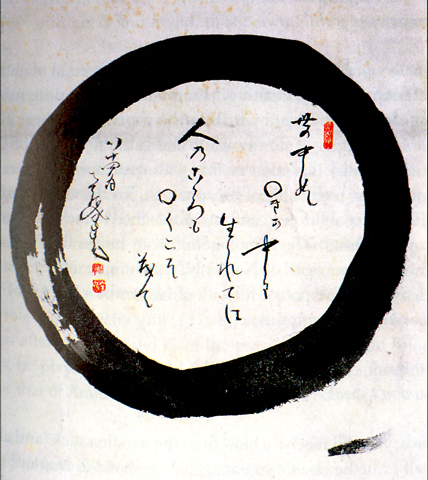
The image I have chosen for the post is an artwork by the Japanese Zen master, Nakahara Nantenbō (1839 – 1925). The artwork is a depiction of ensō (circle). The caption reads:

Born within the ensō (circle) of the world, the human heart must also become an ensō (circle).

Please maintain social distance and wear masks. Please take vaccination, if able. Stay safe and Always keep on learning…

In case you missed it, my last post was The Ghost in the System:

This post is also available as a podcast – https://anchor.fm/harish-jose/episodes/The-Reality-of-Informationally-Closed-Entities-e16ke0d

References:

  1. An Introduction to Cybernetics, Ross Ashby (1956)
  2. An introductory perturbation: what is constructivism and is there a future in it?, Raskin, Jonathan D. (2015)