The Two Dogmas of Complexity Science: How Our Best Tools Can Mislead Us

I borrow the term ‘dogma’ from W. V. Quine’s classic essay Two Dogmas of Empiricism, where he showed that unquestioned assumptions can quietly shape an entire field. Complexity science, too, rests on its own dogmas that deserve examination.

In today’s post, I want to explore what I see as two fundamental dogmas with how we think about complexity science. These dogmas are deeply embedded in our thinking, and they shape how we create tools, design interventions, and understand organizational life without us realizing it.

To explain these dogmas, let me use the chart of Ashby Space by Max Boisot and Bill McKelvey. It appears clean, scientific, and objective. The kind of visualization that makes the science feel rigorous and mathematical.
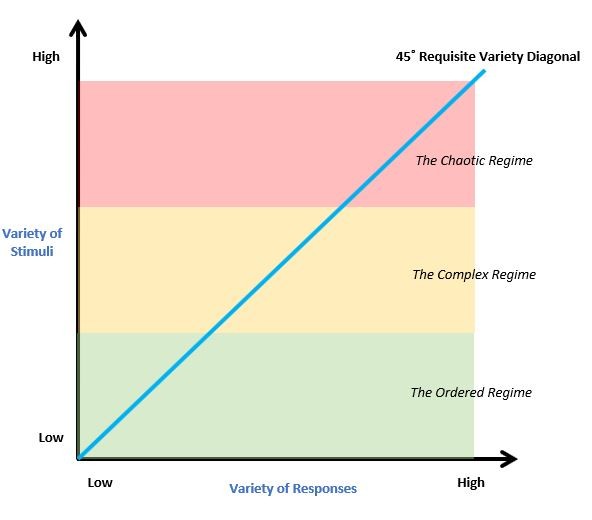
This framework comes from Ross Ashby’s Law of Requisite Variety. It maps organizational viability across different complexity regimes. It seems to offer clear insights. Systems in the ordered regime operate through routine procedures. Those in the complex regime require learning and adaptation. Those in the chaotic regime lose coherence when environmental variety exceeds their response capacity.

The 45° diagonal represents Ashby’s famous law. Only variety can absorb variety. Systems above this line face more environmental complexity than they can handle. Systems below it have excess capacity for response. From a conventional perspective, an organization might assess their position by measuring environmental turbulence against internal response capabilities. They might conclude they need to increase internal variety to match external complexity.

It is worth noting that Ashby himself understood variety as observer-dependent. His cybernetic work emphasized that distinctions are made by observers, not discovered in objective reality. The challenge arises when we operationalize such insights into frameworks and tools. What began as a nuanced understanding of observer-enacted variety becomes translated into seemingly measurable coordinates. This transformation from process to representation exemplifies the dogmas I want to examine.

This transformation reveals two fundamental dogmas that have shaped complexity science.

The First Dogma: Ontological Complexity Realism

The chart treats “variety of stimuli” as if it were an objective quantity that exists independently in the environment. It waits to be measured and plotted on the Y-axis. This reflects what I call ontological complexity realism. This is the belief that complexity is an intrinsic property of systems that exists regardless of who observes them.

Here lies the fundamental problem. Variety does not exist “out there” in any objective sense. What counts as variety depends entirely on the distinctions made by the observer or system. The environment does not contain variety. Variety emerges through the interaction between system and environment, mediated by the system’s capacity for making distinctions.

Let me give you a concrete example from healthcare. Is an emergency room “complex”? For a patient’s family member, the ER appears chaotic and overwhelming. Multiple alarms sound. Staff rush between rooms. Medical terminology flies around that they cannot understand. Life-and-death decisions happen at bewildering speed.

For an experienced ER physician, the same environment reveals familiar patterns. They recognize the rhythm of triage protocols. They understand the meaning behind different alarm sounds. They know the standard procedures that guide most interventions. The complexity is not inherent in the ER itself. It emerges from the coupling between the medical environment and each observer’s capacity for clinical distinction-making.

But this observer-dependence extends equally to the horizontal axis. What counts as “variety of responses” depends entirely on the distinctions the observer can make about available actions. The same ER situation reveals entirely different response repertoires to different observers.

The family member might see only binary options. Panic or wait helplessly. The nurse sees a rich array of possible interventions. The attending physician distinguishes even more nuanced response possibilities. The hospital administrator observes yet another set of responses. None of these response varieties exists independently in the situation. Each emerges from the specific capacity of the observer to make distinctions about what constitutes meaningful action.

John Dewey understood this when he argued that organism and environment must be understood as parts of a single transaction rather than separate things that interact. Traditional thinking assumes we have an organism “here” and an environment “there.” Then we study how they interact. But Dewey argues this separation is itself an artificial division that obscures the primary reality. The ongoing transaction between organism and environment creates experience itself.

The key insight is that stimulus and response are not external to each other. They are “always inside a coordination and have their significance purely from the part played in maintaining or reconstituting the coordination”. The stimulus is not something that happens to the organism from outside. It is something “to be discovered,” something “to be made out.” It is “the motor response which assists in discovering and constituting the stimulus.”

As Dewey puts it, “The stimulus is that phase of the forming coordination which represents the conditions which have to be met in bringing it to a successful issue. The response is that phase of one and the same forming coordination which gives the key to meeting these conditions”.

This transactional view transforms how we understand knowledge. Instead of a mind representing an external world, we have knowing as a mode of transaction between organism and environment. Knowledge emerges from this transaction rather than copying something pre-existing. This is not purely subjective nor purely objective, but relational.

Applied to complexity science, Dewey’s approach reveals why Ashby Space fails. The chart treats “variety of stimuli” and “variety of responses” as if they were separate, measurable quantities. But these are artificial divisions of the ongoing transaction between system and environment. There is no variety “out there” waiting to be counted. There are no responses “in here” waiting to be catalogued. There is only the ongoing transaction through which system and environment mutually specify each other.

The Second Dogma: Epistemological Representationalism

The chart presents itself as a neutral representation of complexity regimes. This embodies what I call epistemological representationalism. This is the belief that our task is to discover and measure pre-existing complexity through better methods and tools.

This dogma assumes we can create objective maps of complexity that correspond to how the world really is. The clean boundaries between regimes suggest we are mapping objective territory. The precise diagonal line suggests objective measurement. The measurable axes suggest neutral observation rather than conceptual construction.

But the moment you try to actually use this framework, its claims about objectivity break down. Where exactly would you locate a specific organization on these coordinates? How would you measure “variety of stimuli” independently of the system’s own distinction-making processes?

The chart cannot answer these questions because it treats as measurable quantities what are actually dynamic processes of distinction-making. It tries to map what can only be enacted.

Humberto Maturana and Francisco Varela’s work on structural coupling reveals why this approach fails. Living systems do not represent an independent environment. They enact their world through their structure and history of coupling. As Maturana put it, “everything said is said by an observer to an observer.” The boundaries we draw around “systems” and “environments” are distinctions made by observers, not features of an objective world waiting to be mapped.

The Fundamental Contradiction: Mapping the Unmappable

Here lies the deeper issue that cuts to the heart of what we mean by complexity itself. The very notion that complexity can be mapped contradicts the fundamental nature of what it means for something to be complex.

If something is indeed complex, it resists reduction to mappable coordinates. Complexity implies emergence, unpredictability, context-sensitivity, and observer-dependence. These are not accidental features that better measurement tools might eventually overcome. They are defining characteristics of complexity itself.

Yet the frameworks prevalent in complexity science attempt to do precisely what complexity theory tells us should be impossible. It tries to reduce emergent, context-dependent, observer-enacted phenomena to static, universal, objective coordinates. This creates a performative contradiction. We use the insights of complexity science to argue that phenomena are emergent and context-dependent. Then we immediately create tools that treat those same phenomena as mappable and context-independent.

The contradiction runs deeper still. If complexity truly emerges from the recursive coupling between observers and their domains of inquiry, then any attempt to create a universal map of complexity must necessarily fail. The observer drawing the map cannot step outside the epistemic coupling that generates the complexity in the first place.

Why These Dogmas Generate Persistent Puzzles

These two dogmas create persistent puzzles that are often ignored. The list below is not meant to be an exhaustive list at all.

The Expert-Novice Paradox Why do experts and novices see different levels of complexity in the same system? If complexity emerges from epistemic coupling, then of course they enact different complexities. They have different capacities for distinction-making.

The Measurement Tool Problem Why do different measurement tools reveal different complexities? If complexity is relational, then different tools necessarily enact different varieties by making different distinctions possible.

The Scaling Paradox Why does complexity seem to change when we shift between levels of analysis? Different levels of observation necessarily enact different complexities.

The Intervention Prediction Failure Why do interventions designed based on complexity mappings so often produce unexpected results? Because any intervention changes the observer-system relationship itself. This makes prediction inherently problematic.

These puzzles persist not because of inadequate methods. They persist because they are generated by the assumptions we bring to complexity science.

Beyond the Dogmas: Epistemic Coupling as Transaction

What if we abandoned these dogmas entirely? Instead of asking “How complex is this system?” we might ask this. “How does complexity emerge from the recursive interaction between this knowing system and its environment?”

This shifts focus from measuring pre-existing complexity to understanding epistemic coupling. The dynamic process through which systems and environments mutually specify each other through ongoing interaction. Complexity becomes not a property to be measured but a relationship to be understood.

This framework synthesizes insights from three traditions.

Dewey’s Transaction Theory Instead of separate entities that interact, we have organism-environment as a unified field. The “stimuli” and “responses” in Ashby Space are abstractions from this ongoing transaction.

Maturana and Varela’s Structural Coupling Living systems do not represent an environment but enact their world through their structure. The coupling between system and environment is the source of complexity.

Ashby’s Cybernetics Before the Law of Requisite Variety can even apply, an observer must create variety through distinction-making. The law cannot operate on raw reality. It requires an observer to carve up the world into meaningful categories.

This reinterpretation transforms Ashby’s contribution from a focus on objective regulatory mechanisms to an emphasis on the active and constitutive role of the knowing system in shaping the very “variety” it then seeks to regulate. Rather than discovering pre-existing variety that must be matched, systems participate in enacting the complexity they face through their own distinction-making capacities.

The Chart as Tool, Not Map

This does not mean frameworks like Ashby Space are useless. But we need to understand them differently. Not as maps of objective complexity regimes but as tools for thinking about epistemic coupling processes.

Used this way, the framework serves as what Wittgenstein called a ladder. Something we climb up to reach a new perspective, then kick away once we no longer need it. It helps us think more clearly about complexity without pretending to be complexity itself.

Final Words: Complexity as Participation

The chart looked so clean and objective at first. But complexity is messier, more relational, and more participatory than any representation can capture. That is not a limitation to be overcome. It is the very nature of what we are trying to understand.

Understanding complexity as epistemic coupling opens different possibilities. For designing systems that can remain coherent while staying open to surprise. For cultivating capacities for distinction-making that can expand as we encounter new varieties. For taking responsibility for the complexities we participate in creating.

Heinz von Foerster understood this when he formulated his ethical imperative. “Act always so as to increase the number of choices”. If we are responsible for constructing our realities through our distinctions, then we are also responsible for ensuring that others can participate in that construction.

The challenge is not to model the world but to participate in it more wisely. That participation depends fundamentally on understanding that complexity emerges from epistemic coupling. The recursive interaction between knowing systems and their domains of inquiry. This makes us responsible not just for our actions but for the worlds those actions help bring forth.

 I will finish with wise words from Quine:
No statement is immune to revision.

Stay curious and Always Keep on Learning…
The Art of ‘Somewhat’:

In today’s post, I am exploring Ashby’s Law of Requisite Variety and why it might be both more necessary and more slippery than most presentations suggest. Ashby’s Law might not be just another management principle. It could be a window into how we navigate complexity when the world refuses to be pinned down by our desire for certainty.

Stafford Beer once wrote something that might be more profound than it first appears:

Instead of trying to specify a system in full detail, specify it only somewhat. You can then ride on the dynamics of the system in the direction you want to go.

That word ‘somewhat’ could be carrying more weight than we realize. It might signal a kind of intellectual humility that most management theories avoid. It suggests that our relationship with complex systems is not one of mastery but of skillful navigation. Perhaps it is more like learning to surf than trying to control the ocean.

This brings us to Ashby’s Law of Requisite Variety, which is a simple statement. “Only variety can absorb variety.” This looks simple, clean, and mathematical. This is the kind of principle that promises hard tangible answers in a soft world. We need to attenuate excess external variety so that we focus on only the relevant variety, and we need to amplify our internal variety so that we can adequately respond to the external variety.

Let us look at the nuances of this law more.

Ashby’s Law tells us that a regulator can only control outcomes it can distinguish and respond to. If environmental disturbances exceed the regulator’s response capacity, some disturbances will pass through uncontrolled. This is presented as a logical necessity. It appears as inevitable as gravity.

And in one sense, it is. Given any finite set of regulatory responses, there will always be environmental states that cannot be adequately handled. Mathematics seems to be unforgiving. The logic seems to be airtight.

But mathematics operates within assumptions, and assumptions are where humans enter the picture. Most presentations of Ashby’s Law miss this. The law is simultaneously necessary and observer-dependent. It might be a constraint that applies absolutely, but only within the frames we construct.

The Indefinite World:

There is a distinction that might change how we see everything. The external variety is not infinite. It is something else entirely. It is indefinite.

Infinite means without limits. It is a mathematical concept that extends forever. Indefinite here means without defined limits. It requires someone to do the defining.

This might not be academic hairsplitting. It could be the key to understanding why Ashby’s Law feels both rock-solid and frustratingly slippery to grasp.

The world contains countless differences, but only some matter for any given purpose. Gregory Bateson captured this. “Information is a difference that makes a difference.” The same principle applies to variety. Variety is not a raw count of states “out there.” It is a relational property that emerges when an observer draws distinctions that serve a purpose.

Think about managing a parking lot as an example. How many “states” might this system have? If you only care about full or empty, there are two states. If you track individual spaces, there might be hundreds. If you include weather patterns, time of day, driver behavior, and maintenance schedules, there could be thousands. The world contains all these potential distinctions simultaneously. But variety for control purposes might depend entirely on which distinctions you choose to make matter.

This creates a fundamental tension. Ashby’s Law holds as a logical necessity. If your frame ignores differences that turn out to matter, your system will fail. But the application of the law depends entirely on how you frame the situation.

When Frames Collide with Reality:

The COVID-19 pandemic might have given us a natural experiment in how different frames handle the same underlying reality.

Some governments approached the crisis with what we might call a narrow medical frame. The pandemic was fundamentally a healthcare capacity problem for them. The focus was on hospital beds, ventilators, testing infrastructure, and transmission control. Their variety management attempted to attenuate viral spread while amplifying medical response capacity. From this perspective, lockdowns might be seen as a straightforward attenuation strategy, and field hospitals as variety amplification.

This frame had a certain elegant simplicity. The problem was clearly defined, the metrics were measurable, and the interventions had precedent in public health history.

But other governments adopted what we could call a broad socio-economic-health frame. From this perspective, the pandemic was not just a medical crisis. It might be a system-wide disruption that threatened social cohesion, economic stability, and political legitimacy simultaneously. Their variety management involved coordinated interventions across multiple domains. Public health measures, economic support packages, mental health services, educational continuity, and social solidarity initiatives.

Both approaches were tested against the same underlying reality. The virus did not care about our framing preferences. But the broader frame generally proved more viable because it might have acknowledged more of the variety that actually mattered for maintaining social stability during the crisis.

The narrow medical frame was not wrong in many regards. It might have been incomplete. It failed to account for economic disruption, compliance fatigue, mental health deterioration, and social unrest. When these unacknowledged varieties of disturbance began overwhelming the system, control failures cascaded in directions the frame could not anticipate.

This might be where Ashby’s Law reveals its true nature. The law did not prescribe which frame to use. It simply ensured that inadequate frames would reveal themselves through control failures.

The Observer Inside the System:

Here is where the story might deepen into something more complex than most management textbooks are comfortable acknowledging.

Traditional cybernetics, what we might call first-order cybernetics, treats the observer as outside the system being controlled. From this perspective, variety could be objective. You count the states, build matching responses, and apply the law mechanically.

But second-order cybernetics recognizes something that might be more unsettling. The observer is always inside the system. The regulator is part of what is being regulated. Variety is not given. It might be constructed through distinctions that reflect purpose, context, and the observer’s own limitations.

This might mean Ashby’s Law operates at two levels simultaneously. At the operational level, your responses must match the variety you have acknowledged as relevant. If you identify ten types of disturbances, you might need at least ten different responses. This could be the familiar version of the law.

But at a deeper level, your capacity to make useful distinctions must itself be adequate to the situation’s demands. If your frame excludes crucial differences, operational control might fail regardless of how well you handle the differences you do recognize.

The law does not fail when you frame poorly. Your framework fails. The law simply describes what happens when your variety is inadequate, regardless of whether that inadequacy comes from poor responses or poor framing.

Back to Riding the Dynamics:

This brings us back to Beer’s insight about specification. If the world might be indefinite rather than infinite, if variety could depend on the distinctions we draw rather than existing independently, then total specification becomes not just impossible but potentially counterproductive.

The goal is not to capture all possible variety in advance. It is to develop the capacity to recognize when your current framing is failing and to generate alternatives before failure becomes catastrophic.

This reflexivity can be viewed as a type of variety amplification. Instead of just amplifying operational responses, we can amplify our capacity to reframe situations when current framings prove inadequate.

What might this look like in practice? Running scenario exercises that stress-test your assumptions. Monitoring for weak signals that could indicate emerging types of disturbance your current frame does not recognize. Institutionalizing checkpoints where teams question basic premises. Building relationships with people who might frame problems differently.

These are not just theoretical exercises but insurance policies against the kind of frame failure we saw in the early pandemic response.

The Paradox of Precision:

Here is something that might bother us about how Ashby’s Law is usually presented. It gets dressed up in mathematical clothing similar to formal models, game theory, Bayesian analysis, etc. These might make the approach feel objective and precise.

But precision might be exactly what we need to be suspicious of. Those models feel rigorous because, once you set the assumptions, the math is unforgiving. But who might define the players in your game theory model? Who sets the priors in your Bayesian analysis? Who decides what payoffs could matter?

Those are framing decisions. Ashby’s Law might apply before your math begins. If your framing excludes relevant variety, even perfect calculations could fail when they meet reality.

The law might remind us that objectivity begins after assumptions are set, but assumptions are never neutral. They could reflect purpose, context, and the inevitable limitations of the framers.

Living with Indefiniteness:

All this might be making the reader wonder… Are we condemned to relativism, where any frame could be as good as any other?

The answer in my opinion is – Not quite. The test of a frame might not be whether it is objectively true. That is not necessarily available to us. The test is whether it enables viable action in pursuit of purposes we care about.

This provides a practical discipline. You cannot retroactively change your frame to explain away failure. Either your original frame enabled adequate control or it did not. The test could be prospective viability, not post-hoc rationalization.

And frames do get tested. Reality pushes back. Systems fail in ways that might reveal the blind spots in our framing. The pandemic was particularly instructive because it tested everyone’s frames simultaneously against the same underlying dynamics.

The countries that performed best were not necessarily those with the most resources or the smartest experts. They might have been those with the most adaptive framing capacity. The ability to recognize when initial approaches were not working and to generate alternatives. It also means the ability to use multiple approachesinstead of adhering to one or the other. Variety gives you the grip needed to grasp the situation to manage it.

The Art of Somewhat:

Which brings us full circle to Beer’s notion of specifying “only somewhat.”

This might not be about being vague or uncommitted. It could be about building systems that can evolve their own specifications as they encounter unexpected variety. It might be about designing for frame flexibility rather than frame optimization.

In practical terms, this means designing feedback loops that can detect when current framings are failing. Building redundancy not just in operational responses but in framing capacity. Distributing the work of making distinctions across multiple agents. Creating safe spaces for questioning fundamental assumptions before those assumptions might lead to failure.

Most importantly, it means accepting that our relationship with complexity could be more like navigation than engineering. We might influence direction, but we cannot control destination with the precision our engineering metaphors suggest.

The question is not whether we can master complexity. The question is whether we can learn to move skillfully within it, specifying only somewhat and riding the dynamics in directions we care about.

That might not be a limitation of Ashby’s law. That could be its gift. It might free us from the impossible burden of total specification while preserving the discipline of logical constraint. It is inviting epistemic humility because we can never ever have complete information, especially when the external world has indefinite variety and is dynamic.

Final Words:

Ashby’s Law teaches us something deeper than just variety management. It shows us how to live with indefiniteness without abandoning the pursuit of viable action. In a world that refuses to hold still for our theories, the art of somewhat might be the most important skill we can develop.

The law is neither a rigid formula nor empty relativism. It is a constraint that operates within human-constructed frames, testing whether those frames prove adequate for achieving intended purposes. Its power lies not in prescribing solutions but in revealing inadequacies. It forces us to confront the relationship between our conceptual maps and the territories we are trying to navigate.

Stay Curious and Always Keep Learning…

A Tale of a Thousand Models:

In today’s post, I am further exploring the notion of models and mental models. We often speak of mental models as though they are neat packages of knowledge stored somewhere in the mind. These models are typically treated as internal blueprints and as simplified representations of the world that help us navigate and make decisions. But what exactly do we mean when we call something a model? And are we always speaking about the same kind of thing?

The term model, in both technical and informal contexts, carries more ambiguity than we often acknowledge. In classical cybernetics, W. Ross Ashby gave the concept a central role. For Ashby, a model was a representation that could simulate the behavior of a system. A good regulator, he argued, must contain a model of the system it seeks to control. This model did not need to be a literal image or a complete mirror. It simply needed to have the right kind of functional correspondence with just enough structure to predict and act upon.

Ashby’s definition is rigorous and functional. The model need not share the same physical form or medium as the system it regulates. What matters is not material resemblance but structural correspondence across selected variables. The model must preserve the relations and transformations that enable viable regulation. Ashby called this ‘isomorphism’. This isomorphism does not demand total replication. It requires that the model preserve only those relations necessary for viable control. This is the basic premise of First Order Cybernetics.

This isomorphic correspondence is what makes the model useful for regulation. The regulator can manipulate the model, run it forward, test interventions, explore possibilities, and trust that the results will map back to the actual system. The model becomes a kind of structural analogue: a way of capturing pattern without requiring material similarity.

When we look deeper, something about this view of models can feel distant. It risks separating the observer from the observed, the knower from the known. It tends toward a view of knowledge that is separated from lived experience. What does it mean for an organism to contain a model of its world, if that organism is not a computer but a living, breathing being?

This is where the Thousand Brains Hypothesis (TBH) offers a helpful contrast. Jeff Hawkins, in developing this hypothesis, suggests that intelligence arises not from a single unified model of the world, but from many partial models working in parallel. Here, however, Hawkins seems to use ‘model’ in a markedly different sense than Ashby’s isomorphic structures. For Hawkins, a cortical column’s model is not a representation that stands apart from experience but a learned pattern of prediction embedded within sensorimotor engagement itself.

Each cortical column builds what Hawkins calls a model of objects in the world, but this model is constituted by the column’s capacity to predict sensory sequences as the body moves through space. The column does not store a picture of a coffee cup. Instead, it develops expectations about what sensations will follow from particular movements when encountering cup-like patterns. Some of these may be visual, some tactile, while others may be of a different sense altogether. The model is not a static thing, but a dynamic process. It is a way of being attuned to specific sensorimotor regularities.

While Hawkins retains the term “model,” his usage stretches its meaning. These patterns may not be models in the traditional sense at all. When we say a cortical column builds a model or learns expectations, we may still be trapped in representational thinking. The cortical column does not store information about objects. It maintains patterns of connectivity shaped by experience. These patterns do not represent the world per se. Instead, they enact a way of being responsive to it. A column’s knowledge of a coffee cup is not a stored description, but a readiness to engage with cup-like affordances. This is the key nuance I would like to offer.

This view of modeling resonates with Heidegger’s phenomenological understanding of being-in-the-world. Heidegger once noted that a hammer is not first known through its shape or composition, but through its use. It becomes present to us as ready-to-hand, as something we know by doing. Similarly, a cortical column knows an object by interacting with it, not by storing a detached image of it. As Heinz von Foerster once said, if you want to see, learn how to act.

In earlier reflections, I explored the limitations of treating mental models as internal representations. When we interact with a system or object, we are not retrieving stored pictures. Instead, we are drawing upon a history of lived engagement. Our orientation is not merely cognitive, but bodily and situated. The notion of a model here becomes something that reveals itself through action, not inspection. The Thousand Brains Hypothesis reinforces this idea by showing how perception and prediction are distributed. A single cortical column may only know part of an object in a specific sensory dimension, but through movement and integration with other columns, it participates in a kind of collective intelligence. There is no master map but only partial perspectives constantly updating and coordinating with one another. The columns are not comparing models. They are participating in a dynamic process of mutual constraint and coordination. This is what Maturana and Varela would recognize as structural coupling. Each column’s activity is shaped by its coupling with other columns, with the body, and with the environment. The result is a network of mutual specification rather than a collection of independent representations.

Intelligence, in this view, emerges not from the integration of discrete models but from the ongoing attunement of multiple sensorimotor streams. This attunement is guided not by accuracy but by viability. Viability is the organism’s capacity to maintain its structure and continue its pattern of living. It is often misunderstood that accuracy directly correlates with viability. The external world presents more complexity than any cognitive system can represent in full. The response, shaped by both constraint and energetic efficiency, is not to build exhaustive models but to maintain abstractions that are good enough. These are not symbolic summaries, but embodied dispositions formed through recurrent interaction.

This is not a flaw, but a feature of adaptive beings. Cognitive structures are not designed to capture the world exhaustively, but to filter it selectively. The principle of structural coupling rests on repetition. It rests on the organism’s ability to reinforce useful patterns over time. What endures are not accurate representations but habits of orientation that have proven viable. Cortical columns do not construct truthful depictions of the world. They cultivate ways of engaging that preserve continuity and coherence within the organism’s domain of living.

This stands in contrast to the classical view where the model is assumed to be singular, coherent, and representational. The model is not something we hold apart from the world, but something we become a part of through interaction with it*. This framing aligns with the constructivist view that organisms are informationally closed. An organism does not passively receive information from an objective world. It brings forth a world through its own structural coupling. What we call a model, then, is not a mirror of external reality but a structure of engagement, a dynamic fit between the organism and its environment.

The language of structure is important. Rather than thinking of models as things organisms have, we might think of them as patterns organisms are. A cortical column’s responsiveness to a coffee cup is not something it possesses but something it enacts. The pattern of connectivity is not a representation of the cup, but a way of being coupled to the cup’s affordances. Whether we call these models, structures of prediction, or patterns of skilled engagement, what unites them is that they are not static descriptions. They are emergent dispositions, formed through repeated interaction. Each term foregrounds a different aspect such as structure, process, or habit. However, they all point to intelligence as enacted rather than mirrored.

This is not to dismiss Ashby’s insight. His use of the term model was never about mirroring for its own sake. It was about enabling viable regulation and constructing just enough structure to explain and act. Perhaps it is more accurate to think of such models as habits of expectation. They are not representations but anticipations. They do not describe the world as it is but orient us toward what is likely to come. They are pragmatic, situated, and always in motion. Or perhaps the term model itself is too burdened. What we call a model may be better understood as a form of skilled attunement. It becomes a pattern of responsiveness that is cultivated through history, shaped by constraints, and sustained by viability. The cortical column does not model the coffee cup. It simply becomes responsive to it.

This reframing opens up deeper questions. If intelligence is not the construction of better representations but the cultivation of more viable engagements, what does this mean for artificial intelligence? Can machines learn to be responsive rather than simply predictive? Can they participate in the world, rather than map it?

The Thousand Brains Hypothesis, interpreted through the lens of structural coupling and lived engagement, suggests that intelligence emerges not from central models but from richly distributed interactions. It implies that robust intelligence does not require more accurate representations, but more diverse ways of being coupled to the world.

To model, in this deeper sense, is to engage. It is to live into a world that reveals itself not all at once, but gradually through action, adjustment, and care. Perhaps, the real power of what we call a model may not lie in what it represents, but in what it enables us to do. Or more accurately, in what it allows us to become.

Final Words:

This shift from models as internal representations to models as patterns of skilled engagement challenges deeply held assumptions about knowledge, cognition, and intelligence. It is not merely a technical redefinition. It is a philosophical turning. If cognition is not about mirroring the world but about maintaining a viable relation to it, then intelligence becomes a matter of fitting rather than mapping. It is not about what we store, but about how we respond. Even this post is not free of modeling. It draws distinctions, frames structures, and builds conceptual pathways. But it does so with an orientation toward viability, not toward finality. The second order reflexive nature of this inquiry (modeling the limits of models) underscores the point. Intelligence is not found in having the final answer, but in remaining open to reframing, recoupling, and reengaging as the world shifts around us.

This reframing also casts new light on the ambitions of artificial intelligence. If intelligence is not the construction of better representations but the cultivation of more viable engagements, then it becomes clear that AI systems, as currently conceived, may be fundamentally limited. The limitation is not merely technical. It is existential. Intelligence, in this deeper sense, emerges from embodied interaction, historical coupling, and recursive responsiveness to a world that matters. Machines that manipulate symbols or detect statistical regularities may approximate aspects of intelligent behavior, but they remain ungrounded in the affective, bodily, and experiential dynamics that make living cognition what it is. Responsiveness is not a product of prediction alone. It emerges from vulnerability, concern, and the need to maintain coherence amid complexity.

Without changes in their environment shaping how they persist, machines may simulate participation, but they do not truly engage. They act without inhabiting. They process without perspective. Perhaps this is one of the main reasons artificial intelligence may fall short of achieving sentience. It relies on static internal representations and lacks the embodied, experiential living necessary for understanding, concern, or care. Without lived coupling, there may be behavior, but not presence. There may be processing, but not perspective.

While navigating complexity, my hope is that this reframing offers both humility and hope. Humility, because it reminds us that our understanding is always partial and situated. Hope, because it suggests that intelligence is not a fixed capacity, but a living process which is co-created, and transformed through our engagements with the world and with each other in a social realm. I will finish with an excellent quote from Di Paolo, Rhohde and De Jaegher:

Organisms do not passively receive information from their environments, which they then translate into internal representations. Natural cognitive systems are simply not in the business of accessing their world in order to build accurate pictures of it. They participate in the generation of meaning through their bodies and action often engaging in transformational and not merely informational interactions; they enact a world.

Always keep learning…

* Hat tip to Heinz von Foerster’s wonderful quote. Am I apart from the universe or am I a part of the universe?

Cybernetics of Kindness – 2

In today’s post, I want to explore what I have been thinking of as the Cybernetics of Kindness. In my recent reflections, I have been drawn to the quiet power of compassion and kindness, particularly in a world increasingly fascinated by toughness, dominance, and the mythology of machismo. I want to step back from all that noise, and spend some time examining what actually helps us hold together. What allows systems to remain viable. What allows people to remain human.

Ross Ashby, one of the early pioneers of Cybernetics, gave us the Law of Requisite Variety (LRV). LRV states only variety can absorb variety. Variety, in this context, refers to the number of distinguishable states a system can occupy. A coin, for instance, has a variety of two: heads or tails. It can help resolve a binary choice. But if the number of options increases, say to six, a single coin is no longer sufficient. You need more variety, such as a six-sided die.

This idea anchors a fundamental principle in cybernetics: in order to regulate a system, the controller must match or exceed the complexity of the disturbances it encounters. Otherwise, essential variables, those tied to the survival of the system, start to drift beyond safe limits.

Ashby’s insight was later extended by Aulin-Ahmavaara, who formalized the dynamics of regulation as follows:

H(E) ≥ H(D) − H(A) + H(A|D) − B

Here:

H(E) is the entropy of the essential variables, representing the uncertainty we seek to minimize.

H(D) is the entropy of external disturbances, representing the variety the system must absorb.

H(A) is the entropy of the actions available to the controller.

H(A|D) represents the uncertainty in selecting the right action for a given disturbance, reflecting our ignorance, in a sense.

B is the buffering capacity, representing our passive resilience, such as slack or social safety nets.

Setting aside the formal nature of the equation, this inequality makes something quite clear. If we want to maintain low H(E), to keep our core variables stable and viable, we must either reduce external disturbances H(D), increase the range of available actions H(A), reduce the uncertainty in choosing the appropriate response H(A|D), or increase our buffer (B). When H(E) rises, we begin to lose grip on the things that matter most.

So what does all of this have to do with compassion and kindness?

Kindness as a Variety Amplifier:

There is often a temptation to reach for control by enforcing uniformity through rules, rigid processes, standardization or exclusion. It can offer a sense of order, especially in the short term. But over time, such enforced uniformity reduces H(A), the range of meaningful action within the system. What emerges may appear efficient, but it is brittle. It lacks depth and cannot adapt when disturbances grow or shift. This brittleness becomes visible in bureaucracies that crumble under stress, in supply chains that falter when pushed, in institutions that sacrificed resilience for efficiency.

Systemically speaking, callousness acts as a suppressor of H(A). It narrows the range of potential responses, disconnects individuals, and isolates perspectives. And when we limit the possibilities available to others, we also limit the future options available to ourselves. The adjacent possible, the wellspring of creativity, regeneration, and learning, starts to shrink.

Compassion, in contrast, expands H(A). When we approach others with care, humility, and openness, we create space for more configurations of interaction. This means more ways to respond and more chances to adapt. This kind of engaged kindness also reduces H(A|D), the uncertainty in deciding what to do, because trust and mutual respect improve our collective sensemaking. In addition, compassionate action builds B. It contributes to buffering. A kind gesture, a moment of patience, a willingness to listen: these are not just social niceties. They accumulate into a resilient web of support that makes systems more robust.

Compassion is not soft in the sense of being weak. It is structural. It is a systemic resource that allows viable systems to emerge and sustain themselves without relying on dominance or top-down control.

When we encourage horizontal variety, diversity distributed across people, perspectives, and functions, we enable innovation and responsiveness.

In the Viable System Model (VSM), systems must manage variety along both horizontal and vertical dimensions. Horizontally, we encounter differences between teams, roles, or individuals. Vertically, we deal with differences between operational reality and strategic guidance. Compassion has a place in both. Horizontally, it enables coordination without coercion. Vertically, it allows for meaningful feedback from the front lines to reach decision-makers, and for leadership to guide with empathy and contextual awareness.

Rigid hierarchies may seem to reduce complexity, but they do so at the cost of resilience. They simplify often by silencing. Compassionate engagement, by contrast, helps absorb variety rather than suppressing it. It preserves individuality while allowing for coherence. It creates a connective tissue that allows people to remain distinct without becoming divided.

This is a subtle but important distinction in the VSM. Horizontal variety contributes to richness and adaptability without overloading the center. Vertical variety, meanwhile, requires a capacity for transduction, the ability to translate and make sense of signals across levels of the system. Here again, compassionate attention matters. It reduces the friction and distortion that often creep into communication. It allows transduction to occur more fluidly, because when people feel heard and valued, they are more likely to share what matters, and more likely to hear what is offered in return. Compassion, in this framing, enhances coherence.

A Reentry Perspective: Second-Order Responsibility:

In Spencer-Brown’s Laws of Form, the act of drawing a distinction is the basic move through which meaning arises. But once distinctions reenter their own space, the system becomes reflexive. It observes itself. This is the moment where second-order cybernetics begins, when the observer becomes part of the system.

From this perspective, callousness often begins when we treat people as problems to be solved, rather than as observers with their own valid distinctions. Callousness denies reentry. It insists on fixed categories. It treats systems as closed, and boundaries as final. This increases H(A|D) not only by generating fear or confusion, but by disabling the our ability to learn from observing ourselves. It blinds us to emergent intelligence.

Compassion, in contrast, is a form of second-order responsibility. It allows reentry to take place with integrity. It treats others not as objects to be managed, but as co-observers. It creates space for us to learn from the distinctions others draw. It is, at its core, an epistemic stance, an ethics of perception.

Final Words:

Heinz von Foerster’s ethical imperative states – act always so as to increase the number of choices. My corollary to this is – always opt for situations that preserve and expand future possibilities.

When we increase H(A), we are expanding our collective capacity to act. This is not just about having more tools; it is about having more meaningful responses under pressure. Compassionate leadership creates conditions where people are more likely to contribute, collaborate, and improvise. In a team where people feel psychologically safe, resilience emerges naturally. In a society where people are not afraid to speak up or to try something new, new pathways remain available. Kindness encourages shared authorship. It distributes ownership and allows us to carry forward together rather than collapse under the weight alone.

When we reduce H(A|D), we decrease collective uncertainty. When people are isolated, fearful, or in survival mode, they second-guess themselves. Even when the right response is available, it may go unrecognized or unused. Compassionate engagement, through listening, transparency, and acknowledgment, cuts through this fog.

When we build B, we create shared capacity to absorb the shocks that are always coming. Buffering is not about hoarding resources. It is about building slack and forgiveness into our relationships and institutions. It is the margin that allows recovery. Acts of kindness add this margin. They offer redundancy that may appear inefficient in the short term, but becomes critical when crises hit. You do not build the buffer when the blow arrives. You build it in advance, through everyday acts of care and connection.

And when we keep H(E) low, we protect what we cannot afford to lose. Essential variables like trust, legitimacy, health, and integrity are not self-sustaining. They require ongoing attention. Compassion helps anchor these values. It reduces volatility, grants time to recalibrate, and holds the space within which people and systems can breathe. We do not wait for collapse. We act now, in small, steady ways, to keep the core intact.

Compassion and kindness, in this light, are not optional. They are strategic capacities.

It is how we expand our range of action, instead of retreating into helplessness. It is how we align perception, rather than drown in confusion. It is how we absorb impact, instead of breaking under it. It is how we hold on to what matters, even when the terrain is shifting. It is how we remain in relationship with the future.

I will finish with a quote from Heinz von Foerster:

A is better off, when B is better off.

Always keep learning…

Another Post on Constraints:

In today’s post, I am looking again at the idea of constraints in relation to Ross Ashby’s ideas and the ideas of second order cybernetics. As far as I know, Ashby did not go into the differentiation of first and second order cybernetics. A lot of what he wrote can be filed away under “First order cybernetics”. But to do so will be missing the forest for the trees. A lot of Ashby’s ideas were ahead of his time and resonate with the ideas of complexity and systems thinking.

Ashby tied the idea of constraints to variety and the observer. Variety, as I have written here before, can be loosely put as the number of possible states differentiated by an observer. So, for example, an analog light switch can be said to have a variety of two – ON and OFF. Constraint is the relational part between an observer and a “system”. A “system” here is a select number of variables chosen by an observer to represent a phenomenon of interest. To elaborate these ideas, I am taking the example of an observer who chooses a Christmas tree as an area of interest. Further, let’s consider that the tree is connected to an analog switch with a variety of two as stated before. The observer can decide they would like to leave the tree ON for the entire Christmas season to reflect the Christmas spirit.  The variety of the switch is now reduced to one, barring any unforeseen incidents. The switch is always kept in the ON position. Out of the two possibilities, a constraint was applied so that there is only one possibility.

Ashby was very clear that Cybernetics is about looking at what something is doing, instead of looking at what that “something” is. From this standpoint, we are looking at possibilities, which is a “black box” view. We are looking at how something is behaving and are not really interested in the intricacies of how things are connected together.

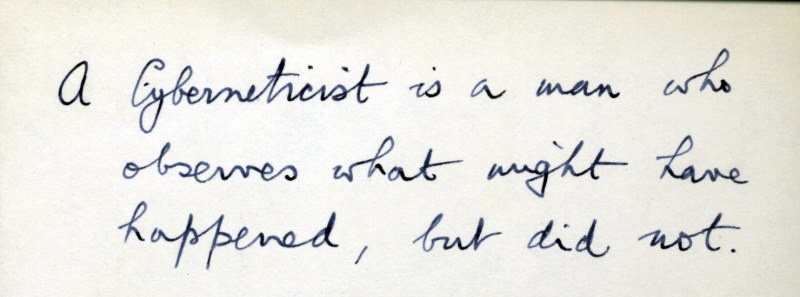
Ashby noted in his private notebook that “A Cyberneticist is a man[sic] who observes what might have happened, but did not.”

This idea of “something that might have happened, but did not” is related to the notion of constraints. Cybernetics is often depicted as a science of teleology. This is the first order Cybernetics. For example, we often depict the idea of a steersman moving towards a goal, where a clear path is set. From the idea of constraints, we should be looking at negative explanations. We may choose the destination, but the path is set by the constraints. Gregory Bateson, another intellectual giant in Cybernetics, noted the following about negative explanation:

Negative explanation is an aspect of cybernetic theory that emphasizes restraints. According to negative explanation, events take a particular course because they are constrained from taking other courses. Alternatively, positive explanation seeks to determine the causes of particular events. Rather than focusing on “Why?”, negative explanation involves describing the constraints under which systems operate.

We consider what alternative possibilities could conceivably have occurred and then ask why many of the alternatives were not followed, so that the particular event was one of those few which could, in fact, occur.

In a similar fashion, Ashby wrote:

Cybernetics looks at the totality, in all its possible richness, and then asks why the actualities should be restricted to some portion of the total possibilities.

The real world gives the subset of what is; the product space represents the uncertainty of the observer. The product space may therefore change if the observer changes; and two observers may legitimately use different product spaces within which to record the same subset of actual events in some actual thing. The “constraint” is thus a relation between observer and thing; the properties of any particular constraint will depend on both the real thing and on the observer. It follows that a substantial part of the theory of organization will be concerned with properties that are not intrinsic to the thing but are relational between the observer and thing.

We often emphasize on having a goal or direction, but we neglect the importance of constraints. Some constraints can be physical such as a ball rolling down a chute.  The ball will always follow the same path. Now compare this to a rock falling down a hill. It may not follow the same path if you repeat rolling it down a hill. Some paths are more likely than others. And no matter how many times you roll it down a hill, some paths are never taken due to the physical constraints of the hill. These can be understood from a first order Cybernetics standpoint. From the second order Cybernetics standpoint, it is very important to understand the relational nature of constraints to the observer. What is limiting to one person can be nurturing for another. From the second order Cybernetics standpoint, the constraints are our biases and other epistemic constraints that limit or enable our actions.

According to Greek mythology, Sisyphus was made to roll a large rock up a hill and have it roll down; only to repeat this exercise again and again for eternity. He was made to do this as a punishment. Curious enough, in another part of the world, in Kerala (India), there is another mythology that talks about another character who rolled a large rock up a hill only to have it roll down. Naranath Branthan (The madman of Naranam) would roll a large rock up a hill and have it roll down. He would repeat this again and again. His reason for doing this was entirely different than Sisyphus. Naranath Branthan was not doing it for punishment. But, he was doing it for fun. The stories about him said that he would laugh with joy and clap his hands as he watched the rock roll down the hill. If Sisyphus would had found joy in what he did, the Gods would have been forced to free him from the punishment since it would cease to be a punishment.

I will finish with a wonderful story about Naranath Brandan.

One day he met Kali, an Indian goddess, as he was retiring for the night. Kali was impressed by the madman and told him that she will give him a boon (blessing).

“I do not want any boons”, the madman said. He just wanted to get on with his night and go to sleep.

Kali informed him that she has to give a boon or a curse, and she insisted that he take a boon.

“I want to increase my life time by a second”, the madman replied. Kali told him that she could not do that.

“Then I want to decrease my life time by a second”, the madman said. Kali told him she could not do that either.

The madman thought for a while and asked Kali to move the elephantiasis from his left leg to the right leg. Kali complied, and the madman lived happily with elephantiasis on his right leg from that day onwards.

Stay safe and always keep on learning…

In case you missed it, my last post was Cybernetics and the Stoics:

The Magical “All Possibilities”:

When you have eliminated all which is impossible, then whatever remains, however improbable, must be the truth. – Holmes

Imagine that you have a coin in your hand, and you are throwing it up in the air. How would you assign probabilities for the outcome? Generally, we are taught that a coin flip has a 50% chance of tails and 50% chance of heads, assuming that we are using a fair coin. The reasoning is that there are only two possible outcomes (heads, tails). Therefore, the probability of either one happening is 50%.

I have written about Bayesian epistemology before. If we evaluate the coin flip example, there is more going on here than meets the eye. The basis of all this is – from whose perspective? In Bayesian epistemology, probability is not a feature of the phenomenon such as the coin flip. The coin is not aware of the probabilities with which it should fall. The probabilities that we assign is a feature of our uncertainty, and it has nothing to do with the coin. In the example, only two outcomes were considered. Depending on the observer, this could be expanded. For example, we can consider the coin falling on its edge. Or perhaps, the coin may not land at all if we can imagine a bird catching it in midair and swallowing it, or it could be that the coin is being thrown in space. Based on our experience, we may conclude that the last two scenarios are unlikely. But the key points here are:

  1. Every description requires a describer. Every observation requires and observer. In science and in general language, we ignore the describer/observer. We engage in conversation or studies as if, we have access to objectivity. The science we have is a human science in the sense that it is a version that we have generated based on what our human interpretative framework affords.
  2. We need to be aware of how we made our observation, and be open to modifying it. Whatever we say or do if based on the current state of our knowledge/belief system. This needs to be updated based on the feedback from the environment.
  3. Any attempt at an experiment or study is to reduce our uncertainty about something. Going back to Bayesian epistemology, any expression in probability is an expression of our uncertainty. The phenomenon that we are studying are not following any rules. They do not have a mind of their own. We are projecting our “certainties” as rules onto them. A great example is the often-quoted scenario of birds flocking together to explain complexity. The birds do not know these rules. They exhibit a behavior that got reinforced through natural selection. The rules are our merely a projection of what we think is going on. In other words, the complexity of the flight of birds coming from the simple rules is just our construction.

The idea of “all the possibilities” is made quite clear in the Arthur Conan Doyle quote at the start of this post. This quote is often touted in TV shows and movies alike. However, the quote represents a fallacious idea, the root of which stems from an incorrect assumption. The assumption here is that one can eliminate ALL which is impossible. Similar to the coin toss example, this depends on the observer and their ability to know ALL that can happen, which requires omniscience. Additionally, one has to disprove every one of those possible outcomes. Only after this can one truly look at whatever remains. Aptly, this fallacy is termed as “Holmesian Fallacy”. We simply do not have access to ALL possibilities.

In Cybernetics, a key idea that is relevant here is variety. Variety is the number of possible states. This was put forward by one of the pioneers in Cybernetics, Ross Ashby. For example, we could say that a coin has a variety of 2 – heads or tails. Or we could say that a coin has a variety of 3 – heads, tails or its edge. As we can see the variety is dependent upon the observer. Being aware of this dependency is part of second order cybernetics. If we could restate the definition of variety in second order cybernetics, it would be – variety is the number of possible states as perceived by an observer. Variety is tightly linked to the concept of entropy.

Ashby noted that the initial variety that we have perceived will tend to decay over time if nothing changes. A great example that Ashby gives is the example of a wife visiting a prisoner. Let’s say that the wife wishes to convey a message to the prisoner using a cup of coffee that she can send to him. The warden is smart and he foretells the wife that he will add cream and sweetener to the coffee, and will also remove the spoon from the coffee. In addition, the coffee will always be filled to the brim. The warden has removed a lot of variety from the cup of coffee. The wife realizes now that the available variety that she has is to do with how hot the coffee is. She perceives the variety as 3 – HOT, TEPID or COLD. However, the warden is able to block this with time. If the warden is able to delay giving the coffee to the prisoner, then this variety is also lost. As Ashby put it, as time progresses the variety in the set cannot increase and will usually diminish.

On a similar note, Ashby also spoke of the law of experience. He noted that when we impose a change in a ‘system’, we tend to reduce its knowledge of its initial state or variety. The example he gave is that of a group of boys who have been to the same school – it is found that a number of boys of marked individuality, having all been through the same school, develop ways that are more characteristic of the school they attended than of their original individualities.

If we are including the idea of observer here, we see the “system” as the “system” that also includes the observer. This brings in a self-referential nature to this. If nothing changes, then our useful information regarding a phenomenon will either stay the same or decay over time. The useful variety that we have perceived will remain a constant or will decay over time. In addition, as the observer, we ourselves tend to fall along a line or conform to whichever tribe or community we belong to. We lose our original variety with time. The first step in overcoming these is to be aware. Be aware of our blindness; be aware of our limitations and biases; be aware of our shortcomings. We have to be aware that we do not have knowledge of “ALL possibilities”. We have to be open to challenging our worldviews. We have to evaluate and error-correct our beliefs on a regular basis. We do not perform error-correction on a continuous basis, but on a discontinuous basis.

I will finish with an anecdote on the apparent randomness of quantum mechanics that prompted Einstein to say that God does not play dice. As noted Italian physicist Carlo Rovelli wrote:

When Einstein objected to quantum mechanics by remarking that “God does not play dice,” Bohr responded by admonishing him, “Stop telling God what to do.” Which means: Nature is richer than our metaphysical prejudices. It has more imagination than we do.

Einstein was worried about the uncertainties he faced with quantum mechanics and he noted that the metaphorical God does not play dice like that. In a similar way the late Stephen Hawking noted:

So God does play dice with the universe. All the evidence points to him being an inveterate gambler, who throws the dice on every possible occasion… Not only does God definitely play dice, but He sometimes confuses us by throwing them where they can’t be seen. 

Stay safe and always keep on learning… In case you missed it, my last post was The “Mind Projection Fallacy” in Systems Thinking:

Ashby’s Trowel:

In today’s post, I am looking at a concept that I am referring to as Ashby’s trowel. The premise of this idea is very simple – context matters! I will start off the discussion using the very well-known heuristic of Occam’s razor. Occam’s razor, named after the 14th century English Franciscan friar, William of Occam. This is commonly described as – entities should not be multiplied beyond necessity. In other words, explanations should only have the necessary number of assumptions. Very often this is incorrectly presented as a call to seek simplicity. As a cybernetician, I can tell you that simplicity is overrated.

The idea of a philosophical razor is that it can be used to remove the unwanted things by slicing the unwanted assumptions away from the model. Occam’s razor is the most famous of the many philosophical razors. In medicine, Occam’s razor is often contrasted with Hickam’s dictum. Hickam’s dictum is named after the twentieth century American physician, John Hickam. It is described as – patients can have as many diseases as they damn (or darn) well please. So, if an elderly patient complains of several ailments, Hickam would advise that we trust the patient and try to treat several likable diseases instead of assuming that the different ailments are resulting from one single disease. This heuristic is meaningful when the patient is elderly, is on multiple medications, and if the ailments started at different times. In other words, simplicity is overrated when dealing with a complex situation as our human bodies, especially when tackled with age and side effects of many different medications.

A trowel is a tool used by a mason to add and to remove mortar as needed so that a clean level surface is achieved. With Ashby’s trowel, I am putting forth the reminder that the solution that you are seeking should have enough complexity to match the complexity of the problem that you are seeking to solve. Ashby presented this as his law of Requisite Variety – only variety can absorb variety. Here variety refers to the number of possible states of a “system” conjured up (constructed) by an observer. If we take the example of a light switch, it generally has two states – ON and OFF. Thus, its variety is 2. The external variety is always more than the internal variety. In the case of a light switch, the user’s variety of needing something ON and OFF when they want, can be easily met by the light switch. But now consider if the user wants to dim the lighting with the switch. The variety of ON and OFF cannot meet this new demand that is added by the user. The Engineer now has to come up with a dimmer switch that has indefinite variety between its LOW and HIGH setting.

When we have a problem, we are often reminded to go for simple solutions. This may be a good heuristic to hold on to, however this should not be the law. One of the problems with seeking simple solutions is that we stop searching for more solutions once we get to a “simple” solution. This is referred to as the “satisfaction of search.”

From the cybernetics standpoint, simplicity and complexity also depend upon who is doing the observing. What is simple to you may be complicated for me, and vice versa. The more meaningful heuristic to have is Ashby’s trowel – context matters, so we have to match the complexity.

I welcome the reader to look into this more –

I will finish with a wise quote that is very much aligned to Ashby’s trowel, from one of my favorite philosophers, David Hume – If the cause, assigned for any effect, be not sufficient to produce it, we must either reject that cause, or add to it such qualities as will give it a just proportion to the effect.

Stay safe and always keep on learning…

In case you missed it, my last post was The Purpose of Purposeful Entities in Purposive Systems:

The Cybernetics of “Here & Now” and “There & Then”:

This is available as part of a book offering that is free for community members of Cyb3rSynLabs. Please check here (https://www.cyb3rsynlabs.com/c/books/) for Second Order Cybernetics Essays for Silicon Valley. The e-book version is available here (https://www.cyb3rsyn.com/products/soc-book)

In case you missed it, my last post was The Cybernetics of Bayesian Epistemology:

Direct and Indirect Constraints:

In today’s post, I am following on the theme of Lila Gatlin’s work on constraints and tying it up with cybernetics. Please refer to my previous posts here and here for additional background. As I discussed in the last post, Lila Gatlin used the analogy of language to explain the emergence of complexity in evolution. She postulated that lower complex organisms such as invertebrates focused on D1 constraints to ensure that the genetic material is passed on accurately over generations, while vertebrates maintained a constant level of D1 constraints and utilized D2 constraints to introduce novelty leading to complexification of the species. Gatlin noted that this is similar to Shannon’s second theorem which points out that if a message is encoded properly, then it can be sent over a noisy medium in a reliable manner. As Jeremy Campbell notes:

In Shannon’s theory, the essence of successful communication is that the message must be properly encoded before it is sent, so that it arrives at its destination just as it left the transmitter, intact and free from errors caused by the randomizing effects of noise. This means that a certain amount of redundancy must be built into the message at the source… In Gatlin’s new kind of natural selection, “second-theorem selection,” fitness is defined in terms very different and abstract than in classical theory of evolution. Fitness here is not a matter of strong bodies and prolific reproduction, but of genetic information coded according to Shannon’s principles.

The codes that made possible the so-called higher organisms, Gatlin suggests, were redundant enough to ensure transmission along the channel from DNA to protein without error, yet at the same time they possessed an entropy, in Shannon’s sense of “amount of potential information,” high enough to generate a large variety of possible messages.

Gatlin viewed that complexity arose from the ability to introduce more variety while at the same time maintaining accuracy in an optimal mix, similar to human language where there is always constant emergence of new and new ideas while the main grammar, syntax etc. are maintained. As Campbell continues:

In the course of evolution, certain living organisms acquired DNA messages which were coded in this optimum way, giving them a highly successful balance between variety and accuracy, a property also displayed by human languages. These winning creatures were the vertebrates, immensely innovative and versatile forms of life, whose arrival led to a speeding-up of evolution.

As Campbell puts it, vertebrates were agents of novelty. They were able to revolutionize their anatomy and body chemistry. They were able to evolve more rapidly and adapt to their surroundings. The first known vertebrate is a bottom-dwelling fish that lived over 350 million years ago. They had a heavy external skeleton that anchored them to the floor of the water-body. They evolved such that some of the spiny parts of the skeleton grew into fins. They also evolved such that they developed skull with openings for sense organs such as eyes, nose, ears etc. Later on, some of them developed limbs from the bony supports of fins, leading to the rise of amphibians.

What kind of error-correcting redundancy did he DNA of these evolutionary prize winners, the vertebrates, possess? It had to give them the freedom to be creative, to become something markedly different, for their emergence was made possible not merely by changes in the shape of a common skeleton, but rather by developing whole new parts and organs of the body. Yet this redundancy also had to provide them with the constraints needed to keep their genetic messages undistorted.

Gatlin defined the first type of redundancy, one that allows deviation from equiprobability as ‘D1 constraint’. This is also referred to as ‘governing constraint’. The second type of redundancy, one that allows deviation from independence was termed by Gatlin as ‘D2 constraint’, and this is also referred to as ‘enabling constraint’. Gatlin’s speculation was that vertebrates were able to use both D1 and D2 constraints to increase their complexification, ultimately leading to a high cognitive being such as our species, homo sapiens.

One of the pioneers in Cybernetics, Ross Ashby, also looked at a similar question. He was looking at the biological learning mechanisms of “advanced” organisms. Ashby identified that for lower complex organisms, the main source of regulation is their gene pattern. For Ashby, regulation is linked to their viability or survival. He noted that the lower complex organisms can rely just on their gene pattern to continue to survive in their environment. Ashby noted that they are adapted because their conditions have been constant over many generations. In other words, a low complex organism such as a hunting wasp can hunt and survive simply based on their genetic information. They do not need to learn to adapt, they can adapt with what they have. Ashby referred to this as direct regulation. With direct regulation, there is a limit to the adaptation. If the regularities of the environment change, the hunting wasp will not be able to survive. It relies on the regularities of the environment for its survival. Ashby contrasted this with indirect regulation. With indirect regulation, one is able to amplify adaptation. Indirect regulation is the learning mechanism that allows the organism to adapt. A great example for this is a kitten. As Ashby notes:

This (indirect regulation) is the learning mechanism. Its peculiarity is that the gene-pattern delegates part of its control over the organism to the environment. Thus, it does not specify in detail how a kitten shall catch a mouse, but provides a learning mechanism and a tendency to play, so that it is the mouse which teaches the kitten the finer points of how to catch mice.

The learning mechanism in its gene pattern does not directly teach the kitten to hunt for the mice. However, chasing the mice and interacting with it, trains the kitten how to catch the mice. As Ashby notes, the gene pattern is supplemented by the information supplied by the environment. Part of the regulation is delegated to the environment.

In the same way the gene-pattern, when it determines the growth of a learning animal, expends part of its resources in forming a brain that is adapted not only by details in the gene-pattern but also by details in the environment. The environment acts as the dictionary, while the hunting wasp, as it attacks its prey, is guided in detail by its genetic inheritance, the kitten is taught how to catch mice by the mice themselves. Thus, in the learning organism the information that comes to it by the gene-pattern is much supplemented by information supplied by the environment; so, the total adaptation possible, after learning, can exceed the quantity transmitted directly through the gene-pattern.

Ashby further notes:

As a channel of communication, it has a definite, finite capacity, Q say. If this capacity is used directly, then, by the law of requisite variety, the amount of regulation that the organism can use as defense against the environment cannot exceed Q.  To this limit, the non-learning organisms must conform. If, however, the regulation is done indirectly, then the quantity Q, used appropriately, may enable the organism to achieve, against its environment, an amount of regulation much greater than Q. Thus, the learning organisms are no longer restricted by the limit.

In the same way the gene-pattern, when it determines the growth of a learning animal, expends part of its resources in forming a brain that is adapted not only by details in the gene-pattern but also by details in the environment. The environment acts as the dictionary, while the hunting wasp, as it attacks its prey, is guided in detail by its genetic inheritance, the kitten is taught how to catch mice by the mice themselves. Thus, in the learning organism the information that comes to it by the gene-pattern is much supplemented by information supplied by the environment; so the total adaptation possible, after learning, can exceed the quantity transmitted directly through the gene-pattern.

As I look at Ashby’s ideas, I cannot help but see similarities between the D1/D2 constraints and Direct/Indirect regulation respectively. Indirect regulation, similar to enabling constraints, helps the organism adapt to its environment by connecting things together. Indirect regulation has a second order nature to it such as learning how to learn. It works on being open to possibilities when interacting with the environment. It brings novelty into the situation. Similar to governing constraints, direct regulation focuses only on the accuracy of the ‘message’. Nothing additional or any form of amplification is not possible. Direct regulation is hardwired, whereas indirect regulation is enabling. Direct regulation is context-free, whereas indirect regulation is context-sensitive. What the hunting wasp does is entirely reliant on its gene pattern, no matter the situation, whereas, what a kitten does is entirely dependent on the context of the situation.

Final Words:

Cybernetics can be looked at as the study of possibilities, especially why out of all the possibilities only certain outcomes occur. There are strong undercurrents to information theory in Cybernetics. For example, in information theory entropy is a measure of how many messages might have been sent, but were not. In other words, if there are a lot of possible messages available, and only one message is selected, then it eliminates a lot of uncertainty. Therefore, this represents a high information scenario. Indirect regulation allows us to look at the different possibilities and adapt as needed. Additionally, indirect regulation allows retaining the successes and failures and the lessons learned from them.

I will finish with a great lesson from Ashby to explain the idea of the indirect regulation:

If a child wanted to discover the meanings of English words, and his father had only ten minutes available for instruction, the father would have two possible modes of action. One is to use the ten minutes in telling the child the meanings of as many words as can be described in that time. Clearly there is a limit to the number of words that can be so explained. This is the direct method. The indirect method is for the father to spend the ten minutes showing the child how to use a dictionary. At the end of the ten minutes the child is, in one sense, no better off; for not a single word has been added to his vocabulary. Nevertheless, the second method has a fundamental advantage; for in the future the number of words that the child can understand is no longer bounded by the limit imposed by the ten minutes. The reason is that if the information about meanings has to come through the father directly, it is limited to ten-minutes’ worth; in the indirect method the information comes partly through the father and partly through another channel (the dictionary) that the father’s ten-minute act has made available.

Please maintain social distance, wear masks and take vaccination, if able. Stay safe and always keep on learning…

In case you missed it, my last post was D1 and D2 Constraints: