The Ethics of Choice: Ackoff Meets von Foerster

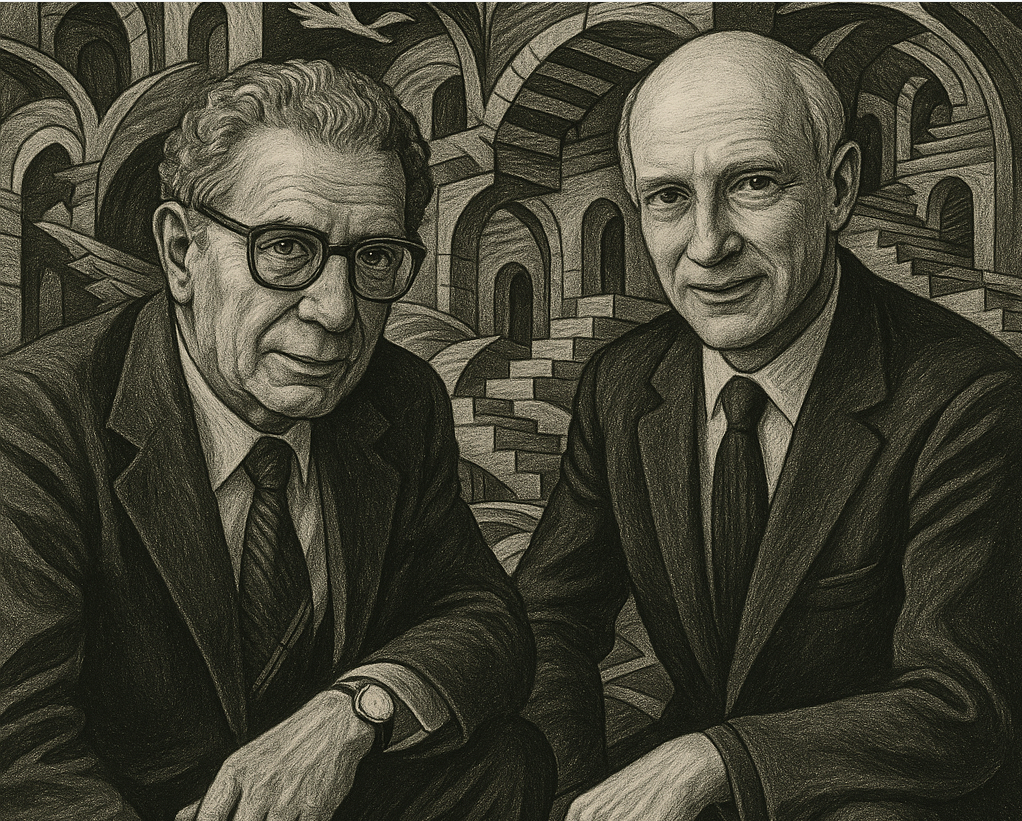
In today’s post I am exploring the need for ethics in Systems Thinking using the ideas of Heinz von Foerster and Russell Ackoff. Russell Ackoff and Heinz von Foerster came from different traditions within systems thinking. Ackoff comes from operations research and organizational design, and von Foerster comes from physics and second-order cybernetics. Yet, in their mature work, they both arrived at a strikingly similar ethical stance: that “systems” ought to be structured in ways that expand the capacity of their parts to choose, act, and develop.

Von Foerster’s ethical imperative is deceptively simple: “Act always so as to increase the number of choices“. It is easy to misread this as a general appeal to openness, ambiguity, or liberal tolerance. But that would miss its depth. For von Foerster, the notion of “choices” is rooted in constructivism. We are not passive recipients of a pre-given world. We are active participants in the construction of our realities. Therefore, every action we take contributes to shaping the world that others, too, will inhabit.

I have written about my corollary to Heinz von Foerster’s ethical imperative before: always opt for situations that preserve and expand future possibilities.

To increase the number of choices is not merely to keep options open. It is to take responsibility for the kind of world we are helping bring into being. It is to recognize that our models, narratives, and designs are not neutral. They create constraints or possibilities. The ethical dimension emerges from this constructivist insight. If we are the ones constructing meaning and order, then we are also responsible for ensuring that others can participate in that construction.

Russell Ackoff, coming from a different intellectual lineage, spoke in similar terms about purposeful systems. In his view, a social system, unlike a machine or an organism, is composed of parts that have purposes of their own. This is not just a descriptive claim. It is a normative one. To treat an enterprise as a social system is to treat its people as agents. That means enabling them to select both ends and means relevant to them. It means expanding the variety of behaviors available to the parts of the system. And it means refusing to reduce individuals to roles, procedures, or interchangeable units.

As Ackoff said: [1]

An enterprise conceptualized as a social system should serve the purposes of both its parts and the system of which it is a part. It should enable its parts and its containing systems to do things they could not otherwise do. They enable their parts to participate directly or indirectly in the selection of both ends and means that are relevant to them. This means that enterprises conceptualized as social systems increase the variety of both the means and ends available to their parts, and this, in turn, increases the variety of behavior available to them.

Ackoff does not describe freedom in abstract terms. Instead, he frames it in terms of viable behavior. If systems are to be purposeful and adaptive, they must support the ability of their parts to choose and act. This is not a luxury. It is an imperative in turbulent environments. Ackoff continues:

The parts of a completely democratic system must be capable of more than reactive or responsive behavior. They must be able to act. Active behavior is behavior for which no other event is either necessary or sufficient. Acts, therefore, are completely self-determined, the result of choice. Choice is essential for purposeful behavior. Therefore, if the parts of a system are to be treated as purposeful, they must be given the freedom to choose, to act.

This parallels von Foerster’s call to increase choices. It also deepens it. Ackoff is not only speaking of choice as a moral principle. He is showing that without choice, systems cannot act purposefully. They can only react. In complex systems, where change is constant, such reactivity is insufficient.

Though Ackoff and von Foerster rarely cited one another, their parallel conclusions suggest a convergence shaped by a shared moral sensitivity to the role of agency in system design.

Von Foerster’s imperative finds its most serious grounding in historical trauma. His insistence on the responsibility of the observer was not theoretical. He lived through the Nazi era when many claimed they “had no choice”. His ethical imperative arose in opposition to this very notion. The idea that one was simply “following orders” was, to him, a denial of personhood. To say “I had no choice” is not merely an evasion. It is a collapse of moral responsibility. It turns the observer into an automaton and ethics into compliance.

Ackoff, like von Foerster, saw how ethical collapse begins when systems are designed to remove agency under the guise of order. When systems are designed to remove or suppress choice, they not only become unethical but also incapable of long-term success. The suppression of choice results in stagnation, in the inability to deal with novelty, and in the eventual failure to match the variety of the environment.

As he explained:

Enterprises conceptualized and managed as social systems, and their parts, can respond to the unpredictable changes inherent in turbulent environments and can deal effectively with increasing complexity. They can expand the variety of their behavior to match or exceed the variety of the behavior of their environments because of the freedom of choice that pervades them. They are capable not only of rapid and effective passive adaptation to change but also of active adaptation. They can innovate by perceiving and exploiting opportunities for change that are internally, not externally, stimulated.

This ability to innovate from within is exactly what von Foerster meant by ethical action. It is not enough to survive. We must be able to imagine alternatives, to create futures. That can happen only when participants are seen as observers and constructors, not as passive components.

Ackoff takes this one step further by reminding us that systems have multiple levels of purpose.

The social-systemic view of an enterprise is based on considering three ‘levels’ of purpose: the purposes of the larger system of which an enterprise is a part, the purposes of the enterprise itself, and the purposes of its parts.

The ethical task is not to enforce alignment but to cultivate conditions where these levels support and enhance one another. That means making space for new forms of participation. It means resisting the urge to simplify or to eliminate tensions.

Both thinkers were concerned with the future. Ackoff warned:

Today, however, we frequently make decisions that reduce the range of choices that will be available to those who will occupy the future.

For example, future options are significantly reduced by destruction and pollution of our physical environment, extinction of species of plants and animals, and exhaustion of limited natural resources. War – perhaps the most destructive of human activities – removes some or all future options for many. We have no right to deprive future generations of the things they might need or desire, however much we may need or desire them.

Here again, von Foerster would agree. The responsibility of the observer extends through time. Ethics is primarily oriented toward the future. To act ethically is to preserve and enlarge the set of future choices, not just present ones.

This is the intersection between Ackoff and von Foerster. It is not primarily about designing for freedom, as Stafford Beer might have framed it, but about cultivating the ethical awareness that we are always shaping what freedom becomes. Ethical systems are not those that impose order from above. They are those that create the conditions for others to choose, to act, and to become.

To act ethically, then, is to act in a way that enlarges the scope of agency around us. It is to refuse the claim that “there was no other way.” It is to question not only the actions of individuals but also the design of systems that make those actions seem inevitable. Von Foerster challenges us to build systems that do not foreclose choice but rather multiply it. Ackoff challenges us to design organizations in which people can act with purpose, both their own and that of the larger system.

The convergence of these two thinkers gives us a powerful way to think about ethics in complexity. It is not about controlling outcomes. It is about enabling emergence. It is not about defending what is. It is about creating the conditions for what could be.

What is common between them is not method, but ethos. They both believed that how we think about systems shapes how we act within them. And how we act, in turn, shapes what becomes possible for others. In a world increasingly constrained by the consequences of past decisions, we must always opt for situations that preserve and expand future possibilities.

Final Words:

Heinz von Foerster knew too well the cost of systems that suppress choice. His ethical imperative was not a poetic suggestion but a moral demand born from lived experience. For him, the statement “I had no choice” was a warning sign. It was a marker of ethical blindness. To live ethically, he believed, was to remain aware that we are always constructing reality, whether we recognize it or not.

Ethics, then, is not a separate layer added to action. It is embedded in every decision, every design, every interpretation. By increasing the number of choices for others, we resist systems that close down alternatives and silence difference. We push back against the machinery of obedience. We make space for novelty, for learning, and for the dignity of self-determined action.

Von Foerster did not ask us to design perfect “systems”. He asked us to remain awake to our role within them. To be a responsible observer is to see how our ways of seeing shape what is possible. That is the ethical task he left us. Not to necessarily control the future, but to leave it open.

I will finish with a very wise quote from Ackoff:

The righter we do the wrong thing, the wronger we become.

Always keep learning…

[1] The Democratic Corporation, Russell L. Ackoff (1994)
Rethinking Efficiency- The Human Element in Systems Thinking:

In today’s post, I am exploring the notion of efficiency. The emergence of a new government agency in the US focused specifically on efficiency in the public sector intrigues and challenges me as a cybernetician and systems thinker. I want to examine two critical aspects of this concept.

1) The Delicate Balance of Systemic ‘Fat‘:

The first idea aligns with the principle of Lean, which was developed after Toyota’s Production System (TPS). For those curious about my use of “Toyota’s” instead of Toyota, I invite you to check out a previous post.

TPS was developed by Taiichi Ohno. While the name Lean implies “without fat,” Ohno did not advocate for complete elimination of excess. In a previous post, I explained this nuance further. Instead, Ohno understood the critical importance of carefully planned buffers—what might be called “fat”—to ensure production system resilience. The right amount of redundancy becomes an ally—what in Cybernetics is termed as having the “good” kind of variety to manage external world complexity.

When one fails to understand the nuances of a complex network like the public sector, the idea of efficiency becomes dangerous. Managing high levels of complexity requires maintaining variety at the points where the external environment intersects with the system. Most often, this critical information remains opaque at the executive level—where the rubber meets the road. There is no more perilous individual than one who believes they fully comprehend the complexity of the world around us. Variety engineering in Cybernetics offers an excellent approach to navigating these challenges. Improving our understanding of complexity requires humility and adaptability.

2) The Humans in the ‘System’:

The second idea is perhaps the most important of all. A focus on efficiency alone is a dangerous idea. I will lean on the ‘Socrates of Systems Thinking’, Russel Ackoff for this. Ackoff was a brilliant man with wonderful insights. Ackoff believed that one of the main functions of leadership is an aesthetic function. Leadership in his eyes is fundamentally about creating meaning, beauty and possibility, rather than technical efficiency. [1] Efficiency measures resource utilization in a value-neutral manner, while effectiveness weights these resources against the values of achieved outcomes.

The difference between efficiency and effectiveness is important to an understanding of transformational leadership. Efficiency is a measure of how well resources are used to achieve ends; it is value-free. Effectiveness is efficiency weighted by the values of the ends achieved; it is value-full.

He gave an example to clarify this:

For example, a men’s clothing manufacturer may efficiently turn out suits that do not fit well. Another less efficient manufacturer may turn out suits that do fit well. Because “fit” is a value to customers, the second manufacturer would be considered to be the more effective even though less efficient than the first. Of course, a manufacturer can be both efficient and effective.

Ackoff on another occasion offered this gem about being careful when pursuing efficiency:

The more efficient you are at doing the wrong thing, the wronger you become. It is much better to do the right thing wronger than the wrong thing righter. If you do the right thing wrong and correct it, you get better.

In our metrics-driven world, we reduce everything to measurable data—even human experiences become quantifiable units. Ackoff challenged this reductive approach, emphasizing that the value of an action is inherently personal and subjective.

The efficiency of an act can be determined without reference to those affected by it. Not so for effectiveness. It is necessarily personal. The value of an act may be, and usually is, quite different for different individuals.

Every system is fundamentally a human system, created as a mental construct to make sense of our complex world. Complexity itself is not an objective measure, but a perspective shaped by human values and purposes. Wisdom, as Ackoff eloquently explained, requires expanding our consideration of consequences—both in scope and time. It involves consciously inserting values into decision-making, preventing the sacrifice of long-term potential for short-term gains.

He further elaborated on the value-based approach:

Values are the concern of ethics and aesthetics. Therefore, they are necessarily involved in the conversion of efficiency into effectiveness. The production of data, information, knowledge, and understanding are primarily functions of science. The production of wisdom, which presupposes all four, is primarily a function of ethics and aesthetics because it involves the conscious insertion of values into human decision making and evaluation of its outcomes.

Effectiveness is a product of wisdom which enlarges both the range of consequences considered in making a decision and the length of time over which the decision is believed to have possible consequences. By taking long- as well as shortrun consequences into account, wisdom prevents sacrificing the future for the present… Wisdom is required for the effective pursuit of ideals, and therefore is required of leadership. Leaders must also have a creative and recreative role in the pursuit of ideals, and these are aesthetic functions.

The pursuit of effectiveness is an art form—requiring wisdom, empathy, and a profound understanding of human complexity. It demands that we look beyond the numbers, recognize the subjective nature of value, and create systems that serve not just productivity, but human potential. In an age obsessed with efficiency, our greatest leadership skill may be the capacity to see beyond the metrics—to understand that the most meaningful progress is rarely the most measurable.

I will conclude with another memorable quote from Ackoff:

A good deal of the corporate planning I have observed is like a ritual rain dance; it has no effect on the weather that follows, but those who engage in it think it does. Moreover, it seems to me that much of the advice and instruction related to corporate planning is directed at improving the dancing, not the weather.

Always keep on learning.

[1] A Systemic View of Transformational Leadership – Russell L. Ackoff

Lillian Gilbreth’s Synthesist:

Lillian Gilbreth is one of my heroes in Industrial Engineering. I have written about her here and here. In today’s post, I am looking at Gilbreth’s idea of an analyst and synthesist. The term “analyst” is in common vocabulary, whereas the term “synthesist” is not. Even Microsoft Word is identifying that the term “synthesist” is incorrect.

In any introduction class to systems thinking, we get introduced to the idea of analysis and synthesis. As Russell Ackoff, the giant in Systems Thinking, teaches us:

A system is a whole which consists of a set of two or more parts. Each part affects the behavior of the whole, depending on how it interacts with the other parts of the system. To understand a system, analysis says to take it apart. But when you take a system apart, it loses all of its essential properties. The discovery that you cannot understand the nature of a system by analysis forced us to realize that another type of thinking was required. Not surprisingly, it came to be called synthesis.

Analysis… reveals structure— how a system works. If you want to repair an automobile, you have to analyze it to find what part isn’t working. Synthesis reveals understanding—why it works the way it does. The automobile, for example, was originally developed for six passengers. But no amount of analysis will help you to find out why. The answer lies in the fact that cars were designed for the average American family, which happened to be 5.6 at the time.

Lillian Gilbreth also talked about analysis and synthesis, back in 1914, in her book, The Psychology of Management. Gilbreth discussed ideas from the British psychologist, James Sully.

Analysis is defined by Sully as follows: “Analysis” is “taking apart more complex processes in order to single out for special inspection their several constituent processes.” He divides elements of thought activity into two:

(a) analysis: abstraction, (b) synthesis: comparison.”

Gilbreth further clarified what an analyst does:

ANALYST’S WORK IS DIVISION. – It is the duty of the analyst to divide the work that he is set to study into the minutest divisions possible.

She went on to describe the qualifications of an analyst.

QUALIFICATIONS OF AN ANALYST. – To be most successful, an analyst should have ingenuity, patience, and that love of dividing a process into its component parts and studying each separate part that characterizes the analytic mind. The analyst must be capable of doing accurate work, and orderly work.

To get the most pleasure and profit from his work he should realize that his great, underlying purpose is to relieve the worker of unnecessary fatigue, to shorten his work period per day, and to increase the number of his days and years of higher earning power. With this realization will come an added interest in his subject.

Gilbreth defined the role of a synthesist as follows:

THE SYNTHESIST’S WORK IS SELECTION AND ADDITION. – The synthesist studies the individual results of the analyst’s work, and their inter-relation, and determines which of these should be combined, and in what manner, for the most economic result. His duty is to construct that combination of the elements which will be most efficient.

The qualifications of a synthesist was explained as:

QUALIFICATIONS OF THE SYNTHESIST. – The synthesist must have a constructive mind, for he determines the sequence of events as well as the method of attack. He must have the ability to see the completed whole which he is trying to make, and to regard the elements with which he works not only as units, but in relation to each other. He must feel that any combination is influenced not only by the elements that go into it, but by the inter-relation between these elements. This differs for different combinations as in a kaleidoscope.

The relationship between the analyst and synthesist was best explained by Gilbreth as:

If synthesis in Scientific Management were nothing more than combining all the elements that result from analysis into a whole, it would be valuable. Any process studied analytically will be performed more intelligently, even if there is no change in the method. But the most important part of the synthesist’s work is the actual elimination of elements which are useless, and the combination of the remaining elements in such a way, or sequence, or schedule, that a far better method than the one analyzed will result.

Final Words:

Lillian Gilbreth’s ideas, as the cliché goes, were truly ahead of her times. We have all benefited from her brilliance. Gilbreth viewed a synthesist as a conserver of a valuable elements as well as an inventor involved in invention of better methods of doing work, such as tools or equipment. She also said that a synthesist is a discoverer of laws because they have the ability to understand why the parts are working the way they are, in relation to one another. A systems thinker fuses analysis and synthesis. Moreover, a systems thinker should be able to find differences among apparently similar things and similarities among apparently different things.

I will finish with further ideas from the 18th century French Philosopher Victor Cousin:

The legitimacy of every synthesis is directly owing to the exactness of analysis; every system which is merely [sic] an hypothesis is a vain system; every synthesis which has not been preceded by analysis is a pure imagination: but at the same time every analysis which does not aspire to a synthesis which maybe equal to it, is an analysis which halts on the way.

On the one hand, synthesis without analysis gives a false science; on the other hand, analysis without synthesis gives an incomplete science.

Stay safe and Always keep on learning…

In case you missed it, my last post was The Truths of Complexity:

Nietzsche’s Overman at the Gemba:

Overman

In today’s post, I am looking at Nietzsche’s philosophy of Übermensch. Friedrich Wilhelm Nietzsche is probably one of the most misunderstood and misquoted philosophers. The idea of Übermensch is sometimes mistranslated as Superman. A better translation is “Overman”. The German term “mensch” means “human being” and is gender neutral. Nietzsche spoke about overman first in his book, “Thus Spoke Zarathustra.” In the prologue of this book, Nietzsche through Zarathustra asks:

I teach you the overman. Man is something that shall be overcome. What have you done to overcome him?

Nietzsche provides further clarification that, “Man is a rope, fastened between animal and Übermensch – a rope over an abyss.Übermensch is an idea that represents a being who has overcome himself and his human nature – one who can break away from the bondage of ideals and create new ones in place of the old stale ones.

Nietzsche came to the conclusion that humanity was getting stale by maintaining status quo through adhering to ideals based in the past. He also realized that the developments in science and technology, and the increase in collective intelligence was disrupting the “old” dogmatic ideals and the end result was going to be nihilism – a post-modern view that life is without meaning or purpose. Nietzsche famously exclaimed that; God is dead! He was not rejoicing in that epiphany. Nietzsche proposed the idea of Übermensch as a solution to this nihilistic crisis. Übermensch is not based on a divine realm. Instead Übermensch is a higher form on Earth. Overcoming the status quo and internal struggles with the ideals is how we can live our full potential in this earth and be Übermensch.

Nietzsche contrasted Übermensch with “Last Man”. The last man embraces status quo and lives in his/her comfort zone. The last man stays away from any struggle, internal or external. The last man goes with the flow as part of a herd. The last man never progresses, but stays where he is, clutching to the past.

Nietzsche used the metaphors of the camel, the lion and the child to detail the progress towards becoming an Übermensch. As the camel, we should seek out struggle, to gain knowledge and wisdom through experience. We should practice self-discipline and accept more duties to improve ourselves. As the lion, we should seek our independence from the ideals and dogmas. Nietzsche spoke of tackling the “Thou Shalt” dragon as the lion. The dragon has a thousand scales with the notation, “thou shalt”. Each scale represents a command, telling us to do something or not do something. As the lion, we should strongly say, “No.” Finally, as the child, we are free. Free to create a new reality and new values.

At the Gemba:

Several thoughts related to Übermensch  and Lean came to my mind. Toyota teaches us that we should always strive toward True North, our ideal state. We are never there, but we should always continue to improve and move towards True North. Complacency/the push to maintain status quo is the opposite of kaizen, as I noted in an earlier post.

I am reminded of a press article about Fujio Cho. In 2002, when Fujio Cho was the President of Toyota Motor Corporation, Toyota became the third largest automaker in the world and had 10.2% of share of world market. Cho unveiled a plan to be world’s largest automaker with 15% global market share. Akio Matsubara, Toyota’s managing director in charge of the corporate planning division, stated:

“The figure of 15 percent is a vision, not a target,” he said. “Now that we’ve achieved 10 percent, we want to bring 15 percent into view as our next dream. We don’t see any significance in becoming No. 1.”

The point of the 15 percent figure, he said, is to motivate Toyota employees to embrace changes to improve so they would not become complacent with the company’s success.

My favorite part of the article was Morgan Stanley Japan Ltd. auto analyst Noriaki Hirakata’s remarks about Fujio Cho. Toyota’s executives, he said, believe Toyota is “the best in the world, but they don’t want to be satisfied.”

It’s as if Cho’s motto has become “Beat Toyota,” Hirakata said.

I am also reminded of a story that the famous American Systems Thinker, Russel Ackoff shared. In 1951, he went to Bell Labs in Murray Hill, New Jersey, as a consultant. While he was there, all the managers were summoned to an impromptu urgent meeting by the Vice President of Bell Labs. Nobody was sure what was going on. Everyone gathered in a room anxious to hear what the meeting was about. The Vice President walked in about 10 minutes late and looked very upset. He walked up to the podium and everyone became silent. The Vice President announced:

“Gentlemen, the telephone system of the United States was destroyed last night.”

He waited as everyone started talking and whispering that it was not true. The Vice President continued:

“The telephone system was destroyed last night and you had better believe it. If you don’t by noon, you are fired.”

The room was silent again. The Vice President then started out laughing, and everyone relaxed.

“What was that all about? Well, in the last issue of the Scientific American,” he said, “there was an article that said that these laboratories are the best industrially based scientific laboratories in the world. I agreed, but it got me thinking.”

The Vice President went to on to state that all of the notable inventions that Bell Lab had were invented prior to 1900. This included the dial, multiplexing, and coaxial cable. All these inventions were made prior to when any of the attendees were born. The Vice President pointed out that they were being complacent. They were treating the parts separately and not improving the system as a whole. His solution to the complacency? He challenged the team to assume that the telephone system was destroyed last night, and that they were going to reinvent and rebuilt it from scratch! One of the results of this was the push button style phones that reduced the time needed to dial a number by 12 seconds. This story reminds me of breaking down the existing ideals and challenging the currently held assumptions.

Nietzsche challenges us to overcome the routine monotonous ideas and beliefs. Instead of simply existing, going from one day to the next, we should challenge ourselves to be courageous and overcome our current selves. This includes destruction and construction of ideals and beliefs. We should be courageous to accept the internal struggle, when we go outside our comfort zone. The path to our better selves is not inside the comfort zone.

Similar to what Toyota did by challenging the prevalent mass production system and inventing a new style of production system, we should also challenge the currently held belief system. We should continue evolving toward our better selves. As Nietzsche said:

What is great in man is that he is a bridge and not an end.

I say unto you: One must still have chaos in oneself to be able to give birth to a dancing star.

Always keep on learning…

In case you missed it, my last post was Solving a Lean Problem versus a Six Sigma Problem:

Four Approaches to Problem Solving:

dc

As a Quality professional, I am always interested in learning about problem solving. In today’s post I will be looking at the four approaches to Problem Solving as taught by the late great Systems Thinker, Russell Ackoff. He called these “Problem Treatments” – the ways one deals with problems. They are;

  1. Absolution – This is a common reaction to a problem. This means to ignore a problem with the hope that it will solve by itself or it will go away of its own accord.
  2. Resolution – This means to do something that yields an outcome that is “good enough”, in other words, that “satisfices”. This involves a clinical approach to problems that relies heavily on past experience, trial and error, qualitative judgment, and so-called common sense.
  3. Solution – This means to do something that yields the best outcome that “optimizes”. This involves a research approach to problems, one that often relies on experimentation, quantitative analysis, and uncommon sense. This is the realm of effective counterintuitive solutions.
  4. Dissolution – This means to redesign either the entity that has the problem or its environment in such a way as to eliminate the problem and enable the entity involved to do better in the future that the best it can do today – in a word, to “idealize”.

I see it also as the progression of our reaction to a big problem. At first, we try to ignore it. Then we try to put band aids on it. Then we try to make the process better, and finally we change a portion of the process so that the problem cannot exist in the new process. Ackoff gave a story in his book, “The Democratic Corporation”, to further explain these ideas. Ackoff was called in by a consultant to help with a problem in a large city in Europe. The city used double-decker buses for public transportation that had a bus driver and a conductor in it. The driver got paid extra based on how efficiently he could keep up with the schedule, and the conductor got paid extra based on how efficiently he could collect fares and keeps track of receipts. The conductor was also in charge of letting the driver know when the bus was ready to move by signaling to them from the rear entrance to the bus. During peak hours, problems arose. To meet the high volume of passengers, conductors started to let passengers in without collecting fares with the thought that they could be collected between stops. The conductors could not always get back to the entrance to signal to the driver that they were ready to move. The drivers started to determine themselves when they could move by trying to see that no one was getting off or on to the bus. All this caused delays that were costly to the driver. This resulted in great hostility between the drivers and the conductors. The drivers were trying to do what was best for them, and the conductors were trying to do what was best for them.

The management at first tried to “absolve” by pretending that the problem would go away on its own. When things got worse, the management tried to “resolve” by proposing to retract the incentives. This was not met well by both the drivers and conductors, and the management was not willing to increase their wages to offset the incentives. Next the management tried to “solve” the problem by proposing that the driver and the conductor share the total sum of incentives. This also was not met well by the drivers and the conductors because of lack of trust and unwillingness to increase their interdependence.

Finally, Ackoff proposed a modification to the process. He proposed that during the peak hours the conductors should be taken off the bus and placed at the stops. This way he can collect the fares from the people already at the stop, and he can verify the receipts of the people getting off the bus. He also can easily signal the bus driver. The problem was “dissolved” by this modification to the process.

Final Words:

One of the best teachings from Ackoff for Management is that to manage a system effectively, you must focus on the interactions of the parts rather than their behaviors (actions) taken separately. The next time you are facing a problem, think and understand if you are trying to absolve, resolve, solve or dissolve the problem. I will finish with a great story from Osho about the butcher who never had to sharpen his knife.

There was a great butcher in Japan and he was said to be a Zen master. After hearing about him, the emperor came to see him at his work. The emperor asked only one thing, about the knife that he used to kill the animals. The knife looked so shiny, as if it had just been sharpened.

The emperor asked, “Do you sharpen your knife every day?”

He said, “No, this is the knife my father used, and his father used, and it has never been sharpened. But we know exactly the points where it has to cut the animal so there is a minimum of pain possible — through the joints where two bones meet. The knife has to go through the joint, and those two bones that meet there go on sharpening the knife. And that is the point where the animal is going to feel the minimum pain. I am aware of the interactions.”

“For three generations we have not sharpened the knife. A butcher sharpening a knife simply means he does not know his art.”

Always keep on learning…

In case you missed it, my last post was Respect for People in light of Systems Thinking.

Respect for People in Light of Systems Thinking:

rc

Respect for People is one of the two pillars in the Toyota Way and in today’s post I will be looking at Respect for People in the light of ideas from the late great Systems Thinker, Russell Ackoff. This post is inspired by Ackoff’s teachings.

Back in the old days (Renaissance period onwards – 1400’s) humans knew little and thought that they knew everything. There was a lot of stress on “Analysis” and “cause and effect” thinking. The thinking behind “Analysis” is that one learns a phenomenon by taking things apart. This was seen as the only way to understand the universe – by breaking down things and studying each part. This fostered the idea of cause and effect thinking. Every relationship was seen as a cause and an effect, in a linear fashion. In Ackoff’s words, this led to interesting doctrines;

The commitment to cause-and-effect thinking led to … if we want to explain a phenomenon, all we have to do is find its cause. To further explain that cause, we simply treat it as an effect and find its cause. But is there any end to this causal regression? If the universe can be completely understood, there had to be a first cause—and this was the official doctrine as to why God exists. God is the only thing in the universe that could not be explained because God was the first cause.

This type of linear thinking led us to thinking of the world as a clockwork machine. The Industrial Revolution introduced the machine age where work could be mechanized. Work was seen in a reductionist viewpoint as a simple transformation of matter through energy. Frederick Taylor, proponent of Scientific Management, introduced the ideas of improving efficiency through principles of Industrial Engineering. Work could now be broken down into basic elements – analysis, and each element can be focused on to improve it. The modern factory consisted of machines and humans engaged in these basic tasks in a clockwork fashion. In Ackoff’s words;

The machines and people were then aggregated into a network of elementary tasks dedicated to the production of a product—the modern factory. In the process of mechanizing work, however, we made people behave as though they were machines. We dehumanized work.

This goes against the idea of Respect for Humanity. Toyota teaches that its production system is a Thinking Production System, and that their operators are not just a pair of hands.

Ackoff concludes that the idea of free will, introduction of the Uncertainty principle and Systems Thinking launched the Systems Age in the first half of Twentieth Century. In Systems Thinking, the approach of “Synthesis” was introduced. “Synthesis” uses the opposite approach to “Analysis”.” Synthesis” is the idea of putting things together to understand the system. In Ackoff’s words;

The first step of synthesis is to determine the larger system of which the system to be explained is a part. The second step is to try to understand the larger system as a whole. The third step is to disaggregate the understanding of the whole into an understanding of the part by identifying its role or function in the containing system.

If Analysis leads to Knowledge, Synthesis leads to Understanding! However, this also meant that we may never be able to understand the whole universe. The concept of Synthesis forces us to look at the impact of the environment and each factor and how they interact with each other. This was missing in Analysis. This idea led to the understanding that an organization is not a simple mechanistic clockwork where people are mere forms of “living machinery”. An organization in the light of Systems Thinking becomes a Social Technical system. Ackoff advises us;

Most managers are still acting as though the corporation is a mechanism or an organism, not a social system. Although we don’t normally treat machines as organisms, one legacy from the Machine Age is that we have a tendency to treat organisms as machines, and even social systems as machines. That has a very limited usefulness, but it is not nearly as useful as looking at a social system as a social system.

This provides further insight into the concept of Respect for People in my opinion. Respect for People is not thinking in terms of the Machine Age. It is about looking at the social system and seeing workers as people who can think and come up with better ways of doing things, and where the system gains from their input.

Final Words:

I encourage the readers to read or watch anything that is available from Russell Ackoff. I will finish off with a “Zen” story from Japan that talks about the harmony of the whole;

There’s a story about the famous rock garden at Ryōanji temple. The story goes that when the garden was finished, the designer showed it to the priest and asked him what he thought.

The priest was delighted. “It’s magnificent!” he said. “Especially that rock there!”

The garden designer immediately removed the rock. For him, the harmony of the whole was paramount.

Always keep on learning…

In case you missed it, my last post was The Value of Silence.