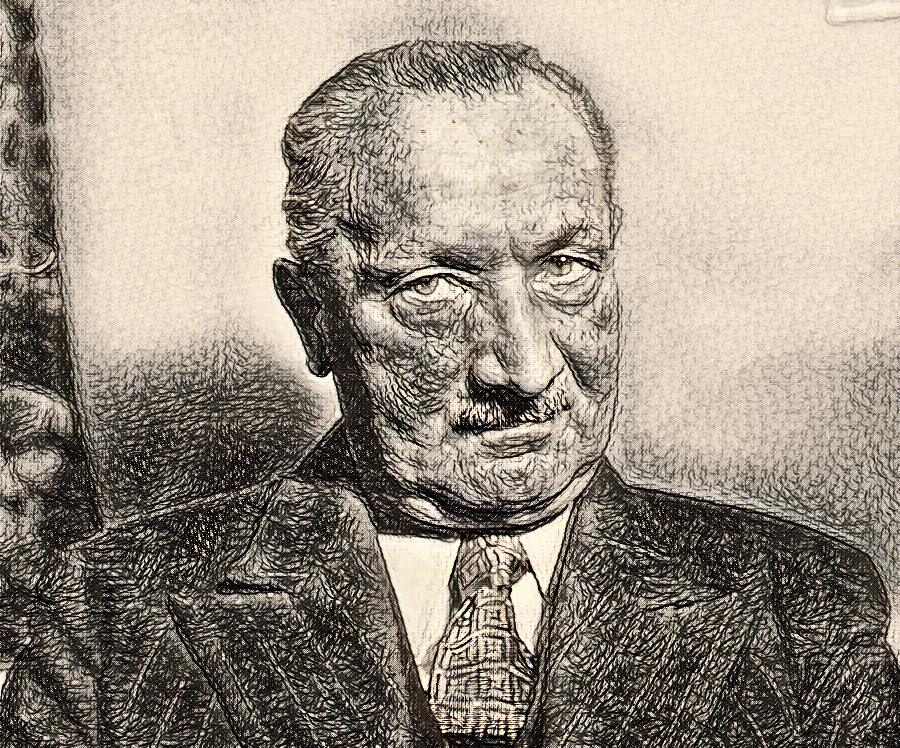
In today’s post, I am following up on the ideas of the controversial German philosopher, Martin Heidegger in relation to Systems Thinking. This will be a series of posts. I have utilized his early work, particularly his tool analysis from “Being and Time” for this post.
I do not have a high opinion of Heidegger as a person. But his philosophical ideas are quite insightful and provide a deeper understanding for systems thinking. I believe his ideas offer a humanistic view of Systems Thinking. Readers of my blog should now be introduced to the notion of ‘systems’ as mental constructs that we use to make sense of the world around us. The statement, ‘Systems do not exist’, is used to drive this point home. However, this quite often raises the question as to whether this is purely a subjective view, and some even go to the extreme end of blaming this to be a solipsistic idea. To me, there are a lot of nuances around this. I think that the ideas of Heidegger quite nicely provide a great background for this.
Ready-to-Handedness of Systems:
Heidegger rejects the traditional subject-object dichotomy that has dominated Western Philosophy since Renee Descartes. Heidegger was focused on the practical engagement with things in their context of use. He gave the example of a person with a hammer to explain this. When we are skillfully using a hammer, we do not experience the hammer as an ‘object’ separate from ourselves as ‘subject’. Instead, we are together caught up in a unified field of practical activity. Heidegger termed this ‘ready-to-handedness’. This is our primary mode of being in the world. When the hammer breaks down, it becomes simply present-at-hand. This idea provides a nuanced view of ‘systems’. ‘Systems being mental constructs’ is not merely about subjectivity versus objectivity, but about the fundamentally practical nature of our engagement with the world.
Often, when we speak about systems, we treat them as being out there separate from us as part of an objective reality, waiting to be discovered. When we identify a ‘system’, we are performing an act of abstraction guided by practical concerns. We select certain elements as relevant, establish boundaries, and identify patterns of relationships while ignoring countless other potential elements. This selection process is inherently pragmatic, shaped by our ‘concernful’ dealings with the world.
This connects to Heidegger’s concept of ‘world’ as a context of significance rather than a collection of objects. The ‘world’ emerges through our projects and concerns. Similarly, systems emerge as pragmatic ways of organizing our engagement with reality rather than discoveries of pre-existing structures.
When Heidegger rejects the subject-object dichotomy, he is pointing toward what precedes both – our practical involvement in what he calls ‘being-in-the-world.’ Systems emerge from this practical engagement, not from either pure subjectivity or pure objectivity.
Heidegger notes:
‘The ready-to-hand is not grasped theoretically at all… The peculiarity of what is proximally ready-to-hand is that, in its readiness-to-hand, it must, as it were, withdraw in order to be ready-to-hand quite authentically.’
When Heidegger says, ‘the ready-to-hand is not grasped theoretically at all,’ he is distinguishing our primary way of engaging with things (as tools or equipment for our projects) from the detached, theoretical stance that philosophy has traditionally privileged. In our everyday dealings, we do not first observe objects with properties and then decide how to use them—we encounter them directly as meaningful within our practical concerns.
The second part—’it must, as it were, withdraw in order to be ready-to-hand quite authentically’—reveals something profound about skilled engagement. When we are skillfully using a tool, the tool itself recedes from our explicit attention. A skilled surgeon does not focus on the scalpel as an object but sees through it to the tissue being cut. The carpenter does not contemplate the hammer but is absorbed in the activity of driving the nail.
This ‘withdrawal’ is crucial for authentic practical engagement. The moment we begin to theoretically contemplate the hammer as an object with properties, it has already shifted from being ‘ready-to-hand’ to being ‘present-at-hand’—it has lost its primary mode of being as equipment.
Healthcare ‘systems’, for example, function most effectively when practitioners are not explicitly thinking about ‘the system’ but are engaged directly with patient care. The structures withdraw, allowing the practitioner to work through it rather than on it.
Take the example of an ER department. A skilled nurse does not consciously think about the triage system as an abstract model but embodies it in practice, moving seamlessly through assessment protocols while attending to the unique needs of each patient. The moment the nurse must stop to explicitly consider ‘how the system works’, the flow is disrupted.
This withdrawal is not a flaw but is essential to practical engagement. It is precisely because systems withdraw from explicit attention that they can effectively organize our practical dealings with complexity. The moment we make systems themselves the focus of theoretical attention, we have already shifted away from the primary mode in which they function to organize meaning.
This is why attempts to perfectly model complex systems often fail to improve practice—they shift our orientation from ready-to-hand engagement to present-at-hand contemplation, missing the practical wisdom embedded in skilled doing.
Pluralism:
As noted before, different practical orientations bring forth different systems from the same reality. Let us take the example of a forest. The forest appears as one system to the ecologist, another to the logger, and yet another to the spiritual seeker. This is not because reality is arbitrary, but because different practical concerns illuminate different aspects of it.
No two people share identical practical concerns or histories of engagement, which is why their systems may never be identical. But this does not make systems merely subjective. They remain constrained by both the resistance of external world and our shared practical traditions. In this light, systems are not arbitrary mental projections nor discovered objective structures, but practical organizations of meaning that emerge from our concernful dealings.
This view has profound implications. It suggests that different system boundaries and descriptions can be equally valid depending on practical contexts. The healthcare ‘system’, eco ’system’, and economic ‘system’ are not competing descriptions of reality but pragmatically useful constructions for different purposes.
To understand someone else’s system is not just to access their mental model as if it were a static blueprint. Rather, it is to grasp the practical context in which that system emerged — their concerns, skills, goals, histories, and engagements with the world.
When we say systems are mental constructs, we are not simply pointing to the mind’s capacity to generate arbitrary interpretations. We are recognizing that each person brings a unique mode of involvement with the world. The ‘mental construct’ is not a detached abstraction. It is situated, embodied, and shaped by practical relevance. There is an indefinite variety of practical orientations, which means different systems can (and often will) emerge from the same situation, depending on the person’s intentions and history of interactions. Different practical orientations bring forth different systems from the same reality… not because reality is arbitrary, but because different practical concerns illuminate different aspects of it.
‘Systems’ are emergent expressions of lived involvement, often unique to those who live it.
Understanding another person’s system is an act of empathic attunement — not reading their mind, but listening deeply to how the world discloses itself to them through practice. It is not stepping into their mind, but stepping into a shared space of unfolding meaning — where both your world and theirs begin to overlap. From a second order standpoint, the act of observing brings in observer’s own ‘thrownness’, with their own background of concerns, preunderstandings and practices. In other words, the observer is also disclosing a world while watching another world gets disclosed. This encounter between ‘systems’ is itself a system — one that emerges through dialogue, empathy, and mutual disclosure. Doing this requires epistemic and ontological humility.
Systems Thinking practices in Heideggerian manner will be to attending to practical concerns and lived engagements. In this, we must observe how the participants actually work rather than just asking them how they think they work. We should look for times when systems break down, as these reveal key underlying assumptions. We should focus on how and why the boundaries are drawn as they are. In this, models used to map the systems are provisional tools, and not representations of truth. We must acknowledge our own role in shaping what is being seen. We should allow space for plurality, emergence and non-finality.
Always keep learning…
Note:
In referencing the work of Martin Heidegger, I want to acknowledge the deeply troubling fact of his affiliation with the Nazi party. This aspect of his life casts a long and painful shadow over his legacy. While I draw on specific philosophical ideas that I find thought-provoking or useful, this is not an endorsement of the man or his actions. Engaging with his work requires ethical vigilance, and I remain mindful of the responsibility to not separate ideas from the broader context in which they were formed.