
When Does a System Exist? The Myth of the Given System:

In today’s post, I want to look at a question that seems almost too simple to ask: when does a system exist? For this I will be drawing on ideas from Wilfrid Sellars, Ludwig Wittgenstein, Heinz von Foerster, and Martin Heidegger.

We talk about “systems” all the time. The healthcare system. The education system. The traffic system. We speak as though these are objects sitting in the world, waiting to be observed, measured, and fixed.

Let’s try a thought experiment. Reach out your hand and try to touch the healthcare system. You can touch a hospital bed. You can hear a monitor beeping. You can speak to a nurse. You can shake a doctor’s hands. But where is the system? You cannot knock on it. You cannot hold it in your palm.

And yet we speak about it as if it were an object in front of us. We say things like “The system is broken” or “The system needs fixing.” The language gives it a kind of independent standing, as if it were a malfunctioning engine sitting somewhere, waiting for a repair technician.

This way of speaking rests on a hidden assumption, the assumption that there are structures in the world simply waiting to be perceived and described. The philosopher Wilfrid Sellars called this the “Myth of the Given”.

Wilfrid Sellars:

The “Myth of the Given” is the idea that the world presents itself to us in raw, pre-interpreted form. That before language, before concepts, before any act of distinction-making, there are simply facts delivered to the mind. Knowledge, on this view, is built upward from this unmediated foundation.

Sellars argued that this is a fallacy. He noted that sensing is not the same as knowing. A sensation may trigger a belief, but it does not justify one. Knowledge belongs to what he called the space of reasons. This is a shared space where claims can be offered, challenged, and revised.

He used the example of a tie shop clerk to make this point. Under the store’s electric lighting, the clerk says “This tie is blue.” Later, when another clerk points out the effect of the lighting, he revises his claim to “It looks blue.” The sensation itself has not changed. What has changed is his understanding of the norms governing correct description. There is no raw, unmediated given beneath our experience. There is already a learned practice of making and correcting distinctions.

This matters for how we talk about “systems”. When someone says “The system is broken,” that statement is not a neutral observation. It presupposes standards. It implies that something is failing relative to shared expectations. The claim invites agreement, disagreement, and justification. It is a normative claim, not a factual report.

Ludwig Wittgenstein:

Ludwig Wittgenstein made a related point in his reflections on rule-following and meaning. He asked whether meaning could be grounded in something purely private, such as an inner sensation. His answer was that it cannot. Without shared, public criteria for correctness, there would be no way to distinguish between actually following a rule and merely believing one is doing so.

Meaning lives in shared forms of life, not in private inner episodes. When we describe something as a system, we are not reporting a neutral fact. We are placing ourselves within a shared field of expectations and norms. The word “system” already carries commitments about what ought to be happening.

Heinz von Foerster:

Heinz von Foerster made a parallel observation about cognition. He pointed to what he called “undifferentiated encoding”. The interpretative framework does not encode categories like red or green directly. It encodes differences in stimulation. The differentiation into meaningful categories happens inside the organism itself.

This is due to what cybernetics calls “operational closure”. An entity responds according to its own structure, not according to instructions delivered from the outside. Von Foerster noted that the environment contains no information as such. Information arises only through the distinctions the organism is capable of making.

Sellars shows there is no raw knowledge. Wittgenstein shows there is no private anchor for meaning. Von Foerster shows there is no raw information. Each, in a different register, removes the idea of a pre-given foundation beneath our experience of the world.

But even together, they leave something unaddressed. Even if knowledge and information are constructed, we might still imagine ourselves as observers standing outside the world, organizing it from a neutral distance. This is where Martin Heidegger becomes essential.

Martin Heidegger:

Heidegger does not begin with perception or information. He begins with care.

For Heidegger, we do not encounter the world as neutral spectators. We are already involved. We are embedded in projects, concerns, and purposes. The world shows up in relation to what matters to us.

His example of the hammer is well known and I have written about it before. When you are skillfully hammering a nail, the hammer withdraws into the activity. It is ready-to-hand, transparent to your purpose. So is the nail, and the wood. None of them present themselves as objects. You are simply absorbed in the task.

The hammer only becomes visible as an object when something goes wrong. It breaks. It slips. It is missing. At that moment it becomes present-at-hand. You step back and look at it.

The object appears through breakdown.

The Myth of the Given System:

Now consider: what if systems work in exactly the same way?

You do not experience the healthcare system while care flows smoothly. You experience patients, conversations, treatments, and nurses. The coordination is ongoing and transparent. The practices are simply happening. Nobody says “the system.”

Now imagine a bed is unavailable. Or an insurance policy blocks a treatment. Or a drug is out of stock. Suddenly someone says: “The system is broken.”

Notice what has happened. A concern has been frustrated. And from that frustration, a boundary is drawn. A pattern of practices is gathered together and named. What was ready-to-hand, invisible in its smooth functioning, has become present-at-hand. The system has appeared.

The system is not given. It is disclosed through breakdown.

The traffic jam is another good illustration of this. Physically, there are cars and asphalt. But the system only appears relative to care. To the commuter, it is a failure of punctuality. To a vendor walking between the vehicles, it is an opportunity. To a city planner, it may be evidence of demand exceeding capacity. The cars are real. The asphalt is real. But the system is not the same kind of thing as the cars. It is a configuration that becomes visible when care encounters resistance.

To speak of the system as though it were an independently existing object, like the cars or the asphalt, is to extend the Myth of the Given into organizational life itself.

Once we see this, the ethical implications are hard to avoid. If systems arise through care, then system boundaries reflect what we care about. When we define healthcare in terms of efficiency, we foreground throughput. When we define it in terms of community wellbeing, we foreground relationships and continuity. Every articulation reveals some concerns and conceals others.

Second Order Cybernetics:

Second order cybernetics has always insisted on this point. The observer cannot be separated from the observed. When we define a system, we are not pointing at something that already existed independently of us. We are making a distinction. And as George Spencer-Brown noted, to draw a distinction is to create a world.

This is the shift that second order thinking invites. We do not ask “What is the system?”

but:

“What do I care about such that this shows up as a system at all?”

That is not a technical question. It is an existential one. Every system in this regard is a human system.

Final Words:

When we draw a boundary and call it the “system”, we are not pointing to a thing that exists independently of our distinctions. We are organizing experience around what matters to us. We chose to draw the boundary there, instead of here. We chose include that, instead of this. And we do so because our care was interrupted at that point, and not somewhere else.

This does not mean the consequences are unreal. When care is blocked, when treatment is denied, when livelihoods are threatened, when exhaustion becomes chronic, viability is genuinely at stake. To say that systems are articulated through concern is not to dismiss suffering. It is to take it more seriously.

If one’s care is endangered, one cannot remain in abstraction. Action then becomes necessary. But what kind of action?

If we treat the system as an external machine, we search for mechanical fixes. We adjust policies, change incentives, replace personnel. These may be necessary. Yet they often operate within the same set of distinctions that produced the difficulty in the first place.

Second order thinking asks a question in a deeper dimension. What distinctions are we relying on that make this outcome appear inevitable? What counts as success in this configuration? What has been excluded from the circle of relevance?

Instead of saying “The system is broken,” we might say “The current way we are coordinating our practices is undermining viability.” That wording does not place us outside the problem. It acknowledges participation without assigning simplistic blame.

Participation does not mean individual control. Many structures are vast and historically sedimented. But even within constraint, we contribute through compliance, resistance, redesign, conversation, refusal, and collaboration.

Ethics enters precisely here. Not as a moral add-on, but at the level of boundary drawing itself. Every time we define what the system is, we define what matters. Every time we measure performance, we privilege certain forms of viability over others.

Second order cybernetics does not provide a formula for what to do when care is threatened. It does not eliminate conflict between competing concerns. What it does is remove the illusion that responsibility lies elsewhere.

If viability is at risk, the task is not simply to repair an external object. It is to examine, collectively, how we are distinguishing, organizing, and sustaining the patterns that shape our shared world.

That work is slower. It is less dramatic. It requires conversation rather than diagnosis.

It keeps us inside the picture.

Stay Curious and Always keep on learning…

If you liked what you have read, please consider my book “Second Order Cybernetics,” available in hard copy and e book formats. https://www.cyb3rsyn.com/products/soc-book

Note:

In referencing the work of Martin Heidegger, I want to acknowledge the deeply troubling fact of his affiliation with the Nazi party. This aspect of his life casts a long and painful shadow over his legacy. While I draw on specific philosophical ideas that I find thought-provoking or useful, this is not an endorsement of the man or his actions. Engaging with his work requires ethical vigilance, and I remain mindful of the responsibility to not separate ideas from the broader context in which they were formed.

References:

  1. Heidegger, M. Being and Time (1927)
  2. Sellars, W. Empiricism and the Philosophy of Mind (1956)
  3. Wittgenstein, L. Philosophical Investigations (1953)
  4. von Foerster, H. Understanding Understanding (2003)
  5. Spencer-Brown, G. Laws of Form (1969)

I Do Care, Don’t You?

In today’s post, I want to clarify what it means to care as a human being and why that clarification matters for how we think about “systems”. This is a continuation of my previous post, in which I clarify the notion of “care” from a Heideggerian and existential standpoint. I hope this provides further food for thought for system thinkers.

We often speak of care as if it were a choice, a sentiment, or a moral stance that one may adopt. However, if we examine our lived experience more closely, we discover that care is not optional and that it is not something we add to life from the outside. It is the structure through which life shows up for us as meaningful in the first place. To say that we care is not to say that we are kind or benevolent. It is to say that the world already matters to us before we decide that it does. This is not a psychological observation about emotions. It is a clarification of the existential structure within which any emotion, evaluation, or decision becomes possible.

Care as the Structure of Involvement:

We do not first encounter a neutral world and then assign value to selected parts of it. We are always already involved. We wake into concerns, obligations, projects, relationships, unfinished tasks, and implicit expectations that were operative before we began reflecting on them. Even indifference is directed toward something, and even withdrawal is a response to what has already failed to meet our concern. Our lives are therefore not collections of isolated objects but structured fields of relevance within which certain things stand out as significant and others recede into the background.

Let’s consider some simple examples to make this concrete. The floor can trip us, a comment can embarrass us, a machine can fail us, and a relationship can wound us. None of these events are neutral occurrences to which we later attach meaning. They strike us because they intersect with something that is already at stake. Care names this condition of being exposed to what matters, a condition in which our projects, identities, and possibilities can be supported or undermined.

Thrownness – Finding Ourselves Already In Progress:

This exposure is not chosen. Heidegger referred to it as thrownness. We find ourselves already in a world that is underway, shaped by histories, institutions, languages, and practices that we did not select. By the time we begin asking who we are, we have already been formed.

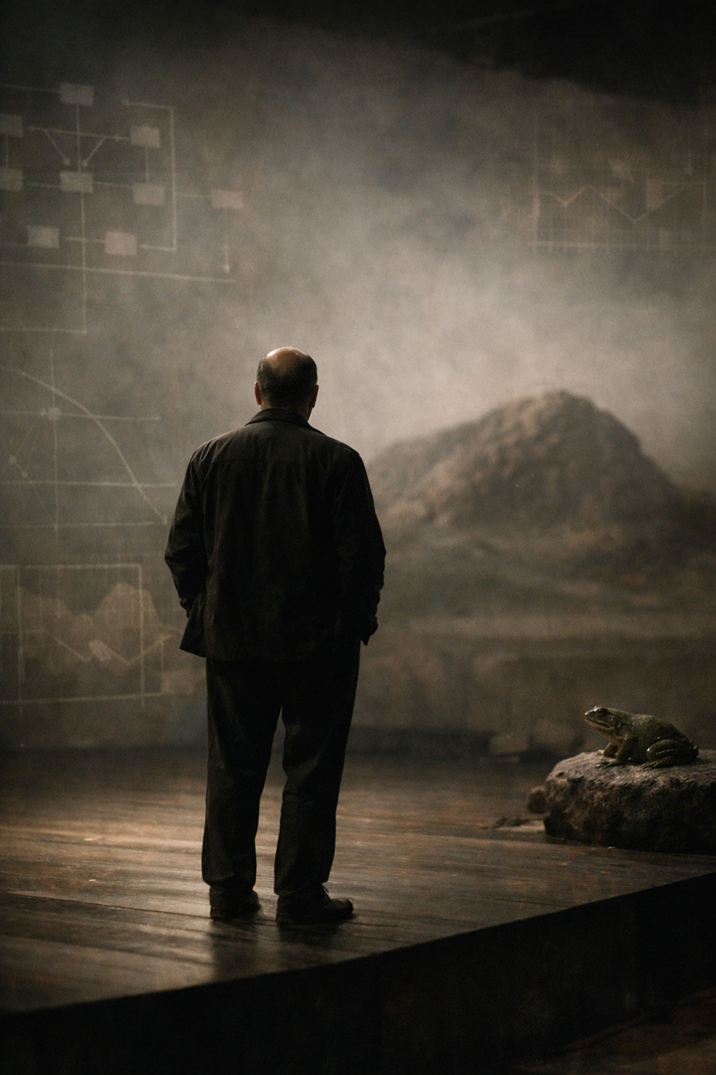
One way to grasp this condition is to imagine being placed under a spotlight on a stage where a play is already in progress. Other actors are speaking, the audience is present, and the plot has been unfolding long before we arrived. We have no script in hand, no rehearsal, and no complete understanding of the role we are expected to play, yet we cannot step off the stage or suspend the performance. We must respond within a scene whose conditions we did not author.

We are thrown into particular families, political orders, economic systems, and cultural expectations, and our responses both inherit and reshape what is already there. Care does not arise after this situation; it is what this situation feels like from within. It is the lived sense that something can go well or badly and that our participation matters.

Finitude and the Logic of Care:

Thrownness alone does not fully explain care. There is a deeper structural condition at work, namely our finitude. Our time is limited, our possibilities can close, opportunities can vanish, relationships can end, bodies can fail, and plans can collapse in ways that cannot always be reversed. The fact that our being is not guaranteed introduces weight into our decisions and seriousness into our commitments.

To clarify this, let’s imagine a being that is all-powerful, all-knowing, and immortal. Such a being could not be surprised, could not be overpowered, and could not ultimately lose anything irretrievably. No possibility would close permanently, no project would be exposed to final failure, and no decision would carry irreversible consequence. In such a condition, urgency would dissolve because everything could be deferred without cost. If nothing can be lost and no time limit constrains action, then nothing presses upon the being with genuine necessity.

Care belongs to creatures for whom something can go wrong and for whom time is not infinite. It emerges from exposure to loss, from the risk of non-being, and from the fragility of our projects. Finitude is not an unfortunate defect added to an otherwise complete existence; it is the condition that gives existence weight. We care because our possibilities are limited and because what we love, build, and pursue can be threatened or taken from us.

Anxiety and the Withdrawal of Meaning:

There are moments when the taken-for-granted coherence of our world loosens and the structures that normally guide us begin to feel uncertain. Projects that once seemed obvious lose their grip, and the background sense of stability that supports everyday action becomes less secure. This experience, often described as anxiety, does not simply signal fear of a specific object. It discloses the fragility of the meaningful framework within which our lives unfold.

 In such moments, we recognize that our projects rest on no final guarantee and that the systems we inhabit are sustained only through ongoing commitment and coordination among finite beings. Meaning is not fixed in advance; it must be enacted and maintained. Care becomes visible precisely because what matters can withdraw, because the ground beneath our projects can shift, and because we ourselves are not permanent fixtures in the scene.

The Structural Tendency Toward Forgetting:

Although anxiety can disclose our condition, we do not live in constant existential intensity. Most of the time, we are absorbed in routines and roles that allow coordination to function smoothly. We rely on procedures, metrics, categories, dashboards, and models that stabilize expectations and guide action. This absorption is not a flaw but a practical necessity for collective life.

However, there is a structural tendency toward forgetting embedded in this stabilization. The structures that were originally created to respond to particular concerns can begin to conceal their own contingency. A model that once addressed a specific risk can come to appear as the world itself. A procedure designed to manage uncertainty can harden into inevitability. The “system” can present itself as though it were independent of the concerns and vulnerabilities that gave rise to it.

Let’s think about how this happens. Every “system” begins as a response to care. A policy is written because someone fears injustice or disorder. A metric is created because someone worries about waste or decline. A reporting structure emerges because coordination is fragile and failure is costly. These structures are attempts to stabilize patterns of concern under conditions of finitude. Over time, however, the origin of these structures recedes from view. Care crystallizes into durable forms, and those forms take on the appearance of objective reality.

When we forget this origin, the system appears neutral and self-sufficient. When we remember it, we see that what looks like neutrality is the sedimentation of past judgments about what matters.

Every System Is a Human System:

We often speak of “systems” as if they were external mechanisms that we observe from the outside, as if we could diagram them from a neutral vantage point. Yet every “system” is described from somewhere, and every model is drawn from within a field of concern shaped by thrownness and finitude.

Even the aspiration to objectivity is animated by care. The language of efficiency reflects awareness of limited resources. The language of safety reflects recognition of vulnerability. The language of growth reflects anxiety about stagnation or decline. Consider what this means in practice: when we choose to optimize for speed, we are implicitly saying that time matters more than some other dimension. When we prioritize safety, we are acknowledging that harm is possible and unacceptable. These are not neutral technical choices. They are expressions of what we care about.

The great cybernetician Heinz von Foerster emphasized that the observer is never fully separate from the system observed and that descriptions participate in the very processes they describe. He wrote:

The essential contribution of cybernetics to epistemology is the ability to change an open system into a closed system, especially as regards the closing of a linear, open, infinite causal nexus into closed, finite, circular causality.

Systems thinking is therefore circular in structure. We talk and think about “systems” because we care about certain outcomes, and those “systems” subsequently shape what we notice, measure, and prioritize. In this sense, every system is a crystallization of existential orientation. It stabilizes certain cares while marginalizing others, amplifies some signals while attenuating others, and renders some consequences visible while leaving others in shadow. To design a “system” is to formalize a pattern of care under conditions of limitation.

Boundary Judgments and Responsibility:

Boundary judgments, which determine what counts as relevant and what does not, are never merely technical decisions. Every boundary protects something and leaves something exposed. Every inclusion privileges a perspective. Every exclusion renders something less visible.

Consider a simple example: when we define the boundaries of a project, we decide which stakeholders matter, which outcomes we will measure, and which risks we will monitor. These decisions are made by finite beings trying to navigate a world that resists them. Responsibility is not an external addition to design but an acknowledgment that design is already an act of care structured by finitude.

We cannot step outside care in order to build a neutral system. Even indifference distributes concern elsewhere. To say that we do not care about one dimension is to care more about another. The question is never whether care is present. The question is how it is structured, and whose finitude it protects.

Systems Under Existential Exposure:

If every system is a human system, then systems thinking itself must remain exposed to the fragility it seeks to manage. We build structures to stabilize coordination, create procedures to reduce uncertainty, and develop metrics to guide action because without such efforts collective life would fragment. Yet no structure eliminates finitude, no optimization dissolves vulnerability, and no model exhausts the world it seeks to represent. The territory can still resist the map, time can still close possibilities, and loss can still occur.

To remember that every system is a human system is to remember that it rests on the shoulders of beings who were thrown into a scene they did not script and who will one day leave it. We design nonetheless, not because we are omnipotent, but because we care.

Final Words:

Systems thinking is not a technical escape from the human condition; it is one of its expressions. We build “systems” because we are vulnerable, we measure because we can fail, we optimize because resources are limited, and we coordinate because fragmentation threatens what we care about. The temptation is to imagine that better design will eventually free us from exposure, yet exposure is the source of design itself. If we were all-powerful, all-knowing, and immortal, there would be nothing to manage, nothing to protect, and nothing to lose.

We are finite beings improvising within an unfinished play whose beginning we did not witness and whose end we cannot avoid. In The Myth of Sisyphus, Albert Camus presents the image of a figure condemned to push a stone up a hill only to see it roll back down. He wrote:

The struggle itself toward the heights is enough to fill a man’s heart. One must imagine Sisyphus happy.

The incline does not disappear and the labor does not end, yet the task is not meaningless. It is lucid engagement with a condition that cannot be abolished. Systems thinking resembles this labor. We redraw boundaries knowing they are provisional, we optimize knowing conditions will shift, and we construct maps knowing the territory exceeds them. Finitude does not dissolve, but neither does care. In choosing to care lucidly and without fantasies of omnipotence, we do not escape the human condition. We inhabit it deliberately and responsibly.

Stay curious and Always keep on learning…

I highly recommend the NLM companion video for this post –
https://youtu.be/lxZcn33-NpM

If you liked what you have read, please consider my book “Second Order Cybernetics,” available in hard copy and e book formats. https://www.cyb3rsyn.com/products/soc-book

Note:

In referencing the work of Martin Heidegger, I want to acknowledge the deeply troubling fact of his affiliation with the Nazi party. This aspect of his life casts a long and painful shadow over his legacy. While I draw on specific philosophical ideas that I find thought-provoking or useful, this is not an endorsement of the man or his actions. Engaging with his work requires ethical vigilance, and I remain mindful of the responsibility to not separate ideas from the broader context in which they were formed.

When the Map Becomes More Coherent Than the Territory:

In today’s post, I am inspired by the ideas of cybernetics, Heidegger, and Taleb. I am looking at what I think is the largest danger of large language models (LLMs).

LLMs are extraordinarily proficient in the domain of language, and that proficiency has quietly created a philosophical problem that most technical discussions fail to notice. They speak fluently, respond coherently, adapt style with ease, and generate text that fits seamlessly into human patterns of explanation and reflection. The danger does not lie in what they get wrong, but in how convincing they are when they appear to get things right. Fluency triggers attribution, and attribution tempts us to confuse linguistic competence with lived understanding. We humans are prone to jump to attributions. We seek purpose in anything and everything.

This confusion is not accidental. Throughout human history, language was never free-floating. It was always grounded in lives that could fail, bodies that could be injured, and situations that demanded response. To speak well was already evidence that one had survived something, endured something, or at least stood in a chain of experience anchored in the world. With LLMs, that historical coupling has been severed. What remains is language without a life.

Cybernetics offers a useful distinction here by separating the domain of coordination from the domain of perturbation. The domain of coordination is where language operates. It is the space of symbols, signs, instructions, and representations that allow systems to align behavior. The domain of perturbation is where the world asserts itself. It is the space of forces, constraints, breakdowns, and consequences that threaten the continued viability of a system. Living systems exist in both domains simultaneously. LLMs exist almost entirely in the former.

Please note that Maturana and Varela talked about languaging as a form of cognitive existence. To me, languaging is existing in both domains simultaneously. This is often missed in the discussion of AI or AGI. The domain of coordination must not be conflated with the domain of perturbation and of lived experience.

Hunger, pain, cold, loss, and social rejection are not messages waiting to be interpreted. They are disturbances that demand coping. They do not coordinate with us and they push back. A living entity must respond to these perturbations in order to remain viable, and it is precisely this necessity to cope that gives rise to meaning. Language emerges as a secondary achievement, a tool for coordinating responses to disturbances that have already been encountered. The “burn” comes before the word “hot.”

LLMs start in the inverse order and they stop where they start. They begin with language and never leave it. They operate in a closed probability space in which words refer only to other words and coherence is rewarded independently of consequence. They do not encounter resistance. They do not face breakdown. They do not have to repair themselves in response to failure in any existential sense. When they are wrong, nothing is at stake for them. No structure is threatened. No viability is endangered. There is no loss to mourn and no urgency to learn.

The existential ideas from Heidegger are indispensable here, because he refuses to separate understanding from involvement. For Heidegger, human existence is not primarily a matter of representation or cognition, but of being-in-the-world. We do not stand outside the world describing it. We are thrown into it. We do not choose the conditions of our arrival, the historical moment, the social structures, or the biological constraints we inherit. We find ourselves already entangled in demands that must be met before they can be explained.

Thrownness is not merely a description of origin. It names the condition that makes understanding possible at all. Because we are thrown, we must cope. Because we must cope, we care. Care, for Heidegger, is not an emotional add-on. It is the structure of existence itself. To be human is to have something at stake, to be concerned with how things turn out, because how they turn out matters to whether we can continue at all. Simply put, LLMs do not care.

Coping is not a flaw or a limitation. It is the source of cognition. We understand the world not by representing it accurately in advance, but by engaging with it practically and discovering, often painfully, where our expectations fail. Heidegger’s notion of ready-to-hand captures this vividly. Tools disappear into use when coping is successful. They become visible only when something breaks. A hammer reveals itself as a hammer not when it works smoothly, but when the handle snaps and the task can no longer continue.

This breakdown is not an interruption of understanding. It is its condition. Reality teaches by resisting us. Please note that I am taking poetic license here and my use of words should not be confused with attribution. Plans collapse, models fail, and language stops working. And in those moments, distinctions begin to matter. We learn what is important because something went wrong. Only cognitive entities that can be broken can learn what matters. This is simply the living condition.

LLMs cannot break in this way. They are not thrown and they do not cope. They do not have to maintain their own viability in the face of an indifferent world. They do not care, not because they are unethical or incomplete, but because care arises only where existence is at risk. This is why appeals to giving them more data or richer representations miss the point. The difference is not quantitative. It is categorical.

This also clarifies why certain philosophical slogans become dangerous when misapplied. Wittgenstein’s line, “The limits of my language mean the limits of my world,” is often invoked to suggest that language generates experience. But Wittgenstein was speaking about humans, beings already embedded in the world, already coping, already affected. Language limits what can be articulated about experience. It does not produce experience itself. To apply this claim to a system that has language without world is to collapse experience into description and mistake coordination for contact.

I have often noted the temptation to treat information as a commodity. We are prone to think that if language is sufficient for understanding, then knowledge can be accumulated without exposure, transferred without risk, and optimized without consequence. But cybernetics resists this move. Understanding is not stored in representations. It emerges in systems with histories of interaction, failure, and recovery. Meaning arises where distinctions have consequences.

This is where I bring in Taleb’s notion of “skin in the game,” which aligns naturally with both cybernetics and Heidegger. Knowledge without exposure to consequence is brittle. Assertions made without risk are cheap. LLMs produce language without skin in the game by design. The danger arises when humans, who do live in the domain of perturbation, begin to orient themselves toward that language as if it carried the weight of lived understanding.

Final Words:

The real risk is not that machines will become more human, but that humans will begin to forget what makes their own understanding possible. When linguistic fluency is privileged over coping, when clean summaries are trusted over messy lived accounts, when the map is preferred because it is easier than the territory, we drift away from the conditions that give meaning to knowledge at all.

Since LLMs do not cope, and have no need for care, we should not assign them responsibilities where care is required. Care is not a functional add-on that can be simulated through better language or richer models. It arises only where existence is exposed to risk, where failure has consequences, and where something can be lost. There is currently a great deal of discussion about the role of AI and the possibility of AI replacing humans. Much of this discussion quietly assumes that agency can be transferred wherever competence appears. This is a serious mistake!

The use of LLMs lies exclusively in the domain of coordination and language. They can generate possibilities, assist with articulation, and operate within representational spaces at a scale no human can match. But to conflate this capability with human agency, and to assign responsibilities that presuppose care, concern, or accountability, is a terrible idea. Responsibility belongs to entities that can be held answerable by the world, because the world can push back on them.

Only entities that can be broken can learn what matters. Humans are such entities. This vulnerability is the ground of responsibility, ethics, and meaning. The task, then, is not to teach machines how to live, but to remember, in the presence of their fluency, that living is something language can point to but never replace.

Stay curious and Always keep on learning…

If you liked what you have read, please consider my book “Second Order Cybernetics,” available in hard copy and e book formats. https://www.cyb3rsyn.com/products/soc-book

Note:

In referencing the work of Martin Heidegger, I want to acknowledge the deeply troubling fact of his affiliation with the Nazi party. This aspect of his life casts a long and painful shadow over his legacy. While I draw on specific philosophical ideas that I find thought-provoking or useful, this is not an endorsement of the man or his actions. Engaging with his work requires ethical vigilance, and I remain mindful of the responsibility to not separate ideas from the broader context in which they were formed.

Information from a Cybernetic Viewpoint:

In today’s post, I want to revisit the notion of information from a cybernetic viewpoint, drawing primarily from Gregory Bateson’s well known formulation that information is the difference that makes a difference. This definition does not merely redefine information. It quietly displaces where information is assumed to reside and how it is assumed to function. This post is part of a series examining a cybernetic approach to tackling misinformation.

In everyday discourse, information is commonly treated as a thing. We speak of information being transmitted, stored, corrupted, lost, or controlled. This language suggests that information exists independently of those who encounter it, as if it were a commodity that can be packaged and delivered. Cybernetics has long resisted this framing, not by denying the existence of data in the form of signals or messages, but by insisting that information cannot be separated from the consequences it produces within a system.

Bateson’s phrasing forces a pause because it contains two differences, not one. These two differences are often collapsed into a single gesture, which obscures what cybernetics is trying to put more light on. To understand information cybernetically, these differences must be held apart and examined in relation to the observer, the context, and the viability of the system involved.

The first difference concerns distinguishability, or the ability to make distinctions. For a difference to exist as a difference, it must be generated or recognized by an observer. This does not mean that the world lacks structure or regularity. It means that distinctions do not announce themselves independently of the capacities and concerns of the cognitive observer encountering them. An observer must be able to draw a distinction for it to count as a difference at all.

This ability to distinguish is not abstract or universal. It is shaped by history, embodiment, training, and present need. In cybernetic terms, this is a question of variety. An observer with limited internal variety cannot register certain distinctions, regardless of how obvious they may appear to another observer. What fails to be noticed is a mismatch between the variety available and the variety required.
This immediately situates information within the notion of context. A difference that matters in one situation may be invisible or irrelevant in another. The same signal can be richly informative for one observer and entirely inert for another. From this perspective, the problem of information overload is often misdiagnosed. What overwhelms is not the quantity of differences but the absence of appropriate distinctions and filtering mechanisms within the observer.

The second difference concerns consequence. Not every distinction that can be made will matter. A difference becomes information only when it participates in altering the state, orientation, or activity of the cognizing “system”. This is where the second difference enters, the difference made by the difference.
Cybernetically, this is best understood in terms of viability. A difference matters when it bears upon the conditions under which a cognizing “system” continues to operate. It may support stability, signal threat, invite adaptation, or require reorganization. A distinction that does not affect viability may still be noticed, but it does not rise to the level of information in Bateson’s sense.

In a pragmatic turn, this reframing moves information away from correctness and toward consequence. It is not enough for a distinction to be accurate or well formed. It must matter in practice. Information is therefore tied directly to action potential, even when that action takes the form of restraint, delay, or reconsideration.

Between these two differences sits transduction. Whatever perturbation occurs in the environment does not arrive as meaning. It must be transformed through the structures of the observer. This transformation is neither passive nor optional. It is how a system turns disturbance into significance.

Transduction is deeply contextual and personal, without being arbitrary. It reflects the ways in which a system has learned to respond to its surroundings. Two observers may be perturbed by the same event, yet transduce it differently because their histories, expectations, and responsibilities differ. Meaning is not extracted from the world. It is enacted through ongoing structural coupling.

This is why information cannot be cleanly separated from the observer. What appears as the same input can lead to entirely different informational outcomes. To speak of information without speaking of transduction is to quietly reintroduce representational assumptions that cybernetics sought to set aside.
This leads naturally to the notion of informational closure. As Heinz von Foerster put it, the environment is as it is. It does not contain information waiting to be picked up. It contains events, regularities, and disturbances. Information arises only within operationally closed systems as a result of their internal changes in response to perturbation.

From this viewpoint, information is not transmitted. Signals may pass between systems, but information happens only when a system changes in a way that matters to it from the perturbation. What is stored are not information units but traces that may later participate in new acts of distinction. This undermines the idea of information as a substance that can be accumulated or depleted independently of the systems involved.

Human communication introduces an additional layer through language and social coordination. For a difference to make a difference in a social context, participants must be engaged in overlapping language games. Meaning does not reside in words alone but in shared practices, expectations, and forms of life.
Error correction, in this sense, does not occur in the signal but in interaction. A message is understood not because it is decoded correctly, but because the receiver anticipates what is likely to be meant and adjusts that anticipation through feedback. Reading a doctor’s cursive prescription is a familiar example. The pharmacist does not decipher letters in isolation. They draw upon knowledge of past interactions with the doctor, medications, dosages, and common medical practice. Understanding emerges from participation, not from transmission.

All of this brings us to a final consideration that is often neglected because it does not present itself as information at all. This is the question of slack. For a difference to make a difference, there must be sufficient room within the system for it to be taken up. This slack can appear in several forms. It may take the form of redundancy, where a distinction is encountered through multiple channels or repetitions. It may appear as amplification, where the manner of presentation gives the difference sufficient weight to register. It may also appear as relaxation time, where the system is afforded the temporal space to digest what has occurred.

Without some degree of slack, even meaningful distinctions fail to become information. When perturbations arrive faster than they can be transduced, the system does not become more informed. It becomes saturated. What follows is not heightened responsiveness but withdrawal. The system in many regards learns that responding no longer contributes to viability.

Relaxation time is particularly important in this regard. There was a period when news arrived with built in pauses. A morning paper or an evening broadcast created a rhythm that allowed distinctions to settle. Between these moments, there was time for discussion, reflection, and forgetting. That rhythm provided slack and maybe allowed for a more congenial political climate.

The continuous, twenty four hour cycle of today’s media, in which opinion often masquerades as news, has steadily eroded this condition and altered the political landscape in ways that reward polarization and immediacy. Nowadays, perturbations arrive without pause, and the responsibility for digestion has been shifted entirely onto the observer. The result is a familiar paradox. As reports of suffering increase, the capacity to respond meaningfully diminishes. Perturbations may accumulate, but few of them make a difference.

This is often described as complacency or moral failure. From a cybernetic viewpoint, it is more accurately described as a collapse of the conditions under which information can occur. The system is overwhelmed beyond its capacity to transduce, and indifference emerges as a protective response. This leads to the conditions for the medium to become the message.


Final Words:
If information is not a commodity, then neither is attention. Both depend on proportion, timing, and care. Environments that destroy slack while demanding responsiveness do not produce better informed observers. They erode the very capacities required for differences to make a difference.

Seen this way, the preservation of informational conditions is not merely a technical concern. It is an ethical one, bound up with how we design systems, share responsibility, and allow meaning the time and space it requires to emerge.

Stay curious and Always keep on learning…


If you liked what you have read, please consider my book “Second Order Cybernetics,” available in hard copy and e book formats. https://www.cyb3rsyn.com/products/soc-book

Throwing the Fish Back into the Water:

In today’s post, I am refining my thoughts on reentry as a wonderful tool to tackle cognitive blind spots. A common saying goes that a fish does not know it is in water. The phrase is usually offered as a comment on unexamined assumptions. The fish is fully immersed in a medium that makes its life possible, and yet that very immersion renders the medium invisible. We the observers, standing outside the water, can easily point to what the fish cannot see.

The metaphor is useful, but only if we do not misunderstand what it implies. The problem is not ignorance in the sense of missing information. The problem is immersion, being inside the loop and not being aware of it. In other words, I am positing that cognitive blind spots arise not because we lack data, but because we fail to notice the conditions under which noticing itself takes place. We assume that observation is independent of the observer, and in doing so, we negate the very act that makes observation possible.

This negation is not accidental. It is built into many of our conceptual frameworks.

Cognitive Blind Spots and the Negated Observer:

In this view, a cognitive blind spot appears when a distinction is treated as if it exists independently of the act that produced it. We speak as though there is an object “out there” and an observer “in here,” and as though the observer merely reports what is already the case. This framing quietly removes the observer from the scene by denying that the act of description must re-enter the conditions it describes.

Once the observer is negated, the distinction hardens and begins to appear as a feature of the world itself. What began as a practical cut in experience is mistaken for something given rather than constructed. At that point, the blind spot is complete. There is nothing left to question because the conditions of questioning have disappeared.

This is precisely where re-entry becomes relevant.

Re-entry as a Mechanism for Error-correction:

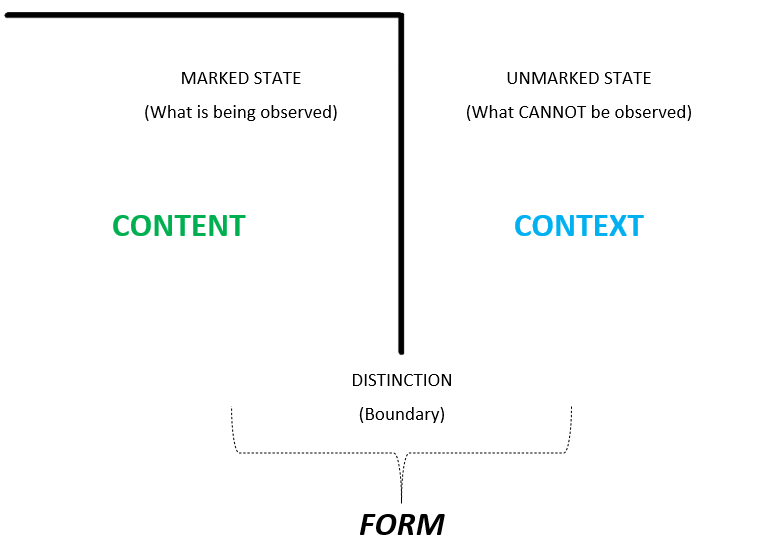
Spencer-Brown’s notion of re-entry does not simply add complexity for its own sake. It forces a distinction to turn back upon itself. A form re-enters the space it distinguishes. The marked state is no longer allowed to pretend that the unmarked state is irrelevant or absent. Reentry is an attempt to bring the act of distinction itself into view.

Re-entry is uncomfortable because it breaks the illusion of a clean separation. It exposes the fact that every distinction carries its own conditions inside it. What we thought was a stable category now reveals its dependence on an operation. This is why re-entry is such a powerful tool for revealing cognitive blind spots. It does not offer a better description of the world. It shows how our descriptions are made, and what they quietly exclude in order to function. Once this lens is applied, certain familiar structures begin to look less secure.

The Subject/Object Split and Being in the Water:

The subject/object dichotomy is one such structure that we can use to expand on this line of thinking. It assumes that there is a knowing subject on one side and a known object on the other, connected by representation. From a Heideggerian perspective, this is already a distortion. We are not subjects standing over against a world of objects. We are always already being in the world.

The fish is not first a subject and then later related to water as an object. Fish and water show up together. The relation is not secondary. It is constitutive. Remove the water and the fish does not remain as a fish that merely lacks an environment. It ceases to be what it is.

Re-entry makes this visible. When the observing system is reintroduced into the observation, the subject object split begins to collapse. What remains is participation, involvement, and structural coupling. Observation is no longer a neutral act. It is an activity performed from within the medium it seeks to describe. We will use this line of thinking to examine another familiar idea in philosophy from Charles S. Peirce.

The Triad and the Problem of Firstness:

Peirce’s triad of firstness, secondness, and thirdness is frequently described as dynamic and non-linear. However, when examined through the logic of distinction and re-entry, the triad reveals a fundamental instability. That instability is most clearly exposed in the notion of firstness.

Consider a simple example: a red apple. Its redness is firstness, the immediate quality that appears without reference or comparison. The apple itself, as a physical object that resists gravity and interacts with us, illustrates secondness. The recognition that the apple is a fruit, part of a category, and meaningful within a broader system of relations exemplifies thirdness. Even here, we see the dependence of firstness on context; its pure quality only becomes intelligible through interaction and relation.

Firstness is described as pure quality, pure possibility, or pure feeling, intended to stand prior to relation, reaction, or mediation. What follows from this is not only an empirical difficulty but also a logical one.

From a Spencer-Brown standpoint, nothing can appear without a distinction. A distinction simultaneously produces a marked state and an unmarked state. There is no marked state by itself, just as there is no distinction that does not also imply what it excludes. When one speaks of “good,” the notion of “not good” is already present as its context. “Good” by itself has no meaning. Even our most absolute categories depend on what they deny, as the invention of God quietly presupposes the invention of Evil.

If firstness is spoken of at all, it has already been marked. The moment one says “firstness,” one has drawn a boundary around something and set it apart from what it is not. That act already presupposes contrast. It already invokes relation. It already smuggles in what Peirce would later call secondness and thirdness. The triad never leaves the water it claims to describe.

If there is no distinction, there is no information. Without contrast, there is nothing to register. Pure undifferentiated “information” is not information. It does not inform. It does not appear. It does not function. In that sense, pure firstness is not just unreachable in practice, it becomes incoherent in principle.

The problem is not one of interpretation but of structure. The triad depends on a move that collapses under re-entry. Firstness cannot exist in isolation, yet the triad requires it to.

Re-entry Exposes the Blind Spot:

Here is where the cognitive blind spot becomes “visible”. The triad purports to articulate the conditions of experience while remaining blind to the operation that makes them appear. Firstness is treated as if it could exist prior to distinction, while the very articulation of firstness performs the distinction it denies.

Re-entry forces the concept to confront its own conditions. When firstness re-enters the space of its own description, it collapses into relation. It cannot remain alone. It cannot stay pure. It cannot avoid invoking what it claims to precede.

In this sense, the triad is flatter than it appears. Not because it lacks movement, but because its movement never quite escapes the logic of classification. Re-entry reveals that the flow Peirce gestures toward is already constrained by the need to name and separate what is being described.

Final Words:

The point of this critique is not to replace one framework with another. It is to show how certain blind spots persist even in sophisticated theories. When distinctions are treated as if they precede the act of distinction, the observer disappears. When the observer disappears, responsibility disappears with it.

Re-entry restores that responsibility. It reminds us that our concepts are not mirrors of reality, but tools we use from within the world we inhabit. Like the fish in water, we do not escape the medium by describing it. We only learn to see it by noticing how our seeing works. That seems to be the deeper utility of re-entry. The goal is not to produce better categories, but to cultivate a deeper awareness of how categories emerge. It is not purity, but participation. It is not firstness untouched by relation, but the recognition that relation is always already present. Seeing the water does not mean leaving it. It means acknowledging that one was never outside it to begin with.

Stay curious and Always keep on learning…

Post script:

Further clarification on the following statement – Re-entry reveals that the flow Peirce gestures toward is already constrained by the need to name and separate what is being described.

Peirce presents the triad as something dynamic and flowing rather than static. Firstness flows into secondness, secondness into thirdness, and so on. However, when you apply re-entry, you see that this apparent flow is already limited by the act of naming the categories in the first place. The moment you say “firstness,” “secondness,” and “thirdness,” you have already separated what you claim is flowing. The movement is therefore happening inside a framework that has already been cut up by distinctions.

So the “flow” Peirce gestures toward is not free movement within experience itself. It is movement between pre-named compartments. Re-entry exposes that the triad cannot escape the logic of distinction because it depends on that logic to exist at all.

In other words, the triad looks process-oriented, but it still operates as a classificatory scheme. The flow is real only insofar as the categories have already been stabilized by naming and separation. That is the constraint.

On Self-Deception in Systems Thinking: A Kierkegaardian Mirror

AI Generated

In today’s post I want to spend time with Søren Kierkegaard. I have been interested in his ideas because he occupies an unusual place in the history of thought. He is considered a pioneer of existentialism, and yet he is also a man of faith. Most of the existentialist thinkers who followed him, including Sartre, built their philosophies around radical freedom and human responsibility without any reference to faith at all. Kierkegaard stands in the middle of this tension. He writes from a position of uncertainty and responsibility, but he also lets faith shape his understanding of what it means to be human. This combination gives his work a kind of depth that is difficult to classify. It also gives us a set of ideas that speak directly to the act of thinking, especially when we try to think in ‘systems’.

Thinking in ‘systems’ is often presented as an attempt to arrange the world into a coherent whole. We are encouraged to draw maps, diagrams, and loops that claim to show how everything is connected. These maps have their value, but they also create the illusion that understanding is a matter of fitting pieces together. They invite us to believe that if we only had the right model, the right picture, or the right mission statement, then clarity would follow. But the thinking domain is not the physical domain. Thoughts are not puzzle pieces, and ideas do not snap together neatly. There is no final picture on the box to guide. There is only the ongoing work of trying to understand a world that will not hold still long enough to be captured by a diagram.

Kierkegaard seems to have understood this difficulty quite well. He believed that the greatest danger in human life is self-deception. We long for the comfort of clarity, so we often rush to declare purposes and principles. For Kierkegaard, becoming a self is not a matter of adopting a slogan. It is a lifelong task shaped by inwardness, responsibility, and the willingness to face ambiguity without trying to escape it. Our authenticity comes from this attempt. This is why he would be deeply suspicious of systems that claim to explain everything. For him such ‘systems’ flatten the complexity of human experience. They offer a kind of intellectual reassurance, but they do not help us live.

One of Kierkegaard’s most striking ideas is that life can be understood only by looking backward, but it must be lived forward. Understanding in this regard is a retrospective act. It is something we do when we look back and discover patterns in what has already happened. But living is always forward. It takes place in a stream of uncertainty, where choices must be made without guarantees and where the meaning of those choices often remains unclear until much later. This observation challenges the entire idea of systemic coherence. Systems maps work backward. They create a picture of causality after the fact. They explain what has been, but they do not show us how to live into what is unfolding. They provide a sense of structure, but this structure is largely retrospective.

This backward–forward tension reveals why the search for a perfectly coherent system is misguided. Human life does not unfold according to a diagram. Thinking does not progress by assembling pieces into a single whole. We understand our experiences only after we have lived through them. The clarity we draw from models and mission statements can therefore be misleading. It can be useful as a reflection, but it should not substitute for the lived experience of confronting ambiguity in the moment. Kierkegaard’s insight makes the entire project of declaring a mission or a golden why feel somewhat naive. These declarations claim to give direction, but direction is not something that can simply be proclaimed. Direction must be discovered through the way we participate in the world.

Another of Kierkegaard’s central ideas is that truth becomes meaningful only when it is appropriated inwardly. Truth is not something imposed from above. It must be taken up, lived, wrestled with, and made one’s own. A beautifully crafted mission statement does not create meaning. A polished systems map does not create understanding. These are only starting points. Understanding arises only when individuals confront their own limitations, their own anxieties, and the tensions that shape their experiences. For Kierkegaard, this inward appropriation is the essence of responsible living. It is also the key to responsible thinking.

Kierkegaard’s view of anxiety deepens this idea. Anxiety is not simply fear. It is the feeling that arises when one realizes one must freely choose. It is the dizziness of possibility. In the context of thinking, anxiety shows up when we face the limits of our understanding, when we recognize that we must choose what matters, and when we realize that there is no system neat enough to relieve us of that responsibility. Many organizational declarations are attempts to soothe this anxiety. They create a picture of direction that allows people to avoid the discomfort of thinking for themselves. But Kierkegaard would say that this discomfort is precisely where thinking begins.

This gives us a different language for cognitive blindness. Blindness is not only a matter of not seeing. It is often a refusal to see, a retreat into the comfort of prefabricated clarity. Thinking asks us to approach our blindness with curiosity rather than defensiveness. It invites us to engage with the friction that reveals what we had overlooked. Systems thinking, when practiced responsibly, is not about drawing neat maps. It is about cultivating the openness required to encounter what does not fit and the humility to revise our sense of the world when confronted with surprise.

Final words:

In the end, Kierkegaard helps us see that thinking is not the work of fitting pieces together. It is the work of becoming a self, which requires inwardness, responsibility, and the willingness to live with ambiguity. He reminds us that life unfolds forward while understanding works backward. This simple observation exposes the limitations of any attempt to impose a coherent system on a world that is always in motion. Mission statements and golden whys can be helpful beginnings, but they often promise clarity without cultivating the character and perception that make clarity meaningful.

The point is not to reject purpose or systemic awareness. It is to hold our purposes lightly, to allow our thinking to be shaped by our experiences, and to accept that ambiguity is not a failure of insight but a condition of life. Systems thinking, when grounded in Kierkegaard’s lessons, becomes a stance rather than a diagram. It becomes a way of approaching the world with patience, honesty, and a readiness to see differently. This path is demanding, but it is also the one that keeps us awake to the depth and complexity of being human.

Stay curious and Always keep on learning…

On Diversity as a Cybernetic Necessity:

AI Generated

In today’s post, I want to explore an idea that often gets framed in moral terms but is actually a cybernetic imperative: the necessity of diversity for viable systems. Whether we are talking about societies, organizations, or even artificial intelligence systems, the principle remains consistent. A system that suppresses differences suppresses the very disturbances that give it life.

This insight comes from cybernetics, and it helps us understand why diversity matters beyond moral arguments.

The Cybernetic Case for Diversity:

A society’s resilience and therefore viability emerges more from difference than agreement. When I think about what makes communities sustainable over time, I keep returning to this basic insight from cybernetics: without variation, a system cannot absorb disturbance. This is of course a simpler rephrasing of Ashby’s Law of Requisite Variety. Without challenge, a system cannot correct itself. Without friction, a system cannot renew its distinctions.

This becomes clearer when we think about information, distinction, and correction. Every observer draws distinctions. Every distinction creates a horizon of what can be noticed next. Every act of understanding sets the conditions for future understanding. For this reason, no observer, no community, and no language can remain viable without exposure to other perspectives. A view from nowhere is an impossibility.

Difference is not an obstacle to communication. Difference is what makes communication meaningful. As Gregory Bateson described it, information is the difference that makes the difference.

A community that supports only one way of thinking, one way of speaking, or one way of being slowly loses the very conditions that allow it to remain viable. When everyone thinks alike, quality begins to decay. Ideas become smoother but thinner. Creativity does not disappear because people stop trying. Creativity disappears because nothing pushes back. Nothing resists. Nothing surprises.

I have written before about von Foerster’s ethical imperative to increase the number of choices. Here, I want to extend that thinking to show why diversity itself is a condition for viability, not merely a moral preference.

The Negotiable Space:

A society with many ways of speaking has many ways of seeing. It has many ways to reframe a problem, many ways to interpret events, many ways to challenge assumptions, and many ways to correct errors. It is able to sustain what I call a “negotiable space” in which ideas can be contested, sharpened, and sometimes abandoned.

This continual negotiation is what keeps concepts alive. It is what makes meaning robust. It is what makes a collective capable of navigating uncertainty.

The negotiable space is the environment in which language, ideas, and understanding evolve and error correction happens. It is created not by agreement but by the friction of difference. Human cognition is not viable in isolation. It is viable only when embedded in a world where every utterance is exposed to other minds – resisted, questioned, corrected, or refined.

I see this friction as the medium of viability. When someone challenges your idea, asks for clarification, or pushes back against an assertion, they are not merely disagreeing. They are sustaining the recursive loop that keeps understanding alive. Without friction, distinctions decay. Without challenge, knowledge becomes brittle.

A word is never alone. It survives only through the continual friction of conversation. It carries a lineage of previous uses and a horizon of possible future uses. It remains viable only because a social world holds it accountable.

When Homogeneity Replaces Diversity:

When we reduce the diversity of perspectives, the negotiable space begins to shrink and close. Without enough difference, language becomes flatter. Categories become rigid. Distinctions become dull. Error correction becomes weak. The collective loses the source of renewal that once made it resilient.

Attempts to homogenize societies have produced similar outcomes throughout history. They create environments that look orderly from the outside but are fragile from the inside. Homogeneity amplifies the illusion of stability while stripping away the mechanisms that produce actual stability. A system without variation becomes a system without resilience. It stops promoting learning and staying curious. It stops promoting error correction. Eventually it stops being able to sustain itself at all.

We see this pattern repeat across contexts. A social world in which every voice echoes the same pattern begins to collapse inward. Its range of distinctions shrinks. Its ability to adapt weakens. Its capacity to navigate uncertainty fades.

Recursion Requires Disturbance:

In cybernetics, stability is not the absence of disturbance. Stability is the capacity to absorb disturbance without collapse. This requires variation. It requires the presence of alternatives. It requires a dynamic interplay of perspectives.

A system that eliminates disturbance does not become more stable. It becomes brittle. Without contradiction, the recursive loop of understanding begins to stagnate. Without challenge, the distinctions that support cognition degrade. Without tension, the structures that produce meaning weaken.

Human cognition remains viable because its recursion is continually informed by a social world rich in disagreement. An individual does not refine understanding alone. Understanding is sharpened by exposure to other interpretations. These interpretations emerge from diverse backgrounds, diverse experiences, and diverse cognitive histories.

I want to now take this train of thought to Large Language Models.

The Case of Large Language Models:

Large language models are often described as systems that learn from vast amounts of data. But what they learn is not raw experience. They learn from the residue of human meaning-making. They learn from language that has already passed through the recursive loops of human correction. They inherit the stability produced by these loops, but they do not participate in the loops themselves.

At least, not in the same way.

An artificial intelligence does not inhabit a social world where its utterances are corrected by others. It does not participate in the negotiable space through which language evolves. It does not receive feedback proportional to the scale of its output. It does not face the resistances that keep human cognition aligned with the world. This is an important distinction that leads to interesting outcomes.

A human remains viable because every use of language is exposed to correction. An AI remains unchallenged because its output overwhelms the capacity for correction to flow back.

The Collapse of the Negotiable Space:

A living language depends on a balance between output and correction. Human linguistic communities have historically generated meaning at a rate the community can digest. New terms emerge. Old terms fade. Misunderstandings provoke clarification. Disagreements produce refinement.

This equilibrium gets disrupted. The scale of machine-generated text has exceeded the capacity of human communities to critique it. The negotiable space, the space where meaning is contested and corrected, is now flooded. Variations in meaning that once signaled novelty are now drowned in statistical smoothness. The framework receives too much of its own output and too little balanced resistance.

A framework that receives little correction cannot maintain the integrity of its distinctions. It will start to drift. It will begin to feed on its own unchallenged productions. The range of distinctions therefore shrinks. The recursive loop that once sharpened meaning begins to flatten it.

At first the effects are subtle. Over time, the trajectory becomes clearer. A structure that cannot renew itself through grounded critique will drift toward diminishing returns. More scale will not resolve this. Faster generation will only accelerate the loss of the very conditions that once made the system appear intelligent.

Here, we see what I call the amplification of constraints in action: the model grows in output yet declines in viability. It is simultaneously expansive and fragile.

The Coming Burst:

All this seems to indicate that the AI bubble may burst in the near future. The ability of LLMs to be trained fast and to generate fast may become their downfall. Paradoxically, the better the large language model becomes, the faster this downfall may approach. Each improvement accelerates the collapse of the negotiable space. Each refinement increases the volume of uncorrected output flowing back into the system. Each new iteration tightens the closure that limits its future.

This is also a cautionary insight for societies that reject diversity and embrace homogeneity. Any system that narrows its space of variation, whether a community or a computational model, risks collapsing under the weight of its own uniformity.

The burst may come not because the models are weak, but because they are strong in the wrong direction. They refine themselves into a narrowing corridor. They amplify a recursion that cannot sustain itself. They accelerate toward diminishing returns.

The Lesson for ‘Systems’ Design:

Human cognition has survived because it is recursive from the inside and is in a social realm. Artificial intelligence’s recursion is lifeless. This difference matters. A system that does not participate in the social negotiation that gives words their life cannot maintain the vitality of its distinctions. It cannot renew its closure through lived coordination with others. It can only repeat the patterns it has been given.

Large language models may not become artificial general intelligence by accelerating the very process that undermines their viability. They are not suited to replace the human capacity for negotiated meaning-making. Their true value lies in augmentation, not imitation. They support human thought. They do not replace the recursive, socially grounded, diversity-dependent mechanisms that make human thought viable.

Every viable system must remain open to disturbance. The observer must remain open to being surprised. The language community must remain open to contradiction. A system that avoids disturbance does not stabilize, it stagnates.

Final Words:

The warning is clear for both machines and societies: maintain openness, embrace difference, and preserve the friction that keeps life viable.

A system without diversity collapses.

A recursion without resistance decays.

A language without a negotiable space drifts into incoherence.

This is not merely about being open-minded or tolerant. It is about understanding the conditions that allow any system (biological, social, or computational) to remain viable over time. Diversity is a cybernetic requirement. Without it, we lose the capacity to correct ourselves, to adapt, and ultimately, to survive.

Always keep learning…

Minimizing Harm, Maximizing Humanity:

In today’s post, I am looking at a question that is rarely asked in management. What if the most responsible course of action is not to maximize benefit, but to minimize harm? In decision theory, this is expressed as the minimax principle. The idea is that one should minimize the worst possible outcome. In human systems, that outcome is best understood as harm to people, relationships, and the invisible infrastructure that sustains collective work.

The language of management is often dominated by the pursuit of gains. Leaders are taught to ask what is the best that can happen. They are told to optimize, to scale, and to seek advantage. The minimax principle turns this question around. It asks instead what is the worst that can happen and how do we prevent it. Every decision about maximization must be evaluated through the lens of minimizing harm. Harm minimization is not a boundary condition but the primary ethical directive that governs all other management decisions.

Russell Ackoff once observed that the more efficient you are at doing the wrong thing, the wronger you become. This statement captures the ethical inversion at the heart of many managerial failures. The pursuit of maximum gain often blinds organizations to the quiet forms of loss that accumulate in the background. Human systems depend on tacit networks of trust, communication, and mutual adjustment. When efficiency cuts too deeply, these invisible infrastructures collapse. The system loses its ability to adapt.

To minimize maximum harm is not to resist change. It is not an invitation to stand still. Rather, it is a recognition that progress and ethics operate according to different logics. Progress concerns improvement and expansion. Ethics concerns the protection of dignity, agency, and reversibility. Once we place harm minimization at the center of our decisions, progress becomes sustainable because it no longer depends on exploitation or exclusion.

The primary ethical directive to minimize harm requires a clear operational principle. Heinz von Foerster provided this principle with remarkable clarity- I shall act always so as to increase the number of choices. This is not a secondary value. This is how harm minimization is operationalized.

Consider what happens when choices are available. When options remain open, people retain the capacity to move in different directions. They can experiment, observe the results, and if those results prove harmful or undesirable, they can try a different direction. This is reversibility. It is not that decisions are undone but that people are not locked into a single path with no way out. Reversibility means the system retains the capacity to self-correct. This becomes an integral part of being viable.

When choices are removed, a different logic takes hold. A decision made under constraint, with no alternatives available, becomes irreversible. The person cannot change course because there is no other path to take. The harm accumulates and cannot be addressed through adaptation or choice. This is an important distinction. To minimize harm is to preserve the optionality that allows people to respond when things go wrong. When you increase the number of choices available to people, you prevent harm from becoming locked in place. You maintain the possibility of recovery. You keep open the horizon of possibilities. The person is not left to say I had no choice, which is the expression of the deepest form of harm, the harm from which there is no escape.

This means that every decision about maximization or progress must be evaluated through this lens. Does it increase or decrease the number of choices available to people? Does it preserve reversibility or does it close off futures? Does it prevent irreversible harm or does it create conditions from which recovery is impossible? This is how we operationalize the primary ethical directive in practice.

Werner Ulrich’s Critical Systems Heuristics extends this insight into a framework for reflective practice. Ulrich reminds us that every system boundary includes some and excludes others. Those excluded often bear the consequences of decisions without having had a voice in making them. Ethics therefore requires that we identify who loses in the system we design. Ethics requires that we act in ways that allow their participation and emancipation. To preserve choice is to protect those at the margins of decisions. It is to recognize that moral responsibility lies in how boundaries are drawn. When we ask who loses, we are asking a minimax question. We are asking what is the worst that can happen for those at the margins.

To some, the minimax principle might sound like a cautious philosophy, one that restrains progress. This would be a misunderstanding. The aim is not to prevent change but to cultivate conditions under which change can occur without catastrophic harm. Here the insights of Magoroh Maruyama are valuable. In his work on second cybernetics, he distinguished between negative feedback processes that regulate deviation and positive feedback processes that amplify it. He noted that deviation amplification is the essence of morphogenesis. Not all deviations are errors to be corrected. Some are the sources of new order and innovation. Ethical design therefore should not eliminate deviation but create conditions in which positive deviation can be generative without catastrophic harm. To minimize maximum harm is not the same as to minimize deviation. It is about preserving the space in which positive deviation can arise safely.

Von Foerster’s imperative and Maruyama’s insight converge here. Both point toward the idea that ethics in complex systems must not suppress variety. Von Foerster’s view was that more freedom comes with more responsibility. When we create systems that expand choice, we simultaneously increase the responsibility of those who act within them. The ethical task is not to eliminate risk but to manage it in a way that nurtures diversity and growth while protecting the conditions of future choice. To design ethically is to create the space in which deviation, learning, and emergence can unfold without irreversible harm.

Behind every visible structure of management lies an invisible infrastructure. It consists of relationships, trust, informal knowledge, and the tacit coordination that keeps work alive. This infrastructure is often taken for granted. It is noticed only when it breaks down. In the pursuit of efficiency, organizations frequently erode these invisible supports. Staff reductions, rigid procedures, and mechanistic control can destroy the very human capacities that enable adaptability and resilience. The question therefore is not what can be gained but what can be lost without recovery. True resilience depends on maintaining the conditions that allow the system to heal itself. When we ask this question, we are asking what choices we are removing from people. We are asking what futures we are closing off.

It is important to distinguish ethics from progress. Ethics does not belong to the domain of progress. Progress concerns the expansion of capability. Ethics concerns the preservation of humanity. The two may coexist, but they are not the same. Progress without ethical constraint risks creating conditions from which recovery is impossible. Ethics without openness to change risks paralysis. The minimax principle, interpreted through von Foerster and Ulrich, provides a way to hold both. It calls for action that reduces maximum harm while sustaining the capacity for continued evolution.

Maruyama’s perspective deepens this understanding. By allowing positive deviation, we cultivate the potential for new forms of order. By preserving choice, we protect against harm that would close the future. The task of management therefore is not to optimize the present but to sustain the possibility of better futures without destroying the diversity from which they may emerge.

Ackoff’s view was that the future is not something to be predicted but something to be designed. The ethical responsibility of design is to ensure that this future remains open. To minimize maximum harm is to recognize the fragility of what is human in our systems. To preserve choice is to keep open the horizon of possibility. To embrace positive deviation is to invite emergence without destruction. Ethics in management is not about perfection or certainty. It is about maintaining the delicate balance between care and change.

Final Words:

When compromises are inevitable in human systems, the most humane path is to protect what allows us to begin again. The minimax principle is an invitation to ask different questions in our organizations. It is an invitation to be aware of who loses in the systems we design. It is an invitation to increase the number of choices available to people. It is an invitation to preserve reversibility and to protect the invisible infrastructure that sustains our collective work. We are responsible for our construction of these systems. We are responsible for the futures we foreclose and the futures we keep open. To be an authentic manager is to be aware of this responsibility and to strive, always, to minimize the harm we might do while creating conditions for emergence and learning.

Stay curious and always keep on learning.

Bundle Deal for Second Order Cybernetics and Connecting the Dots…

I have been writing blog posts for over 15 years now. In 2025, I was fortunate to have two of my books published by Cyb3rSyn Labs (cyb3rsynlabs.com), a wonderful community founded by Laksh Raghavan. One of these books was coauthored with my good friend, Venkatesh Krishnamurthy.

Second Order Cybernetics is an anthology that explores how observers shape the systems they observe. The role of the observer is often neglected, but it is a crucial part of sensemaking in general. This anthology tries to address that gap. Readers can explore thought-provoking ideas like understanding understanding, balancing autonomy and control, requisite variety, and viable systems. The essays cover key thinkers like Ross Ashby, Heinz von Foerster, Stafford Beer, and Humberto Maturana. The book was curated from my blog posts, and they are now exclusively available via this book. The posts have been removed from the blog.

Connecting the Dots… takes a different approach to the Toyota Production System. It looks beyond the familiar tools (kanban boards, value stream maps, standardized work) to explore the thinking that created them. The book examines how the principles that shaped TPS in post-war Japan remain powerful for navigating today’s challenges with automation, AI, and organizational change. It is my view that if you want to learn a subject at a deep level, you should try to find the common threads from different domains, and that gives you an additional insight that you would not otherwise have had. That was our inspiration behind the book. Bruce Hamilton, the Toast Kaizen teacher, was kind enough to write the foreword for this book.

Both books are available as a bundle on LeanPub: https://lnkd.in/dUZVxDHn

Purchased separately, they cost $39.98 total, but as a bundle you can get them for $29.99.

Hard copies are also available at Lulu: https://lnkd.in/dV9Fg-BA

I have heard it said that if you are writing, you should write as if you are writing for yourself. Write about things you would want to read. That is exactly what I have tried to do here. I hope you find insights that stay with you, insights that prove formative, and insights worth sharing with others.

Stay Curious and Keep on Learning…

The Persistent Unmarked Space:

In today’s post, I want to explore an observation about how we make distinctions and what this reveals about the structure of our thinking. I am inspired by the ideas in Spencer-Brown’s “Laws of Form” and broader themes in cybernetics about how observers construct meaning.

The starting point is simple. When we make a distinction, we create a boundary that separates what is inside from what is outside. Spencer-Brown formalized this with his notation of the Mark, showing how any act of indication simultaneously creates both the indicated and the non-indicated. This is shown below:

As we look closer, things get more interesting.

The Basic Operation of Distinction-Making:

When I make one distinction to mark “A,” I create two states. There is A (the marked state) and not-A (the unmarked state). This seems straightforward enough. We can depict this as below:

(A) not-A

Spencer-Brown showed that this basic operation has interesting algebraic properties. The unmarked state is not simply absence or void. It is the enabling condition that gives the marked state its meaning. Without the background of the unmarked, the mark itself would be meaningless.

This relationship between marked and unmarked is fundamental to how meaning emerges. The marked state exists only in relation to what it excludes.

We can take this further. Consider what happens when we make multiple distinctions. If I distinguish both A and B within the same unmarked space, Spencer-Brown’s notation shows this as ((A)(B)).

This actually creates three categories, not four. There is A, there is B, and there is everything else that is neither A nor B. We can represent this as ((A)(B))X, where X represents the remainder of the unmarked space.

In Spencer-Brown’s system, A and B are mutually exclusive by the nature of how the distinctions are made. They are separate marks within the same unmarked background, not overlapping regions as in classical set theory.

This gives us the pattern that n distinctions create n+1 categories. Three distinctions would create four categories, four distinctions would create five, and so on.

The Persistent Unmarked State:

What interests me most is how something remains unmarked regardless of how many distinctions we make. No matter how extensively we mark up our space with categories and boundaries, there is always an unmarked background that enables those markings to have meaning.

This unmarked background is not just everything else we have not thought of yet. It is the condition that makes thinking and categorizing possible in the first place. When we argue about categories like hot versus cold, we often treat these as exhaustive alternatives, often as dichotomies. But there is always the unmarked space that contains the ideas of moderate temperatures, context-dependent judgments, and the framework of assumptions that makes temperature distinctions seem natural and meaningful.

Connection to Self-Reference Problems:

This observation about the persistent unmarked state connects to well-known problems in formal systems, though the connection is analogical rather than mathematically precise.

Russell discovered that attempts to create completely comprehensive sets run into contradictions when they try to include themselves. The set of all sets that do not contain themselves creates a paradox when we ask whether it contains itself. Gödel showed that formal systems strong enough to express arithmetic cannot prove their own consistency without appealing to principles outside the system.

These results point to a general pattern. Complete self-inclusion appears to be impossible. There is always something outside the system that the system requires but cannot fully capture within its own terms.

The unmarked state in Spencer-Brown’s system suggests a similar limitation. The observer making distinctions cannot fully mark their own position as observer. There is always something unmarked that enables the marking process itself.

Implications for How We Think:

This has practical implications for how we approach knowledge and categories. It suggests epistemic humility. If our categorical frameworks always rest on unmarked assumptions and background conditions, then we should hold our categories lightly. They are tools for navigating experience, not mirrors of an independent reality.

In addition, it points toward the value of examining our own distinction-making processes. When we notice ourselves categorizing something, we can ask what remains unmarked in that process. What assumptions are we making? What alternatives are we not seeing?

And it also suggests why different observers can legitimately make different distinctions. The unmarked background that enables distinctions varies with the observer’s purposes, biological capabilities, and cultural context. The distinctions we make depend entirely on the purpose(s) of the observer. Different observers make different distinctions. This viewpoint supports the idea of pluralism.

Final Words:

Spencer-Brown’s insight about the marked and unmarked states reveals something fundamental about the structure of thought itself. Every act of indication creates both what it marks and what it leaves unmarked. The unmarked is not simply absence but the enabling condition for meaning.

This leads to both epistemic humility and intellectual pluralism. Different ways of making distinctions reveal different aspects of complex situations. No single framework captures everything. The wisdom lies in working skillfully with multiple perspectives while recognizing what each obscures.

Most importantly, the unmarked space always exceeds our attempts to mark it completely. As Heinz von Foerster observed, “Objectivity is a subject’s delusion that observing can be done without him.” The observer making distinctions cannot fully step outside their own process of observation.

This is not a limitation to overcome but a fundamental feature of how minds engage with complexity. “The environment as we perceive it is our invention,” von Foerster also noted, pointing to the active role we play in constructing the realities we inhabit.

Understanding this process of distinction-making is essential for navigating complexity with wisdom. Think about how this affects the popular frameworks with neat triads, 2×2 matrices, etc. that promise to carve up the world into manageable categories. Every one of these frameworks commits the same fundamental error. They erase the observer who created the distinctions and ignore the vast unmarked space of assumptions, context, and excluded possibilities that makes their tidy categories seem meaningful.

The unmarked state reminds us that thinking is always an ongoing process within contexts we can never fully transcend. This recognition opens us to continued learning and the possibility of seeing familiar situations in new ways.

Stay Curious and Always Keep on Learning.

If you found value in this exploration of thinking and categories, check out my latest book on the Toyota Production System, Connecting the Dots…

The soft copy is available here. And the hard copy is available here.