I have been writing blog posts for over 15 years now. In 2025, I was fortunate to have two of my books published by Cyb3rSyn Labs (cyb3rsynlabs.com), a wonderful community founded by Laksh Raghavan. One of these books was coauthored with my good friend, Venkatesh Krishnamurthy.
Second Order Cybernetics is an anthology that explores how observers shape the systems they observe. The role of the observer is often neglected, but it is a crucial part of sensemaking in general. This anthology tries to address that gap. Readers can explore thought-provoking ideas like understanding understanding, balancing autonomy and control, requisite variety, and viable systems. The essays cover key thinkers like Ross Ashby, Heinz von Foerster, Stafford Beer, and Humberto Maturana. The book was curated from my blog posts, and they are now exclusively available via this book. The posts have been removed from the blog.
Connecting the Dots… takes a different approach to the Toyota Production System. It looks beyond the familiar tools (kanban boards, value stream maps, standardized work) to explore the thinking that created them. The book examines how the principles that shaped TPS in post-war Japan remain powerful for navigating today’s challenges with automation, AI, and organizational change. It is my view that if you want to learn a subject at a deep level, you should try to find the common threads from different domains, and that gives you an additional insight that you would not otherwise have had. That was our inspiration behind the book. Bruce Hamilton, the Toast Kaizen teacher, was kind enough to write the foreword for this book.
I have heard it said that if you are writing, you should write as if you are writing for yourself. Write about things you would want to read. That is exactly what I have tried to do here. I hope you find insights that stay with you, insights that prove formative, and insights worth sharing with others.
“Treat the patient, not the protocol” – Dr. Walsh, THE PITT (2025—)
In today’s post, I am following up on the ideas of the controversial German philosopher, Martin Heidegger in relation to Systems Thinking. This will be a series of posts. See Part 1 here.
In the last post, I discussed the ready-to-hand nature of ‘Systems’, which is based on Heidegger’s earlier ideas. Today, I am exploring his later concepts. I will use an Emergency Room as an example, inspired by ‘The Pitt’ on Max—a medical drama set in a Pittsburgh hospital that illustrates many of the concepts we are discussing. The show explores complex issues faced by both staff and patients, and I highly recommend it.
Beyond Hard Systems Thinking
The general notion of Systems Thinking is to use it to understand and address problems in a system. Some view this as identifying a goal state and developing a map toward achieving that state. Others might reduce it to drawing boxes and arrows. These approaches involve seeing interconnected elements of a system and making changes to improve efficiency or solve problems. In this view, a system is something external that can be fixed or adjusted.
If we follow Heideggerian ideas, however, we begin to challenge the notion of system as an object to be controlled. His philosophy helps us reimagine systems thinking not as a mechanism for optimization, but as a way of engaging with the world that prioritizes reflection, inclusion, and emancipation.
This reimagination sets the stage for fixing the notion of ‘fixing the system’.
Fixing the Notion of Fixing the System
We often point at the physical artifacts of a system and conclude that the system itself is a physical thing “out there.” When something goes wrong—be it biased decision-making, inefficiency, or inequality—the focus is typically on fixing the system. We might say we just need to identify and correct inefficiencies, include more stakeholders, or model it better.
This approach assumes that the system itself is something that can be analyzed, optimized, and managed. The system is seen as an object to be controlled, which Heidegger warns can lead us into a technological mindset he called ‘Gestell’. This German word can mean a physical shelf, rack, or framework in everyday usage. Heidegger used it to refer to how modern technology frames our approach to the world.
In his critique of technology [1], Heidegger explains that modern technology enframes the world as ‘standing-reserve’—a view where everything, including people and natural resources, is seen as a resource to be optimized, controlled, and efficiently managed. For Heidegger, this mode of seeing the world is pervasive in modern life. It is not merely a matter of wrong ideas or flawed methods; it reflects a deeper shift in how the world reveals itself to us.
In systems thinking, this means that even when we attempt to fix systems, we may still be working within the same way of thinking. We focus on models and boundaries, still seeing the system as something external that can be engineered and controlled. According to Heidegger, we cannot escape this framing by simply improving analytical methods; instead, we need a shift in understanding how the world reveals itself to us—a shift that cannot be engineered or willed into existence, but one that we must arrive at organically.
Recognizing this leads us to ask: if fixing the system is not the answer, what is? It is here that we move from a mindset of control to one of care.
From Control to Care
For Heidegger, the hope lies not in better models, but in a new beginning of thinking. Rather than treating the world and systems as collections of problems to be solved, this approach encourages us to engage with the world as a field of beings to care for. This means approaching the world not as a collection of objects to manipulate, but as a web of interconnected, living entities, each with intrinsic value and meaning.
This shift has practical implications for systems thinking. It means stepping back from the drive to “fix” the system and instead focusing on how we frame the system in the first place. It is about asking, “Who defined the system, and what is concealed by that definition?” This questioning resists Gestell and pushes us toward a more open, reflective, and inclusive approach to systems. This approach aligns with the soft systems thinking school pioneered by Churchman, Vickers, Checkland, Ulrich, Jackson, and others.
Boundaries and Emancipation
From this viewpoint, system boundaries are contingent. Every boundary drawn includes certain aspects while excluding others, and these decisions are made by those who defined the system. For example, in healthcare, a system might be narrowly defined to include only hospitals and doctors, or more broadly to include public health and social factors. The boundaries are not neutral; they reflect values and interests.
We require critical reflection regarding who holds the power to define the system and who are the winners and losers within it. This leads us to focus on emancipation, which involves challenging dominant framings of the system and reimagining boundaries to be more just and inclusive. It is about opening up the framing process to empower marginalized voices and create a more diverse, equitable, and inclusive system.
In the Heideggerian essence, this is about liberating systems thinking from being a tool of control to becoming a process of unveiling and co-creating alternative futures.This involves letting go and being receptive to the world around us, allowing things to emerge and reveal themselves without immediately trying to control or optimize them. Heidegger advises us to shift our attunement—to change how we approach systems. Instead of seeing systems as mechanical entities to be fixed, he encourages engagement that is more reflective, inclusive, and humane.
Letting Go of Control
When we talk about “letting go” in systems thinking, we refer to relinquishing the desire to control or optimize systems in the traditional sense. In much of traditional systems thinking, there is strong emphasis on identifying the “right” model, fixing inefficiencies, and controlling outcomes, often with the mindset that the system can be “engineered” into something better.
However, Heidegger’s perspective asks us to let go of this drive for mastery and optimization. Instead of focusing on fixing the system, he encourages us to focus on how we relate to it—shifting attention away from controlling outcomes toward engaging with the system in a more reflective, open, and inclusive way.
‘Letting go’ is not about giving up on making things better, but about releasing the impulse to always have a fixable or controlled solution. It is about recognizing that systems are complex, messy, and sometimes unpredictable, and that meaningful change often comes from attuning to these complexities rather than imposing rigid solutions.
An Emergency Room Example
Consider an overstretched Emergency Room suffering from long wait times, staff burnout, and patient dissatisfaction. The traditional approach might focus on optimizing wait times, improving throughput, or redesigning workflows—all within the same Gestell mindset of optimization and control.
A Heideggerian approach would invite us to engage with the ER as a shared world, not just a system to be fixed. We might ask:
What does the ER mean to those who work and visit here?
What are the invisible boundaries that shape this system?
Who gets to define what a “good day” in the ER looks like?
By creating space for these questions, we allow the ER to disclose itself in a way that invites reflection and co-creation. This approach might lead to solutions that do not just optimize efficiency but also restore dignity, care, and trust.
We begin to see the hospital not just as a system to optimize or a place where resources are managed, but as a place where people—patients, doctors, nurses, janitors—are engaged in a shared, living experience. Instead of focusing solely on throughput and efficiency, we listen to the experiences of all involved, understand their needs, and respond with care.
‘The Pitt’ portrays this attunement through scenes where ER staff focus on the human elements of care—pausing to notice the little things, the moods of patients, the tone of voice of colleagues, and the atmosphere in the waiting room.
Final Words
Ultimately, integrating Heidegger’s critique of technology into systems thinking teaches us that true emancipation is not about better control over systems. It is about freedom from the need to control systems. The real shift comes not from improving models or creating more inclusive diagrams, but from a new beginning of thinking—one that is more reflective, inclusive, and ethical in how we frame and engage with the systems around us.
In the last and final post of this series, I will examine Heidegger’s thoughts on Cybernetics.
I will finish with a quote from Heidegger [1]:
Enframing not only conceals a former way of revealing, bringing-forth, but it conceals revealing itself and with it That wherein unconcealment, i.e., truth, comes to pass.
Heidegger is warning us of the most insidious danger of Gestell. Gestell does not just hide what is revealed, but it also hides the very process of revealing. It is like wearing glasses that distort our vision, but it also makes us forget that we are wearing the glasses.
Always keep learning…
[1] The Question Concerning Technology and Other Essays, M. Heidegger, translated by William Lovitt, 1977.
Note:
In referencing the work of Martin Heidegger, I want to acknowledge the deeply troubling fact of his affiliation with the Nazi party. This aspect of his life casts a long and painful shadow over his legacy. While I draw on specific philosophical ideas that I find thought-provoking or useful, this is not an endorsement of the man or his actions. Engaging with his work requires ethical vigilance, and I remain mindful of the responsibility to not separate ideas from the broader context in which they were formed.
In today’s post, I am following up on the ideas of the controversial German philosopher, Martin Heidegger in relation to Systems Thinking. This will be a series of posts. I have utilized his early work, particularly his tool analysis from “Being and Time” for this post.
I do not have a high opinion of Heidegger as a person. But his philosophical ideas are quite insightful and provide a deeper understanding for systems thinking. I believe his ideas offer a humanistic view of Systems Thinking. Readers of my blog should now be introduced to the notion of ‘systems’ as mental constructs that we use to make sense of the world around us. The statement, ‘Systems do not exist’, is used to drive this point home. However, this quite often raises the question as to whether this is purely a subjective view, and some even go to the extreme end of blaming this to be a solipsistic idea. To me, there are a lot of nuances around this. I think that the ideas of Heidegger quite nicely provide a great background for this.
Ready-to-Handedness of Systems:
Heidegger rejects the traditional subject-object dichotomy that has dominated Western Philosophy since Renee Descartes. Heidegger was focused on the practical engagement with things in their context of use. He gave the example of a person with a hammer to explain this. When we are skillfully using a hammer, we do not experience the hammer as an ‘object’ separate from ourselves as ‘subject’. Instead, we are together caught up in a unified field of practical activity. Heidegger termed this ‘ready-to-handedness’. This is our primary mode of being in the world. When the hammer breaks down, it becomes simply present-at-hand. This idea provides a nuanced view of ‘systems’. ‘Systems being mental constructs’ is not merely about subjectivity versus objectivity, but about the fundamentally practical nature of our engagement with the world.
Often, when we speak about systems, we treat them as being out there separate from us as part of an objective reality, waiting to be discovered. When we identify a ‘system’, we are performing an act of abstraction guided by practical concerns. We select certain elements as relevant, establish boundaries, and identify patterns of relationships while ignoring countless other potential elements. This selection process is inherently pragmatic, shaped by our ‘concernful’ dealings with the world.
This connects to Heidegger’s concept of ‘world’ as a context of significance rather than a collection of objects. The ‘world’ emerges through our projects and concerns. Similarly, systems emerge as pragmatic ways of organizing our engagement with reality rather than discoveries of pre-existing structures.
When Heidegger rejects the subject-object dichotomy, he is pointing toward what precedes both – our practical involvement in what he calls ‘being-in-the-world.’ Systems emerge from this practical engagement, not from either pure subjectivity or pure objectivity.
Heidegger notes:
‘The ready-to-hand is not grasped theoretically at all… The peculiarity of what is proximally ready-to-hand is that, in its readiness-to-hand, it must, as it were, withdraw in order to be ready-to-hand quite authentically.’
When Heidegger says, ‘the ready-to-hand is not grasped theoretically at all,’ he is distinguishing our primary way of engaging with things (as tools or equipment for our projects) from the detached, theoretical stance that philosophy has traditionally privileged. In our everyday dealings, we do not first observe objects with properties and then decide how to use them—we encounter them directly as meaningful within our practical concerns.
The second part—’it must, as it were, withdraw in order to be ready-to-hand quite authentically’—reveals something profound about skilled engagement. When we are skillfully using a tool, the tool itself recedes from our explicit attention. A skilled surgeon does not focus on the scalpel as an object but sees through it to the tissue being cut. The carpenter does not contemplate the hammer but is absorbed in the activity of driving the nail.
This ‘withdrawal’ is crucial for authentic practical engagement. The moment we begin to theoretically contemplate the hammer as an object with properties, it has already shifted from being ‘ready-to-hand’ to being ‘present-at-hand’—it has lost its primary mode of being as equipment.
Healthcare ‘systems’, for example, function most effectively when practitioners are not explicitly thinking about ‘the system’ but are engaged directly with patient care. The structures withdraw, allowing the practitioner to work through it rather than on it.
Take the example of an ER department. A skilled nurse does not consciously think about the triage system as an abstract model but embodies it in practice, moving seamlessly through assessment protocols while attending to the unique needs of each patient. The moment the nurse must stop to explicitly consider ‘how the system works’, the flow is disrupted.
This withdrawal is not a flaw but is essential to practical engagement. It is precisely because systems withdraw from explicit attention that they can effectively organize our practical dealings with complexity. The moment we make systems themselves the focus of theoretical attention, we have already shifted away from the primary mode in which they function to organize meaning.
This is why attempts to perfectly model complex systems often fail to improve practice—they shift our orientation from ready-to-hand engagement to present-at-hand contemplation, missing the practical wisdom embedded in skilled doing.
Pluralism:
As noted before, different practical orientations bring forth different systems from the same reality. Let us take the example of a forest. The forest appears as one system to the ecologist, another to the logger, and yet another to the spiritual seeker. This is not because reality is arbitrary, but because different practical concerns illuminate different aspects of it.
No two people share identical practical concerns or histories of engagement, which is why their systems may never be identical. But this does not make systems merely subjective. They remain constrained by both the resistance of external world and our shared practical traditions. In this light, systems are not arbitrary mental projections nor discovered objective structures, but practical organizations of meaning that emerge from our concernful dealings.
This view has profound implications. It suggests that different system boundaries and descriptions can be equally valid depending on practical contexts. The healthcare ‘system’, eco ’system’, and economic ‘system’ are not competing descriptions of reality but pragmatically useful constructions for different purposes.
To understand someone else’s system is not just to access their mental model as if it were a static blueprint. Rather, it is to grasp the practical context in which that system emerged — their concerns, skills, goals, histories, and engagements with the world.
When we say systems are mental constructs, we are not simply pointing to the mind’s capacity to generate arbitrary interpretations. We are recognizing that each person brings a unique mode of involvement with the world. The ‘mental construct’ is not a detached abstraction. It is situated, embodied, and shaped by practical relevance. There is an indefinite variety of practical orientations, which means different systems can (and often will) emerge from the same situation, depending on the person’s intentions and history of interactions. Different practical orientations bring forth different systems from the same reality… not because reality is arbitrary, but because different practical concerns illuminate different aspects of it.
‘Systems’ are emergent expressions of lived involvement, often unique to those who live it.
Understanding another person’s system is an act of empathic attunement — not reading their mind, but listening deeply to how the world discloses itself to them through practice. It is not stepping into their mind, but stepping into a shared space of unfolding meaning — where both your world and theirs begin to overlap. From a second order standpoint, the act of observing brings in observer’s own ‘thrownness’, with their own background of concerns, preunderstandings and practices. In other words, the observer is also disclosing a world while watching another world gets disclosed. This encounter between ‘systems’ is itself a system — one that emerges through dialogue, empathy, and mutual disclosure. Doing this requires epistemic and ontological humility.
Systems Thinking practices in Heideggerian manner will be to attending to practical concerns and lived engagements. In this, we must observe how the participants actually work rather than just asking them how they think they work. We should look for times when systems break down, as these reveal key underlying assumptions. We should focus on how and why the boundaries are drawn as they are. In this, models used to map the systems are provisional tools, and not representations of truth. We must acknowledge our own role in shaping what is being seen. We should allow space for plurality, emergence and non-finality.
Always keep learning…
Note:
In referencing the work of Martin Heidegger, I want to acknowledge the deeply troubling fact of his affiliation with the Nazi party. This aspect of his life casts a long and painful shadow over his legacy. While I draw on specific philosophical ideas that I find thought-provoking or useful, this is not an endorsement of the man or his actions. Engaging with his work requires ethical vigilance, and I remain mindful of the responsibility to not separate ideas from the broader context in which they were formed.
Last month, my first book was published. The book is a collection of essays that was written over the course of five years and covers ideas in second order cybernetics. The book is aptly titled – “Second Order Cybernetics”. The cover art is done by my lovely daughter, Audrey Jose. The book is published by Laksh Raghavan as part of Cyb3rSyn Labs Community offering. The hardcover of the book is available at this link. The hard cover copy is a beautifully typeset deluxe edition. I am thankful for my readers and Laksh for his trust in my ideas.
The venture by Laksh represents a great opportunity to mingle with people from different backgrounds to pursue cross-disciplinary learning in themes such as cybernetics, systems thinking, philosophy, and more. I am excited to be part of this intellectual community and ongoing dialogue.
The table of contents of the book is given below:
The Recursive Mirror: Why I Write
I write to make sense of the world and my place in it. Moreover, I write to find myself. Writing gathers my scattered thoughts, helping me wrestle with ideas and shape them into something coherent. It is a way to lay out the pieces of a puzzle, to see where they fit and where they do not. By externalizing my thoughts through writing, I can spot flaws in my thinking, correct errors, and refine my understanding.
I understand that my ideas might be fallible. Writing is a form of error correction, a way to surface hidden assumptions and test them. The act of translating thoughts into words forces me to confront contradictions and gaps in my reasoning. However, error correction does not end with me. By putting my ideas out into the world, I invite others to scrutinize them, to challenge and refine my thinking in ways I might not achieve alone.
Concepts, unlike physical objects, do not reveal their mismatches as easily. You know when an oversized peg will not fit into a hole, but conceptual contradictions and paradoxes linger in cognitive blind spots. Writing becomes a tool to illuminate those hidden contradictions, to test ideas and see if they truly hold. Each iteration of thought, refined through reflection and external feedback, sharpens understanding.
I strive to be able to find differences among apparently similar things and similarities among apparently different things. Writing is my way of exploring those connections, of noticing patterns that might otherwise stay buried. Maturana spoke of “aesthetic seduction“, the idea that we should not seek to convince others but to attract them to our way of seeing. I write not to persuade, but to offer my thoughts as an invitation. As informationally closed entities, readers must convince themselves; my role is simply to present the ideas in their most compelling form.
Baltasar Gracián wrote, “The best skill at cards is knowing when to discard.” [1]Writing teaches me this skill, knowing which ideas to keep and which to let go of. It clears the mental clutter, revealing what truly matters. Error correction itself is recursive, an ongoing cycle of questioning, refining, and discarding what no longer serves understanding.
Ultimately, I write first for myself. It is a way to think, to question, and to grow. And by putting my words out into the world, I open the door for unexpected connections, corrections, and conversations. Writing, then, becomes not just a means of expression but an evolving dialogue; with myself, with others, and with the ever-changing nature of truth. I write so that I can keep learning.
References:
[1] The Art of Worldly Wisdom: A Pocket Oracle. – Baltasar Gracián
What can be studied is always a relationship or an infinite regress of relationships. Never a “thing.” – Gregory Bateson
In today’s post, I am continuing to look at the infatuation of blindly pursuing efficiencies. I am utilizing the thinking from the American sociologist Susan Leigh Star. Susan Leigh Star’s concept of invisible infrastructure focuses on the human and social dimensions of ‘systems’ that are often overlooked or undervalued when evaluating their efficiency. Star’s concept of “infrastructure” extends far beyond physical systems like roads or servers. In her framework, infrastructure is a sociotechnical web that includes both material and human elements, all of which are deeply embedded in organizational and social practices. Her key insight was that when things work, what makes them work remains invisible to us.
She wrote [1]: People commonly envision infrastructure as a system of substrates—railroad lines, pipes and plumbing, electrical power plants, and wires. It is by definition invisible, part of the background for other kinds of work. It is ready-to-hand. This image holds up well enough for many purposes—turn on the faucet for a drink of water and you use a vast infrastructure of plumbing and water regulation without usually thinking much about it.
For Star, the idea of an infrastructure is a complex domain with several underlying attributes. She and her team identified the following attributes [1]:
Embeddedness: Infrastructure is fundamentally integrated within other structures, social arrangements, and technologies. These elements are so interconnected that it becomes difficult to separate the infrastructure from the social and organizational systems it supports.
Transparency: Infrastructure operates invisibly to support tasks without requiring rebuilding or reconfiguration. Expert users understand exactly what needs to be done, making the infrastructure transparent to them. For novices, however, the same infrastructure may appear opaque and challenging to navigate.
Reach and Scope: Infrastructure’s influence extends beyond specific tasks or locations, creating patterns that affect both spatial and temporal aspects of work. These broader impacts often remain subtle until explicitly examined.
Learned as Part of Membership: Users develop familiarity with infrastructure through ongoing participation in their communities. While newcomers might struggle initially, regular users develop an implicit understanding that allows them to work with the infrastructure naturally.
Links with Conventions of Practice: Infrastructure shapes community practices while simultaneously being shaped by them. The QWERTY keyboard exemplifies this relationship – its design constraints have influenced modern computing interfaces despite the original mechanical limitations no longer being relevant.
Embodiment of Standards: While infrastructure incorporates standardized practices, these standards vary across different communities and contexts. This variation reflects local adaptations and specific needs of different groups.
Built on an Installed Base: Infrastructure develops from existing systems, inheriting both their capabilities and their constraints. This inheritance affects how new capabilities can be implemented and integrated.
Becomes Visible Upon Breakdown: Infrastructure remains invisible during normal operation, becoming apparent only when it fails. This invisibility masks the complexity of interactions and dependencies until disruption occurs.
Fixed in Modular Increments: The notion that infrastructure can be fixed comprehensively or globally is problematic, as modifications must occur while maintaining existing operations.
Star highlighted that much of the labor that sustains infrastructure is hidden from view. This includes everyday tasks like troubleshooting, mentoring, and resolving problems that aren’t captured in traditional efficiency metrics. This “invisible labor” is essential for keeping systems running smoothly but is often unacknowledged until it breaks down. She noted that infrastructure is invisible when it works well, meaning people do not usually notice the networks or the labor involved unless something goes wrong. For example, employees who manage crises or adapt systems to unexpected challenges often go unnoticed, but when they are gone, the gaps they filled become painfully obvious.
Star illustrates this further through the example of nursing work in hospitals. When such work remains implicit, it becomes invisible – as one respondent noted, it is simply “thrown in with the price of the room.” However, once this work is made explicit and measurable, it becomes vulnerable to cost-cutting measures and efficiency metrics. This example demonstrates how the very act of making invisible work visible can threaten its existence, despite its crucial role in maintaining the infrastructure.
Human participants are what connect the elements of a network. The values or purposes come from the participants. Star noted that the infrastructure is embedded in social practices and human relationships. This means that the work of employees, how they interact with each other, share knowledge, or resolve conflicts, becomes part of the infrastructure itself. When organizations remove people to streamline operations, they erase these informal networks, which can undermine the functioning of the ‘system’.
Another key insight from Star was that the pursuit of mindless efficiencies can propagate deep social inequalities. Star emphasized that infrastructure is not neutral; it reflects power dynamics, values, and social structures. When efficiencies are pursued without recognizing the human labor behind them, it can perpetuate inequities and make the infrastructure less adaptable and more vulnerable to failure. Most often, layoffs that happen as part of the pursuit of efficiencies affect marginalized workers who help to keep the infrastructure invisible.
From a cybernetic perspective, maintaining viability requires some redundancy or capacity to achieve requisite variety. External variety is always orders of magnitude higher than internal variety. Most of the time, the policies or procedures set in place by the higher-ups are rigid and unable to meet this external variety. The management of variety in these situations is provided by the employees at those levels where the variety is being thrown at by the external world. These are not documented in any of the policies or procedures. This ignores how the real-world messiness is tackled on a daily basis by the employees. Cutting staff removes tacit knowledge and informal networks that are critical to keeping systems running, even if they are not formally acknowledged by management.
Efficiency assumes predictability, and this is not a luxury that organizations can afford. These are tagged by quantifiable metrics such as productivity quotas. These quantifiable metrics have a tendency to obfuscate the complexity of the networks.
Final Words:
The tendency to view infrastructure as merely technical ‘systems’ that can be optimized through efficiency metrics fundamentally misunderstands how complex ‘systems’ actually work. The invisible elements – human relationships, tacit knowledge, informal networks, and social practices – are not inefficiencies to be eliminated but rather critical components that enable ‘systems’ to adapt and survive in an unpredictable world.
When organizations pursue efficiency without recognizing these invisible dimensions, they risk damaging the very mechanisms that make their systems resilient. The human capacity to adapt, solve problems, and maintain relationships forms an essential infrastructure layer that formal processes and metrics cannot capture. This “invisible infrastructure” provides the flexibility and intelligence needed to handle real-world complexity. Removing this impacts the infrastructure’s ability to self-regulate. The error correction of error correction for a network lies within the tacit and social dimensions. This is a key aspect for making networks viable in the sea of complexity. We need to start framing resilience and redundancy as infrastructure investments, not inefficiencies. We need to start valuing the invisible.
I will finish with a thought-provoking quote from Star and Bowker:
But what are these categories? Who makes them, and who may change them? When and why do they become visible? How do they spread?…Remarkably for such a central part of our lives, we stand for the most part in formal ignorance of the social and moral order created by these invisible, potent entities.
References:
[1] The Ethnography of Infrastructure, Susan Leigh Star
In today’s post, I am looking at Immanuel Kant’s Thing-in-Itself and Hans Vaihangar’s ideas. In Kant’s philosophy, the “Thing-in-itself” (or Ding an sich) refers to the reality that exists independently of human perception or experience. Kant argued that while we can know phenomena (the appearances of things as they present themselves to us), the “Thing-in-itself” remains inaccessible to human cognition, as our knowledge is always mediated by the structures of our mind (such as space, time, and categories of understanding). The Kantian dichotomy therefore is phenomena (things as they appear to us) and the noumena (the “Things-in-themselves”). For Kant, the Thing-in-itself is something that exists independently of human perception, but it is forever inaccessible to us. We can only know the world as it appears to us, not as it truly is in itself. This creates a separation between appearance and reality, and Kant suggests that this gap is unbridgeable for human beings.
I am not a fan of dichotomies. Most often, dichotomies are created as linguistic tools to aid our thinking. But they form a life of their own and cause confusion in our thinking. There are a few ways to think about the thing-in-itself. One is to take the road that reality is indeed accessible to us. This will be the approach of a naïve realist. This notion can be easily disproven by the use of numerous illusions. The second route is to be an idealist. Loosely put, this approach takes the view that everything is in the mind. This notion is also not very useful. This again is another dichotomy – reality is directly accessible out there versus reality is all inside our minds.
It is more useful to take a middle path. Here also, there are different ways to go. One example is Charles Sanders Peirce, who is a realist American philosopher. He believed that reality does exist out there independent of our perception. We may not have direct access to it, but we can gradually make sense of it. He believed that all knowledge is fallible and subject to revision. Instead of positing an unknowable reality, he focused on the continuous process of inquiry and the gradual approximation of truth. In this view, the notion of the thing-in-itself is not value adding since he is proposing that reality or portions of reality are eventually accessible to us. Peirce was a pragmatist (or a pragmaticist as he called himself). As noted above, pragmaticism supports the idea of truth. If there is a practical or pragmatic observable effect, then that becomes truthful. Truth in this case is not absolute since pragmatists support the idea of fallibilism. Truth is provisional. What we have discussed so far moves towards the realist camp.
It is here that I want to introduce the ideas of Hans Vaihinger. At this point in time, I side with Vaihinger’s ideas. Vaihinger was a German philosopher who studied Kant vigorously. His ideas have many familiarities with pragmatism. He proposed the philosophy of “as-if”. He came up with the notion of “useful fictions” instead of “truth” in pragmatism. Similar to pragmatism, he was interested in practical applications in the world. Vaihinger argued that the thing-in-itself is not something we can know, but that it functions as a “useful fiction” that helps guide our thinking and practical action. According to Vaihinger, we can use the concept of the thing-in-itself as a heuristic tool, a fiction that helps us organize our experience and navigate the world, even though it does not correspond to anything directly accessible to human cognition.
In a sense, Vaihinger suggests that the thing-in-itself has practical utility, even if it is ultimately unknowable. It provides a framework for understanding reality, even if that framework is not literally true. For Vaihinger, this “fiction” is necessary for guiding human action and thought, even if it is not an accurate representation of an objective reality. He is not interested in “Truth”. Unlike the pragmatists, he calls his ideas fictions.
Vaihinger discussed his ideas in his magnum opus, “The Philosophy of As-If“. He argues that human thought, fundamentally, is geared not towards metaphysical truth or solving abstract problems, but towards survival and fulfilling the “Life-will” (Arthur Schopenhauer’s term for the fundamental drive to live and survive). This perspective leads Vaihinger to conclude that human cognitive faculties are inherently limited, not because they are defective, but because they evolved for very specific, practical, and existential purposes: to help humans navigate the world and satisfy their basic needs.
Vaihinger views human thought as essentially a tool for life, serving the practical ends of survival rather than speculative exploration of ultimate reality. Human cognition was not designed to uncover metaphysical truths or answer the “big questions” about the nature of the universe. Instead, it evolved as a means to manage and react to immediate environmental challenges—finding food, avoiding danger, securing shelter, reproducing, and so on. From this perspective, thought is a functional tool, not a quest for objective knowledge.
In this way, Vaihinger agrees with Kant that human knowledge is bound by certain limits. But Vaihinger takes Kant’s idea further: instead of viewing these limits as a tragic deficiency (i.e., the inability to access noumena or things-in-themselves), Vaihinger argues that they are the natural result of human thought’s biological and practical function. Thought was never intended to grasp the ultimate nature of reality; it evolved to solve problems relevant to human survival and everyday life.
Given that human thought is limited in this way, Vaihinger proposes that we use certain concepts—like the thing-in-itself—as fictions. These fictions are not intended to describe the ultimate nature of reality but to help us organize and navigate our experience of the world. The thing-in-itself, as a fiction, becomes a useful tool for thought, enabling us to conceptualize reality in a way that facilitates practical action and understanding, even if that concept does not correspond to anything we can directly know or experience.
Vaihinger argues that these fictions are essential because they allow us to deal with phenomena that cannot be grasped directly. The thing-in-itself becomes a placeholder or a symbolic construct that helps us maintain coherence in our thinking and practical activities, even though it does not correspond to any knowable “reality”. In this way, Vaihinger’s approach offers a way to work with limitations in thought while still being able to reason, act, and engage with the world meaningfully. Similar to Peirce, Vaihinger maintained that all knowledge is fallible and provisional. He also emphasized the idea of correcting them when they are no longer viable.
The Paradox of Thing-in-itself:
The notion of the thing-in-itself comes with a paradox. If the thing-in-itself is not accessible to us, then how can we even talk about it? How can we ascertain that what we experience is supposed to represent the thing-in-itself? The very act of trying to access the thing-in-itself proves its inaccessibility. Kant acknowledged the limits of human cognition and left us with the concept of the thing-in-itself to indicate that reality exists beyond our perception. Kant insisted that we cannot know the thing-in-itself because our mind imposes its own structures onto the world. So, the thing-in-itself is something that remains, by definition, unknowable. We humans are separated from the “true” nature of things.
Let us use an example to make things clearer. Imagine the reality of a landscape. Kant originally suggested this is a reality we cannot directly touch, like the landscape is behind a thick fog. We can see outlines, but not the detailed terrain itself. Peirce proposed that we have multiple ways to understand that landscape such as signs, instruments, mathematical models etc. It is not that the landscape is unknowable, but that we approach it through creative interpretation. These are not just representations – they are active ways of constructing understanding. Instead of seeing the thing-in-itself as an impenetrable mystery, Peirce suggests it is more like a dynamic puzzle. We do not give up because we cannot see the whole picture immediately. We use every tool we have – mathematical models, technological instruments, logical reasoning – to progressively understand. Peirce claimed we can access reality through signs and mediation.
If we look at Vaihinger’s ideas, Vaihinger would call Peirce’s signs still fictions we have constructed. The mathematical models, instruments, and interpretive frameworks are themselves useful fictions that help us navigate experience. The key distinction between Peirce and Vaihinger is that Peirce believed that we are progressively accessing reality, and Vaihinger saw us as creating increasingly sophisticated, but still fundamentally, fictional frameworks of understanding. In our example, it is like different ways of mapping an unknown territory. Peirce is thinking that we are gradually revealing the actual landscape. Vaihinger is saying that we are creating ever more useful maps, knowing that they are not the territory itself.
In my opinion, there is a Noumenal gap that realism cannot transcend. No matter how sophisticated our signs, instruments, or mediations, we cannot escape the fundamental epistemological limitation. Our cognitive apparatus always interprets, always mediates, always transforms. Any “progress” is still within our conceptual framework. We are not getting closer to the thing-in-itself. We are often simply creating more complex interpretive structures.
Vaihinger’s idea that the thing-in-itself is a “useful fiction” suggests a very different way of thinking. Vaihinger argues that while we may never have direct access to the thing-in-itself (or any ultimate reality), the concept of the thing-in-itself can still be useful for organizing experience and guiding practical action. According to Vaihinger, the idea of the thing-in-itself is a fiction, but one that is necessary for making sense of the world. It is a construct that helps us navigate and interact with our experiences, even if it does not correspond to any objective reality beyond our conceptual framework.
Vaihinger’s view allows us to maintain the utility of concepts like the thing-in-itself without being trapped in the idea that they correspond to something inaccessible in a metaphysical sense. For Vaihinger, the thing-in-itself is not some unreachable essence, but a concept that functions within human thought in a way that allows us to make sense of the world. It is a fiction that helps us act and think meaningfully, even though we know it does not correspond to something we can access directly.
This is a much more flexible and practical stance than Kant’s and Peirce’s, because it allows for the continued use of concepts like the thing-in-itself without needing to assert that they refer to an objective, inaccessible reality. Instead, we can use them for practical reasoning, action, and understanding, while acknowledging their fictional status.
Vaihinger moves beyond the notion that we are limited by a distance from ultimate reality and suggests that the limitations of our understanding do not prevent us from using concepts that guide our actions. He does not need to answer whether we can access the thing-in-itself in any literal sense because he acknowledges that it is a fiction—yet a necessary one. Vaihinger provides a path forward in that sense: we no longer need to grapple with the unknowability of ultimate reality, but instead can work with useful fictions that help us navigate the world. This gives us a much more flexible, non-dogmatic framework for understanding our place in the world and how we think about things like the thing-in-itself.
If we ask for burden of proof for the various ideas we have discussed here, we see that both realism and idealism carry a significant burden of proof because they are making claims. Even with Peirce, there is a significant burden of proof. He must still prove that signs can access reality. Vaihinger on the other hand avoids any metaphysical commitments. By calling the thing-in-itself as a useful fiction, he sidesteps the burden of proof altogether. His focus is only on the viability of an idea.
I will finish with a quote from Vaihinger:
The world of ideas… we generally call “truth” is consequently only the most expedient error, i.e, that system of ideas which enables us to act and to deal with things most rapidly, neatly and safely, and with minimum of irrational elements.
Note: There are of course numerous other schools of philosophy such as critical realism, radical constructivism etc. that I have not looked at here.
In today’s post, I am looking at Batesonian abduction through the lens of George Spencer Brown’s Laws of Form (LoF). I have written about LoF here, here and here. Spencer Brown came up with an elegant algebra mechanism to capture the thinking process using a notation called as “mark”. I welcome the reader to explore the ideas in the links given above.
Laws of Form (LoF):
I will go through the basic calculations and notations needed for this post. I am going to use parentheses to capture the notion of the mark. For example, the distinction of an idea ‘A’ can be notated as:
(A)
The first principle in LoF is the Law of Condensation. This basically means that when an idea is repeated, it condensates into the original idea itself. For example, if I make a distinction of an apple, and I repeat the distinction again, I have not added anything new if the two concepts are identical to each other. The original concept remains the same. This is shown below:
(Apple) (Apple) → (Apple)
However, distinct ideas maintain their separation.
(Apple) (Orange) → (Apple) (Orange)
Through contrast and comparison of different ideas, we can achieve deeper understanding. This is shown below where we gain a better understanding of fruits in terms of Apples and Oranges:
(Fruits ((Apple) (Orange)))
Abduction:
With the basic notations of LoF out of the way, let us look at abduction. Abduction is a reasoning process introduced by Charles S. Peirce. It is a way of coming up with hypotheses to explain surprising or puzzling observations. It is different from induction (generalizing from observations) and deduction (deriving conclusions from general principles).
Peirce saw abduction as important in the context of discovery, the stage in science where new theories or ideas are generated. The modern notion of abduction has become more focused. Modern views of abduction often focus on finding the “best” explanation for a given observation. Peirce did not emphasize choosing the best hypothesis among many possibilities. He was more focused on generating hypotheses that could later be tested and refined. Peirce thought that while the hypothesis might be influenced by existing knowledge, abduction is still important because it leads you to consider new possibilities you have not fully explored yet.
For example, if a scientist notices that certain plants grow better near a specific type of soil, they might abduce the hypothesis that certain nutrients in the soil are helpful for growth. This hypothesis can later be tested through experiments and predictions.
Batesonian Abduction:
Gregory Bateson, the renowned anthropologist and cybernetician, developed a more nuanced interpretation of abduction. His approach emphasized understanding relationship patterns rather than linear cause-and-effect explanations. Bateson positioned abduction within the broader context of pattern recognition in networks, viewing it as a cognitive process for interpreting systemic patterns.
For Bateson, abduction was about seeing how different elements in a system relate to each other in a non-linear way. Instead of finding a single cause, Bateson was interested in contexts and feedback loops — how an element can be part of a larger dynamic pattern or system. Bateson, while acknowledging abduction as a method of forming hypotheses, placed it more broadly within the context of pattern recognition in networks. He saw abduction not just as a logical operation but as a cognitive process that helps us interpret and make sense of patterns in the world. For Bateson, abduction was related to the way humans and animals perceive and respond to relationships between elements in a ‘system’, not simply in relation to surprising observations or hypotheses.
Bateson asked in Mind and Nature:
What pattern connects the crab to the lobster and the orchid to the primrose and all the four of them to me? And me to you? And all the six of us to the amoeba in one direction and to the backward schizophrenic in another?… What is the pattern which connects all the living creatures?
His central thesis proposed that the connecting pattern is itself a metapattern—a pattern of patterns that defines the broader generalization of connectivity through patterns.
Bateson explained his take on abduction as:
Every abduction may be seen as a double or multiple description of some object or event or sequence.
The idea of double or multiple descriptions is very profound. In simple words, it is better to have multiple perspectives of a situation to have a better understanding of the situation. This represents a pluralistic framework. A simple example is the binocular vision we have. Each eye captures a slightly different image because they are located on opposite sides of the face. The brain combines these two images to create a single, three-dimensional perception of the world. Using our LoF notation, this can be described as follows:
(3-dimensional perception of the world ((Left eye image) (Right eye image)))
In terms of abduction, the brain “abductively” connects these two different descriptions (the views from each eye) to create a unified perception. The brain interprets the difference between the two flat images to infer depth – how far away objects are. This is similar to how abduction works by generating an explanation (in this case, the perception of depth) based on two related but distinct pieces of information (the two images).
The pluralistic aspect is the most important idea that I want to bring to the readers. In order to improve our understanding of a situation in complexity science or systems thinking or thinking in general, we should have epistemic humility and welcome different perspectives. Bateson also defined information as the difference that makes the difference. If the two descriptions are identical, we do not generate a new understanding. This would be very similar to being in an echo chamber. Now, this does not of course mean that you need to welcome ideas that are demonstrably absurd. The gist is that you need to be open to other perspectives and take a pluralistic approach.
Final Words: The etymology of “abduction” means to lead away. It suggests leading away from our current knowledge to new explanations. It represents a movement away from what we already know. It is about being led away to new understanding.
A profound connection from Bateson’s Double Description suggests that real learning is not about accumulating single descriptions, but about developing the ability to see patterns across contexts. Using LoF helps us see why – the form (pattern((A)(B))) shows how understanding emerges from relationship rather than from things themselves. The Metapattern structure suggests that what we are really doing in double description is learning to recognize “patterns that connect” – metapatterns. This is why Bateson saw it as crucial for understanding complex situations like ecosystems or minds.
The LoF notation reveals something profound about abduction itself – it’s not just inference, but a leap to a new logical type. When we write (pattern ((A )(B))), we’re showing how abduction creates new knowledge by seeing across levels.
The use of LoF notation perhaps gives us a new way to look at things. I will finish with another example of improving our understanding utilizing a pluralistic approach. The paper, An update on Inuit perceptions of their changing environment, Qikiqtaaluk (Baffin Island, Nunavut) by Sansoulet, Therrien et al, offers an example of a pluralistic approach to understanding climate change, as it incorporates indigenous knowledge and perspectives alongside scientific observations. A LoF notation might be:
There are several examples in the paper that talks to the changes that the Inuit have seen as part of climate change. With respect to Inuit perceptions on climate change, including weather, climate impacts on the ice, and invasive/disappearing species, Inuit report the change in the ice as the main and most widespread change to have occurred in the last decades, with adaptation to this change being increasingly difficult and unsafe for hunters.
This integration of different ways of knowing exemplifies Bateson’s vision of abduction as a tool for understanding complex systems. It shows how the marriage of traditional knowledge and scientific observation can lead to richer, more nuanced understanding – exactly the kind of “difference that makes a difference” that Bateson emphasized. Through this lens, we see that addressing complex challenges like climate change requires not just multiple sources of data, but the ability to recognize and connect patterns across different domains of knowledge.
The application of Batesonian abduction and LoF notation thus offers not just a theoretical framework, but a practical approach to understanding and addressing complex challenges in our interconnected world. It reminds us that a nuanced and better understanding emerges from our ability to recognize and integrate the patterns that connect diverse ways of knowing.
In today’s post, I am following up on the theme of complexity by drawing upon ideas from Derrida to further explore these concepts. I will start with a fundamental question regarding the basic premise- Is complexity an inherent property of a situation, independent of the observer, or does it emerge through observation and purpose? In other words, is complexity a given phenomenon in the external world or is it constructed?
This question might seem strange to some, while straightforward to others. Some might argue that this leads us down the path of solipsism, while others might contend that this approach is superior as it pushes us away from naive realism. In this article, we will examine the perspective where complexity manifests as an observer-dependent phenomenon, shaped by intention, purpose, and the limitations of presence. Through Derrida’s philosophical framework, we will explore how complexity emerges not as an absolute property, but as a relational phenomenon tied to observer intention and capability.
When we discuss observer-independent properties, we generally refer to physical properties of a situation that are ‘objective’. Consider the example of a termite hill. The material composition, number of tunnels, number of intersections, and other dimensional properties are indeed independent of the observer. However, I would posit that complexity is fundamentally different, and this difference can be demonstrated through three levels of analysis.
First, at the ontological level, complexity emerges as a second-order property. While first-order properties like mass, dimension, or quantity exist independently, complexity arises from the relationships between these properties. These relationships do not exist in isolation but are perceived and constructed through an observer’s cognitive framework. For instance, in our termite hill example, the mere presence of multiple tunnels does not inherently create complexity – it is the observer’s attempt to understand their interconnections, purpose, and evolutionary significance that generates the perception of complexity.
Second, at the epistemological level, complexity manifests through the limitations and capabilities of the observer. Consider two observers of the same termite hill: an entomologist and a child. The entomologist might find the structure’s organization relatively straightforward due to their understanding of termite behavior and construction patterns. The child, lacking this specialized knowledge, might perceive the same structure as overwhelmingly complex. This demonstrates that complexity is not merely about what is being observed, but about the relationship between the observer’s knowledge framework and the observed phenomenon.
Third, at the teleological level, complexity emerges through purpose and intention. When we declare something as ‘complex’, we are not making a purely objective observation. Instead, this declaration typically arises from a specific purpose or intention. This may be tied to the need to manage a situation, the desire to understand a situation, the need to solve a problem or the obligation to make decisions.
This three-tiered analysis demonstrates that the concept of complexity makes most sense when an observer is involved. As Derrida notes in “Of Grammatology” [1]– There is no outside-text. Similarly, there is no complexity outside of our purposeful engagement with situations. The very act of identifying complexity is embedded in our intentions and purposes. Complexity ’emerges’ when we try to understand something, manage something, or achieve something. It is inextricably tied to our purposes and capabilities.
The next point to consider is how différance structures our understanding of complexity. When we identify something as complex, we explain it through emergence. This emergence is further explained through various properties, which in turn point to relationships that lead us back to emergence and complexity. This pattern mirrors Derrida’s différance, where meaning is constantly deferred through a chain of references.
As he notes in “Structure, Sign, and Play in the Discourse of the Human Sciences” [2]:
The center is not the center… the concept of centered structure is in fact the concept of a freeplay based on a fundamental ground, a freeplay constituted upon a fundamental immobility and a reassuring certitude, which is itself beyond the reach of the freeplay.
In his deconstructionist approach, Derrida critiqued the traditional metaphysical idea that meaning or reality is grounded in an immediate, fully present essence—something that can be directly perceived and understood without ambiguity. This notion of “presence” suggests that there is a fundamental truth or meaning that is self-evident and immediately accessible to the mind. However, Derrida challenges this assumption, arguing that meaning is never fully present or directly available. Complexity, in this view, is never completely “present.” It is always understood in relation to other concepts, each of which itself requires further explanation and definition. In this way, complexity can never be reduced to a simple, fixed presence; instead, it is always deferred, dependent on the play of differences and relationships between terms.
Derrida’s concept of différance provides crucial insights into how complexity ‘operates’. In “Margins of Philosophy” [3], he writes:
Différance is what makes the movement of signification possible only if each so-called ‘present’ element… is related to something other than itself, thereby keeping within itself the mark of its past element and already letting itself be vitiated by the mark of its relation to the future element.
Complexity is never purely present. It carries traces of past experiences, and it points toward future implications. In this perspective, complexity exists in a network of relationships. The concept of trace is particularly relevant to understanding complexity. In “Of Grammatology” [1], Derrida explains:
The presence-absence of the trace… carries in itself the problems of the letter and the spirit, of body and soul, and of all the problems whose primary affinity I have recalled.
This suggests that complexity is both present (in our observation) and absent (in its continual deferral). Complexity carries within itself marks of our purposes and intentions. It also contains traces of our past experiences and future expectations. This leads us to a nuanced understanding of complexity as a perspective of possibilities. This is further illuminated by Derrida’s critique of ‘presence’ in “Speech and Phenomena” [4]:
The presence of the perceived present can appear as such only inasmuch as it is continuously compounded with a nonpresence and nonperception, with primary memory and expectation.
Derrida explores the idea that our perception of the present moment is inherently tied to our understanding of time, memory, and anticipation. In other words, we cannot fully experience or recognize the “present” unless it is continuously linked to what is not present—our memory of the past and our expectations for the future. This further supports the view of complexity as being grounded in our capabilities and shaped by our purposes. It is influenced by our past experiences and directed toward future actions.
Final Thoughts
Much like Berkeley’s question of whether a tree falling in the forest will make a sound if there is no one to hear it, I propose that complexity requires an observer. Complexity measures are always knowledge and purpose-relative. This means that different purposes yield different complexities. What is complex to one observer may be merely complicated to another. No absolute measure can exist independent of purpose. Consider the example of a pandemic: there may be objective properties such as transmission rate, virus size, and type, but the notion of complexity makes sense only within the network of relationships, purposes, and meanings. Here, complexity emerges through various needs such as public health management, economic considerations, and social conditions.
As Derrida’s philosophy suggests, complexity exists not as a presence but as a network of relationships, purposes, and meanings. There is no ‘ground’ for complexity as a pure property independent of an observer. This view offers a more nuanced and practical approach to understanding and managing complex situations. This perspective changes how we approach complex challenges, suggesting that effective management requires understanding not just situations, but the purposes, capabilities, and contexts that make them complex in the first place.
Managing complexity within this framework requires understanding the specific purposes of the participants, their capabilities, contextual factors, and available resources. We should appreciate multiple perspectives and not fear provisional solutions. I invite readers to check out this post that goes deeper into Derrida’s deconstruction.
I will conclude with Derrida’s words:
There are things like reflecting pools, and images, an infinite reference from one to the other, but no longer a source, a spring. There is no longer any simple origin. For what is reflected it split in itself and not only as an addition to itself of its image. The reflection, the image, the double, splits what it doubles. The origin of the speculation becomes a difference. What can look at itself is not one; and the law of the addition of the origin to its representation, or the thing to its image, is that one plus one makes at least three.
(Simply put, the above passage suggests that representation or reflection always results in a gap because they are inherently split. This gap creates a difference between the original and its image. As a result, the traditional notion of a stable origin or source is undermined. Instead, meaning emerges through a play of differences. The idea that “one plus one makes at least three” indicates that when an origin is reflected or represented, a third element, the difference or gap between them, emerges. This reveals that neither the original nor its reflection is self-contained or stable.)
Always keep on learning…
[1] Of Grammatology, Derrida. 1967
[2] Structure, Sign, and Play in the Discourse of the Human Sciences, Derrida. 1970
In today’s post, I am looking at the notion of a patron saint of complexity. I have had the question posed to me – why I am a fan of Ludwig Wittgenstein? In fact, I think that today’s post might get some responses similar to how overrated Wittgenstein is. The answer is simple – I have come to see Wittgenstein as the patron saint of complexity. He stands as philosophy’s patron saint of complexity, reminding us that all systems are fundamentally human constructions. While the world simply is, it’s our minds that weave the intricate web of meanings and patterns we call complexity.
I am of the school that complexity is something that we, humans, attribute to the world around us. It is a form of perspective, a form of expression. As Heinz von Foerster, a distant relative of Wittgenstein and the Socrates of Cybernetics, said – the environment as we perceive it is our invention. Wittgenstein’s point is that our understanding of the world is something we construct socially, and it is unique to our ‘human’ understanding. He sought to use philosophy as a means of therapy to find our way around the world.
Complexity emerges not as an inherent property of a ‘system’ but through how an observer interacts with and frames it. Wittgenstein’s insights suggest that the ‘complexity’ of a situation depends on the observer’s language games and forms of life. This perspective aligns with several key ideas from his later work. I encourage the reader to explore these ideas here.
Language games emphasize that meaning arises from context and use within specific activities. Just as words mean different things in different contexts, a situation’s complexity depends on the framing and engagement of the observer. These meanings are tied to the practices and ‘forms of life’ of a community – our background, values, and experiences shape how we perceive and interpret complexity. Wittgenstein’s rejection of fixed structures supports the idea that ‘systems’, and therefore, complexity, are emergent and non-linear, defying reductionist interpretations. His shift to examining ordinary language and everyday practices focuses on the dynamics of interaction. There is no universal viewpoint – only perspectives grounded in specific contexts.
A Thought Experiment: I invite the reader to engage in a thought experiment – Imagine a world without language. How would that impact the complexity around us?
Without language, much of our socially constructed complexity would disappear. ‘Systems’ like economics, politics, and science – built on linguistic frameworks – would dissolve, leaving only direct, lived experience. A ‘market’ as we understand it, with its web of transactions, expectations, and regulations, would reduce to immediate barter or interaction, lacking the social conceptual scaffolding of ‘value’ or ‘profit’.
Yet paradoxically, individual perception of complexity might increase because the interpretive burden would shift entirely to the individual. Every interaction or phenomenon would need to be understood in real-time, without the benefit of shared categories or explanations. Consider how a pre-linguistic human might experience a tree – they would see its shape, feel its bark, notice its movement in the wind, and understand functionally that it provides shelter and fruit. But they couldn’t categorize it within abstract concepts like ‘ecosystem’ or ‘life cycle’.
This suggests something interesting – Language does not just describe complexity, it also generates complexity. Through language, we create nested layers of abstraction, build shared conceptual frameworks, accumulate and transmit knowledge across generations.
Without language, the world would be both simpler and more ineffable – but not necessarily less complex. We wouldn’t experience this as “simplicity” because the very concept of “simple vs. complex” is itself a linguistic construct. Like a wolf in the forest, we would simply experience raw reality without the mediating layer of linguistic abstraction.
We can see that language is both a magnifier and a creator of complexity. It allows us to construct shared realities that vastly exceed the sum of our individual experiences. Without it, the world would likely feel simpler in its structure but more intricate in its immediacy. This reminds us that complexity is not just ‘out there’, but also deeply entangled with how we communicate and make sense of the world.
The world would continue in all its intricate interactions – weather patterns would still form, ecosystems would still function, quantum particles would still behave in their strange and mysterious ways. We just wouldn’t have the linguistic frameworks to model and discuss these phenomena. Perhaps this reveals our linguistic bias – the assumption that the world must be either ‘more complex’ or ‘more simple’. Without language, such distinctions wouldn’t exist. The world would just be.
I will finish with an apt quote from Wittgenstein:
The sense of the world must lie outside the world. In the world everything is as it is, and everything happens as it does happen: in it no value exists—and if it did exist, it would have no value.
In today’s post, I am exploring complexity through the lens of George Spencer Brown’s “Laws of Form”. This philosophical and mathematical treatise explores the foundations of logic and mathematics via a unique symbolic system. Spencer Brown introduces a primary algebra based on a simple mark and the act of drawing a distinction. The mark itself is a fundamental concept that represents both the act of drawing a boundary and the boundary itself. I welcome the reader to explore the main concepts here and here.
Spencer Brown wrote the following in Laws of Form:
A universe comes into being when a space is severed or taken apart. The skin of a living organism cuts off an outside from an inside. So does the circumference of a circle in the plane. By tracing the way we represent such a severance, we can begin to reconstruct, with an accuracy and coverage that appear almost uncanny, the basic forms underlying linguistic, mathematical, physical, and biological science, and can begin to see how the familiar laws of our own experience follow inexorably from the original act of severance.
Imagine a blank sheet of paper, and now imagine drawing a line anywhere on it. Perhaps you drew a vertical line or a horizontal line. Perhaps you drew it near the left edge, or perhaps in the middle. No matter where the line was drawn, you have now created two sides that were not there before. Now select one side. The side you chose might be the left side, or perhaps the smallest of the two sides, or the largest. It could be on your dominant side or the one with a black speck on it. As you can see, there are numerous ways to define the distinction you just made. All this depends on the observer.
The form of the mark is shown below:
The side that you chose is the marked state, and the side that was not chosen is called the unmarked state. The line is called the distinction. The curious thing about the line is that it contains the marked state and yet is no part of the content itself. Consider the name of an object. The name is a word that refers to the object yet is not the object itself. Similar to a fence or a wall around a property, it marks the boundary while not being the property itself. The property is what is contained inside the boundary. It is neither part of the inside nor the outside. The boundary is what allows the observer to see the possibilities of the contained. The mark simultaneously separates and connects.
The reader might now be reminded of Gibson’s ‘affordances’. Affordances lie in the realm of the mark. They are not properties exclusive to the object or the subject. Affordances are action potentials identified by the subject or the person making the distinction. According to Gibson, affordances are opportunities for action that the environment offers to an organism, but these opportunities are defined in relation to the capabilities of the organism.
Let’s use the example of a door. The mark identifies action potentials such as the ability to provide an opening when the door handle is rotated, to hang a wreath on it, or to add a means to peek at the external world through the door. These action potentials are the various possibilities recognized by the observer. They are reliant on the observer’s previous interactions. This points to an important idea in Cybernetics called ‘variety’. Variety refers to the number of distinct states identified by an observer of a ‘system’ constructed by the observer. Variety is also used as a measure of complexity.
Spencer Brown said that the mark provides perfect continence. This means the mark perfectly contains what is inside without any leaks. It creates a boundary that separates the inside from the outside. From this perspective, what is inside the mark is internally coherent since it is perfectly contained by the mark. The observer can hold multiple distinctions within a mark. A door and a window are both framed openings for a building. The observer has distinguished between the two, yet they can be combined into a new grouping – framed openings for a building. A door is an internally coherent concept, as is a window. Both are internally coherent when taken as framed openings for a building. The concept of framed openings for a building is also an internally coherent concept.
In the example above, the reader can see the ‘nestedness’ of various marks. This brings up the next important idea. The boundaries are recursive. What is contained inside the boundary or the mark is self-contained and can contain further marks or be positioned inside a larger mark. We have been discussing the notion of internal coherence. Another way to look at it is through the idea of viability. The various marks drawn that contain and are contained inside larger marks should be viable. When an observer is drawing a boundary around a whole, the whole should be a viable entity. This is also the basis for Stafford Beer’s Viable System Model. VSM offers a framework to diagnose the viability of a given ‘system’. I welcome the reader to explore this further here.
The last concept I want to introduce is the ‘Markovian’ nature of complexity. We have seen that complexity refers to the action possibilities of a situation reliant on the observer and the distinctions made that are internally coherent. The various distinctions go together, yielding new possibilities while maintaining the internal coherence of the larger whole. The action possibilities of a situation are entirely based on the current state – the different possibilities made available and identified by the observer at a given time. In other words, future possibilities are based on the current state only – where we are right now determines where we can go next. It does not depend on previous states. This can seem confusing since where we are right now depended on our past actions. But if you think about it, our next set of actions are made possible through our current states only.
Historical context and path dependency in many fields—from ecology to economics—seemingly suggest that past states fundamentally shape future potentials. While conventional wisdom argues that our trajectory is deeply rooted in historical conditions, this perspective oversimplifies the dynamic nature of complex ‘systems’. The current state is not merely a passive recipient of historical momentum, but an active generative point of emergence.
This means that every moment contains an infinite landscape of possibilities, yet these possibilities are simultaneously constrained and enabled by our present configuration. The past does not directly determine future states. Instead, it provides a contextual substrate from which current possibilities arise. Our current state is a complex compression of historical interactions, not a linear continuation of them.
In complex ‘systems’, the relationship between past and present is not deterministic but probabilistic. In this view, the current state acts as a filter, transforming historical conditions into immediate possibilities. These possibilities are not predetermined but emerge through the intricate interactions of the system’s current elements. The past provides context, but the present provides agency.
This understanding reveals a profound generative principle: potential is fundamentally a property of the present moment. While historical interactions create the conditions for current possibilities, these possibilities are activated and defined solely by the current state’s unique configuration. The past whispers, but the present speaks.
Moreover, this perspective invites a more dynamic understanding of complexity. Instead of viewing systems as predetermined trajectories, we can see them as constantly emerging landscapes of possibility, where each moment represents a unique point of potential transformation. The current state is not bound by historical determinism but is a creative threshold of becoming.
This approach does not negate the importance of historical context but reframes it. Historical interactions are not chains that bind future potential, but rather the rich, complex background from which new possibilities continuously emerge. The present moment is always more than the sum of its historical parts—it is a generative interface where past, present, and potential converge.
Final words:
This viewpoint invites us to see boundaries not as rigid divisions, but as dynamic interfaces of possibility. The concept of affordances and variety provides a rich framework for exploring how systems emerge, interact, and evolve. The true power of this perspective lies in its invitation to reimagine boundaries—not as limitations, but as generative spaces of potential. Whether in scientific inquiry, organizational design, or personal understanding, the act of drawing distinctions becomes a creative process of world-making.
I will finish with a wonderful quote from Spencer Brown:
Thus, we cannot escape the fact that the world we know is constructed in order to see itself. This is indeed amazing. Not so much in view of what it sees, although this may appear fantastic enough, but in respect of the fact that it can see at all. But in order to do so, evidently it must first cut itself up into at least one state which sees, and at least one other state which is seen.

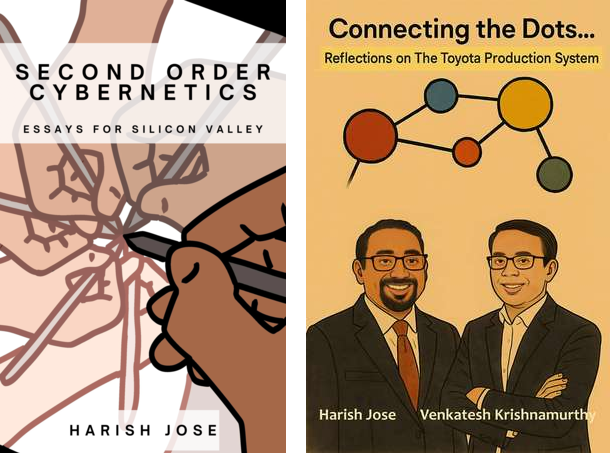

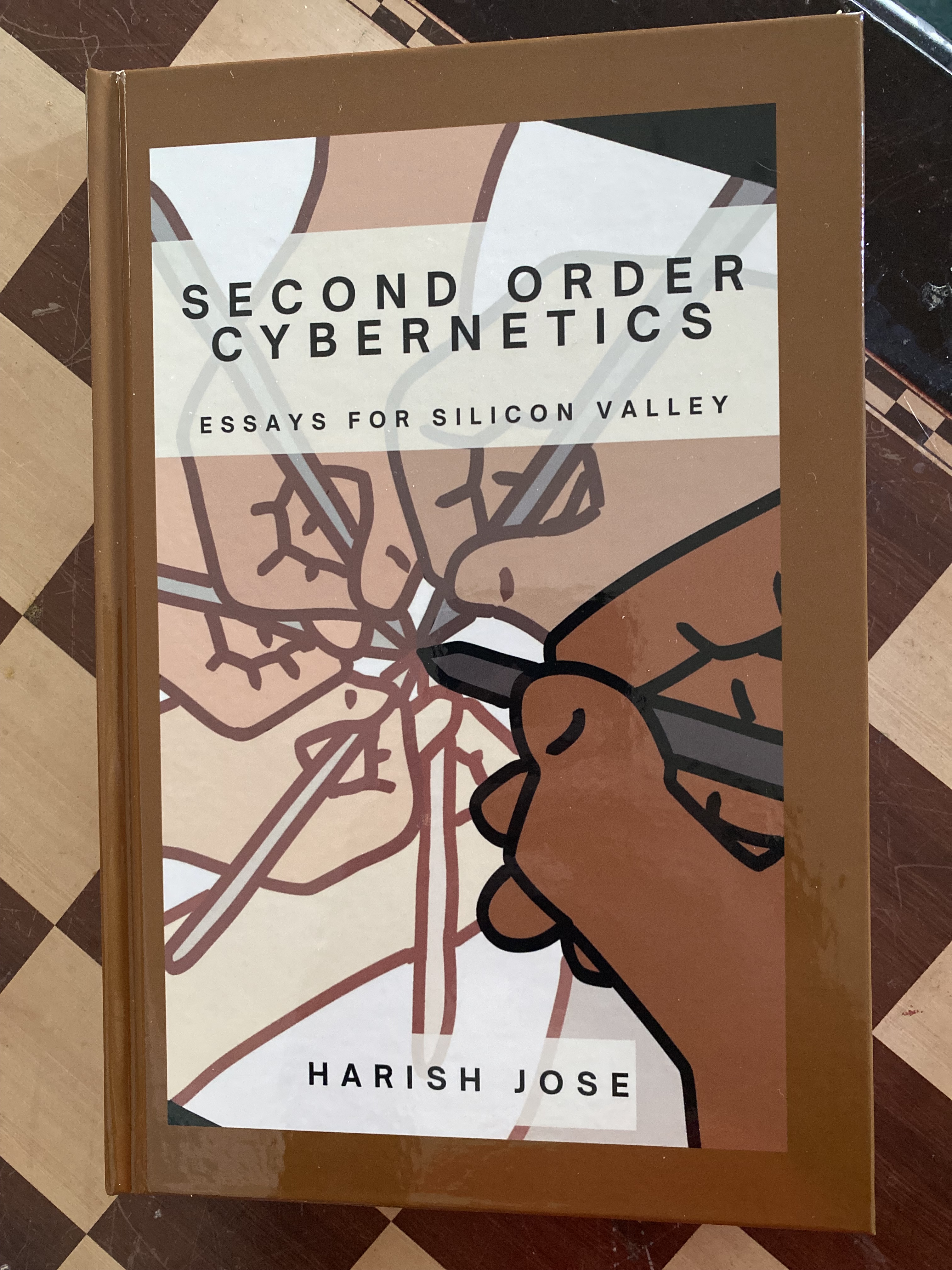

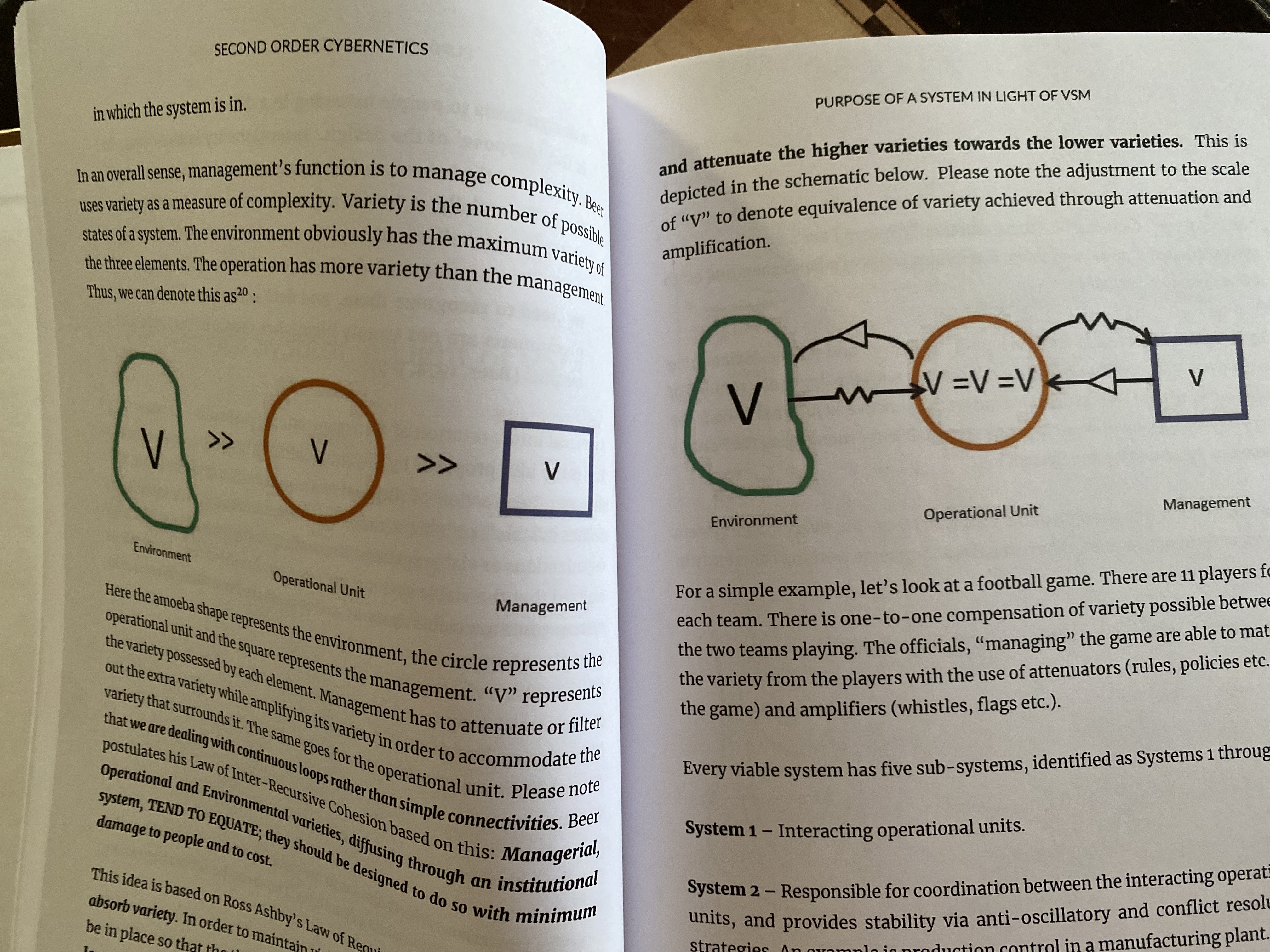
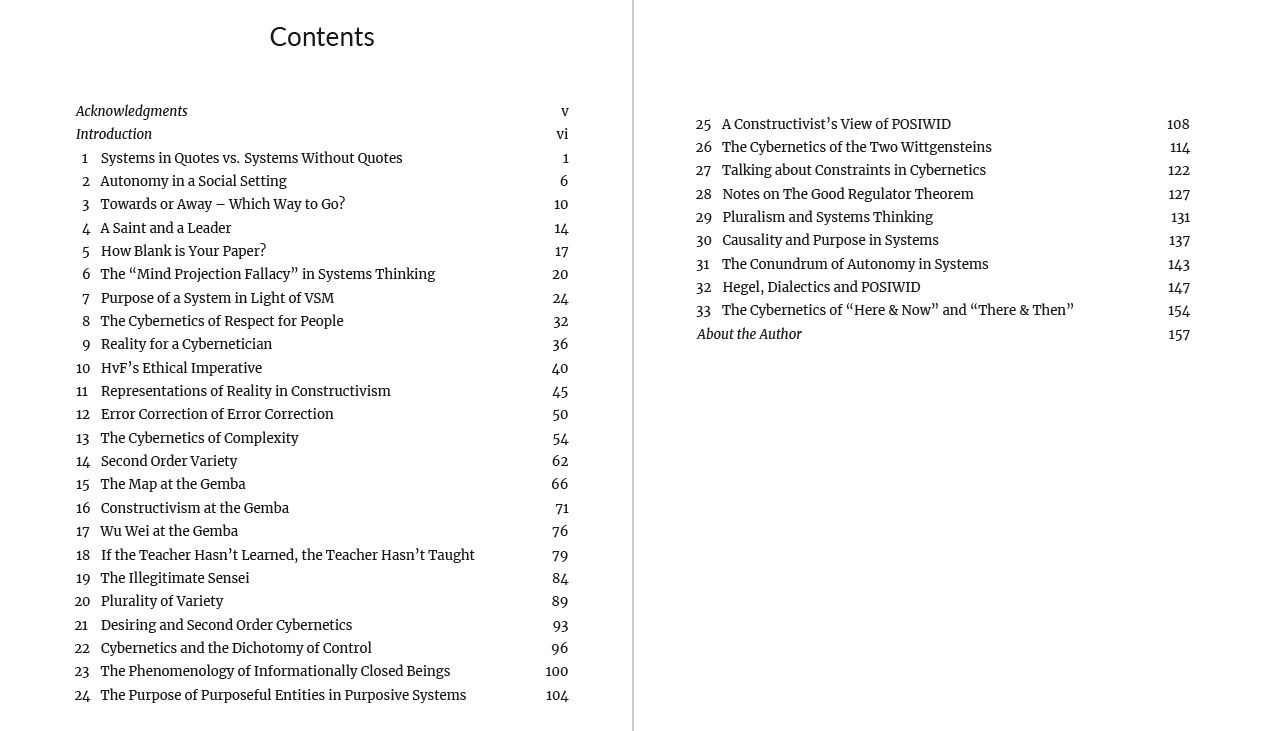

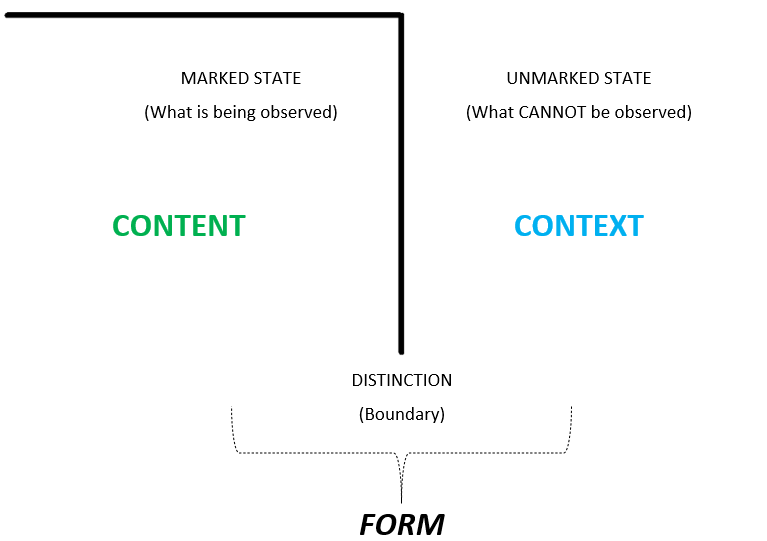
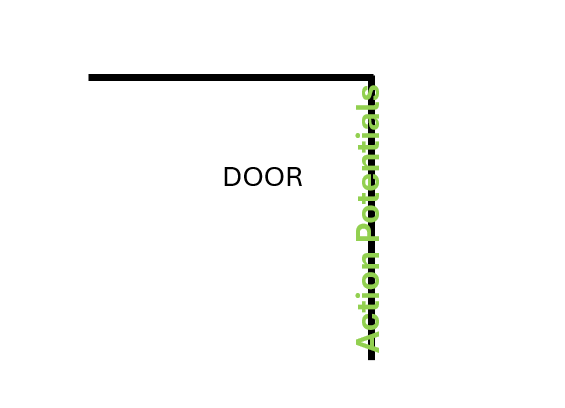
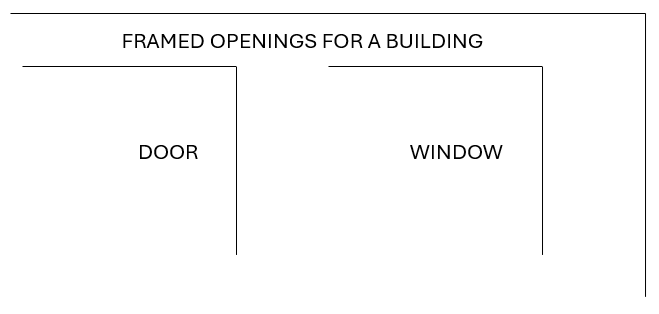
 Harish's Notebook - My notes... Lean, Cybernetics, Quality & Data Science.