In today’s post, I am looking at absurdity in Systems Thinking. Absurdity is an official term used in the school of philosophy called existentialism. An existentialist believes that existence precedes essence. This means that our essence is not pregiven. Our meaning and purpose are that which we create. In existentialism, the notion of absurdity comes from the predicament that we are by nature meaning makers, and we are thrown into a world devoid of meaning. We do not have direct access to the external world; therefore, our cognitive framework has been tweaked by evolution to seek meaning in all perturbations we encounter. We are forever trying to make sense of a world devoid of any sense or meaning.
We like to imagine that there is greater meaning to this all and that there is a “system” of objective truths in this world. In this framework, we all have access to an objective reality where we can use 2 x 2 matrices to solve complex problems. In the existentialist framework, we see that instead of a “system” of objective truths, we have multiplicity of subjective truths. Soren Kierkegaard, one of the pioneers of existentialism, viewed subjective truth as the highest truth attainable.
When we talk about a “system” we are generally talking about a collection of interrelated phenomena that serves a purpose. From the existentialism standpoint, every “system” is a construction by someone to make sense of something. For example, when I talk about the healthcare system, I have a specific purpose in mind – one that I constructed. The parts of this system serve the purpose of working together for a goal. However, this is my version and my construction. I cannot act as if everyone has the same perspective as me. I could be viewing this as a patient, while someone else, say a doctor, could see an entirely different “system” from their viewpoint. Systems have meaning only from the perspective of a participant or an observer. We are talking about systems as if they have an inherent meaning that is grasped by all. When we talk about fixing “systems”, we again treat a conceptual framework as if they are real things in the world like a machine. The notion of absurdity makes sense here. The first framework is like what Maurice Merleau-Ponty, another existential philosopher, called “high-altitude thinking”. Existentialism rejects this framework. In existentialism, we see that all “systems” are human systems – conceptual frameworks unique to everyone who constructed them based on their worldviews and living experiences. Each “system” is thus highly rich from all aspects of the human condition.
Kevin Aho wrote about this beautifully in the essay, “Existentialism”:
By practicing what Merleau-Ponty disparagingly calls, “high-altitude thinking”, the philosopher adopts a perspective that is detached and impersonal, a “God’s eye view” or “view from nowhere” uncorrupted by the contingencies of our emotions, our embodiment, or the prejudices of our time and place. In this way the philosopher can grasp the “reality” behind the flux of “appearances,” the essential and timeless nature of things “under the perspective of eternity” (sub specie aeternitatis). Existentialism offers a thoroughgoing rejection of this view, arguing that we cannot look down on the human condition from a detached, third-person perspective because we are already thrown into the self-interpreting event or activity of existing, an activity that is always embodied, felt, and historically situated.
We are each thrown here into the world devoid of any meaning, and we try to make meaning. In the act of making sense and meaning, we tend to believe that our version of world and systems are real. We often forget to see the world from others’ viewpoints.
Every post about Systems Thinking must contain the wonderful quote from West Churchman – the systems approach begins when first you see the world through the eyes of another. This beautifully captures the essence of Systems Thinking. Existentialism teaches us to realize the absurdity of seeking meaning in a world devoid of any meaning, while at the same time realizing that the act of seeking meaning itself is meaningful for us.
In today’s post, I am looking at the famous American philosopher Morris Weitz’s Closed and Open Concepts. Weitz studied aesthetics, the branch of philosophy interested in beauty and taste. He looked at the simple or not so simple question of “how do you define art?” This might seem to be a simple question at first. As we try to answer this, we will soon find that this is not so easy to answer. This might remind you of Socrates and the Socratic method of asking questions. Socrates would ask questions such as what is virtue? For any answer he got, he would find a contradiction that would push the other person further and further into a corner. Weitz came out against this approach and said that the question “what is art?” is itself the wrong question. Instead, he said that you should ask “what sort of concept is art?” The general tendency amongst theorists is to use strict definitions about the essence of something. Weitz called this approach a “closed concept”. Weitz said:
If necessary and sufficient conditions for the application of a concept can be stated, the concept is a closed one. But this can happen only in logic or mathematics where concepts are constructed and completely defined. It cannot occur with empirically-descriptive and normative concepts unless we arbitrarily close them by stipulating the ranges of their uses.
In this fashion, Weitz noted that – Art, as the logic of the concept shows, has no set of necessary and sufficient properties, hence a theory of it is logically impossible and not merely factually difficult.
To contrast the closed concept with the open concept, Weitz stated:
A concept is open if its conditions of application are emendable and corrigible; i.e., if a situation or case can be imagined or secured which would call for some sort of decision on our part to extend the use of the concept to cover this, or to close the concept and invent a new one to deal with the new case and its new property.
Weitz had strong words against the theorists of Aesthetics wanting to confine the subject into a box:
Aesthetic theory is a logically vain attempt to define what cannot be defined, to state the necessary and sufficient properties of that which has no necessary and sufficient properties, to conceive the concept of art as closed when it’s very use reveals and demands its openness.
Weitz was a fan of Wittgenstein and seems to have been influenced by his idea of “what a game is?” In his posthumous book, Philosophical Investigations, Wittgenstein talked about how a concept such as a game can be defined. There are so many different games that you would be able to identify a game when you engage in it. They all have similarities but it is very hard to properly define a game in a closed concept sense. You know that Chess and Soccer (Football) are games, but also very different. Similarly, skating and polo are games, again of very different nature. They have family resemblances! Wittgenstein’s main point is that the meaning of a word is in its use. Weitz noted:
In his new work, Philosophical investigations, Wittgenstein raises as an illustrative question, What is a game? The traditional philosophical, theoretical answer would be in terms of some exhaustive set of properties common to an games. To this Wittgenstein says, let us consider what we call “games”: “I mean board-games, card-games, ball-games, Olympic games, and so on. What is common to them all?—Don’t say: ‘there must be something common, or they would not be called “games'” but look and see whether there is anything common to all.—For if you look at them you will not see something that is common to all, but similarities, relationships, and a whole series of them at that. … ” Card games are like board games in some respects but not in others. Not all games are amusing, nor is there always winning or losing or competition. Some games resemble others in some respects—that is all. What we find are no necessary and sufficient properties, only “a complicated network of similarities overlapping and crisscrossing,” such that we can say of games that they form a family with family resemblances and no common trait. If one asks what a game is, we pick out sample games, describe these, and add, “This and similar things are called ‘games.’ ” This is all we need to say and indeed all any of us knows about games. Knowing what a game is, is not knowing some real definition or theory but being able to recognize and explain games and to decide which among imaginary and new examples would or would not be called “games.”
In other words, a “game” is an open concept. How you define a game is specifically up to how you, as the observer, view the actual functioning of the concept. Weitz does note that it is possible to “close” an “open” concept in certain cases. The example he gives is that of “tragedy” and “Greek tragedy”. Tragedy is an open concept, whereas Greek tragedy is a closed concept. He notes:
Of course, there are legitimate and serviceable closed concepts in art. But these are always those whose boundaries of conditions have been drawn for a special purpose. Consider the difference, for example, between “tragedy” and “Greek tragedy. ” The first is open and must remain so to allow for the possibility of new conditions, e.g., a play in which the hero is not noble or fallen or in which there is no hero but other elements that are like those of plays we already call “tragedy.” The second is closed. The plays it can be applied to, the conditions under which it can be correctly used are all in, once the boundary, “Greek,” is drawn. Here the critic can work out a theory or real definition in which he lists the common properties at least of the extant Greek tragedies.
Systems:
I was fascinated with the idea of open and closed concepts. I think this has use in Systems Thinking. Often, systems are depicted as real entities in the world that one can change or fix. This is to me, the use of a closed concept in systems thinking. Systems, similar to art, should be viewed as an open concept. A system is entirely dependent upon who does the observation. If we have three observers, then there are at least three systems of the same phenomenon. To paraphrase Dominik Jarczewski, the question whether something is a system is not a factual problem. It is a decision problem. How you define your system is entirely contingent upon your worldview, your biases and your experiential realities. The knowledge of what is a system is not theoretical but practical. You can replace the word “art” in the previous section with “system”, and there will be no meaning lost.
Peter Checkland, the eminent Systems Thinker provides more light on this. He noted that there will be an observer who gives an account of the world, or part of it, in systems terms; the principle which makes them coherent entities; the means and mechanism by which they tend to maintain their integrity; their boundaries, inputs, outputs, and components; their structure. Finally their behavior may be described in terms of inputs and outputs via state descriptions.
If you are trying to understand a system, you must not view it as a closed concept. You must view it as an open concept, and this means that you have to try to understand where the other person is coming from, and how it is constructed by that person. In other words, how does the functioning of the coherent whole affect that person. It is easy to fall into the mindset that systems can be viewed as closed concepts, where the purpose, the whole, etc. are definable and understandable by everybody. You might be tempted to say that the whole is more important than the parts, as if your whole is accepted by everybody. You might think that holism is the way to do systems thinking, and that reductionism is a terrible idea. When you embrace systems as an open concept, you realize that holism can be as bad as reductionism and reductionism can be as good as holism. All you have are abstractions. Even the holism you look at, is a form of reductionism.
I will finish with some more food-for-thought idea from Weitz that systems thinking is a meta-discipline (replacing “art” with “system”):
If I may paraphrase Wittgenstein, we must not ask, What is the nature of any system x?, or even, according to the semanticist, What does “x” mean?, a transformation that leads to the disastrous interpretation of “system” as a name for some specifiable class of objects; but rather, What is the use or employment of “x”? What does “x” do in the language? This, I take it, is the initial question, the begin-all if not the end-all of any philosophical problem and solution. Thus, … our first problem is the elucidation of the actual employment of the concept of a system, to give a logical description of the actual functioning of the concept, including a description of the conditions under which we correctly use it or its correlates.
Please maintain social distance, wear masks and take vaccination, if able. Stay safe and always keep on learning…
In today’s post, I am looking at the idea of ‘category mistake’ by the eminent British philosopher Gilbert Ryle. Ryle was an ardent opponent of Rene Descartes’ view of mind-body dualism. Ryle also came up with the phrase ‘the ghost in the machine’ to mock the idea of dualism. Cartesian dualism is the idea that mind and body are two separate entities. Descartes was perhaps influenced by his religious beliefs. Our bodies are physical entities that will wither away when we die. But our minds, Descartes concluded are immaterial and can “live on” after we die. Descartes noted:
There is a great difference between mind and body, inasmuch as body is by nature always divisible, and the mind is entirely indivisible… the mind or soul of man is entirely different from the body.
Ryle called this idea the official doctrine:
The official doctrine, which hails chiefly from Descartes, is something like this. With the doubtful exceptions of idiots and infants in arms every human being has both a body and a mind. Some would prefer to say that every human being is both a body and a mind. His body and his mind are ordinarily harnessed together, but after the death of the body his mind may continue to exist and function.
Ryle referred to the idea of Cartesian dualism as the dogma of the ghost in the machine – the physical body being the machine, and the mind being the ghost. Ryle pointed out that Descartes was engaging in a category mistake by saying that mind and body are separate things. A category mistake happens when we operate with an idea as if it belongs to a particular category. Loosely put, it is like comparing apples to oranges, or even better, comparing apples to hammers. The two items do not belong to the same category and hence, a comparison between the two is a futile and incorrect attempt. The mind is not separate from the body. In fact, the two are interconnected and influence each other in a profound manner. Ryle talked about the idea of dualism as the absurdity of the official doctrine:
I shall often speak of it, with deliberate abusiveness, as ‘the dogma of the Ghost in the Machine’. I hope to prove that it is entirely false, and false not in detail but in principle. It is not merely an assemblage of particular mistakes. It is one big mistake and a mistake of a special kind. It is, namely, a category-mistake. It represents the facts of mental life as if they belonged to one logical type or category (or range of types or categories), when they actually belong to another. The dogma is therefore a philosopher’s myth.
Ryle explained the category mistake with some examples. One of the examples was that of a foreigner visiting Oxford or Cambridge:
A foreigner visiting Oxford or Cambridge for the first time is shown a number of colleges, libraries, playing fields, museums, scientific departments and administrative offices. He then asks ‘But where is the University? I have seen where the members of the Colleges live, where the Registrar works, where the scientists experiment and the rest. But I have not yet seen the University in which reside and work the members of your ‘University’. It has then to be explained to him that the University is not another collateral institution, some ulterior counterpart to the colleges, laboratories and offices which he has seen. The University is just the way in which all that he has already seen is organized. When they are seen and when their co-ordination is understood, the University has been seen. His mistake lay in his innocent assumption that it was correct to speak of Christ Church, the Bodleian Library, the Ashmolean Museum and the University, to speak, that is, as if ‘the University’ stood for an extra member of the class of which these other units are members. He was mistakenly allocating the University to the same category as that to which the other institutions belong.
The foreigner committed the category mistake by assuming that the university is a material entity just like different buildings he saw. He could not understand that the university is a collective whole made up of the different buildings, the students, the staff etc. I will discuss one more example that Ryle gave:
The same mistake would be made by a child witnessing the march-past of a division, who, having had pointed out to him such and such battalions, batteries, squadrons, etc., asked when the division was going to appear. He would be supposing that a division was a counterpart to the units already seen, partly similar to them and partly unlike them. He would be shown his mistake by being told that in watching the battalions, batteries and squadrons marching past he had been watching the division marching past. The march-past was not a parade of battalions, batteries, squadrons and a division; it was a parade of the battalions, batteries and squadrons of a division.
Similar to the foreigner, the child was looking for a separate entity called “the division”. He could not understand that the division is what he is seeing. It was not a parade of battalions, batteries, squadrons and a division; it was a parade of the battalions, batteries and squadrons of a division.
Ryle also gave another example of a visitor who was getting an explanation of the game of Cricket. He saw and understood the different players in the field such as the batsman, the bowler, the fielder etc. After he looked at each one of the players, he asked who is in charge of the team spirit. “But there is no one left on the field to contribute the famous element of team-spirit. I see who does the bowling, the batting and the wicket-keeping; but I do not see whose role it is to exercise esprit de corps.” Ryles explained:
Once more, it would have to be explained that he was looking for the wrong type of thing. Team-spirit is not another cricketing-operation supplementary to all of the other special tasks. It is, roughly, the keenness with which each of the special tasks is performed, and performing a task keenly is not performing two tasks. Certainly exhibiting team-spirit is not the same thing as bowling or catching, but nor is it a third thing such that we can say that the bowler first bowls and then exhibits team-spirit or that a fielder is at a given moment either catching or displaying esprit de corps.
The reader would have noticed that I titled the post – The Ghost in the System. I am alluding to the category mistakes we make in systems thinking. Most often we commit the category mistake of assuming that the system is a standalone objective entity. This is an ontological error. We talk of a hospital system or a transportation system as if it is a physical entity that is visible for everyone to see and understand. We talk about optimizing the system or changing the system as if it is a machine that we can repair by changing out a faulty part with another. In actuality, the system we refer to is a mental construct of how we imagine the different chosen components interact with each other producing specific outcomes we are interested. When we talk of the issues haunting the hospital system, we might be meaning the long waits we have to endure, or the expensive tests that we had to go through. Each one of us construct a version of a “system” and yet we use the same term “system” to talk about different aspects. It is a category mistake to assume that we know what the others are saying. Coming back to the example of the hospital system, when we speak of a hospital system, we point to the hospital buildings, the equipment in the hospitals, the waiting rooms, the doctors, the staff, or the patients. But that is not a hospital system, not really because a system is mental construct that is entirely dependent on who is doing the observing. The observer has a specific thing in mind when they use that word. It is a category mistake to assume that you know what was said. The artifacts are not the system.
Ryle viewed category mistakes occurring due to problems in vocabulary. He wrote:
These illustrations of category-mistakes have a common feature which must be noticed. The mistakes were made by people who did not know how to wield the concepts University, division and team-spirit. Their puzzles arose from inability to use certain items in the English vocabulary.
Wittgenstein famously wrote – The limits of language are the limits of my world. Our use of language limits what we can know or tell about the world. To go further with this idea, I am looking at the idea of systems from West Churchman’s viewpoint. Churchman advised us that a systems approach begins when first you see the world through the eyes of another. We live in a social realm and by social realm, I mean that we live in a world where “reality” is co-constructed with the other inhabitants of the realm. We define and redefine reality on an ongoing basis through continual interactions with the other cocreators. We should have a model or an image of what we are trying to manage. But if social realm is cocreated, we need to be aware of others in the realm and treat it as a cocreation rather than an objective reality that we have access to. Systems do not have an objective existence. Each one of us view and construct systems from our viewpoint. Thus, how we define a system is entirely dependent on us, the observers. What we have to do is to seek understanding before we rush in to change or optimize a system. The first step is to be aware of the others in the realm. The next step is to seek understanding and see how each one of them views the world. We have to better our vocabulary so that we can speak their language.
There is no ghost in the machine. There is only the machine.
I will finish with a wonderful reflexive nugget from Ryle:
In searching for the self, one cannot be the hunter and the hunted.
Please maintain social distance and wear masks. Please take vaccination, if able. Stay safe and Always keep on learning…
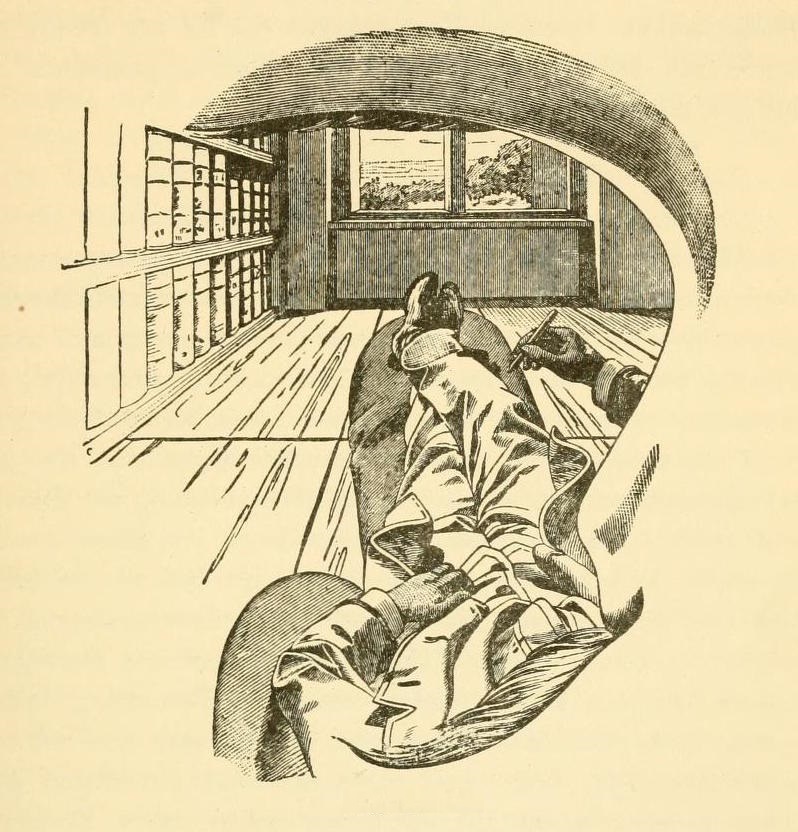
I was introduced to the drawing above through Douglas Harding who wrote the Zen book, “The Headless Way.” The drawing was drawn by Ernst Mach, the 19th Century Austrian physicist. He called the drawing, “the view from the left eye.” What is beautiful about the drawing is that it is sort of a self-portrait. This is the view we all see when we look around (without using a mirror or other reflective surfaces). If we could draw what we see of ourselves, this would be the most accurate picture. This brings me to the point about the different modes of observing.
Right now, you are most likely reading this on a screen of some sort or perhaps you are listening to this as a podcast. You were not paying attention to the phone or computer screen – until I pointed it out to you. You were not paying attention to how your shoes or socks or clothes feel on your body – until I pointed them out to you. This is mostly how we are in the world. We are just being in the world most of the time. Everything that we interact with is invisible to us. They just flow along the affordances we can afford. The keyboard clacks away when we hit on the keys, the door knobs turn when we turn them, etc. We do not see them until we have to see them. The 20th century German philosopher, Martin Heidegger called this ready-to-handedness. Everything is connected to everything else. We interact with the objects in order to achieve something. We open the door to go inside a building to do something else. We get in the car to get to a place. We use a hammer to hammer a nail in order to build something. Heidegger called these things equipment, and he called the interconnectedness, the totality of the equipment. The items are in the background to us. We do not pay attention to them. This is how we generally see the world by simply being in the world.
Now let’s say that the general flow of things breaks down for some reason. We picked up the hammer, and it is heavier than we thought and we pay attention to the hammer. We look at the hammer as a subject looking at an object. We start seeing that it has a red handle and a steel head. The hammer is not ready-to-hand anymore. The hammer has become an object and in the foreground. Heidegger called this as present-at-hand. When we really look at something, we realize that we, the subjects, are looking at something, the object. We no longer have the affordances to interact with it in a nonchalant manner. We have to pay attention in order to engage with the object, if needed.
With this background, I turn to observing again. In my view(no pun intended), there are three modes of observing:
No self – similar to ready-to-hand, you just “are” in the world, enacting in the world. You just see things without any thought to self. There is no distinction of self in what you observe. Perhaps, we can refer to this as the zero person or zero order view.
Seeing self – you make a distinction with this. You draw a line between you the subject, and the world out there. The world is out there and you are separate from the world. This is similar to present-at-hand. The world is out there. This is also the first order in First Order Cybernetics.
Seeing self through self/others – Here you are able to see yourself through self or others. You are able to observe yourself observing. This is the second order in Second Order Cybernetics. In this case, the world is in here, within you, as a constructed stable reality.
In the first mode, you are being in the world. Heidegger would call this as “dasein.” In the second mode, you see the world as being outside. And in the third mode, you see the world as being inside. There are no hierarchies here. Each mode is simply just a mode of observing. In the second and third modes, you become aware of others who are like you in the world. In the third mode, you will also start to see how the others view the world since you are looking through others’ eyes. You realize that just as you construct a world, they too construct a world. Just like you have a perspective, they too have a perspective. The different modes of observing lead to a stable reality for us based on our interpretative framework. We cognize a reality by constructing it based on the stable correlations we infer from our being in the world. Sharing this with others lead to a stable societal realm through our communication with others. A community is formed when we share and something common emerges. It is no accident that the word “community” stems from the root word “common.”
When we observe a system, we also automatically stipulate a purpose for it. Systems are not real-world entities, but a means for the observer to make sense of something. We may call a collection of automobiles on the road as the transportation system just so that we can explain the congestion in the traffic. The same transportation system might be entirely different for the construction worker working on the pavement.
We have to go through the different modes of observation to help further our understanding. Seeing through the eyes of others is a practice for empathy. And this is something that we have to continuously practice to get better at. Empathy requires continuous practice.
I will finish with Ernst Mach’s explanation for his drawing:
Thus, I lie upon my sofa. If I close my right eye, the picture represented in the accompanying cut is presented to my left eye. In a frame formed by the ridge of my eyebrow, by my nose, and by my moustache, appears a part of my body, so far as visible, with its environment. My body differs from other human bodies beyond the fact that every intense motor idea is immediately expressed by a movement of it, and that, if it is touched, more striking changes are determined than if other bodies are touched by the circumstance, that it is only seen piecemeal, and, especially, is seen without a head…
It was about 1870 that the idea of this drawing was suggested to me by an amusing chance. A certain Mr L., now long dead, whose many eccentricities were redeemed by his truly amiable character, compelled me to read one of C. F. Krause’s writings, in which the following occurs:
“Problem : To carry out the self-inspection of the Ego.
Solution : It is carried out immediately.”
In order to illustrate in a humorous manner this philosophical “much ado about nothing,” and at the same time to shew how the self-inspection of the Ego could be really “carried out,” I embarked on the above drawing. Mr L.’s society was most instructive and stimulating to me, owing to the naivety with which he gave utterance to philosophical notions that are apt to be carefully passed over in silence or involved in obscurity.
In today’s post, I am inspired by the idea of Metanarratives from the French philosopher, Jean-François Lyotard. Lyotard’s most famous work is The Postmodern Condition: A Report on Knowledge. He presented the term “postmodern” in this book. He defined postmodern as:
Simplifying to the extreme, I define postmodern as incredulity toward metanarratives.
A metanarrative or a grand narrative is a larger scale narrative that a group of people hold on to, to make sense of how the world is progressing around them. There is a teleological aspect to it such that the “progression” of the society can be explained. Leotard viewed this as a grand narrative of modernity, one where the society is progressing towards a future where all our problems are solved and where we all live happily ever after. The postmodern view distrusts any such grand narratives. The grand narrative is how we find meaning in the world around us.
The New World Encyclopedia defines metanarratives as follows:
Metanarrative or grand narrative or mater narrative is a term developed by Jean-François Lyotard to mean a theory that tries to give a totalizing, comprehensive account to various historical events, experiences, and social, cultural phenomena based upon the appeal to universal truth or universal values. In this context, the narrative is a story that functions to legitimize power, authority, and social customs. A grand narrative or metanarrative is one that claims to explain various events in history, gives meaning by connecting disperse events and phenomena by appealing to some kind of universal knowledge or schema. The term grand narratives can be applied to a wide range of thoughts which includes Marxism, religious doctrines, belief in progress, universal reason, and others.
Perhaps, it is because the world has grown closer together and more exposed to the different cultures that the postmodernists believe that we have lost faith in the grand narratives. Instead of grand narratives, what we have are localized small narratives that are often intertwined. Lyotard uses the Wittgenstein’s language games to explain this. Wittgenstein noted that the meaning of a word is in how we use the word. The words themselves are invariant; their meanings are not. The words are not fixed labels of things, but something we come together to agree upon while engaged in language games. As Simon Malpas notes:
Like normal games, there are a variety of language games that may not always have rules in common. For example, in chess there are rules that allow us to move the pieces in certain ways, set out our objectives for victory and make certain moves illegal. In the same way, in science certain types of statement can be made about the world and certain aims and rules are involved in scientific enquiry and experimentation. The success or failure of a given statement is thus determined by how well it works within the rules of the language game in which it occurs.
Located in a multiplicity of language games that no longer follow a single metanarrative, an individual’s identity becomes dispersed… As language games are linked to identity, Lyotard argues that the wider range of different language games that are considered legitimate within society, the more open and pluralist that society can become. The main threat facing postmodern society is the reduction of knowledge to a single system whose only criterion is efficiency… Once the grand narratives have fallen away, we are left only with the diverse range of language games, and the aim of postmodern criticism should be to do justice to them by allowing them to be heard in their own terms.
It is easy to be mesmerized by a grand narrative. This could be a political slogan about making a country great again. It could also be the belief that the whole is always greater than sum of its parts. We might be told that we should be willing to sacrifice for the benefit of the whole. These grand narratives often lack the variety to sustain itself. The idea of the whole being greater than some of its parts is often taught in Systems Thinking. This posits the view that there is indeed an objective whole. As David M. Boje notes, a system is a fiction of the whole. The most important piece that is often ignored is the question – to whom? All systems are mental constructs that an observer or a group of observer constructs. The keyword here is the observer. The grand narrative that “the whole is greater” is based on an observer. This does not mean that another observer will see the system identically. To a patient, the healthcare system has specific needs such as affordable healthcare and this may be entirely different than the CEO managing a hospital. If we are able to answer the following questions, then we might be able to better understand the “whole” – who does the summation? From whose perspective is the whole and parts determined? For whose purpose?
Lyotard noted that no self is an island; each exists in a fabric of relations that is now more complex and mobile than ever before.
The social subject itself seems to dissolve in the dissemination of language games. The social bond is linguistic, but is not woven with a single thread. It is a fabric formed by the intersection of at least two (and in reality an indeterminate number) of language games, obeying different rules.
One single grand narrative cannot explain away the multitude of human experiences. Our role as a systems thinker is to welcome the multiple local narratives and engage in the different language games. We should challenge the rules that govern images and narratives. We should understand that the different language games may not always work together. We should welcome pluralism – the idea that multiple perspectives may be equally meaningful and valid.
It may be difficult at first to digest the postmodernist ideas. The realization that there is no singular objective reality may not be easy to accept. This realization however makes us more acceptable to welcome other perspectives of the world, the social realm. Socrates was declared wise by the oracle of Delphi because one thing Socrates knew was that he did not know anything. This type of self-reflection is possible when we give upon the metanarrative of an objective knowledge.
Please maintain social distance and wear masks. Please take vaccination, if able. Stay safe and Always keep on learning…
In today’s post, I am carrying on some of the ideas from Heidegger. See the last post for more details. I have written about Hermeneutics before here. Heidegger was a student of the great German philosopher, Edmund Husserl. Husserl pioneered the school of phenomenology. Phenomenology is the study of how things appear to us experientially. The objects we experience are the phenomena. As Susan Laverty notes:
Phenomenology is essentially the study of lived experience or the life world (van Manen, 1997). Its emphasis is on the world as lived by a person, not the world or reality as something separate from the person (Valle et al., 1989). This inquiry asks “What is this experience like?” as it attempts to unfold meanings as they are lived in everyday existence. Polkinghorne (1983) identified this focus as trying to understand or comprehend meanings of human experience as it is lived. The ‘life world’ is understood as what we experience pre-reflectively, without resorting to categorization or conceptualization, and quite often includes what is taken for granted or those things that are common sense (Husserl, 1970). The study of these phenomena intends to return and re-examine these taken for granted experiences and perhaps uncover new and/or forgotten meanings.
Husserl taught that to understand things around us, we have to go back to the things themselves. He gave a detailed methodology to make phenomenology happen. He wanted a structured approach just like in science or mathematics. Husserl believed that how we experience things can be affected by our biases about things. So, he proposed that we “bracket” our presuppositions, biases etc. and approach the thing at hand. This suspension of our presuppositions is a phenomenological reduction. It is said that Husserl would spend days with his class analyzing a trivial object such as a mailbox. His version of phenomenology was free of social, cultural and historical “grasps” on the object. The object was a standalone entity waiting to be experienced, and through this experience an understanding of the entity was possible. He suggested with his method, we are able to come to a descriptive presentation of the phenomena.
Heidegger, as Husserl’s student was very taken by the idea of phenomenology. However, Heidegger realized that we cannot be separated from our presuppositions. We can understand existence only through our existing; the way we are. Heidegger realized that the experience of a phenomenon is a personal activity, and therefore we may come up with multiple descriptions of the phenomenon. Most importantly, the process of coming up with a description is an interpretive process. We make sense of the phenomenon as an interpretive process. Heidegger’s version of phenomenology is thus termed as “hermeneutic phenomenology”, whereas Husserl’s version is termed as “transcendental phenomenology”. Heidegger realized that the knowledge we achieve at any point in time is incomplete, and is contingent on our existence at that point in time. Our relationship to the phenomenon is affected by who we are, where we are, when we are and how we are experiencing the phenomenon.
A key point in hermeneutics is the hermeneutic circle. This circle is actually a recursion. Hermeneutics is generally associated with interpreting a text. Generally, when we start to read a part of the text, we get an idea of what the whole of the text stands for. As we get more into the text, we get a better understanding of the part, which helps with a better understanding of the whole text, and so on. This can be viewed as a recursive function. The uniqueness of our worldview comes from the recursive nature of our experiential living. We keep updating our worldview based on the current worldview which is impacted by our past worldview. And round and round we go.
Heidegger’s view that we cannot assume freedom from our presuppositions is an important thing to keep in mind in Systems Thinking. This reaffirms the idea that we are not able to experience a singularly objective reality. Reality is multidimensional, and have many variations contingent on many social factors. The circularity of hermeneutics is explained well by M. N. Babu:
The most important consequence of the circularity of understanding for hermeneutics that there is no pure starting point for understanding because every act of understanding takes place within a finite historically conditioned horizon, within an already understood frame of reference. It is no longer a question of how we are to enter the hermeneutical circle, because human consciousness is always already in it. We understand only by constant reference to what we have already understood, namely, our past and anticipated experience. The experiencing and reflecting subject is never a tabula rasa upon which the understanding of raw experience inscribes its objective character, rather, all experience and reflection are the result of a confrontation between one’s pre-understanding or even prejudice and new or perhaps strange objects. The inevitable presence of pre-understanding or prejudice is not necessarily the distortion of the meaning of an object by an arbitrary subject, rather, it is the very condition for any understanding of all. Heidegger, however, contends that presuppositions are the very condition for any reception of the object whatsoever. His notions of the ontological character of understanding and the primordial connection of subject and object in their pre- understanding and the primordial connection of subject and object in their pre-reflective relational whole provides the foundation for this contention. For him, all interpretation is a derivative form of a prior understanding, in which the prior relationship between subject and object is brought to explication.
How does one proceed when we realize that we cannot be free of our presuppositions? Heidegger advises that we need to get into the circle in the right way. Hans-Georg Gadamer provides clarity on this. As Jean Grondin notes:
Gadamer takes up Heidegger’s suggestion that the important thing is to get into the circle in the right way, but for him this mainly means that the “prejudiced” nature of our understanding should be recognized as that which makes understanding possible in the first place. This is what he calls the “ontological” and positive aspect of the hermeneutical circle. He emphasizes the ontological nature of the circle to fight against the false ideal of a presupposition‐less type of knowledge which would have been imposed upon the humanities by the objectivity requirement of exact science. His aim in highlighting the hermeneutical circle is to liberate the humanities from this alienating model. But does this mean that all presuppositions, prejudices, and anticipations are valid? Obviously not, since this would call into question the very idea of truth, which a book entitled Truth and Method surely wants to defend. Gadamer does maintain the distinction between adequate and inadequate anticipations. According to his best account of this key critical difference, it is through temporal distance and the work of history that we are able to make this distinction.
The most important thing in the process of making sense of a phenomenon is to understand the context. If the context is not understood, we fall into the trap of relativism. Relativism is the idea that all views are equally valid. A better nuanced version of this is pluralism. Pluralism is the idea that there are multiple views of a phenomenon that are different but equally valid. The difference between pluralism and relativism is in understanding the context. As we have been discussing, this understanding requires hermeneutical phenomenology. When we are aware that our understanding is always incomplete and imperfect, we are more open to going through the self-correcting hermeneutic cycle. We are open to challenge what we think we know, and we welcome scrutiny of our ideas. We put our assumptions open for all to see. Rather than being stuck with the realization that our views are imperfect and incomplete, we learn to cope with the world.
The great Systems Thinker, C. West Churchman said that the systems approach begins when first you see the world through the eyes of another.
We can only know things in terms of things we already know. From this standpoint, when we are looking at a new phenomenon, we have to look at it in terms of things we already know. If we are looking at a social “system”, then we have to always start from things that are common. The basis of all that is common in a social realm is the humanity in us all, and that is a good place to start. This is my takeaway from Churchman’s advice.
Please maintain social distance and wear masks. Please take vaccination, if able. Stay safe and Always keep on learning…



 Harish's Notebook - My notes... Lean, Cybernetics, Quality & Data Science.